
Loading article…
債券市場(債務市場または信用市場とも呼ばれる)は、参加者が新規債務を発行する(プライマリー市場)か、債務証券を売買する(セカンダリー市場)ことができる金融市場です。これは通常、債券の形をとりますが、公的支出および民間支出のための手形、債券なども含まれます。債券市場は主に米国が支配しており、市場全体の約40%を占めています。証券業金融市場協会(SIFMA)によると、2026年の債券市場規模(発行済み債務総額)は、世界全体で143兆1500億ドル、米国市場では58兆ドルと推定されています。
債券と銀行融資は、信用市場として知られています。世界の信用市場は、全体として世界の株式市場の約3倍の規模です。[ 1 ]銀行融資は米国証券取引法の下では証券ではありませんが、債券は通常証券であり、そのためより厳しく規制されています。債券は通常担保によって保証されていません(ただし、担保されることもあります)し、1,000ドルから10,000ドル程度の比較的小額で販売されます。銀行融資とは異なり、債券は個人投資家が保有することができます。債券は融資よりも頻繁に取引されますが、株式ほど頻繁ではありません。
米国の債券市場における1日の平均取引のほぼすべては、分散型の店頭(OTC)市場でブローカーディーラーと大手機関の間で行われている。 [ 2 ]ただし、少数の債券、主に社債は取引所に上場されている。債券の取引価格と取引量は、金融業界規制機構(FINRA)の取引報告およびコンプライアンスエンジン(TRACE)で報告される。
債券市場の重要な部分を占めるのが国債市場です。これは、その規模と流動性の高さによるものです。国債は、信用リスクを測るために他の債券と比較する際によく用いられます。債券の評価額と金利(または利回り)は逆相関の関係にあるため、債券市場は金利の変化や「資金調達コスト」の指標である利回り曲線の形状を示す指標としてよく用いられます。米国やドイツなどの低リスク国の国債利回りは、リスクフリーのデフォルト率を示すと考えられています。同じ通貨(米ドルまたはユーロ)建ての他の債券は、通常、より高い利回りとなります。これは主に、米国やドイツの中央政府よりも他の借り手の方がデフォルトする可能性が高く、デフォルトが発生した場合の投資家の損失も大きくなると予想されるためです。デフォルトの主な原因は、全額を支払わないこと、または期日までに支払わないことです。
証券業界金融市場協会(SIFMA)は、広範な債券市場を5つの特定の債券市場に分類している。
債券市場の参加者は、ほとんどの金融市場の参加者と同様であり、基本的には資金の買い手(債券発行体)か売り手(金融機関)のいずれかであり、多くの場合その両方である。
参加者は以下の通りです。
個々の債券発行の特殊性、および多くの小規模債券における流動性の低さから、発行済み債券の大部分は年金基金、銀行、投資信託などの機関投資家によって保有されている。米国では、市場の約10%が個人投資家によって保有されている。
銀行の債券資本市場部門において、プライマリー市場における「顧客」の定義は、部門全体で統一されていない。


世界の債券市場の未償還残高は、2012年3月までの12か月間で2%増加し、約100兆ドルに達した。国内債券が全体の70%を占め、残りは国際債券である。米国が全体の33%で最大の市場であり、次いで日本(14%)となっている。世界のGDPに占める債券市場の割合は、2008年の119%、10年前の80%から、2011年には140%以上に増加した。この著しい成長により、2012年3月時点では、時価総額が約53兆ドルの世界株式市場よりもはるかに大きくなっている。景気減速開始以降の市場の成長は、主に政府による債券発行の増加によるものである。債券の数で言えば、米国には50万種類以上の社債が存在する。[ 3 ]
2011年の国際債券の未償還額は2%増加し、30兆ドルとなった。同年に発行された1.2兆ドルは、前年の総額の約5分の1減少した。2012年上半期は8,000億ドルを超える発行で好調なスタートを切った。未償還額では米国が全体の24%を占めてトップとなり、次いで英国が13%だった。[ 4 ]
証券業金融市場協会(SIFMA)[ 5 ]によると、2017年第1四半期の米国債券市場規模は(10億ドル単位)以下の通りであった。
SIFMAが認めた連邦政府の債務総額は、当時米国財務省が発行した手形、債券、債券の総額(約19.8兆ドル) [ 6 ]よりも大幅に少ない。この数字には、連邦準備制度や社会保障信託基金が保有する債務などの政府間債務は含まれていない可能性が高い。

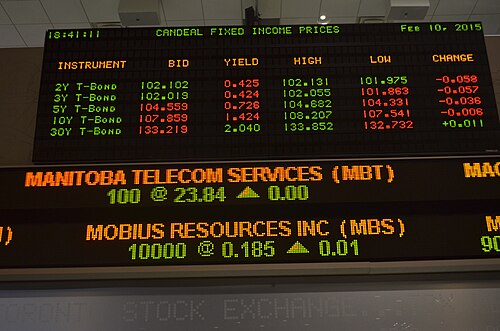
債券を保有し、クーポンを受け取り、満期まで保有する市場参加者にとって、市場の変動は無関係である。元本と利息は、あらかじめ定められたスケジュールに従って受け取られる。
But participants who buy and sell bonds before maturity are exposed to many risks, most importantly changes in interest rates. When interest rates increase, the value of existing bonds falls, since new issues pay a higher yield. Likewise, when interest rates decrease, the value of existing bonds rises, since new issues pay a lower yield. This is the fundamental concept of bond market volatility—changes in bond prices are inverse to changes in interest rates. Fluctuating interest rates are part of a country's monetary policy and bond market volatility is a response to expected monetary policy and economic changes.
Economists' views of economic indicators versus actual released data contribute to market volatility. A tight consensus is generally reflected in bond prices and there is little price movement in the market after the release of "in-line" data. If the economic release differs from the consensus view, the market usually undergoes rapid price movement as participants interpret the data. Uncertainty (as measured by a wide consensus) generally brings more volatility before and after a release. Economic releases vary in importance and impact depending on where the economy is in the business cycle.
Bonds typically trade in $1,000 increments and are priced as a percentage of par value (100%). Many bonds have minimums imposed by the bond or the dealer. Typical sizes offered are increments of $10,000. For broker/dealers, however, anything smaller than a $100,000 trade is viewed as an "odd lot".
Bonds typically pay interest at set intervals. Bonds with fixed coupons divide the stated coupon into parts defined by their payment schedule, for example, semi-annual pay. Bonds with floating rate coupons have set calculation schedules where the floating rate is calculated shortly before the next payment. Zero-coupon bonds do not pay interest. They are issued at a deep discount to account for the implied interest.
Because most bonds have predictable income, they are typically purchased as part of a more conservative investment scheme. Nevertheless, investors have the ability to actively trade bonds, especially corporate bonds and municipal bonds with the market and can make or lose money depending on economic, interest rate, and issuer factors.
Bond interest is taxed as ordinary income, in contrast to qualified dividend income which receives favorable taxation rates, unlike ordinary dividends. However many government and municipal bonds are exempt from one or more types of taxation.
Investment companies allow individual investors the ability to participate in the bond markets through bond funds, closed-end funds and unit-investment trusts. In 2006, total bond fund net inflows increased 97% to $60.8 billion from a previous $30.8 billion in 2005.[7]Exchange-traded funds (ETFs) are another alternative to trading or investing directly in a bond issue. These securities allow individual investors the ability to overcome large initial and incremental trading sizes.
A number of bond indices exist for the purposes of managing portfolios and measuring performance, similar to the S&P 500 or Russell Indexes for stocks. The most common American benchmarks are the Barclays Capital Aggregate Bond Index, Citigroup BIG and Merrill Lynch Domestic Master. Most indices are parts of families of broader indices that can be used to measure global bond portfolios, or may be further subdivided by maturity or sector for managing specialized portfolios.
In ancient Sumer, temples functioned both as places of worship and as banks, under the oversight of the priests and the ruler.[8] Loans were made at a customary fixed 20% interest rate; this custom was continued in Babylon, Mesopotamia and written into the Code of Hammurabi.[9]
The first known bond in history dates from circa 2400BC in Nippur, Mesopotamia (modern-day Iraq).[10] It guaranteed the payment of grain by the principal. The surety bond guaranteed reimbursement if the principal failed to make payment. Corn (grain) was often the currency priced.
In these ancient times, loans were initially made in cattle or grain from which interest could be paid from growing the herd or crop and returning a portion to the lender. Silver became popular as it was less perishable and allowed large values to be transported more easily, but unlike cattle or grain could not naturally produce interest. Taxation derived from human labor evolved as a solution to this problem.[11]
プランタジネット朝の時代までに、イングランド王室はトスカーナのルッカのリッカルディのようなイタリアの金融業者や商人と長年にわたるつながりを持っていた。これらの貿易関係は、現代の銀行融資に似た融資に基づいていた。[ 12 ] [ 13 ] [ 14 ]他の融資は十字軍の資金調達の必要性と結びついており、イタリアの都市国家は国際貿易、[ 15 ] [ 16 ] [ 17 ]金融と宗教の交差点に独自に位置していた。しかし、当時の融資はまだ債券の形で証券化されていなかった。その革新はさらに北のヴェネツィアからもたらされた。
12世紀のヴェネツィアでは、都市国家政府がプレスティティと呼ばれる戦時債券の発行を開始した。これは5%の固定利率を支払う永久債である[ 18 ] [ 19 ]。当初は疑わしいと見なされていたが、売買できる能力が価値あるものと見なされるようになった。この中世後期の証券は、現代の定量金融で使用される手法と非常によく似た手法で価格設定されていた[ 20 ]。債券市場が始まった[ 21 ] 。
百年戦争の後、イングランドとフランスの君主はヴェネツィアの銀行家に対する巨額の債務を履行できず、1345年にロンバルディア銀行制度が崩壊した。 [ 22 ] [ 23 ]この経済的後退は、衣服、食料、衛生など経済生活のあらゆる面に影響を与え、その後の黒死病の流行によりヨーロッパ経済と債券市場はさらに衰退した。ヴェネツィアは銀行家による国債取引を禁止したが、債務を取引可能な手段とみなす考え方、ひいては債券市場は存続した。
債券は古代に起源を持ち、 1602年に最初の合資会社であるオランダ東インド会社とともに登場した株式市場よりもはるかに古い[ 24 ](ただし、一部の学者は合資会社に似たものが古代ローマに存在していたと主張している[ 25 ])。
史上初の国債は、1693年に新設されたイングランド銀行によって発行された。この国債はフランスとの紛争資金として利用された。その後、他のヨーロッパ諸国政府もこれに倣った。
米国は、アメリカ独立戦争の資金調達のために初めて国債を発行した。第一次世界大戦の資金調達にも再び国債(「自由債券」)が用いられ、米国がドイツに宣戦布告した直後の1917年に発行された。
債券の満期(1年、2年、5年など)はそれぞれ独立した市場として考えられていましたが、1970年代半ばにソロモン・ブラザーズのトレーダーたちが利回り曲線を描き始めたことで状況は一変しました。この革新的な手法、すなわち利回り曲線は、債券の価格設定と取引方法を根本的に変革し、定量金融の発展への道を開きました。
1970年代後半から、投資適格格付けのない上場企業も社債を発行することが認められるようになった。
次の革新は1980年代以降のデリバティブの出現であり、これにより担保付債務証券、住宅ローン担保証券、構造化商品産業が誕生した。[ 26 ]