
Loading article…
| プロスペクトパーク | |
|---|---|
 | |
 | |
| タイプ | 都市公園 |
| 位置 | ブルックリン、ニューヨーク、アメリカ合衆国 |
| 座標 | 北緯40度39分42秒 西経73度58分15秒 / 北緯40.66167度 西経73.97083度 / 40.66167; -73.97083 |
| エリア | 526エーカー(2.13 km 2) |
| 作成 | 1867–1873 |
| 所有者 | ニューヨーク市の公園 |
| 運営者 | プロスペクトパークアライアンス |
| 訪問者 | 年間約800万~1000万[1] [2] |
| 状態 | 年中無休 |
| 公共交通機関へのアクセス | 地下鉄とバス(下記参照) |
| Webサイト | www.prospectpark.org |
ニューヨーク市ランドマーク No.0901 [ 4]
| |
| 建築家 | フレデリック・ロー・オルムステッドとカルバート・ヴォークス(ランドスケープアーキテクト) |
| NRHP参照 番号 | 80002637 [3] |
| NYCL 番号 | 0901 [4] |
| 重要な日付 | |
| NRHPに追加されました | 1980年9月17日 |
| 指定NYCL | 1975年11月25日[4] |
プロスペクトパークは、ニューヨーク市ブルックリン区にある526エーカー(2.13 km 2)の都市公園です。公園は、パークスロープ、プロスペクトハイツ、プロスペクトレファーツガーデン、フラットブッシュ、ウィンザーテラスの各地区の間に位置し、ブルックリン美術館、グランドアーミープラザ、ブルックリン植物園に隣接しています。面積526エーカー(213ヘクタール)[5]のプロスペクトパークは、ブルックリンではマリンパークに次いで2番目に大きい公立公園です。ニューヨーク市の景勝地として指定され、国家歴史登録財に登録されているプロスペクトパークは、プロスペクトパークアライアンスとニューヨーク市公園局によって運営されています。
プロスペクト パークは、1859 年に可決された法律で初めて提案され、当時独立していたブルックリン市のために、造園家のフレデリック ロー オルムステッドとカルバート ヴォークスによって設計されました。プロスペクト パークは 1867 年にオープンしましたが、実質的に完成したのは 1873 年でした。その後、公園の施設は何度も改修および拡張されました。1890 年代には、シティ ビューティフル建築運動の一環として、公園にいくつかの増築が完成しました。20 世紀初頭、ニューヨーク市公園レクリエーション局(NYC Parks) の局長ロバート モーゼスは、プロスペクト パークの清掃プログラムを開始しました。20 世紀後半の衰退期をきっかけに、プロスペクト パーク アライアンスが設立され、1980 年代から 2020 年代にかけて公園の多くの部分が改修されました。
公園の主な見どころとしては、90エーカー(36ヘクタール)のロング・メドウ、ピクニック・ハウス、リッチフィールド・ヴィラ、プロスペクト・パーク動物園、ボートハウス、コンサート・グローブ、60エーカー(24ヘクタール)のブルックリン唯一の湖、夏には野外コンサートが開催されるプロスペクト・パーク・バンドシェルなどがあります。公園にはスポーツ施設もあり、プロスペクト・パーク・テニスセンター、バスケットボールコート、野球場、サッカー場、パレード・グラウンドのニューヨーク・ペタンク・クラブなどがあります。また、野球場近くのクエーカー・ヒルには、私設の友の会(クエーカー)墓地もあります。さらに、プロスペクト・パークは、ロングアイランド西部に広がる緑地ネットワークであるブルックリン・クイーンズ・グリーンウェイの一部です。
歴史
公園の前に

約17,000年前、ロングアイランドを形成した後退するウィスコンシン氷河の末端モレーン、ハーバーヒルモレーンは、公園の北部に丘陵とケトルの列、南部に低い流出平野を形成しました。 [6] [7]フラットブッシュアベニューとイースタンパークウェイの交差点近くにあるマウントプロスペクト(またはプロスペクトヒル)は、ブルックリンで最も高い丘の1つで、海抜200フィート(61メートル)の高さがあります。[8] : 218 [9]サリバンヒルズ、ブリーズヒルズ、ルックアウトヒルズを含む公園内に広がる一連の丘の中で最も高い丘です。この地域はもともと森林でしたが、2世紀にわたるヨーロッパ人の植民地化の後、開けた牧草地になりました。重要な樹木群は、 9番街とフラットブッシュアベニューの南を中心とした泥炭湿原と、9番街の北にある大きな湿原にのみ残っており、栗、白ポプラ、オークが含まれていました。[11]これらの樹木群の一部は、現在のプロスペクトパーク渓谷に保存され、「ブルックリン最後の森」というニックネームが付けられました。[12]
アメリカ独立戦争(1775-1783)の間、この公園はロングアイランドの戦い(別名ブルックリンの戦い)の現場となった。アメリカ軍はバトルパスを守ろうとした。バトルパスは、旧フラットブッシュ道路がブルックリンの村からフラットブッシュに通る末端モレーンの開口部で、イギリス軍の進軍を阻むため大きなホワイトオークの木が切り倒された。[13]この戦いで最も激しい戦闘の後にこの木は陥落し、この木を失ったことがジョージ・ワシントンの撤退の決断につながった。大陸軍は戦いに敗れたものの、ワシントン軍がイースト川を渡ってマンハッタンに逃げるのに十分な時間イギリス軍を食い止めることができた。動物園の北側にある銘板とルックアウト・ヒルのふもとのメリーランド記念碑はこの出来事を記念している。[14] [15]
当時独立していたブルックリン市は、1856年にプロスペクトヒルに貯水池を建設し、リッジウッド貯水池から汲み上げた水を市の西半分に供給した。[16]貯水池周辺の土地を開発から守る必要性と、バトルパス地域の保護が、近くに大きな公園を設立する2つの理由として挙げられた。[17]
計画

プロスペクト・パーク建設のきっかけは、1859年4月18日のニューヨーク州議会の法令に端を発し、12名の委員にブルックリン市の公園建設場所の推薦権限を与えた。[18] [19]当時、ブルックリンは世界初の通勤郊外であり、[20] 1860年から1880年にかけてはニューヨーク市(当時はマンハッタンとブロンクス区の一部を含んでいた)とフィラデルフィアに次ぐ国内第3の都市となった。[21]この時期に、公共公園に関する概念が普及した。1858年、フレデリック・ロー・オルムステッドとカルバート・ヴォークスがマンハッタンのセントラル・パークの設計図を作成し、これが米国初の造園公園となった。[14] [17]当時ブルックリン公園委員会の会長だった ジェームズ・S・ストラナハンは、ブルックリンの公園は「私たちのコミュニティのあらゆる階層の人々のお気に入りのリゾートとなり、何千人もの人々が一年中いつでもきれいな空気と健康的な運動を楽しむことができるようになるだろう」と信じていました。彼はまた、公共の公園は裕福な住民を引き付けるだろうとも考えていました。[14]ストラナハンは当初、東のクイーンズ区ジャマイカまで広がる1つの大きな公園を構想していました。しかし、街の急速な発展によりこれは不可能になり、今日、この提案された景観の最大の名残はクイーンズ区のプロスペクト公園と538エーカー(218ヘクタール)のフォレストパークです。[22]
1860年2月、15人の委員からなるグループがブルックリンの4つの大きな公園と3つの小さな公園の場所、およびそれらの公園を結ぶ一連の大通りの提案を提出した。[ 17] [19] [23]これらの提案された公園の中で最大のものは、マウントプロスペクトを中心とし、北はウォーレン通り、西はヴァンダービルト通り、第9通り、第10通り、南は第3通りと第9通り、東はワシントン通りに囲まれた320エーカー(1.3 km 2 )の区画であった。[17] [24]エグバート・ヴィールは、当初その場所と呼ばれていた「マウントプロスペクト公園」の設計図を描き始め、1861年に提案を発表した。公園はフラットブッシュ通りにまたがり、プロスペクトヒル、および現在ブルックリン公共図書館、ブルックリン植物園、ブルックリン美術館が占めている土地を含むことになっていた。[17] [23]
1860年後半までには、ヴィールの計画のために土地が購入されていた。[17]しかし、南北戦争の勃発によりそれ以上の活動は停止し、大通りや小規模な公園の建設は延期された。[23]この遅れによりいくらかの検討が促され、ストラナハンは1865年初頭にヴィールの計画を見直すようカルバート・ヴォークスに招いた。[17] [25]ヴォークスはフラットブッシュ・アベニューによる公園の分割に異議を唱え、公園には湖があるべきだと考え、市域を越えて当時独立していたフラットブッシュの町まで南に拡張することを主張した。[26] : 86–91 1865年2月のヴォークスの提案は、現在の公園のレイアウトを反映したものであった。北と西は牧草地、東は樹木が生い茂った渓谷、南は湖という3つの特徴的な地域であり、フラットブッシュ・アベニューによって分割されていない。ヴォークスは公園の北端に楕円形の広場を組み込んだが、これが後にグランド・アーミー・プラザとなった。[27] [28]改訂された計画では、プロスペクト湖を収容するために南と西の追加区画の購入が求められましたが、プロスペクトヒル自体を含むフラットブッシュアベニューの東ですでに購入された区画は除外されました。さらに、担当エンジニアのジョセフ・P・デイビスとアシスタントのジョン・ボガートとジョン・Y・カリヤーがプロジェクトに従事するよう指名されました。[17] [29] [30]

その頃には、土地投機が進行していた。3丁目と15丁目の間の9番街と10番街に囲まれた土地は、不動産開発業者のエドウィン・クラーク・リッチフィールドが所有していた。彼は1857年に9番街の東側にリッチフィールド・マナーという自宅を建てていた。 [31]公園管理委員会は最終的に1868年にリッチフィールドの土地を170万ドルで取得した。これは公園の面積のわずか5%強を占めるだけだったが、土地の総支出の42%にあたる。この土地の多くは管理ヤードになっており、一般の人が目にすることはほとんどない。[32] 1866年、ニューヨーク州議会は公園の南西側の追加土地の取得を承認する法案を可決した。[17] [33]この公園は、既存のクエーカー教徒の墓地の周りに建設されました。 [34]これは、クエーカー教徒の会が未使用の土地を公園に譲渡するという合意に基づいていました。その代わりに、彼らは残りの10エーカーを永久に私有墓地として保持し、墓地への立ち入り権も保持しました。[17]
工事
ヴォークスの修正案が反響を呼んだにもかかわらず、ストラナハンは修正案を支持した。ヴォークスはオルムステッドを雇い、1866年2月に正式に計画を提示した。 [35]修正案は5月までに承認された。建設は翌月に始まり、最初の作業は土地の排水に重点が置かれた。[17]次に、プロスペクト公園内の道路、乗馬道、散歩道が整地され、個々の特徴が造園された。西、中央、東の3つの景観道路が公園の周囲に建設された。時期に応じて、250人から2,000人の労働者が雇用された。[17] [29] [36]造園の多くは、穴や沼地などの障害物の除去と、丘などの他の自然の特徴の向上に重点が置かれていた。木は、建設中の道路や小道を塞ぐ場合にのみ伐採された。[37] : 38
公園の最初の区画は、まだ建設中だった1867年10月19日に一般に公開されました。一般に公開された区画には、現在のグランドアーミープラザにある公園の北端と南東の角にあるコニーアイランドアベニューの間のイーストドライブの一部が含まれていました。[38] [39]公園には当初、クロッケーの芝生、帆船の池、迷路、サマーハウスを備えた遊び場がありました。1868年までに、プロスペクトパークのオープン部分は毎月10万人の利用者があり、[17]数マイルの道路、小道、歩道が完成しました。[29]プロスペクトパークのパレードグラウンドの土地はその年に取得されました。[33]公園内の歩行者と車両の交通を分離するための一連の歩行者用アーチもこの時期に建設されました。[17]
新たな訪問者を収容するために、200 台を超えるベンチが設置されました。プロスペクト パークの湖岸には、「さまざまな長方形や多角形」の素朴な木製のシェルターが設置され、景色を眺める場所として利用されるよう設計されました。公園の素朴な雰囲気を高めるために、いくつかの橋と 800 の鳥の巣箱が設置されました。[17] 1870 年の年次報告書で、ブルックリン公園の委員は、湖がほぼ完成し、近くの道路の拡張が進行中であると報告しました。[37] : 9, 11 1871 年までに、月間訪問者数は 250,000 人に増加しました。[17]公園の利用者は増え続け、1873 年の記事で、ニューヨーク タイムズはプロスペクト パークが「ブルックリンの何千人もの労働者にとって欠かせない日曜日のリゾート」になったと説明しました。[40]しかし、利用者が多いことにはマイナス面もあった。1875年のタイムズ紙の社説では、多くの人が指定されたルートを通らずに芝生に沿って近道を取ると指摘されている。[41]
プロスペクト・パークは1873年にほぼ完成していたが、その年の金融恐慌により、オルムステッドとヴォークスは公園建設への協力をやめた。当初構想されていた公園の一部、例えば展望塔、テラス付きレストラン、屋根付きの客車通路などは建設されなかった。[15] [42]オルムステッドとヴォークスはプロスペクト・パークに接続するパークウェイのシステムも計画していたが、実際に建設されたのは南のコニーアイランドまで走るオーシャン・パークウェイと東のクラウン・ハイツまで走るイースタン・パークウェイの2本だけだった。[36]結局、ブルックリン市は公園用地の取得に400万ドル以上を費やし、実際の建設費は500万ドル以上に達した。[17]
ストラナハンは、19世紀の同業者から真の「プロスペクト公園の父」とみなされていた。この評判は、彼が公園委員会の委員長として22年間(1860年から1882年)、オルムステッドとヴォークスの契約、複雑な土地買収の監督、[43]公園建設のための資金の確保、そして公園完成後には全体の設計に合わない変更から公園を守ったことなどを通じて確立された。[44]ジェームズ・S・ストラナハンの像は1890年に提案された。 [45]グランド・アーミー・プラザの入り口にあるこの像は、フレデリック・マクモニーズによって彫刻され、1891年6月にストラナハンに贈呈された。[46]
19世紀後半
.jpg/500px-Prospect_Park,_Brooklyn,_1880._(5832926707).jpg)
プロスペクト パークはオープン後広く利用されるようになり、多くのスポーツが開催されました。19 世紀後半には、ロング メドウで行われるスポーツの中でアーチェリーが最も人気のあるスポーツの 1 つとなり、[42]週末の午後には 100 ものグループがロング メドウに集まり、クロッケーを楽しみました。 [47]冬には、人々は湖で「アイス ベースボール」を練習しました。[42]アイス スケートも一般的なスポーツで、冬には湖でよく行われていました。[48]セントラル パークではピクニックが禁止されており、マンハッタンの他の多くの公園でも一般的に認められていなかったため、プロスペクト パークは人気のピクニック スポットになりました。[15] [49]しかし、これによってゴミも散乱し、1881 年までにニューヨーク タイムズ紙は公園の清潔さの欠如について苦情を受けていました。[50]
プロスペクトパークには1882年まで新しい建物は建てられなかったが、その年、公園の西側に実用的なレンガ造りの馬小屋が建てられた。[17]同年、ブルックリン市長セス・ローはストラナハンや他の委員を再任しなかったが、ストラナハンも他の委員もこの変更に積極的に反対しなかった。ストラナハンは、ブルックリンの他の問題にもっと関与するようになっていった。[51]しかし、この行動は公園管理のスタイルの変化を示し、新古典主義を取り入れるようになった。[25]
同時に1880年代には、プロスペクトパークは過度の利用とそれに伴うメンテナンス不足により質が低下していた。[42]ブルックリン市長アルフレッド・C・チャピンは1888年に公園を散策した後、改良のために10万ドルを割り当てるよう要請した。[52]その後、ブルックリン公園委員会は公園を修復するために20万ドルのプログラムに着手した。多くの歩道や車道が再舗装され、植物が植え替えられた。[53] : 9–12 オーシャンパークウェイとウィリンクプラザの入り口に華やかな門が追加されました。[54] [55]委員会はまた、公園の最終計画から除外されていた、現在のプロスペクトパークの北東にあるマウントプロスペクト貯水池周辺の土地の購入を提案した。[56] : 54–64 [57]その代わりに、この場所は1890年代にブルックリン美術館として開発され、 20世紀初頭にはブルックリン中央図書館とブルックリン植物園が続きました。 [17]貯水池は埋め立てられ、マウントプロスペクトヒルとともに1940年に独立したマウントプロスペクト公園になりました。 [58]
その後、公園とその周辺は1890年代の美しい都市運動の際に修復された。[42]グランド・アーミー・プラザの兵士と水兵のアーチが1892年に建設された後、公園のコミッショナーはマッキム、ミード、ホワイト建築会社にグランド・アーミー・プラザを補完的な新古典主義の方法で再設計するよう依頼した。1896年までに、グランド・アーミー・プラザには、基部に彫刻された束柱と鷲で飾られた4本のそびえ立つ花崗岩の柱が建てられたが、柱上の青銅の鷲は1902年まで設置されなかった。シンプルな木製フェンスは装飾的な青銅の壷が付いた花崗岩のフェンスに置き換えられ、公園の東西の角にある多角形の花崗岩のパビリオンは、以前の素朴なシェルターに取って代わった。公園のすべての主要な入口は、同様の新古典主義の処理を受けた。 20世紀に入ると、フレデリック・マクモニーズによる彫刻がアーチを飾るようになり、マクモニーズとアレクサンダー・プロクターの作品が多くの入口を飾るようになった。[25]
公園内の他の場所にも新古典主義の建造物が建てられた。マッキム・ミード・アンド・ホワイトは、1890年にオープンしたオーシャン・パークウェイとウィリンクの入口を設計した。[59]同じ会社は、1893年から1894年にかけて、公園の北東の象限にある子供の遊び場とプールを、それぞれ正式に整備された空間であるローズガーデンとカシミア渓谷に改造した。[17]スタンフォード・ホワイトのメリーランド記念碑は、ルックアウト・ヒルの斜面でロングアイランドの戦いで戦った メリーランド400人を称えて、1895年にテラス橋の近くに設置された。[8] : 130 [60]
-
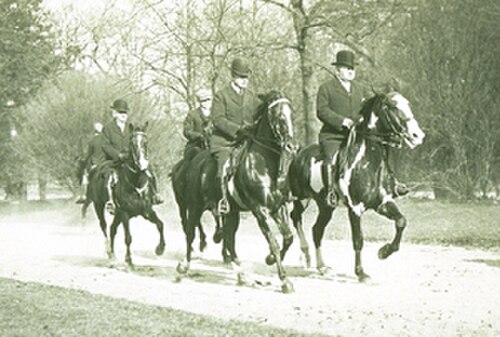 プロスペクト パークの乗馬道を歩く馬乗りたち、1912 年、チャールズ D. レイ
 -
 ブルックリン美術館、プロスペクトパーク、1903年~1910年頃。ユージン・ウェムリンガー
 -
 雪景色、プロスペクト パーク、1872 年~ 1887 年頃。ジョージ ブラッドフォード ブレーナード
 -
 冬のバラのアーバー、プロスペクトパーク、ブルックリン、1872年~1887年頃。ジョージ・ブラッドフォード・ブレーナード
 -
 給水塔、プロスペクト パーク、1903 年~ 1910 年頃。ユージン ウェムリンガー
20世紀初頭

ブルックリン市は1898年にマンハッタンおよび他の近郊の行政区と合併し、グレーター・ニューヨーク市が誕生した。世紀の終わりまでに、プロスペクト・パークには年間約1500万人の訪問者が訪れた。[36]プロスペクト・パークでピクニックやその他の大規模な食事会を開催することは公式には禁止されていたが、この規則は1903年まで数年間施行されなかった。マンハッタンからの訪問者が急増し、昼食会の開催が増えたためである。[61] 1907年には、公園内でのカップルのキスやその他の親密な行為を阻止するための照明が設置された。[62]同時に、市はプロスペクト・パークの改善プログラムに着手し、景観をきれいにし、バーテル・プリチャード・スクエアの入り口を建設し、ボートハウス・オン・ザ・ラルウォーターに取って代わられた古いボートハウスを撤去した。[63]
20 世紀の最初の 10 年間は、建物の建設が続いた。新古典主義のペリスタイル(1904)、ボートハウス(1905)、テニス ハウス (1910)、ウィリンク コンフォート ステーション(1912) はすべて、マッキム、ミード、ホワイトの卒業生で弟子のヘルムル、ハズウェル、ヒューバティによって設計された。[8] : 130 [60]この時期に建設されたプロスペクト パークの入り口も新古典主義様式であった。[8] : 130 [17]半島には、現在は取り壊されている 2 つの建物、モデル ヨット クラブ ハウス (1900–1956) とシェルター (1915 – 1940年代頃) も建設された。[17]オルムステッドは、公園の当初の計画に対するこれらの変更に「困惑」したと言われている。[36]
第一次世界大戦から1930年代のフィオレロ・ラガーディア市長政権まで、公園のインフラへの投資は減少した。1916年に動物園に2階建てのレンガ造りの建物がオープンし、サル、小型哺乳類、鳥類が飼育されていた。[64]第一次世界大戦の終結後、戦死した兵士を追悼する記念碑の建設が提案され、[65] 1921年に献納された。[66]この時期に建設された他の建造物は、ピクニックハウス(1927年)とオーシャンアベニュー入口の小さなトイレ(1930年)のみで、どちらもJ・サースフィールド・ケネディが設計した。[17] 1920年代にロングメドウにゴルフコースを建設することが提案されたが、最終的には公園の南端の湖に隣接する半島に建設された。[42] 1932年、ジョージ・ワシントン生誕200年を記念して、プロスペクト公園に偽のマウント・バーノンが建てられた。 [67]しかし、プロスペクト公園は大部分が停滞しており、市内の多くの公園と同様に、予算が年々減少しながら運営されていた。ニューヨーク・タイムズ紙は、1930年代までに「公園局の役人たちは代々、維持費を流用することで裕福な暮らしをし、公園は半世紀にわたる乱用と放置の結果を示していた」と指摘した。[68]
ロバート・モーゼス時代
1934年1月、新任のフィオレロ・ラガーディア市長は、ロバート・モーゼスをニューヨーク市公園局(NYC公園)の局長に任命した。これは、区立公園局長を廃止した新しい組織である。[69]モーゼスはその後26年間局長を務め、市の公園に大きな影響を与えた。モーゼスは大恐慌時代の失業救済のために利用可能となった連邦政府の資金を使用し、これがプロスペクト公園の建設ブームをもたらした。 [25] [70] プロスペクト公園動物園は、以前の動物園に代わる、公園の東側に1935年にオープンした。[70]野外音楽堂と5つの遊び場も、1930年代の終わりに向けて建設された。[25] [70]さらに、故慈善家マイケル・フリードサムの財団からの寄贈として、1949年にカルーセルがオープンした。[71] [72]モーゼスは公園内で新たな政策も制定し、ロングメドウでの羊の放牧を禁止した。[26] : 16 [73]
第二次世界大戦中、プロスペクトパークは市の対空防衛の一部の拠点となった。300人の兵士がロングメドウのスワンレイク周辺の砲台、地下弾薬庫、監視塔、修理工場、兵舎に駐留した。1944年に防衛隊は解散したが、数年後も塹壕や土嚢を積んだ砲台の跡が見つかっている。[74] 1959年、ロングメドウの南側3分の1が整地され、フェンスで囲まれて野球場となった。[17] [75]
.jpg/500px-Prospect_Park_boathouse_(61446p).jpg)
ケイト・ウォルマン記念リンクの計画は1960年に承認され、[76]リンクは1961年12月にオープンしました。[77] リンクはプロスペクト湖の埋め立て地に建設されたため、ミュージックアイランドとオルムステッドとヴォークスが作った湖のパノラマビューを撤去する必要がありました。[76]公園をより視覚的に魅力的なものにするために、ニューヨーク市公園局は雑草や外来種の除去も始めましたが、これは意図せず浸食を早める効果がありました。[17] [75] [78]
モーゼス在任中、特に彼が去った後の10年間は、あまり利用されていない建物や不要な建物をひっそりと撤去することは珍しいことではなかった。そうすることは経済的で慎重な管理だと考えられていた。1960年5月にモーゼスがニューヨーク市公園局長の職を退くまでに、いくつかの建物が破壊されていた。これらには、1935年に破壊された酪農場[17]、1949年に取り壊されたコンサートグローブハウス[79]、1960年に取り壊されたミュージックアイランド[80] [81]、フラワーガーデン[15]、 1940年代に破壊された茅葺きシェルター[ 17] [82]、1956年に全焼したモデルヨットクラブ[17] [82]、1955年に解体された温室[83]などがある。
20世紀後半
1960年代と1970年代
1963年から1968年にかけてマンハッタンのペンシルベニア駅が取り壊されたことをきっかけに、歴史的建造物保存運動が勃興した。[84] 1964年9月、公園局はラルウォーターのボートハウスを取り壊すまであと48時間というところだった。[17] [85]当時、この建物は十分に活用されておらず、ボートの営業は週末のみで、ピーク時の交通量は1時間あたり10人未満だった。[86]しかし、ボートハウスは有名な駅と多くの建築設計上の共通点があった。保存団体「プロスペクト公園の友の会」には、長年ブルックリンに在住する詩人でマリアンヌ・ムーアもメンバーとして名を連ねており、[87]公園内の歴史的建造物が消えつつあることや絶滅の危機に瀕する植物について世間の認識を高めた。世論の圧力を受けて、公園局長のニューボルド・モリスは1964年12月、ボートハウスを取り壊す決定を撤回した。[88]
プロスペクト公園を修復するプロジェクトは1960年代後半に開始された。1965年、市はブルックリンの300周年と翌年の公園の100周年を前に、カシミア渓谷とローズガーデンの改修に45万ドルを割り当てた。[89]さらに22万5千ドルがボートハウスの改修に割り当てられ、24万9千ドルが全体的な改修に割り当てられた。[90]市は公園の北西側にあるロングメドウの一部と子供用農場を改修した。しかし、ボートハウスやテニスコートの改修、1968年に焼失したミュージックパゴダの再建など、いくつかの契約は遅れた。[91] 1971年までに、市はボートハウスの改修や湖の浚渫など、プロスペクトパークの改修に400万ドルを費やした。ローズガーデンとカシミア渓谷も再造園された。[92]また、改修の一環として、1971年から1974年にかけてプロスペクトパークの回転木馬の修復が行われ、[93]ボートハウスの外観は1979年に修復された。 [94]
1970年代までに、プロスペクトパークは犯罪に悩まされるようになり、1974年の報告書では、市の住民の44パーセントが、いかなる状況でも公園に近づかないように警告すると報告されています。[42] プロスペクトパークの大部分は土壌浸食に見舞われ、メンテナンス不足により景観が悪化しました。1979年までに、公園の入場者数は200万人に落ち込み、公園の歴史上最低の記録となりました。[25]
1980年代と1990年代
エド・コッチ市長政権は1980年に、問題を抱えていたプロスペクトパーク動物園の運営を野生生物保護協会に引き渡す計画を立てた。[95]その後7年間で、市は公園の清掃に1,700万ドルを投資したが、[96]これにはコミュニティ開発ブロック助成金からの連邦資金1,000万ドルも含まれている。[97] 1980年から1987年の間に、年間訪問者数はほぼ3倍の500万人に達した。[96]この期間中、プロスペクトパークは2つの歴史的指定も受けた。 1975年11月25日にニューヨーク市の景観ランドマークに指定され、 [4] 1980年9月17日に国家歴史登録財に登録された。[3]
非営利団体のプロスペクトパークアライアンスは、1980年代にセントラルパークの修復を支援したセントラルパークコンサバトリーをモデルに、1987年4月に設立されました。その後まもなく、ニューヨーク市公園局は同団体と修復プロジェクトに着手しました。 [96]アライアンスの最初の主要プロジェクトは、1987年から1989年にかけて行われた55万ドルをかけたメリーゴーランドの修復でした。メリーゴーランドは1983年以来稼働しておらず、修復中に元々あった馬の形をした座席は取り外されました。[98] 9年後の1996年には、450万ドルをかけてラビーンの修復を開始しました。[12] [42]ボートハウスも、外装のテラコッタの劣化のため、1990年代後半に再度修復されました。[94]全米オーデュボン協会は2000年にボートハウスの賃貸契約を結び、[99]この建物はアメリカ初の都市型オーデュボン協会の拠点となった。[100]ハーモニー・プレイグラウンドと野外音楽堂の修復は同年に完了した。[101]しかし、プロスペクト・パークの他の部分、例えば公園の東側は、西側よりも周辺地域が一般的に貧しいため、放置されたままであった。[102]
21世紀初頭
2000年代と2010年代

2000年までに、ウォルマン・リンクは老朽化が進み、建て替えが必要となった。[103]アライアンスはすぐに、1960年のリンク建設によって消滅したミュージック・アイランドと元の海岸線を復元する計画を立てた。[104] [105]モーゼス時代の遊び場や野外音楽堂のいくつかは、人気があったためそのまま残された。プロスペクト・パーク湖畔、ラルウォーター沿い、渓谷には、元々の素朴な夏の家が復元または再現された。[106]復元計画の一環として、ウォルマン・リンクは、通年利用できるレクリエーション施設である新しいレフラック・センターの2つのリンクに置き換えられることになっていた。[106]ルフラックセンターの工事は2009年に始まり、ウォルマンリンクは2011年までに取り壊されました。 [107]レイクサイドのサミュエルJ.アンドエセルルフラックセンターは、7,400万ドルの費用で2013年12月に完成しました。[108] [109]ウォルマンリンクの代替として、修復されたミュージックアイランドの計画が2009年に発表されました。[110]チャイムバイエルミュージックアイランドと島を見下ろすシェルビーホワイトアンドレオンレヴィエスプラネードは、1,000万ドルの助成金を使用して修復され、2012年10月に正式に再奉納されました。[80] [81]
プロスペクトパーク連盟はその後、公園の修復プロジェクトを完了または提案しました。[111]ロングメドウ球技場1は2013年から2014年の間に再建されました。[112]翌年、連盟はプロスペクトパークの東側で20万ドルのバトルパスの修復を含むいくつかのプロジェクトを発表しました。連盟はまた、水害を受けたオリエンタルパビリオンを200万ドルで修復し、フラットブッシュアベニューのフェンスを240万ドルで交換する予定でした。[111] 2016年に、連盟はまた、フラットブッシュアベニューに70年以上ぶりの公園の新しい入り口となる2つの新しい入り口を建設するために、ニューヨーク市公園局の国境なき公園プログラムから320万ドルを受け取りました。[113] [114]また、ウィリンク入り口を再建しました。[115] 2016年6月30日に終了した市の2016年度中に、政治家たちは公園のさまざまな修復プロジェクトに資金を提供した。これには、レファーツ歴史館の改修に250万ドル、歩道の再建に200万ドル、オーシャンアベニューのフェンスの交換に175万ドル、ロングメドウの野球場の改修に75万ドル、カルーセルの修復に50万ドルが含まれていた。さらに、パークドライブに実験的なランニングコースを設置するために10万ドルが割り当てられ、参加型予算プログラムを通じて、周辺地域の住民は新しい水飲み場、ドッグラン、コミュニティバーベキューサイト、水生雑草収穫機などの他のプロジェクトに資金を割り当てた。[116] [117]また、2016年には、2012年のハリケーン・サンディによる被害を修復するプロジェクトの一環として、プロスペクト・パーク・アライアンスは、カシミア渓谷周辺の森林の灌木をヤギを使って清掃し、[118] 72万7000ドルの費用をかけて敷地を再整備しました。[111]
湖畔にあるウェルハウスは2017年に堆肥化トイレとして再オープンし、[119] [120]水路沿いのアッパープールにあるドッグビーチも改装されました。[121]同年、アライアンスはパレードグラウンド、テニスハウス、野球場を改装するための資金を受け取りました。[122]アライアンスはローズガーデンの改装も発表しました。[123]球技場6と7は2017年に改修され再オープンし、[124]球技場4と5は2020年後半に再オープンしました。[125]フラットブッシュアベニューのフェンスの修復工事は2018年に始まり、新しい入口は2019年初頭に着工される予定でした。[114] [126]パレードグラウンドのドッグランの建設も2019年8月に始まり、[127]ドッグランは2020年7月にオープンしました。[128]さらに、アマンダウィリアムズとオラレカンジェイファスは、オーシャンアンドパークサイドアベニューの入り口近くにある記念碑「Our Destiny, Our Democracy」の設計者となるために2019年に選ばれました。 [129] [130]
2020年代
コンサートグローブパビリオンは1年間の改修工事を経て2021年4月に再オープンした。[131] [132]その年の12月、4000万ドルをかけてカシミア渓谷を改修することが発表された。[133] [134]ロングメドウの最後の2つの野球場は数年にわたる改修工事を経て2023年初頭に再オープンした。[135] [136] 2023年半ば、ニューヨーク市政府はプロスペクトパークにテントを張り、亡命希望者を一時的に収容することを検討した。[137] [138]プロスペクトパークアライアンスは2023年10月にフォールキル滝を一般に再オープンした。[139] [140]フォールキル滝が再オープンする前は、不法侵入者が頻繁に立ち入っていた。[141]同団体は2024年1月、オーシャン・アベニューとパークサイド・アベニューの入り口にある廃墟となった慰安所を、シャーリー・チザムの名を冠したウェルカムセンターに改装し、2年後にオープンする予定であると発表した。[142]同年7月、プロスペクト・パーク・ボートハウスにカフェがオープンした。[143] [144]
地理

プロスペクト パークの有名な建物と構造物の地図 (注: すべての入口が示されているわけではありません)。詳細については、ポイントをクリックしてください。
プロスペクトパークはブルックリン中心部の526エーカー(213ヘクタール)を占めています。北西はプロスペクトパークウェストとパークスロープ地区、南西と西はプロスペクトパークサウスウェストとウィンザーテラス地区、南と南東はパークサイドアベニュー、オーシャンアベニュー、フラットブッシュアベニューとフラットブッシュ地区、北はグランドアーミープラザとプロスペクトハイツ地区に囲まれています。[5]
デザイン
フレデリック・ロー・オルムステッドとカルバート・ヴォークスは、現代絵画に表現された田園的で絵画的で美的な理想を現実の空間に再現するためにプロスペクト・パークを設計した。[4] : 3 [8] : 219–220 全体的なデザインは、部分的にイギリスのバーケンヘッド・パークに触発された。 [42]プロスペクト・パークには田園スタイルの先例があり、特にボストン近郊のマウント・オーバーン墓地と数ブロック離れたグリーンウッド墓地が有名である。 [23]オルムステッドとヴォークスは、ブルックリンでは障害が少ないためより大きな成功を収めたと感じていたが、公園コミッショナーのジェームズ・ストラナハンの支援と計画への支援も一部役立った。[8] : 219–220
二人のデザイナーは、訪問者がプロスペクトパークを様々な視点から見て回り、どの順番でも楽しめるようにしたいと考えていた。[23]オルムステッドはプロスペクトパークの全体的なデザインに関わり、ヴォークスは細かい部分に関わっていた。[42]彼らは泥炭湿原が点在する丘陵の高地牧草地から広大なロングメドウを作った。また、木を移動して植え、表土を運び、木を個別に、またはまとめて配置した広大な芝生を作った。デザイナーたちは、ルックアウトヒルをプロスペクト湖とその向こうの農地、遠くの湾と海を見渡せる場所にしたいと考えていた。[17]広々とした空間という錯覚を作り出すために、オルムステッドとヴォークスはプロスペクトパークの小道を曲がりくねって設計した。[42]
レイアウト
オルムステッドとヴォークスの公園の最終計画では、公園は3つの異なるゾーンに分割されました。オープンセクション、森林地帯、水辺地帯です。南西端のパレードグラウンドはゾーンシステムから除外されました。[17] [23] [145]
最初のゾーンは、公園の西側に沿った広いオープンスペースであるロングメドウで構成されていました。[146]トンネルを通る2つの入り口、メドウポートアーチとエンデールアーチがあります。[145]サードストリートプレイグラウンド、ハーモニープレイグラウンド、野外ステージ、ピクニックハウスとテニスハウスもここにあります。ウェストドライブはプロスペクトパークのこのセクションを横切っています。[146]
2番目のゾーンは公園の中央にある森林地帯で、公園の水源があります。公園の北東側のこのゾーンには、渓谷、カシミア渓谷、ローズガーデン、ザッカー自然探検エリア、プロスペクトパーク動物園など、いくつかの興味深い場所があります。[146]このエリアには、精巧な3スパンの橋であるネザーミードアーチがあります。[145]クエーカーヒルとフレンズ墓地は、プロスペクトパークの南西境界近くにあります。[34]ルックアウトヒルとネザーミードと呼ばれる大きな広場は、それぞれクエーカーヒルの南と東にあります。[146]渓谷には、建設中にプロスペクトパークに組み込まれた原生林であるミッドウッドもあります。[12] [15] [147]
3つ目のゾーンは公園の南側で、プロスペクト湖と、湖の北岸から東に突き出た半島で構成されています。[146]ここは、曲がりくねった小川、ラルウォーターの出口です。[145]ラルウォーターの東岸には、市と連邦政府が指定したランドマークであるクラシックスタイルのボートハウスがあります。 湖の東岸の南には、ホワイトレヴィエスプラネードと、多目的レクリエーションセンターであるレイクサイドのルフラックセンターがあります。[146]レイクサイドのルフラックセンターは、植栽された屋根を共有する2つの平屋建ての建物で構成されています。リンクの天井には、青の背景に抽象的な明るい色の縞模様があり、スケーターの動きを表現しています。また、ルフラックセンターの一部には、カフェ、オフィス、イベントスペースのある建物があります。[148]
パークサイド アベニューは、おおよそ東西に走る通りで、プロスペクト パークの南西部と公園の残りの部分を分けています。この独立した公園の細長い部分は、北はパークサイド アベニュー、西はコニー アイランド アベニュー、南はケイトン アベニュー、東はパレード プレイスに囲まれています。パレード グラウンドには、さまざまなスポーツ用の番号付きコートとフィールドが 15 面あります。[146]
景観の特徴
水路
湖
プロスペクト公園の水路はすべて、人工的に作られた単一の水路の一部です。いくつかの池がある曲がりくねった自然の水路は、公園の南端にある60エーカー(24ヘクタール)の湖に水を供給しています。[146]水路の設計では、オルムステッドとヴォークスは、既存の氷河で形成されたケトル池と低地の流出平野も利用して、水路を中心とした流域を作りました。彼らは、川岸の重要な動植物の生息地である急峻で森林に覆われた渓谷を含むように水路を設計しました。[17] [149]その結果、水路は多くの鳥や魚の個体群を収容できるようになりました。[150]
水路の大部分は、降水量や追加の水流を吸収するように設計された植物で覆われています。[149]オルムステッドはまた、現在も使用されている拡張排水システムを含め、ロングメドウ、ラヴィーン、ネザーミードの下に広がっています。[42]プロスペクトパーク湖の水の約3分の2は通常蒸発します。しかし、大雨後の洪水を防ぐために、プロスペクトパークの従業員はバルブを使用して湖からの水の流出を制御することができます。[149] [151]
20世紀半ばまでに、これらの人工水路とその周囲の急斜面は、当初の設計の特徴を失っていました。1994年、プロスペクトパークアライアンスは、25年間、4,300万ドルの水路修復プロジェクトを開始しました。[12]
小規模な水路
プロスペクト公園の水源は、公園の中央、クエーカーヒルのすぐ北、ロングメドウの東にあるフォールキル滝の頂上です。[58] [146] 湖の北側にあるウェルハウスは、もともと水路に水を供給し、地下の帯水層に接続されていました。[17] [149]ウェルハウスは、20世紀初頭にプロスペクト公園がニューヨーク市の水道システムに接続されたときに時代遅れになりました。 [58] [120] [152] 21世紀までに、フォールキル滝には市の水道システムからのパイプが水を供給するようになりました。[149] [151]

フォールキル滝の水はフォールキル橋を過ぎ、アッパープールとロウワープールを通り、フォールキルプールに流れ込む。ここでは渡り鳥が休息し、湿地やその他の水生植物が見られる。[58]アッパープールはドッグビーチに隣接しており、ロングメドウはロウワープールに隣接している。[146]その後、水はアンバーギル池にかかる歩道橋、エスデール橋の下を通過する。池と、そのすぐ先にあるアンバーギル滝は、オルムステッドによって名付けられ、古ノルド語で「小川」を意味する。[58]アンバーギル滝を通過した後、水はロックアーチ橋の下を流れ、渓谷を過ぎて、オランダ語で「中」を意味する言葉にちなんで名付けられたビンネンウォーターに流れ込む。[26] : 64 [58]その後、水はビンネン橋の下を流れ落ち、東岸にボートハウスがある小さな池、ラルウォーターに流れ込む。その後、水はラルウォーター橋とテラス橋の下を流れて半島に至り、そこは鳥類保護区とレクリエーション場として管理されている。[58] [146]
湖
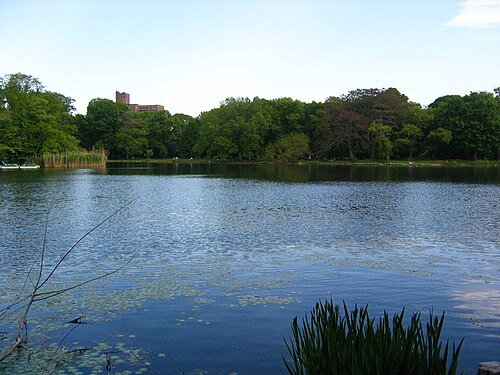
プロスペクト パークの水路の河口は、人工の 60 エーカーのプロスペクト湖 (プロスペクト パーク湖とも呼ばれる) です。[150]プロスペクト湖にはいくつかの島があり、20 種類以上の魚が生息しています。毎年、この湖では RH メイシーズ フィッシング コンテストが開催されます。[153]このコンテストは 1947 年から続いています。[154]ニューヨーク市公園局は、一般的にライセンスを持った釣り人に釣りを許可していますが、魚の減少を防ぐためにキャッチ アンド リリースポリシーを維持しています。[ 155 ]さらに、訪問者は、レイクサイドの LeFrak センターで利用できるカヤックやペダル ボート、または20 世紀に日帰り旅行者を湖の周りを運んだオリジナルの電動ボートのレプリカであるインディペンデンスで湖を探索できます。 [157]湖岸には、湖の美しい景色を楽しめる「素朴なシェルター」がいくつかあります。[82]
セントラルパークで人気を博したアイススケートは、プロスペクト湖を公園の水路の設計に組み込む主な理由でした。[17] 19世紀後半から20世紀初頭にかけて、トロリーカーの前面に掲げられた赤いボールは、氷の厚さが少なくとも4インチあることを意味していました。[158]グランドアーミープラザにも、氷の厚さが十分であることを示すために赤い旗が立てられました。[159]その後、緑の旗は氷の厚さが十分であることを示し、赤い旗は氷が薄すぎることを示し始めました。それ以来、安全上の懸念から湖でのスケートは中止されました。気候変動の結果、21世紀の冬は19世紀に比べて暖かくなり、湖の氷はスケーターを収容するには薄すぎました。[103]アイススケートは1960年にケイトウォルマンリンクに移り、2012年に再びレイクサイドセンターに移動しました。[106]
渓谷

プロスペクト・パークの内部の146エーカー(59ヘクタール)の部分は、ラビーンとして知られています。[160] [161]この地域には、公園の水系の源流と、ブルックリンに残る唯一の原生林であるミッドウッドがあります。[12] [15] [147]オルムステッドとヴォークスは、ラビーンをプロスペクト・パークの中心であり、アディロンダック山脈に似た山岳風景の中心と見なし、[162]セントラル・パークのランブルと同様の方法で設計しました。[58]このエリアの周囲は、急峻で狭い100フィート(30メートル)の峡谷です。水路はボートハウスに向かう途中でラビーンを通ります。[163]
渓谷の元々のデザインは機能よりも美観を重視したもので、何十年にもわたるメンテナンスの延期により渓谷は劣化し、排水が困難になっていた。1970年代には、強盗が隠れにくくなるように雑木が刈り込まれ、1990年代までには川は干上がった。[42] 1996年、土壌の圧縮と浸食を引き起こした数十年にわたる過度の使用からまだ回復途中だった渓谷と周囲の森林は、450万ドルの修復を受けた。[12] [78]渓谷は2年後にツアーのためにオープンした。[78] [163] 2002年までに渓谷の一部が修復され、一般に公開された。[163]
渓谷の真南にはネザーミードと呼ばれる草原があり、センター通りとウェルハウス通りの間の水路の西岸沿いのスペースの多くを占めています。[146]ネザーミードの南西にはルックアウトヒルがあり、センター通りとウェルハウス通りの間の残りのエリアを占めています。[17] [146]
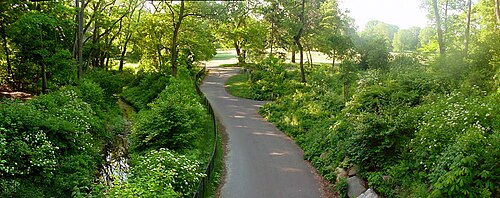
ロングメドウ
.jpg/500px-A_walk_in_the_park_(49086734093).jpg)
ロングメドウはプロスペクトパークの西側に広がっています。[146]この牧草地には、2つの遊び場、テニスハウス、ピクニックハウス、野外ステージ、ドッグビーチ、ニューヨーク市公園管理施設があります。[17]渓谷と水路とは対照的に、ロングメドウは大部分が平坦なオープンスペースです。設計通り、西側の住宅街と公園内部の間に視覚的な緩衝帯を提供しました。建設中、オルムステッドは牧草地の周りに何百本もの木を細心の注意を払って配置しました。[17] [73]
もともとロングメドウでは、アーチェリー、[42]クロッケー、[47]ボーリング、フットボール、野球、テニスなどのスポーツが行われていました。[17]牧草地の牧草地としての性質を保つため、1930年代まで羊が放牧されていました。[26] : 16 [73]今日、ロングメドウの大部分はさまざまな目的で使用されています。[26] : 16 [164]ロングメドウの南部には7つの野球場があります。[146] [164]
動物と植物

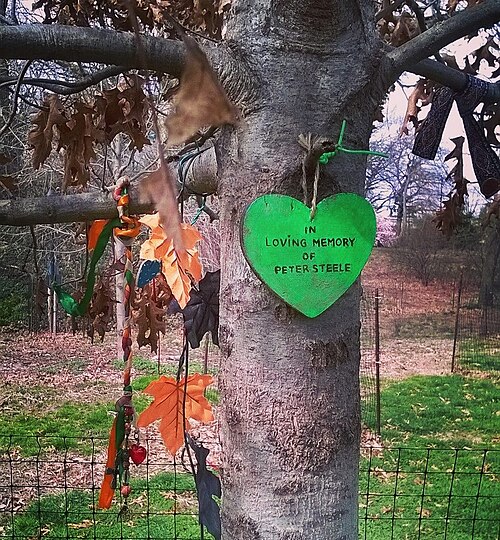
2018年現在[update]、プロスペクトパークには約200種の固有種からなる3万本の樹木がありました。[165]いくつかの例外を除いて、プロスペクトパークの木はほとんどが手植えでした。初期の頃、プロスペクトパークは木や植物の苗床を維持しており、そこから最終的に10万以上の標本が採取されました。[17] [166]現在、プロスペクトパークアライアンスは定期的に公園の植物相を維持しており、侵入種を除去し、在来植物を追加しています。[166]プロスペクトパークには、ニューヨーク市公園局が特別に認定した4本の「偉大な木」があります。これには、ボートハウスの南にあるキャンパーダウンエルム(米国で最初に植えられたものの一つ)、キャンパーダウンエルムの近くにあるアメリカシデと日本のパゴダツリー、ウェストドライブ沿いのイングリッシュエルムが含まれます。[166] [167] [168] 2011年後半、2010年に亡くなったバンド「タイプ・オー・ネガティブ」のメンバーでブルックリン出身のピーター・スティールを追悼して、公園にオークの木が植えられた。 [169]
プロスペクト公園には、多くの鳥類が生息している。毎年、何百種もの渡り鳥がこの公園に立ち寄り、冬には、都市部のバードウォッチャーは、天気の良い日に60種、通常のシーズンには100種の固有種がこの公園で観察されたと報告している。[26] : 94 長年にわたり、プロスペクト公園では合計298種が記録されており、そのうち11種は他の都市公園では見られなかったものである。[170] : 35 公園で観察された鳥類の公式リストはないが、ブルックリン・バード・クラブは1967年から1990年の間にこの公園で観察された鳥類の記録を保管している。[170] : 34–35 鳥類の人気スポットには、ルックアウト・アンド・クエーカー・ヒルズ、ザ・ラビーン、ザ・ヴェール・オブ・カシミア、リリー・ポンドなどがある。[17]

プロスペクトパークには他の動物種も生息しています。特に、水路には水鳥、カメ、ウシガエル、魚、甲殻類が生息しています。また、公園の木々にはリスがよく見られます。[17] [26] : 94 [150]蝶の目撃も多く、1990年代から2000年代にかけてプロスペクトパークではコウモリの目撃数が増えています。[26] : 94
ランドマークと建造物
広場と入口
プロスペクト パークは、おおよそ凹んだ六角形のような形をしています。プロスペクト パークの外側の角には 3 つの円形または広場があり、これらの円形と広場のすべてに「主要な」公園入口があります。[17] [171] : 7 (PDF p. 8)
主要な入口
グランド・アーミー・プラザは、プロスペクト・パーク・ウェスト、フラットブッシュ・アベニュー、イースタン・パークウェイ、およびいくつかの脇道の交差点にある北の角にある楕円形の広場である。オルムステッドとヴォークスは、この広場を公園の正面入口にすることを意図しており、1860年代後半に公園とともに建設された。 [172] [173]グランド・アーミー・プラザの最大の特徴は、楕円形の中央にある大きな凱旋門であるソルジャーズ・アンド・セーラーズ・アーチで、1892年に献納された。広場には、 1894年から1896年にかけて建設された4本のドーリア式の円柱、2つの噴水があった場所に1929年から1932年にかけて建設されたベイリー噴水、および有名人の彫像がいくつかある。[173]
バーテル・プリチャード広場は実際には円形で、プロスペクト公園の西端、プロスペクト公園西と南西の交差点に位置し、それぞれ9番街と15番街に分かれている。1923年に現在の名称で開園したこの広場は、第一次世界大戦中に戦死したブルックリン在住のエミール・バーテルとウィリアム・プリチャードにちなんで名付けられた。[174]広場から公園への入口は1896年にスタンフォード・ホワイトによって設計された。[26] : 48
マチェート サークルは、プロスペクト パーク ウェスト、オーシャン パークウェイ、パークサイド アベニューの交差点の南西角にあります。元々はパーク サークルと呼ばれていましたが、1989 年に職務中に亡くなった警察官に敬意を表して改名されました。マチェート サークルからの公園の入り口もスタンフォード ホワイトによって設計されました。[175]
追加の「主要な」入口は、公園の南側にあるパレードグラウンド、公園の南東角にあるパークサイドアベニューとオーシャンアベニュー、東の境界にあるフラットブッシュアベニューとオーシャンアベニューにあるウィリンクヒルにあります。 [171] : 7 (PDF p. 8) [176]オーシャン/パークサイドとウィリンクの入口は、マッキム、ミード、ホワイトによって新古典主義様式で設計され、1890年代と1900年代に建設されました。ウィリンクの入口は、一対の花崗岩の小塔に囲まれており、オーシャン/パークサイドの入口は、湾曲した花崗岩の列柱の2つの部分の間にあります。[17]ウィリンクの入口の反対側には、1979年に設置され、2015年に再装飾された、緑色の金属板の天蓋が付いた3つのコンクリートの円筒形のフラットブッシュツリーがあります。 [ 177]
その他の入口
公園の境界に沿って、他にも多数の入口が点在している。これには、プロスペクト パーク ウェストに 5 つ、プロスペクト パーク サウスウェストに 4 つ、公園の東の境界にあるオーシャン アベニューに 3 つある。合計で、公園の入口は 18 個ある。[176]これらのうち、3 番街、9 番街、16 番街、リンカーン ロードの入口は「主要な入口」とみなされており、記念碑やその他の装飾が両側にある。[171] : 7 (PDF p. 8) プロスペクト パークへの入口は 1940 年代以降建設されていないが、[126] 2016 年にフラットブッシュ アベニュー側に 2 つの入口が提案され、2020 年半ばに完成する予定である。[126] [178]
橋
アーチ
アーチ
左上から時計回りに: エンデール・アーチ(2020年に修復)、イースト・ウッド・アーチ、メドウポート・アーチ、クレフト・リッジ・スパン
プロスペクト公園にはもともと、歩行者と車両の交通を分離するためのアーチ橋がいくつかありました。通常、車両用通路はアーチの上にあり、歩行者用通路は下にあります。[17] [179]これは、当時の他の公園とは対照的で、そのような分離はありませんでした。アーチは、景観を邪魔しないように、できるだけ小さく、自然な外観になるように設計されました。[4] : 6 [37] : 39–40 アーチの下のスペースの大部分には、もともとベンチが備えられており、アーチ自体は木々の葉と溶け合っていました。[37] : 40 最終的に5つのアーチ橋が建設されましたが、すべて1860年代後半から1870年代初頭にかけてのことでした。[17]
エンデール・アーチ(別名エンターデール・アーチ)は、イースト・ドライブの下、公園の北側にあるグランド・アーミー・プラザ入口の少し南、ロング・メドウの北東側に隣接している。[146] [180]これは1868年に完成した最初の2つのアーチのうちの1つである。その外観は、黄色のオハイオ州砂岩と赤色のニュージャージー州ブラウンストーンが点在していた。[4] : 6 [17]内部は、黒と黄色の木目が交互に並んだレンガで構成されており、結露が下に滴り落ちるのを防ぐように設計されていた。[17] [37] : 39–40 エンデール・アーチの下には座席があったが、後に撤去された。[179] [181] 2014年、プロスペクト・パーク・アライアンスが5年間のアーチ修復を開始し、[182] 2020年に完了した。[181] [183]
イーストウッド・アーチ(またはイーストウッド・アーチ)もイースト・ドライブの下にあり、ネザーミード・アーチとプロスペクト・パークの東側にあるウィリンク・ヒルの入り口を結んでいる。[4] : 6 これは1868年に完成した2つのアーチのうちの2番目のものだった。イーストウッド・アーチはエンデール・アーチと似たデザインだが、よりシンプルな半円形をしている。[17] [180]
メドウポート・アーチはロング・メドウの北西側に位置し、ウェスト・ドライブの下を通っている。[146] [180]完成したのは1870年である。 [17] [180]東端には2つの入口があり、互いに直角になっており、交差ヴォールトを形成している。アーチの内側はオハイオ砂岩と木で裏打ちされており、入口には円形のコーニス、外向きの支柱、八角形のドーム型の頂華が付いていた。[4] : 6 [17]メドウポート・アーチは1980年代に修復されたが、その後荒廃している。[179]
ネザーミード・アーチも1870年頃に 完成し、[17]センター・ドライブを公園の中央に通している。[146] [180] この橋には3つのアーチがあり、アンバーギル、公園の小道、乗馬用の小道の上にそれぞれ1つずつある。[180]橋の支間はオハイオ砂岩でできており、花崗岩で縁取られている。[4] : 6 [17]他のアーチと異なり、ネザーミードには内部に木材がなく、代わりに模様のある赤レンガが使われている。[179] ニューヨーク・タイムズ紙は、その3つの支間を「都市公園で最も驚くべき構造物の一つ」と評した。[145]
クレフトリッジスパンは、プロスペクトパークの東側、ブリーズヒルのウェルハウスドライブの下にあります。[4] : 6 [146]これは1872年に開通した最後のアーチスパンでした。このスパンは、「ベトンコワニエ」と呼ばれる赤、黄土色、淡い灰色のコンクリートブロックを使用しているのが特徴です。[17] [179] [184]クレフトリッジは、米国で最初のコンクリートアーチスパンだった可能性があります。[184]内部と外部のデザインはどちらも精巧でしたが、これらはその後侵食されました。[17]
その他のスパン
ラルウォーター橋とテラス橋は、水路にかかる橋の中で自動車交通を扱うために建設された唯一の橋である。[58]ラルウォーター橋は、ボートハウスのすぐ下流、プロスペクト公園の東側にある。[146]現在の金属製の橋は1905年に建設され、元々1868年に建設されたこの場所のオーク材の橋に代わるものである。[26] : 68–69 [180]さらに下流では、テラス橋がウェルハウスドライブを水路に渡し、湖に注ぐ直前に渡している。[146] 1890年に建設されたテラス橋も以前の木製の橋に代わったもので、その下には鋳鉄のトレーサリーとレンガ造りの天井があるが、その後劣化している。[26] : 70–71 [180]この橋は、1873年の金融危機後にキャンセルされた未建設の食堂を見下ろす予定だったため、このように名付けられた。[17] [58]
北西から南東にかけて、フォールキル橋、エスデール橋、ネザーミード・アーチ橋、ロック・アーチ橋、ミュージック・グローブ橋、ビネン橋もラルウォーター橋の上流で水路を渡っている。フォールキル橋、エスデール橋、ロック・アーチ橋はネザーミード・アーチの北西に位置し、ミュージック・グローブ橋とビネン橋はアーチの南東に位置している。[146] [180]水路の源流では、フォールキル橋とエスデール橋はどちらも木製の橋のように見えるように設計されているが、実際は鋼鉄とコンクリートのフレームでできている。[26] : 55 [180]岩を敷き詰めたスパンのロック・アーチ橋はアンバーギル滝を渡っている。滝はかつて橋の石積みで埋もれていたが、20世紀後半に橋が修復されたときに復元された。[26] : 56 [180]南では、ビネン橋とミュージック・グローブ橋はどちらも木製の橋として設計された。[58]ビンネン橋はラルウォーターのすぐ北に位置し、さらに上流のミュージックグローブ橋はミュージックパゴダの隣にあります。[146]
ドライブとパス
プロスペクトパークが建設された当時、横断道路はありませんでした。代わりに、ウェスト、センター、ウェルハウス、イーストドライブと名付けられた4つの景観の良いドライブウェイが周囲を囲んでいました。[4] : 6 これらのドライブウェイには、より広範な歩行者用および乗馬用の道が並行して走っています。[17] [146]公園内のいくつかの道は、イーストドライブと同様に、古代のネイティブアメリカンの道に沿っています。[15] [185]
車道はもともと幅40フィート(12メートル)で、砂利で舗装されていました。西車道と東車道からなるメインの環状線は、公園の境界のすぐ内側を蛇行して回っています。[17]環状線はアスファルトで舗装され、1918年に自動車の通行が可能になりました。 [186]その後の数十年間で、公園を車両で通行できる時間は徐々に制限されていきました。[187] 自動車通行禁止の支持者は、公園は自動車がもたらす都市のストレスからの避難場所であるべきであり、自動車に公園を使わせると、公園をレクリエーションに利用する人々の安全が犠牲になると主張しました。 [187] [188]一方、反対者は、公園での交通を禁止すると公園外の交通量が増えることを懸念しました。[189] 公園のウェストドライブは2015年に交通が遮断されました。2017年の夏に公園を車両通行禁止にする試験運用を行った後、市は近くの道路に大きな影響はないと判断し、2018年1月から公園への車両の進入を全面的に禁止しました。[186] [190] [191]すべてのドライブは自転車専用レーンとして指定されています。[192]
プロスペクト公園内には、ラルウォーター、ミッドウッド、ペニンシュラ、ウォーターフォールの4つのハイキングコースもあります。長さは0.5マイルから1.0マイル(0.80 kmから1.61 km)で、ニューヨーク市公園局はすべてのコースを「初級」に分類しています。コースの名前は、公園内のどのセクションに位置するかにちなんで付けられています。[193]
記念碑と彫像
プロスペクトパークには、次のような著名人の記念碑や彫像が数十個あります。[194]
- 1869年にヘンリー・カーク・ブラウンによって彫刻されたエイブラハム・リンカーンのブロンズ像。元々はグランド・アーミー・プラザに置かれていたが、 1896年にプロスペクト・パークのコンサート・グローブに移設され、1980年代後半に修復された。[195] 2010年代のコンサート・グローブの修復に伴い、像を元の位置に戻すことが提案されたが、[196] 2016年現在もコンサート・グローブに置かれていた。[197][update]
- グランド・アーミー・プラザの入口近くに、フレデリック・マクモニーズが彫刻した大理石の上に置かれたジェームズ・S・ストラナハンのブロンズ像があります。 [198]この像は1891年に奉納され、公園開発の重要人物の一人であるストラナハンを称えています。[46]
- ラファイエット記念碑は、公園の西側、9番街の入り口にある花崗岩の浅浮き彫りである。この記念碑は、ラファイエット侯爵のジルベール・デュ・モティエを称えるもので、ダニエル・チェスター・フレンチによって彫刻され、1917年に完成した。[17] [199]
- メリーランド記念碑は、テラス橋の近くにあるコリント式の柱です。スタンフォード・ホワイトによって作られ、1895年に献納されました。[200]この柱は、アメリカ独立戦争中のロングアイランドの戦いで、数の上で劣勢であったにもかかわらずルックアウトヒルのイギリス軍に突撃した第1メリーランド連隊のメリーランド400人を記念しています。[201]
- プロスペクトパーク戦争記念碑は湖の東岸に沿って建てられている。ヘンリー・オーガスタス・ルークマンの彫刻作品で、1921年に献納された。この記念碑は、第一次世界大戦で亡くなった2,800人の名前が刻まれた記念碑の付いた湾曲した壁の前にある2体のブロンズ像で構成されている。[17] [66]
- コンサート・グローブにはベートーヴェン、モーツァルト、ウェーバーなどのクラシック音楽の作曲家たちの記念碑がある。[ 147] [202]周辺には詩人のトーマス・ムーア、作家のワシントン・アーヴィング、クラシック音楽の作曲家エドヴァルド・グリーグへの賛辞もある。[202]
- パークサイド・アベニューとオーシャン・アベニューの入り口にシャーリー・チザムの記念碑を建てる計画。アーティストのアマンダ・ウィリアムズとオラレカン・ジェイファスがデザインする予定。[203]
注目すべき建造物
西側とロングメドウ

ピクニックハウスはプロスペクトパークの西側、ロングメドウにあります。[146] 1927年に建てられたこの建物は、前年に焼失した素朴な建物の代わりとなりました。[204]この建物はJ.サースフィールド・ケネディによって設計されました。[17]
リッチフィールド・ヴィラは、 5番街とプロスペクト・パーク・ウェストの交差点近く、ピクニック・ハウスの真西に位置している。[146]この建物はもともと1854年から1857年にかけてイタリア風の様式で建てられた個人邸宅だった。ニューヨーク市公園管理局は19世紀後半からリッチフィールド・ヴィラをメンテナンスおよびオフィスビルとして利用してきた。[17]このヴィラは1977年に国家歴史登録財(NRHP)に登録された。 [205]ニューヨーク市公園管理局が使用するガレージ敷地はヴィラの真南に隣接している。[17] [146]
テニスハウスは、1909年から1910年にかけてヘルムリ、ハズウェル、ヒューバティによって建設され、ウェストドライブのロングメドウに位置し、およそ8番街の西側にあります。[146]この建物は、石灰岩とレンガでできた新古典主義の建物で、赤い瓦屋根が特徴です。[8] : 130 最初はテニスプレーヤーのロッカールームとして使用されていましたが、後に非公開のニューヨーク市公園施設に改装されました。[17] 2000年代までに、この建物は老朽化していました。2017年に、510万ドルの4年間のプロジェクトの一環として、テニスハウスを改装してトイレに改造することが発表されました。[122] [206]
テニスハウスの南東には、フォールキル川の西岸にあるドッグビーチがあります。[146]プロスペクトパークには早朝と深夜に犬のリードを外すことができる「ノーリード」ポリシーがあるため、夏には犬とその飼い主がよく利用します。[207]ビーチは2017年に修復されました。[121]

ウェストドライブの西、10番街には、ハーモニープレイグラウンドとバンドシェルがあります。[146]アイマール・エンバリー2世が設計したバンドシェルは、1939年にアーチェリーやホッケーに使用されていた元「動物園」の場所に建てられました。バンドシェルと隣接する遊び場は2000年に修復され、音楽のテーマが与えられました。[101] 2021年6月、プロスペクトパークバンドシェルは、成功したエンターテイナーでありブルックリン出身のレナ・ホーンに敬意を表し、黒人コミュニティとの連帯を示すために、レナ・ホーンバンドシェルに改名されました。[208] [209]バンドシェルでは、毎年夏にBRIC Celebrate Brooklyn!フェスティバルを通じて数多くのコンサートが開催されます。
北東側
ローズガーデンはフラットブッシュアベニューの隣にあり、グランドアーミープラザ入口の南西、プロスペクトパークの北側にあります。[146]プロスペクトパークで最初にオープンした芝生の遊び場があった場所に建てられました。[17] 19世紀後半から20世紀初頭にかけて、この庭園にはバラと金魚の池がありました。[147]ローズガーデンは1960年代に改装され、[92]それ以降、バラは植えられなくなりました。[123] [147] 2017年にプロスペクトパークアライアンスは庭園を修復する計画を発表し、[210]その間、訪問者を引き付けるために7,000個の風車を設置しました。[123]
西側には、ローズガーデンに隣接して、カシミア渓谷と呼ばれる別の庭園があります。この庭園は、トーマス・ムーアの詩「ララ・ルーク」にちなんで名付けられました。 [82] [147]これは、当時北インドにあったカシミールを指しています。 [211]カシミア渓谷は、かつては裕福な人々がよく利用していました。[212]ここには噴水があり、中央には裸の若者と6匹のカメの彫刻がありましたが、彫刻は1941年に盗まれました。 [82] 20世紀には、カシミア渓谷は草木に覆われ、噴水は放棄されました。カシミア渓谷は、トーマス・ローマの著書「カシミア渓谷で」に記録されているように、後にゲイのクルージングの人気スポットになりました。[147]渓谷周辺の森は、2012年のハリケーン・サンディで被害を受けましたが、その後修復されました。[111]
プロスペクトパーク動物園は、ブルックリン植物園からフラットブッシュアベニューを渡ったローズガーデンの少し南に位置する12エーカー(4.9ヘクタール)の敷地[213]を占めています。[146]動物園は1935年に開園し[17] 、 1980年から野生生物保護協会によって運営されています。 [214] 2016年現在、プロスペクトパーク動物園には176種864匹の動物が飼育されています。[215][update]
東側

プロスペクトパークで最も古い建物であるレファーツ歴史館は、動物園の南、オーシャンアベニュー、フラットブッシュアベニュー、エンパイアブールバードの交差点近くにあります。[146] 1783年に建てられ、もともとはウィリンクヒルの入り口近くにありました。この建物は1920年にウィリンクの入り口を作るために移転されました。[216]この家はニューヨーク市指定のランドマークであり、19世紀のブルックリンの家族生活を紹介する子供博物館として運営されています。[217]
プロスペクトパークの回転木馬は、レファーツ歴史館のすぐ西にあります。[146]この回転木馬には、1912年に馬の彫刻の名手チャールズ・カーメルによって作られた53頭の馬と、他の動物の彫刻3体、2台の馬車があります。[218]この回転木馬は1952年10月にオープンし、[71] [72] 20年以上前に焼失した別の回転木馬に取って代わりました。[219]その後、1971年から1974年、[93] 1987年から1989年にかけて修復されました。 [98]現在の回転木馬がオープンする前は、公園の歴史を通じて3つの別々の木製の回転木馬が作られ、公園のさまざまな場所に設置されていました。[17]
ウィリンクヒルの入り口には、新古典主義のウィリンクエントランスコンフォートステーションがあります。[146]この建物は1912年にオープンし、テニスハウスに似たデザインになっています。[8] : 130 [17]
ウィリンク入口のさらに南には、ラルウォーターの東岸にあるボートハウスがあります。[146] 1905年から1907年に建てられたこのボートハウスは、公園内でマッキム、ミード、ホワイトによって建てられた最初の建造物であり、新古典主義様式で建てられました。[8] : 130 1964年に破壊から救われた後、[17] [147] 1972年にNRHPに登録されました。[220]

ボートハウスの南、クレフトリッジアーチを過ぎると、湖の北東端にコンサートグローブがある。 [146]もともとは1847年に建設され、[221]公園の利用者が、後に取り壊されたミュージックアイランドで演奏されている音楽を聞けるように設計された。グローブのスタイルはセントラルパークモールのスタイルを補完しているが、放射状に配置されていた。[17]グローブにはクラシック音楽の作曲家の胸像もある。[147]コンサートグローブにはエイブラハムリンカーンの像がある。[195]グローブの中央にはコンサートグローブパビリオン、別名オリエンタルパビリオンがあり、広さは40×80フィート (12×24 m)で、屋根と柱は中東またはインド風である。[17] [147]かつてはレストランとして使われていたが、その後荒廃している。[111] [221] 2021年にコンサートグローブパビリオンが修復されました。[131] [132]
レイクサイドのサミュエル・J・アンド・エセル・ルフラック・センターは、コンサート・グローブのすぐ南に位置しています。[146] 2013年12月に完成し、以前のウォルマン・リンクの代わりとなりました。[108] [109]この多目的施設は、通年営業しており、アイススケート、ボート、サイクリング、ローラースケートのほか、ホッケーやカーリングなどの冬季スポーツにも使用されています。[164] [222]ルフラック・センターは、年間20万人以上の来場者を受け入れています。[106]
ネザーミードとルックアウトヒル
.jpg/500px-Music_Pagoda_in_Prospect_Park_(81543p).jpg)
ミュージック パゴダは、ネザーミードの、水路の西岸沿いの公園の東側にあります。[146] 1887 年に建てられた元のパゴダは、八角形の屋根と石の土台を備えた木造の建物でした。これは、ラルウッド近くの「一時的な」譜面台に代わるものでした。[17]ミュージック パゴダは、1968 年に焼失するまで、コンサートに使用されていました。現在この場所にあるパゴダは、1971 年に建てられた元のパゴダを再現したものです。[223]
The Well House is located on the northern shore of the Lake, abutting the southern slope of Lookout Hill on the southwestern side of Prospect Park.[82][146] It was the last structure in the park to be built by Olmsted and Vaux, having been built in 1869. It was made of gray stone and brick, and featured a hip roof and a doorway inside a Tudor arch. The house initially contained machinery that powered Prospect Park's watercourse, and at one point, pumped 750,000 U.S. gallons (2,800,000 liters) of water into the watercourse each day.[17] The water from the Well House was drawn from a 70-foot-deep (21 m) well, which led to the Brooklyn Aquifer.[58][149] Originally, there was a 60-foot-tall (18 m) smokestack behind the Well House, as well as a cistern in front of the building.[58][152] The machines became obsolete in the early 20th century when Prospect Park was connected to New York City's municipal water system.[120][152] Subsequently, the tower was demolished and the cistern was filled in.[152] In 2017, the Well House was restored and turned into a composting restroom.[119][120]
South side
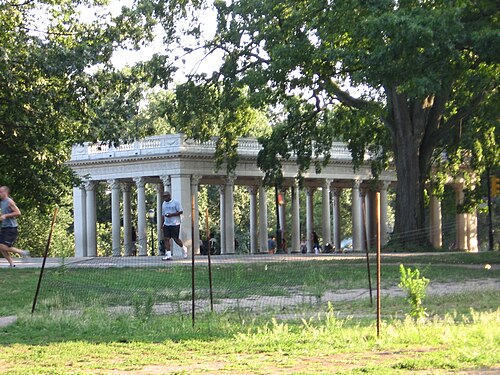
The Prospect Park Peristyle, also known as the Grecian Shelter or Croquet Shelter, is located on the southwest corner of the park, south of the Lake.[146] Constructed by McKim, Mead and White in 1905, this peristyle was built on the site of the 1860s-era Promenade Drive Shelter. The Prospect Park Peristyle is actually designed in the Renaissance architectural style and consists of a rectangular colonnade with Corinthian columns.[17] It was rehabilitated in 1966 and listed on the NRHP in 1972.[224]
Former structures

The Dairy Cottage, or "the Dairy", was located near Boulder Bridge west of the zoo. It was a two-story stone cottage with two gabled wings; a public room and women's quarters on the first floor; and a single residence on the second floor.[17] The Dairy was built in 1869 or 1871 to sell fresh milk and other light refreshments to the public; a similar building was also built in Central Park. At the time, sheep and cows were allowed to pasture on the meadows of Prospect Park, and seven cows were purchased specifically to provide milk. However, according to the Brooklyn Daily Eagle, news articles after 1879 do not make a mention of the Dairy providing milk.[225] The cottage later became part of the Menagerie, the precursor to the modern-day zoo, and was encircled by several other zoo buildings to its north and east. All of these buildings were demolished in 1935 when the zoo was built.[17]
There were two unusual structures built in Prospect Park in its early years. The first was a camera obscura booth located on Breeze Hill's western slope, at the east end of the park, built in the early 1880s.[15][82] The second was the Circular Yacht or Rotary Yacht, a floating carousel with yacht-shaped vehicles. Located near the Long Meadow, the Circular Yacht was constructed by inventor David Smith in 1878 and could hold up to 220 people at once.[15][226] These structures were both demolished before the 1900s, and the camera obscura later became the site of the now-demolished Old Fashioned Flower Garden.[15][17]
The park contained a Music Island near the east shore of the Lake.[17] The island was used by musicians who were performing for audiences in the nearby Concert Grove. It was demolished in 1960 to make way for the Wollman Rink. Following the rink's demolition in the early 2010s,[107] a replica of the island was constructed, and it opened in 2012.[80][81] Across the Lake, two structures were built on the peninsula in the late 19th and early 20th centuries. The Model Yacht Club House, built on the south side of the peninsula in 1900, was an octagonal wood-frame clubhouse that burned down in a fire in 1956. On the opposite or northern side of the peninsula, there was another shelter, similar in design to the Concert Grove Pavilion, which lasted from 1915 to around the 1940s.[17][82]
On the west side of Prospect Park, there was a conservatory on the Long Meadow. It consisted of sixteen greenhouses located near Seventh Street and Prospect Park West.[227] Though it was a popular visitor attraction, it was supplanted by the Brooklyn Botanic Garden past the park's eastern edge. The conservatory's greenhouses were renovated in 1929–1930, but the cost of upkeep soon became exorbitant.[17] In 1955, the greenhouses were considered redundant and were demolished. At that point, the conservatory's main attraction was an annual Easter flower show.[83][228]
Recreation
There are numerous sports hosted in Prospect Park, and specialized facilities exist for several sports. Seven baseball fields are located in the Long Meadow between 9th and 15th Streets. Two are major league-sized fields serving older age groups, while the other five are slightly smaller and intended for younger children, typically 8–12 years old.[146] In the winter, ice skating, cross-country skiing, figure skating, curling, hockey, and tennis are provided in the LeFrak Center at Lakeside.[222] The LeFrak Center also accommodates boating and biking.[164] The Parade Ground also contains a variety of fields for several sports.[229]
Runners also use the trails and drives of Prospect Park. The pedestrian lanes of East Drive and West Drive form an 3.36-mile-long (5.41 km) paved loop.[230] The Prospect Park Track Club, formed in 1970,[230] organizes regular training runs and races in and around the park.[231] Reporting over 2,000 members, Prospect Park Track Club records itself as one of the largest running clubs in Brooklyn as of 2023[update].[232] Organizations including NYCRUNS and the New York Road Runners also host road running races in the park.[230] This includes the New York City Half Marathon which, since 2018, has been run from Prospect Park to Central Park.[233] NYCRUNS's Brooklyn Marathon was first hosted in 2011, with a course that initially consisted of eight laps around Prospect Park;[234] in 2022, the marathon adopted a new course that crossed Brooklyn and passed through the park.[235]
Other sports are also played in Prospect Park. The Prospect Park Women's Softball League has been playing softball games on summer evenings in Prospect Park since 1973.[236] Circle rules football is also played seasonally inside the park.[237] Since the 1930s, the nearby Kensington Stables has hosted horse-riding lessons in Prospect Park.[238] Pedalboating is also open to the public on the lake.[156] Prospect Park's rolling hills also accommodate sledding during the winters.[239][240]
The Bandshell hosts frequent concerts, most notably the "Celebrate Brooklyn!" Performing Arts Festival, a series of summer concerts founded in 1979 that draws performing artists from around the world. The festival is produced by BRIC Arts Media Bklyn.[241]
Parade Ground
The site of the present-day Parade Ground, at Prospect Park's southwest corner, was first proposed in 1866 and was to be used for training militia.[242] The state approved the acquisition of a 40-acre (16 ha) rectangular area just south of Parkside Avenue and handed control of the plot to the Prospect Park commissioners.[243] The Parade Ground was designated to be used for sports and military drills. It was set apart from the main section of the park in fear that the high level of activity would damage the grass and plants and disrupt the park's pastoral feel. Initially, the Parade Ground contained a long, wood-frame building, which included a two-story pavilion for officers' quarters, as well as a restroom to the south and a guard room to the north.[17] Other uses included a gathering on June 15, 1927, when the Parade Ground attracted over 200,000 people to greet pioneering aviator Charles Lindbergh.[244][245]
The militia no longer use the Parade Ground, but the plot is still an active athletic complex.[229] In its present form, the Parade Ground has fifteen numbered courts and fields, used for soccer, baseball, softball, basketball, and volleyball.[146][229] They encompass the Prospect Park Tennis Center, four baseball diamonds, two softball fields, a football field, a soccer field, basketball and volleyball courts, the Paul Ricard Pétanque Court and three giant multi-use fields.[229] The Stewart Playground is also on the east side of the Parade Ground.[246]
Many Major League Baseball stars got their start at the Parade Ground, including Joe Torre and Sandy Koufax.[229] In 2003, the Parade Ground had a netball court installed next to the basketball courts.[247] The next year, the Parade Ground underwent a $12.4 million restoration.[229] The netball court was replaced by an outdoor adult fitness center in 2019, due to a lack of use,[248] and a dog run in the Parade Ground opened in 2020.[128]

Management
A nonprofit organization called Prospect Park Alliance manages Prospect Park, while NYC Parks owns and operates the land and facilities. The Alliance's responsibilities include maintaining and restoring natural and recreational areas, as well as providing educational and cultural programs.[249] In the fiscal year ending June 30, 2022, the Alliance had net assets (own equity) of about $37.2 million and liabilities of $3.1 million, which amounted to total assets of $40.3 million. Net assets increased $5.9 million from the fiscal year ending June 30, 2021.[250]
Prior to the Prospect Park Alliance's founding, there was no private maintenance of the park. The Alliance was created in April 1987[96] after the city had spent $10 million in federal funds to renovate the park in the early 1980s.[97] The Alliance subsequently started new programs to reach out to the surrounding communities, and its renovation programs caused housing prices in the area to increase by the 1990s.[251]
Transportation

There are four New York City Subway stations that directly serve the park.[252] The eastern side of Prospect Park is served by the park's eponymous station (B, Q, and S trains) and the Parkside Avenue station (Q train). The western side is served by 15th Street–Prospect Park (F, <F>, and G trains). Grand Army Plaza is served by the 2 and 3 trains at the plaza's eponymous station.[253] Bus service is provided on the western side by the B61, B67 and B69 buses, the southwestern side by the B68 bus; the eastern side by the B16, B41, B43 and B48 buses; and the southern side by the B16 bus.[253][254]
Incidents
Animals
During the 1970s, there were multiple incidents involving animal injuries or deaths at the Prospect Park Zoo. This included the scalding death of a monkey in 1975, allegedly by a zoo employee, as well as an acting zoo director who was accused of shooting at pigeons and killing zoo animals.[255][256] A zoo employee also locked himself in a monkey enclosure for several hours in 1974 to protest the deaths of ten animals.[256][257] These incidents, as well as several others at the Central Park Zoo, prompted protests by animal-rights groups who wanted to close the two zoos and move the animals to the larger Bronx Zoo.[256] This directly led to the Wildlife Conservation Society's takeover of the Prospect Park Zoo in 1980.[95]
In May 1987, an 11-year-old boy climbed into the polar bear enclosure after hours at the Prospect Park Zoo and was subsequently mauled by two of the bears; both bears were then fatally shot by police officers. The incident contributed to the Wildlife Conservation Society's decision to redesign the zoo to emphasize species more appropriate to its small size and to visitor interactions.[258]
In July 2010, federal authorities captured 400 Canada geese in the park and gassed them to death due to air safety concerns brought up after the emergency landing of US Airways Flight 1549 in January 2009.[259]
Crimes and deaths
Several murders have occurred in Prospect Park during its history. In August 1975, a 15-year-old recent graduate of Ditmas Junior High School, was strangled with a belt in a wooded area of the Vale of Cashmere.[260] In June 1993, a 42-year-old man was shot to death while resisting a group of teenagers trying to steal his bicycle; the shooter received a maximum 25-year prison term.[261] In April 2006, a 61-year-old man was found stabbed to death in the Vale of Cashmere.[262] A 41-year-old homeless man was found beaten to death in a wooded area near a jogging path two years later, in June 2008.[263] A 23-year-old man was fatally shot at the Parade Ground in March 2011, having recently been jailed on charges of being an accomplice in another man's murder.[264]
Other incidents have included the April 2018 suicide of lawyer and environmental activist David Buckel, who lit himself on fire to protest the use of fossil fuels.[265][266]
See also
- List of New York City scenic landmarks
- List of New York City Designated Landmarks in Brooklyn
- List of parks in New York City
- National Register of Historic Places listings in Brooklyn
References
- ^ "Prospect Park Timeline". prospectpark.org. Archived from the original on May 30, 2014. Retrieved March 20, 2018.
- ^ "Millions (and millions) of visitors poured into Brooklyn Bridge Park this summer". Brooklyn Eagle. December 26, 2017. Archived from the original on July 9, 2019. Retrieved July 8, 2019.
- ^ a b "National Register Information System – (#80002637)". National Register of Historic Places. National Park Service. March 15, 2006.
- ^ a b c d e f g h i j k "Prospect Park" (PDF). Landmarks Preservation Commission. November 25, 1975. Archived (PDF) from the original on December 23, 2016. Retrieved December 28, 2018.
- ^ a b "Prospect Park". New York City Department of Parks & Recreation. June 26, 1939. Archived from the original on November 19, 2018. Retrieved January 28, 2019.
- ^ "Prospect Park: Wetlands of New York City". New York City Department of Parks and Recreation. December 7, 2001. Archived from the original on March 12, 2005. Retrieved November 20, 2007.
- ^ "NYC Regional Geology: 62 Prospect Park". United States Geological Survey. 2004. Archived from the original on November 9, 2007. Retrieved November 20, 2007.
- ^ a b c d e f g h i Tate, Alan (2015). Great City Parks. Taylor & Francis. ISBN 978-1-317-61298-8. Archived from the original on August 2, 2023. Retrieved January 29, 2019.
- ^ Brooklyn (NY) Topographical Map (PDF) (Map). USGS. 2013. Archived (PDF) from the original on July 27, 2019. Retrieved January 19, 2019.
- ^ Levison, Wallace Goold (1909). Louis Pope Gratacap (ed.). "The Peat Beds of Prospect Park, Brooklyn, New York" in Geology of the City of New York. New York: H. Holt and Company. pp. 224–225. Archived from the original on January 24, 2024. Retrieved October 19, 2020.
- ^ The large peat bog north of Ninth Street, running east of Prospect Park West, was called the Pigeon Ground and occupied much of the area that was to become the Long Meadow.[10]
- ^ a b c d e f Martin, Douglas (April 9, 1995). "Urban Backyard To Be Revitalized". The New York Times. ISSN 0362-4331. Archived from the original on August 21, 2019. Retrieved August 20, 2019.
- ^ Dongan Oak Marker Archived July 3, 2019, at the Wayback Machine, New York City Department of Parks and Recreation. Accessed January 1, 2024. "One of several small monuments in the vicinity of what is known as the "Battle Pass" in Prospect Park, the Dongan Oak Monument commemorates events which took place in this area during the Battle of Long Island on August 27, 1776. During this significant battle of the Revolutionary War, a large white oak mentioned in 1685 in the patent of Governor Thomas Dongan (1634–1715), was cut down by Colonial soldiers and thrown across the road to impede the advance of the British army."
- ^ a b c "History timeline". prospectpark.org. Archived from the original on December 31, 2008. Retrieved March 20, 2018.
- ^ a b c d e f g h i j "Secrets of Prospect Park". am New York. October 19, 2014. Archived from the original on February 9, 2019. Retrieved February 7, 2019.
- ^ Spellen, Suzanne (July 22, 2011). "Past and Present: The Mt. Prospect Reservoir". Brownstoner. Archived from the original on January 1, 2024. Retrieved July 5, 2024.
In 1856, the city of Brooklyn built a huge reservoir on the top of the hill to supply water to the western part of the city. The water came from the Ridgewood Reservoir in Cypress Hills, flowing to Mt. Prospect through underground pipes. The 80' tower at the edge of the reservoir also held water, which then flowed to a pumping station on Underhill Avenue, and then on down the line to homes and businesses.
- ^ a b c d e f g h i j k l m n o p q r s t u v w x y z aa ab ac ad ae af ag ah ai aj ak al am an ao ap aq ar as at au av aw ax ay az ba bb bc bd be bf bg bh bi bj bk bl bm bn bo bp bq br bs bt bu bv bw bx by bz ca cb Lancaster, Clay (1972). Prospect Park Handbook (2nd ed.). New York: Long Island University Press. ISBN 978-0-913252-06-2. Archived from the original on October 1, 2019. Retrieved February 15, 2019.
- ^ Anderson, J.A. (1887). Laws Relating to the Public Parks, Parkways, and Other Property Under the Care and Control of the Brooklyn Park Commissioners. p. 1. Archived from the original on August 1, 2023. Retrieved January 20, 2019.
- ^ a b "Public Parks and Promenades". Brooklyn Daily Eagle. May 29, 1860. p. 2. Archived from the original on August 1, 2023. Retrieved January 19, 2019 – via Brooklyn Public Library; newspapers.com
 .
.
- ^ Margino, Megan. "From Suburb to City and Back Again: A Brief History of the NYC Commuter" Archived January 24, 2024, at the Wayback Machine, New York Public Library, May 10, 2016. Accessed January 1, 2024.
- ^ Berman, Andrew. "Sorry, Chicago: Brooklyn Will Soon Be The Third Largest City In America" Archived January 1, 2024, at the Wayback Machine, Gothamist,August 9, 2016. Accessed January 1, 2024. "Brooklyn has held the Third City spot twice before: From 1860–1880, when Philly was No. 2 and New York, which comprised Manhattan and parts of today's Bronx, was No. 1; and again (unofficially) from 1910, when it overtook Philadelphia, until 1970, when the population of Los Angeles surpassed Brooklyn's for the first time."
- ^ "Oak Ridge house in Forest Park is rich in Queens history: Our Neighborhood, The Way it Was". QNS.com. September 8, 2018. Archived from the original on July 26, 2019. Retrieved May 31, 2019.
- ^ a b c d e f Bluestone, Daniel M. (1987). "From Promenade to Park: The Gregarious Origins of Brooklyn's Park Movement". American Quarterly. 39 (4). JSTOR: 529–550. doi:10.2307/2713123. ISSN 0003-0678. JSTOR 2713123.
- ^ "Prospect Park". Brooklyn Daily Eagle. May 19, 1861. p. 2. Archived from the original on August 1, 2023. Retrieved January 19, 2019 – via Brooklyn Public Library; newspapers.com .
- ^ a b c d e f "History and Nature: History of the Park". Prospect Park Alliance. 2007. Archived from the original on December 24, 2014. Retrieved November 23, 2007.
- ^ a b c d e f g h i j k l m Berenson, Richard J.; deMause, Neil (2001). The Complete Illustrated Guidebook to Prospect Park and the Brooklyn Botanic Garden. New York: Silver Lining Books. ISBN 978-0-7607-2213-8.
- ^ Grand Army Plaza Archived February 7, 2019, at the Wayback Machine, New York City Department of Parks and Recreation. Accessed January 1, 2024. "Grand Army Plaza, the oval at the main entrance of Brooklyn's Prospect Park, was meant to provide a wide and picturesque approach to the park, which park designer Calvert Vaux (1824–1895) considered a vital design element. The Plaza was one of the first features of Prospect Park to be built and marks the beginning of the Eastern Parkway (1866), the world's first parkway, also designed by Vaux and his partner Frederick Law Olmsted (1822–1903)."
- ^ Grand Army Plaza – Brooklyn Archived January 8, 2024, at the Wayback Machine, The Cultural Landscape Foundation. Accessed January 1, 2024. "First envisioned in 1865, the plaza was conceived as the primary entrance for Olmsted and Vaux's 526-acre Prospect Park. The elliptical plaza capped the park's northern tip with a paved, pedestrian area ringed by carriageways and heavily-planted crescent-shaped berms."
- ^ a b c "Prospect Park; Progress of the Work—Descriptive Particulars". The New York Times. December 15, 1868. ISSN 0362-4331. Archived from the original on January 29, 2019. Retrieved January 28, 2019.
- ^ Annual reports of the Brooklyn Park Commissioners, 1861–1873. Brooklyn Park Commissioners. 1873. p. 127. Retrieved January 28, 2019 – via Internet Archive.
- ^ "Litchfield Villa". Prospect Park Alliance: Official WebSite of Prospect Park. Prospect Park Alliance. 2008. Archived from the original on October 29, 2008.
- ^ Morrone, Francis (2001). An Architectural Guidebook to Brooklyn. Salt Lake City: Gibbs-Smith. ISBN 978-1-58685-047-0. Archived from the original on January 24, 2024. Retrieved October 23, 2016.
- ^ a b Annual report of the Commissioners of Prospect Park. Commissioners of Prospect Park. 1868. p. 68. Retrieved January 28, 2019 – via Internet Archive.
- ^ a b Biederman, Marcia (September 27, 1998). "Neighborhood Report: Prospect Park/Park Slope; He's Here for Eternity, but Don't Ask Where". The New York Times. ISSN 0362-4331. Archived from the original on August 21, 2019. Retrieved August 21, 2019.
- ^ "Prospect Park; The Architect's Plan For Its Improvement". Brooklyn Daily Eagle. February 5, 1866. p. 2. Archived from the original on January 29, 2019. Retrieved January 28, 2019 – via Brooklyn Public Library; newspapers.com .
- ^ a b c d Jackson, Kenneth T., ed. (2010). The Encyclopedia of New York City (2nd ed.). New Haven: Yale University Press. p. 1043. ISBN 978-0-300-11465-2.
- ^ a b c d e "1870 Brooklyn Park Commissioners Annual Report" (PDF). nyc.gov. New York City Department of Parks and Recreation. January 1871. Archived from the original (PDF) on February 11, 2017. Retrieved January 29, 2019.
- ^ "Prospect Park". Brooklyn Daily Eagle. I. Van Anden. October 21, 1867. p. 2. Archived from the original on February 14, 2019. Retrieved February 13, 2019 – via Brooklyn Public Library; newspapers.com .
- ^ "Prospect Park". The New York Times. October 22, 1867. ISSN 0362-4331. Archived from the original on January 29, 2019. Retrieved January 28, 2019.
- ^ "Prospect Park.; the View from the Reservoir Boating on the Lake. the Central Park. the Merrick Camp-Meeting. Departure of the Highlanders. the Labor Movement". The New York Times. August 11, 1873. ISSN 0362-4331. Archived from the original on February 9, 2019. Retrieved February 7, 2019.
- ^ "Prospect Park". The New York Times. June 22, 1875. ISSN 0362-4331. Archived from the original on February 13, 2019. Retrieved February 12, 2019.
- ^ a b c d e f g h i j k l m n Dailey, Jessica (August 7, 2013). "25 Little-Known Facts About Olmsted & Vaux's Masterpiece". Curbed NY. Archived from the original on January 29, 2019. Retrieved January 28, 2019.
- ^ "The Park "Magician": Is He Cornered At Last?". Brooklyn Daily Eagle. Brooklyn Eagle Inc. June 7, 1882. p. 2, cols. 1–2. Archived from the original on February 15, 2019. Retrieved November 20, 2007 – via Brooklyn Public Library; newspapers.com .
- ^ "Mr. Stranahan Dead". Brooklyn Daily Eagle. September 3, 1898. p. 1, col 1; p. 2, cols 4–6 .
- ^ "For A Statue; In Honor of James S. T. Stranahan". Brooklyn Daily Eagle. January 15, 1890. p. 6, col. 3. Archived from the original on February 15, 2019. Retrieved May 27, 2007 – via Brooklyn Public Library; newspapers.com .
- ^ a b "The Father of the Park". Brooklyn Daily Eagle. Brooklyn Eagle Inc. June 7, 1891. p. 20, col. 3. Archived from the original on February 14, 2019. Retrieved November 20, 2007 – via Brooklyn Public Library; newspapers.com .
- ^ a b Rueb, Emily S. (July 8, 2014). "A Flashback to Croquet's Heyday in Prospect Park". The New York Times. ISSN 0362-4331. Archived from the original on February 16, 2019. Retrieved February 15, 2019.
- ^ "Skating at Prospect Park.; Women Who Can Do Tricks on Skates Like the Men". The New York Times. January 25, 1893. ISSN 0362-4331. Archived from the original on February 15, 2019. Retrieved February 14, 2019.
- ^ "Prospect Park Picnics". Brooklyn Daily Eagle. August 15, 1886. p. 11. Archived from the original on January 29, 2019. Retrieved January 28, 2019 – via Brooklyn Public Library; newspapers.com .
- ^ "Facts About Prospect Park.; the Great Pleasure Ground Not Quite Gone to Decay". The New York Times. June 3, 1881. ISSN 0362-4331. Archived from the original on February 15, 2019. Retrieved February 14, 2019.
- ^ "Municipal: Interesting Happenings at City Hall Today". Brooklyn Daily Eagle. Brooklyn Eagle Inc. June 7, 1882. p. 4, col. 3. Archived from the original on January 3, 2008. Retrieved November 23, 2007.
- ^ "Prospect Park's Decay.; Mayor Chapin Wants $100,000 Appropriated at Once". The New York Times. April 20, 1888. ISSN 0362-4331. Archived from the original on February 15, 2019. Retrieved February 14, 2019.
- ^ "1889 Brooklyn Borough Parks Department Annual Report" (PDF). New York City Department of Parks and Recreation. January 7, 1890. Archived from the original (PDF) on May 29, 2010. Retrieved February 14, 2019.
- ^ "Park Improvements". The Brooklyn Citizen. October 17, 1888. p. 6. Retrieved July 11, 2024.
- ^ "Contractors Indignant". Times Union. December 12, 1888. p. 1. Retrieved July 11, 2024.
- ^ "1888 Brooklyn Borough Parks Department Annual Report" (PDF). New York City Department of Parks and Recreation. March 11, 1889. Archived from the original (PDF) on February 3, 2017. Retrieved February 14, 2019.
- ^ "For Public Use: Proposing to Retain the East Side Lands". Brooklyn Daily Eagle. April 3, 1889. p. 3. Archived from the original on February 15, 2019. Retrieved February 14, 2019 – via Newspapers.com .
- ^ a b c d e f g h i j k l m Kadinsky, Sergey (2016). Hidden Waters of New York City: A History and Guide to 101 Forgotten Lakes, Ponds, Creeks, and Streams in the Five Boroughs. New York, NY: Countryman Press. pp. 226–229. ISBN 978-1-58157-566-8.
- ^ "New Park Entrances". The Brooklyn Daily Eagle. August 3, 1890. p. 3. Retrieved July 11, 2024.
- ^ a b "Olmsted and Vaux". Prospect Park Alliance. 2008. Archived from the original on March 22, 2009. Retrieved March 21, 2009.
- ^ "No Eating in Prospect Park; Manhattan Visitors Too Careless with Refuse Led to Blue Laws". The New York Times. July 21, 1903. ISSN 0362-4331. Archived from the original on February 15, 2019. Retrieved February 14, 2019.
- ^ "Kennedy and Cozier Conspire Against Cupid". Brooklyn Daily Eagle. July 12, 1907. p. 2. Archived from the original on January 24, 2024. Retrieved February 14, 2019 – via Brooklyn Public Library; newspapers.com .
- ^ "PRIMING UP CITY'S PARKS: Many Changes Are Now Under Way in Prospect Park". New-York Tribune. April 26, 1908. p. C8. ProQuest 572080805.
- ^ "Open Prospect Park Zoo; New Menagerie Building Dedicated by Commissioner Ingersoll". The New York Times. April 30, 1916. ISSN 0362-4331. Archived from the original on February 15, 2019. Retrieved February 15, 2019.
- ^ "Plan Soldiers' Memorial; Brooklyn Monument in Prospect Park to Bear About 2,000 Names". The New York Times. February 20, 1919. ISSN 0362-4331. Archived from the original on February 15, 2019. Retrieved February 15, 2019.
- ^ a b "Prospect Park War Memorial : NYC Parks". Prospect Park Monuments. June 26, 1939. Archived from the original on February 14, 2019. Retrieved February 14, 2019.
- ^ "Permanent Revolution". New York magazine. September 10, 2012. Archived from the original on April 8, 2014. Retrieved April 7, 2014.
- ^ "Olmsted and Moses Were the Key Figures in Development of City Parks". The New York Times. October 13, 1980. ISSN 0362-4331. Archived from the original on August 21, 2019. Retrieved August 20, 2019.
- ^ "Smith Hails Moses As City Parks Head; Tells of His Service to State and City at Luncheon Given by Long Island Leaders". The New York Times. January 19, 1934. ISSN 0362-4331. Archived from the original on February 17, 2019. Retrieved February 16, 2019.
- ^ a b c "Smith Decries 'Back-Alley Politics' Of La Guardia in Row With Moses; At Opening of New Prospect Park Zoo Former Governor Extols Park Commissioner, Who Joins Mayor in Shunning Ceremony – 3,000 View Glittering $500,000 Centre". The New York Times. July 4, 1935. ISSN 0362-4331. Archived from the original on June 18, 2018. Retrieved February 16, 2019.
- ^ a b Hanmer, Wendell (October 22, 1952). "Big, Small Fry Vie for Brass Ring". Brooklyn Daily Eagle. p. 3. Archived from the original on January 24, 2024. Retrieved February 14, 2019 – via Brooklyn Public Library; newspapers.com .
- ^ a b "Carrousel is Dedicated; Prospect Park Merry-Go-Round Gets Official City Send-Off". The New York Times. October 22, 1952. ISSN 0362-4331. Archived from the original on February 17, 2019. Retrieved February 16, 2019.
- ^ a b c Jacobs, Karrie (July 12, 2017). "The manhole in the meadow". Curbed NY. Archived from the original on February 16, 2019. Retrieved February 15, 2019.
- ^ Willensky, E. (1986). When Brooklyn was the World, 1920–1957. Harmony Books. p. 210. ISBN 978-0-517-55858-4. Archived from the original on January 24, 2024. Retrieved February 20, 2019.
- ^ a b Illson, Murray (October 17, 1959). "Pruning and Cleaning Begun in Prospect Park; City Says Program Will Make Area Prettier and Safer Department Splits Job Into 5 Sections in 5-Year Effort". The New York Times. ISSN 0362-4331. Archived from the original on February 9, 2019. Retrieved February 7, 2019.
- ^ a b "Prospect Park Rink Approved; Wollman Fund Gives $300,000". The New York Times. October 7, 1960. ISSN 0362-4331. Archived from the original on February 9, 2019. Retrieved February 7, 2019.
- ^ "New Wollman Rink Is Dedicated in Brooklyn". The New York Times. December 23, 1961. ISSN 0362-4331. Archived from the original on October 22, 2019. Retrieved February 16, 2019.
- ^ a b c Martin, Douglas (September 14, 1998). "Prospect Park's Ravine Inching Closer to Past". The New York Times. ISSN 0362-4331. Archived from the original on February 16, 2019. Retrieved February 15, 2019.
- ^ "Concert Grove History". Prospect Park Alliance. 2008. Archived from the original on March 23, 2009. Retrieved March 21, 2009.
- ^ a b c Dunlap, David W. (October 3, 2012). "An Island of Tranquillity Is Reclaimed in Prospect Park". City Room. Archived from the original on October 2, 2019. Retrieved January 31, 2019.
- ^ a b c "The Daily Plant : NYC Parks". New York City Department of Parks & Recreation. October 23, 2012. Archived from the original on February 1, 2019. Retrieved January 31, 2019.
- ^ a b c d e f g h "Secrets of Prospect Park". Forgotten New York. May 30, 2005. Archived from the original on February 9, 2019. Retrieved February 7, 2019.
- ^ a b "City to Discard 17 Greenhouses". The New York Times. May 23, 1955. ISSN 0362-4331. Archived from the original on August 21, 2019. Retrieved August 20, 2019.
- ^ "Laying the Preservation Framework: 1960–1980". Cultural Landscapes (U.S. National Park Service). April 24, 1962. Archived from the original on September 6, 2018. Retrieved September 6, 2018.
- ^ "Audubon Center – History". Prospect Park Alliance. 2008. Archived from the original on March 21, 2009. Retrieved March 21, 2009.
- ^ Tolchin, Martin (September 14, 1964). "A Gaslight Relic Awaits Verdict; Prospect Park Boathouse May Face Demolition". The New York Times. ISSN 0362-4331. Archived from the original on August 21, 2019. Retrieved August 20, 2019.
- ^ Graff, M. M.; George Kalmbacher (1982). Tree Trails of Prospect Park. New York: Greensward Foundation.
- ^ Tolchin, Martin (December 11, 1964). "Boathouse Saved At Prospect Park; Morris 'Succumbs to Public Opinion' on Landmark". The New York Times. ISSN 0362-4331. Archived from the original on August 21, 2019. Retrieved August 20, 2019.
- ^ "City Will Spruce Up Brooklyn's Prospect Park in a $450,000 Project". The New York Times. August 8, 1965. ISSN 0362-4331. Archived from the original on February 17, 2019. Retrieved February 16, 2019.
- ^ Tolchin, Martin (December 1, 1964). "Restoration Due In Prospect Park; Planners Vote $924,000 -Citizens' Group Hailed". The New York Times. ISSN 0362-4331. Archived from the original on February 17, 2019. Retrieved February 16, 2019.
- ^ "Rap City for Lagging on Repairs to Prospect Park". New York Daily News. April 5, 1970. p. 109. Archived from the original on January 24, 2024. Retrieved February 7, 2019 – via Newspapers.com .
- ^ a b Knight, Michael (February 28, 1971). "Prospect Park's Future Is Pondered: A Place to Play or a Place to Find Tranquillity?". The New York Times. ISSN 0362-4331. Archived from the original on February 1, 2019. Retrieved January 31, 2019.
- ^ a b Cadkin, Janice C. (October 13, 1974). "Park Carousel Reopening". The New York Times. ISSN 0362-4331. Archived from the original on February 15, 2019. Retrieved February 15, 2019.
- ^ a b Gray, Christopher (June 30, 1996). "Streetscapes/Prospect Park Boathouse;After a 1971 Restoration Fails, It's Time to Re-Restore". The New York Times. ISSN 0362-4331. Archived from the original on February 9, 2019. Retrieved February 7, 2019.
- ^ a b "City's 3 Zoos to Be Taken Over By New York Zoological Society". The New York Times. April 23, 1980. ISSN 0362-4331. Archived from the original on April 22, 2019. Retrieved August 20, 2019.
- ^ a b c d Anderson, Susan Heller (April 6, 1987). "Nonprofit Group To Nourish Once-Shabby Prospect Park". The New York Times. ISSN 0362-4331. Archived from the original on February 10, 2019. Retrieved February 10, 2019.
- ^ a b Laskow, Sarah (June 30, 2014). "What donors do for (some) city parks". Politico PRO. Archived from the original on February 15, 2017. Retrieved January 10, 2017.
- ^ a b Martin, Douglas (October 7, 1989). "About New York; Restoring Some Magic To Brooklyn". The New York Times. ISSN 0362-4331. Archived from the original on February 10, 2019. Retrieved February 10, 2019.
- ^ Bahrampour, Tara (April 30, 2000). "Neighborhood Report: Prospect Park; Bird Lovers Will Find a Home in a Beaux-Arts Boathouse". The New York Times. ISSN 0362-4331. Archived from the original on February 15, 2019. Retrieved February 15, 2019.
- ^ "Audubon New York". National Audubon Society. 2008. Archived from the original on January 16, 2009. Retrieved November 29, 2008.
- ^ a b "Prospect Park Highlights". Harmony Playground : NYC Parks. June 26, 1939. Archived from the original on February 16, 2019. Retrieved February 15, 2019.
- ^ Brick, Michael (May 27, 2004). "A Park Pretty for the Rich Yet Run-Down for the Poor; Prospect Park Overseers Direct Money To Make East Side More Like the West". The New York Times. ISSN 0362-4331. Archived from the original on March 28, 2019. Retrieved March 28, 2019.
- ^ a b Bahrampour, Tara (December 3, 2000). "Neighborhood Report: Prospect Park; Brooklyn's Prized Wollman Rink Is Feeling Its Age". The New York Times. ISSN 0362-4331. Archived from the original on February 1, 2019. Retrieved January 31, 2019.
- ^ Prospect Park Alliance Annual Report 2006 (PDF). New York: Prospect Park Alliance. 2006. p. 9. Archived from the original (PDF (Portable Document Format)) on February 28, 2008. Retrieved March 21, 2009.
- ^ "Wollman Rink". Prospect Park Alliance. 2008. Archived from the original on February 20, 2009. Retrieved March 21, 2009.
- ^ a b c d "The Lakeside Center at Prospect Park". Prospect Park Alliance. August 2008. Archived from the original on September 5, 2008. Retrieved August 30, 2008.
- ^ a b Pollak, Michael (August 7, 2011). "Monitoring Progress of Wollman Rink in Prospect Park". The New York Times. ISSN 0362-4331. Archived from the original on March 9, 2021. Retrieved February 16, 2019.
- ^ a b "Opening of new LeFrak Center ice rink". The official website of the City of New York. December 17, 2013. Archived from the original on January 30, 2019. Retrieved January 28, 2019.
- ^ a b Kimmelman, Michael (October 20, 2013). "Restoring Brooklyn's Pastoral Heart". The New York Times. ISSN 0362-4331. Archived from the original on January 29, 2019. Retrieved January 28, 2019.
- ^ Newman, Andy (December 10, 2009). "Where Rink Now Stands, an Isle Is Planned". City Room. Archived from the original on February 1, 2019. Retrieved January 31, 2019.
- ^ a b c d e "Group Plans to Renovate Long-Neglected Areas of Prospect Park". The New York Times. August 5, 2015. ISSN 0362-4331. Archived from the original on February 1, 2019. Retrieved January 31, 2019.
- ^ "Prospect Park Long Meadow Ballfield 1 Reconstruction : NYC Parks". New York City Department of Parks & Recreation. June 26, 1939. Archived from the original on February 16, 2019. Retrieved February 15, 2019.
- ^ "Prospect Park To Build Two New Flatbush Avenue Entrances; BP Urges Traffic Calming". BKLYNER. May 26, 2016. Archived from the original on February 13, 2019. Retrieved February 12, 2019.
- ^ a b "2 new entrances coming to Prospect Park". am New York. April 26, 2018. Archived from the original on February 13, 2019. Retrieved February 12, 2019.
- ^ "Prospect Park New Flatbush Avenue Entrances Construction and Willink Entrance Reconstruction : NYC Parks". New York City Department of Parks & Recreation. June 26, 1939. Archived from the original on February 13, 2019. Retrieved February 12, 2019.
- ^ "City Budget Invests in Prospect Park". Prospect Park. July 13, 2016. Archived from the original on February 14, 2019. Retrieved February 14, 2019.
- ^ "Prospect Park gets $3.7 million in funding for improvements". Brooklyn Daily Eagle. November 2, 2015. Archived from the original on February 14, 2019. Retrieved February 14, 2019.
- ^ Stapinski, Helene (October 5, 2017). "In Prospect Park, First the Goats, Then the Shrubbery". The New York Times. ISSN 0362-4331. Archived from the original on February 1, 2019. Retrieved January 31, 2019.
- ^ a b "Prospect Park Wellhouse is Flowing Once Again". Spectrum News NY1 | New York City. June 19, 2017. Archived from the original on February 2, 2019. Retrieved February 2, 2019.
- ^ a b c d Warerkar, Tanay (June 19, 2017). "Prospect Park's 148-year-old Wellhouse is transformed into a composting restroom". Curbed NY. Archived from the original on February 2, 2019. Retrieved February 2, 2019.
- ^ a b Peele, Robert (November 8, 2017). "Where the Dogs Are". The New York Times. ISSN 0362-4331. Archived from the original on February 14, 2019. Retrieved February 13, 2019.
- ^ a b "Prospect Park Receives Funding To Restore Tennis House, Parade Ground, And More". BKLYNER. July 27, 2017. Archived from the original on February 9, 2019. Retrieved February 7, 2019.
- ^ a b c "Planting a new Rose Garden! Prospect Park officials call for ideas to revive forgotten patch of greenspace". Brooklyn Paper. May 26, 2017. Archived from the original on February 1, 2019. Retrieved January 31, 2019.
- ^ "Double play: Prospect Park honchos unveil pair of renovated ball fields". Brooklyn Paper. September 29, 2017. Archived from the original on February 16, 2019. Retrieved February 15, 2019.
- ^ Verde, Ben (October 13, 2020). "Prospect Park ballfields reopen after restoration". Brooklyn Paper. Archived from the original on April 22, 2023. Retrieved April 22, 2023.
- ^ a b c "Upgrades And New Entrances Coming To Flatbush Avenue Side Of Prospect Park". BKLYNER. April 26, 2018. Archived from the original on February 13, 2019. Retrieved February 12, 2019.
- ^ Graham, Aidan (July 30, 2019). "Work starts on long-delayed Kensington Dog Run". Brooklyn Paper. Archived from the original on July 30, 2019. Retrieved July 30, 2019.
- ^ a b DeJesus, Jaime (July 7, 2020). "Ribbon cut on new dog run in Prospect Park". The Brooklyn Home Reporter. Archived from the original on July 16, 2020. Retrieved July 16, 2020.
- ^ Franklin, Sydney (May 13, 2019). "Shirley Chisholm monument designers discuss using space to honor a legacy". The Architect's Newspaper. Archived from the original on January 15, 2024. Retrieved January 15, 2024.
- ^ Steinhauer, Jillian (April 23, 2019). "The Shirley Chisholm Monument in Brooklyn Finds Its Designers". The New York Times. ISSN 0362-4331. Archived from the original on March 14, 2020. Retrieved January 15, 2024.
- ^ a b Rahmanan, Anna (April 9, 2021). "The concert pavilion in Prospect Park has reopened after seven years". Time Out New York. Archived from the original on September 1, 2021. Retrieved August 1, 2021.
- ^ a b Verde, Ben (April 7, 2021). "Restored Concert Grove Pavilion in Prospect Park reopens after six-year closure". Brooklyn Paper. Archived from the original on June 16, 2021. Retrieved August 1, 2021.
- ^ "Mayor Bill de Blasio announces historic $40M in funding to transform the Vale in Prospect Park". Brooklyn Eagle. December 16, 2021. Archived from the original on December 23, 2021. Retrieved December 23, 2021.
- ^ Barron, James (December 16, 2021). "How Eric Adams Picked a Police Commissioner". The New York Times. ISSN 0362-4331. Archived from the original on December 24, 2021. Retrieved December 24, 2021.
- ^ Beer, Isabel Song (April 5, 2023). "Play ball! Prospect Park ballfield renovations wrap up just in time for baseball season". Brooklyn Paper. Archived from the original on April 22, 2023. Retrieved April 22, 2023.
- ^ Rahhal, Emily (April 4, 2023). "Play Ball!: Prospect Park Baseball Fields Reopen After Renovations". Prospect Heights-Crown Heights, NY Patch. Archived from the original on April 22, 2023. Retrieved April 22, 2023.
- ^ Rubinstein, Dana (May 8, 2023). "Racetracks, Parks, Offices: A Frantic Search for Migrant Housing". The New York Times. ISSN 0362-4331. Archived from the original on May 12, 2023. Retrieved May 12, 2023.
- ^ Gloria Pazmino, Samantha Beech (May 6, 2023). "New York City mayor announces plan to transport willing migrants to locations outside the city ahead of expected surge". CNN. Archived from the original on May 12, 2023. Retrieved May 12, 2023.
- ^ Gonella, Catalina (October 25, 2023). "Fallkill Trail opens to public at Prospect Park after restoration". Gothamist. Archived from the original on November 20, 2023. Retrieved November 20, 2023.
- ^ Frost, Mary (October 27, 2023). "After 28 years, Prospect Park reopens Fallkill Trail". Brooklyn Eagle. Archived from the original on November 20, 2023. Retrieved November 20, 2023.
- ^ Fadulu, Lola (October 23, 2023). "Visitors Will Be Able to See Prospect Park's Waterfall. Eventually". The New York Times. Archived from the original on October 24, 2023. Retrieved October 24, 2023.
- ^ Camille, Jada (January 11, 2024). "Prospect Park Alliance to open new Shirley Chisholm Welcome Center in Brooklyn's Backyard". Brooklyn Paper. Archived from the original on January 15, 2024. Retrieved January 15, 2024.
- ^ Brendlen, Kirstyn (June 27, 2024). "Summer gets sweeter as Purselane Cafe opens at Prospect Park boathouse". Brooklyn Paper. Retrieved June 29, 2024.
- ^ Ginsburg, Aaron (June 28, 2024). "Sustainable cafe with coffee and cocktails opening at Prospect Park Boathouse terrace". 6sqft. Retrieved June 29, 2024.
- ^ a b c d e Gray, Christopher (July 17, 1994). "Streetscapes/Prospect Park; The Other Olmsted & Vaux Landscape Masterpiece". The New York Times. ISSN 0362-4331. Archived from the original on January 29, 2019. Retrieved January 28, 2019.
- ^ a b c d e f g h i j k l m n o p q r s t u v w x y z aa ab ac ad ae af ag ah ai aj ak al am an ao ap aq Prospect Park Alliance Map (PDF) (Map). Prospect Park Alliance. 2018. Archived (PDF) from the original on August 10, 2019. Retrieved January 28, 2019.
- ^ a b c d e f g h i j Scherer, Jenna (August 10, 2017). "15 hidden gems of Prospect Park". Curbed NY. Archived from the original on February 1, 2019. Retrieved January 31, 2019.
- ^ Bendov, Pavel (2017). New Architecture New York. New York, NY: Prestel Publishing. p. 121. ISBN 978-3-7913-8368-2. OCLC 976405424.
- ^ a b c d e f "The Park is functioning as designed". Brooklyn Paper. August 26, 2011. Archived from the original on February 14, 2019. Retrieved February 13, 2019.
- ^ a b c "Prospect Park Highlights – the Wetlands of New York City : NYC Parks". Prospect Park. June 26, 1939. Archived from the original on October 14, 2021. Retrieved February 15, 2019.
- ^ a b Pollak, Michael (November 15, 2009). "Take That, E-Mail". The New York Times. ISSN 0362-4331. Archived from the original on February 14, 2019. Retrieved February 13, 2019.
- ^ a b c d De Vries, Susan (June 20, 2018). "Take a Seat on a Piece of Engineering History in Prospect Park". Brownstoner. Archived from the original on February 2, 2019. Retrieved February 2, 2019.
- ^ Avery, Susan (July 10, 2006). "Go Fish". NYMag.com. Archived from the original on August 5, 2020. Retrieved February 7, 2019.
- ^ Chan, Sewell (July 18, 2016). "Go Fish: Trying to Land a Big One in Prospect Park". City Room. Archived from the original on October 7, 2019. Retrieved February 7, 2019.
- ^ Skog, Jason (July 8, 2006). "Catch This! Lake Full of Largemouth Only a Subway Ride Away". The New York Times. ISSN 0362-4331. Archived from the original on February 9, 2019. Retrieved February 7, 2019.
- ^ a b "Boating in Prospect Park". Prospect Park. Archived from the original on March 15, 2019. Retrieved February 7, 2019.
- ^ "Audubon Center at the Boathouse – Things to do in Prospect Park, Brooklyn". Time Out New York. March 7, 2011. Archived from the original on February 9, 2019. Retrieved February 7, 2019.
- ^ "Ball Goes Up Again". Brooklyn Daily Eagle. January 9, 1900. p. 17. Archived from the original on February 14, 2019. Retrieved February 20, 2018 – via Brooklyn Public Library; newspapers.com .
- ^ "From the Archives: Skating through History". Prospect Park. January 22, 2019. Archived from the original on February 16, 2019. Retrieved February 15, 2019.
- ^ Ct), News-Times (November 24, 2009). "New life for Prospect Park". NewsTimes. Archived from the original on November 20, 2023. Retrieved November 20, 2023.
- ^ "Prospect Park". The Cultural Landscape Foundation. Archived from the original on November 20, 2023. Retrieved November 20, 2023.
- ^ "29 Reasons Why Prospect Park Is The Best In New York". businessinsider.com. Archived from the original on March 21, 2018. Retrieved March 20, 2018.
- ^ a b c "Ravine District history". prospectpark.org. Archived from the original on July 13, 2014. Retrieved March 20, 2018.
- ^ a b c d "How to Enjoy Brooklyn's Prospect Park". The New York Times. June 19, 2018. ISSN 0362-4331. Archived from the original on February 16, 2019. Retrieved February 15, 2019.
- ^ Leonhardt, Andrea (October 2, 2018). "Survey Reveals Eco Benefits and Value of Prospect Park Trees". BK Reader. Archived from the original on December 9, 2021. Retrieved February 5, 2019.
- ^ a b c "The Tall History of Prospect Park's Trees". Prospect Park. Archived from the original on October 14, 2021. Retrieved February 5, 2019.
- ^ "The Results Are In! Prospect Park Tree Survey". Prospect Park. September 14, 2018. Archived from the original on February 7, 2019. Retrieved February 5, 2019.
- ^ "Prospect Park Great Trees : NYC Parks". New York City Department of Parks & Recreation. June 26, 1939. Archived from the original on February 7, 2019. Retrieved February 5, 2019.
- ^ Yakowicz, Will (March 8, 2013). "Memorial for Peter Steele, Type O Negative Front Man, in Prospect Park". Park Slope, NY Patch. Archived from the original on April 14, 2023. Retrieved April 14, 2023.
- ^ a b Buckley, P.A.; Sedwitz, W.; Norse, W.J.; Kieran, J. (2018). Urban Ornithology: 150 Years of Birds in New York City. Cornell University Press. ISBN 978-1-5017-1962-2. Archived from the original on January 24, 2024. Retrieved February 5, 2019.
- ^ a b c Prospect Park Alliance (November 14, 2017). "New Entrances for Prospect Park on Flatbush Avenue Located between Grand Army Plaza and the Prospect Park Zoo on Flatbush Avenue" (PDF). nyc.gov. New York City Landmarks Preservation Commission. Archived (PDF) from the original on February 13, 2019. Retrieved February 12, 2019.
- ^ "Prospect Park". Brooklyn Daily Eagle. June 20, 1867. p. 2. Archived from the original on June 12, 2011. Retrieved February 5, 2019 – via Brooklyn Public Library; newspapers.com.
- ^ a b "Grand Army Plaza Highlights : NYC Parks". New York City Department of Parks & Recreation. June 26, 1939. Archived from the original on February 7, 2019. Retrieved February 5, 2019.
- ^ Levy, Nicole (March 4, 2016). "How Bartel-Pritchard 'Square' Got Its Name Despite Being Circle-Shaped". DNAinfo New York. Archived from the original on October 11, 2016. Retrieved October 11, 2016.
- ^ "Machate Circle Highlights : NYC Parks". New York City Department of Parks & Recreation. June 26, 1939. Archived from the original on February 7, 2019. Retrieved February 5, 2019.
- ^ a b "Park Entrances". Prospect Park. Archived from the original on February 7, 2019. Retrieved February 5, 2019.
- ^ Scherer, Jeff (June 29, 2015). "Spring Has Finally Come to the Flatbush Trees". Brownstoner. Archived from the original on July 21, 2019. Retrieved July 21, 2019.
- ^ "Prospect Park New Flatbush Avenue Entrances Construction and Willink Entrance Reconstruction : NYC Parks". www.nycgovparks.org. Archived from the original on August 4, 2019. Retrieved July 21, 2019.
- ^ a b c d e Gray, Christopher (June 23, 2011). "The Fate of Prospect Park's Five Arches". The New York Times. ISSN 0362-4331. Archived from the original on January 30, 2019. Retrieved January 29, 2019.
- ^ a b c d e f g h i j k "THE BRIDGES OF PROSPECT PARK". Forgotten New York. August 16, 2001. Archived from the original on January 29, 2019. Retrieved January 29, 2019.
- ^ a b Saraniero, Nicole (November 16, 2020). "Prospect Park's Endale Arch Magnificently Restored". Untapped New York. Archived from the original on November 17, 2020. Retrieved November 21, 2020.
- ^ "Endale Arch Restoration". Prospect Park. November 20, 2014. Archived from the original on January 30, 2019. Retrieved January 29, 2019.
- ^ Carlson, Jen (November 17, 2020). "Inside The Beautifully Restored Endale Arch In Prospect Park". Gothamist. Archived from the original on November 17, 2020. Retrieved November 21, 2020.
- ^ a b Chamberlin, William P. (1983). "The Cleft-ridge Span: America's First Concrete Arch". IA, The Journal of the Society for Industrial Archeology. 9 (1): 29–44. JSTOR 40968042.
- ^ Bolton, Reginald Pelham (1922). Indian paths in the great metropolis. Retrieved February 7, 2019 – via Internet Archive.
- ^ a b Baker, R.C. (January 2, 2018). "Prospect Park Is Car-Free At Last". Village Voice. Archived from the original on September 12, 2018. Retrieved February 5, 2019.
- ^ a b Aaron Gordon (January 2, 2018), Prospect Park Is Car-Free at Last, The Village Voice, archived from the original on June 22, 2018, retrieved June 21, 2018
- ^ "Transportation Alternatives Car-Free Prospect Park Campaign". transalt.org. Archived from the original on December 7, 2004. Retrieved March 20, 2018.
- ^ Keep Cars in Prospect Park Archived December 3, 2008, at the Wayback Machine Brooklyn Paper, October 2, 2008
- ^ "Prospect Park Goes Permanently Car-Free". CBS New York. January 2, 2018. Archived from the original on April 16, 2018. Retrieved April 15, 2018.
- ^ "Prospect Park Is Permanently Going Car-Free: Mayor". NBC 4 New York. October 23, 2017. Archived from the original on June 22, 2018. Retrieved June 21, 2018.
- ^ "NYC DOT – Bicycle Maps" (PDF). nyc.gov. New York City Department of Transportation. 2019. Archived (PDF) from the original on May 14, 2019. Retrieved May 14, 2019.
- ^ "Prospect Park Hiking Trails : NYC Parks". New York City Department of Parks & Recreation. June 26, 1939. Archived from the original on February 14, 2019. Retrieved February 13, 2019.
- ^ "Prospect Park Monuments". NYC Parks. June 26, 1939. Archived from the original on February 14, 2019. Retrieved February 14, 2019.
- ^ a b "Abraham Lincoln". Abraham Lincoln : NYC Parks. June 26, 1939. Archived from the original on February 9, 2019. Retrieved February 14, 2019.
- ^ Newman, Barry (December 10, 2011). "In Brooklyn, G Marks the Spot for a Bust of Abe Lincoln". WSJ. Archived from the original on February 15, 2019. Retrieved February 14, 2019.
- ^ "Emancipation desecration! Prospect Park's historic Lincoln statue vandalized". Brooklyn Paper. November 25, 2016. Archived from the original on August 20, 2019. Retrieved August 21, 2019.
- ^ "James S.T. Stranahan : NYC Parks". Prospect Park Monuments. June 26, 1939. Archived from the original on May 6, 2021. Retrieved February 14, 2019.
- ^ "Lafayette Memorial : NYC Parks". Prospect Park Monuments. June 26, 1939. Archived from the original on December 3, 2020. Retrieved February 14, 2019.
- ^ "A Memorial to Brave Marylanders". The New York Times. February 4, 1895. ISSN 0362-4331. Archived from the original on February 15, 2019. Retrieved February 14, 2019.
- ^ "Maryland Monument : NYC Parks". Prospect Park Highlights. June 26, 1939. Archived from the original on February 14, 2019. Retrieved February 14, 2019.
- ^ a b "Von Weber Memorial : NYC Parks". Prospect Park Monuments. June 26, 1939. Archived from the original on February 14, 2019. Retrieved February 14, 2019.
- ^ Steinhauer, Jillian (April 23, 2019). "The Shirley Chisholm Monument in Brooklyn Finds Its Designers". The New York Times. ISSN 0362-4331. Archived from the original on March 14, 2020. Retrieved February 25, 2020.
- ^ "Picnic House Razed by Fire in Brooklyn". The New York Times. April 26, 1926. ISSN 0362-4331. Archived from the original on August 21, 2019. Retrieved August 20, 2019.
- ^ "National Register Information System – Litchfield Villa (#77000946)". National Register of Historic Places. National Park Service. April 15, 2008. Retrieved January 31, 2019.
- ^ Spivack, Caroline (July 27, 2017). "107-Year-Old Prospect Park Tennis House to Get $5.1 Million Makeover". DNAinfo New York. Archived from the original on February 9, 2019. Retrieved February 7, 2019.
- ^ "Prospect Park Long Meadow – Things to do in Prospect Park, New York". Time Out New York. August 5, 2010. Archived from the original on February 16, 2019. Retrieved February 15, 2019.
- ^ "Prospect Park Bandshell renamed Lena Horne Bandshell". prospectpark.org. June 25, 2021. Archived from the original on September 1, 2021. Retrieved September 1, 2021.
- ^ Quinn, Anna (June 17, 2021). "Prospect Park Bandshell Renamed For Black Trailblazer Lena Horne". Park Slope, NY Patch. Archived from the original on September 1, 2021. Retrieved August 1, 2021.
- ^ "What's in store for the Prospect Park rose garden?". am New York. May 25, 2018. Archived from the original on February 1, 2019. Retrieved January 31, 2019.
- ^ Gordon, David (January 27, 1974). "A Designer of Prospect Park Stepping Out of Olmsted's Shadow". The New York Times. ISSN 0362-4331. Archived from the original on February 1, 2019. Retrieved January 31, 2019.
- ^ "The Abandoned Garden of Prospect Park – New York Public Radio, Podcasts, Live Streaming Radio, News". WNYC. August 28, 2014. Archived from the original on February 1, 2019. Retrieved January 31, 2019.
- ^ Wildlife Conservation Society (Summer 2007). "Prospect Park Zoo (prospectparkzoo.com) Visitor Brochure". 200/603. Wildlife Conservation Society.
{{cite journal}}: Cite journal requires|journal=(help) - ^ "City's 3 Zoos to Be Taken Over By New York Zoological Society; City's Zoos to Be Run by Zoological Society Zoo Was Rebuilt in 1934 $8.3 Million for Central Park". The New York Times. April 23, 1980. ISSN 0362-4331. Archived from the original on February 1, 2019. Retrieved January 31, 2019.
- ^ Wildlife Conservation Society (December 2016). "Annual Report 2016" (PDF). Wildlife Conservation Society: 176 (PDF p. 81). Archived from the original (PDF) on May 12, 2008. Retrieved January 31, 2019.
{{cite journal}}: Cite journal requires|journal=(help) - ^ "Prospect Park Historic Houses : NYC Parks". New York City Department of Parks & Recreation. June 26, 1939. Archived from the original on February 1, 2019. Retrieved January 31, 2019.
- ^ Graeber, Laurel (September 16, 2005). "Another Star Vehicle Has Its Revival". The New York Times. ISSN 0362-4331. Archived from the original on February 1, 2019. Retrieved January 31, 2019.
- ^ "Carousel in Prospect Park". Prospect Park. Archived from the original on March 16, 2019. Retrieved February 15, 2019.
- ^ "Carousel Promised for Prospect Park". Brooklyn Daily Eagle. April 15, 1952. p. 8. Archived from the original on February 16, 2019. Retrieved February 14, 2019 – via Brooklyn Public Library; newspapers.com .
- ^ "National Register Information System – Boathouse on the Lullwater of the Lake in Prospect Park (#72000850)". National Register of Historic Places. National Park Service. April 15, 2008. Retrieved January 31, 2019.
- ^ a b "Prospect Park Concert Grove". NYCgo.com. Archived from the original on February 1, 2019. Retrieved January 31, 2019.
- ^ a b "LeFrak Center at Lakeside in Prospect Park". Prospect Park. Archived from the original on February 16, 2019. Retrieved February 15, 2019.
- ^ "MUSIC PAGODA, Prospect Park". Forgotten New York. October 30, 2015. Archived from the original on February 9, 2019. Retrieved February 7, 2019.
- ^ Spellen, Suzanne (May 1, 2012). "Building of the Day: Prospect Park Peristyle". Brownstoner. Archived from the original on February 2, 2019. Retrieved February 2, 2019.
- ^ "Park Once Operated Own Dairy Business". Brooklyn Daily Eagle. May 1, 1932. p. 16. Archived from the original on January 24, 2024. Retrieved January 31, 2019 – via Brooklyn Public Library; newspapers.com .
- ^ "Prospect Park's Bizarre Bygone Attraction". Prospect Park. October 17, 2018. Archived from the original on February 9, 2019. Retrieved February 7, 2019.
- ^ "Prospect Park to Get Only Flower Shows". New York Daily News. January 3, 1939. p. 275. Archived from the original on January 24, 2024. Retrieved February 14, 2019 – via Newspapers.com .
- ^ Gordon, David (March 24, 1955). "Cashmore OKd End of Greenhouses". New York Daily News. p. 97. Archived from the original on January 24, 2024. Retrieved February 14, 2019 – via Newspapers.com .
- ^ a b c d e f "Parade Ground Highlights : NYC Parks". New York City Department of Parks & Recreation. June 26, 1939. Archived from the original on January 29, 2019. Retrieved January 28, 2019.
- ^ a b c "Running and Walking – Prospect Park Alliance". Prospect Park. Archived from the original on December 11, 2023. Retrieved March 16, 2024.
- ^ Bloom, Marc (October 30, 1998). "Weekend Warrior; The Hills Are Alive (or Just Lively) for Runners Who Prefer Soft Trails to Punishing Pavement". The New York Times. ISSN 0362-4331. Retrieved March 16, 2024.
- ^ "Club History – Prospect Park Track Club". Prospect Park Track Club. Archived from the original on December 4, 2023. Retrieved March 16, 2024.
- ^ "New York Road Runners Introduces Iconic New Course and Expanded Field for 2018 United Airlines NYC Half, Set for Sunday, March 18". New York Road Runners. 2017. Retrieved October 9, 2017.
- ^ Futterman, Matthew (June 16, 2021). "New York City Gets Another Major Marathon, in Brooklyn". The New York Times. ISSN 0362-4331. Retrieved March 16, 2024.
- ^ Lynch, Scott (April 25, 2022). "Scenes from the Brooklyn Marathon and Brooklyn Half". Brooklyn Magazine. Retrieved March 16, 2024.
- ^ "Prospect Park Women's Softball League – Women's Softball in Prospect Park Since 1973". www.ppwsl.org. Archived from the original on March 21, 2018. Retrieved March 20, 2018.
- ^ "Circle Rules Football: Experimental Theater Meets Sports". WIRED. May 13, 2011. Archived from the original on October 24, 2020. Retrieved February 15, 2019.
- ^ Smith, Rachel Holliday (July 5, 2017). "Kensington Stables Owner Accepts City Buyout at Prospect Park Horse Barn". DNAinfo New York. Archived from the original on February 16, 2019. Retrieved February 15, 2019.
- ^ "Sledding in Parks : NYC Parks". New York City Department of Parks & Recreation. June 26, 1939. Archived from the original on February 16, 2019. Retrieved February 15, 2019.
- ^ "Top Sledding Spots in Prospect Park". Prospect Park. January 22, 2019. Archived from the original on February 16, 2019. Retrieved February 15, 2019.
- ^ "Celebrate Brooklyn! Performing Arts Festival". briconline.org. Archived from the original on September 3, 2003. Retrieved March 20, 2018.
- ^ "Our Albany Correspondence; An Important Question to Tax-payers". Brooklyn Daily Eagle. March 14, 1866. p. 2. Archived from the original on February 13, 2019. Retrieved February 12, 2019 – via Brooklyn Public Library; newspapers.com .
- ^ Brooklyn (New York, N. Y. ) Park Commissioners (1873). Annual Reports of the Brooklyn Park Commissioners, 1861–1873: Reprinted by Order of the Board, with Such Acts of the Legislature in Their Amended Form, as Relate to the Brooklyn Parks, and Their Management. p. 236. Archived from the original on January 24, 2024. Retrieved February 12, 2019.
- ^ "Huge Brooklyn Crowds Hail Lindbergh". Brooklyn Daily Eagle. June 6, 1927. p. 1. Archived from the original on August 29, 2019. Retrieved August 28, 2019 – via Brooklyn Public Library; newspapers.com .
- ^ Walsh, Kevin (June 13, 2018). "PARADE GROUND, Flatbush". Forgotten New York. Archived from the original on August 29, 2019. Retrieved August 29, 2019.
- ^ "Detective Dillon Stewart Playground : NYC Parks". Prospect Park Highlights. June 26, 1939. Archived from the original on March 5, 2021. Retrieved March 11, 2021.
- ^ "Bats, Balls, Nets & Hoops | Stories of sports in Brooklyn" (PDF). Archived (PDF) from the original on March 8, 2021. Retrieved October 21, 2019.
- ^ Wong, Pamela (May 6, 2019). "New Adult Fitness Area Opens In Prospect Park". BKLYNER. Archived from the original on May 9, 2019. Retrieved October 21, 2019.
- ^ "About the Alliance". Prospect Park. January 22, 2019. Archived from the original on February 17, 2019. Retrieved February 16, 2019.
- ^ "Financial Statement for the Year Ending June 30, 2022" (PDF). Prospect Park Alliance. June 30, 2022. pp. 4–5. Archived (PDF) from the original on March 12, 2023. Retrieved February 16, 2023.
- ^ "A Critical Tour of the Empire: Battery Park to High Bridge". The New York Times. May 1, 1994. ISSN 0362-4331. Archived from the original on September 28, 2017. Retrieved October 11, 2017.
- ^ "Subway Map" (PDF). Metropolitan Transportation Authority. September 2021. Retrieved September 17, 2021.
- ^ a b "MTA Neighborhood Maps: neighborhood". Metropolitan Transportation Authority. 2018. Retrieved October 1, 2018.
- ^ "Brooklyn Bus Map" (PDF). Metropolitan Transportation Authority. October 2020. Retrieved December 1, 2020.
- ^ Parloff, Roger (May 7, 1979). "The Zoo Story: Part Two". New York Magazine. New York Media, LLC. p. 62. Archived from the original on January 24, 2024. Retrieved February 20, 2019.
- ^ a b c Fowler, Glenn (April 1, 1976). "Prospect Park Zoo Head Accused of Killing Animals". The New York Times. ISSN 0362-4331. Archived from the original on February 21, 2019. Retrieved February 20, 2019.
- ^ Friend, Tad (April 24, 1995). "It's A Jungle in Here". New York Magazine. New York Media, LLC. p. 48. Archived from the original on January 24, 2024. Retrieved February 20, 2019.
- ^ Barron, James (May 20, 1987). "Polar Bears Kill a Child at the Prospect Park Zoo". The New York Times. ISSN 0362-4331. Archived from the original on April 29, 2011. Retrieved January 25, 2011.
- ^ Raftery, Isolde (July 12, 2010). "400 Park Geese Die, for Human Fliers' Sake". The New York Times. ISSN 0362-4331. Archived from the original on April 29, 2011. Retrieved January 25, 2011.
- ^ "Body of a Girl, 15, is Found in Park". The New York Times. August 10, 1975. ISSN 0362-4331. Archived from the original on July 17, 2019. Retrieved July 17, 2019.
- ^ Fried, Joseph P. (May 26, 1994). "Maximum Term Imposed in Killing Over Bike". The New York Times. ISSN 0362-4331. Archived from the original on July 15, 2010. Retrieved January 25, 2011.
- ^ Jacobs, Andrew; Farmer, Ann (April 24, 2006). "An Avid Walker, 61, Is Stabbed to Death in Prospect Park". The New York Times. ISSN 0362-4331. Archived from the original on April 29, 2011. Retrieved January 25, 2011.
- ^ Mcnamara, Paul; Lemire, Jonathan (July 31, 2008). "Prospect Park slay victim identified". Daily News. Retrieved January 25, 2011.
- ^ Goldstein, Joseph (March 24, 2011). "Man Facing Homicide Charge Is Shot Dead in Brooklyn". The New York Times. ISSN 0362-4331. Archived from the original on October 2, 2015. Retrieved April 4, 2011.
- ^ "Prominent gay rights' attorney dead after apparent self-immolation, police say". CBS News. April 15, 2018. Archived from the original on April 15, 2018. Retrieved April 15, 2018.
- ^ Ring, Trudy (April 15, 2018). "Former Lambda Legal Lawyer David Buckel Dies After Self-Immolation". The Advocate. Archived from the original on April 15, 2018. Retrieved April 15, 2018.
External links

Wikimedia Commons has media related to Prospect Park.

Wikivoyage has a travel guide for Brooklyn/Prospect Park.
- Prospect Park Alliance
- 1870–1880 views of Prospect Park, from the Robert N. Dennis collection of stereoscopic views, New York Public Library