
Loading article…
ロマノフ家[ b ] (ロマノフとも表記される。ロシア語: Романовы 、ローマ字表記: Romanovy、IPA: [ rɐˈmanəvɨ ] )は、1613年から1917年に廃位されるまでロシアの皇帝家であった。アナスタシア・ロマノヴナが全ロシア初の戴冠皇帝であるイヴァン雷帝と結婚した後に、ロマノフ家は名声を得た。ロシア最後の皇帝ニコライ2世とその近親者は1918年に処刑されたが、ロマノフ家の他のメンバーの子孫は今も生きている。
この家系は、 1598年にフョードル1世の死によって断絶したリューリク朝の支配下にあったロシアのボヤール(当時のロシア貴族の中で最高位)で構成されていた。その結果生じた継承危機によって引き起こされた動乱の時代には、ポーランド・リトアニア占領中に、数人の僭称者や詐欺師がロシアの帝位を主張した。1613年2月21日、ゼムスキー・ソボルはミハイル・ロマノフをツァーリに選出し、ロマノフ家はロシアの2番目の王朝となった。
ミハイルの孫であるピョートル1世は、1721年に皇帝の称号を名乗り、ロシア帝国を宣言し、一連の戦争と改革を通じて国を大国へと変貌させた。ロマノフ家の直系男子は、エリザベータが1762年に子を残さずに亡くなったことで途絶えた。その結果、彼女の甥であるピョートル3世(ホルシュタイン=ゴットルプ家(ドイツのオルデンブルク家の分家)の男系一族)が帝位に就き、ロマノフ家の母の家名を名乗った。[ 7 ]正式にはロマノフ家の一員として知られるエリザベータの子孫は、ホルシュタイン=ゴットルプ=ロマノフと呼ばれることもある。[ 8 ]
パヴェル1世は最初の皇位継承者となり、ツェサレーヴィチの称号を得た。この称号はその後、すべての主要な皇位継承者に用いられるようになった。[ 9 ]
1917年3月15日(旧暦3月2日)の二月革命によるニコライ2世の退位は、 304年にわたるロマノフ朝の統治を終わらせ、 1917年から1922年のロシア内戦に先立つロシア臨時政府によるロシア共和国の樹立につながった。1918年、ボリシェヴィキはニコライ2世とその家族を処刑した。ロマノフ家の65人のメンバーのうち、47人が国外に亡命した。[ 10 ] 1924年、長子相続制でロシア皇帝アレクサンドル2世の男系子孫として生き残った最年長のキリル・ウラジーミロヴィチ大公が、消滅したロシア帝室の当主の地位を主張した。
法的には、1613年にミハイル・ロマノフがロシア帝位に就いた後、彼の姓(またはその後の男系子孫の姓)を廃止する勅令が出されたかどうかは不明のままである。ただし、伝統的に、君主王朝の成員は姓をほとんど使用せず、代わりに王朝の称号(「イワン・アレクセーエヴィチ皇太子」、「ニコライ・ニコラエヴィチ大公」など)で知られている。 1762年1月[旧暦1761年12月]以降、ロシア帝国の君主は、ホルシュタイン=ゴットルプ公カール・フリードリヒと結婚したロシア大公女アンナ・ペトロヴナ(1708年~1728年)の親族として帝位を主張した。そのため、彼らはもはや父系でロマノフ家ではなく、デンマークを統治していたドイツのオルデンブルク家のホルシュタイン=ゴットルプ分家に属していた。 1944 年版の『アルマナック・デ・ゴータ』には、ピョートル3 世 (在位 1761~1762 年)の時代からのロシアの支配王朝の名前が「ホルシュタイン=ゴットルプ=ロマノフ」と記録されている。 [ 11 ]しかし、「ロマノフ」や「ロマノフ家」という用語は、ロシアの皇室に関する公式な言及でよく使われた。ロマノフのボヤールの紋章は、皇室に関する法律に含まれており、[ 12 ] 1913 年の記念式典 では、ロシアは「ロマノフ家の統治 300 周年」を公式に祝った。[ 13 ]
1917年の2月革命後、ロシア臨時政府の特別法令により、皇族全員に「ロマノフ」という姓が与えられた。唯一の例外は、ドミトリー・パヴロヴィチ大公(1891年~1942年)の貴賤結婚の子孫で、亡命先でイリンスキーという姓を名乗った。[ 11 ] [ 14 ]


ロマノフ家は、他の20数軒のロシア貴族家と共通の起源を持つ。彼らの最も古い共通の祖先は、1347年頃にモスクワ公でありウラジーミル大公であったシメオンに仕えるボヤールとして記録されているアンドレイ・コビラである。[ 11 ]後世の人々は、コビラに輝かしい家系を帰した。18世紀の系図では、彼は13世紀後半に侵略してきたドイツ人から逃れてロシアに来た古プロイセン公グランダ・カンビラの息子であるとされている。実際、1260年から1274年にかけてのドイツ騎士団に対する古プロイセンの反乱の指導者の一人はグランダという名前だった。ロマノフ家の起源に関するこの伝説的なバージョンは、ノヴゴロドのボヤール家からの子孫であるという別のバージョンによって異議を唱えられている。[ 15 ]
コビラの息子の一人、ドミトリー・ドンスコイのボヤール・ドゥーマの議員であったフョードルは、コシュカ(「猫」)というあだ名で呼ばれていた。彼の子孫はコシュキンという姓を名乗り、後にザハリン(ザハリの子孫)に改名し、さらにザハリン=ヤコブレフ(ヤコフ・ザハリエヴィチの子孫)とザハリン=ユーリエフ(ユーリー・ザハリエヴィチの子孫)の2つの系統に分かれた。[ 11 ]イヴァン雷帝の治世中、前者はヤコブレフ(アレクサンドル・ゲルツェンもその一人)として知られるようになり、一方、ロマン・ユーリエヴィチ・ザハリイン=ユーリエフの孫たちは「ロマノフ」という姓に改名した。[ 11 ]
フョードル・ニキティチ・ロマノフは、リューリク朝の女系子孫である。彼の母エヴドキヤ・ゴルバタヤ=シュイスカヤは、リューリク朝のシュイスキー家の王女で、アレクサンドル・ゴルバティイ=シュイスキーの娘であった。ミハイル1世ロマノフの9代前の祖先は、ドミトリー・コンスタンチノヴィチである。
1547年2月3日(13日)にロマンの娘アナスタシア・ザハリイナがイヴァン4世(「雷帝」)と結婚したことで、一家の財産は急増した。 [ 7 ]夫が1547年1月16日に「カエサル」の称号に由来する全ロシア皇帝の称号を名乗ったため、彼女はロシア初のツァーリツァとして戴冠した。1560年の彼女の謎の死はイヴァンの性格を悪化させた。ボヤールたちが愛する妻を毒殺したと疑ったイヴァンは、彼らに対して恐怖政治を開始した。アナスタシアとの間に生まれた子供たちのうち、長男のイヴァンは口論で皇帝に殺された。次男のフョードルは敬虔だが怠惰な王子で、1584年に父の死後、王位を継承した。
フョードルの治世(1584年~1598年)を通して、皇帝の義弟であるボリス・ゴドゥノフと彼のロマノフ家の従兄弟たちは、ロシアの事実上の支配権を争った。フョードルが子孫を残さずに亡くなると、700年続いたリューリク朝は終焉を迎え、動乱の時代が始まった。長い闘争の末、ボリス・ゴドゥノフの派閥がロマノフ家に勝利し、 1598年にゼムスキー・ソボルはゴドゥノフを皇帝に選出した。短い平和期間の後、1600年にゴドゥノフは一族の指導者であるフョードル・ニキティチ・ロマノフとその兄弟たちを反逆罪と魔術の罪で告発した。ゴドゥノフによるロマノフ家への復讐は、一族とその親族全員がロシア北部やウラルの辺境に追放される結果となり、そのほとんどが飢餓や鎖につながれて死んだ。フョードルはアントニエフ・シイスキー修道院に追放され、フィラレートという修道名で修道誓願を立てることを強いられた。一方、彼の兄弟のうち3人は、おそらく皇帝の命令で暗殺されたと思われる死を遂げた。[ 16 ]
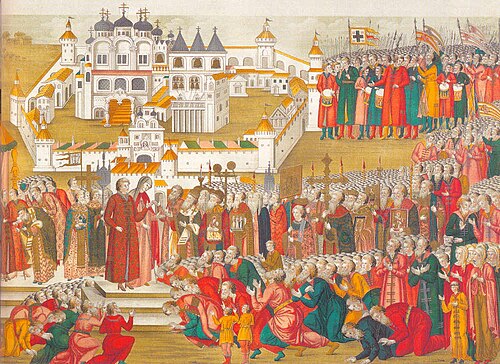
ロマノフ家の運命は、1605年6月のゴドゥノフ王朝の崩壊とともに再び劇的に変化した。反ゴドゥノフ派の元指導者であり、最後の正統なツァーリの従兄弟であったフィラレート・ロマノフは、動乱の時代にリューリク朝の遺産と王位を主張しようとした複数の偽者によって認められようとした。偽ドミトリー1世は彼をロストフ・ナ・ドヌの府主教にし、偽ドミトリー2世は彼を総主教の地位にまで高めた。[ 17 ]彼の兄弟イヴァン・ロマノフは、ロシアのヴァシリー4世の打倒に参加した。[ 18 ] 1612年にポーランド軍 がモスクワから追放されると、ゼムスキー・ソボルは数人のリューリク朝とゲディミニア朝の公にロシアの王冠を提供したが、全員がその栄誉を辞退した。[ 11 ]結局、フィラレートの16歳の息子ミハイル・ロマノフがコサックと貴族の間の妥協候補として選ばれ、1613年2月13日に皇帝に即位した。[ 19 ]
コストロマのイパチェフ修道院に住んでいたミハイルは、ロシアの王位を打診されると、恐怖と絶望のあまり泣き崩れた。ゼムスキー・ソボルから派遣された使節団に説得されてようやく王位を受け入れることになり、 7月11日に戴冠した。[ 20 ]王位の不安定さを感じたミハイルは、最後のリューリク朝ツァーリとの繋がりを強調し[ 21 ]、君主制の神聖さを再確立しようと試み、重要な問題すべてについてゼムスキー・ソボルとボヤールに助言を求めた。この戦略は成功した。[ 22 ]


ミハイルは1645年に唯一生き残った息子アレクセイに後を継がれ、数々の困難を乗り越えて静かに国を統治した。1676年にアレクセイが亡くなると、最初の妻マリア・イリイニチナ・ミロスラフスカヤとの間の子供たち(フョードル3世、ソフィア・アレクセーエヴナ、イヴァン5世)と、2番目の妻ナタリヤ・キリロヴナ・ナリシキナとの間の息子、後のピョートル大帝の間で王朝の争いが起こった。ピョートルは1682年から1725年に亡くなるまで統治した。[ 7 ]数々の戦争に勝利し、ツァーリ国をヨーロッパの主要国となる巨大な帝国へと拡大した。彼は文化革命を主導し、伝統的で中世的な社会政治システムの一部を近代的で科学的、ヨーロッパ志向の合理主義的なシステムに置き換えた。[ 23 ]
New dynastic struggles followed the death of Peter. His only son to survive into adulthood, Tsarevich Alexei, did not support Peter's modernization of Russia. He had previously been arrested and died in prison shortly thereafter. Near the end of his life, Peter managed to alter the succession tradition of male heirs, allowing him to choose his heir. Power then passed into the hands of his second wife, Empress Catherine, who ruled until her death in 1727.[7]Peter II, the son of Tsarevich Alexei, took the throne but died in 1730, ending the Romanov male line.[11] He was succeeded by Anna I, daughter of Peter the Great's half-brother and co-ruler, Ivan V. Before she died in 1740 the empress declared that her grandnephew, Ivan VI, should succeed her. This was an attempt to secure the line of her father, while excluding descendants of Peter the Great from inheriting the throne. Ivan VI was only a one-year-old infant at the time of his succession to the throne, and his parents, Grand Duchess Anna Leopoldovna and Duke Anthony Ulrich of Brunswick, the ruling regent, were detested for their German counselors and relations. As a consequence, shortly after Empress Anna's death, Elizabeth Petrovna, a legitimized daughter of Peter I, managed to gain the favor of the populace and dethroned Ivan VI in a coup d'état, supported by the Preobrazhensky Regiment and the ambassadors of France and Sweden. Ivan VI was murdered in 1764 while imprisoned, and his parents died from illness during their captivity.[24]

ロシアのホルシュタイン=ゴットルプ家はロマノフ姓を保持し、アンナ・ペトロヴナ(ピョートル1世の2番目の妻との間の長女)を通してピョートル大帝からの母系血統を強調した。 [ 11 ] 1742年、ロシアのエリザベータ女帝はアンナの息子で甥のピョートル・フォン・ホルシュタイン=ゴットルプをサンクトペテルブルクに連れてきて、彼を後継者と宣言した。やがて彼女は彼をドイツの王女、アンハルト=ツェルプストのゾフィーと結婚させた。[ 7 ] 1762年、エリザベータ女帝の死後まもなく、結婚時にロシア名エカチェリーナを名乗ったゾフィーは、愛人のグリゴリー・オルロフの助けを借りて不人気な夫を打倒した。彼女はエカチェリーナ大帝として君臨した。1796年に母の後を継いだエカチェリーナの息子、パーヴェル1世[ 7 ]は、ピョートル大帝の曾孫であることを特に誇りに思っていたが、彼の母の回想録は、パーヴェルの実父は夫のピョートルではなく、実際には彼女の愛人セルゲイ・サルティコフであったことを示唆している可能性がある。継承争いから生じる危険を痛切に認識していたパーヴェルは、ロマノフ家のための家法、いわゆるパウリヌス法(ヨーロッパで最も厳格な法律の一つ)を布告し、半サリカ長子相続制を王位継承の規則として確立し、君主と王朝、君主の配偶者と近親者に正教の信仰を要求した。その後、アレクサンドル1世は、1820年の弟で後継者の貴賤結婚に対応して[ 7 ]、ロシアのすべての王朝の男系における配偶者は同等の出自(つまり、王家または主権王朝に生まれた者)でなければならないという要件を追加した。
Paul I was murdered in his palace in Saint Petersburg in 1801. Alexander I succeeded him on the throne and later died without leaving a son. His brother, crowned Nicholas I, succeeded him on the throne[11] in 1825. The succession was far from smooth, however, as hundreds of troops took the oath of allegiance to Nicholas's elder brother, Constantine Pavlovich who, unbeknownst to them, had renounced his claim to the throne in 1822, following his marriage. The confusion, combined with opposition to Nicholas's accession, led to the Decembrist revolt.[7] Nicholas I fathered four sons, educating them for the prospect of ruling Russia and for military careers, from whom the last branches of the dynasty descended.
Alexander II, son of Nicholas I, became the next Russian emperor in 1855, in the midst of the Crimean War. While Alexander considered it his charge to maintain peace in Europe and Russia, he believed only a strong Russian military could keep the peace. By developing the Imperial Russian Army, giving increased autonomy to Finland, and freeing the serfs in 1861, he gained much popular support for his reign.
しかし、人気にもかかわらず、1860年代半ばまでに彼の家庭生活は崩壊し始めた。1864年、長男で後継者である皇太子ニコライが急死した。結核を患っていた妻のマリア・アレクサンドロヴナ皇后は、多くの時間を海外で過ごした。アレクサンドルは最終的に愛人であるエカテリーナ・ドルゴルコワ公女に目を向けた。1880年に妻が亡くなるとすぐに、彼はドルゴルコワと貴賤結婚をした。[ 11 ]彼が子供たちを嫡出子と認めたこと、そして新しい妻を皇后に戴冠させることを検討しているという噂は、王朝内に緊張を引き起こした。特に、大公女たちは、妻の存命中にアレクサンドルとの間に何人もの子供を産んだ女性に服従するという見通しに憤慨した。しかし、キャサリン王女が地位を昇格する前に、1881年3月13日、アレクサンドルはイグナツィ・フリニエヴィエツキが投げた手製の爆弾で暗殺された。 スラヴ愛国心、文化復興、汎スラヴ主義の思想は今世紀後半に重要性を増し、コスモポリタン王朝よりもロシア的な王朝への期待が高まった。 他の支配的なスラヴ王朝や正教王朝(ギリシャ、モンテネグロ、セルビア)のメンバーとの結婚がいくつか行われた。[ 11 ] 20世紀初頭には、2人のロマノフ王女がロシアの高位貴族と結婚することが許されたが、1850年代までは事実上すべての結婚がドイツの王子とのものであった。[ 11 ]

アレクサンドル2世の後を継いだのは、息子のアレクサンドル3世だった。ロマノフ朝最後の皇帝から2番目のこの皇帝は、ロシアで保守的な改革を主導した。王位継承は期待されていなかったため、兄のニコライの死後になって初めて国政について教育を受けた。外交訓練の不足は、彼自身の政治だけでなく、息子のニコライ2世の政治にも影響を与えた可能性がある。アレクサンドル3世は体格が立派で、身長が高いだけでなく(資料によっては1.93メートル、6フィート4インチ)、体格も大きく、かなりの力を持っていた。彼の髭は昔の皇帝を彷彿とさせ、無骨な権威のオーラを醸し出し、ある者には畏敬の念を抱かせ、ある者には疎外感を与えた。アレクサンドルは父の運命を恐れ、ロシアの専制政治を強化した。より自由主義的だったアレクサンドル2世が推し進めた改革の一部は撤回された。
Alexander had inherited not only his dead brother's position as Tsesarevich, but also his brother's Danish fiancée, Princess Dagmar. Taking the name Maria Feodorovna upon her conversion to Orthodoxy, she was the daughter of King Christian IX of Denmark and the sister of the future kings Frederik VIII and George I of Greece, as well as of Britain's Queen Alexandra, consort of Edward VII.[7] Despite contrasting natures and backgrounds, the marriage was considered harmonious, producing six children and acquiring for Alexander the reputation of being the first tsar not known to take mistresses.
His eldest son, Nicholas, became emperor upon Alexander III's death due to kidney disease at age 49 in November 1894. Nicholas reputedly said, "I am not ready to be tsar...." Just a week after the funeral, Nicholas married his fiancée, Alix of Hesse-Darmstadt, a favorite grandchild of Queen Victoria of the United Kingdom. Though a kind-hearted man, he tended to leave intact his father's harsh policies. For her part, the shy Alix, who took the name Alexandra Feodorovna, became a devout convert to Orthodoxy as well as a devoted wife to Nicholas and mother to their five children, yet avoided many of the social duties traditional for Russia's tsarinas.[7] Seen as distant and severe, unfavorable comparisons were drawn between her and her popular mother-in-law, Maria Fyodorovna.[7] When, in September 1915, Nicholas took command of the army at the front lines during World War I, Alexandra sought to influence him toward an authoritarian approach in government affairs even more than she had done during peacetime. His well-known devotion to her injured both his and the dynasty's reputation during World War I, due to both her German origin and her unique relationship with Rasputin, whose role in the life of her only son was not widely known. Alexandra was a carrier of the gene for haemophilia, inherited from her maternal grandmother, Queen Victoria.[7] Her son, Alexei, the long-awaited heir to the throne, inherited the disease and suffered agonizing bouts of protracted bleeding, the pain of which was sometimes partially alleviated by Rasputin's ministrations. Nicholas and Alexandra also had four daughters: the Grand Duchesses Olga, Tatiana, Maria and Anastasia.[7]
The six crowned representatives of the Holstein-Gottorp-Romanov line were: Paul (1796–1801), Alexander I (1801–1825), Nicholas I (1825–1855), Alexander II (1855–1881), Alexander III (1881–1894), and Nicholas II (1894–1917).[11]
Constantine Pavlovich and Michael Alexandrovich, both morganatically married, are occasionally counted among Russia's emperors by historians who observe that the Russian monarchy did not legally permit interregnums. Yet neither was crowned; Constantine renounced the throne before his brother's death, and Michael deferred his acceptance of the throne, effectively ending the monarchy.

The February Revolution of 1917 resulted in the abdication of Nicholas II in favor of his brother Grand Duke Michael Alexandrovich.[7] The latter declined to accept imperial authority save to delegate it to the Provisional Government pending a future democratic referendum, effectively terminating the Romanov dynasty's rule over Russia.
After the February Revolution, Nicholas II and his family were placed under house arrest in the Alexander Palace. While several members of the imperial family managed to stay on good terms with the Provisional Government and were eventually able to leave Russia, Nicholas II and his family were sent into exile in the Siberian town of Tobolsk by Alexander Kerensky in August 1917. In the October Revolution of 1917 the Bolsheviks ousted the Provisional Government. In April 1918, the Romanovs were moved to the Russian town of Yekaterinburg, in the Urals, where they were placed in the Ipatiev House. Here, on the night of 16–18 July 1918, the entire Russian Imperial Romanov family, along with several of their retainers, were executed by Bolshevik revolutionaries, most likely on the orders of Vladimir Lenin.

Late on the night of 16 July, Nicholas, Alexandra, their five children and four servants were ordered to dress quickly and go down to the cellar of the house in which they were being held. There, the family and servants were arranged in two rows for a photograph they were told was being taken to quell rumors that they had escaped. Suddenly, a dozen armed men burst into the room and gunned down the imperial family in a hail of gunfire. Those who survived the shooting were stabbed to death.
The remains of Nicholas, Alexandra and three of their children were excavated in a forest near Yekaterinburg in 1991 and positively identified two years later using DNA analysis. The Tsesarevich Alexei and one Romanov daughter were not accounted for, fueling the persistent legend that Anastasia, the youngest Romanov daughter, had survived the execution of her family. Of the several "Anastasias" that surfaced in Europe in the decade after the Russian Revolution, Anna Anderson, who died in the United States in 1984, was the most convincing. In 1994, however, scientists used DNA testing to prove that Anna Anderson was not the tsar's daughter but a Polish woman named Franziska Schanzkowska.[25]
Initially, gunmen shot at Nicholas who immediately fell dead as a result of multiple bullet wounds. Then the dark room where the family was held filled with smoke and dust from the spray of bullets. With limited visibility, the gunmen shot blindly, often hitting the ceiling and walls, creating more dust and debris. As a result of this many of the gunmen themselves were injured. Alexandra was soon shot in the head by military commissar Peter Ermakov and was killed. It was not until after the room had been cleared of smoke that the shooters re-entered to find the remaining imperial family still alive and uninjured. Maria attempted to escape through the doors at the rear of the room, leading to a storage area, but the doors were nailed shut. The noise produced as she rattled the doors attracted the attention of Ermakov. Some of the family were shot in the head, but several of the others, including the young and frail tsarevich, would not die either from multiple close-range bullet wounds or bayonet stabs. The gunmen then proceeded to shoot each family member once again. Even so, two of the daughters were still alive 10 minutes later, and were then bludgeoned to death with the butt of a rifle. Later it was discovered that the bullets and bayonet stabs had been partially blocked by diamonds sewn into the children's clothing.[26]
Following the murder of the Romanov family, the Bolsheviks made several attempts to dispose of the bodies. Initially the bodies were to be thrown down a mineshaft; however, the location of the disposal site was revealed to locals, causing them to change the location. Instead of a burial, the Bolsheviks decided to burn two of the corpses of the former royal family. Burning the corpses proved to be difficult as it took significant time, so the group resorted to disfiguring the pair with acid. In a rush, the Bolsheviks threw nine additional bodies into a grave and covered them with acid as well.
The bodies of the Romanovs were then hidden and moved several times before being interred in an unmarked pit where they remained until the summer of 1979 when amateur enthusiasts disinterred and re-buried some of them, and then decided to conceal the find until the fall of the USSR. In 1991 the grave site was excavated and the bodies were given a state funeral under the nascent democracy of post-Soviet Russia, and several years later DNA and other forensic evidence was used by Russian and international scientists to make accurate identifications.[27]
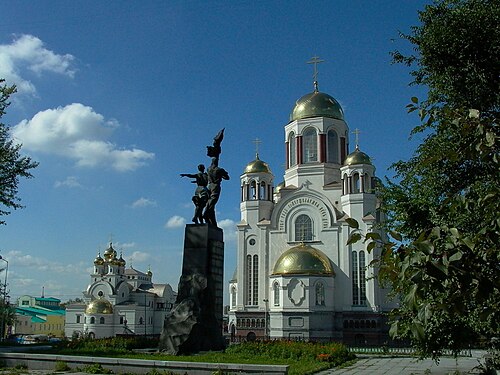
The Ipatiev House has the same name as the Ipatiev Monastery in Kostroma, where Mikhail Romanov had been offered the Russian Crown in 1613. The large memorial church "on the blood" has been built on the spot where the Ipatiev House once stood.
Nicholas II and his family were proclaimed passion-bearers by the Russian Orthodox Church in 2000. In Orthodoxy, a passion-bearer is a saint who was not killed because of his faith, like a martyr; but who died in faith at the hand of murderers.

In the mid-1970s, Dr. Alexander Avdonin discovered the mass grave containing the remains of Nicholas II, Alexandra Feodorovna, and three of five Romanov children. The remains were found near Old Koptyaki road in Yekaterinburg, Russia. The grave contained 44 heavily degraded bone and tooth fragments. Avdonin released his discovery following the collapse of the Soviet Union in 1991 prompting investigation by the Russian government.[27]
The area where the remains were found was near the old Koptyaki Road, under what appeared to be double bonfire sites about 70 meters (230 ft) from the mass grave in Pigs Meadow near Yekaterinburg.[27] The archaeologists stated that the bones were from a boy who approximately between the ages of 10 and 13 years at the time of his death and of a young woman who was between the ages of 18 and 23 years old.[28] At the time, Anastasia was 17 years old while Maria was 19 years. Their brother Alexei was just a few weeks away from turning 14. Alexei's elder sisters Olga and Tatiana were 22 and 21 years old at the time of the murder respectively. The bones were found using metal detectors and metal rods as probes. Also, striped material was found that appeared to have been from a blue-and-white striped cloth; Alexei commonly wore a blue-and-white striped undershirt.
In mid-2007, a Russian archaeologist announced a discovery by one of his workers. The excavation uncovered the following items in the two pits which formed a "T":
Geneticists used a combination of autosomal STR and mtDNA sequencing to detect relationships between the family members' remains. Using a DNA sample from Prince Philip, Duke of Edinburgh, a grand nephew of Alexandra, scientists matched his DNA to her and her children's remains found in the mass grave. The investigation concluded that Alexei and one Romanov daughter were missing. Experts continue to debate which daughter was missing from the grave; those from the United States believe the missing child to be Anastasia, while those from Russia believe it to be Maria.[29] However, "conspiracy theories"[30] persisted throughout the 20th century, with some authors still contending that "somehow the real Anastasia, Maria, or perhaps Aleksei, might have survived the Russian Revolution"[31] even after the discovery of the bodies and the confirmation of their identities was made public. Additionally, despite their discovery in 2007, the remains of the two bodies found in the separate grave did not "receive a proper burial due to the Russian Orthodox Church's unsubstantiated doubts about their authenticity."[31]
As for Nicholas II, scientists used mtDNA heteroplasmy using samples from Princess Xenia Cheremeteff Sfiri and the Duke of Fife. In the early 1990s, considerable controversy surrounded the accuracy of mtDNA heteroplasmy for DNA testing particularly for distant relatives. In an attempt to refine the results of the investigation, Russian authorities exhumed the remains of Nicholas II's brother, George Alexandrovich. George's remains matched the heteroplasmy of the remains found in the grave, indicating that they did in fact belong to Tsar Nicholas II.
After the bodies were exhumed in June 1991,[32] they remained in laboratories until 1998, while there was a debate as to whether they should be reburied in Yekaterinburg or St. Petersburg. A commission eventually chose St. Petersburg. The remains were transferred with full military honor guard and accompanied by members of the Romanov family from Yekaterinburg to St. Petersburg. In St. Petersburg remains of the imperial family were moved by a formal military honor guard cortege from the airport to St Petersburg's Saints Peter and Paul Cathedral where they (along with several loyal servants who were killed with them) were interred in a special chapel near the tombs of their ancestors. At the cathedral, the remaining Romanov family hosted a formal funeral for Tsar Nicholas II attended by many relatives and representatives from nations worldwide.[33]
On 18 July 1918, the day after the killing at Yekaterinburg of the tsar and his family, members of the extended Russian imperial family were killed near Alapayevsk by Bolsheviks. They included: Grand Duke Sergei Mikhailovich of Russia, Prince Ioann Konstantinovich of Russia, Prince Konstantin Konstantinovich of Russia, Prince Igor Konstantinovich of Russia and Prince Vladimir Pavlovich Paley, Grand Duke Sergei's secretary Varvara Yakovleva, and Grand Duchess Elisabeth Feodorovna, a granddaughter of Queen Victoria and elder sister of Tsarina Alexandra. Following the 1905 assassination of her husband, Grand Duke Sergei Alexandrovich, Elisabeth Feodorovna had ceased living as a member of the Imperial family and took up life as a serving nun, but was nonetheless arrested and slated for death with other Romanovs.[34] They were thrown down a mine shaft into which explosives were then dropped, all being left to die there slowly.[35]

The bodies were recovered from the mine by the White Army in 1918, who arrived too late to rescue them. Their remains were placed in coffins and moved around Russia during struggles between the White and the opposing Red Army. By 1920, the coffins were interred in a former Russian mission in Beijing, now beneath a parking area. In 1981 Grand Duchess Elisabeth was canonized by the Russian Orthodox Church Outside of Russia, and in 1992 by the Moscow Patriarchate. In 2006, representatives of the Romanov family were making plans to re-inter the remains elsewhere.[36] The town became a place of pilgrimage to the memory of Elisabeth Fyodorovna, whose remains were eventually re-interred in Jerusalem.
On 13 June 1918, Bolshevik revolutionary authorities killed Grand Duke Michael Alexandrovich of Russia and Nicholas Johnson (Michael's secretary) in Perm.[37] Their bodies have never been found.[38]
The exiled Grand Duke Nicholas Konstantinovich of Russia died on 26 January 1918, with some rumors claiming he was killed by the Bolsheviks.[39] His son Prince Artemy Nikolayevich Romanovsky-Iskander died on 8 October 1935 in Paris.[40]
In January 1919, revolutionary authorities killed Grand Dukes Dmitry Konstantinovich, Nikolai Mikhailovich, Paul Alexandrovich and George Mikhailovich, who had been held in the prison of the Saint Peter and Paul Fortress in Petrograd. The four Grand Dukes were buried in a mass grave in the fortress, though Dmitry Konstantinovich's body was collected by his former adjutant, rolled up in a rug and taken away for a private burial in the garden of a house in Petrograd, where he remains to this day.[41]
In 1919, Maria Feodorovna, widow of Alexander III, and mother of Nicholas II, managed to escape Russia aboard HMS Marlborough, which her nephew, King George V of the United Kingdom, had sent to rescue her, at the urging of his own mother, Queen Alexandra, who was Maria's elder sister. After a stay in England with Queen Alexandra, she returned to her native Denmark, first living at Amalienborg Palace, with her nephew, King Christian X, and later, at Villa Hvidøre. Upon her death in 1928, her coffin was placed in the crypt of Roskilde Cathedral, the burial site of members of the Danish royal family.
In 2005, the coffin with her remains was moved to the Peter and Paul Fortress to be buried beside that of her husband. The transfer of her remains was accompanied by an elaborate ceremony at Saint Isaac's Cathedral officiated by Patriarch Alexy II of Moscow. Descendants and relatives of the Dowager Empress attended, including her great-grandson Prince Michael Andreevich, Princess Catherine Ivanovna of Russia, the last living member of the Imperial Family born before the fall of the dynasty,[42] and Prince Dmitri and Prince Nicholas Romanov.
ロシアからの脱出に成功した亡命者の中には、マリア・フョードロヴナの二人の娘、クセニア・アレクサンドロヴナ大公女とオリガ・アレクサンドロヴナ大公女、それぞれの夫であるアレクサンドル・ミハイロヴィチ大公とニコライ・クリコフスキー大公、そしてその子供たち、さらにクセニアの二人の長子の配偶者と孫娘も含まれていた。クセニアは母親がデンマークに帰国した後もイギリスに留まったが、母親の死後、オリガは夫とともにカナダに移住し[ 43 ]、姉妹はともに1960年に亡くなった。ニコライ2世の叔父であるウラジーミル大公の未亡人であるマリア・パヴロヴナ大公女と、その子供たちであるキリル、ボリス、アンドレイ大公、そしてキリルの妻ヴィクトリア・メリタと子供たちもロシアからの脱出に成功した。ニコライ2世の従兄弟であるドミトリー・パヴロヴィチ大公は、グリゴリー・ラスプーチンの殺害に関与したとして1916年にコーカサス地方に追放され、ロシアからの脱出に成功した。第一次世界大戦中にニコライ2世が指揮を執る前のロシア軍最高司令官であったニコライ・ニコラエヴィチ大公は、弟のピョートル大公、姉妹である妻のアナスタシア大公女とミリツァ大公女、そしてピョートルの子供たち、婿、孫娘とともに国外に逃亡した。
コンスタンチン・コンスタンチノヴィチの未亡人エリザベータ・マヴリキエヴナは、娘のヴェラ・コンスタンチノヴナと息子のゲオルギー・コンスタンチノヴィチ、孫の フセヴォロド・イヴァノヴィチ公爵と孫娘のエカテリーナ・イヴァノヴナ公女とともにスウェーデンへ逃れた。もう一人の娘タチアナ・コンスタンチノヴナも、子供のナターシャとテイムラズ、そして叔父の副官アレクサンドル・コロチェンゾフとともにルーマニアを経てスイスへ逃れた。ガヴリール・コンスタンチノヴィチは投獄された後、パリへ逃亡した。
イオアン・コンスタンチノヴィチの妻、エレナ・ペトロヴナは、アラパエフスクとペルミで投獄された後、スウェーデンとフランスのニースに脱出した。
ギリシャ王太后であり、夫の死後ロシアに帰国していたロシアのオリガ・コンスタンティノヴナは、デンマーク大使館の助けを借りてスイスへ逃れることができた。彼女の娘でゲオルギー・ミハイロヴィチの妻であるマリア・ゲオルギエヴナは、戦争勃発当時、娘のニーナとクセニアと共にイギリスで休暇を過ごしており、ロシアへは戻らないことを選択した。
革命後、ロマノフ家の生存者に関する報告や、廃位された皇帝ニコライ2世の家族の一員であるとする個人による根拠のない主張が数多くあり、最も有名なのはアンナ・アンダーソンである。しかしながら、確かな調査により、エカテリンブルクのイパチェフ邸に囚われていたロマノフ家の人々は全員殺害されたことが確認されている。[ 44 ] [ 27 ]
アレクサンドル2世の男系孫であるキリル・ウラジーミロヴィチ大公は、廃位されたロシア帝室の当主の地位を主張し、継承順位上位のロマノフ家の人々が全員殺害されたという証拠が決定的なものと思われた1924年に、僭称者として「全ロシアの皇帝兼専制君主」の称号を名乗った。[ 45 ]キリルの後を継いだのは、ムフラニ公女レオニダ・バグラチオンと結婚した唯一の息子ウラジーミル・キリロヴィチである。 [ 7 ]ウラジーミルの唯一の子供はマリア・ウラジーミロヴナ(1953年生まれ)で、プロイセンのフランツ・ヴィルヘルム王子との結婚でゲオルギー・ミハイロヴィチという子供を一人もうけた。[ 46 ] 1991年以来、旧ロシア帝位継承は、主に王朝の結婚の有効性に関する意見の相違により、争われている。[ 47 ] 1992年4月21日にウラジーミル・キリロヴィチが死去すると、娘のマリアは、ロマノフ家のパウリン法によれば、自分が皇室最後の男性王朝の唯一の子であるという理由で、ロシア皇室の当主として後継者になると主張した。パウリン法は、他の支配家またはメディア化された家系との対等な結婚から生まれた子にのみ継承権を認めていた。[ 48 ]それ以来、彼女の息子ゲオルギー・ミハイロヴィチはイタリア国民レベッカ・ベッタリーニと貴賤結婚し、[ 49 ] [ 50 ]彼と彼の母親が(彼らの主張によれば)皇室の最後の残されたメンバーとなった。[ 51 ]
故ニコライ・ロマノフ王子の権利を支持する意見もある。ニコライ王子の弟であるディミトリ・ロマノフ王子は、ロマノフ家の次の男子相続人であり、その後アンドレイ・ロマノフ王子、そしてその息子のアレクシス・ロマノフに継承された。[ 52 ] [ 3 ] [ 4 ] [ 5 ]彼らは皆、不平等な結婚から生まれ、 1979年に設立されたロマノフ家協会の会員であるか、かつて会員であった。この協会は、ロシア皇帝パーヴェル1世の現存する男子子孫のほとんど(マリア・ウラジーミロヴナとその息子を除く)からなる私的な組織であり、家族による王朝の主張はなされるべきではないことを公に認め、ロシア国民が選ぶいかなる形態の政府も支持することを公式に約束している。[ 53 ]
あるいは、ライニンゲン公カール・エミヒ(ウラジーミル・キリロヴィチの妹マリアを通じて大甥にあたる)は、2013年から廃止されたロシアの帝位継承権を主張している。[ 54 ]彼と支持者たちは、マリア・ウラジーミロヴナの両親の結婚はパウリン法に違反していたと主張している。彼らは、バグラチオン=ムフラニ家は主権を有しておらず、 1911年にロシアのタチアナ・コンスタンティノヴナ公女とコンスタンチン・バグラチオン=ムフラニスキー公が結婚した当時、ニコライ2世によって王朝結婚の目的で平等と認められていなかったと主張している。これは、レオニダ公女とウラジーミル・キリロヴィチ大公の結婚の37年前のことである。[ 54 ]したがって、ロシア君主党は、ウラジーミルの近親者(彼の娘を除く)として、カール・エミヒをロシア帝位継承者として認めている。なぜなら、彼と彼の妻は2013年6月1日にルター派から東方正教会に改宗し、彼の即位を可能にしたからである。[ 55 ]
ロシア皇帝一族は、ニコライ1世の息子たちの名前をとって4つの主要な分家に分かれた。
ロシア帝国の皇室法は、皇族の財産に関する権利を規定していた。様々な資料には、皇帝の子孫が受け取る権利があった収入や一時金について、それぞれ異なる金額が記載されている。
1912 年版のSvod Zakonov (ロシア帝国の公式法律集) には、1886 年 7 月 2 日/14 日に承認された改訂版の皇族法が再録されています。これは、誰が称号の資格を持ち、支援がどのように構成されているかを規定しています。[ 56 ]標準的なロシアの参考書である Brockhaus & Efron 百科事典 (1890 年代) には、当時有効だった皇族の子女と孫に対する行政手当の額がまとめられています。[ 57 ] [ 58 ]これらの資料は、ミハイル・ドルビロフの 2023 年の査読付き研究「統治家の管理: 王族、官僚、そして 1886 年ロシア帝国皇族法の出現」で検討されており、1886 年の「財政規範」(RGIA)セクションを参照しながら、1886 年以降の皇族に対する財政規定を詳細に検討しています。[ 59 ] [ 60 ]これらの資料は、1886年から1917年の期間におけるロマノフ一族全体の年金および金銭的権利に関する以下のデータを提供している。
Following the Russian Revolution, the reputed size of the deposed Emperor's personal fortune was subject to various rumours and estimates, many of which were likely exaggerated. As Emperor of All The Russias, and an autocrat, the resources under his command were virtually incalculable. However, the vast majority of this was owned by the state as crown property; the Romanov family's personal wealth was only a fraction of this. As monarch, the income of Nicholas was 24 million gold roubles per annum: this derived from a yearly allowance from the treasury, and from the profits of crown farmland.[61] From this income, he had to fund staff, the upkeep of imperial palaces and imperial theatres, annuities for the royal family, pensions, bequests, and other outgoings; consequently "before the end of the year, the Tsar was usually penniless; sometimes he reached this embarrassing state by autumn."[61] According to the Grand Marshal of the Court, Count Paul Benckendorff, the family's total financial resources amounted to between 12.5 and 17.5 million roubles.[62] As a comparison, Prince Felix Yusupov estimated his family's worth in real estate holdings alone as amounting to 50 million gold roubles.[63]
20世紀初頭のロマノフ王朝の財政をめぐる謎と噂については、ニコライ2世の義理の兄弟(そして又従兄弟)であるアレクサンドル・ミハイロヴィチ大公の1932年の回顧録『かつて大公だった』で詳しく取り上げられている。[ 64 ]アレクサンドル・ミハイロヴィチは、第一次世界大戦前のロシア皇帝の収入は主に3つの源泉から得られていたと主張した。
アレクサンドル・ミハイロヴィチは、第一次世界大戦以前のロシア皇帝の年間総収入は1,000万~1,200万ドルと推定した。これらの収入源に加え、王朝の「凍結」資産(宝石や貴石などの蓄積)は、20世紀初頭には推定8,000万ドルの価値があった。皇帝はこの年間収入から、宮廷の維持費、複数の邸宅の維持費、そして皇族に支給される年俸を賄う必要があった。
他の情報源によると、各大公に支払われた年金は 280,000 ルーブルであったとされ[ 65 ] 、大公妃は出生時から 50,000 ルーブルの年金を受け取り、成人すると 100,000 ルーブルに増加し、結婚したすべての大公妃と大公には 1000,000 ルーブルの一時金が支払われたとされています[ 66 ] 。ロシア帝国の収入に関する引用されている数字のばらつきは、 19 世紀から 20 世紀初頭にかけてのロシア ルーブルと他の主要通貨との為替レートの変動によりさらに複雑化している可能性があります。19 世紀後半のルーブルと米ドルおよび英ポンドとの概算為替レートは、19 世紀後半には 2:1 ドル、10:1 ポンドでした。 1914年から1917年の期間には、これは3ルーブル/ドル/ドル、15ルーブル/ポンド/ポンドまで下落した。[ 67 ] [ 68 ]
アレクサンドル・ミハイロヴィチ大公は、皇帝がロンドンのマーチャントバンクに投資していたとよく言われる2,000万ポンドの私財が第一次世界大戦中に枯渇したとも主張した。アレクサンドル2世の治世以来ロンドンに保管されていたとされるこの財産は、「戦争中(1915年~1917年)に皇室が後援する病院やその他の様々な慈善事業を支援するために全額使われた」[ 64 ] : 155アレクサンドル・ミハイロヴィチはまた、回顧録の中で、1914年に「皇帝の命令に反して行動した、過度に慎重な宮廷大臣」[ 64 ] : 162 が、ニコライ2世の5人の子供に支払われる年俸から保有していた約700万ルーブルをベルリンに送金したと主張した。その結果、ロマノフ家の財産のこの部分は、 1920年代初頭にワイマール共和国で発生したハイパーインフレによって失われた。 [ 64 ]: 162
宝物のほとんどはロシアのダイヤモンド基金に収蔵されており、博物館で最も高価な展示品となっている。[ 69 ]ロマノフ家が在位中に収集した宝石類は一般に「ロシアの王冠の宝石」と呼ばれており[ 70 ]、公式の国家の宝飾品だけでなく、ロマノフ家の支配者とその家族が身につけていた個人的な宝飾品も含まれている。皇帝が退位し、その家族が処刑された後、宝石類は新しいソビエト政府の所有となった。[ 71 ]コレクションの中から選りすぐりの品々が、1927年3月にロンドンのクリスティーズで競売にかけられた。 [ 72 ]残りのコレクションは現在、モスクワのクレムリン武器庫で展示されている。[ 73 ]
2009年8月28日、スウェーデンの公共ニュースメディアは、ウラジーミル大公妃が所有していた宝石で覆われた60個以上のシガレットケースとカフスボタンのコレクションがスウェーデン外務省のアーカイブで発見され、ウラジーミル大公妃の子孫に返還されたと報じた。宝石は、 1918年11月にメクレンブルク=シュヴェリーン公妃マリーによってサンクトペテルブルクのスウェーデン大使館に保管のために預けられたとされている。宝石の価値は2000万スウェーデンクローナ(約260万米ドル)と推定されている。[ 74 ]


{{cite web}}: CS1メンテナンス: アーカイブサービスは非推奨になりました (リンク)検査により、アンダーソンは詐欺師であることが証明された。彼女はロマノフ家の一員ではなかった。代わりに、彼女のDNAはシャンツコフスカ家と一致した。