
Loading article…
| 人工授精 | |
|---|---|
 人間の人工授精の模式図 | |
| ICD-9-CM | 69.92 |
| メッシュ | D007315 |
人工授精は、性交以外の手段による体内受精を通じて妊娠を達成することを目的として、女性の子宮頸管または子宮腔に精子を意図的に導入することです。これは人間の不妊治療であり、乳牛(凍結牛精液を参照)や豚を含む動物の飼育では一般的な方法です。
人工授精では、生殖補助技術、精子提供、畜産技術が利用されることがあります。人工授精技術には、子宮頸管内授精 ( ICI ) と子宮内授精 ( IUI ) があります。第三者の配偶子が使用される場合、この手順は「補助授精」と呼ばれることがあります。
人間
歴史
人工授精の最初の記録は、 1790年にジョン・ハンターがリネン織物の妻を妊娠させたケースである。[1] [2]ドナーによる人工授精の最初の報告されたケースは1884年に発生した。フィラデルフィアの教授ウィリアム・H・パンコーストが「最も見栄えの良い」学生の精子を採取し、麻酔をかけた女性に無断で授精させた。[3] [4]このケースは25年後に医学雑誌で報告された。[5] 精子バンクは、アイオワ大学医学部の研究者ジェローム・K・シャーマンとレイモンド・バンジが行った研究により、1950年代にアイオワで開発され始めた。[6]
イギリスでは、英国の産科医メアリー・バートンが1930年代にドナーによる人工授精を提供する最初の不妊治療クリニックの一つを設立し、彼女の夫ベルトルト・ヴィースナーは何百人もの子どもをもうけた。[7] [8]
1980年代には、直接腹腔内授精(DIPI)が時折行われ、医師が手術の穴や切開を通して下腹部に精子を注入し、卵巣で卵母細胞を見つけるか、卵管口から生殖管に入った後に卵母細胞を見つける目的で行われました。[9] [10]
患者と配偶子提供者
人工授精に必要な精液を得るには複数の方法があり、人工授精で使用する精子は受精患者のパートナーから提供される場合もあれば、身元が判明している、あるいは判明していない精子提供者から提供される場合もあります。
人工授精技術は、もともとは妊娠に困難を抱える異性愛カップルの補助として主に使用されていましたが、この分野の技術、特にICSIの進歩により、そのようなカップルに対する人工授精の使用はほとんど不要になりました。しかし、カップルが男性パートナーの精子を使用した人工授精を使用しようとする理由はまだあります。そのようなカップルの場合、解決策として人工授精に頼る前に、医師は、カップルが満足のいく性交を行うことを妨げる要因など、自然に妊娠することを妨げているあらゆる身体的障害を取り除くために、関係する男性と女性の両方を検査する必要があります。カップルはまた、男性の精子の運動性、数、生存能力、および女性の排卵の成功を判断するために、不妊検査を受けます。これらの検査の結果、医師は人工授精の形態を推奨する場合としない場合があります。検査の結果、例えば、女性の免疫系がパートナーの精子を侵入分子として拒絶している可能性があることが判明するかもしれません。[11]子宮頸部の瘢痕、子宮内膜症による子宮頸管閉塞、または厚い頸管粘液など、子宮頸部に問題がある女性も、精子が受精するためには子宮頸部を通過する必要があるため、人工授精の恩恵を受ける可能性があります。
現在、人間の人工授精は、主に、男性パートナーがいないが自分の子供を持ちたい女性(レズビアン関係の女性や独身女性など)が性交の代わりとして利用されており、精子提供者の精子が使用される。さらに、卵子提供者が利用される場合もあり、その場合、受精患者は人工授精を利用して遺伝的に関係のない子供を妊娠する。その子供は、精子の入手方法に応じて、パートナー(いる場合)と関係があるかどうかはわからない。これは通常、年齢や健康上の懸念により自分の卵子を使用できない女性のための選択肢であり、体外受精によって行われる。[12]
患者とドナーにとっての障壁
国によっては、誰が精子を提供でき、誰が人工授精を受けることができるかを制限し、規制する法律がある。[13]自分が置かれている状況では人工授精が許可されていない管轄区域に住んでいる女性の中には、人工授精が許可されている別の管轄区域に旅行する人もいる。自然授精と比較すると、人工授精はより高価で侵襲性が高く、専門家の助けが必要になる場合がある。
準備
タイミングは重要です。受精のチャンスは卵子の放出からわずか 12 時間以内だからです。成功率を高めるために、女性の月経周期を注意深く観察します。排卵検査キット、超音波検査、血液検査、基礎体温検査、膣粘液の色や質感、子宮頸管の柔らかさなどを観察します。人工授精の成功率を高めるために、刺激周期を作り出す薬剤が使用されることもありますが、そのような薬剤を使用すると多胎出産の可能性も高まります。
精子は新鮮な状態でも洗浄済みの状態でも提供できます。[14]特定の状況では洗浄済みの精子が必要になります。運動精子の濃縮前と濃縮後の数がカウントされます。精子バンクの精子は一定期間凍結され隔離され、ドナーはサンプル採取の前後に検査され、伝染病に罹患していないことが確認されます。精子バンクの精子は、凍結、保管、輸送を補助する精液増量剤にも懸濁されます。
精子が個人提供者から直接提供される場合、または精子代理店を通じて提供される場合、精子は通常、冷凍ではなく新鮮な状態で提供され、隔離されません。このように提供された精子は、受精女性またはそのパートナーに直接提供されるか、特別に断熱された容器で輸送されることがあります。精子を凍結して保管するための独自の凍結装置を持っている提供者もいます。
テクニック

使用される精液は、新鮮、生、または冷凍のいずれかです。ドナー精子が精子バンクから提供される場合、それは常に隔離され凍結されており、使用前に解凍する必要があります。精子は、潤滑剤が精子の運動性を阻害する可能性があるため、潤滑剤なしで2〜3日間禁欲した後に提供されるのが理想的です。[15]卵子が放出されると、使用される方法に応じて、 精液が女性の膣、子宮、または子宮頸部に導入されます。
精子は「治療周期」内で 2 回挿入されることもあります。
子宮頸管内
子宮頸管内授精(ICI)は、性交中にペニスから膣内に自然に射精される現象を最も忠実に模倣した人工授精法です。痛みがなく、洗浄していない精液または生の精液を通常は針のない注射器で 子宮頸部の入り口から膣内に注入する、最も単純で簡単かつ最も一般的な人工授精法です。
ICI は、家庭で自己授精や医師による授精によって一般的に使用されています。ICI 授精で使用する精子は、精液を除去するために「洗浄」する必要がないため、個人提供者からの生の精液を使用できます。ICI または IUI 用に準備された精子バンクから提供された精液は、ICI に適しています。ICI は、オンラインで提供精子を購入する独身女性やレズビアン女性の間で人気の授精方法です。
ICIは人工授精の最も簡単な方法ですが、メタ分析ではIUIと比較して生児出生率に差がないことが示されています。[16]また、女性が個人的に行うこともできますが、パートナーがいる場合はパートナーの立ち会いのもとで行うことも、パートナーが行うこともできます。ICIは以前は多くの不妊治療センターで人工授精の方法として使用されていましたが、他のより信頼性の高い人工授精方法が利用可能になったため、この文脈での人気は衰えています。
ICI では、針のない注射器から空気が排出され、液化した精液で満たされます。この目的には、先端が広く丸みを帯びた特別設計の注射器を使用できます。さらに閉じ込められた空気は、プランジャーを前方に静かに押し出すことで除去されます。女性は仰向けに寝て、注射器を膣に挿入します。注射器を挿入する際は、先端が子宮頸部の入り口にできるだけ近くなるように注意する必要があります。この目的には膣鏡が使用され、精液が子宮頸部の入り口にできるだけ近くなるように、注射器の先端にカテーテルが取り付けられる場合があります。次に、プランジャーをゆっくりと前方に押し、注射器内の精液を膣の奥深くに静かに排出します。安全と最良の結果のためには、注射器をゆっくりと空にすることが重要です。この処置の目的は、膣内の精液の自然な沈着をできるだけ忠実に再現することであることを念頭に置いてください。注射器 (および使用する場合カテーテル) は、取り外す前に数分間そのままにしておくことができます。女性はオーガズムに達することができ、子宮頸部が精液のプールに「沈み込む」ことで、膣性交を忠実に再現し、成功率を向上させることができます。
受精後、受精可能な精子は、性交によって膣内に注入されたかのように、子宮頸管から子宮に、そしてそこから卵管へと自然に泳ぎ進みます。したがって、妊娠を促すために、女性は30分ほどじっと横たわっていることが推奨されます。
通常、1 周期中に 1 回の人工授精で十分です。同じ周期中にさらに人工授精を行っても、妊娠の可能性は上がらない可能性があります。
この過程では、通常の性用潤滑剤は使用しないでください。ただし、容易さと快適さを高めるために、特別な生殖能力用または「精子に優しい」潤滑剤を使用することができます。
専門家の立ち会いなしに自宅で行う場合、膣内の精子を子宮頸部に向けることはより困難であり、精子を具体的に子宮頸部の入り口に向けるよりも、膣が精液で「溢れる」ような効果になる可能性がある。この処置は「膣内授精」(IVI)と呼ばれることもある。[17]精子バンクから提供された精子は凍結されており、授精前に解凍しなければならない。ストロー自体の密封された端は切り離さなければならず、ストローの開いた端は通常、内容物が注射器に吸い込まれるように、注射器の先端にまっすぐに固定される。通常、複数のストローからの精子を同じ注射器で使用できる。新鮮な精液を使用する場合は、注射器に挿入する前に液化させるか、注射器に逆さまに詰める必要がある。
受胎キャップは受胎器具の一種で、授精後に膣に挿入され、数時間そのままにしておくことができる。この方法を使用すると、子宮頸管キャップが子宮頸管の入り口近くの膣内で精液を保持する間、女性は普段通りの活動を続けることができる。この方法の支持者は、妊娠の可能性が高くなると主張している。受胎器具の利点の 1 つは、新鮮で液化していない精液を使用できることである。男性はキャップ内に直接射精し、新鮮な精液が液化するのを待たずにすぐに膣に挿入することができるが、収集カップを使用することもできる。膣に精液を挿入するために他の方法を使用することができ、特に受胎キャップのさまざまな用途を伴う。これには、チューブが取り付けられた特別に設計された受胎キャップがあり、これを空の状態で膣に挿入し、その後液化した精液をチューブに注ぐことができる。これらの方法は、精液が可能な限り子宮頸部に近い場所に注入され、そこに留まって受精の可能性を高めるように設計されています。
子宮内
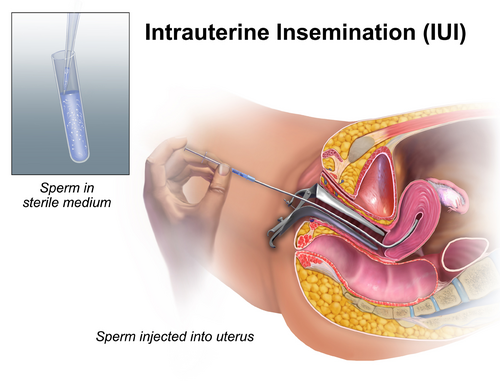
子宮内人工授精(IUI)では、洗浄した精子をカテーテルで子宮に直接注入します。この方法による授精では、精子は粘液層で覆われた子宮頸管を泳いで通過する必要がありません。この粘液層は精子の通過を遅らせ、多くの精子が子宮に入る前に死滅する可能性があります。ドナー精子は、ICI授精に使用する場合、粘液浸透性についてテストされることがあります。しかし、パートナーの精子が子宮頸管を通過できるかどうかはわかりません。このような場合、IUIを使用すると、より効率的に精子を送り込むことができます。一般的に、IUIは通常、ICIまたはIVIよりも効率的であると見なされています。したがって、ドナー精子を使用して妊娠を希望する独身女性やレズビアンの女性には、医学的な問題ではなく、男性パートナーがいないため人工授精が必要になることが多いため、IUIが選択肢となります。精子提供サービスを利用する受精者の数が多いため、IUI は現在不妊治療クリニックで最も人気のある受精方法です。「人工授精」という用語は、多くの場合、IUI 受精を意味するようになりました。
洗浄精子を使用することが重要だ。なぜなら、洗浄されていない精子はプロスタグランジンを含んでいるため、子宮のけいれんを引き起こし、精液が排出され、痛みを引き起こす可能性があるからだ。(プロスタグランジンは、月経中に子宮筋層を収縮させ、月経血を子宮から排出させる原因となる化合物でもある。)IUI後、女性がテーブルの上で15分間休むことは、妊娠率を高めるのに最適である。[18]
この技術を使用すると、ICI と同様に、性交後に起こるのと同じように、卵管の外側部分で自然に受精が起こります。
異性愛カップルの場合、子宮内人工授精を行う適応症は通常、中程度の男性因子、膣内で射精できないこと、および特発性不妊症です。子宮内人工授精前の短期間の射精禁欲は、より高い妊娠率と関連しています。[19]男性の場合、TMSは1mlあたり500万以上が最適です。[20]実際には、ドナー精子はこれらの基準を満たし、IUIはICIよりも効率的な人工授精法であり、一般的に成功率が高いため、不妊治療センターでドナー精子を使用する独身女性やレズビアンの場合、IUIが通常選択される授精手順です。レズビアンや独身女性は、自分自身の不妊問題を抱えている可能性が低く、ドナー精子を直接子宮に挿入できるようにすることで、妊娠する可能性が高くなることがよくあります。 2019年の研究では、IUIを受けたレズビアン女性と異性愛者の女性の妊娠率は同程度であることが示されました。しかし、排卵誘発(OI)を受けたレズビアン女性の多胎妊娠率は、自然周期のレズビアン女性と比較して有意に高いことが判明しました。[21]
ICIとは異なり、子宮内人工授精では通常、医師が施術を行う必要があります。要件の1つは、子宮卵管造影検査で少なくとも1本の透過性卵管があることが証明されることです。不妊期間も重要です。30歳未満の女性はIUIで妊娠する可能性が最も高くなります。有望な周期とは、hCG投与日に16 mmを超える卵胞が2つあり、エストロゲンが500 pg/mLを超える周期です。[20]しかし、ランダム化比較試験によると、着床時にGnRHアゴニストを投与しても、子宮内人工授精周期における妊娠結果が改善されないことがわかりました。[22]ヨーロッパの著名な私立クリニックの一つがデータを発表しました。多重ロジスティック回帰モデルは、精子の起源、母親の年齢、hCG投与日の卵胞数、卵胞破裂、および2回目の人工授精後に観察された子宮収縮の数が生児出生率と関連していることを示しました。 [23] 子宮内人工授精を行うための手順は次のとおりです。
- 軽度制御卵巣刺激法(COS):排卵を促す際に、同時に何個の卵子があるかを制御することはできません。そのため、超音波検査(同時に発育している卵胞の数を確認)で排卵量を確認し、希望する量のホルモンを投与する必要があります。
- 排卵誘発:排卵誘発剤と呼ばれる物質を使用します。
- 精液の受精能獲得: 洗浄および遠心分離、スイムアップ、または勾配。受精は受精後 1 時間以上経過してから行う必要があります。ドナー精液を使用する場合は、「洗浄精子」を精子バンクから直接購入することができます。または、「未洗浄精液」は、受精能獲得によって通常最低 500 万個の運動精子が残ることを条件に、IUI 受精を行う前に解凍して受精能獲得することができます。
- 黄体期サポート:子宮内膜のプロゲステロンが不足すると妊娠が終了してしまう可能性があります。これを避けるために、200 mg/日の微粉化プロゲステロンを膣から投与します。妊娠している場合は、このホルモンを妊娠 10 週目まで投与し続けます。
子宮内人工授精(IUI)の費用の内訳は、いくつかの要素から成ります。処置自体は、通常、保険なしで1サイクルあたり300ドルから1,000ドルの範囲です。[24]精子の費用は大きく異なり、精子バンクからの価格は1瓶あたり500ドルから1,000ドル以上です。[25]追加費用には、診察料、排卵誘発剤、超音波検査、血液検査などがあります。[24]
子宮内人工授精(IUI)を含む不妊治療に対する保険適用範囲は、かなり多様です。保険プランによっては費用の一部をカバーしてくれるところもありますが、不妊治療に対する金銭的支援を一切提供しないところもあります。保険適用範囲は、保険プラン、州の政策や規制、不妊の根本的な原因など、さまざまな要因によって異なります。いくつかの州では、保険会社に不妊治療に対する保険適用を義務付けています。[26]
IUI は、制御された卵巣過剰刺激法(COH)と併用することができます。IVF に進む前に卵巣を刺激するために、クロミフェン シトレートが第一選択薬、レトロゾールが第二選択薬です。[15]それでも、高齢出産は成功率の低下を引き起こします。38~39 歳の女性は、卵巣過剰刺激法と IUI の最初の 2 サイクルでかなりの成功を収めているようです。しかし、40 歳以上の女性の場合、COH/IUI の 1 サイクル後にはメリットがないようです。 [27]そのため、医療専門家は、40 歳以上の女性の場合、COH/IUI の 1 サイクルが失敗した後は体外受精を検討することを推奨しています。 [27 ]
二重子宮内授精は、排卵期の妊娠可能期間を逃すリスクを減らすことで、理論的には妊娠率を高めます。しかし、卵巣過剰刺激後の授精に関する無作為化試験では、単一子宮内授精と二重子宮内授精の生児出生率に差は見られませんでした。[28]コクランでは、タイミングを計った性交や待機管理と比較したIUIの生児出生率への影響について不確かな証拠が見つかりましたが、制御された卵巣過剰刺激を伴うIUIは、待機管理よりも優れている可能性があります。[29]
対照臨床試験による信頼できる証拠が不足しているため、妊娠率と生児出生率の観点から、どの精液調製技術(洗浄遠心分離法、スイムアップ法、勾配法)がより効果的であるかは不明である。[30]
子宮内管腹膜
子宮内管腹膜授精(IUTPI)では、洗浄した精子を子宮と卵管の両方に注入する。次に、膣への精子の漏れを防ぐために子宮頸管をクランプするが、これは特別に設計されたダブルナット二枚貝(DNB)スペキュラムを使用すると最も効果的である。精子は、子宮腔を満たすのに十分な10mlの量になるように混合され、管の間質部分と膨大部を通過し、最終的に腹腔とダグラス窩に到達し、腹膜液と卵胞液と混合される。IUTPIは、原因不明の不妊症、軽度または中等度の男性不妊症、軽度または中等度の子宮内膜症に有効である。 [31]非卵管性低受精症では、卵管精子灌流が子宮内授精よりも好ましい技術である可能性がある。[32]
卵管内
卵管内授精(ITI)では、洗浄した精子を卵管に注入しますが、この手順はIUIと比較して有益な効果があるとは一般的には考えられなくなりました。[33]ただし、ITIは配偶子卵管内移植と混同しないでください。配偶子卵管内移植では、卵子と精子の両方が女性の体外で混合され、その後すぐに卵管に挿入され、そこで受精が行われます。
LGBTQ+に関する懸念
IUI などの多くの受精処置は、通常、医療現場で行われますが、異性間の性交では妊娠できない可能性のある人々の生活において、これが果たす重要な役割が社会でますます認識されつつあります。LGBTQ+ の個人やカップルに対する精子提供者を使用した人工授精は、子育てのより費用対効果の高い手段の 1 つです。クリニック ベースの IUI は多くの人に開かれているかもしれませんが、通常、受精処置が結婚したカップルのみを対象としていたことや、LGBTQ+ コミュニティにこれらのサービスを拡大することに多くの社会で抵抗があったことに起因する、異性間の生殖に関する物語がまだ含まれています。実際、初期の頃には、独身女性やレズビアンのカップルにサービスを提供する不妊治療クリニックはほとんどありませんでした。英国では、この点で注目すべき先駆者として、 1992年に不妊治療サービスが法的に規制される以前に運営されていた英国妊娠諮問サービス(BPAS)と妊娠諮問サービス(PAS)、および1998年から独身女性とレズビアンに人工授精を提供していたロンドン女性クリニック(LWC)がある。今日多くの国で行われているドナーによる人工授精のほとんどは、レズビアンのカップルまたは主にレズビアンの独身女性向けだが、そのレトリックや広告の多くは異性愛カップルに向けられている。実際、多くの精子バンクは、提供された精子のほとんどがレズビアンや独身女性のために使用されることをドナーに知らせたがらないようだ。社会がドナーによる人工授精について語り、それを実行する方法を改善するには、包括的な言語を使用する必要がある。これを行う1つの方法は、このプロセスにLGBTQの物語を持ち込み、特にこれが家族中心のプロセスであることを重視することです。 [ 34]医療現場であっても、親密さと家族中心主義をこのプロセスに取り入れることが重要です。なぜなら、そうすることで、敵対的で差別的な環境と見なされることもある中で、つながりと包括性を促進することができるからです。[34] LGBTQのカップルや個人は、不妊治療を受ける際に、異性愛者のカップルよりも多くの複雑さと障壁を乗り越えなければならないのが一般的です。 [34]例えば、偏見やキャリアの決定などです。そのため、プロセスの中で親密さとつながりの余地を残すことで、個人の経験を向上させ、ストレスを軽減し、疎外された個人を標的とする障壁を最小限に抑えることができます。
レズビアンカップルは、友人や家族を精子提供者として選ぶことも、匿名の提供者を選ぶこともできる。[35]精子提供者が選ばれた後、カップルはドナー精子IUIを進めることができる。IUIは同性カップルにとって経済的な選択肢であり、薬を使わずに行うことができる。[36] 2021年の研究によると、IUIを受けたレズビアン女性の臨床妊娠率は平均13.2%、成功率は42.2%で、平均サイクル数は3.6だった。[37]
妊娠率

人工授精の妊娠成功率は、ICIでは月経周期あたり10~15% [39] 、 IUIでは1周期あたり15~20%です。[40] IUIでは、6周期後に約60~70%が妊娠に至ります。[41]
しかし、これらの妊娠率は非常に誤解を招く可能性がある。なぜなら、意味のある答えを出すためには、成功の定義や総人口の計算など、多くの要因を考慮する必要があるからである。[42]これらの率は、年齢、全体的な生殖健康、および患者が授精中にオーガズムに達したかどうかによって影響を受ける可能性がある。授精後の固定が妊娠の可能性を高めるかどうかについては、文献で矛盾している。[43]以前のデータでは、患者が授精後15分間動かないことが統計的に有意であると示唆されているが、別のレビュー記事ではそうではないと主張している。[44]考慮すべき点は、15分間動かないことで妊娠の可能性が高まるとすれば、患者または医療制度にコストがかかることである。原因不明の不妊症のカップルの場合、無刺激IUIは自然な妊娠方法よりも効果的ではない。[45] [46]
妊娠率は、 1 周期に使用された総精子数、より具体的には総運動精子数(TMSC) にも左右されます。成功率は TMSC が増加するにつれて増加しますが、成功が制限される他の要因がある一定の数までに限られます。各周期で 500 万の TMSC (グラフでは約 1000 万の TSC になる場合があります) を使用した 2 周期の合計妊娠率は、1000 万の TMSC を使用した 1 周期よりも大幅に高くなります。ただし、コスト効率は高くなりますが、TMSC を低くすると妊娠に至るまでの平均時間も長くなります。年齢が妊娠力の大きな要因になりつつある女性は、その余分な時間を費やしたくないかもしれません。
子ども1人あたりのサンプル数
子どもを産むために必要なサンプル(射精液)の数は、個人によってもクリニックによっても大きく異なります。ただし、次の式は、関係する主な要因を一般化したものです。
子宮頸管内授精の場合:
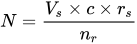
- Nは、単一のサンプルから何人の子供が生まれるかを表します。
- Vsはサンプル(射精液)の体積であり、通常は1.0mL から6.5mLの範囲である[47]
- cは凍結融解後のサンプル中の運動精子の濃度で、1mlあたり約500万~2000万個であるが、大幅に変動する。
- r sは1周期あたりの妊娠率で、10%から35%の範囲です[39]
- n r は、膣授精 (VI) または子宮頸管授精 (ICI) に推奨される総運動精子数で、1 ml あたり約 2,000 万個です。
使用される運動精子の数が増えるにつれて妊娠率は上がりますが、他の要因が制限となる場合は、ある程度までしか上がりません。
方程式の導出(右をクリックして表示)
最も単純な形式では、この式は次のようになります。
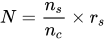
- Nは、1つのサンプルから何人の子供が生まれるかである。
- n sはサンプルごとに生産されるバイアルの数です
- n c はサイクルで使用されるバイアルの数です
- r sは周期あたりの妊娠率である
nはさらに次のように分割できます。
- n sはサンプルごとに生産されるバイアルの数です
- V sはサンプルの体積である
- V v は使用されるバイアルの容量です

n c は次のように分割できます。
- n c はサイクルで使用されるバイアルの数です
- n rは、周期で使用することが推奨される運動精子の数です。
- n sはバイアル内の運動精子の数である

nは次のように分割できます。
- n sはバイアル内の運動精子の数である
- V v は使用されるバイアルの容量です
- cはサンプル中の運動精子の濃度である

したがって、要因は次のように表すことができます。
- Nは、1つのサンプルが何人の子供を助けることができるかを表し、
- V sはサンプルの体積である
- cはサンプル中の運動精子の濃度である
- r sは周期あたりの妊娠率である
- n rは、サイクルで使用するために推奨される運動精子の数です。
- V v は使用されるバイアルの容量です(その値はNに影響を与えないので省略できます。つまり、バイアルが小さいほど、使用されるバイアルの数が多くなります)
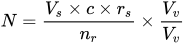

これらの数字から、1 つのサンプルは平均して 0.1 ~ 0.6 人の子供を生み出すのに役立ちます。つまり、実際には子供 1 人を産むのに平均 2 ~ 5 つのサンプルが必要です。
子宮内人工授精の場合、遠心分離率(f c)を式に加えることがあります。
- f c はサンプルの遠心分離後に残る体積の割合であり、約半分 (0.5) から 3 分の 1 (0.33) になります。

一方、IUIでは1周期あたり500万個の運動精子しか必要ありません(n r =500万)。
したがって、IUI に使用する場合、子供 1 人あたり 1 ~ 3 個のサンプルのみが必要になる場合があります。
社会的影響
生殖補助医療(ART)への依存度が高まったことで生じた重要な問題の一つは、カップルに妊娠を強いるプレッシャーである。「子どもを持つことが非常に望まれ、親になることは文化的に義務付けられており、子どもがいないことは社会的に受け入れられない」[48]
不妊症の医療化は、個人が不妊症を非常に否定的に考えるように促す枠組みを作り出します。多くの文化では、ドナーによる人工授精は宗教的および文化的に禁止されており、多くの場合、体外受精のような、アクセスしにくい「ハイテク」で高価なARTが唯一の解決策となります。
不妊症の治療において生殖技術に過度に依存すると、特に中央アフリカと南アフリカの「不妊地帯」の多くの人々が、人工授精技術で治療可能な不妊症の主な原因の多く、すなわち予防可能な感染症、食事や生活習慣の影響に対処することができなくなってしまう。[48]
適切な記録が残されていない場合、子孫が成長したときに偶発的な近親相姦の危険にさらされることになります。
リスク要因
人工授精のリスク要因は、他の不妊治療に比べて比較的低い。最も顕著なリスク要因は、処置後の感染症であり、その他のリスク要因としては、双子や三つ子を出産するリスクが高いこと、処置中に少量の膣出血があることなどが挙げられる。[49]
これらのリスク要因は軽微で、一般的には対処可能ですが、不妊治療全般のリスク要因については、アイデンティティグループ間で大きな知識格差があります。たとえば、LGBTQ+の人々は「異性愛者の女性の同僚と比較した場合、生殖結果に関連するリスク要因に関する大きな知識格差があった」ことが判明しました。[50]そのため、医療提供者は、人工授精の潜在的なリスク要因についてLGBTQ+の患者を教育する際に特別な注意を払うことが不可欠です。 LGTBQ+の人々と異性愛者の個人との間のこの知識格差の影響は深刻であり、注目に値します。これらの手順に関する適切な情報とリスク要因へのアクセスが不足していると、これらの手順を完全に追求することを思いとどまらせる可能性があります。その結果、LGBTQ+の家族作りと生殖の標準化が低下し、LGBTQ+の人々の間での情報不足のサイクルが永続するだけです。
法的制限
国によっては、さまざまな方法で人工授精を制限しています。たとえば、独身女性に対する人工授精を認めていない国もあれば、ドナー精子の使用を認めていない国もあります。
2013 年 5 月現在、以下のヨーロッパ諸国では独身女性に対する医療支援による AI が認められています。

.svg/500px-Flag_of_Belgium_(civil).svg.png)



















米国の法律
人工授精に関する法律の歴史
人工授精はかつては姦通とみなされ、1960年代に州が人工授精で生まれた子供を嫡出子と認めるまでは違法だった。[52]子供が嫡出子と認められるようになると、子供の親は誰か、代理出産をどう扱うか、父親の権利、そして最終的には人工授精とLGBT+の親に関する法的な疑問が生じ始めた。人工授精が使われるようになる前は、子供の法的な親は子供を妊娠した2人、または子供を出産した人とその法的な配偶者であったが、[52]人工授精は親になる法的手続きと子供の親が誰であるかを複雑にする。子供の親が誰であるかを決めることは、人工授精をめぐる最大の法的難題である。しかし、代理出産とドナーの権利に関する疑問も、親を決める際の副次的な問題として浮上する。人工授精と親の権利を扱った主な訴訟としては、KM v EG、ジョンソン v カルバート、Matter of Baby M、 In Re KMHなどがあります。
法的親子関係と人工授精
子どもが伝統的な方法で妊娠した場合、その子どもの法的な親が誰であるかに関して相違はほとんどありません。しかし、人工授精で妊娠した子どもは両親の一方または両方と遺伝的に関係がない場合があるため、子どもの法的な親が誰であるかが問題になることがあります。1973年に統一親子関係法が可決される前は、人工授精で妊娠した子どもは「非嫡出」の子どもとみなされていました。[52]統一親子関係法は、人工授精で生まれた子どもを法的に認め、子どもの法的な親を決定する方法の先例を築きました。[52]しかし、この法律は結婚したカップルの子どもにのみ適用されました。[52]この法律は、子どもを出産した人が母親であり、父親はその女性の夫であると定めました。[52] 2002年、州ごとに個別に採択されている統一親子関係法[53]が改正され、未婚のカップルにも対処する内容となり、未婚のカップルも結婚したカップルと同じ権利を子供に対して持つと定められた。[53]これにより、親になる権利が「父親」としての社会的役割を果たす男性にまで拡大された。[53]子供が精子提供者によって生まれたか代理母によって生まれたかによって、母親と父親の両方に親権を確立する方法が数多く存在するようになった。現在、いくつかの州で統一親子関係法の改正版が可決され始めており、親子関係の判定方法が拡大されている。[54]この法案には、「父親」の意味を性別に関係なく父親の役割を果たす人すべてに拡大し、「母親」の意味を性別に関係なく子供を産む人すべてに拡大することが含まれている。さらに、この法律では「夫」や「妻」という表現を「配偶者」に変更する。[54]
父親の権利
人工授精と父親の権利に関しては、全50州に適用される連邦法はないが、多くの州が採用しているモデルとして統一親子法がある。[55] 1973年の統一親子法では、医師免許を持つ人による人工授精を受ける異性愛者の夫婦は、精子提供者ではなく夫を子供の実父として記載することができる。[55]その後、この法律の改訂版が導入されたが、あまり広く採用されていない[55]
Generally paternity is not an issue when artificial insemination is between a married woman and an anonymous donor.[55] Most states provide that anonymous donors' paternity claims are not recognized, and most sperm donation centers make use of contracts that require donors to sign away their paternity rights before they can participate.[55] When the mother knows the donor, however, or engages in artificial insemination while unmarried, complications may arise.[55] In cases of private sperm donation, paternity rights and responsibilities are often conferred onto sperm donors when: the donor and recipient did not comply with state laws regarding artificial insemination, the sperm donor and recipient know one another, or the donor had the intent of being a father to the child.[55] When one or a number of these things is true, courts have at times found written agreements relinquishing parental rights to be unenforceable.[55]
Opposition and criticism
Religious opposition
Some theologically buttressed arguments reject the moral validity of this practice, such as Pope John XXIII. However, according to a document of the USCCB, the intrauterine insemination (IUI) of “licitly obtained” (normal intercourse with a silastic sheath i.e. a perforated condom) but technologically prepared semen sample (washed, etc.) has been neither approved nor disapproved by Church authority and its moral validity remains under discussion.[56] Some religious groups, such as the Catholic Church, and individuals have also criticized artificial insemination because acquiring sperm for the procedure is seen as "a form of adultery promoting the vice of masturbation."[57]
Other morality-based opposition
There are critics of artificial insemination who voice concerns regarding the potential for AI to encourage eugenicist practices through selection of particular traits. The line of reasoning follows the history of artificial insemination in breeding livestock and other domesticated animals wherein preferred traits are encouraged through human-controlled selection.[57]
Other animals
.jpg/500px-Inseminatie_(4494727256).jpg)
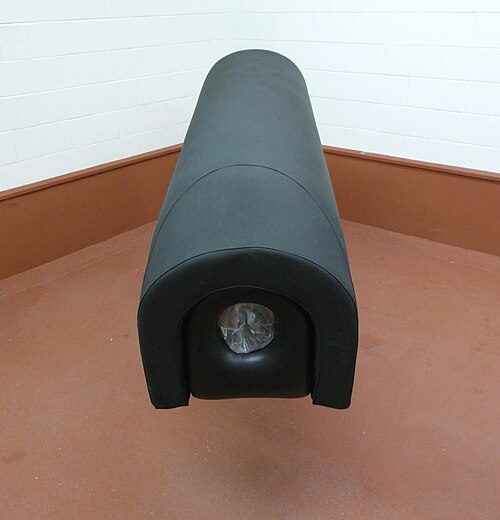
Artificial insemination is used for pets, livestock, endangered species, and animals in zoos or marine parks difficult to transport.
Reasons and techniques
It may be used for many reasons, including to allow a male to inseminate a much larger number of females, to allow the use of genetic material from males separated by distance or time, to overcome physical breeding difficulties, to control the paternity of offspring, to synchronize births, to avoid injury incurred during natural mating, and to avoid the need to keep a male at all (such as for small numbers of females or in species whose fertile males may be difficult to manage).
Artificial insemination is much more common than natural mating, as it allows several female animals to be impregnated from a single male. For instance, up to 30-40 female pigs can be impregnated from a single boar.[58] Workers collect the semen by masturbating the boars, then insert it into the sows via a raised catheter known as a pork stork.[59] Boars are still physically used to excite the females prior to insemination, but are prevented from actually mating.[60]
Semen is collected, extended, then cooled or frozen. It can be used on-site or shipped to the female's location. If frozen, the small plastic tube holding the semen is referred to as a straw. To allow the sperm to remain viable during the time before and after it is frozen, the semen is mixed with a solution containing glycerol or other cryoprotectants. An extender is a solution that allows the semen from a donor to impregnate more females by making insemination possible with fewer sperm. Antibiotics, such as streptomycin, are sometimes added to the sperm to control some bacterial venereal diseases. Before the actual insemination, estrus may be induced through the use of progestogen and another hormone (usually PMSG or Prostaglandin F2α).
History

The first viviparous animal to be artificially fertilized was a dog. The experiment was conducted with success by the Italian Lazzaro Spallanzani in 1780. Another pioneer was the Russian Ilya Ivanov in 1899. In 1935, diluted semen from Suffolk sheep was flown from Cambridge in Britain to Kraków, Poland, as part of an international research project.[61] The participants included Prawochenki (Poland), Milovanoff (USSR), Hammond and Walton (UK), and Thomasset (Uruguay).
Modern artificial insemination was pioneered by John O. Almquist of Pennsylvania State University. He improved breeding efficiency by the use of antibiotics (first proven with penicillin in 1946) to control bacterial growth, decreasing embryonic mortality, and increase fertility. This, and various new techniques for processing, freezing, and thawing of frozen semen significantly enhanced the practical utilization of artificial insemination in the livestock industry and earned him the 1981 Wolf Foundation Prize in Agriculture.[62] Many techniques developed by him have since been applied to other species, including humans.
Species
Artificial insemination is used in many non-human animals, including sheep, horses,[63] cattle, pigs, dogs, pedigree animals generally, zoo animals, turkeys and creatures as tiny as honeybees and as massive as orcas (killer whales).
Artificial insemination of farm animals is common in the developed world, especially for breeding dairy cattle (75% of all inseminations). Swine are also bred using this method (up to 85% of all inseminations). It is an economical means for a livestock breeder to improve their herds utilizing males having desirable traits.
Although common with cattle and swine, artificial insemination is not as widely practiced in the breeding of horses. A small number of equine associations in North America accept only horses that have been conceived by "natural cover" or "natural service" – the actual physical mating of a mare to a stallion – the Jockey Club being the most notable of these, as no artificial insemination is allowed in Thoroughbred breeding.[64] Other registries such as the AQHA and warmblood registries allow registration of foals created through artificial insemination, and the process is widely used allowing the breeding of mares to stallions not resident at the same facility – or even in the same country – through the use of transported frozen or cooled semen.
In modern species conservation, semen collection and artificial insemination are used also in birds. In 2013 scientist of the Justus-Liebig-University of Giessen, Germany, from the working group of Michael Lierz, Clinic for birds, reptiles, amphibians, and fish, developed a novel technique for semen collection and artificial insemination in parrots producing the world's first macaw by assisted reproduction.[65]
Scientists working with captive orcas were able to pioneer the technique in the early 2000s, resulting in "the first successful conceptions, resulting in live offspring, using artificial insemination in any cetacean species".[66] John Hargrove, a SeaWorld trainer, describes Kasatka as being the first orca to receive artificial insemination.[67]
Violation of rights
Artificial insemination on animals has been criticised as a violation of animal rights, with animal rights advocates equating it with rape and arguing it constitutes institutionalized bestiality.[68][69] Artificial insemination of farm animals is condemned by animal rights campaigners such as People for the Ethical Treatment of Animals (PETA) and Joey Carbstrong, who identify the practice as a form of rape due to its sexual, involuntary and perceived painful nature.[70][71] Animal rights organizations such as PETA and Mercy for Animals frequently write against the practice in their articles.[72][73][74] Much of the meat production in the United States depends on artificial insemination, resulting in an explosive growth of the procedure over the past three decades.[75] The state of Kansas makes no exceptions for artificial insemination under its bestiality law, thus making the procedure illegal.[75]
Criteria for benefiting from artificial insemination according to the 2021 Bioethics Law
According to the 2021 Bioethics Law, the criteria that must be met to benefit from artificial insemination are as follows:
- Artificial insemination can be performed using sperm from the husband or frozen sperm from an anonymous donor.
- Both spouses or the unmarried woman must consent in advance to artificial insemination or embryo transfer.
- The parenting project must be validated through a series of interviews with professionals (doctors, psychologists, etc.).
- Individuals benefiting from artificial insemination must be of reproductive age.
The 2021 Bioethics Law has expanded the scope of Medically Assisted Procreation (MAP).[76]
See also
References
- ^ "ARTIFICIAL INSEMINATION OF MARRIED WOMEN (Hansard, 26 February 1958)". api.parliament.uk. Retrieved 2020-03-02.
- ^ Ombelet, W.; Van Robays, J. (2015). "Artificial insemination history: hurdles and milestones". Facts, Views & Vision in ObGyn. 7 (2): 137–143. PMC 4498171. PMID 26175891.
- ^ Yuko, Elizabeth (2016-01-08). "The First Artificial Insemination Was an Ethical Nightmare". The Atlantic. Retrieved 2019-07-17.
- ^ Kramer, Wendy (2016-05-10). "A Brief History of Donor Conception". HuffPost. Retrieved 2021-07-29.
- ^ "Letter to the Editor: Artificial Impregnation". The Medical World: 163–164. April 1909. Archived from the original on 2012-07-24. (cited in Gregoire, A.; Mayer, R. (1964). "The impregnators". Fertility and Sterility. 16: 130–4. doi:10.1016/s0015-0282(16)35476-0. PMID 14256095.)
- ^ Kara W. Swanson, "The Birth of the Sperm Bank," Annals of Iowa, 71 (Summer 2012), 241–76.
- ^ Smith, Rebecca (2016-08-10). "British man 'fathered 600 children' at own fertility clinic - Telegraph". Archived from the original on 2016-08-10. Retrieved 2020-02-05.
- ^ Hitchings, Henry (2019-03-26). "Mary's Babies review — Fertility clinic's dark truth". www.standard.co.uk. Retrieved 2021-07-29.
- ^ Cox, Lauren (3 February 2010). "Oral Sex, a Knife Fight and Then Sperm Still Impregnated Girl. Account of a Girl Impregnated After Oral Sex Shows Sperms' Incredible Survivability". abc NEWS.
- ^ Cimino, C.; Guastella, G.; Comparetto, G.; Gullo, D.; Perino, A.; Benigno, M.; Barba, G.; Cittadini, E. (1988). "Direct intraperitoneal insemination (DIPI) for the treatment of refractory infertility unrelated to female organic pelvic disease". Acta Europaea Fertilitatis. 19 (2): 61–68. PMID 3223194.
- ^ Robinson, Sarah (2010-06-24). "Professor". International Federation of Gynecology and Obstetrics. Archived from the original on 2012-11-04. Retrieved 2012-12-27.
- ^ "Egg Donation (for the recipient)". Yale Medicine. Retrieved 2024-08-16.
- ^ "Europe moves towards complete statutory regulation of ART". EurekAlert!. Retrieved 2024-08-16.
- ^ Adams, Robert (1988). in vitro fertilization technique. Monterey CA.
{{cite book}}: CS1 maint: location missing publisher (link) - ^ a b Ginsburg, Elizabeth (June 4, 2018). "Procedure for intrauterine insemination (IUI) using processed sperm". Uptodate.com.
- ^ O'Brien, P; Vandekerckhove, P (26 October 1998). "Intra-uterine versus cervical insemination of donor sperm for subfertility". Cochrane Database of Systematic Reviews (2): CD000317. doi:10.1002/14651858.CD000317. PMID 10796709.
- ^ European Sperm Bank USA
- ^ Laurie Barclay. "Immobilization May Improve Pregnancy Rate After Intrauterine Insemination". Medscape Medical News. Retrieved October 31, 2009.
- ^ Marshburn PB, Alanis M, Matthews ML, et al. (September 2009). "A short period of ejaculatory abstinence before intrauterine insemination is associated with higher pregnancy rates". Fertil. Steril. 93 (1): 286–8. doi:10.1016/j.fertnstert.2009.07.972. PMID 19732887.
- ^ a b Merviel P, Heraud MH, Grenier N, Lourdel E, Sanguinet P, Copin H (November 2008). "Predictive factors for pregnancy after intrauterine insemination (IUI): An analysis of 1038 cycles and a review of the literature". Fertil. Steril. 93 (1): 79–88. doi:10.1016/j.fertnstert.2008.09.058. PMID 18996517.
- ^ Nazem, Taraneh Gharib; Chang, Sydney; Lee, Joseph A.; Briton-Jones, Christine; Copperman, Alan B.; McAvey, Beth (March 2019). "Understanding the Reproductive Experience and Pregnancy Outcomes of Lesbian Women Undergoing Donor Intrauterine Insemination". LGBT Health. 6 (2): 62–67. doi:10.1089/lgbt.2018.0151. PMID 30848719.
- ^ Bellver J, Labarta E, Bosch E, Melo MA, Vidal C, Remohí J, Pellicer A, et al. (June 2009). "GnRH agonist administration at the time of implantation does not improve pregnancy outcome in intrauterine insemination cycles: a randomized controlled trial". Fertil. Steril. 94 (3): 1065–71. doi:10.1016/j.fertnstert.2009.04.044. PMID 19501354.
- ^ Blasco V, Prados N, Carranza F, González-Ravina C, Pellicer A, Fernández-Sánchez M, et al. (June 2014). "Influence of follicle rupture and uterine contractions on intrauterine insemination outcome: a new predictive model". Fertil. Steril. 102 (4): 1034–1040. doi:10.1016/j.fertnstert.2014.06.031. PMID 25044083.
- ^ a b "What Is Intrauterine Insemination (IUI)?". Planned Parenthood. Retrieved December 3, 2023.
- ^ "Donor Insemination". American Pregnancy Association. 25 April 2012. Retrieved December 3, 2023.
- ^ Richburg, Caroline E.; Jackson Levin, Nina; Moravek, Molly B. (March 2022). "Laboring to Conceive: Reducing Barriers to Fertility Care for Same-Sex Mothers Pursuing Parenthood". Women. 2 (1): 44–55. doi:10.3390/women2010005. PMC 10702875. PMID 38076707.
- ^ a b Harris, I.; Missmer, S.; Hornstein, M. (2010). "Poor success of gonadotropin-induced controlled ovarian hyperstimulation and intrauterine insemination for older women". Fertility and Sterility. 94 (1): 144–148. doi:10.1016/j.fertnstert.2009.02.040. PMID 19394605.
- ^ Bagis T, Haydardedeoglu B, Kilicdag EB, Cok T, Simsek E, Parlakgumus AH (May 2010). "Single versus double intrauterine insemination in multi-follicular ovarian hyperstimulation cycles: a randomized trial". Hum Reprod. 25 (7): 1684–90. doi:10.1093/humrep/deq112. PMID 20457669.
- ^ Ayeleke, RO; Asseler, JD; Cohlen, BJ; Veltman-Verhulst, SM (3 March 2020). "Intra-uterine insemination for unexplained subfertility". The Cochrane Database of Systematic Reviews. 2020 (3): CD001838. doi:10.1002/14651858.CD001838.pub6. PMC 7059962. PMID 32124980.
- ^ Boomsma, CM; Cohlen, BJ; Farquhar, C (15 October 2019). "Semen preparation techniques for intrauterine insemination". The Cochrane Database of Systematic Reviews. 10 (11): CD004507. doi:10.1002/14651858.CD004507.pub4. PMC 6792139. PMID 31612995.
- ^ Leonidas Mamas, M.D. (March 2006). "Comparison of fallopian tube sperm perfusion and intrauterine tuboperitoneal insemination:a prospective randomized study". Fertility and Sterility. 85 (3): 735–740. doi:10.1016/j.fertnstert.2005.08.025. PMID 16500346.
- ^ Shekhawat, G.S. (July 2012). "Intrauterine insemination versus fallopian tube sperm perfusion in non-tubal infertility". Medical Journal Armed Forces India. 68 (3): 226–230. doi:10.1016/j.mjafi.2012.02.013. PMC 3862360. PMID 24532873.
- ^ Hurd WW, Randolph JF, Ansbacher R, Menge AC, Ohl DA, Brown AN (February 1993). "Comparison of intracervical, intrauterine, and intratubal techniques for donor insemination". Fertil. Steril. 59 (2): 339–42. doi:10.1016/S0015-0282(16)55671-4. PMID 8425628.
- ^ a b c Yao, Hong; Yang, Jieyi; Lo, Iris Po Yee (June 2023). "Lesbian couples' childbearing experiences using assisted reproductive technology: A netnography study". Midwifery. 121: 103656. doi:10.1016/j.midw.2023.103656. PMID 37019000. S2CID 257741047.
- ^ "Lesbian Fertility Options - Donor Sperm IUI - Reciprocal IVF - LGBT". Southern California Fertility. Retrieved 2021-12-07.
- ^ "LGBTQ Fertility Services". Obstetrics & Gynecology. 2018-12-18. Retrieved 2021-12-07.
- ^ Johal, Jasmyn K.; Gardner, Rebecca M.; Vaughn, Sara J.; Jaswa, Eleni G.; Hedlin, Haley; Aghajanova, Lusine (2021-09-01). "Pregnancy success rates for lesbian women undergoing intrauterine insemination". F&S Reports. 2 (3): 275–281. doi:10.1016/j.xfre.2021.04.007. PMC 8441558. PMID 34553151.
- ^ England, Fertility Centers of New (2011-03-03). "Andrology: Sperm Volume & Concentration". Fertility Centers of New England. Retrieved 2021-01-04.
- ^ a b Utrecht CS News Archived 2018-10-01 at the Wayback Machine Subject: Infertility FAQ (part 4/4)
- ^ Allahbadia, Gautam N. (December 2017). "Intrauterine Insemination: Fundamentals Revisited". The Journal of Obstetrics and Gynecology of India. 67 (6): 385–392. doi:10.1007/s13224-017-1060-x. PMC 5676579. PMID 29162950.
- ^ Intrauterine insemination. Information notes from the fertility clinic at Aarhus University Hospital, Skejby. By PhD Ulrik Kesmodel et al.[verification needed]
- ^ IVF.com
- ^ Cordary, D.; Braconier, A.; Guillet-May, F.; Morel, O.; Agopiantz, M.; Callec, R. (December 2017). "Immobilization versus immediate mobilization after intrauterine insemination: A systematic review and meta-analysis". Journal of Gynecology Obstetrics and Human Reproduction. 46 (10): 747–751. doi:10.1016/j.jogoh.2017.09.005. PMID 28964965.
- ^ Custers, I. M; Flierman, P. A; Maas, P.; Cox, T.; Van Dessel, T. J H M; Gerards, M. H; Mochtar, M. H; Janssen, C. A H; van der Veen, F.; Mol, B. W. J (29 October 2009). "Immobilisation versus immediate mobilisation after intrauterine insemination: randomised controlled trial". BMJ. 339 (oct29 1): b4080. doi:10.1136/bmj.b4080. PMC 2771078. PMID 19875843.
- ^ "Fertility treatments 'no benefit'". BBC News. 7 August 2008.
- ^ Bhattacharya S, Harrild K, Mollison J, et al. (2008). "Clomifene citrate or unstimulated intrauterine insemination compared with expectant management for unexplained infertility: pragmatic randomised controlled trial". BMJ. 337: a716. doi:10.1136/bmj.a716. PMC 2505091. PMID 18687718.
- ^ Essig, Maria G. (2007-02-20). Van Houten, Susan; Landauer, Tracy (eds.). "Semen Analysis". Healthwise. Reviewed by Martin Gabica and Avery L. Seifert. WebMD. Retrieved 2007-08-05.
- ^ a b Inhorn, Marcia C (May 2003). "Global infertility and the globalization of new reproductive technologies: illustrations from Egypt". Social Science & Medicine. 56 (9): 1837–1851. doi:10.1016/s0277-9536(02)00208-3. PMID 12650724.
- ^ "Intrauterine insemination (IUI) - Mayo Clinic". www.mayoclinic.org. Retrieved 2023-11-29.
- ^ Thomas, S.; Chung, K.; Paulson, R.; Bendikson, K. (March 2018). "Barriers to conception: LGBT individuals have worse fertility health literacy than their heterosexual female peers". Fertility and Sterility. 109 (3): e53–e54. doi:10.1016/j.fertnstert.2018.02.102.
- ^ a b c d e f g h i j k l m n o p q r s t u v w Rainbow Europe Country Index[permanent dead link]
- ^ a b c d e f Luetkemeyer, Lisa (June 1, 2015). "Paternity Law: Sperm Donors, Surrogate Mothers and Child Custody". Missouri Medicine. 112 (3): 162–165. PMC 6170122. PMID 26168582.
- ^ a b c Pedersen, Jamie D. "The New Uniform Parentage Act of 2017". www.americanbar.org. Retrieved March 23, 2023.
- ^ a b "Parentage Act - Uniform Law Commission". www.uniformlaws.org. Retrieved 2023-03-24.
- ^ a b c d e f g h Gill, Lauren (1 April 2013). "Who's Your Daddy? Defining Paternity Rights in the Context of Free, Private Sperm Donation". William & Mary Law Review. 54 (5): 1715.
- ^ U.S. Conference of Catholic Bishops (USCCB) (2020). «Reproductive Technology (Evaluation & Treatment of Infertility): Guidelines for Catholic Couples». www.usccb.org.
- ^ a b Ombelet, W.; Van Robays, J. (2015). "Artificial insemination history: hurdles and milestones". Facts, Views & Vision in ObGyn. 7 (2): 137–143. ISSN 2032-0418. PMC 4498171. PMID 26175891.
- ^ "Pigs | The Vegetarian Society". Vegetarian Society. Retrieved 2019-06-03.
- ^ "Inseminating sows". Qld Government Department of Agriculture and Fisheries.[permanent dead link]
- ^ "Collecting semen from boars". Qld Government Department of Agriculture and Fisheries.[permanent dead link]
- ^ "Experiment in Sheep Breeding". Daily Telegraph. London. 16 May 1936. p. 3. Retrieved 2 June 2023.
- ^ Chet, Ilan (2009). "John O. Almquist". Wolf Prize in Agriculture. World Scientific. pp. 121–134. ISBN 978-981-283-585-7.
- ^ "Equine Artificial Insemination". www.equine-reproduction.com. Retrieved 2018-03-01.
- ^ The Jockey Club has never allowed artificial insemination. Archived September 20, 2008, at the Wayback Machine
- ^ Lierz M, Reinschmidt M, Müller H, Wink M, Neumann D (2013). "A novel method for semen collection and artificial insemination in large parrots (Psittaciformes)". Sci Rep. 3: 2066. Bibcode:2013NatSR...3E2066L. doi:10.1038/srep02066. PMC 3691562. PMID 23797622.
- ^ Robeck, T.R.; Steinman, K.J.; Gearhart, S.; Reidarson, T.R.; McBain, J.F.; Monfort, S.L. (1 August 2004). "Reproductive Physiology and Development of Artificial Insemination Technology in Killer Whales (Orcinus orca)1". Biology of Reproduction. 71 (2): 650–660. doi:10.1095/biolreprod.104.027961. PMID 15115725.
- ^ Hargrove, John (22 March 2016). "I trained killer whales at SeaWorld for 12 years. Here's why I quit". Vox. Retrieved 25 February 2019.
- ^ Rosenberg, Gabriel (October 2017). "How Meat Changed Sex". GLQ: A Journal of Lesbian and Gay Studies. 23 (4): 473–507. doi:10.1215/10642684-4157487. S2CID 148931942.
- ^ Fischer, Bob (2019). The Routledge handbook of animal ethics. Routledge handbooks in applied ethics. New York, NY: Routledge. ISBN 978-1-13-809506-9. OCLC 1111771459.[page needed]
- ^ "Is Your Food a Product of Rape?". PETA. September 2016.
- ^ "Why Vegans Are Going On TV to Call Farmers 'Rapists'". VICE. 6 February 2018.
- ^ "Is your food a product of rape?". PETA.org. PETA. September 2016. Retrieved 15 January 2021.
Cows and other factory-farmed female animals endure being raped repeatedly, and their babies are torn away from them before they're all killed.
- ^ "Sex and Violence in the Meat Industry". MercyforAnimals.org. Mercy for Animals. 3 November 2010. Archived from the original on 31 July 2021. Retrieved 15 January 2021.
In an eye-opening article in The Huffington Post, Bruce Friedrich gives readers one more reason to boycott meat, dairy and eggs: institutionalized bestiality. Aside from horrifying personal accounts from factory farmers and slaughterhouse workers bragging about sexually abusing animals and undercover video footage exposing animals being raped and sexually assaulted, Friedrich explains how routine – and legal – acts of bestiality are perpetrated every day on modern farms.
- ^ Jarvenpaa, Mikko (23 December 2019). "Mercy For Animals: Interview with President Leah Garcés". Sentientmedia.org. Sentient Media. Retrieved 15 January 2021.
Mercy For Animals pursues change for the better by reducing the suffering of the 80 billion farmed animals raped and killed every year, Garcés says.
- ^ a b Rosenberg, Gabriel N.; Dutkiewicz, Jan (11 December 2020). "The Meat Industry's Bestiality Problem". The New Republic. TNR. Retrieved 15 January 2021.
- ^ "La loi de bioéthique qui encadre l'AMP (ou PMA) - Assistance médicale à la procréation (AMP)". Assistance médicale à la procréation (in French). Retrieved 2023-11-12.
Further reading
- Hammond, John, et al., The Artificial Insemination of Cattle (Cambridge, Heffer, 1947, 61pp)
External links

Wikimedia Commons has media related to Artificial insemination.
- Detailed description of the different fertility treatment options available
- A history of artificial insemination
- What are the Ethical Considerations for Sperm Donation?
- United States state court rules sperm donor is not liable for children Archived 2007-10-13 at the Wayback Machine
- UK Sperm Donors Lose Anonymity
- AI technique in the equine
- IntraUterine TuboPeritoneal Insemination (IUTPI)
- The Hastings Center's Bioethics Briefing Book entry on assisted reproduction Archived 2016-08-06 at the Wayback Machine
- Annales de Gembloux L´Organisation Scientifique de l Índustrie Animale en URSS, Artificial Insemination in the URSS, by Luis Thomasset, 1936[permanent dead link]