
Loading article…

映画は、劇場公開、ホームビデオ、テレビ放映権、マーチャンダイジングなど、いくつかの収入源から収入を生み出しています。しかし、映画館での興行収入は、業界誌が映画の成功を評価する際の主な指標です。これは主に、ホームビデオや放映権の売上高と比較してデータが利用可能であることと、歴史的慣行によるものです。リストには、興行収入上位のチャート(収入の名目値と実質値の両方でランク付け)、暦年別の高収益映画のチャート、最高収益の映画記録の変遷を示すタイムライン、最高収益の映画フランチャイズとシリーズのチャートが含まれています。すべてのチャートは、ホームビデオ、放映権、および商品から得られる収入を除いた、可能な限り国際的な劇場興行成績でランク付けされています。
伝統的に、戦争映画、ミュージカル、歴史ドラマが最も人気のあるジャンルであったが、フランチャイズ映画は21世紀で最も優れた業績を上げている作品の一つである。スーパーヒーローのジャンルには大きな関心があり、マーベル・シネマティック・ユニバースの映画11本が名目上の収益上位にランクインしている。最も成功したスーパーヒーロー映画であるアベンジャーズ/エンドゲームは、名目上の収益チャートで2番目に高い興行収入を記録した映画でもあり、アベンジャーズのコミックブックに基づいた映画は合計でトップ20にランクインしています。他のマーベルコミックの映画化作品では、スパイダーマンとX-メンが成功を収めており、 DCコミックのバットマンとスーパーマンに基づいた映画は概して好成績を収めています。スターウォーズも5本の映画で名目上の収益チャートに登場し、ジュラシック・パーク・フランチャイズが目立つ位置にあります。名目収益チャートは既存作品の映画化や続編が占めているが、オリジナル作品である『アバター』がチャートをリードしている。アニメの家族向け映画は一貫して好調で、ディズニー映画はホームビデオの時代以前には利益の出る再公開を楽しんでいた。ディズニーはまた、後に『アナと雪の女王』とその続編、『ズートピア』、『ライオンキング』 (およびコンピュータアニメによるリメイク)などの映画で成功を収めたほか、ピクサー部門では『インサイド・ヘッド2』(最高の興行収入を上げたアニメ映画)、 『Mr.インクレディブル2』 、 『トイ・ストーリー3』と『トイ・ストーリー4 』が最も好成績を収めた。ディズニーとピクサーのアニメーション以外では、『怪盗グルーの月泥棒』と『シュレック』シリーズが最も成功を収めている。
1950年代、1960年代、1970年代の映画の大半はインフレによって興行成績が落ち込んでいるが、その時代に誕生し今もなお公開されているシリーズもある。 『スター・ウォーズ』や『スーパーマン』のシリーズ以外にも、ジェームズ・ボンドやゴジラの映画は今も定期的に公開されており、これら4作品はいずれも興行成績上位のシリーズである。興行成績最高記録を保持していた古い映画の中には、今日の基準で見ても依然としてかなりの興行成績を上げているものもあるが、個々のチケット価格がはるかに高い時代においては、もはや今日のトップ興行成績映画と数字的に張り合うことはない。しかし、それらの価格をインフレ調整すると、 『風と共に去りぬ』は25年間興行成績最高記録を保持し、今でも史上最高の興行成績を収めた映画である。リスト上の興行成績はすべて、特に断りのない限り、名目価値で 米ドルで表されている。
興行収入上位の映画

全世界興行収入が29億ドルを超える『アバター』は「最も興行収入の高い」映画とされているが、こうした主張は通常、劇場興行収入のみを指し、映画の収益のかなりの部分を占める可能性があるホームビデオやテレビの収入は考慮されていない。ホームエンターテイメントからの収入を考慮に入れると、どちらの映画が最も成功したかはすぐには分からない。『タイタニック』は、劇場興行収入22億ドルに加えて、ビデオとDVDの販売とレンタルで12億ドルを稼いだ[1] 。 『アバター』の完全な売上データは入手できないが、北米でのDVDとブルーレイの販売1600万台で3億4500万ドルを稼ぎ、 [2]最終的に全世界でDVDとブルーレイの合計販売台数が3000万台に達した。[3]ホームビデオの収入を差し引くと、どちらの映画もそれぞれ30億ドル以上の収益を上げている。テレビ放映権も映画の収益に大きく貢献し、ペイパービュー収入に加え、テレビ放映2回で劇場興行収入の20~25%に相当する収入を得ることも珍しくありません。[4] 『タイタニック』はNBCとHBOの放映権からさらに5,500万ドルの収入を得ており、 [1]これは北米興行収入の約9%に相当します。
映画が商業的に十分に活用できる資産である場合、付随収入が直接の映画販売による収入を圧倒することがあります。[5] 『ライオン・キング』(1994年)は興行収入とホームビデオの売り上げで20億ドル以上を稼ぎましたが、[1]これは舞台版が世界中で興行収入で稼いだ80億ドルと比べると見劣りします。[6] マーチャンダイジングも非常に儲かることがあります。『ライオン・キング』は30億ドルのグッズも売り上げました。[7]一方、ピクサーの『カーズ』は劇場興行収入で4億6200万ドルを稼ぎ、他のピクサー映画と比べると控えめなヒットにとどまりましたが、 [8] 2006年の公開後5年間で80億ドルを超える世界的なグッズ販売を生み出しました。[9] [10]ピクサーは『トイ・ストーリー3』でも大ヒットし、興行収入10億ドルに加えて、グッズ小売売上高がほぼ100億ドルに達しました。[11]
このチャートでは、映画は名目上の劇場公開による収益と、その最高順位によってランク付けされています。全世界で 20 億ドルを超える収益を上げている映画は合計 6 本あり、その中で『アバター』がトップにランクされています。これらの映画はすべて 21 世紀に劇場公開 (再公開を含む) されており、この期間に上映されていない映画は、チケット価格の高騰、人口規模、チケット購入傾向が考慮されていないため、チャートには表示されません。
- †背景の網掛けは、2024年9月27日から始まる週に世界中の劇場で上映される映画を示しています。
T Box Office MojoとThe Numbersで発表された『タイタニック』の合計はどちらも正しくありません。2023 年の再公開に先立ち、両方のトラッカーでの合計は実際の数字よりも高く評価されていました。
- 2019年の時点で、Box Office Mojoは『タイタニック』のオリジナル公開時の興行収入が18億4,300万ドル、2012年の3D再公開時の興行収入が3億4,400万ドル、2017年の限定公開時の興行収入がさらに69万2,000ドルで、累計興行収入が21億8,700万ドルであると正しく記録していた。 [13] 2020年に限定再公開後、Box Office Mojoは誤ってオリジナル公開時の合計興行収入に700万ドルを追加した。[14] 2021年末までに、Box Office Mojoはオリジナル公開時の合計興行収入を訂正したが、2012年と2017年の再公開時の合計興行収入に700万ドルの数字を追加したため、累計興行収入が誤って1,400万ドル増加して22億200万ドルとなった。[15] 2023年の初めに、Box Office Mojoは2017年の再発行の合計を訂正し、生涯総収入を21億9500万ドルに引き下げましたが、2012年の再発行の誤りはそのまま残しました。[16]
- The Numbersは個々のリリースを記録していないが、2014年9月に生涯総収入が21億8600万ドルと記録した(オリジナルリリースが約18億4300万ドル、3D再発が約3億4360万ドルに相当)。[17]数週間後、The Numbersは説明なしに生涯総収入を22億800万ドルに引き上げた。[18]
F Box Office Mojoは、 2014年8月、まだ公開中だった『アナと雪の女王』の主な合計額の更新を停止しました。ここに記載されている合計額には、2015年末までの日本、ナイジェリア、スペイン、英国、ドイツでの収益が含まれていますが、数十万ドルに上るトルコ、アイスランド、ブラジル、オーストラリア(2016年)での収益は含まれていません。数字の不正確さを補うために、合計額は100万ドルに切り上げられています。2017年12月、映画「オラフのフローズン アドベンチャー」という特集付きで英国で再公開され、さらに230万ドルの収益を上げました。
F8 『ワイルド・スピード ICE BREAK』の場合、興行収入は Box Office Mojo のアーカイブ版から引用しているが、これは現在の数字に不規則性が発見されたためである。いくつかの国で毎週興行収入が減少し続けており、アルゼンチンが最も影響を受けているが、これが世界全体の興行収入の減少につながった。[19]出典に異常があると思われるため、以前の数字が示されている。
RK 『ロード・オブ・ザ・リング/王の帰還』は、 2020年初頭に当初の興行収入が修正されました。この修正の結果、『スパイダーマン:ファー・フロム・ホーム』、『キャプテン・マーベル』、『トランスフォーマー/ダークサイド・ムーン』はいずれも、付随する情報源に示されているよりも1つ低い順位でピークを迎えました。
TS3 Box Office Mojoは2016年8月にピクサー映画の興行収入を改訂し、その結果『トイ・ストーリー3』の興行収入は10億6,300万ドルから10億6,700万ドルに修正された。[20] [21]これは、情報源が示した5位ではなく、公開終了時に『パイレーツ・オブ・カリビアン/デッドマンズ・チェスト』を上回り、最高4位になったことを意味する。
インフレ調整後の興行収入上位映画

インフレの長期的な影響、特に映画館の入場料の大幅な値上がりのため、インフレ調整前のリストでは後期の映画にかなり重点が置かれる。[22]そのため、調整前のリストは報道でよく見られるものの、時間的に大きく離れた映画を比較するのにはほとんど意味がない。なぜなら、価格上昇分を調整すると商業的に大きな成功を収めたにもかかわらず、多くの初期の映画は現代の調整前のリストには載らないからである。[23]通貨の切り下げを補うために、一部のチャートではインフレ調整を行っているが、入場料とインフレは必ずしも連動するとは限らないため、この方法でさえ問題を完全には解決していない。たとえば、1970年の入場料は1.55ドルで、インフレ調整後の2004年のドルに換算すると約6.68ドルだった。1980年までに価格は約2.69ドルに上昇し、インフレ調整後の2004年のドルに換算すると5.50ドルに下がった。[24]チケット価格も世界中で異なるインフレ率で上昇しており、世界興行収入の調整プロセスをさらに複雑にしている。[22]
もう一つの複雑な点は、複数の形式で公開され、それぞれ異なるチケット価格が設定されていることだ。この現象の顕著な例としては、3DとIMAXでも公開された『アバター』が挙げられる。同映画のチケットのほぼ3分の2は3D上映で平均価格は10ドル、約6分の1はIMAX上映で平均価格は14.50ドル以上だった。2010年の2D映画の平均価格は7.61ドルだった。[25]人口の変化[26]や国際市場の成長[27] [28] [29]などの社会的・経済的要因も、劇場のチケットを購入する人の数に影響を与えている。また、観客の人口統計によると、一部の映画では割引された子供用チケットの割合が非常に高かったり、チケット価格が高い大都市で成績が良かったりする。[23]
映画の成功を測る測定システムは、主に映画業界の慣習により歴史的に常にこの方法が行われてきたため、調整されていない興行収入に基づいています。興行収入は劇場によって集計され、配給会社に伝えられ、配給会社がそれをメディアに発表します。[30]興行収入ではなくチケット販売数をカウントするより代表的なシステムに変更することも、古い映画について入手できるデータは販売総額のみであるため、問題が伴います。[26]映画業界は現在公開中の映画のマーケティングに重点を置いているため、マーケティングキャンペーンでは常に調整されていない数字が使用され、新しい大ヒット映画ははるかに簡単に高い販売ランキングを獲得し、「史上最高の映画」として宣伝されます。[24] [31]そのため、マーケティングやニュース性の観点から、より堅牢な分析に切り替える動機はほとんどありません。[30]
インフレを考慮することは本質的に困難であるにもかかわらず、いくつかの試みがなされてきた。推定値は興行収入の調整に使用される物価指数に依存し、[31]通貨間の換算に使用される為替レートも計算に影響を与える可能性があり、どちらもインフレ調整済みリストの最終的な順位に影響を与える可能性がある。 1939年に最初に公開された「風と共に去りぬ」は、一般的に最も成功した映画と考えられており、ギネス世界記録は2014年にその調整後世界興行収入を34億ドルと推定している。「風と共に去りぬ」の調整後興行収入の推定値は大幅に変動しており、所有者であるターナーエンターテインメントは、ギネスの推定値よりも数年前の2007年に調整後利益を33億ドルと推定している。[32]他の推定ではこの金額の両側に及び、1つは2010年の興行収入が30億ドルをわずかに下回るとしており、[33]別の推定では2006年の興行収入が38億ドルとしている。[34]どの映画が『風と共に去りぬ』に最も近いライバルになるかは、使用される数字の組み合わせによって異なる。ギネスは『アバター』を30億ドルで2位としているが、他の推定では『タイタニック』が2010年の価格で全世界での初公開収益が約29億ドルで次点となっている。[33]
インフレ調整は、国際通貨基金(IMF)が発表する先進国の消費者物価指数を使用して行われます。[36]この指数は、2014年の指数から始まり、2014年にギネス世界記録が発表したチャートの総計に均一に適用されます。上記のチャートの数値は、2014年に発生したインフレと、それ以降2022年までのすべての利用可能な年に発生したインフレを考慮に入れています。
GW 『風と共に去りぬ』の調整後興行収入には、ギネス基準年から調整された1998年までのオリジナル公開と再公開の興行収入と、2020年の指数から調整された2019年の興行収入[37]が含まれている。2020年代には限定的な再公開がいくつかあったが、これらの再公開による興行収入は調整後興行収入には反映されていない。
A1アバターの調整後興行収入には、オリジナル版と4つの再発行版すべての収益が含まれています。オリジナル版と2010年の特別版の興行収入はギネス基準年から調整されており、2020年と2021年の興行収入は2021年の指数から調整されており、2022年の興行収入は2022年から調整されています。[38]
ギネスによる『タイタニック』の調整後総収入は、2012年版(2011年発行)と2015年版の間でわずか1億200万ドルの増加にとどまり、チャート内の他の調整後総収入と同様に4.2%の増加となった。また、2012年の3D再公開の総収入は省略されている。 [35] [39]このチャートには、再公開の総収入3億4355万770ドルが組み込まれており、2013年の指数から調整されている。 [40] 『タイタニック』は2017年と2020年の限定再公開でさらに76万2994ドルの収益を上げており、これらは25周年記念再公開の総収入に組み込まれ、2023年の指数から調整されている。[41]
ET ETの調整後総収入には、オリジナルリリースとすべての再リリースからの収入が含まれます。オリジナルリリースと1985年と2002年の再リリースはギネス基準年から調整され、2020年と2022年の収入[42]は2022年の指数から調整されています。
AE 『アベンジャーズ/エンドゲーム』の興行収入は2020年の指数から調整されています。
TFA 『スター・ウォーズ/フォースの覚醒』の興行収入は2016年の指数から調整されています。
年別興行収入上位映画
用語集:ディストリビューターレンタル
興行収入は、総収入または配給会社によるレンタル収入で報告されるが、後者は特に古い映画に当てはまる。ホームビデオ収入と間違われることが多いが、配給会社によるレンタル収入は、映画の劇場収入(興行収入から上映会社の取り分を差し引いたもの)に対する配給会社の取り分である。[43] [44]歴史的に、配給会社が映画館チェーンを所有していた頃のレンタル料金は平均30~40%で、総収入の3分の1強が映画の配給会社に支払われていた。[45]現代の市場では、レンタル料金はさまざまな要因によって大きく異なるが、大手スタジオの映画の平均は43%である。[43]
20世紀の観客の嗜好はかなり多様でしたが、いくつかの傾向が生まれました。無声映画の時代には、戦争をテーマにした映画が観客に人気があり、『創生』(南北戦争)、『黙示録の四騎士』 (第一次世界大戦) 、『ビッグ・パレード』、 『ウィングス』(すべて第一次世界大戦)が、それぞれの公開年に最も成功した映画となりましたが、この傾向は1930年の『西部戦線異状なし』で終わりを迎えました。 1927年にトーキーが導入されると、新しい技術を披露するのに最適なジャンルであるミュージカルが、観客に最も人気のある映画のジャンルとなり、1928年と1929年にはミュージカル映画がトップになりました。このジャンルは1930年代も好調を維持したが、第二次世界大戦の勃発により、1939年の『風と共に去りぬ』(南北戦争)に始まり、 1946年の『我が生涯最良の年』(第二次世界大戦)で終了するなど、この時期は再び戦争をテーマにした映画が主流となった。1950年代を通じて、映画がテレビと観客獲得を競い合う中、『サムソンとデリラ』 (1949年)で、古代ローマ/聖書の時代を舞台にした歴史ドラマの制作費がますます高くなる傾向が見られ、 [46] 『クオ・ヴァディス』、『聖衣』、『十戒』、『ベン・ハー』、『スパルタカス』はいずれも公開当初は年間最高興行収入を記録したが、いくつかの注目度の高い失敗作が出た後、このジャンルは衰退し始めた。[47] 1950年代の『ホワイト・クリスマス』と『南太平洋』の成功は、1960年代のミュージカルの復活を予感させるもので、 『ウエスト・サイド物語』、『メリー・ポピンズ』、『マイ・フェア・レディ』、『サウンド・オブ・ミュージック』 、 『ファニー・ガール』はいずれもこの10年間のトップ映画となった。1970年代には観客の嗜好がハイコンセプト映画に移行し、1980年代にはジョージ・ルーカスかスティーブン・スピルバーグが制作したハイコンセプト映画6本がチャートのトップを飾った。21世紀にはフランチャイズや翻案への依存が高まり、既存の知的財産に基づいた映画の興行収入が記録的な水準に達した。[48]

チャートに最も多く登場する監督はスティーヴン・スピルバーグで、6本の映画を手掛け、1975年、1981年、1982年、1984年、1989年、1993年にトップの座を占めている。セシル・B・デミル(1932年、1947年、1949年、1952年、1956年)は5本の映画で2位、ウィリアム・ワイラー(1942年、1946年、1959年、1968年)とジェームズ・キャメロン(1991年、1997年、2009年、2022年)は4本の映画で3位タイとなっている。DW グリフィス(1915、1916、1920)、ジョージ ロイ ヒル(1966、1969、1973)、ルッソ兄弟(2016、2018、2019) は、それぞれ 3 本の映画で頻繁に登場します。ジョージ ルーカスは、1977 年と 1999 年にヒット作 2 本を監督しましたが、1980 年、1981 年、1983 年、1984 年、1989 年にはプロデューサーや脚本家としてクリエイティブな役割も果たしました。以下の監督も、いずれもこのチャートに載っている映画を2本監督しています:フランク・ロイド、キング・ヴィダー、フランク・キャプラ、マイケル・カーティス、レオ・マッケリー、アルフレッド・ヒッチコック、デヴィッド・リーン、スタンリー・キューブリック、ガイ・ハミルトン、マイク・ニコルズ、ウィリアム・フリードキン、ピーター・ジャクソン、ゴア・ヴァービンスキー、マイケル・ベイ。マーヴィン・ルロイ、ケン・アナキン、ロバート・ワイズは、それぞれ単独クレジットと共同クレジットが1つずつあり、ジョン・フォードは2本の映画を共同監督しました。ディズニー映画は通常共同監督であり、一部の監督は複数の受賞チームに参加しています:ウィルフレッド・ジャクソン、ハミルトン・ラスケ、クライド・ジェロニミ、デヴィッド・ハンド、ベン・シャープスティーン、ウォルフガング・ライターマン、ビル・ロバーツは、いずれもこのリストに載っている映画を少なくとも2本共同監督しています。連続してチャートのトップに立った監督はわずか7人である:マッカリー(1944年と1945年)、ニコルズ(1966年と1967年)、スピルバーグ(1981年と1982年)、ジャクソン(2002年と2003年)、ヴァーバンスキー(2006年と2007年)、そしてルッソ兄弟(2018年と2019年)。
公開スケジュール(特に年末に公開される映画の場合)や、世界各地での公開パターンの違いにより、多くの映画は2年以上にわたって興行成績を上げることができます。そのため、ここで記録されている興行成績は公開年のみに限定されません。興行成績は最初の劇場公開に限定されず、多くの古い映画は定期的に再公開されるため、数字は最初の公開以来の映画の興行成績全体を表します。映画の初回公開興行成績がわかっている場合は、合計の後に括弧内に表示されます。データが不完全なため、一部の映画がいつ、いくら稼いだかは正確にはわかりませんが、一般的にこのチャートは各年で最も収益を上げた映画を記録しています。推定値が矛盾する場合は両方の映画が記録され、映画が再公開されたために1位になった場合は、以前の記録保持者も保持されます。
- †背景の網掛けは、2024年9月27日から始まる週に世界中の劇場で上映される映画を示しています。
(中略)興行収入は初回の劇場公開に限定されていないため、映画の初回公開時の興行収入がわかっている場合は、合計額の後に括弧内に表示されます。
*カナダと米国のみの総額。
Rディストリビューターのレンタル。
TBA確認待ち。
『海底2万マイル』の興行収入に関する当時の資料はないが、『ザ・ナンバーズ』は北米興行収入を800万ドルとしている。[54]しかし、この数字は1954年の再制作版と間違えられた可能性があり、再制作版も北米でのレンタル収入で800万ドルを稼いだ。[55]
FH『The Numbers』などの情報源によると、『南海の香り』は300万ドルを稼ぎ、その年の最高興行収入を記録した映画だという。[56]しかし、同時代の情報源では『南海の香り』の数字は示されていないため、300万ドルという数字が何に関係しているのかは不明である。もしこれがレンタル収入であれば、その年の最高興行収入を記録した映画というだけでなく、無声映画時代の最高興行収入を記録した映画の1つとなったはずであり、そうだとすれば『International Motion Picture Almanac』と『Variety』の両方がこの映画をリストから外すのは異例である。
SSサニーサイドアップの数字が北米の数字なのか世界全体の数字なのかは明らかではない。他の情報源では収益は200万ドルとしているが[57] 、この時期の国際的な数字の混乱を考えると、より高い数字は世界全体のレンタル料である可能性を示唆している。[58]
ON 『素晴らしき哉、人生!』の数字は、その成功を真に表すものではない。この映画は24本以上のコロンビア映画とパッケージとして配給され、総収益は平均化されたものであり、実際の興行収入はもっと高かったはずだ。[59]
シーズン 7 の『白雪姫』の世界累計興行収入4 億 1,800 万ドルには、1987 年以降の北米以外での収益は含まれていません。
GW 『風と共に去りぬ』が公開当初にどれだけの興行収入を上げたかは、はっきりしていません。当時の記録では、北米でのレンタル収入が3,200万ドルと記載されることが多く、過去のチャートでもこの主張が繰り返されることがよくあります。しかし、これは全世界でのレンタル収入だった可能性が高いです。業界誌は、成功した映画の宣伝に熱心な配給会社自身からデータを入手するか、劇場を調査して推定値を作成することでデータを収集しました。配給会社は、数字が高いほど映画が成功したように見えるため、全世界でのレンタルを報告することが多く、一方推定値は北米での興行成績に限定されていました。そのため、全世界と北米のレンタルが混同されることは珍しくありませんでした。第二次世界大戦の勃発後、ハリウッドは海外の市場を利用できなくなったため、北米の興行成績のみを報告するのが標準的な方法になりました。[58]この新しいアプローチに従って、『風と共に去りぬ』の北米でのレンタル収入は1947年に2100万ドル(以前の数字より1100万ドル低い)に修正され、[60] 1947年の再公開後の1953年には、『バラエティ』誌は収益が2600万ドルであると報告していた。[61] 1956年までに、MGMは3回の公開で北米での累計収益が3001万5000ドル、海外での収益が1896万4000ドルだったと報告した。[62]初回公開からの全世界でのレンタル収入3200万ドルは、修正された数字や後に報告された全世界での数字と一致している。それらによると、この映画は初回公開から北米で2100万ドル、海外で1100万ドルの収益を上げ、1956年までの再公開でさらに北米で900万ドル、海外で800万ドルを稼いだことを示している。
『ママとパパ』は、独立系配給のため、バラエティ誌が発表するような「興行収入の高い」リストには通常登場しない。本質的にはエクスプロイテーション・ジャンルに属するこの映画は、検閲法を回避するために性衛生教育映画として宣伝された。映画製作コードに抵触したため、 『ママとパパ』は主流の配給を阻止され、独立系映画館とドライブインシアターでの上映に制限された。この映画は、この種の映画としては最大のヒットとなり、ハードコア・ポルノが最終的に主流となった1970年代まで継続的に配給された。1947年末には200万ドル、1949年には800万ドルの興行収入を上げ、1956年までにレンタル収入2,200万ドル、興行収入8,000万ドルを記録し、1940年代後半から1950年代前半の映画のトップ10に優にランクインしていただろう。総収益は1億ドルにも達すると推定されている。
UNチョプラ・ガントは『アンコンクワーズ』の興行収入は北米の興行収入であるとしているが、当時はよくあることだったが、この表では全世界の興行収入と北米の興行収入が混同されている。他の資料によると、『フォーエバー・アンバー』(800万ドル)と『ライフ・ウィズ・ファーザー』(650万ドル)[63]の興行収入は実際には全世界のレンタル収入だったため、 『アンコンクワーズ』についても同様の可能性がある。
CIシネラマの数字は興行収入を表す。シネラマ社が映画館を所有していたため、映画のレンタル料はかからず、スタジオは興行収入の100%を受け取る。これは、配給会社が受け取る興行収入の半分以下が一般的である他のほとんどの映画の場合とは異なる。当時、バラエティ誌は米国とカナダでのレンタル料で映画をランク付けしていたため、チャート内の他の映画と比較するための基準として、シネラマ映画のレンタル料の仮定値を作成した。 『This Is Cinerama』の場合、全世界での興行収入5000万ドルは、米国でのレンタル料1250万ドルとして再構成された。これはシネラマが報告した金額のちょうど25%であるため、バラエティの計算式では、米国のシェアを推定するために興行収入を半分にし、レンタル料をシミュレートするためにさらに半分にしたようだ。[64]シネラマの5本の映画は、全世界で合わせて1億2000万ドルの興行収入を上げた。[65]
GSバラエティ誌は、公開から1年後の『地上最大のショウ』の全世界レンタル収入を約1,835万ドル(うち米国での1,280万ドル[55])としている。しかし、バーチャードは1962年までの収益を1,500万ドル強としている。バーチャードの数字は北米での総レンタル収入に過ぎず、1954年と1960年の再発行による収入も含まれている可能性が高い。
SW 『スター・ウォーズ』の「初回」興行収入には、1997 年の特別版の公開による収益は含まれていません。ただし、この数字には特別版に先立つ再公開による収益が含まれています。
HP1 Box Office Mojoが記録した『ハリー・ポッターと賢者の石』の再発行によるブラジル(2020年)、イタリア(2021年)、オランダ(2021年)、韓国(2021年)の累計興行収入は、Box Office Mojoがこれらの国でのオリジナル公開興行収入を二重にカウントしたため、累計興行収入から差し引かれました。
HP8 の制作費は『ハリー・ポッターと死の秘宝 PART1』と共同で負担した。
興行収入上位映画のタイムライン

1915年に『創世記』がトップの座を獲得して以来、少なくとも11本の映画が「最高興行収入映画」の記録を保持している。 『創世記』と『風と共に去りぬ』はどちらも25年連続で最高興行収入を記録し、スティーブン・スピルバーグ監督の映画とジェームズ・キャメロン監督の映画がそれぞれ3回記録を保持していた。スピルバーグは『ジュラシック・パーク』が『ET』を追い抜いたときに自身の記録を更新した最初の監督となり、キャメロンは『アバター』が『タイタニック』の記録を破ったときにその偉業を踏襲した。2019年にトップの座を引き継いだ『アベンジャーズ/エンドゲーム』は、最高興行収入映画の記録を保持した最初の続編となり、これにより36年間続いたスピルバーグ/キャメロンの独占を中断し、 2年後の2021年に『アバター』が再公開されてトップの座を取り戻した。
いくつかの情報源によれば、『大パレード』は『創生』を抜いて最高の興行収入を記録した映画となり、最終的には『白雪姫』に取って代わられ、さらにすぐに『風と共に去りぬ』に抜かれたという。[66] 『創生』の正確な数字は不明だが、当時の記録では1919年時点で全世界での興行収入は520万ドルだったとされている。[67]国際公開は第一次世界大戦の影響で遅れ、多くの国では1920年代まで公開されなかった。アメリカでの再公開と合わせて、 1932年に『バラエティ』誌が報じた興行収入1000万ドルは、以前の数字と一致している。[68]この時点では、 『創世記』は配給会社レンタル収入で『ビッグ・パレード』(640万ドル)を上回っており、同誌の推定が正しければ『白雪姫』(850万ドル)[69] は最初の劇場公開では記録を破るほどの収益を上げていなかっただろう。 [70]ただし、同作品は『歌う道化師』 (590万ドル)を抜いて、最高の興行収入を記録した「トーキー」映画だっただろう。 [71]一般に『創世記』がサイレント時代の映画に抜かれることはまずないと考えられているが、 [73] 『創世記』の興行収入が推定より大幅に低かった場合、記録は1925年の『ベン・ハー』(938万6000ドル)に取って代わられることになる。[74]公開上映による総レンタル収入に加え、『創世記』は多数の個人、クラブ、団体の興行でも上映されたが、その数字は不明である。[75]この映画は、勧誘活動に利用したクー・クラックス・クランの間で大人気で、 [76]バラエティ誌は一時、総収益を約5000万ドルと推定した。[77]後にこの主張は撤回されたが、その金額は裏付けのないまま広く報道されている。[67]公開当初に『風と共に去りぬ』が興行収入最高記録を打ち立てたことは一般に認められているが、公開上映に関しては事実であるものの、総収益で『創世記』を追い抜いたのはずっと後になってからで、1960年代まで最高収益映画として報道されていた。[75]風と共に去りぬ 映画『十戒』(1956年)は1960年末に全世界で5800万~6000万ドルのレンタル収入で終了し[78] [79]、一方『風と共に去りぬ』は5900万ドルだった。[ 80 ]仮に『十戒』がトップの座を獲得したとしても、その地位は短命だった。『風と共に去りぬ』は翌年に再公開され、収益を6700万ドルに増やしたからである。推定の正確さにもよるが、1959年の『ベン・ハー』のリメイク版も『風と共に去りぬ』の記録を破った可能性がある。1961年末の時点で全世界で4700万ドルの収益を上げ[81] 、1963年には『風と共に去りぬ』にわずか200万ドル差で迫り、全世界での収益は6500万ドルとなり[82] 、最終的には初公開から6600万ドルを稼いだ。[83]
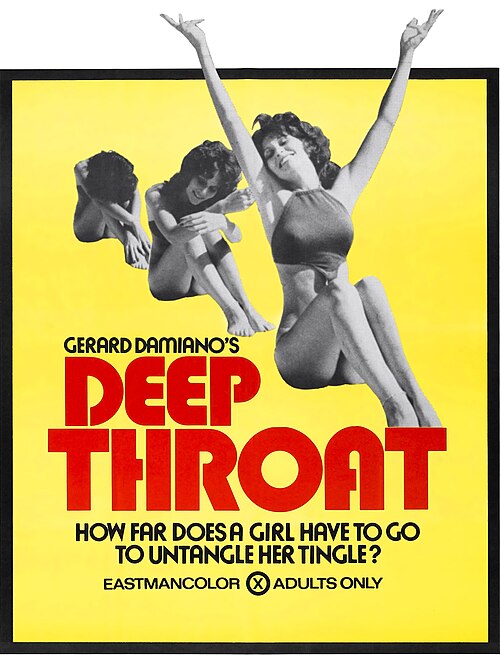
興行収入が最も高かったとされるもう1本の映画は、1972年のポルノ映画 『ディープ・スロート』である。1984年、リンダ・ラヴレースは米国上院司法委員会の少年司法小委員会で、この映画は6億ドルの収益を上げたと証言した。 [84]この数字は多くの憶測の的となっている。もしこれが正確であれば、この映画は『スター・ウォーズ』よりも多くの収益を上げ、1970年代を最高の興行収入を記録した映画として終えたことになるからである。この数字に対する主な反論は、この映画が最終的にこの金額を稼ぐのに必要な金額を維持できるほど広く公開されなかったというものである。[85]正確な数字は不明だが、映画公開から約4年後の1976年の連邦裁判での証言では、映画の収益は2,500万ドル以上だったことが示されている。[86] ロジャー・エバートは、この時期には成人向け映画館のほとんどがギャングによって所有されており、それらを通じて麻薬や売春による収入を洗浄していたため、映画の興行収入はおそらく水増しされたため、紙の上では6億ドルもの利益を上げた可能性があると推論している。[87]
『創世記』、『風と共に去りぬ』、『ゴッドファーザー』、『ジョーズ』、『スター・ウォーズ』、『E.T.』、および『アバター』はいずれも再公開により記録的な興行収入を伸ばした。ここには、劇場公開時の興行収入に加え、記録が破られるまでの再公開による合計も含まれる。したがって、『創世記』の合計には1940 年までの再公開による収入が含まれる。『スター・ウォーズ』の合計には1970 年代後半から 1980 年代前半の再公開による収入が含まれるが、1997 年の特別版による収入は含まれない。『ET』の合計には1985年の再発行による収益が含まれていますが、2002年の収益は含まれていません。チャートに初めて登場した『アバター』の合計には、レコードを放棄した時点までのすべての収益を表す2010年のスペシャル・エディションの収益が含まれていますが、2回目の登場では、アジア太平洋地域での2020年の再リリースと、レコードを取り戻すのに役立った2021年の中国での再リリースによる収益も含まれています。『風と共に去りぬ』も同様にチャートに2回表示されています。1940年のエントリには、1939年から1942年にかけて段階的に公開された収益(ロードショー/一般公開/セカンドラン)[88]と、1966年にサウンド・オブ・ミュージックにレコードを失う前の1961年の再発行までのすべての収益が含まれています。レコードを取り戻した後の1971年の項目には、1967年と1971年の再発行による収入が含まれていますが、それ以降のリリースは除外されています。『ゴッドファーザー』は第45回アカデミー賞での成功の後、1973年に再リリースされ、『ジョーズ』は1976年に再リリースされたため、ここでの興行収入にはおそらくそれらのリリースによる収入が含まれています。『サウンド・オブ・ミュージック』、『ゴッドファーザー』、『ジョーズ』、『ジュラシック・パーク』、および『タイタニック』はいずれもその後のリリースで収入を増やしていますが、再リリースされる前にすでにレコードを譲り渡していたため、ここでの合計には含まれていません。
Rディストリビューターのレンタル。
‡再公開による収益を含みます。映画が記録を保持しながら再公開によって興行収入が増加した場合は、最高興行収入を記録した年も斜体で記載されます。
最も興行収入の高いフランチャイズと映画シリーズ
2000年以前には、興行収入が10億ドルを超えた映画シリーズは7本だけだった。ジェームズ・ボンド、[100] スター・ウォーズ、[101] インディ・ジョーンズ、[102] ロッキー、[103] [104] [105] バットマン、[106] ジュラシック・パーク、[107]スタートレック[108]である。21世紀に入ってから、その数は100本以上に増加した。[109]これはインフレと市場の成長によるところが大きいが、ハリウッドがフランチャイズモデルを採用したことも一因である。フランチャイズモデルとは、よく知られた文学作品や確立されたキャラクターをベースにした、ブランド認知度が組み込まれた映画である。この手法は、観客がすでによく知っているものに関連した映画は、より効果的に観客に売り込むことができるという概念に基づいており、そのため業界内では「事前販売」映画と呼ばれている。[110]
フランチャイズは通常、共通の知的財産から派生した少なくとも2つの作品と定義されます。伝統的に、作品は財産と同語反復的な関係にありますが、これは前提条件ではありません。フランチャイズモデルの永続的な定番はクロスオーバーの概念であり、「2つ以上の個別のテキストまたは一連のテキストのキャラクターまたは概念が出会う物語」と定義できます。[111]クロスオーバーの結果として、知的財産が複数のフランチャイズで利用される場合があります。たとえば、バットマン vs スーパーマン ジャスティスの誕生は、バットマンとスーパーマンのフランチャイズだけでなく、共有ユニバースであるDCエクステンデッドユニバースにも属しています。共有ユニバースは、さまざまな架空の作品の多数のキャラクターが架空の世界を共有することになる特定のタイプのクロスオーバーです。[112]映画という媒体で最も成功した共有ユニバースは、マーベルコミックが所有する複数のスーパーヒーロープロパティ間のクロスオーバーであるマーベルシネマティックユニバースです。マーベル・シネマティック・ユニバースは興行収入が310億ドルを超える、最も収益の高いフランチャイズでもあります。
スパイダーマン映画は、単一の作品をベースにしたシリーズとしては最高の興行収入をあげており、興行収入は106億ドルを超えている(ただし、ジェームズ・ボンド映画シリーズは 、現在の価格に調整すると合計190億ドル以上を稼いでいる)。[a]マーベル・シネマティック・ユニバースには、興行収入が10億ドルを超える映画が最も多く、11本ある。アベンジャーズ映画4本、アナと雪の女王映画2本、アバター映画2本は、各作品が10億ドルを超える興行収入を上げている唯一のフランチャイズだが、ジュラシック・パーク、ブラックパンサー、インサイド・ヘッドシリーズは、平均して1作品あたり10億ドルを超えている。
- † 背景の陰影は、このシリーズの少なくとも 1 つの映画が、2024 年 9 月 27 日から始まる週に世界中の劇場で上映されることを示しています。
*カナダと米国のみの総額。
Rディストリビューターのレンタル。
参照

注記
- ^ 2015年に 『スペクター』が公開される前、ジェームズ・ボンドシリーズは2015年の価格で約177億ドルの収益を上げていた。[113] 『スペクター』と『 007 ノー・タイム・トゥ・ダイ』の16億ドルを超える収益を考慮すると、インフレ調整後のシリーズは少なくとも193億ドルの収益を上げている。
参考文献
- ^ abc Pincus-Roth, Zachary (2006年1月8日). 「映画だけがBOモンスターではない」. Variety . 2021年4月20日時点のオリジナルよりアーカイブ。2014年2月2日閲覧。
- ^ 「アバター – ビデオ販売」。数字。ナッシュ・インフォメーション・サービス。2018年11月25日時点のオリジナルよりアーカイブ。2013年11月12日閲覧。
- ^ “Unkind unwind”.エコノミスト. 2011年3月17日. 2017年9月4日時点のオリジナルよりアーカイブ。 2022年4月6日閲覧。
- ^ Vogel, Harold L. (2010).エンターテインメント産業経済学: 財務分析ガイド.ケンブリッジ大学出版局. p. 224. ISBN 978-1-107-00309-5
ほとんどの映画は、ゴールデンタイムのネットワークで2回上映され、劇場興行収入の20%から25%を獲得する可能性が高い
。 - ^ クラーク、エマ(2001年11月12日)。「映画はどうやってお金を稼ぐのか」BBCニュース。2017年9月8日時点のオリジナルよりアーカイブ。 2012年4月12日閲覧。
- ^ シーモア、リー(2017年12月18日)。「過去20年間、ブロードウェイの『ライオンキング』はディズニーに『スターウォーズ』よりも多くの収益をもたらした」フォーブス。2023年6月10日時点のオリジナルよりアーカイブ。2019年7月28日閲覧。
- ^ “The Entertainment Glut”. Bloomberg . 1998年2月15日. 2017年10月12日時点のオリジナルよりアーカイブ。 2022年4月6日閲覧。
- ^ “Pixar – Worldwide (Unadjusted)” Box Office Mojo . 2019年8月29日時点のオリジナルよりアーカイブ。2012年4月12日閲覧。
- ^ Szalai, Georg (2011年2月14日). 「ディズニー:『カーズ』が世界小売売上高80億ドルを突破」ハリウッド・レポーター。2011年3月19日時点のオリジナルよりアーカイブ。 2022年4月6日閲覧。
- ^ Chmielewski, Dawn C.; Keegan, Rebecca (2011年6月21日). 「商品販売がPixarの『カーズ』フランチャイズを牽引」ロサンゼルス・タイムズ。2013年7月9日時点のオリジナルよりアーカイブ。 2012年4月12日閲覧。
- ^ Palmeri, Christopher; Sakoui, Anousha (2014年11月7日). 「2017年の『トイ・ストーリー4』でディズニーの楽しさとゲームがさらに広がる」ブルームバーグニュース。2015年7月5日時点のオリジナルよりアーカイブ。 2015年6月30日閲覧。
- ^ “All Time Worldwide Box Office Grosses”. Box Office Mojo . 2020年12月29日時点のオリジナルよりアーカイブ。2022年4月6日閲覧。
- ^ 「タイタニック (1997)」。Box Office Mojo 。 2019年10月27日閲覧– Wayback Machine経由。
- ^ 「タイタニック(1997)」。Box Office Mojo 。 2020年10月30日閲覧。Wayback Machine経由。
- ^ 「タイタニック(1997)」。Box Office Mojo 。 2021年10月26日閲覧。Wayback Machine経由。
- ^ “タイタニック (1997)”。Box Office Mojo 。 2023年2月5日閲覧。Wayback Machine経由。
- ^ 「タイタニック」。The Numbers 。 2014年9月2日閲覧– Wayback Machine経由。
- ^ 「タイタニック」。The Numbers 。 2014年9月13日閲覧– Wayback Machine経由。
- ^ 「ワイルド・スピード ICE BREAK (2017) – 国際興行成績: アルゼンチン」Box Office Mojo . 2018年1月11日閲覧。
- ^ “Pixar Movies at the Box Office”. Box Office Mojo . 2016年8月16日時点のオリジナルよりアーカイブ。
- ^ “Pixar Movies at the Box Office”. Box Office Mojo . 2016年8月20日時点のオリジナルよりアーカイブ。
- ^ ab Bialik, Carl (2010年1月29日). 「ハリウッド興行成績記録の作り方」.ウォール・ストリート・ジャーナル. 2011年11月1日時点のオリジナルよりアーカイブ。2011年8月9日閲覧。
- ^ ab Pincus-Roth, Zachary (2009年7月6日). 「Best Weekend Never」. Slate . 2022年4月6日時点のオリジナルよりアーカイブ。 2022年4月6日閲覧。
- ^ ab Anderson, S. Eric; Albertson, Stewart; Shavlick, David (2004年3月). How the movie industry miscalculates box office incomes. Proceedings of the Midwest Business Economics Association. Loma Linda University . 2013年10月29日時点のオリジナル(DOC)からアーカイブ。2013年4月8日閲覧。
- ^ グレイ、ブランドン。「『アバター』が史上最高の興行収入を記録」。Box Office Mojo。2010年2月7日時点のオリジナルよりアーカイブ。 2022年4月6日閲覧。
- ^ ab Bialik, Carl (2010年1月30日). 「映画がNo.1になるために必要なこと」.ウォール・ストリート・ジャーナル. 2018年12月18日時点のオリジナルよりアーカイブ。 2011年8月9日閲覧。
- ^ Kolesnikov-Jessop, Sonia (2011年5月22日). 「ハリウッドがグローバル・アジェンダを押し進める」.ニューヨーク・タイムズ. 2018年12月18日時点のオリジナルよりアーカイブ。2012年1月4日閲覧。
- ^ Hoad, Phil (2011年8月11日). 「国際興行収入の上昇」. The Guardian . 2023年6月29日時点のオリジナルよりアーカイブ。2012年1月4日閲覧。
- ^ フランケル、ダニエル(2011年5月1日)。「なぜ海外興行収入がリードするのか:『ワイルド・スピード5』と『マイティ・ソー』が海外で最初に公開」ザ・ラップ。 2019年1月9日時点のオリジナルよりアーカイブ。 2022年4月6日閲覧。
- ^ ab Bialik, Carl (2007年12月17日). 「興行成績は『伝説』の源泉」.ウォール・ストリート・ジャーナル. 2013年10月29日時点のオリジナルよりアーカイブ。 2011年8月10日閲覧。
- ^ ab レオンハート、デイヴィッド(2010年3月1日)。「『アバター』が興行収入トップの映画ではない理由」ニューヨークタイムズ。2021年10月16日時点のオリジナルよりアーカイブ。 2013年4月7日閲覧。
- ^ ab ミラー、フランク; スタッフォード、ジェフ (2007年1月5日). 「風と共に去りぬ (1939) – 記事」.ターナークラシック映画. 2013年9月26日時点のオリジナルよりアーカイブ。
- ^ ab トム・ショーン(2010年2月3日)「オスカー2010:ジェームズ・キャメロンが世界を制覇した方法」デイリー・テレグラフ。2022年1月10日時点のオリジナルよりアーカイブ。 2012年3月22日閲覧。
- ^ ヒル、ジョージ F. (2006年6月25日). 「確かに、風と共に去りぬ」ワシントンポスト。2018年12月27日時点のオリジナルよりアーカイブ。
- ^ ab ギネス世界記録。第60巻(2015年版)。ギネス世界記録。2014年。pp. 160–161。ISBN 978-1-908843-70-8。
- ^ 「世界経済見通し:インフレ率、期間末消費者物価」国際通貨基金。2019年5月10日時点のオリジナルよりアーカイブ。2024年6月16日閲覧。
- ^ 「風と共に去りぬ(2019年再公開)」Box Office Mojo 。 2024年6月16日閲覧。
興行収入:2,176,120ドル
- ^ “アバター (2009)”。Box Office Mojo。2021年5月3日時点のオリジナルよりアーカイブ。 2022年9月10日閲覧。
2020年再公開:1,281,204ドル、2021年再公開:57,995,770ドル、2022年再公開:76,012,917ドル
- ^ グレンデイ、クレイグ編(2011年)。 Гиннесс。 Мировые рекорды[ギネス世界記録] (ロシア語)。アンドリアノフ、PI、パロバ、IVによる翻訳 (2012年版)。モスクワ:アストレル。p. 211。ISBN 978-5-271-36423-5。
- ^ 「タイタニック3D (2012) – 国際興行成績」Box Office Mojo。2019年10月27日時点のオリジナルよりアーカイブ。 2012年11月25日閲覧。3
億4,355万770ドル
- ^ 「タイタニック (1997)」。Box Office Mojo 。 2012年11月25日閲覧。
2017年再公開:691,642ドル、2020年再公開:71,352ドル、25周年記念:70,157,472ドル
- ^ 「E.T. ET (1982)」Box Office Mojo . 2024年6月16日閲覧。
2020年再公開:516,969ドル、2022年再公開:2,834,590ドル
- ^ a b Cones, John W. (1997). The feature film distribution deal: a critical analysis of the single most important film industry agreement. Southern Illinois University Press. p. 41. ISBN 978-0-8093-2082-0.
Distributor rentals: It is also important to know and recognize the difference between the distributor's gross receipts and the gross rentals. The term "rentals" refers to the aggregate amount of the film distributor's share of monies paid at theatre box offices computed on the basis of negotiated agreements between the distributor and the exhibitor. Note that gross receipts refers to amounts actually received and from all markets and media, whereas gross rentals refers to amounts earned from theatrical exhibition only, regardless of whether received by the distributor. Thus, gross receipts is the much broader term and includes distributor rentals. The issue of film rentals (i.e., what percentage of a film's box office gross comes back to the distributor) is of key importance...More current numbers suggest that distributor rentals for the major studio/distributor released films average in the neighborhood of 43% of box office gross. Again, however, such an average is based on widely divergent distributor rental ratios on individual films.
- ^ Marich, Robert (2009) [1st. pub. Focal Press:2005]. Marketing to moviegoers: a handbook of strategies used by major studios and independents (2 ed.). Southern Illinois University Press. p. 252. ISBN 978-0-8093-2884-0.
Rentals are the distributors' share of the box office gross and typically set by a complex, two-part contract.
- ^ Balio, Tino (2005). The American film industry. University of Wisconsin Press. p. 296. ISBN 978-0-299-09874-2.
Film Rentals as Percent of Volume of Business (1939): 36.4
- ^ Balio, Tino (1987). United Artists: the Company that Changed the Film Industry. University of Wisconsin Press. p. 124–125. ISBN 978-0-299-11440-4.
To rekindle interest in the movies, Hollywood not only had to compete with television but also with other leisure-time activities...Movies made a comeback by 1955, but audiences had changed. Moviegoing became a special event for most people, creating the phenomenon of the big picture.
- ^ Hall & Neale 2010, p. 179. "Later epics proved far more disastrous for the backers. Samuel Bronston's The Fall of the Roman Empire, filmed in Spain, cost $17,816,876 and grossed only $1.9 million in America. George Stevens's long-gestating life of Christ, The Greatest Story Ever Told (1965), which had been in planning since 1954 and in production since 1962, earned domestic rentals of $6,962,715 on a $21,481,745 negative cost, the largest amount yet spent on a production made entirely within the United States. The Bible: In the Beginning... (1966) was financed by the Italian producer Dino De Laurentiis from private investors and Swiss banks. He then sold distribution rights outside Italy jointly to Fox and Seven Arts for $15 million (70 percent of which came from Fox), thereby recouping the bulk of his $18 million investment. Although The Bible returned a respectable world rental of $25.3 million, Fox was still left with a net loss of just over $1.5 million. It was the last biblical epic to be released by any major Hollywood studio for nearly twenty years."
- ^ Williams, Trey (September 25, 2015). "Ridley Scott's latest 'Alien' announcement drives Hollywood's sequel problem". MarketWatch. Archived from the original on June 8, 2016. Retrieved May 12, 2016.
- ^ "Yearly Box Office". Box Office Mojo. Archived from the original on July 29, 2015. Retrieved January 6, 2012.
- ^ "Movie Index By Year". The Numbers. Nash Information Services. LLC. Archived from the original on December 21, 2011. Retrieved January 6, 2012.
- ^ Dirks, Tim. "All-Time Box-Office Hits By Decade and Year". Filmsite.org. American Movie Classics. Retrieved January 5, 2012.
- ^ "Griffith's 20 Year Record". Variety. September 5, 1928. p. 12. Retrieved March 21, 2023.
- ^ Schickel, Richard (1996). D. W. Griffith: An American Life. Limelight Series. Hal Leonard Corporation. p. 326. ISBN 978-0-87910-080-3.
...there exists a very precise production accountant's statement, drawn up some time after the picture was finished, previews had been held and release prints struck. This document shows that the negative cost of the picture was precisely $385,906.77...
- ^ 「海底2万マイル」。The Numbers。Nash Information Services 。 2012年1月5日閲覧。
- ^ フィンラー 2003、358 ページより
- ^ ミルウォーキー マガジン。第 32 巻。2007 年。
その年最高の興行収入を記録した映画
『アロマ』
は、最初の 3 か月で 300 万ドルの収益を上げ、ウィスコンシン シアターでの初演のためにグレイをミルウォーキーに呼び戻しました。
- ^ パーキンソン、デイビッド (2007)。映画ミュージカルのラフガイド。ドーリング・キンダーズリー。p. 28。ISBN 978-1-84353-650-5しかし彼らは、それ以前にも
『サニー・サイド・アップ』
(1929年)で、いかにして普通の人々を主人公にしたミュージカルが実現できるかを示すことに成功しており、この作品は興行収入200万ドルを稼ぎ、ストーリーとダンスの演出における新たな成熟度と独創性を示した。
- ^ Hall & Neale 2010、6~7ページ。 「説明責任という同様の理由から、バラエティ誌は、通常、全世界の収益ではなく、国内(米国およびカナダ)の収益の数字を使用してきました。これは、ヨーロッパで戦争が勃発し、アメリカ映画産業が(結局は一時的でしたが)収益を国内市場に全面的に依存すべきであると確信した 1940 年に標準の方針となりました。これ以前にバラエティ誌で特定のレンタルデータが報告されている場合(散発的である傾向がありましたが)、それらは国内ではなく全世界の業績に関するものであることが多かったです。これは、1930 年代初頭以降、独自の歴代ヒット リストを発行している Quigley の年刊 Motion Picture Almanac などの他の業界ソースでも同様でした。その後、国内と世界の数字、レンタルと興行収入の数字が混同されたため、ハリウッドの歴史に関する多くの出版物(バラエティ誌自体のものも含む)で問題が生じており、私たちはそれらの違いを明確にするよう努めてきました。」
- ^ マクブライド、ジョセフ(2011)。フランク・キャプラ:成功の大惨事。ミシシッピ大学出版局。p.309。ISBN 978-1-60473-838-4
スタジオの記録によれば、
『素晴らしき哉、人生!』は
公開当初に100万ドルの映画レンタル収入を上げたが、ジョー・ウォーカーが指摘したように、この映画が24本以上のコロンビアのマイナーな映画と一括して劇場に販売され、そのパッケージの合計レンタル収入がそれらの映画すべてに分配されていなかったら、その数字はもっと大きくなっていただろう。これは当時の慣例だった。なぜなら、そうすることでリスクが最小限に抑えられ、大手スタジオが市場を独占できたからである。
- ^ シアラー、ロイド(1947年10月26日)。「GWTW:壮大な叙事詩の物語」ニューヨークタイムズ。 2012年7月14日閲覧。
- ^ 「映画:大ヒット映画」Time誌、1953年2月2日。2008年12月22日時点のオリジナルよりアーカイブ。2012年9月15日閲覧。
- ^ Block & Wilson 2010、129 ページ。「国内レンタル: 30,015,000 ドル (61%)、海外レンタル: 18,964,000 ドル (39%)...『風と共に去りぬ』には、最初の公開に加え、4 回の再公開 (1941 年、1942 年、1947 年、1954 年) が含まれます。海外レンタル収入は 1956 年までの累計のみでした。」
- ^ マクダーモット、クリスティン (2010)、「父との生活」、307 ページ、
宣伝文句がどうであろうと、この映画はスウェーデンの『Pappa och vi』からイタリアの『Vita col padre』まで、世界中で 650 万ドルのレンタル収入を記録し、世界的ヒットとなったが、純損失は 35 万ドルであった。
Block & Wilson 2010より。 - ^ Mulligan, Hugh A. (1956 年 9 月 23 日)。「シネラマが最大の金儲けの担い手として躍進」。The Register-Guard 紙。オレゴン州ユージーン。p. 7B。
- ^ Hall & Neale 2010、145 ページ。「シネラマの 5 つの旅行記は、1962 年までに全世界で合計 1 億 2000 万ドルの興行収入 (米国とカナダでの 8200 万ドルを含む) を稼ぎ出した商業的成功であり、それでもなお、主流の業界に特殊スクリーン形式の市場価値を証明した。」
- ^ abcdef Dirks, Tim. 「歴代トップ映画:パート1 - 興行成績上位映画」Filmsite.org 。 2010年8月11日閲覧。
- ^ ab Wasko, Janet (1986). 「DW Griffiths と銀行: 映画資金調達のケーススタディ」。 Kerr, Paul (編) 『ハリウッド映画産業: 読本』。Routledge。p . 34。ISBN 978-0-7100-9730-9
公開後数年間の利益は1500万から1800万ドルと様々な報告で言及されているが、提案されているサウンド版への潜在的な投資家に宛てた手紙の中で、エイトキンは興行収入1500万から1800万ドルは「控えめな見積もり」だと述べている。長年、バラエティ誌は『バース・
オブ・
ネイション』の
レンタル
総額を5000万ドルと記載してきた
。(これは配給会社に支払われる総額であり、興行収入ではない。) この「業界の伝説」はついに
バラエティ誌
によって「とんでもない神話」として認められ、金額は500万ドルに修正された。この数字ははるかに現実味があるようで、グリフィス・コレクションの収益に関する報告書には1915年から1919年の総収入が520万ドル強(海外配給を含む)、一般事務経費(ロイヤルティは除く)を差し引いた総収益が約200万ドルと記載されている。
- ^ 「Biggest Money Pictures」. Variety 1932年6月21日、p. 1 – Archive.org経由。「Biggest Money Pictures」に引用。Cinemaweb。2011年11月5日時点のオリジナルよりアーカイブ。2015年6月25日閲覧。
- ^ "「『ピーター・パン』が再び飛ぶ」。デイリー・レコード、ワシントン州エレンズバーグ、ユナイテッド・プレス・インターナショナル、1989年7月21日、16ページ。
- ^ Block & Wilson 2010、237 ページ。「1938 年末までに、この映画は世界中で 800 万ドル以上のレンタル収入を上げ、当時は 1925 年の叙事詩『ベン・ハー』に次いで 2 番目に高い興行収入を記録した映画となった。」
- ^ Finler 2003、47 ページ。「ウォルト・ディズニーは、最初の長編アニメーション映画『白雪姫と七人の小人』に 150 万ドルを投資することを決めたとき、大きなリスクを負いました。この映画はトーキー時代の最大のヒットとなり、『国民の創生』以来最大の興行収入を記録しました。独立系プロデューサーのデヴィッド・O・セルズニックの『風と共に去りぬ』がわずか 2 年後に公開されるまでは。」
- ^ バリオス、リチャード(1995年)。『暗闇の歌:ミュージカル映画の誕生』オックスフォード大学出版局、p.49。ISBN 978-0-19-508811-3.
シンギング・フール
は今日ではあまり見られないため、しばしばジャズ・シンガーと混同されるが、ジョルソンと、その全体に漂う感傷的な雰囲気を除けば、この2作品に共通点はほとんどない。前作ではジョルソンは母親に異常なほど執着し、「マミー」を歌っていたが、本作では幼い息子に執着し、「サニー・ボーイ」が大ヒットした。映画も同様で、全世界で590万ドルという驚異的な興行収入を上げた...一部の情報源によると、これは「風と共に去りぬ」以前の初公開作品の中で最高の興行収入だったという。これはおそらく誇張だろう。MGMの記録によると、「ベン・ハー」と「ビッグ・パレード」の興行収入はもっと高く、「バース・オブ・ネイション」の興行収入は正確には誰も知らない。それでも、当時の基準からすれば、驚くべき金額である。
- ^ エバーソン、ウィリアム・K. (1998) [初版1978年]。アメリカの無声映画。ダ・カーポ・プレス。p. 374。ISBN 978-0-306-80876-0
『創世記』を
5位にランク付けするのは
疑問の余地がある。なぜなら、この映画は一般に史上最高の興行収入を記録した映画と認められているからだ。しかし、この映画の興行収入に関する信頼できる数字を入手するのは常に困難であり、1930年代半ばにはさらに困難だったかもしれない。1970年代半ばまでこの映画を興行収入トップに挙げていたが
、
正確な数字を引用するのは不可能だと判断した業界誌『
バラエティ』は、突然その主張を否定したが、具体的な詳細や理由は示さなかった。有料入場者数と
継続的な
上映数に基づくと
、この映画が1位になったのは妥当と思われる。
- ^ Hall & Neale 2010、163 ページ。「1925 年末に公開されたMGM の無声映画『ベン・ハー』は、同社が 1926 年に公開した他のすべての映画の興行収入を合わせた額を上回りました。初公開時の全世界でのレンタル収入は 938 万 6000 ドルで、唯一の例外である『國民の創生』を除けば、無声映画時代全体で最も収益の高い映画となりました。」
- ^ ab du Brow, Rick (1965 年 9 月 22 日)。「KKK に関するドキュメンタリーは Du Brow に大きなインパクトを与えた」。The Columbus Dispatch。12ページ。
- ^ ホジキンソン、ウィル(2004年4月12日)。「文化の激震:国民の誕生」。デイリー・テレグラフ。2022年1月10日時点のオリジナルよりアーカイブ。2012年1月31日閲覧。
- ^ トーマス、ボブ(1963年1月18日)。「『ウエスト・サイド物語』は昨年1900万ドルを稼いだ」。リーディング・イーグル。AP通信。20ページ。
- ^ Klopsch, Louis; Sandison, George Henry; Talmage, Thomas De Witt (1965). Christian Herald. Vol. 88. p. 68.
Yet "The Ten Commandments" has earned 58 million dollars in film rentals and is expected to bring in 10 to 15 million each year it is reissued.
- ^ Hall & Neale 2010, pp. 160–161. "General release began at normal prices in 1959 and continued until the end of the following year, when the film was temporarily withdrawn (the first of several reissues came in 1966). The worldwide rental by this time was around $60 million. In the domestic market it dislodged Gone with the Wind from the number one position on Variety's list of All-Time Rentals Champs. GWTW had hitherto maintained its lead through several reissues (and was soon to regain it through another in 1961)."
- ^ Oviatt, Ray (April 16, 1961). "The Memory Isn't Gone With The Wind". Toledo Blade. p. 67–68.
- ^ "Ben-Hur (1959) – Notes". Turner Classic Movies. Retrieved November 17, 2012.
- ^ Thomas, Bob (August 1, 1963). "Movie Finances Are No Longer Hidden From Scrutiny". The Robesonian. Associated Press. p. 10.
- ^ Block & Wilson 2010, p. 324. "Worldwide rentals: $66.1 million (initial release)"
- ^ Washington (AP) (September 13, 1984). "'Deep Throat' star against pornography". The Free Lance–Star. p. 12.
- ^ Hiltzik, Michael (February 24, 2005). "'Deep Throat' Numbers Just Don't Add Up". Los Angeles Times. Retrieved February 2, 2012.
- ^ Memphis (UPI) (May 1, 1976). "'Deep Throat' Defendant Found Guilty of Conspiring". The Palm Beach Post. p. A2.
- ^ Ebert, Roger (February 11, 2005). "Inside Deep Throat". rogerebert.com. Chicago Sun-Times. Archived from the original on June 6, 2011. Retrieved February 2, 2012.
- ^ Bartel, Pauline (1989). The Complete Gone with the Wind Trivia Book: The Movie and More. Taylor Trade Publishing. p. 127. ISBN 978-0-87833-619-7.
At the end of the 1941 general release, MGM decided to withdraw GWTW again. The prints were battered, but the studio believed one final fling for GWTW was possible. The film returned to movie theaters for the third time in the spring of 1942 and stayed in release until late 1943 ... When MGM finally pulled the film from exhibition, all worn-out prints were destroyed, and GWTW was at last declared out of circulation. MGM, which by then had sole ownership of the film, announced that GWTW had grossed over $32 million.
- ^ Dick, Bernard F. (1997). City of Dreams: The Making and Remaking of Universal Pictures. University Press of Kentucky. p. 168. ISBN 978-0-8131-2016-4.
Jaws (1975) saved the day, grossing $104 million domestically and $132 million worldwide by January 1976.
- ^ Kilday, Gregg (July 5, 1977). "Director of 'Jaws II' Abandons His 'Ship'". The Victoria Advocate. p. 6B.
- ^ New York (AP) (May 26, 1978). "Scariness of Jaws 2 unknown quantity". The StarPhoenix. p. 21.
- ^ Fenner, Pat C. (January 16, 1978). "Independent Action". Evening Independent. p. 11-A.
- ^ Cook, David A. (2002). Lost Illusions: American Cinema in the Shadow of Watergate and Vietnam, 1970–1979. Vol. 9 of History of the American Cinema, Charles Harpole. University of California Press. p. 50. ISBN 978-0-520-23265-5.
The industry was stunned when Star Wars earned nearly $3 million in its first week and by the end of August had grossed $100 million; it played continuously throughout 1977–1978, and was officially re-released in 1978 and 1979, by the end of which it had earned $262 million in rentals worldwide to become the top-grossing film of all time – a position it would maintain until surpassed by Universal's E.T.: The Extra-Terrestrial in January 1983.
- ^ "Titanic sinks competitors without a trace". BBC News. BBC. February 25, 1998. Retrieved August 13, 2010.
- ^ Cieply, Michael (January 26, 2010). "He Doth Surpass Himself: 'Avatar' Outperforms 'Titanic'". The New York Times. Retrieved January 27, 2010.
- ^ Segers, Frank (January 25, 2010). "'Avatar' breaks 'Titanic' worldwide record". The Hollywood Reporter. Retrieved December 4, 2010.
- ^ Whitten, Sarah (July 21, 2019). "'Avengers: Endgame' is now the highest-grossing film of all time, dethroning 'Avatar'". CNBC. Archived from the original on July 21, 2019. Retrieved July 21, 2019.
- ^ Robbins, Shawn (July 20, 2019). "Avengers: Endgame Surpasses Avatar As #1 Global Release of All Time on Saturday". BoxOffice. Archived from the original on July 24, 2019. Retrieved July 24, 2019.
- ^ Tartaglione, Nancy (March 13, 2021). "'Avatar' Overtakes 'Avengers: Endgame' As All-Time Highest-Grossing Film At Global Box Office; China Reissue Growing". Deadline Hollywood. Retrieved March 13, 2021.
- ^ "Box Office History for James Bond Movies". The Numbers. Nash Information Services. Retrieved January 4, 2012.
- ^ "Box Office History for Star Wars Movies". The Numbers. Nash Information Services. Retrieved January 4, 2012.
- ^ "Indiana Jones – Worldwide (Unadjusted)". Box Office Mojo. Retrieved January 6, 2012.
- ^ Anderson, Dave (November 16, 2003). "Bayonne Bleeder Throws a Punch at the Italian Stallion". The New York Times. Retrieved January 4, 2012.
- ^ Schneiderman, R. M. (August 10, 2006). "Stallone Settles With The 'Real' Rocky". Forbes. Retrieved January 4, 2012.
- ^ Poller, Kenneth G. (November 12, 2003). "Charles Wepner v. Sylvester Stallone" (PDF). Mango & Iacoviello. Archived from the original (PDF) on October 29, 2013. Retrieved January 4, 2012.
- ^ "Batman – Worldwide (Unadjusted) & Batman: Mask of the Phantasm". Box Office Mojo. Retrieved January 6, 2012.
- ^ "Jurassic Park – Worldwide (Unadjusted)". Box Office Mojo. Retrieved January 6, 2012.
- ^ "Box Office History for Star Trek Movies". The Numbers. Nash Information Services. Retrieved January 4, 2012.
- ^ "Movie Franchises". The Numbers. Nash Information Services. Retrieved September 15, 2024.
- ^ The Economist online (July 11, 2011). "Pottering on, and on". The Economist. Archived from the original on July 11, 2011.
- ^ Nevins, Jess (August 23, 2011). "A Brief History of the Crossover". io9. Retrieved July 19, 2018.
- ^ Nevins, Jess (September 9, 2011). "The First Shared Universes". io9. Retrieved July 19, 2018.
- ^ "How 'Spectre' May Stack Up With 'Thunderball' as a James Bond Blockbuster". The New York Times. November 6, 2015. Retrieved January 7, 2018.
Box office sources
- ^ a b c d "Avatar (2009)". Box Office Mojo. Retrieved March 21, 2023.
Worldwide: $2,923,706,026; Original Release: $2,743,577,587; 2010 Special Edition: $44,838,548; 2020 Re-release: $1,281,204; 2021 Re-release: $57,995,770; 2022 Re-release: $76,012,917
- ^ "All Time Worldwide Box Office". Box Office Mojo. Archived from the original on November 3, 2010.
- ^ a b c "Avengers: Endgame (2019)". Box Office Mojo. Archived from the original on January 7, 2023. Retrieved March 13, 2021.
- ^ a b c d e "All Time Worldwide Box Office". Box Office Mojo. Archived from the original on October 23, 2019.
- ^ a b "Avatar: The Way of Water (2022)". Box Office Mojo. Archived from the original on December 19, 2022. Retrieved May 26, 2023.
- ^ "All Time Worldwide Box Office". Box Office Mojo. Archived from the original on June 7, 2023.
- ^ a b c Titanic
- Pre-2020 releases: "Titanic (1997)". Box Office Mojo. Archived from the original on October 27, 2019.
Worldwide: $2,187,615,730; Original release: $1,843,373,318; 2012 3D Release: $343,550,770; 2017 Re-release: $691,642
- 2020 Re-release: "Titanic (2020 Re-release)". Box Office Mojo.
2020 Re-release: $71,352
- 2023 Re-release: "Titanic (25 Year Anniversary)". Box Office Mojo.
2023 Re-release: $70,157,472
- Pre-2020 releases: "Titanic (1997)". Box Office Mojo. Archived from the original on October 27, 2019.
- ^ a b "All Time Worldwide Box Office". Box Office Mojo. Archived from the original on July 16, 2001.
- ^ a b "Star Wars: The Force Awakens (2015)". Box Office Mojo. Archived from the original on November 8, 2019. Retrieved August 15, 2016.
- ^ "All Time Worldwide Box Office". Box Office Mojo. Archived from the original on April 5, 2016.
- ^ a b "Avengers: Infinity War (2018)". Box Office Mojo. Archived from the original on February 21, 2020. Retrieved January 13, 2019.
- ^ a b c d "All Time Worldwide Box Office". Box Office Mojo. Archived from the original on April 1, 2019.
- ^ a b "Spider-Man: No Way Home (2021)". Box Office Mojo. Archived from the original on July 29, 2022. Retrieved June 28, 2024.
All Releases: $1,922,598,800; Original Release: $1,912,233,593
- ^ "All Time Worldwide Box Office". Box Office Mojo. Archived from the original on July 29, 2022.
- ^ a b "Inside Out 2 (2024)". Box Office Mojo. Retrieved October 1, 2024.
- ^ "Jurassic World (2015)". Box Office Mojo. Archived from the original on March 8, 2021. Retrieved March 7, 2022.
- ^ a b "All Time Worldwide Box Office". Box Office Mojo. Archived from the original on November 26, 2015.
- ^ "The Lion King". Box Office Mojo. Archived from the original on November 25, 2020. Retrieved January 8, 2020.
- ^ a b "The Avengers (2012)". Box Office Mojo. Archived from the original on January 6, 2023. Retrieved January 18, 2023.
- ^ "All Time Worldwide Box Office". Box Office Mojo. Archived from the original on October 1, 2012.
- ^ "Furious 7 (2015)". Box Office Mojo. Archived from the original on November 2, 2019. Retrieved January 9, 2023.
- ^ a b "All Time Worldwide Box Office". Box Office Mojo. Archived from the original on June 26, 2015.
- ^ "Top Gun: Maverick (2022)". Box Office Mojo. Archived from the original on June 17, 2022. Retrieved June 8, 2023.
- ^ "All Time Worldwide Box Office". Box Office Mojo. Archived from the original on December 29, 2022.
- ^ "Frozen II". Box Office Mojo. Archived from the original on August 12, 2019. Retrieved March 26, 2020.
- ^ a b c "Top Lifetime Grosses – Worldwide". Box Office Mojo. Archived from the original on August 1, 2020.
- ^ a b "Barbie (2023)". Box Office Mojo. Archived from the original on August 9, 2023. Retrieved March 28, 2024.
- ^ "All Time Worldwide Box Office". Box Office Mojo. Archived from the original on January 17, 2024.
- ^ "Avengers: Age of Ultron (2015)". Box Office Mojo. Archived from the original on December 18, 2022. Retrieved January 8, 2022.
- ^ "The Super Mario Bros. Movie (2023)". Box Office Mojo. Archived from the original on April 5, 2023. Retrieved May 17, 2024.
- ^ "All Time Worldwide Box Office". Box Office Mojo. Archived from the original on August 29, 2023.
- ^ "Black Panther (2018)". Box Office Mojo. Archived from the original on August 30, 2020. Retrieved October 29, 2018.
- ^ "All Time Worldwide Box Office". Box Office Mojo. Archived from the original on July 1, 2018.
- ^ a b Harry Potter and the Deathly Hallows – Part 2
- Total: "Harry Potter and the Deathly Hallows Part 2 (2011)". Box Office Mojo. Retrieved November 29, 2023.
- Production cost: Frankel, Daniel (November 17, 2010). "Get Ready for the Biggest 'Potter' Opening Yet". The Wrap. Archived from the original on November 20, 2010. Retrieved August 27, 2011.
- ^ a b "All Time Worldwide Box Office". Box Office Mojo. Archived from the original on October 31, 2011.
- ^ a b "Star Wars: The Last Jedi". Box Office Mojo. Archived from the original on December 1, 2019. Retrieved May 21, 2018.
- ^ "All Time Worldwide Box Office". Box Office Mojo. Archived from the original on April 27, 2018.
- ^ "Deadpool & Wolverine (2024)". Box Office Mojo. Retrieved October 1, 2024.
- ^ "Jurassic World: Fallen Kingdom (2018)". Box Office Mojo. Archived from the original on August 21, 2020. Retrieved January 12, 2019.
- ^ a b Frozen
- "Frozen (2013) – International Box Office Results". Box Office Mojo. Archived from the original on August 9, 2014.
Worldwide – $1,274,219,009 (total as of August 8, 2014; including Japanese gross up to August 3, Spanish gross up to July 27, UK gross up to June 8, German gross up to March 30, and omitting Nigerian gross)
- "Frozen (2013) – International Box Office Results: Japan". Box Office Mojo. Retrieved September 3, 2014.
- Total as of August 3, 2014: $247,650,477
- Total as of August 31, 2014: $249,036,646
- "Frozen (2013) – International Box Office Results: Nigeria". Box Office Mojo. Retrieved September 3, 2014.
- Total as of August 17, 2014: $167,333
- "Frozen (2013) – International Box Office Results: Spain". Box Office Mojo. Retrieved November 6, 2014.
- Total as of July 27, 2014: $21,668,593
- Total as of November 2, 2014: $22,492,845
- "Frozen (2013) – International Box Office Results: United Kingdom". Box Office Mojo. Retrieved March 30, 2016.
- Total as of June 8, 2014: £39,090,985
- Total as of November 30, 2014: £40,960,083 ($1 = £0.63866)
- Total as of December 7, 2014: £41,087,765 ($1 = £0.64136)
- Total as of December 14, 2014: £41,170,608 ($1 = £0.636)
- Total as of November 26, 2017: £42,840,559 ($1 = £0.7497)
- Total as of December 3, 2017: £42,976,318 ($1 = £0.742)
- "Frozen (2013) – International Box Office Results: Germany". Box Office Mojo. Retrieved March 30, 2016.
- Total as of March 30, 2014: €35,098,170
- Total as of October 18, 2015: €42,526,744
- nb. the exact euro to dollar conversion rate is unknown for earnings since April 2014, but the euro never fell below parity with the dollar during 2014 and 2015 (as can be verified by comparing the exchange rate on the individual date entries at the provided reference) so an approximate conversion rate of €1: $1 is used here to give a lower-bound.
- "Frozen (2013) – International Box Office Results". Box Office Mojo. Archived from the original on August 9, 2014.
- ^ "All Time Worldwide Box Office". Box Office Mojo. Archived from the original on July 2, 2014.
- ^ "Beauty and the Beast (2017)". Box Office Mojo. Archived from the original on August 18, 2019. Retrieved September 5, 2017.
- ^ a b c "All Time Worldwide Box Office". Box Office Mojo. Archived from the original on December 11, 2017.
- ^ "Incredibles 2 (2018)". Box Office Mojo. Archived from the original on October 21, 2020. Retrieved March 25, 2019.
- ^ "The Fate of the Furious (2017)". Box Office Mojo. Archived from the original on August 22, 2017.
- ^ "Iron Man 3 (2013)". Box Office Mojo. Archived from the original on December 15, 2017. Retrieved October 28, 2013.
- ^ "All Time Worldwide Box Office". Box Office Mojo. Archived from the original on February 21, 2014.
- ^ "Minions (2015)". Box Office Mojo. Archived from the original on November 2, 2019. Retrieved January 18, 2023.
- ^ a b "Captain America: Civil War (2016)". Box Office Mojo. Archived from the original on January 6, 2023. Retrieved January 18, 2023.
- ^ "All Time Worldwide Box Office". Box Office Mojo. Archived from the original on August 1, 2016.
- ^ "Aquaman (2018)". Box Office Mojo. Archived from the original on June 17, 2023. Retrieved January 18, 2023.
- ^ a b "The Lord of the Rings: The Return of the King". Box Office Mojo. Archived from the original on November 5, 2023. Retrieved November 7, 2023.
- ^ "All Time Worldwide Box Office". Box Office Mojo. Archived from the original on June 5, 2004.
- ^ "Spider-Man: Far From Home". Box Office Mojo. Archived from the original on November 2, 2019. Retrieved June 28, 2024.
- ^ "Captain Marvel (2019)". Box Office Mojo. Archived from the original on February 21, 2020. Retrieved July 21, 2019.
- ^ "All Time Worldwide Box Office". Box Office Mojo. Archived from the original on July 23, 2019.
- ^ "Transformers: Dark of the Moon (2011)". Box Office Mojo. Archived from the original on November 2, 2019. Retrieved January 18, 2014.
- ^ "Skyfall (2012)". Box Office Mojo. Archived from the original on October 17, 2022. Retrieved August 4, 2024.
- ^ "All Time Worldwide Box Office". Box Office Mojo. Archived from the original on March 3, 2013.
- ^ a b "Transformers: Age of Extinction". Box Office Mojo. Archived from the original on November 2, 2019. Retrieved May 17, 2015.
- ^ "All Time Worldwide Box Office". Box Office Mojo. Archived from the original on November 2, 2014.
- ^ "The Dark Knight Rises (2012)". Box Office Mojo. Archived from the original on September 4, 2023. Retrieved November 7, 2023.
- ^ "All Time Worldwide Box Office". Box Office Mojo. Archived from the original on December 3, 2012.
- ^ "Joker (2019)". Box Office Mojo. Archived from the original on August 1, 2023. Retrieved November 30, 2022.
- ^ "Star Wars: Episode IX – The Rise of Skywalker". Box Office Mojo. Archived from the original on December 30, 2019. Retrieved March 21, 2020.
- ^ "Toy Story 4". Box Office Mojo. Archived from the original on December 14, 2019. Retrieved December 7, 2019.
- ^ a b "Toy Story 3 (2010)". Box Office Mojo. Archived from the original on January 6, 2023. Retrieved January 18, 2023.
- ^ a b "All Time Worldwide Box Office". Box Office Mojo. Archived from the original on July 18, 2011.
- ^ a b "Pirates of the Caribbean: Dead Man's Chest (2006)". Box Office Mojo. Retrieved January 18, 2023.
- ^ "All Time Worldwide Box Office". Box Office Mojo. Archived from the original on December 1, 2006.
- ^ "Rogue One: A Star Wars Story (2016)". Box Office Mojo. Archived from the original on November 5, 2019. Retrieved September 2, 2022.
- ^ "All Time Worldwide Box Office". Box Office Mojo. Archived from the original on April 19, 2017.
- ^ "Aladdin (2019)". Box Office Mojo. Archived from the original on June 17, 2019. Retrieved November 2, 2019.
- ^ a b Star Wars Episode I: The Phantom Menace
- Total: "Star Wars: Episode I – The Phantom Menace (1999)". Box Office Mojo. Retrieved June 2, 2024.
$1,046,515,409
- Original release: "Star Wars: Episode I – The Phantom Menace (1999)". Box Office Mojo. Archived from the original on July 19, 2011. Retrieved November 8, 2012.
$924,317,558
- Total: "Star Wars: Episode I – The Phantom Menace (1999)". Box Office Mojo. Retrieved June 2, 2024.
- ^ "Pirates of the Caribbean: On Stranger Tides". Box Office Mojo. Archived from the original on March 23, 2020. Retrieved August 22, 2011.
- ^ a b c Jurassic Park
- Pre-2022 releases: "Jurassic Park (1993)". Box Office Mojo. Archived from the original on January 26, 2021. Retrieved March 7, 2022.
Worldwide: $1,033,928,303; Original Release: $912,667,947; Production Budget: $63 million
- 2022 re-release: "Jurassic Park (2022 Re-release)". Box Office Mojo. Retrieved July 1, 2022.
Mexico: $270,700
- 2023 re-release: "Jurassic Park (2023 Re-release)". Box Office Mojo. Retrieved September 8, 2023.
$3,336,227
- As of 2010: Block & Wilson 2010, pp. 756–757. "Production Cost: $70.0 (Unadjusted $s in Millions of $s) ... Jurassic Park was a smash at the box office, bringing in $920 million in worldwide box office and spawning two sequels."
- Pre-2022 releases: "Jurassic Park (1993)". Box Office Mojo. Archived from the original on January 26, 2021. Retrieved March 7, 2022.
- ^ Krämer, Peter (1999). "Women First: Titanic, Action-Adventure Films, and Hollywood's Female Audience". In Sandler, Kevin S.; Studlar, Gaylyn (eds.). Titanic: Anatomy of a Blockbuster. Rutgers University Press. pp. 108–130. ISBN 978-0-8135-2669-0.
On page 130, the list has Jurassic Park at number one with $913 million, followed by The Lion King...
- ^ "Despicable Me 3 (2017)". Box Office Mojo. Archived from the original on January 17, 2021. Retrieved January 18, 2023.
- ^ "Finding Dory (2016)". Box Office Mojo. Archived from the original on September 29, 2022. Retrieved January 18, 2023.
- ^ "All Time Worldwide Box Office". Box Office Mojo. Archived from the original on December 25, 2016.
- ^ "Alice in Wonderland (2010)". Box Office Mojo. Archived from the original on November 2, 2019. Retrieved January 18, 2023.
- ^ "All Time Worldwide Box Office". Box Office Mojo. Archived from the original on July 1, 2010.
- ^ Monaco, James (2009). How to Read a Film:Movies, Media, and Beyond. Oxford University Press. p. 262. ISBN 978-0-19-975579-0.
The Birth of a Nation, costing an unprecedented and, many believed, thoroughly foolhardy $110,000, eventually returned $20 million and more. The actual figure is hard to calculate because the film was distributed on a "states' rights" basis in which licenses to show the film were sold outright. The actual cash generated by The Birth of a Nation may have been as much as $50 million to $100 million, an almost inconceivable amount for such an early film.
- ^ a b Wasko, Janet (1986). "D.W. Griffiths and the banks: a case study in film financing". In Kerr, Paul (ed.). The Hollywood Film Industry: A Reader. Routledge. p. 34. ISBN 978-0-7100-9730-9.
Various accounts have cited $15 to $18 million profits during the first few years of release, while in a letter to a potential investor in the proposed sound version, Aitken noted that a $15 to $18 million box-office gross was a 'conservative estimate'. For years Variety has listed The Birth of a Nation's total rental at $50 million. (This reflects the total amount paid to the distributor, not box-office gross.) This 'trade legend' has finally been acknowledged by Variety as a 'whopper myth', and the amount has been revised to $5 million. That figure seems far more feasible, as reports of earnings in the Griffith collection list gross receipts for 1915–1919 at slightly more than $5.2 million (including foreign distribution) and total earnings after deducting general office expenses, but not royalties, at about $2 million.
- ^ Lang, Robert, ed. (1994). The Birth of a nation: D.W. Griffith, director. Rutgers University Press. p. 30. ISBN 978-0-8135-2027-8.
The film eventually cost $110,000 and was twelve reels long.
- ^ Block & Wilson 2010, p. 26.
- Cleopatra: "Domestic Rentals: $0.5; Production Cost: $0.3 (Unadjusted $s in Millions of $s)."
- ^ Birchard, Robert S. (2010), Intolerance, p. 45,
Intolerance was the most expensive American film made up until that point, costing a total of $489,653, and its performance at the box ... but it did recoup its cost and end with respectable overall numbers.
In: Block & Wilson 2010. - ^ Coons, Robin (June 30, 1939). "Hollywood Chatter". The Daytona Beach News-Journal. p. 6.
- ^ Shipman, David (1970). The great movie stars: the golden years. Crown Publishing Group. p. 98.
It was a low budgeter—$120,000—but it grossed world-wide over $3 million and made stars of Chaney and his fellow-players, Betty Compson and Thomas Meighan.
- ^ a b c d "Biggest Money Pictures". Variety. June 21, 1932. p. 1 – via Archive.org. Cited in "Biggest Money Pictures". Cinemaweb. Archived from the original on July 8, 2011. Retrieved July 14, 2011.
- ^ a b Solomon, Aubrey (2011). The Fox Film Corporation, 1915–1935: A History and Filmography. McFarland & Company. ISBN 978-0-7864-6286-5.
- Way Down East: p. 52 Archived April 4, 2023, at the Wayback Machine. "D.W. Griffith's Way Down East (1920) was projected to return rentals of $4,000,000 on an $800,000 negative. This figure was based on the amounts earned from its roadshow run, coupled with its playoff in the rest of the country's theaters. Griffith had originally placed the potential film rental at $3,000,000 but, because of the success of the various roadshows that were running the $4,000,000 total was expected. The film showed a profit of $615,736 after just 23 weeks of release on a gross of $2,179,613."
- What Price Glory?: p. 112 Archived April 4, 2023, at the Wayback Machine. "What Price Glory hit the jackpot with massive world rentals of $2,429,000, the highest figure in the history of the company. Since it was also the most expensive production of the year at $817,000 the profit was still a healthy $796,000..."
- Cavalcade: p. 170 Archived April 4, 2023, at the Wayback Machine. "The actual cost of Cavalcade was $1,116,000 and it was most definitely not guaranteed a success. In fact, if its foreign grosses followed the usual 40 percent of domestic returns, the film would have lost money. In a turnaround, the foreign gross was almost double the $1,000,000 domestic take to reach total world rentals of $3,000,000 and Fox's largest profit of the year at $664,000."
- State Fair: p. 170 . "State Fair did turn out to be a substantial hit with the help of Janet Gaynor boosting Will Rogers back to the level of money-making star. Its prestige engagements helped raked in a total $1,208,000 in domestic rentals. Surprisingly, in foreign countries unfamiliar with state fairs, it still earned a respectable $429,000. With its total rentals, the film ended up showing a $398,000 profit."
- ^ Hall & Neale 2010, p. 53. "The Four Forsemen of the Apocalypse was to become Metro's most expensive production and one of the decade's biggest box-office hits. Its production costs have been estimated at "something between $600,000 and $800,000." Variety estimated its worldwide gross at $4 million in 1925 and at $5 million in 1944; in 1991, it estimated its cumulative domestic rentals at $3,800,000."
- ^ Brownlow, Kevin (1968). The parade's gone by . University of California Press. p. 255. ISBN 978-0-520-03068-8.
The negative cost was about $986,000, which did not include Fairbanks' own salary. Once the exploitation and release prints were taken into account, Robin Hood cost about $1,400,000—exceeding both Intolerance ($700,000) and the celebrated "million dollar movie" Foolish Wives. But it earned $2,500,000.
- ^ Vance, Jeffrey (2008). Douglas Fairbanks. University of California Press. p. 146. ISBN 978-0-520-25667-5.
The film had a production cost of $930,042.78—more than the cost of D.W. Griffith's Intolerance and nearly as much as Erich von Stroheim's Foolish Wives (1922).
- ^ a b "Business: Film Exports". Time. July 6, 1925. Archived from the original on November 5, 2010. Retrieved July 12, 2011.
- ^ a b c d e Birchard, Robert S. (2009). Cecil B. DeMille's Hollywood. University Press of Kentucky. ISBN 978-0-8131-3829-9.
- ch. 45. The Ten Commandments (1923). "Cost: $1,475,836.93; Gross: $4,169,798.38"
- ch. 56. The Sign of the Cross Archived April 3, 2023, at the Wayback Machine. "Cost: $694,064.67; Gross: $2,738,993.35 (to 1937)"
- ch. 68. Samson and Delilah Archived April 4, 2023, at the Wayback Machine. "Cost: $3,097,563.05"
- ch. 69. The Greatest Show on Earth Archived April 3, 2023, at the Wayback Machine. "Cost: $3,873,946.50; Gross receipts: $15,797,396.36 (to December 29, 1962)"
- ch. 70. The Ten Commandments (1956). "Cost: $13,272,381.87; Gross receipts: $90,066,230.00 (to June 23, 1979)"
- ^ May, Richard P. (Fall 2005), "Restoring The Big Parade", The Moving Image, 5 (2): 140–146, doi:10.1353/mov.2005.0033, ISSN 1532-3978, S2CID 192076406,
...earning somewhere between $18 and $22 million, depending on the figures consulted
- ^ Robertson, Patrick (1991). Guinness Book of Movie Facts and Feats (4 ed.). Abbeville Publishing Group. p. 30. ISBN 978-1-55859-236-0.
The top grossing silent film was King Vidor's The Big Parade (US 25), with worldwide rentals of $22 million.
- ^ Hall & Neale 2010, pp. 58–59. "Even then, at a time when the budget for a feature averaged at around $300,000, no more than $382,000 was spent on production...According to the Eddie Mannix Ledger at MGM, it grossed $4,990,000 domestically and $1,141,000 abroad."
- ^ "Ben-Hur (1925) – Notes". Turner Classic Movies. Archived from the original on July 24, 2019. Retrieved December 19, 2017.
- ^ Hall & Neale 2010, p. 163. "MGM's silent Ben-Hur, which opened at the end of 1925, had out-grossed all the other pictures released by the company in 1926 combined. With worldwide rentals of $9,386,000 on first release it was, with the sole possible exception of The Birth of a Nation, the highest-earning film of the entire silent era. (At a negative cost of $3,967,000, it was also the most expensive.)"
- ^ Miller, Frank. "For Heaven's Sake (1926) – Articles". Turner Classic Movies. Archived from the original on July 24, 2019. Retrieved January 15, 2012.
- ^ Finler 2003, p. 188. "At a cost of $2 million Wings was the studio's most expensive movie of the decade, and though it did well it was not good enough to earn a profit."
- ^ a b The Jazz Singer and The Singing Fool
- Block, Hayley Taylor (2010), The Jazz Singer, p. 113,
The film brought in $2.6 million in worldwide rentals and made a net profit of $1,196,750. Jolson's follow-up Warner Bros. film, The Singing Fool (1928), brought in over two times as much, with $5.9 in worldwide rentals and a profit of $3,649,000, making them two of the most profitable films in the 1920s.
In: Block & Wilson 2010.
- Block, Hayley Taylor (2010), The Jazz Singer, p. 113,
- ^ Crafton, Donald (1999). The Talkies: American Cinema's Transition to Sound, 1926–1931. University of California Press. pp. 549–552. ISBN 978-0-520-22128-4.
The Singing Fool: Negative Cost ($1000s): 388
- ^ Birchard, Robert S. (2010), The Broadway Melody, p. 121,
It earned $4.4 million in worldwide rentals and was the first movie to spawn sequels (there were several until 1940).
In: Block & Wilson 2010. - ^ Bradley, Edwin M. (2004) [1st. pub. 1996]. The First Hollywood Musicals: A Critical Filmography of 171 Features, 1927 Through 1932. McFarland & Company. ISBN 978-0-7864-2029-2.
- The Singing Fool: p. 12 Archived April 4, 2023, at the Wayback Machine. "Ego aside, Jolson was at the top of his powers in The Singing Fool. The $150,000 Warner Bros. paid him to make it, and the $388,000 it took to produce the film, were drops in the hat next to the film's world gross of $5.9 million. Its $3.8-million gross in this country set a box-office record that would not be surpassed until Walt Disney's Snow White and the Seven Dwarfs (1937)."
- The Broadway Melody: p. 24 Archived April 4, 2023, at the Wayback Machine. "The Broadway Melody with a negative cost of $379,000, grossed $2.8 million in the United States, $4.8 million worldwide, and made a recorded profit of $1.6 million for MGM."
- Gold Diggers of Broadway: p. 58 Archived April 4, 2023, at the Wayback Machine. "It grossed an impressive $2.5 million domestically and nearly $4 million worldwide."
- ^ a b c Solomon, Aubrey (2002) [First published 1988]. Twentieth Century-Fox: a corporate and financial history. Filmmakers series. Vol. 20. Rowman & Littlefield. ISBN 978-0-8108-4244-1.
- Sunny Side Up: p. 10 Archived February 10, 2024, at the Wayback Machine. "Sunny Side Up, a musical starring Janet Gaynor and Charles Farrell, showed domestic rentals of $3.5 million, a record for the company."
- Forever Amber: p. 66 Archived November 7, 2023, at the Wayback Machine. "On the surface, with world rentals of $8 million, Forever Amber was considered a hit at distribution level."
- The French Connection
- p. 167 Archived November 7, 2023, at the Wayback Machine. "The Planet of the Apes motion pictures were all moneymakers and Zanuck's record would have immediately improved had he stayed through the release of The French Connection, which took in rentals of approximately $75 million worldwide."
- p. 256 Archived November 7, 2023, at the Wayback Machine. "$3,300,00".
- ^ Block & Wilson 2010, p. 46. "Production Cost: $0.6 (Unadjusted $s in Millions of $s)."
- ^ Cormack, Mike (1993). Ideology and Cinematography in Hollywood, 1930–1939. Palgrave Macmillan. p. 28. ISBN 978-0-312-10067-4.
Although costing $1250000—a huge sum for any studio in 1929—the film was a financial success. Karl Thiede gives the domestic box-office at $1500000, and the same figure for the foreign gross.
- ^ a b Balio, Tino (1996). Grand Design: Hollywood as a Modern Business Enterprise, 1930–1939. Vol. 5 of History of the American Cinema. University of California Press. ISBN 978-0-520-20334-1.
- Cavalcade: p. 182 Archived April 4, 2023, at the Wayback Machine. "Produced by Winfield Sheehan at a cost of $1.25 million, Cavalcade won Academy Awards for best picture, director, art direction and grossed close to $4 million during its first release, much of which came from Great Britain and the Empire."
- Whoopee: p. 212 Archived April 4, 2023, at the Wayback Machine. "Produced by Sam Goldwyn at a cost of $1 million, the picture was an adaptation of a smash musical comedy built around Eddie Cantor...A personality-centered musical, Whoopee! made little attempt to integrate the comedy routines, songs, and story. Nonetheless, Cantor's feature-film debut grossed over $2.6 million worldwide and started a popular series that included Palmy Days (1931), The Kid from Spain (1932), and Roman Scandals (1933)."
- ^ Hell's Angels
- Balio, Tino (1976). United Artists: The Company Built by the Stars. University of Wisconsin Press. p. 110.
Hughes did not have the "Midas touch" the trade press so often attributed to him. Variety, for example, reported that Hell's Angels cost $3.2 million to make, and by July, 1931, eight months after its release, the production cost had nearly been paid off. Keats claimed the picture cost $4 million to make and that it earned twice that much within twenty years. The production cost estimate is probably correct. Hughes worked on the picture for over two years, shooting it first as a silent and then as a talkie. Lewis Milestone said that in between Hughes experimented with shooting it in color as well. But Variety's earnings report must be the fabrication of a delirious publicity agent, and Keats' the working of a myth maker. During the seven years it was in United Artists distribution, Hell's Angels grossed $1.6 million in the domestic market, of which Hughes' share was $1.2 million. Whatever the foreign gross was, it seems unlikely that it was great enough to earn a profit for the picture.
- Balio, Tino (1976). United Artists: The Company Built by the Stars. University of Wisconsin Press. p. 110.
- ^ Feaster, Felicia. "Frankenstein (1931)". Turner Classic Movies. Archived from the original on December 21, 2014. Retrieved July 4, 2011.
- ^ Block & Wilson 2010, p. 163. "It drew $1.4 million in worldwide rentals in its first run versus $1.2 million for Dracula, which had opened in February 1931."
- ^ Vance, Jeffrey (2003). Chaplin: genius of the cinema. Abrams Books. p. 208.
Chaplin's negative cost for City Lights was $1,607,351. The film eventually earned him a worldwide profit of $5 million ($2 million domestically and $3 million in foreign distribution), an enormous sum of money for the time.
- ^ Ramsaye, Terry, ed. (1937). "The All-Time Best Sellers – Motion Pictures". International Motion Picture Almanac 1937–38: 942–943.
Kid from Spain: $2,621,000 (data supplied by Eddie Cantor)
- ^ a b c d Sedgwick, John (2000). Popular Filmgoing In 1930s Britain: A Choice of Pleasures. University of Exeter Press. pp. 146–148. ISBN 978-0-85989-660-3.
Sources: Eddie Mannix Ledger, made available to the author by Mark Glancy...
- Grand Hotel: Production Cost $000s: 700; Distribution Cost $000s: 947; U.S. box-office $000s: 1,235; Foreign box-office $000s: 1,359; Total box-office $000s: 2,594; Profit $000s: 947.
- The Merry Widow: Production Cost $000s: 1,605; Distribution Cost $000s: 1,116; U.S. box-office $000s: 861; Foreign box-office $000s: 1,747; Total box-office $000s: 2,608; Profit $000s: -113.
- Viva Villa: Production Cost $000s: 1,022; Distribution Cost $000s: 766; U.S. box-office $000s: 941; Foreign box-office $000s: 934; Total box-office $000s: 1,875; Profit $000s: 87.
- Mutiny on the Bounty: Production Cost $000s: 1,905; Distribution Cost $000s: 1,646; U.S. box-office $000s: 2,250; Foreign box-office $000s: 2,210; Total box-office $000s: 4,460; Profit $000s: 909.
- San Francisco: Production Cost $000s: 1,300; Distribution Cost $000s: 1,736; U.S. box-office $000s: 2,868; Foreign box-office $000s: 2,405; Total box-office $000s: 5,273; Profit $000s: 2,237.
- ^ Shanghai Express
- Block & Wilson 2010, p. 165. "Shanghai Express was Dietrich's biggest hit in America, bringing in $1.5 million in worldwide rentals."
- ^ King Kong
- Jewel, Richard (1994). "RKO Film Grosses: 1931–1951". Historical Journal of Film, Radio and Television. 14 (1): 39.
1933 release: $1,856,000; 1938 release: $306,000; 1944 release: $685,000
- "King Kong (1933) – Notes". Turner Classic Movies. Archived from the original on November 17, 2015. Retrieved January 7, 2012.
1952 release: $2,500,000; budget: $672,254.75
- Jewel, Richard (1994). "RKO Film Grosses: 1931–1951". Historical Journal of Film, Radio and Television. 14 (1): 39.
- ^ "I'm No Angel (1933) – Notes". Turner Classic Movies. Archived from the original on December 17, 2019. Retrieved January 7, 2012.
According to a modern source, it had a gross earning of $2,250,000 on the North American continent, with over a million more earned internationally.
- ^ Finler 2003, p. 188. "The studio released its most profitable pictures of the decade in 1933, She Done Him Wrong and I'm No Angel, written by and starring Mae West. Produced at a rock-bottom cost of $200,000 each, they undoubtedly helped Paramount through the worst patch in its history..."
- ^ Block, Alex Ben (2010), She Done Him Wrong, p. 173,
The worldwide rentals of over $3 million keep the lights on at Paramount, which did not shy away from selling the movie's sex appeal.
In: Block & Wilson 2010. - ^ Phillips, Kendall R. (2008). Controversial Cinema: The Films That Outraged America. ABC-CLIO. p. 26. ISBN 978-1-56720-724-8.
The reaction to West's first major film, however, was not exclusively negative. Made for a mere $200,000, the film would rake in a healthy $2 million in the United States and an additional million in overseas markets.
- ^ Block & Wilson 2010, p. 135. "Total production cost: $274,076 (Unadjusted $s)."
- ^ a b Turk, Edward Baron (2000) [1st. pub. 1998]. Hollywood Diva: A Biography of Jeanette MacDonald. University of California Press. ISBN 978-0-520-22253-3.
- The Merry Widow: p. 361 Cost: $1,605,000. Earnings: domestic $861,000; foreign $1,747,000; total $2,608,000. Loss: $113,000.
- San Francisco: p. 364 Cost: $1,300,000. Earnings: domestic $2,868,000; foreign $2,405,000; total $5,273,000. Profit: $2,237,000. [Reissues in 1938–39 and 1948–49 brought profits of $124,000 and $647,000 respectively.]
- ^ "Wall St. Researchers' Cheery Tone". Variety. November 7, 1962. p. 7.
- ^ Dick, Bernard F. (2008). Claudette Colbert: She Walked in Beauty. University Press of Mississippi. p. 79. ISBN 978-1-60473-087-6.
Although Columbia's president, Harry Cohn, had strong reservations about It Happened One Night, he also knew that it would not bankrupt the studio; the rights were only $5,000, and the budget was set at $325,000, including the performers' salaries.
- ^ Snow White and the Seven Dwarfs
- Monaco, Paul (2010). A History of American Movies: A Film-By-Film Look at the Art, Craft, and Business of Cinema. Scarecrow Press. p. 54. ISBN 978-0-8108-7434-3.
Considered a highly risky gamble when the movie was in production in the mid-1930s, by the fiftieth anniversary of its 1937 premiere Snow White's earnings exceeded $330 million.
- Wilhelm, Henry Gilmer; Brower, Carol (1993). The Permanence and Care of Color Photographs: Traditional and Digital Color Prints, Color Negatives, Slides, and Motion Pictures. Preservation Pub. p. 359. ISBN 978-0-911515-00-8.
In only 2 months after the 1987 re-release, the film grossed another $45 million—giving it a total gross to date of about $375 million!
- "Snow White and the Seven Dwarfs (1987 Re-issue)". Boxoffice. Archived from the original on January 8, 2019. Retrieved May 29, 2016.
North American box-office: $46,594,719
- "Snow White and the Seven Dwarfs (1993 Re-issue)". Boxoffice. Archived from the original on December 25, 2018. Retrieved May 29, 2016.
North American box-office: $41,634,791
- Monaco, Paul (2010). A History of American Movies: A Film-By-Film Look at the Art, Craft, and Business of Cinema. Scarecrow Press. p. 54. ISBN 978-0-8108-7434-3.
- ^ a b Snow White and the Seven Dwarfs and Pinocchio
- Block & Wilson 2010
- p. 207 Archived April 4, 2023, at the Wayback Machine. "When the budget rose from $250,000 to $1,488,423 he even mortgaged his own home and automobile. Disney had bet more than his company on the success of Snow White."
- p. 237 Archived April 4, 2023, at the Wayback Machine. "By the end of 1938, it had grossed more than $8 million in worldwide rentals and was ranked at the time as the second-highest-grossing film after the 1925 epic Ben-Hur".
- p. 255 Archived April 3, 2023, at the Wayback Machine. "On its initial release Pinocchio brought in only $1.6 million in domestic rentals (compared with Snow White's $4.2 million) and $1.9 million in foreign rentals (compared with Snow White's $4.3 million)."
- ^ 1938
- You Can't Take It with You:"You Can't Take It With You Premieres". Focus Features. Archived from the original on September 13, 2012.
You Can't Take It With You received excellent reviews, won Best Picture and Best Director at the 1938 Academy Awards, and earned over $5 million worldwide.
- Boys Town: Block, Alex Ben (2010), Boys Town, p. 215,
The film quickly became a smash nationwide, making a profit of over $2 million on worldwide rentals of $4 million.
In: Block & Wilson 2010. - The Adventures of Robin Hood: Glancy, H. Mark (1995). "Warner Bros Film Grosses, 1921–51: the William Schaefer ledger". Historical Journal of Film, Radio and Television. 1 (15): 55–60. doi:10.1080/01439689500260031. ISSN 0143-9685.
$3.981 million.
- Alexander's Ragtime Band: Block, Hayley Taylor (2010), Alexander's Ragtime Band, p. 213,
Once the confusion cleared, however, the film blossomed into a commercial success, with a profit of $978,000 on worldwide rentals of $3.6 million.
In: Block & Wilson 2010.
- You Can't Take It with You:"You Can't Take It With You Premieres". Focus Features. Archived from the original on September 13, 2012.
- ^ Chartier, Roy (September 6, 1938). "You Can't Take It With You". Variety. Archived from the original on September 13, 2012. Retrieved September 13, 2011.
- ^ "Gone with the Wind". The Numbers. Nash Information Services. LLC. Archived from the original on February 1, 2013. Retrieved February 8, 2013.
- ^ "Gone with the Wind". Boxoffice. Archived from the original on December 25, 2018. Retrieved May 29, 2016.
- ^ "Gone with the Wind (1939)". Box Office Mojo. Retrieved October 1, 2024.
- ^ a b Miller, Frank; Stafford, Jeff (January 5, 2007). "Gone With the Wind (1939) – Articles". Turner Classic Movies. Archived from the original on July 28, 2013.
- ^ Hall & Neale 2010, p. 283 ."The final negative cost of Gone with the Wind (GWTW) has been variously reported between $3.9 million and $4.25 million."
- ^ "Pinocchio (1940)". Boxoffice. Archived from the original on May 30, 2016. Retrieved May 29, 2016.
- ^ Barrier, Michael (2003). Hollywood Cartoons: American Animation in Its Golden Age. New York: Oxford University Press. p. 266. ISBN 978-0-19-983922-3.
The film's negative cost was $2.6 million, more than $1 million higher than Snow White's.
- ^ Schatz, Thomas (1999) [1st. pub. 1997]. Boom and Bust: American Cinema in the 1940s. Vol. 6 of History of the American Cinema. University of California Press. p. 466. ISBN 978-0-520-22130-7.
Boom Town ($4.6 million).
- ^ Block & Wilson 2010, pp. 258–259. "Production Cost: $2.1 (Unadjusted $s in Millions of $s) ... Boom Town was the biggest moneymaker of 1940 and one of the top films of the decade."
- ^ Block & Wilson 2010, p. 267. "With worldwide rentals of $7.8 million in its initial release, the movie made a net profit of over $3 million."
- ^ Finler 2003, p. 301. "The studio did particularly well with its war-related pictures, such as Sergeant York (1941), which cost $1.6 million but was the studio's biggest hit of the decade aside from This is the Army (1943), the Irving Berlin musical for which the profits were donated to the Army Emergency Relief fund."
- ^ "Bambi". Boxoffice. Archived from the original on May 30, 2016. Retrieved May 29, 2016.
- ^ Block & Wilson 2010, p. 281. "Worldwide rentals of $3,449,353 barely recouped the film's nearly $2 million production cost."
- ^ a b c d Block & Wilson 2010, pp. 712–713.
- Bambi: "Worldwide Box Office: $266.8; Production Cost: $1.7 (Millions of $s)"
- 101 Dalmatians: "Worldwide Box Office: $215.0; Production Cost: $3.6 (Millions of $s)"
- The Jungle Book: "Worldwide Box Office: $170.8"; Production Cost: $3.9 (Millions of $s)"
- Aladdin: "Worldwide Box Office: $505.1"; Production Cost: $28.0 (Millions of $s)"
- ^ Glancy, Mark (1999). When Hollywood Loved Britain: The Hollywood 'British' Film 1939–1945. Manchester University Press. pp. 94–95. ISBN 978-0-7190-4853-1.
Mrs Miniver was a phenomenon. It was the most popular film of the year (from any studio) in both North America and Britain, and its foreign earnings were three times higher than those of any other MGM film released in the 1941–42 season. The production cost ($1,344,000) was one of the highest of the season, indicating the studio never thought of the film as a potential loss-maker. When the film earned a worldwide gross of $8,878,000, MGM had the highest profit ($4,831,000) in its history. Random Harvest nearly matched the success of Mrs Miniver with worldwide earnings of $8,147,000 yielding the second-highest profit in MGM's history ($4,384,000). Random Harvest was also the most popular film of the year in Britain, where it proved to be even more popular than Britain's most acclaimed war film, In Which We Serve.
- ^ Block & Wilson 2010
- Mrs. Miniver: Burns, Douglas (2010), Mrs. Miniver, p. 279,
Mrs. Miniver's galvanizing effect on Americans spawned a record-breaking ten-week run at Radio City Music Hall and garnered a $5.4 million take in domestic rentals (making Mrs. Miniver 1942's top grosser), with a $4.8 million profit on worldwide rentals of $8.9 million.
- Yankee Doodle Dandy: p. 275 Archived April 4, 2023, at the Wayback Machine. "It became the second biggest box-office hit of 1942 (after Mrs. Miniver) and was praised by critics, making a profit of $3.4 million on worldwide rentals of $6.5 million."
- Mrs. Miniver: Burns, Douglas (2010), Mrs. Miniver, p. 279,
- ^ McAdams, Frank (2010), For Whom the Bell Tolls, p. 287,
Despite the early furor over the novel being "pro-red and immoral," the film opened to strong and favorable reviews and brought in $11 million in worldwide rentals in its initial release.
In: Block & Wilson 2010. - ^ "For Whom the Bell Tolls (1943) – Notes". Turner Classic Movies. Archived from the original on July 24, 2019. Retrieved June 24, 2012.
- ^ a b "A Guy Named Joe (1944) – Notes". Turner Classic Movies. Archived from the original on December 17, 2019. Retrieved August 29, 2012.
According to M-G-M studio records at the AMPAS Library, the film had a negative cost of $2,627,000 and took in $5,363,000 at the box office. When the picture was re-issued for the 1955–56 season, it took in an additional $150,000.
- ^ Bergreen, Laurence (Summer 1996). "Irving Berlin: This Is the Army". Prologue. 28 (2). Part 3. Archived from the original on August 11, 2019. Retrieved August 22, 2012.
- ^ "This Is the Army (1943) – Notes". Turner Classic Movies. Archived from the original on July 15, 2015. Retrieved July 9, 2011.
- ^ a b c d e f g Finler 2003, pp. 356–363
- ^ Block & Wilson 2010, p. 420. "(Unadjusted $s) in Millions of $s – Production Cost: $1.0"
- ^ a b Block & Wilson 2010, p. 232.
- Mrs. Miniver: "Domestic Rentals: $5,358,000; Foreign Rentals: $3,520,000 (Unadjusted $s)"
- Meet Me in St. Louis: "Domestic Rentals: $5,016,000; Foreign Rentals: $1,623,630 (Unadjusted $s)"
- Easter Parade: "Domestic Rentals: $4,144,000; Foreign Rentals: $1,774,134 (Unadjusted $s)"
- ^ Schaefer, Eric (1999). "Bold! Daring! Shocking! True!": A History of Exploitation Films, 1919–1959. Duke University Press. pp. 197–199. ISBN 978-0-8223-2374-7.
Leading the pack of postwar sex hygiene films was Mom and Dad (1944), which would become not only the most successful sex hygiene film in history but the biggest pre-1960 exploitation film of any kind. At the end of 1947, the Los Angeles Times reported that Mom and Dad had grossed $2 million. By 1949 Time had estimated that Mom and Dad had taken in $8 million from twenty million moviegoers. And publicity issuing from Mom and Dad's production company indicated that by the end of 1956 it had grossed over $80 million worldwide. Net rentals of around $22 million by 1956 would easily place it in the top ten films of the late 1940s and early 1950s had it appeared on conventional lists. Some estimates have placed its total gross over the years at up to $100 million, and it was still playing drive-in dates into 1975...The film was made for around $65,000 with a crew of Hollywood veterans including director William "One Shot" Beaudine, cinematographer Marcel LePicard, and a cast that sported old stalwarts Hardie Albright, Francis Ford, and John Hamilton.
- ^ Block & Wilson 2010
- p. 296 Archived April 4, 2023, at the Wayback Machine. "Production Cost: $1.6 (Unadjusted $s in Millions of $s)"
- Wasson, Sam (2010), The Bells of St. Mary's, p. 297,
This was that rare sequel that did even better at the box office than the original, bringing in a $3.7 million profit on $11.2 million in worldwide rentals.
- ^ "Song of the South". The Numbers. Nash Information Services. LLC. Archived from the original on September 3, 2011. Retrieved July 10, 2011.
- ^ Gabler, Neal (2007). Walt Disney: the biography. Aurum Press. pp. 438.
Still, the film wound up grossing $3.3 million...
- ^ "Song of the South (1946) – Notes". Turner Classic Movies. Archived from the original on July 24, 2019. Retrieved July 25, 2012.
- ^ Hall & Neale 2010
- p. 132 Archived April 3, 2023, at the Wayback Machine."Best Years was considerably cheaper, costing only $2.1 million, and therefore vastly more profitable."
- p. 286 Archived April 3, 2023, at the Wayback Machine (note 6.70). "Worldwide rentals for The Best Years of Our Lives amounted to $14,750,000."
- ^ Burns, Douglas (2010), The Best years of Our Lives, p. 301,
The film made a $5 million profit on worldwide rentals of $14.8 million.
In: Block & Wilson 2010. - ^ a b Hall & Neale 2010, p. 285 (note 6.56). "The cost of Duel in the Sun has been reported as both $5,255,000 (Haver, David O'Selznick's Hollywood, 361) and $6,480,000 (Thomson, Showman: The Life of David O'Selznick, 472); the latter figure may include distribution expenses. Forever Amber cost $6,375,000 (Solomon, Twentieth Century-Fox: A Corporate and Financial History, 243)."
- ^ Chopra-Gant, Mike (2006). Hollywood Genres and Post-war America: Masculinity, Family and Nation in Popular Movies and Film Noir. I.B. Tauris. p. 18. ISBN 978-1-85043-815-1.
Forever Amber: $8 million; Unconquered: $7.5 million; Life with Father: $6.25 million
- ^ "Unconquered (1947) – Notes". Turner Classic Movies. Archived from the original on July 15, 2015. Retrieved January 10, 2012.
- ^ Miller, Frank. "Easter Parade (1948) – Articles". Turner Classic Movies. Archived from the original on July 24, 2019. Retrieved July 19, 2012.
- ^ Street, Sarah (2002). Transatlantic Crossings: British Feature Films in the United States. Continuum International Publishing Group. p. 110. ISBN 978-0-8264-1395-6.
Although both films had higher than average budgets (The Red Shoes cost £505,581 and Hamlet cost £572,530, while the average cost of the other thirty films for which Rank supplied information was £233,000), they resulted in high takings at home and abroad.
- ^ Officer, Lawrence H. (2011). "Dollar-Pound Exchange Rate From 1791". MeasuringWorth. Archived from the original on November 18, 2012. Retrieved November 18, 2012.
1947–1948: $4.03 (per British pound)
- ^ "The Snake Pit". The Numbers. Nash Information Services. LLC. Archived from the original on December 28, 2011.
- ^ "'Snake Pit' Seen No Problem After All". Variety. January 19, 1949. p. 7.
- ^ a b Hall & Neale 2010, p. 136–139
- Samson and Delilah: "...the film became the highest grosser in the studio's history to date, with domestic rentals of $7,976,730 by 1955 and a further $6,232,520 overseas...For all their spectacle, Samson and David were quite economically produced, costing $3,097,563 and $2,170,000 respectively."
- Quo Vadis: "Production costs totaled a record $7,623,000...Worldwide rentals totaled $21,037,000, almost half of which came from the foreign market."
- ^ "Cinderella (1950)". The Numbers. Nash Information Services. Archived from the original on June 5, 2019. Retrieved January 2, 2017.
- ^ Eisner, Michael D.; Schwartz, Tony (2009). Work in Progress. Pennsylvania State University. p. 178. ISBN 978-0-7868-8507-7.
Cinderella revived its fortunes. Re-released in February 1950, it cost nearly $3 million to make but earned more than $20 million worldwide.
- ^ Barrier, Michael (2003). Hollywood Cartoons: American Animation in Its Golden Age. Oxford University Press. p. 401. ISBN 978-0-19-516729-0.
It cost around $2.2 million, little more than each of the two package features, Melody Time and The Adventures of Ichabod and Mr. Toad (as Tluo Fabulous Characters had ultimately been named), that just preceded it, but its gross rentals—an amount shared by Disney and RKO—were $7.8 million, almost twice as much as the two package features combined.
- ^ The E. J. Mannix ledger. Margaret Herrick Library, Academy of Motion Picture Arts and Sciences: Howard Strickling Collection. 1962.
- ^ a b Lev, Peter (2006). Transforming the Screen, 1950–1959. Vol. 7 of History of the American Cinema. University of California Press. ISBN 978-0-520-24966-0.
- Quo Vadis: p. 15 Archived April 4, 2023, at the Wayback Machine. "MGM's most expensive film of the period, Quo Vadis (1951) also did extremely well. The cost was $7,623,000, earnings were an estimated $21.2 million (with foreign earnings almost 50 percent of this total), and profit was estimated at $5,562,000."
- Rear Window: pp. 203 Archived April 4, 2023, at the Wayback Machine–204 Archived April 4, 2023, at the Wayback Machine. "Rear Window (1954) was an excellent commercial success, with a cost of $1 million and North American rentals of $5.3 million."
- ^ a b Block & Wilson 2010, p. 335.
- The Robe: "Domestic Rentals: $16.7; Foreign Rentals: $9.4; Production Cost: $4.1 (Unadjusted $s in Millions of $s)."
- Quo Vadis: "Domestic Rentals: $11.1; Foreign Rentals: $15.6; Production Cost: $7.5 (Unadjusted $s in Millions of $s)."
- ^ Mulligan, Hugh A. (September 23, 1956). "Cinerama Pushing Ahead As Biggest Money-Maker". The Register-Guard. Eugene, Oregon. p. 7B.
- ^ Zone, Ray (2012). 3-D Revolution: The History of Modern Stereoscopic Cinema. University Press of Kentucky. p. 71. ISBN 978-0-8131-3611-0.
Produced at a cost of $1 million, This is Cinerama ran 122 weeks, earning $4.7 million in its initial New York run alone and eventually grossed over $32 million. It was obvious to Hollywood that the public was ready for a new form of motion picture entertainment. The first five Cinerama feature-length travelogues, though they only played in twenty-two theaters, pulled in a combined gross of $82 million.
- ^ Burns, Douglas (2010), The Greatest Show on Earth, pp. 354–355,
By May 1953, Variety was reporting that the Best Picture winner had amassed $18.35 million in worldwide rentals.
In: Block & Wilson 2010. - ^ "The Greatest Show on Earth (1952) – Notes". Turner Classic Movies. Archived from the original on July 14, 2015. Retrieved January 8, 2012.
- ^ "Peter Pan (1953) – Notes". Turner Classic Movies. Archived from the original on September 3, 2015. Retrieved July 24, 2011.
- ^ "Top Grossers of 1953". Variety. January 13, 1954. p. 10. Retrieved September 12, 2019.
- ^ Hall & Neale 2010, p. 147–148. "To take full advantage of CinemaScope's panoramic possibilities, shooting was delayed for the sets to be redesigned and rebuilt, adding $500,000 to the eventual $4.1 million budget...It ultimately returned domestic rentals of $17.5 million and $25 million worldwide, placing it second only to Gone with the Wind in Variety's annually updated chart."
- ^ Block & Wilson 2010, p. 367. "It brought in $16.7 million in domestic rentals, $9.4 million in foreign rentals, and made a net profit of $8.1 million."
- ^ "Rear Window". Boxoffice. Archived from the original on May 30, 2016. Retrieved May 29, 2016.
- ^ "White Christmas". Boxoffice. Archived from the original on May 30, 2016. Retrieved May 29, 2016.
- ^ Block & Wilson 2010, p. 420. "Domestic Box Office: $19.6 million; Production Cost: $3.8 million."
- ^ Hall & Neale 2010, p. 149. "VistaVision was first used for the musical White Christmas (1954), which Variety named the top grosser of its year with anticipated domestic rentals of $12 million."
- ^ "20000 Leagues Under The Sea". Boxoffice. Archived from the original on December 25, 2018. Retrieved May 29, 2016.
- ^ Miller, John M. "20,000 Leagues Under the Sea (1954) – Articles". Turner Classic Movies. Archived from the original on December 21, 2014. Retrieved January 9, 2012.
- ^ Finler 2003, p. 320. "It was up and running in time to handle Disney's most elaborate expensive feature, 20,000 Leagues Under the Sea, based on the book by Jules Verne, starring James Mason and Kirk Douglas and directed by Richard Fleischer at a cost of $4.5 million."
- ^ a b c D'Alessandro, Anthony (October 27, 2003). "Disney Animated Features at the Worldwide Box Office". Variety. Archived from the original on November 4, 2020. Retrieved July 4, 2022 – via The Free Library.
The Jungle Book $378 million; One Hundred and One Dalmatians $303 million; Lady and the Tramp $187 million
- ^ "Lady and the Tramp (1955) – Notes". Turner Classic Movies. Archived from the original on September 28, 2015. Retrieved July 27, 2011.
- ^ Minego, Pete (May 21, 1956). "Pete's Pungent Patter". Portsmouth Daily Times. Portsmouth, Ohio. p. 19.
- ^ "Cinerama Holiday (1955) – Notes". Turner Classic Movies. Archived from the original on July 24, 2019. Retrieved July 7, 2012.
- ^ Block & Wilson 2010
- p. 382 Archived April 3, 2023, at the Wayback Machine. "Production Cost: $2.4 (Unadjusted $s in Millions of $s)"
- Burns, Douglas (2010), Mister Roberts, p. 383,
Mister Roberts sailed onto movie screens buoyed by enthusiastic reviews and receptive audiences. For pr, Fonda, Cagney, and lemmon reenacted several scenes on ed sullivan's popular Toast of the Town television variety show. It returned a net profit of $4.5 million on worldwide rentals of $9.9 million, putting it in the top 5 domestic films of 1955.
- ^ Block & Wilson 2010, p. 327. "Production cost: $13.3 million; Domestic Film Rental: $31.3; Foreign Film Rental: $23.9; Worldwide Box office (estimated): $122.7 (Initial Release – Unadjusted $s in Millions of $s)."
- ^ a b Hall & Neale 2010, pp. 159–161
- The Ten Commandments: "No film did more to entrench roadshow policy than The Ten Commandments. While the success of This Is Cinerama, The Robe, and even Eighty Days could be attributed, at least in part, to their respective photographic and projection formats, that of DeMille's film (which cost a record $13,266,491) could not...General release began at normal prices in 1959 and continued until the end of the following year, when the film was temporarily withdrawn (the first of several reissues came in 1966). The worldwide rental by this time was around $60 million. In the domestic market it dislodged Gone with the Wind from the number one position on Variety's list of All-Time Rentals Champs. GWTW had hitherto maintained its lead through several reissues (and was soon to regain it through another in 1961)."
- The Bridge on the River Kwai: Columbia's Anglo-American war film The Bridge on the River Kwai (1957) opened on a roadshow basis in selected U.S. cities (including New York, Chicago, Boston, and Los Angeles) and in London. Costing only $2,840,000 to produce, it grossed $30.6 million worldwide on first release."
- ^ Hall & Neale 2010, p. 153. "South Pacific also became for a time the most successful film ever released in the United Kingdom, where it earned a box-office gross three times its negative cost of $5,610,000. Anticipated global rentals after three years were $30 million."
- ^ Ross, Steven J. (2011). Hollywood Left and Right: How Movie Stars Shaped American Politics. Oxford University Press. pp. 278–279. ISBN 978-0-19-991143-1.
Costing $15 million to produce, the film earned $47 million by the end of 1961 and $90 million worldwide by January 1989.
- ^ Block & Wilson 2010, p. 324. "Worldwide box office: $146.9 million; Worldwide rentals: $66.1 million; Production cost: $15.9 million. (Initial Release – Unadjusted $s in Millions of $s)"
- ^ Reid, John Howard (2006). America's Best, Britain's Finest: A Survey of Mixed Movies. Vol. 14 of Hollywood classics. Lulu. p. 243–245. ISBN 978-1-4116-7877-4.
Negative cost: around $4 million; Worldwide film rentals gross (including 1968 American reissue) to 1970: $30 million.
- ^ Webster, Patrick (2010). Love and Death in Kubrick: A Critical Study of the Films from Lolita Through Eyes Wide Shut. McFarland & Company. pp. 298 (note 2.23). ISBN 978-0-7864-5916-2.
Spartacus cost $12 million and grossed some $60 million at the box office, figures Kubrick rarely again matched.
- ^ a b Hall & Neale 2010, p. 179.
- Spartacus: "In the case of Spartacus, overseas earnings to 1969 amounted to $12,462,044, while U.S. and Canadian rentals (even including a million-dollar TV sale) were only $10,643,181. But the film failed to show a profit on production costs of $10,284,014 because of the distribution charges and expenses amounting to an additional $15,308,083."
- The Bible: "The Bible—In the Beginning... (1966) was financed by the Italian producer Dino De Laurentiis from private investors and Swiss banks. He then sold distribution rights outside Italy jointly to Fox and Seven Arts for $15 million (70 percent of which came from Fox), thereby recouping the bulk of his $18 million investment. Although The Bible returned a respectable world rental of $25.3 million, Fox was still left with a net loss of just over $1.5 million. It was the last biblical epic to be released by any major Hollywood studio for nearly twenty years."
- ^ Nixon, Rob. "Psycho (1960) – Articles". Turner Classic Movies. Archived from the original on September 12, 2015. Retrieved January 9, 2012.
- ^ Tube. (January 18, 1961). "One Hundred and One Dalmatians". Daily Variety. Archived from the original on November 9, 2012. Retrieved August 23, 2011.
- ^ Block, Hayley Taylor (2010), West Side Story, p. 449,
With its three rereleases, it took in over $105 million in worldwide box office ($720 million in 2005 dollars).
In: Block & Wilson 2010. - ^ a b c d e f g Block & Wilson 2010, p. 434.
- The Sound of Music: "Domestic Rentals: $68.4; Foreign Rentals: $46.2; Production Cost: $8.0 (Initial Release – Unadjusted $s in Millions of $s)."
- The Dirty Dozen: "Domestic Rentals: $20.1; Foreign Rentals: $11.2; Production Cost: $5.4 (Initial Release – Unadjusted $s in Millions of $s)."
- 2001: A Space Odyssey: "Domestic Rentals: $16.4; Foreign Rentals: $5.5; Production Cost: $10.3 (Initial Release – Unadjusted $s in Millions of $s)."
- Cleopatra: "Domestic Rentals: $22.1; Foreign Rentals: $18.2; Production Cost: $44.0 (Initial Release – Unadjusted $s in Millions of $s)."
- West Side Story: "Domestic Rentals: $16.2; Foreign Rentals: $15.6; Production Cost: $7.0 (Initial Release – Unadjusted $s in Millions of $s)."
- The Longest Day: "Domestic Rentals: $13.9; Foreign Rentals: $19.3; Production Cost: $8.6 (Initial Release – Unadjusted $s in Millions of $s)."
- Butch Cassidy and the Sundance Kid: "Domestic Rentals: $29.2; Foreign Rentals: $7.9; Production Cost: $6.6 (Initial Release – Unadjusted $s in Millions of $s)."
- ^ Lawrence of Arabia
- 1962 release: "Lawrence of Arabia". The Numbers. Nash Information Services. LLC. Archived from the original on March 16, 2012. Retrieved August 15, 2011.
Worldwide Box Office: $69,995,385; International Box Office: $32,500,000
- U.S. total (including reissues): "Lawrence of Arabia". Boxoffice. Archived from the original on August 10, 2014. Retrieved May 29, 2016.
$44,824,852
- 1962 release: "Lawrence of Arabia". The Numbers. Nash Information Services. LLC. Archived from the original on March 16, 2012. Retrieved August 15, 2011.
- ^ a b c Hall & Neale 2010, p. 165–166
- Lawrence of Arabia: Columbia released the $13.8 million Lawrence of Arabia (1962), filmed in Super Panavision 70, exclusively on a hard-ticket basis, but opened Barabbas (1962), The Cardinal (1963), and the $12 million Joseph Conrad adaptation Lord Jim (1965) as 70 mm roadshows in selected territories only."
- The Longest Day: "Darryl's most ambitious independent production was The Longest Day (1962), a three-hour reconstruction of D-Day filmed in black-and-white CinemaScope at a cost of $8 million. It grossed over $30 million worldwide as a roadshow followed by general release, thereby helping the studio regain stability during its period of reorganization."
- Cleopatra: "With top tickets set at an all-time high of $5.50,Cleopatra had amassed as much as $20 million in such guarantees from exhibitors even before its premiere. Fox claimed the film had cost in total $44 million, of which $31,115,000 represented the direct negative cost and the rest distribution, print and advertising expenses. (These figures excluded the more than $5 million spent on the production's abortive British shoot in 1960–61, prior to its relocation to Italy.) By 1966 worldwide rentals had reached $38,042,000 including $23.5 million from the United States."
- ^ Hall & Neale 2010, p. 164. "West cost $14,483,000; although it earned $35 million worldwide in just under three years, with ultimate domestic rentals totaling $20,932,883, high distribution costs severely limited its profitability."
- ^ a b c d Block & Wilson 2010, pp. 428–429
- From Russia With Love: "Worldwide Box Office: 78.9; Production Cost: 2.0 (in millions of $s)"
- Goldfinger: "Worldwide Box Office: 124.9; Production Cost: 3.0 (in millions of $s)"
- Diamonds Are Forever: "Worldwide Box Office: 116; Production Cost: 7.2 (in millions of $s)"
- Moonraker: "Worldwide Box Office: 210.3; Production Cost: 34.0 (in millions of $s)"
- ^ a b Chapman, James (2007). Licence to thrill: a cultural history of the James Bond films. I.B. Tauris. ISBN 978-1-84511-515-9.
- From Russia With Love: "The American release of From Russia With Love again followed on some six months after it had been shown in Britain. North American rentals of $9.9 million were an improvement on its predecessor, helped by a slightly wider release, though they were still only half the $19.5 million of foreign rentals... (Online copy Archived April 4, 2023, at the Wayback Machine at Google Books)"
- Diamonds Are Forever: "Diamonds Are Forever marked a return to the box-office heights of the Bond films of the mid-1960s. Its worldwide rentals were $45.7 million..."[page needed]
- Moonraker: "These figures were surpassed by Moonraker, which earned total worldwide rentals of $87.7 million, of which $33 million came from North America. (Online copy Archived April 4, 2023, at the Wayback Machine at Google Books)"
- ^ a b Balio, Tino (2009). United Artists, Volume 2, 1951–1978: the Company that Changed the Film Industry. University of Wisconsin Press. p. 261. ISBN 978-0-299-23014-2.
- From Russia With Love: "The picture grossed twice as much as Dr. No, both domestic and foreign—$12.5 million worldwide (Online copy Archived April 4, 2023, at the Wayback Machine at Google Books)"
- Goldfinger: "Produced on a budget of around $3 million, Goldfinger grossed a phenomenal $46 million worldwide the first time around. (Online copy Archived April 4, 2023, at the Wayback Machine at Google Books)"
- ^ a b Hall & Neale 2010, p. 184
- My Fair Lady: "My Fair Lady (1964) cost Warners $17 million to make, including a record $5.5 million just for the film rights to the Alan Jay Lerner and Frederick Loewe stage show and a million-dollar fee for star Audrey Hepburn. By 1967 it was reported to have grossed $55 million from roadshowing worldwide."
- Mary Poppins: "Mary Poppins (1964), which cost $5.2 million, was neither a stage adaptation nor a roadshow. But by the end of its first release, it had grossed nearly $50 million worldwide."
- ^ Burns, Douglas (2010), Mary Poppins, p. 469,
In its initial run, Poppins garnered an astounding $44 million in worldwide rentals and became the company's first Best Picture Oscar contender.
In: Block & Wilson 2010. - ^ "The Sound of Music". Boxoffice. Archived from the original on December 25, 2018. Retrieved May 29, 2016.
- ^ Silverman, Stephen M (1988). The Fox that got Away: The Last Days of the Zanuck Dynasty at Twentieth Century-Fox. Secaucus, N.J.: L. Stuart. p. 325. ISBN 978-0-8184-0485-6.
- ^ "Hawaii". The Numbers. Nash Information Services. LLC. Archived from the original on March 16, 2012. Retrieved August 18, 2011.
- ^ "Who's Afraid of Virginia Wolf? (1966)". The Numbers. Nash Information Services. LLC. Archived from the original on November 12, 2019. Retrieved February 3, 2020.
- ^ Hall & Neale 2010, p. 188. "The negative cost of Warners' adaptation of Edward Albee's play Who's Afraid of Virginia Woolf? (1966)—filmed in widescreen and black-and-white, largely set in domestic interiors and with a cast of only four principal actors—amounted to $7,613,000, in part because stars Elizabeth Taylor and Richard Burton received up-front fees of $1 million and $750,000 respectively, against 10 percent of the gross apiece. (Their participation was presumably added to the budget)."
- ^ "Animals Portray Parts in Disney's "Robin Hood"". Toledo Blade. October 18, 1970. Sec. G, p. 7.
"The Jungle Book," in it's [sic] initial world-wide release, has grossed $23.8 million to date...
- ^ Murphy, A.D. (October 4, 1967). "The Jungle Book". Variety. p. 6. Archived from the original on March 15, 2018. Retrieved March 14, 2018.
It was filmed at a declared cost of $4 million over a 42-month period.
- ^ a b Denisoff, R. Serge; Romanowski, William D. (1991). Risky Business: Rock in Film. Transaction Publishers. ISBN 978-0-88738-843-9.
- The Graduate: p. 167 Archived June 5, 2019, at the Wayback Machine. "World net rental was estimated at more than $85 million by January 1971."
- Grease: p. 236 Archived April 4, 2023, at the Wayback Machine. "The film was produced for $6 million and Paramount reportedly spent another $3 million on promotion."
- ^ a b Hall & Neale 2010, p. 191–192
- The Graduate: "The Graduate eventually earned U.S. rentals of $44,090,729 on a production cost of $3.1 million to become the most lucrative non-roadshow picture (and independent release) to date."
- Butch Cassidy and the Sundance Kid: "None of these films was roadshown in the United States; most were set in contemporary America or had a contemporary "take" on the past (the casting of genuine teenagers to play Romeo and Juliet, the urbane sophistication of the dialogue in Butch Cassidy, the antiauthoritarianism of Bonnie and Clyde and MASH); most were produced on modest or medium-sized budgets (as low as $450,000 for Easy Rider and no higher than $6,825,000 for Butch Cassidy); and all grossed upward of $10 million domestically."
- ^ 2001: A Space Odyssey
- Total: Miller, Frank. "2001: A Space Odyssey (1968) – Articles". Turner Classic Movies. Archived from the original on February 12, 2012. Retrieved August 24, 2011.
2001: A Space Odyssey made $15 million on its initial U.S. release, and currently shows a worldwide gross of over $190 million.
- As of 2006: Palmer, R. Barton (2006). "2001: The Critical Reception and the Generation Gap". In Kolker, Robert Phillip (ed.). Stanley Kubrick's 2001: a Space Odyssey: New Essays. Oxford University Press. p. 16. ISBN 978-0-19-517452-6.
With its initial and subsequent releases, domestic and worldwide, Kubrick's arty, intellectual film earned nearly $138 million, which was, at that time, an astounding figure.
- 2013 re-release: "2001: A Space Odyssey (2013 re-release)". Box Office Mojo. Archived from the original on June 15, 2019. Retrieved September 26, 2018.
Domestic Total Gross: $214,618; United Kingdom: $568,997
- 2014 re-release: "2001: A Space Odyssey (2014 re-release)". Box Office Mojo. Archived from the original on June 5, 2019. Retrieved September 26, 2018.
Domestic Total Gross: $135,370
- 2018 re-release: "2001: A Space Odyssey (2018 re-release)". Box Office Mojo. Archived from the original on June 15, 2019. Retrieved September 26, 2018.
Domestic Total Gross: $1,283,820; Australia: $192,457; Greece: $27,510; Netherlands: $159,068; New Zealand: $5,046; Russia: $155,841; United Kingdom: $296,525
- Total: Miller, Frank. "2001: A Space Odyssey (1968) – Articles". Turner Classic Movies. Archived from the original on February 12, 2012. Retrieved August 24, 2011.
- ^ Haber, Joyces (March 27, 1969). "'Funny Girl' a Box Office Winner". Los Angeles Times. Archived from the original on July 24, 2012. Retrieved March 29, 2012.
..."Funny Girl" will gross an estimated $80 to $100 million worldwide.
- ^ Welles, Chris (September 7, 1970). "Behind the Silence at Columbia Pictures—No Moguls, No Minions, Just Profits". New York. Vol. 3, no. 36. pp. 42–47.
While Columbia, battling Ray Stark over every dollar, did Funny Girl for around $8.8 million, a million or so over budget, Fox spent nearly $24 million on Hello, Dolly!, more than twice the initial budget, and the film will thus have to gross three times as much to break even.
- ^ Butch Cassidy and the Sundance Kid
- United States and Canada: "Butch Cassidy and the Sundance Kid". Boxoffice. Archived from the original on January 8, 2019. Retrieved May 29, 2016.
$102,308,525
- Outside North America: Vanity Fair. 2008. p. 388.
Butch Cassidy went on to be a huge hit—by the spring of 1970 it had taken in $46 million in North America and grossed another $50 million abroad.
- United States and Canada: "Butch Cassidy and the Sundance Kid". Boxoffice. Archived from the original on January 8, 2019. Retrieved May 29, 2016.
- ^ D'Alessandro, Anthony (July 15, 2002). "Top 50 worldwide grossers". Variety. p. 52, Paramount at 90 supplement.
- ^ "'Love Story' II: Ryan Redux?". New York. Vol. 9. 1976. p. 389.
Bring those handkerchiefs out of retirement. ... After all, the first movie made around $80 million worldwide.
- ^ Block, Hayley Taylor (2010), Love Story, p. 545,
The final cost came in at $2,260,000.
In: Block & Wilson 2010. - ^ Block & Wilson 2010, p. 549. "Fiddler had the highest domestic box office of 1971 (it was second in worldwide box office after Diamonds Are Forever), with more than $100 million in unadjusted worldwide box office on its initial release. The soundtrack album was also a huge seller. The 1979 rerelease was not as successful, with the $3.8 million print and ad costs almost as high as the $4.3 million in worldwide rentals."
- ^ a b c d e f Block & Wilson 2010, p. 527.
- Star Wars: "Domestic Rentals: $127.0; Foreign Rentals: $141.5; Production Cost: $13.0 (Initial Release – Unadjusted $s in Millions of $s)."
- The Godfather: "Domestic Rentals: $85.6; Foreign Rentals: $42.0; Production Cost: $7.2 (Initial Release – Unadjusted $s in Millions of $s)."
- Fiddler on the Roof: "Domestic Rentals: $34.0; Foreign Rentals: $11.1; Production Cost: $9.0 (Initial Release – Unadjusted $s in Millions of $s)."
- Rocky: "Domestic Rentals: $56.0; Foreign Rentals: $21.1; Production Cost: $1.6 (Initial Release – Unadjusted $s in Millions of $s)."
- ^ The Godfather
- 1974: Newsweek. Vol. 84. 1974. p. 74.
The original Godfather has grossed a mind-boggling $285 million...
- 1991: Von Gunden, Kenneth (1991). Postmodern auteurs: Coppola, Lucas, De Palma, Spielberg, and Scorsese. McFarland & Company. p. 36. ISBN 978-0-89950-618-0.
Since The Godfather had earned over $85 million in U.S.-Canada rentals (the worldwide box-office gross was $285 million), a sequel, according to the usual formula, could be expected to earn approximately two-thirds of the original's box-office take (ultimately Godfather II had rentals of $30 million).
- Releases: "The Godfather (1972)". Box Office Mojo. Archived from the original on February 6, 2020. Retrieved January 22, 2020.
Original release: $243,862,778; 1997 re-release: $1,267,490; 2009 re-release: $121,323; 2011 re-release: $818,333; 2014 re-release: $29,349; 2018 re-release: $21,701; Budget: $6,000,000
- 1974: Newsweek. Vol. 84. 1974. p. 74.
- ^ Jacobs, Diane (1980). Hollywood Renaissance. Dell Publishing. p. 115. ISBN 978-0-440-53382-5.
The Godfather catapulted Coppola to overnight celebrity, earning three Academy Awards and a then record-breaking $142 million in worldwide sales.
- ^ "The Godfather (1972) – Notes". Turner Classic Movies. Archived from the original on June 15, 2020. Retrieved January 23, 2020.
- ^ "The Exorcist (1973)". Box Office Mojo. Archived from the original on November 1, 2023. Retrieved September 5, 2024.
- ^ Stanley, Robert Henry; Steinberg, Charles Side (1976). The media environment: mass communications in American society. Hastings House. p. 76. ISBN 978-0-8038-4681-4.
...further reflected by the phenomenal successes of The Sting, Chinatown and The Exorcist. The latter film, which cost about $10 million to produce, has grossed over $110 million worldwide.
- ^ "Big Rental Films of 1974". Variety. January 8, 1975. p. 24. Retrieved July 4, 2022 – via Archive.org.
U.S-Canada market only $66,300,000
- ^ a b Pollock, Dale (May 9, 1979). "WB Adds To Its Record Collection". Daily Variety. p. 1.
"Towering Inferno" did $56,000,000 overseas in billings while "The Exorcist" totted up $46,000,000
- ^ New York, vol. 8, 1975,
...Jaws should outstrip another MCA hit, The Sting, which had world-wide revenues of $115 million.
(Online copy Archived April 4, 2023, at the Wayback Machine at Google Books) - ^ Block & Wilson 2010, p. 560. "Production Cost: $5.5 (Unadjusted $s in Millions of $s)."
- ^ "It Towers $203,336,412 (advertisement)". Variety. June 2, 1976. pp. 8–9. Archived from the original on January 8, 2023. Retrieved October 31, 2020.
- ^ Hall & Neale 2010, pp. 206–208. "The most successful entry in the disaster cycle was the $15 million The Towering Inferno which earned over $48,650,000 in domestic rentals and about $40 million foreign."
- ^ Klady, Leonard (1998). "All-Time Top Film Rentals". Variety. Archived from the original on October 7, 1999.
Domestic rentals: $48,838,000
- ^ Block & Wilson 2010, p. 568. "Production Cost: $14.3 (Unadjusted $s in Millions of $s)."
- ^ "Jaws (1975)". Box Office Mojo. Archived from the original on April 2, 2020. Retrieved January 4, 2024.
- ^ a b Kilday, Gregg (July 5, 1977). "Director of 'Jaws II' Abandons His 'Ship'". The Victoria Advocate. p. 6B.
- ^ Priggé, Steven (2004). Movie Moguls Speak: Interviews With Top Film Producers. McFarland & Company. p. 8. ISBN 978-0-7864-1929-6.
The budget for the first Jaws was $4 million and the picture wound up costing $9 million.
- ^ "Rocky (1976)". The Numbers. Nash Information Services, LLC. Retrieved October 2, 2023.
- ^ Hall & Neale 2010, p. 214. "Rocky was the "sleeper of the decade". Produced by UA and costing just under $1 million, it went on to earn a box-office gross of $117,235,247 in the United States and $225 million worldwide."
- ^ Block, Alex Ben (2010), Rocky, p. 583,
The budget was $1,075,000 plus producer's fees of $100,000.
In: Block & Wilson 2010. - ^ "Star Wars (1977)". Box Office Mojo. Archived from the original on March 5, 2023. Retrieved October 1, 2023.
- ^ a b c d Wuntch, Philip (July 19, 1985). "Return of E.T.". The Dallas Morning News. Archived from the original on May 17, 2013. Retrieved March 6, 2012.
Its worldwide box-office gross was $619 million, toppling the record of $530 million set by Star Wars.
- ^ Hall & Neale 2010, p. 218. "Eventually costing $11,293,151, Star Wars was previewed at the Northpoint Theatre in San Francisco on May 1, 1977."
- ^ "Grease (1978)". Box Office Mojo. Archived from the original on May 22, 2023. Retrieved May 14, 2023.
- ^ Hofler, Robert (2010). Party Animals: A Hollywood Tale of Sex, Drugs, and Rock 'N' Roll Starring the Fabulous Allan Carr. ReadHowYouWant.com. p. 145. ISBN 978-1-4596-0007-2.
Despite the fact that Grease was well on its way to becoming the highest-grossing movie musical in the world, and eventually grossed over $341 million...
- ^ "Moonraker (1979)". Box Office Mojo. Archived from the original on January 31, 2023. Retrieved October 2, 2023.
- ^ a b Kramer vs. Kramer
- United & Babson Investment Report. Vol. 72. Babson-United, Inc. 1980. p. 262.
Columbia Pictures Industries is continuing to rake in the box office dollars from its Oscar-winning Kramer vs. Kramer, which has topped $100 million in domestic grosses and $70 million overseas. Kramer, which cost less than $8 million to make, is now the second...
- Prince, Stephen (2002). A New Pot of Gold: Hollywood Under the Electronic Rainbow, 1980–1989. University of California Press. p. 7. ISBN 978-0-520-23266-2.
Much of this was attributable to the performance of its hit film, Kramer vs. Kramer ($94 million worldwide and the number two film in the domestic market).
- United & Babson Investment Report. Vol. 72. Babson-United, Inc. 1980. p. 262.
- ^ "Rocky 2 (1979)". The Numbers. Nash Information Services, LLC. Retrieved October 2, 2023.
- ^ Kilday, Greg (May 22, 1992). "Rules of the Game". Entertainment Weekly. No. 119. Archived from the original on December 25, 2018. Retrieved July 4, 2012.
- ^ The Empire Strikes Back
- Total up to 2014: "The Empire Strikes Back (1980)". Box Office Mojo. Retrieved September 5, 2024.
$538,375,067
- Special edition: "The Empire Strikes Back (Special Edition)". Box Office Mojo. Retrieved October 1, 2023.
North America: $67,597,694; Overseas: $57,214,766
- 2015 re-release: "The Empire Strikes Back (2015 Re-release)". Box Office Mojo. Retrieved October 1, 2023.
United Kingdom: $9,593,937
- 2020 re-release: "The Empire Strikes Back (2020 Re-release)". Box Office Mojo. Retrieved September 5, 2024.
$3,137,879
- Total up to 2014: "The Empire Strikes Back (1980)". Box Office Mojo. Retrieved September 5, 2024.
- ^ a b c Block & Wilson 2010, p. 519.
- The Empire Strikes Back: "Production Cost: $32.0 (Unadjusted $s in Millions of $s)."
- Return of the Jedi: "Production Cost: $42.7 (Unadjusted $s in Millions of $s)."
- The Phantom Menace: "Production Cost: $127.5 (Unadjusted $s in Millions of $s)."
- ^ Raiders of the Lost Ark
- "Raiders of the Lost Ark (1981)". Box Office Mojo. Retrieved June 4, 2023.
Total: $389,925,971; North America: $212,222,025 (original run); Overseas: $141,766,000
- Block & Wilson 2010, p. 625. Domestic Box office: $180.1; "Production Cost: $22.8 (Initial Release – Unadjusted $s in Millions of $s)."
- "Raiders of the Lost Ark (1981)". Box Office Mojo. Retrieved June 4, 2023.
- ^ "E.T.: The Extra-Terrestrial (1982)". Box Office Mojo. Retrieved September 5, 2024.
- ^ a b Block & Wilson 2010, p. 609. "Steven Spielberg, by far the most successful director of the decade, had the highest-grossing movie with 1982's E.T.: The Extra-Terrestrial, which grossed over $664 million in worldwide box office on initial release."
- ^ Block & Wilson 2010, p. 652. "Production Cost: $12.2 (Unadjusted $s in Millions of $s)."
- ^ Return of the Jedi
- Total: "Return of the Jedi (1983)". Box Office Mojo. Retrieved September 5, 2024.
$482,466,382
- Special edition: "Return of the Jedi (Special Edition)". Box Office Mojo. Retrieved April 28, 2023.
$89,388,357
- 2023 Re-release: "Return of the Jedi (2023 Re-release)". Box Office Mojo. Retrieved May 5, 2023.
$7,259,924
- Total: "Return of the Jedi (1983)". Box Office Mojo. Retrieved September 5, 2024.
- ^ "Indiana Jones and the Temple of Doom (1984)". Box Office Mojo. Retrieved September 17, 2023.
- ^ a b c d e f Finler 2003, pp. 190–191.
- ^ Block & Wilson 2010, p. 664. "Production Cost: $28.2 (Unadjusted $s in Millions of $s)."
- ^ Back to the Future
- Original release: "Back to the Future (1985)". Box Office Mojo. Archived from the original on August 6, 2020. Retrieved October 2, 2023.
Worldwide: $381,109,762; Production Budget: $19 million
- 2014 re-release: "Back to the Future (2014 re-release)". Box Office Mojo. Retrieved October 2, 2023.
$5,641,847
- 2020 re-release: "Back to the Future (2020 re-release)". Box Office Mojo. Retrieved October 2, 2023.
$567,495
- 2021 re-release: "Back to the Future (2021 re-release)". Box Office Mojo. Retrieved October 2, 2023.
$1,430,000
- 2023 re-release: "Back to the Future (2023 re-release)". Box Office Mojo. Retrieved October 25, 2023.
$476,685
- Original release: "Back to the Future (1985)". Box Office Mojo. Archived from the original on August 6, 2020. Retrieved October 2, 2023.
- ^ Finler 2003, p. 268. "The studio had a record operating income of $212 million in 1982, the year of Spielberg's E.T. The Extra-Terrestrial (which had cost only slightly over $10 million) and $150 million in 1985, mainly due to another Spielberg production, the $22 million Back to the Future, which became the top box office hit of the year."
- ^ "Top Gun (1986)". Box Office Mojo. Retrieved September 17, 2023.
- ^ McAdams, Frank (2010), Top Gun, pp. 678–679,
Production Cost: $19.0 (Millions of $s) ... Despite mixed reviews, it played in the top 10 for an extended period and was a huge hit, grossing almost $345 million in worldwide box office.
In: Block & Wilson 2010. - ^ Fatal Attraction
- "Fatal Attraction (1987)". Box Office Mojo. Retrieved September 17, 2023.
- Scott, Vernon (June 15, 1990). "'Three Men and Baby' Sequel Adds Cazenove to Original Cast". The Daily Gazette. New York. Hollywood (UPI). p. 9 (TV Plus – The Daily Gazette Supplement).
That legacy is the $167,780,960 domestic box-office and $75 million foreign gross achieved by the original...
- ^ "Rain Man (1988)". Box Office Mojo. Retrieved September 17, 2023.
- ^ Finler 2003, p. 244. "Rain Man: 30.0 (cost in million $s)"
- ^ "Indiana Jones and the Last Crusade (1989)". Box Office Mojo. Retrieved September 17, 2023.
- ^ Block & Wilson 2010, pp. 694–695. "Production Cost: $55.4 (Unadjusted $s in Millions of $s) ... The film went on to haul in over $494 million worldwide."
- ^ "Ghost (1990)". Box Office Mojo. Retrieved July 12, 2020.
- ^ Terminator 2
- Original release: "Terminator 2: Judgment Day (1991)". Box Office Mojo. Archived from the original on June 26, 2017.
$519,843,345
- 3D re-release: "Terminator 2: Judgment Day (1991)". Box Office Mojo. Retrieved September 20, 2017.
- Original release: "Terminator 2: Judgment Day (1991)". Box Office Mojo. Archived from the original on June 26, 2017.
- ^ Ansen, David (July 8, 1991). "Conan The Humanitarian". Newsweek. Retrieved September 19, 2013.
- ^ "Aladdin (1992)". Box Office Mojo. Retrieved September 17, 2023.
- ^ The Lion King
- Total: "The Lion King (1994)". Box Office Mojo. Retrieved July 28, 2024.
Worldwide: $970,707,763; Production Budget: $45 million
- Lifetime grosses (US & Canada): "The Lion King (1994) – Release Summary". Box Office Mojo. Retrieved May 29, 2016.
Initial: $312,855,561; IMAX: $15,686,215; 3D: $94,242,001
- Lifetime grosses (outside U.S. & Canada): Brevert, Brad (May 29, 2016). "'X-Men' & 'Alice' Lead Soft Memorial Day Weekend; Disney Tops $4 Billion Worldwide". Box Office Mojo. Retrieved May 29, 2016.
...the original release of The Lion King made $450.6 million internationally, an additional $3.8 million with the 2002 IMAX reissue, and another $91.3 million from 2011's 3D reissue for an international total of $545.7 million.
- As of 2010: Block & Wilson 2010, p. 764. "Production Cost: $79.3 (Unadjusted $s in Millions of $s)."
- Total: "The Lion King (1994)". Box Office Mojo. Retrieved July 28, 2024.
- ^ Toy Story
- Total: "Toy Story (1995)". Box Office Mojo. Retrieved November 16, 2014.
Worldwide: $373,554,033
- 3D release: "Toy Story in 3D (2009)". Box Office Mojo. Retrieved November 16, 2014.
Foreign Total: $8,680,257
- Total: "Toy Story (1995)". Box Office Mojo. Retrieved November 16, 2014.
- ^ Block & Wilson 2010, pp. 776. "Production Cost: $30.0 (Unadjusted $s in Millions of $s)"
- ^ "Die Hard with a Vengeance (1995)". Box Office Mojo. Retrieved September 17, 2023.
- ^ Finler 2003, p. 123.
- ^ "Independence Day (1996)". Box Office Mojo. Retrieved September 13, 2009.
- ^ "Armageddon (1998)". Box Office Mojo. Retrieved January 18, 2023.
- ^ Block & Wilson 2010, p. 509. "Production Cost: $140.0 (Unadjusted $s in Millions of $s)."
- ^ "Mission: Impossible II". Box Office Mojo. Retrieved September 17, 2023.
- ^ Harry Potter and the Philosopher's Stone
- Total: "Harry Potter and the Sorcerer's Stone (2001)". Box Office Mojo. Retrieved January 20, 2021.
- ^ "The Lord of the Rings: The Two Towers". Box Office Mojo. Retrieved December 20, 2023.
Worldwide: $948,945,489; Original Release: $936,689,735
- ^ "Shrek 2 (2002)". Box Office Mojo. Retrieved May 31, 2024.
- ^ Harry Potter and the Goblet of Fire
- Total: "Harry Potter and the Goblet of Fire (2005)". Box Office Mojo. Retrieved June 15, 2020.
- ^ "Pirates of the Caribbean: At World's End (2007)". Box Office Mojo. Retrieved January 18, 2023.
- ^ The Dark Knight
- Total: "The Dark Knight (2008)". Box Office Mojo. Archived from the original on November 14, 2023. Retrieved November 29, 2023.
- Original release (excluding 2009 IMAX reissue): "The Dark Knight". The Numbers. Nash Information Services. LLC. Archived from the original on February 8, 2009. Retrieved October 28, 2012.
North America: $531,039,412 (as of January 22, 2009); Overseas: $466,000,000; IMAX re-release: January 23, 2009
- 2009 IMAX re-release: "Warner Bros. Entertainment Wraps Record-Breaking Year". Warner Bros. January 8, 2009. Retrieved April 22, 2016.
With worldwide receipts of $997 million, "The Dark Knight" is currently fourth on the all-time box office gross list, and the film is being re-released theatrically on January 23.
- First-run gross and IMAX reissue: Gray, Brandon (February 20, 2009). "Billion Dollar Batman". Box Office Mojo. Retrieved June 7, 2014.
The Dark Knight had been hovering just shy of $1 billion for several months and reportedly sat at $997 million when Warner Bros. modestly relaunched it on Jan. 23, timed to take advantage of the announcement of the Academy Awards nominations on Jan. 22.
- ^ Rubin, Rebecca (April 30, 2018). "'Avengers: Infinity War' Officially Lands Biggest Box Office Opening of All Time". Variety. Archived from the original on May 2, 2018. Retrieved May 14, 2018.
- ^ "Kimetsu no Yaiba: Mugen Ressha-Hen (2020)". The Numbers. Nash Information Services, LLC. Retrieved November 13, 2023.
- ^ Rubin, Rebecca (December 14, 2021). "Box Office Preview: Spider-Man: No Way Home Eyes Mighty, Massive, Marvelous $150 Million-Plus Debut". Variety. Archived from the original on December 14, 2021. Retrieved December 14, 2021.
- ^ McClintock, Pamela (November 22, 2022). "Box Office: 'Avatar: The Way of Water' Lands Coveted China Release". The Hollywood Reporter. Retrieved January 10, 2023.
- ^ Anthony D'Alessandro (December 18, 2022). "'Avatar: The Way Of Water' Opens To $134M; Why Pic's Box Office Fate Will Be Determined Through The Holidays – Sunday AM Update". Deadline. Retrieved January 10, 2023.
- ^ D'Alessandro, Anthony (July 23, 2023). "'Barbie' Still Gorgeous With Best YTD $155M Opening; 'Oppenheimer' Ticking To $80M+ In Incredible $300M+ U.S. Box Office Weekend – Sunday AM Update". Deadline Hollywood. Archived from the original on July 21, 2023. Retrieved July 23, 2023.
- ^ Paskin, Willa (July 11, 2023). "Greta Gerwig's 'Barbie' Dream Job". The New York Times Magazine. Archived from the original on July 11, 2023. Retrieved July 11, 2023.
- ^ Rubin, Rebecca (June 11, 2024). "Box Office: Inside Out 2 Aims to Reverse Pixar's Woes With $85 Million Debut". Variety. Retrieved June 23, 2024.
- ^ "Show Business: Record Wind". Time. February 19, 1940. Archived from the original on February 2, 2010. Retrieved January 19, 2013.
- ^ Thomas, Bob (August 1, 1963). "Movie Finances Are No Longer Hidden From Scrutiny". The Robesonian. Associated Press. p. 10.
- ^ The Atlantic Monthly. Vol. 231. 1973. p. 2.
As of the end of 1971, GWTW stood as the all-time money-drawing movie, with a take of $116 million, and, with this year's reissues, it should continue to run ahead of the second place contender and all-time kaffee-mit-schlag spectacle.
- ^ New Times. Vol. 2. 1974.
Coppola is King Midas, the most individually powerful U.S. filmmaker ." His credits include directing the first Godfather (worldwide earnings: $142 million, ahead of Gone with the Wind, The Sound of Music and The Exorcist)...
(Online copy at Google Books) - ^ Harmetz, Aljean (May 18, 1980). "The Saga Beyond 'Star Wars'". The New York Times. Archived from the original on May 20, 2013. Retrieved January 30, 2012.
"Star Wars" has brought 20th Century-Fox approximately $250 million in film rentals ... "Star Wars" grossed $410 million, and his share was enough to allow him to finance its sequel, "The Empire Strikes Back," himself.
- ^ "Jurassic Park (1993) – Miscellaneous notes". Turner Classic Movies. Retrieved July 9, 2011.
Franchise and series sources
- § "Franchise Index". Box Office Mojo. Retrieved April 23, 2015.
- Avengers
- "Avengers – Worldwide (Unadjusted)". Box Office Mojo. Retrieved October 12, 2015.
- Batman
- "Batman – Worldwide (Unadjusted) & Batman: Mask of the Phantasm". Box Office Mojo. Retrieved July 26, 2016.
- Fathom events
- Batman (UK): "Batman (1989) 30th Anniversary". Box Office Mojo. Retrieved May 25, 2019.
UK: $48,482
- Batman Returns (UK): "Batman Returns (Event)". Box Office Mojo. Retrieved May 25, 2019.
UK: $10,057
- Batman Forever: "Batman Forever (Fathom Event)". Box Office Mojo. Retrieved May 25, 2019.
US: $38,014; UK: $373
- Batman and Robin: "Batman and Robin (Fathom Event)". Box Office Mojo. Retrieved May 25, 2019.
US: $28,597; UK: $196
- Batman (UK): "Batman (1989) 30th Anniversary". Box Office Mojo. Retrieved May 25, 2019.
- Batman: The Movie (1966) – Silverman, Stephen M. (1988). "Breakeven for Feature Productions: 1966 Releases". The Fox That Got Away: The Last Days of the Zanuck Dynasty at Twentieth Century-Fox. L. Stuart. p. 325. ISBN 978-0-8184-0485-6.
- "Catwoman (2004)". Box Office Mojo. Retrieved July 22, 2012.
- "Batman: Return of the Caped Crusaders". The Numbers. Retrieved December 17, 2016.
- "Batman and Harley Quinn (2017)". The Numbers. Retrieved August 22, 2017.
- "Joker (2019)". Box Office Mojo. Retrieved November 11, 2019.
- DC Extended Universe
- "DC Extended Universe – Worldwide (Unadjusted)". Box Office Mojo. Retrieved May 8, 2019.
- Despicable Me
- "Despicable Me (Unadjusted)". Box Office Mojo. Retrieved November 4, 2015.
- The Fast and the Furious
- "The Fast and the Furious – Worldwide (Unadjusted)". Box Office Mojo. Retrieved October 23, 2019.
- "The Fate of the Furious (2017)". Box Office Mojo. Archived from the original on August 22, 2017.
- Wizarding World
- "J.K. Rowling's Wizarding World – Worldwide (Unadjusted)". Box Office Mojo. Retrieved November 17, 2016.
- James Bond
- "James Bond – Worldwide (Unadjusted)". Box Office Mojo. Retrieved April 17, 2016. (Brosnan and Craig)
- Block & Wilson 2010, pp. 428–429. "James Bond Franchise Films: All-Release Worldwide Box Office." (Connery, Lazenby, Moore and Dalton)
- "Never Say Never Again (1983)". The Numbers. Nash Information Services. Retrieved November 25, 2012.
- "Casino Royale (1967)". The Numbers. Nash Information Services. Retrieved January 6, 2012.
- "Casino Royale (Secret Cinema 2019)". Box Office Mojo. Retrieved June 16, 2019.
- Jurassic Park
- "Jurassic Park – Worldwide (Unadjusted)". Box Office Mojo. Retrieved November 25, 2018.
- "Jurassic Park (2011 re-release)". Box Office Mojo. Retrieved January 17, 2015.
United Kingdom: $786,021
- Marvel Cinematic Universe
- "Marvel Cinematic Universe – Worldwide (Unadjusted)". Box Office Mojo. Retrieved June 19, 2016.
- Middle-earth
- "Middle Earth – Worldwide (Unadjusted)". Box Office Mojo. Retrieved November 18, 2016.
- "The Lord of the Rings: The Fellowship of the Ring (2017 re-release)". Box Office Mojo. Retrieved February 6, 2017.
- "The Lord of the Rings: The Two Towers (2017 re-release)". Box Office Mojo. Retrieved February 6, 2017.
- "The Lord of the Rings: The Return of the King (2017 re-release)". Box Office Mojo. Retrieved February 6, 2017.
- "The Lord of the Rings – Worldwide (Unadjusted) & The Lord of the Rings (1978)". Box Office Mojo. Retrieved April 23, 2015.
- Mission: Impossible
- "Mission: Impossible – Worldwide (Unadjusted)". Box Office Mojo. Retrieved November 4, 2015.
- Pirates of the Caribbean
- "Pirates of the Caribbean – Worldwide (Unadjusted)". Box Office Mojo. Retrieved January 6, 2012.
- Shrek
- "Shrek – Worldwide (Unadjusted)". Box Office Mojo. Retrieved December 14, 2012.
- Spider-Man
- "Spider-Man – Worldwide (Unadjusted)". Box Office Mojo. Retrieved December 15, 2014.
- "Spider-Man / Men in Black II". Box Office Mojo. Retrieved May 31, 2018.
- "Columbia 100th Anniversary Series". Box Office Mojo. Retrieved May 5, 2024.
- Star Wars
- "Star Wars (1977)". Box Office Mojo. Retrieved January 6, 2012.
- "The Empire Strikes Back". Box Office Mojo. Retrieved October 8, 2015.
- "Return of the Jedi". Box Office Mojo. Retrieved January 6, 2012.
- "The Phantom Menace". Box Office Mojo. Retrieved November 25, 2012.
- "Attack of the Clones". Box Office Mojo. Retrieved January 6, 2012.
- "Revenge of the Sith". Box Office Mojo. Retrieved January 6, 2012.
- "The Clone Wars". Box Office Mojo. Retrieved January 6, 2012.
- Disney releases (2015–present): "Star Wars – Worldwide (Unadjusted)". Box Office Mojo. Retrieved October 9, 2018.
- Transformers
- "Transformers – Worldwide (Unadjusted)". Box Office Mojo. Retrieved May 17, 2015.
- The Twilight Saga
- "Twilight – Worldwide (Unadjusted)". Box Office Mojo. Retrieved May 1, 2013.
- "Twilight/New Moon Combo (one-night-only)". Box Office Mojo. Retrieved September 25, 2011.
- X-Men
- "X-Men – Worldwide (Unadjusted)". Box Office Mojo. Retrieved March 12, 2017.
Bibliography
- Block, Alex Ben; Wilson, Lucy Autrey, eds. (2010). George Lucas's Blockbusting: A Decade-by-Decade Survey of Timeless Movies Including Untold Secrets of Their Financial and Cultural Success. HarperCollins. ISBN 978-0-06-177889-6.
- Finler, Joel Waldo (2003). The Hollywood Story. Wallflower Press. ISBN 978-1-903364-66-6.
- Hall, Sheldon; Neale, Stephen (2010). Epics, Spectacles, and Blockbusters: A Hollywood History. Wayne State University Press. ISBN 978-0-8143-3008-1.
External links
- All-Time Worldwide Box Office Grosses at Box Office Mojo
- All-Time Highest-Grossing Movies Worldwide at The Numbers
- Box-Office Top 100 Films of All Time at Filmsite.org