
Loading article…

The Duchy of Saxe-Lauenburg (German: Herzogtum Sachsen-Lauenburg, Danish: Hertugdømmet Sachsen-Lauenborg), was a reichsfreiduchy that existed from 1296 to 1803 and again from 1814 to 1876 in the extreme southeast region of what is now Schleswig-Holstein. Its territorial centre was in the modern district of Herzogtum Lauenburg and originally its eponymous capital was Lauenburg upon Elbe, though the capital moved to Ratzeburg in 1619.
In addition to the core territories in the modern district of Lauenburg, other territories, mostly south of the river Elbe, occasionally belonged to the duchy:

1203年、デンマーク王ヴァルデマール2世は後にザクセン=ラウエンブルクとなる地域を征服したが、1227年にザクセン公アルブレヒト1世に返還された。 [ 2 ] 1260年、アルブレヒト1世の息子アルブレヒト2世とヨハン1世が父の後を継いだ。[ 2 ] 1269年、1272年、1282年に、兄弟はエルベ川沿いの領土的に繋がっていない3つのザクセン地域(1つはハーデルン地方、もう1つはエルベ川沿いのラウエンブルク周辺、3つ目はエルベ川沿いのヴィッテンベルク周辺)内で徐々に統治権を分割し、分割の準備を進めた。
ヨハン1世の退位後、アルブレヒト2世は甥のアルブレヒト3世、エリック1世、ヨハン2世と共に統治し、1296年までにザクセンを分割し、兄弟にザクセン=ラウエンブルクを、叔父のアルブレヒト2世にザクセン=ヴィッテンベルクを与えた。兄弟と叔父のアルブレヒト2世がザクセンの共同公爵として言及されている最後の文書は1295年に遡る。[ 3 ] 1296年9月20日の証書には、兄弟の独立した領地として、4つの領地、ザデルバンデ(ラウエンブルクの領地)、ラッツェブルクの領地、ダルツィングの領地(後のノイハウス県)、ハーデルンの領地が挙げられている。[ 3 ]

By 1303, the three jointly ruling brothers had partitioned Saxe-Lauenburg into three shares. However, Albert III died in 1308, and the surviving brothers established, in a territorial realignment in 1321, the Lauenburg Elder Line, with John II ruling Saxe-Bergedorf-Mölln, seated in Bergedorf, and the Lauenburg Younger Line, with Eric I ruling Saxe-Ratzeburg-Lauenburg, seated in Lauenburg upon Elbe. John II, the eldest brother, wielded the electoral privilege for the Lauenburg Ascanians, but was rivalled by their cousin Rudolph I of Saxe-Wittenberg.
In 1314, the dispute escalated into the election of two hostile German kings, the HabsburgFrederick III, the Fair, and his Wittelsbach cousin Louis IV, the Bavarian. Louis received five of the seven votes, to wit John II, Archbishop-Elector Baldwin of Trier, the legitimate King-Elector John of Bohemia, Duke John II of Saxe-Lauenburg using his claim as the Saxon prince-elector, Archbishop-Elector Peter of Mainz, and Prince-Elector Waldemar of Brandenburg.
Frederick the Fair received four of the seven votes in the same election, with the deposed King-Elector Henry of Bohemia illegitimately assuming electoral power, Archbishop-Elector Henry II of Cologne, Louis's brother Prince-Elector Rudolph I of the Electorate of the Palatinate, and Duke Rudolph I of Saxe-Wittenberg, claiming the Saxon prince-electoral power. However, only Louis the Bavarian finally asserted himself as emperor of the Holy Roman Empire. The Golden Bull of 1356, however, conclusively named the dukes of Saxe-Wittenberg as electors.
In 1370, John II's fourth successor Eric III of Saxe-Bergedorf-Mölln pawned the Herrschaft of Bergedorf, the Vierlande, half the Saxon Wood, and Geesthacht to Lübeck in return for a credit of 16,262.5 Lübeck marks.[4] This acquisition included much of the trade route between Hamburg and Lübeck, thus providing a safe passage for freight between the cities. Eric III only retained a life tenancy.
The city of Lübeck and Eric III had stipulated that, upon his death, Lübeck would be entitled to take possession of the pawned areas until his successors repaid the credit and simultaneously exercised the repurchase of Mölln (contracted in 1359), altogether amounting to the then enormous sum of 26,000 Lübeck Marks.[5]
In 1401, Eric III died without issue. The Lauenburg Elder Line was thus extinct in the male line and Eric III was succeeded by his second cousin Eric IV of Saxe-Ratzeburg-Lauenburg of the Younger Line. In the same year, Eric IV, supported by his sons Eric (later ruling as Eric V) and John, forcefully captured the pawned areas, without making any repayment, before Lübeck could take possession of them. Lübeck acquiesced for the time being.[6]

In 1420, Eric V attacked Prince-Elector Frederick I of Brandenburg, and Lübeck allied with Hamburg in support of Brandenburg. Armies of both cities opened a second front and conquered Bergedorf, Riepenburg castle and the Esslingen river toll station (today's Zollenspieker Ferry). This forced Eric V to agree with Hamburg's burgomasterHein Hoyer and Burgomaster Jordan Pleskow of Lübeck to the Treaty of Perleberg on 23 August 1420, which stipulated that all the pawned areas, which Eric IV, Eric V and John IV had violently taken in 1401, were to be irrevocably ceded to the cities of Hamburg and Lübeck, becoming their bi-urban condominium of Bergedorf (Beiderstädtischer Besitz).
From the 14th century, Saxe-Lauenburg termed itself as Lower Saxony (German: Niedersachsen).[7] However, Saxony as a naming for the area comprising the older Duchy of Saxony in its borders before 1180 still prevailed. So, when the Holy Roman Empire established the Imperial Circles in 1500 as tax levying and army recruitment districts, the circle comprising Saxe-Lauenburg and all its neighbours became designated as Saxon Circle, while the Wettin-ruled Saxon electorate and duchies at that time formed the Upper Saxon Circle. The naming of Lower Saxony became more colloquial and the Saxon Circle was later renamed the Lower Saxon Circle. In 1659, Duke Julius Henry decreed in his general disposition (guidelines for his government) "to also esteem the woodlands as heart and dwell [of revenues] of the Principality of Lower Saxony."[8]
The people of Hadeln, represented by their estates of the realm, adopted the LutheranReformation in 1525 and Duke Magnus I confirmed Hadeln's Lutheran Church Order in 1526, establishing Hadeln's separate ecclesiastical body existing until 1885.[9] Magnus did not promote the spreading of Lutheranism in the rest of his duchy.[10] Lutheran preachers, most likely from the southerly adjacent Principality of Lunenburg (Lutheran since 1529), held the first Lutheran preaches; at the northern entrance of St. Mary Magdalene Church in Lauenburg upon Elbe, one is recalled for Saint John's Eve in 1531.[10] Tacitly, the congregations appointed Lutheran preachers so that the visitations of 1564 and 1566, ordered by Duke Francis I, Magnus I's son, on the instigation of the Ritter-und-Landschaft, saw Lutheran preachers in many parishes.[11] In 1566, Francis I appointed the Superintendent Franciscus Baringius as the first spiritual leader of the church in the duchy, not including Hadeln.[12]
Francis I conducted a thrifty reign and resigned in favour of his eldest son Magnus II once having exploited all his means in 1571. Magnus II promised to redeem the pawned ducal demesnes with funds he gained as a Swedish military commander and by his marriage to Princess Sophia of Sweden. However, Magnus did not redeem pawns but further alienated ducal possessions, which ignited a conflict between Magnus and his father and brothers Francis (II) and Maurice as well as the estates of the duchy, further escalating due to Magnus' violent temperament.
In 1573, Francis I deposed Magnus and reascended to the throne while Magnus fled to Sweden. The following year, Magnus hired troops in order to retake Saxe-Lauenburg via force. Francis II, an experienced military commander in imperial service, and Duke Adolphus of Schleswig and Holstein at Gottorp, then Lower SaxonCircle Colonel (Kreisobrist), helped Francis I to defeat Magnus. In return Saxe-Lauenburg ceded the bailiwick of Steinhorst to Gottorp in 1575. Francis II again helped his father to inhibit Magnus' second military attempt to overthrow his father in 1578.[13] Francis I then made Francis II his vicegerent actually governing the duchy.

Shortly before his death in 1581 (and after consultations with his son Prince-Archbishop Henry of Bremen and Emperor Rudolph II, but unconcerted with his other sons Magnus and Maurice), Francis I made his third son, Francis II, whom he considered the ablest, his sole successor, violating the rules of primogeniture.[14] This severed the already difficult relations with the estates of the duchy, which fought the ducal practice of growing indebtedness.[14]
フランツ2世の指示による1581年の教会巡視では、多くの牧師の知識、実践、行動に関して悪い結果が示された。[ 15 ]バリンギウスはこれらの不満の責任を問われ、1582年にゲルハルト・サジタリウスに交代させられた。[ 16 ]そしてついに1585年、フランツ2世は兄である大司教ハインリヒと協議した後、リューベックの監督官アンドレアス・ポウヘニウス長老が起草したザクセン=ラウエンブルクのルター派教会の憲章(ニーダーザクセン教会秩序)を布告した。[ 17 ]それはザクセン=ラウエンブルクのルター派州教会を構成し、総監督(1592 年現在)と教会会議はラウエンブルク市に置かれ、1877 年にシュレースヴィヒ=ホルシュタインに統合された。フランツ 2 世が 1585 年と 1586 年にハーデルンのルター派教会を公国の他の地域の教会と統合しようとした試みは、ハーデルンの聖職者と領主によって満場一致で拒否された。[ 18 ]
しかし、長子相続制の違反は、身分制議会が次期公爵フランツ2世を非嫡出子とみなす根拠となった。このため、フランツ2世は交渉を余儀なくされ、1585年12月16日、ザクセン=ラウエンブルクの貴族(騎士団)とその他の臣民(地方領民)の代表者による「永代連合」(ドイツ語:Ewige Union)の憲法制定によって決着した。これらの臣民は主にエルベ川沿いのラウエンブルクとラッツェブルクの都市出身で、総督(フォン・ビューロー家が世襲する役職)を筆頭とする公爵領(騎士団と地方領民)として組織された。フランツ2世は、彼らを政府問題において重要な発言権を持つ恒久的な機関として認めた。その見返りとして、騎士団と地方領民はフランツ2世を正統な公爵として認め、1586年に公爵として臣従の誓いを立てた。
フランツ2世が皇帝の指揮官として稼いだ金で公爵の駒を買い戻したため、リッター・ウント・ラントシャフトと公爵の関係は改善した。[ 19 ]エルベ川沿いのラウエンブルクの居城(1180~1182年にベルンハルト1世公爵によって建設開始)が1616年に焼失した後、フランツ2世は首都をエルベ川沿いのノイハウスに移した。[ 20 ]
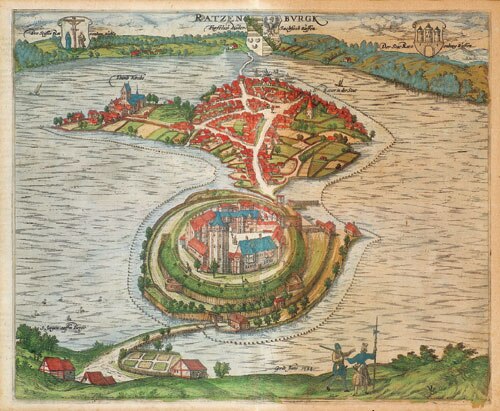
In 1619, Duke Augustus moved Saxe-Lauenburg's capital from Neuhaus upon Elbe to Ratzeburg, where it remained since.[20] During the Thirty Years' War (1618–1648), Augustus always remained neutral, however, billeting and alimenting foreign troops marching through posed a heavy burden onto the ducal subjects.[19] Augustus was succeeded by his elder half-brother Julius Henry in 1656. He had converted from Lutheranism to Catholicism in expectation of becoming appointed Prince-Bishop of Osnabrück in 1615, but guaranteed to leave the Lutheran state church and the Lower Saxon Church Order untouched.[21]
He confirmed the existing privileges of the nobility and the Ritter-und-Landschaft. In 1658, he forbade his vassals to pledge or else alienate fiefs, thus fighting the integration of manor estates in Saxe-Lauenburg into the monetary economies of the neighbouring economically powerful Hanseatic cities of Hamburg and Lübeck. He entered with both city-states into frontier disputes on manor estates which were in the process of evading Saxe-Lauenburgian overlordship into the competence of the city-states.
With the 1689 death of Duke Julius Francis, a son of Julius Henry, the Lauenburg line of the House of Ascania became extinct in the male line.[2] However, female succession was possible by the Saxe-Lauenburgian laws. So, the two surviving daughters of Julius Francis—Anna Maria Franziska of Saxe-Lauenburg and Sibylle Auguste of Saxe-Lauenburg—fought for the succession. Their weak position was abused by Duke George William of the neighbouring Brunswick and LunenburgianPrincipality of Lüneburg, who invaded Saxe-Lauenburg with his troops,[2] thus inhibiting the ascension of the legal heiress to the throne, Duchess Anna Maria.
There were at least eight monarchies claiming the succession,[2] resulting in a conflict involving further the neighbouring duchies of Mecklenburg-Schwerin and of Danish Holstein, as well as the five Ascanian-ruled Principalities of Anhalt, the Electorate of Saxony, which had succeeded the Saxe-Wittenbergian Ascanians in 1422, Sweden, and Brandenburg. Celle and Danish Holstein were militarily engaged, which agreed on 9 October 1693 (Hamburger Vergleich), that Celle—already de facto holding most of Saxe-Lauenburg—would retain the duchy, while the fortress in Ratzeburg, fortified under Celle rule and directed against Holstein, would be razed. In return, Danish Holstein, which had invaded Ratzeburg and ruined the fortress, would withdraw its troops.
George William compensated John George III, Elector of Saxony, for his claim with a substantial sum of money, since the ancestors of both these princes had made treaties of mutual succession with former dukes of Saxe-Lauenburg.[2] The Ritter-und-Landschaft then rendered homage to George William as their duke.[2] On 15 September 1702 George William confirmed the existing constitution, laws and legislative bodies of Saxe-Lauenburg.[22] On 17 May 1705, the Lutheran superintendency was moved from Lauenburg to Ratzeburg and combined with the pastorate of St. Peter's Church.[23] When he died on 28 August the same year, Saxe-Lauenburg passed to his nephew, George I Louis, elector of Hanover, afterwards king of Great Britain as George I.[2] The Lower Saxon Lutheran Church maintained its Church Order with the consistory and General Superintendent Severin Walter Slüter (1646–1697) in Lauenburg, succeeded by incumbents titled again superintendent only.[24]
ザクセン=ラウエンブルク(ハーデルンを除く)はヴェルフ家とその分家であるハノーファー家に引き継がれたが、正当な相続人であるアンナ・マリア・フランツィスカ・フォン・ザクセン=ラウエンブルクとシビル・アウグステ・フォン・ザクセン=ラウエンブルクは、相続権を放棄することなく、領地を剥奪され、前者はボヘミアのプロスコヴィツェに追放された。皇帝レオポルト1世はツェレの継承を拒否し、ツェレの手の届かないハーデルンを自らの支配下に置いた。 1728年、彼の息子である皇帝カール6世は、ザクセン=ラウエンベルクをジョージ1世の息子で後継者であるジョージ2世アウグストに封土として与え、1689年と1693年のジョージ・ヴィルヘルムによる事実上の支配を正当化した。[ 2 ] 1729年8月27日、彼はザクセン=ラウエンベルクの既存の憲法、法律、騎士団領地を確認した。[ 22 ] 1757年4月5日、ニーダーザクセン地方学校法は、ザクセン=ラウエンベルクのすべての子供に義務的な就学を布告した。[ 25 ]ジョージ3世は1760年に即位し、 1765年1月21日にセント・ジェームズ宮殿で発布された勅令により、ザクセン=ラウエンブルクのすべての法律、憲法、騎士領および領地を承認した。 [ 22 ] 1794年、ジョージ3世はザクセン=ラウエンブルクの優秀な教師に毎年報奨金を贈った。[ 26 ]

ザクセン=ラウエンブルク公国は1803年から1805年までフランス軍に占領され、[ 2 ]その後、フランス占領軍はオーストリアに対する作戦のために撤退した。イギリス、スウェーデン、ロシアの連合軍は、フランスに対する第三次対仏大同盟戦争(1805~06年)の開始時に、1805年秋にザクセン=ラウエンブルクを占領した。12月、第一帝政(1804年以降のフランスの新しい政体)は、もはや支配していなかったザクセン=ラウエンブルクをプロイセン王国に割譲し、プロイセン王国は1806年初頭に同公国を占領した。
When Prussia (after it had turned against France as part of the Fourth Coalition) was defeated in the Battle of Jena-Auerstedt (November 11, 1806), France recaptured Saxe-Lauenburg. It remained under French occupation until 1 March 1810, when most of it was annexed to the Kingdom of Westphalia, a French client state. A small area with 15,000 inhabitants remained reserved for Napoléon's purposes. On 1 January 1811, most of the former duchy (except for the Amt Neuhaus and the Marschvogtei, which remained with Westphalia) was annexed to the First French Empire[2] becoming part of the Bouches-de-l'Elbe department.
After the Napoleonic Wars, Saxe-Lauenburg was restored as a Hanoverian dominium in 1813.[2] The Congress of Vienna established Saxe-Lauenburg as a member state of the German Confederation. In 1814 the Kingdom of Hanover bartered Saxe-Lauenburg against Prussian East Frisia. On 7 June 1815, after 14 months under its rule, Prussia granted Saxe-Lauenburg to Sweden, receiving the former Swedish Pomerania in return, however, additionally paying 2.6 million Thaler to Denmark, in order to compensate Denmark for the loss of Norway.[27] In 1815 Denmark gained the portion of Lauenburg north of the Elbe, now ruled in personal union by the Danish House of Oldenburg,[2] from Sweden, which thus again compensated Danish claims to Swedish Pomerania. On 6 December 1815 Frederick VI of Denmark issued his Asseveration Act (Versicherungsacte) affirming the given laws, the constitution and the Ritter-und-Landschaft of Saxe-Lauenburg.[22] In 1816, his administration took possession of the duchy.[2]
第一次シュレースヴィヒ戦争(1848~1851年)の間、騎士団と地方軍はドイツ連邦を代表してハノーファー軍を平和維持占領軍として要請し、プロイセンによる征服を阻止した。[ 2 ] 1851年、デンマーク国王フレデリック7世がザクセン=ラウエンブルク公に復位した。[ 2 ]第二次シュレースヴィヒ戦争中、プロイセン軍とオーストリア軍が公国に侵攻した。ウィーン条約(1864年)により、デンマーク国王クリスチャン9世は公爵位を退位し、公国をプロイセンとオーストリアに割譲した。[ 2 ]オーストリアは30万ポンドの賠償金を受け取った後、1865年8月のガシュタイン条約によりザクセン=ラウエンブルクに対する領有権を放棄した。 [ 2 ]その後、騎士団と地方連合はプロイセンのヴィルヘルム1世に公爵位を申し出た。同年9月、ヴィルヘルム1世はこれを受け入れ、同君連合で公国を統治した。[ 2 ]ヴィルヘルムは当時プロイセン首相であったオットー・フォン・ビスマルクをザクセン=ラウエンブルクの大臣に任命した。1866年、ザクセン=ラウエンブルクは北ドイツ連邦に加盟した。[ 2 ]しかし、連邦参議院 における同地の投票はプロイセンの投票とともに集計された。
1871年、ザクセン=ラウエンブルクは統一ドイツを構成する諸州の一つであった。[ 2 ]しかし、1876年、公爵政府と騎士団は、1876年7月1日をもって公国を解体することを決定した。[ 2 ]その後、その領土はプロイセンのシュレースヴィヒ=ホルシュタイン州に統合され、ラウエンブルク公国を意味するラウエンブルク公領となった。
詳しい歴史については、ラウエンブルク公爵館のウェブサイトをご覧ください。
公爵夫人については、 「ザクセン公爵夫人一覧」を参照のこと(一部肖像画も掲載)。公爵たちの肖像画については、ジュリアス・ハインリヒから始まる「ザクセン君主一覧」を参照のこと。
公爵の数には、先代のアスカニアン公ベルンハルト1世、その息子アルブレヒト1世、そしてアルブレヒトの共同統治者である息子ヨハン1世とアルブレヒト2世が含まれる。彼らは皆、ザクセン=ラウエンブルク公国がザクセン=ヴィッテンベルク公国に分割される以前に、ザクセン公国を統治していた。
1303年、兄弟は遺産を分割したが、相続人がいたのは2人の兄弟だけで、ベルゲドルフ=メルン家とラッツェブルク=ラウエンブルク家が誕生した。
当初はザクセン=メルンと呼ばれていたが、1321年にアルブレヒト3世の領地の一部を含む領土再編が行われた際に改名された。
1401年、長男の家系は断絶し、ラウエンブルクはラッツェブルク=ラウエンブルク家と再統合された。
当初はザクセン=ベルゲドルフ=ラウエンブルクと呼ばれていたが、アルベール3世の領地を継承した後の領土再編に伴い、改名された。
1401年、分家は断絶したベルゲドルフ=メルン本家のラウエンブルクおよびその他の領地を相続した。
For 113 years, the duchy was ruled by members of the Welf dynasty. However, their rule was not legitimised until 1728, when Emperor Charles VI enfeoffed George II Augustus with Saxe-Lauenburg.
For almost fifty years, from 1815, Saxe-Lauenburg was within the German Confederation, and in personal union with the Kingdom of Denmark:
For twelve years Saxe-Lauenburg was ruled in personal union with Prussia, within the North German Confederation (1867–71). In 1871 Saxe-Lauenburg became a component state of united Germany (German Empire).