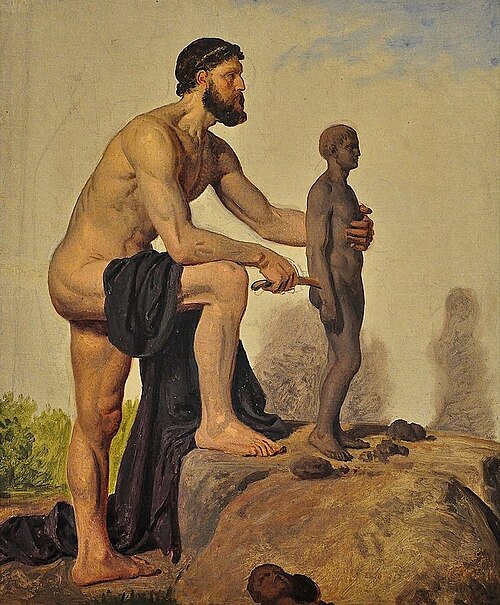
The creation of life from clay (or soil, earth, dust, or mud) appears throughout world religions and mythologies, some of the earliest occurring in the creation myths about the origin of man in the cosmology of the ancient Near East. The idea occurs in both biblical cosmology and Quranic cosmology. The clay represents an unformed, chaotic material which is shaped and given form by the gods in a creative process. A related motif is the use of clay to seed or create the world.[1] In southwest Asia, the clay-shaping was cast as a magical act. In the same way that humans would use clay to make terracotta images of their gods, so the gods moulded humans out of clay in their godlike form. They were described as obtaining this material by pinching off pieces of wet mud.[2]
The Book of Genesis 2:7 states that man was made out of dust. The name Adam derives from the Hebrew word adāmāh, which literally means "red clay".[5]
In Jewish folklore, a golem (Hebrew: גולם) is an animated anthropomorphic being that is created entirely from inanimate matter, usually clay or mud.[6]
Christianity
Many of the Church Fathers, including John Chrysostom and Basil of Caesarea, advocated the creation of Adam from clay. John, Basil, and others interpreted this as God creating man from a low material, which should lead to humility on the part of man.[7]
In the cosmology of the Quran, man is said to have been created from clay (Quran23:12), referred to by the Arabic ṭīn. Adam is also said to have been made from dust (turāb). Like other traditions, the concept has negative connotations in the Quran, and the use of this matter to make Adam is cited as justification by Iblis (Satan) to reject God's command to prostrate to him.[7]
List of examples by region and culture
Ancient Near Eastern
The Epic of Gilgamesh states that the goddess Aruru created humans and animals out of clay. The epic goes on to narrate how Aruru also creates Enkidu out of a pinch of clay.[11]
The Sumerian myth of the Ninhursag states that humans were fashioned from clay to serve the gods (see Enki and the Making of Man) as part of a competition. In the Akkadian version, the Epic of Atrahasis, Enki advises that a god is killed and that Nintur (the birth goddess) mix his flesh and blood with clay to create humans. A similar idea is seen in the Enuma Elish, where Enki creates man out of the blood of a slain revel god.[12]
The Babylonian Epic of Atrahasis states that humans were created by Nintu (Ninhursag) from mixing clay with the blood of a sacrificed god.[13][14] In context, the elder gods forced the younger gods to do all the hard labor so the younger gods devised a plan to create humans to do their bidding instead. The sacrificed god Ilawela (also written as Geshtu-(E), Geshtu, Gestu, or We-ila) is a minor god of intelligence (the text states this quite clearly: "Ilawela ...had intelligence").[15]
Contrary to common misconception, the Babylonian creation epic Enuma Elish says that humans were created from a combination of blood and bone, and not clay. Marduk instructed Enki (Ea) to do this, which he did using the blood of Tiamat's fallen consort, Kingu.[16]
Egyptian
In Ancient Egypt, it was the Egyptian god Khnum that was most commonly associated with the creation of humans. Khnum is said to create human children from clay[17] before placing them into their mother's womb.[18] Khnum was the crafter of all living things, including some gods, on the potter's wheel: "You are the master of the wheel, who is pleased to model on the wheel . . . you have made humans on the wheel, you have created the gods; you have modelled the small and large cattle; you have formed everything on your wheel each day, in your name Khnum the potter".[2]
Greek
In Greek mythology, according to Pseudo-Apollodorus,[19]Prometheus molded men out of water and earth. Near the town of Panopeus, the remaining used clay was allegedly still present in historical times as two cart-sized rocks that smelled like a human body.[20][21] Myths about Prometheus were inspired by Near Eastern Myths about Enki.[22]
Also in Greek mythology, Prometheus moulds a clay statue of Athena, the goddess of wisdom to whom he is devoted, and gives it life from a stolen sunbeam.[23]
Pandora, from Greek mythology, was fashioned from clay and given the quality of "naïve grace combined with feeling".[24]