
Loading article…
| 大学フットボール | |
|---|---|
_rushes_for_one_of_two_touchdowns_while_being_persued_by_Army_defenders_Cason_Shrode_(54)_and_Taylor_Justice_(42).jpg/500px-thumbnail.jpg) | |
| 統治機関 | |
| 初プレイ | 1869 |
クラブ競技 | |
NCAA :
NAIA : NJCAA : | |
観客記録 | |
| シングルマッチ | 156,990 (テネシー 45-24 バージニア工科大学、ブリストル・モーター・スピードウェイ)、2016年9月10日[1] |
カレッジフットボール(フランス語:football universitaire)は、大学や短大のアマチュア学生アスリートのチームによって行われるグリッドアイアンフットボールです。グリッドアイアンフットボールが米国で最初に人気を博したのは、大学の競技を通じてでした。
グリッドアイアンフットボール全般と同様、カレッジフットボールは米国とカナダで最も人気があります。米国にはカレッジフットボールを統括する単一の組織はありませんが、ほとんどの学校、特に最高レベルのプレーをしている学校はNCAAのメンバーです。カナダでは、大学フットボールの競技は大学のU Sportsによって統括されています。カナダ大学体育協会(大学向け) はサッカーやその他のスポーツを統括していますが、グリッドアイアンフットボールは統括していません。メキシコ、日本、韓国などの他の国でも、中程度の支援でカレッジフットボールリーグが開催されています。
北米の他のほとんどの主要スポーツとは異なり、アメリカンフットボールやカナディアンフットボールには公式のマイナーリーグ ファーム組織は存在しない。そのため、大学フットボールは一般的にアメリカンフットボールやカナディアンフットボールの第2層、つまり高校の競技よりは上だがプロの競技よりは下と考えられている。米国の一部地域、特に南部と中西部では、大学フットボールはプロのフットボールよりも人気がある。[2] 20世紀のほとんどの間、大学フットボールは一般的にプロのフットボールよりも権威があると考えられていた。[要出典]
アメリカンフットボールはアメリカで2番目に高いレベルのフットボール競技であり、多くの大学フットボール選手が後にNFLや他のリーグでプロとしてプレーする。毎年春に行われるNFLドラフトでは224人の選手が選ばれ、リーグでプレーする契約をオファーされるが、その大部分はNCAAから来る。CFLやUFLなどの他のプロリーグも毎年独自のドラフトを開催しており、多くの大学選手が選ばれる。選ばれなかった選手も、ドラフト外フリーエージェントとしてプロのロースター入りを狙うことができる。こうした機会があるにもかかわらず、NCAAの大学フットボール選手のうちNFLでプロとしてプレーする選手はわずか1.6%程度である。[3]
歴史
プロのナショナル・フットボール・リーグ(NFL)が誕生した後も、大学フットボールは全米で絶大な人気を保っている[4] 。大学の試合はプロの試合よりも才能に差があるものの、主要大学を応援するファンの数が多いため、試合の財政面では均衡が保たれている。最高レベルのディビジョンIのプログラムは巨大なスタジアムでプレーし、そのうち6つのスタジアムの収容人数は10万人を超えている。[5]多くの場合、大学のスタジアムでは、背もたれや肘掛けのある個別の座席ではなく、ベンチスタイルの座席が採用されている(ただし、多くのスタジアムには、ベンチ席のほかに少数の背もたれ付き椅子席がある)。これにより、一般的なプロのスタジアムよりも、一定のスペースに多くのファンを着席させることができ、プロのスタジアムにはファン向けの機能や快適さが備わっている傾向がある。米国の大学が所有するスタジアムで、完全に背もたれ付き椅子席のみで構成されているのは、ルイビル大学のL&Nスタジアム、ジョージア州立大学のセンターパークスタジアム、フロリダアトランティック大学のFAUスタジアムの3つだけである。
NFLの選手とは異なり、大学のアスリートはNCAAから給与を受け取ることを許可されていない。大学は、授業料、住居、書籍を提供するスポーツ奨学金など、金銭以外の補償のみを提供することが許可されている。NCAAが制定した新しい細則により、大学のアスリートはプロデビュー前にスポンサーや資金を獲得する方法として、 「名前、イメージ、肖像」(NIL)契約を受けることができるようになった。[6]
イギリスとカナダのラグビー
現代の北米のフットボールは、19 世紀半ばにイギリスの公立学校で行われていた「フットボール」と呼ばれるさまざまなゲームに起源があります。1840 年代には、ラグビー校の生徒たちが、ボールを拾って走るゲームをしていました。このスポーツは後にラグビー フットボールとして知られるようになりました。このゲームはカナダに駐留していたイギリス軍兵士によってカナダに持ち込まれ、すぐにカナダの大学で行われるようになりました。
記録に残る最初のグリッドアイアンフットボールの試合は、1861年11月9日にトロント大学のユニバーシティカレッジで行われた。トロント大学の学生が参加したこの試合の参加者の1人は、後に同校の総長となるウィリアム・マロックだった。その後すぐに大学にフットボールクラブが結成されたが、当時の試合ルールははっきりしていない。
1864年、トロント大学のトリニティ・カレッジで、F・バーロウ・カンバーランドとフレデリック・A・ベスーンがラグビーフットボールを基にしたルールを考案した。現代のカナディアンフットボールは、1865年にモントリオールでイギリス陸軍将校が地元の民間人と対戦したゲームが起源であると広く考えられている。このゲームは徐々に人気を集め、1868年にモントリオール・フットボール・クラブが結成された。これはカナダで記録に残る最初の大学以外のフットボールクラブである。
アメリカの大学フットボール
初期のゲームは、イギリスでプレイされていた伝統的な「モブ フットボール」と多くの共通点があったようです。19 世紀に大学のキャンパス内でフットボールの試合が行われるようになるまで、ゲームはほとんど組織化されていませんでした。各学校は独自の種類のフットボールをプレイしていました。プリンストン大学の学生は、1820 年にはすでに「バローン」と呼ばれるゲームをプレイしていました。
1827 年、ハーバード大学の伝統行事として「ブラッディ マンデー」が始まりました。これは、1 年生と 2 年生が集団でボール ゲームを行うというものでした。1860 年、町の警察と大学当局は、ブラッディ マンデーを廃止することに合意しました。ハーバード大学の学生たちは、「フットボール ファイタム」と呼ばれる架空の人物のために喪に服し、葬儀を行いました。当局は断固とした態度を貫き、ハーバード大学でフットボールが再びプレーされるまでにはさらに 12 年かかりました。ダートマス大学は「オールド ディビジョン フットボール」と呼ばれる独自のフットボールをプレーしました。このフットボールのルールは 1871 年に初めて発表されましたが、このゲーム自体の起源は少なくとも 1830 年代に遡ります。これらのゲームやその他のゲームには、共通点がいくつかありました。それらは主に「暴徒」スタイルのゲームのままで、大勢のプレーヤーが、しばしばあらゆる手段を使って、ゴール エリアにボールを進ませようとします。ルールは単純で、暴力や怪我はよくありました。[7] [8]こうした暴徒による暴力的なゲームは広範囲にわたる抗議を引き起こし、ゲームを中止する決定につながった。イェール大学はニューヘイブン市からの圧力を受け、1860年にあらゆる形態のフットボールのプレーを禁止した。[7]
アメリカンフットボールの歴史家パーク・H・デイビスは、 1869年から1875年までの期間を「開拓時代」と呼び、1876年から1893年を「アメリカ大学フットボール協会の時代」、1894年から1933年を「規則委員会と会議の時代」と名付けました。[9]
プリンストン・コロンビア・イェール・ラトガース
1869年11月6日、ラトガース大学はプリンストン大学(当時はニュージャージー大学と呼ばれていた)と初の大学フットボールの試合で対戦した。この試合は21世紀にプレーされているフットボールよりもサッカーに似ていた。この試合は丸いボールでプレーされ、ラトガース大学のキャプテン、ウィリアム・J・レゲットが提案した一連のルールが使用された。このルールはフットボール協会の最初のルールに基づいており、イングランドのパブリックスクールの元生徒が、さまざまなパブリックスクールのルールを統一しようとした初期の試みであった。[7] [10] [11] [12]
この試合はニュージャージー州ニューブランズウィックのラトガースフィールドで行われた。25人の選手からなる2チームが、相手チームのゴールにボールを蹴り込んで得点を競った。ボールを投げたり運んだりすることは禁止されていたが、選手同士の肉体的な接触は十分にあった。先に6ゴールを決めたチームが勝者となった。ラトガースが6対4で勝利した。1週間後、プリンストンでプリンストン独自のルールで再戦が行われた(注目すべき違いの1つは、ボールをキャッチした選手には「フリーキック」が与えられることだった。これはアメリカンフットボール協会のルールから採用された特徴で、フェアキャッチキックのルールは現代のアメリカンフットボールにも引き継がれている)。プリンストンは8対0で勝利した。コロンビア大学は1870年にこのシリーズに参加し、1872年までにエール大学やスティーブンス工科大学など、いくつかの大学が大学対抗チームを編成していた。[7]
コロンビア大学は、チームを編成した3番目の学校でした。ライオンズは1870年11月12日にニューヨーク市からニューブランズウィックまで遠征し、ラトガースに6対3で敗れました。試合は混乱に陥り、選手たちはボールと同じくらいお互いを蹴ったり戦ったりしました。1870年後半、プリンストンとラトガースは再び対戦し、プリンストンがラトガースを6対0で破りました。この試合の暴力行為は大きな抗議を引き起こし、1871年には試合が全く行われませんでした。フットボールは1872年にコロンビアが初めてイェールと対戦したときに復活しました。イェールチームのコーチ兼キャプテンは、ラグビー校在学中にフットボールを学んでいたデビッド・シュレイ・シャフでした。シャフ自身は負傷して試合に出場できませんでしたが、それでもイェールは3対0で試合に勝ちました。1872年後半、スティーブンス・テックはチームを編成した5番目の学校になりました。スティーブンスはコロンビア大学に敗れたが、翌年ニューヨーク大学とニューヨーク市立大学の両方に勝利した。
1873 年までに、フットボールをする大学生たちは、その新興のゲームを標準化するために多大な努力を払っていた。チームの人数は 25 人から 20 人にまで縮小された。得点する唯一の方法は、依然として相手チームのゴールにボールを打つか蹴ることであり、試合は 140 ヤードの長さと 70 ヤードの幅のフィールドで 45 分間のハーフを 2 回戦で戦った。1873 年 10 月 20 日、イェール大学、コロンビア大学、プリンストン大学、ラトガース大学の代表者がニューヨーク市のフィフス アベニュー ホテルに集まり、大学間フットボールの最初のルールを制定した。この会議以前は、各大学が独自のルールを持っており、試合は通常、ホーム チームの独自のコードを使用して行われていた。この会議で、大学間フットボールの試合のルール リストが作成されたが、これは設立されたばかりのラグビー フットボール ユニオンのルールよりもフットボール協会のルールに基づいていた。[7]
ハーバード・マギル大学(1874)

1872 年、ハーバード大学でフットボールが再開され、古い「フットボール ファイタム」が復活しました。しかし、ハーバード大学は「ボストン ゲーム」と呼ばれる、より荒っぽいフットボールを好んでプレイしました。ボストン ゲームでは、丸いボールを蹴ることが最も目立った特徴ですが、プレーヤーはボールを持って走ったり、パスしたり、ドリブルしたり (「ベイビー」として知られています) することもできました。ボールを持っているプレーヤーはタックルされる可能性がありますが、殴ったり、つまずいたり、「ハッキング」したり、その他の不必要な荒っぽい行為は禁止されていました。プレーヤーの数に制限はありませんでしたが、通常は 1 チームあたり 10 人から 15 人でした。プレーヤーは、追いかけられているときのみボールを運ぶことができました。
その結果、ハーバードは、1873年10月20日にニューヨーク市のフィフスアベニューホテルでラトガース大学、プリンストン大学、コロンビア大学が主催したルール会議への出席を拒否し、本質的にはアソシエーションフットボールである形式のフットボールをプレーできるようにする一連のルールと規則に同意することを拒否し、独自の規則の下でプレーし続けた。ハーバードが会議を自主的に欠席したため、他のアメリカの大学との試合をスケジュールすることが困難になったが、モントリオールのマギル大学のラグビーチームとの2試合シリーズでの対戦には同意した。1874年5月14日と15日にマサチューセッツ州ケンブリッジにあるハーバードのジャービス野球場で2試合を行うことが合意され、1試合はハーバードのルールで、もう1試合はより厳格なマギルのラグビー規則の下でプレーされた。ジャービス・フィールドは当時、ハーバード大学キャンパスの北端にある土地で、南北はエベレット通りとジャービス通り、東西はオックスフォード通りとマサチューセッツ通りに囲まれていた。ハーバードは木曜日の「ボストン・ゲーム」でマギル大学に勝ち、金曜日にはマギル大学を0対0の引き分けに抑えた。ハーバードの学生たちはラグビーのルールを自分のものにした。[7] [13] [14]このゲームではラグビー風の長方形のボールではなく丸いボールが使われた。[14]この一連のゲームは、現代のアメリカンフットボールの発展における重要な節目となった。[15] [16] 1874年10月、ハーバードのチームは再びモントリオールに遠征し、ラグビーでマギル大学と対戦し、3トライ差で勝利した。
ラグビーフットボールはイギリスからカナダに移植されたため、マギル大学のチームは、選手がいつでもボールを拾い、走り回ることができるという一連のルールに従ってプレーしていました。マギル大学独自のもう 1 つのルールは、ゴールだけでなくトライ(相手チームのゴールラインを越えてボールを地面に落とす行為。当時はエンドゾーンはありませんでした) も得点にカウントするというものでした。当時のラグビーのルールでは、トライはフィールドからフリーゴールを蹴る試みのみを意味していました。キックが失敗した場合、トライ自体には得点がありませんでした。
ハーバード・タフツ大学、ハーバード・イェール大学(1875)
ハーバードはすぐにラグビーの試合とトライの採用を気に入ったが、トライは当時アメリカンフットボールでは使われていなかった。トライは後にタッチダウンとして知られる得点に進化した。1875年6月4日、ハーバードはタフツ大学と対戦した。これはアメリカの大学同士の初めての試合で、マギル対ハーバードの試合に似たルールで行われ、タフツが1対0で勝利した。[17]ルールには、各チームが常に11人ずつで戦うこと、ボールは蹴るか運ぶことで前進させること、ボールキャリアのタックルでプレーを止めることなどが含まれていた。これらの行動は、今日行われている現代のフットボールにも引き継がれている[18]。
ハーバードはその後、最大のライバルであるイェールに挑戦し、ブルドッグスはこれを受け入れた。両チームは「譲歩ルール」と呼ばれる一連のルールの下でプレーすることに合意した。このルールでは、ハーバードはイェールのサッカーに対していくらか譲歩し、イェールはハーバードのラグビーに対してかなり譲歩する。両チームは、各チーム15人の選手でプレーすることに決めた。1875年11月13日、イェールとハーバードは初めて対戦し、ハーバードが4対0で勝利した。最初のザ・ゲーム(ハーバードとイェールの毎年の試合はこう呼ばれるようになった)には、将来「アメリカンフットボールの父」となるウォルター・キャンプが2000人の観客の中にいた。コネチカット州ニューブリテン生まれのウォルターは、翌年イェールに入学する。彼はハーバードのプレースタイルへの憧れとイェールの敗北の惨めさの間で引き裂かれ、イェールの敗北の復讐を決意した。プリンストンの観客もこの試合を地元に持ち帰り、すぐに最も人気のあるフットボールとなった。[7]
1876年11月23日、ハーバード、イェール、プリンストン、コロンビアの代表者がマサチューセッツ州スプリングフィールドのマサソイト・ハウス・ホテルに集まり、 1874年にマギル大学がハーバードに初めて導入したラグビー競技に基づいた新しいルールを標準化した。この会議の結果、ハーバード、コロンビア、プリンストンの3校が大学対抗フットボール協会を結成した。イェールは当初、チームあたりの選手数に関する意見の相違からこの協会への加入を拒否したが(1879年に譲歩)、ラトガースは会議に招待されなかった。彼らが合意したルールは、トライを決めた際にポイントが与えられるという点を除けば、当時のラグビーユニオンのルールと基本的に同じだった。ちなみに、ラグビーも10年後に同様の得点システムの変更を行った。[19]
ウォルター・キャンプ: アメリカンフットボールの父

ウォルター・キャンプは、アメリカンフットボールの発展において最も重要な人物であると広く考えられています。[10] [11] [19]若い頃、彼は陸上競技、野球、アソシエーションフットボールなどのスポーツで優秀な成績を収め、 1876年にイェール大学に入学した後、学校が提供するすべてのスポーツで優秀な成績を収めました。[19]
アメリカンフットボールにラグビー風のルールが導入された後、キャンプはルールが議論され変更されるマサソイト・ハウスの大会に欠かせない存在となった。キャンプは、無秩序な暴徒に思えたことに不満を抱き、1878年に初めて出席した会議で、最初のルール変更を提案した。それは、プレーヤーを15人から11人に減らすことだった。この動議は当時は却下されたが、1880年に可決された。その結果、ゲームはオープンになり、強さよりもスピードが強調された。キャンプの最も有名な変更である、スクリメージ・ラインとセンターからクォーターバックへのスナップの確立も、1880年に可決された。当初、スナップはセンターの足で実行されていた。後の変更により、空中または直接の手から手のパスで、手でボールをスナップできるようになった。[19]ラグビーリーグはキャンプの例に倣い、1906年にプレー・ザ・ボールルールを導入した。これはキャンプの初期のスクリメージルールとセンタースナップルールに非常によく似ていた。1966年、ラグビーリーグはキャンプの初期のダウン・アンド・ディスタンスルールに基づいて4タックルルール(1972年に6タックルルールに変更)を導入した。
キャンプの新しいスクリメージルールはゲームに革命をもたらしたが、必ずしも意図通りではなかった。特にプリンストンはスクリメージプレーを使ってゲームをスローダウンさせ、ダウンごとにエンドゾーンに向かって徐々に前進した。キャンプの当初の意図であった得点を増やすのではなく、このルールはゲーム全体を通してボールのコントロールを維持するために利用され、スローで面白くない試合となった。1882年のルール会議で、キャンプはチームが3ダウン以内に最低5ヤードボールを進めることを義務付けることを提案した。これらのダウンアンドディスタンスルールとスクリメージラインの確立により、このゲームはラグビーフットボールのバリエーションからアメリカンフットボールという独自のスポーツへと変化した。[19]
キャンプは、アメリカンフットボールを定義することになるいくつかの重要なルール変更の中心人物だった。1881年、フィールドのサイズは現在の120ヤード×53.5ヤード(109.7メートル×48.8メートル)に縮小された。1883年にキャンプは得点ルールを数回変更し、最終的にタッチダウンで4点、タッチダウン後のキックで2点、セーフティで2点、フィールドゴールで5点というルールにたどり着いた。ポイントスコアリングの分野におけるキャンプの革新は、1890年にラグビーユニオンがポイントスコアリングに移行することに影響を与えた。[要出典] 1887年、試合時間は各45分の前後半に設定された。また1887年には、各試合に2人の有給役員(レフリーとアンパイア)が義務付けられた。 1年後、ルールが変更され、腰より下のタックルが許可され、1889年には審判員にホイッスルとストップウォッチが支給された。[19]
1882年にイェール大学を去った後、キャンプは1925年に亡くなるまでニューヘイブン・クロック・カンパニーに勤務した。選手ではなくなったものの、キャンプは生涯を通じて毎年のルール会議に出席し、1889年から1924年まで毎年オールアメリカンチームを自ら選出した。ウォルター・キャンプ・フットボール財団は彼に敬意を表してオールアメリカンチームを選出し続けている。[20]
スコア表
拡大
大学フットボールは 19 世紀最後の 20 年間に大きく発展しました。いくつかの大きなライバル関係はこの時期に始まりました。
1890年11月はフットボールが活発な時期だった。1890年11月22日、カンザス州ボールドウィンシティでカンザス州で初めて大学フットボールの試合が行われた。ベイカーがカンザスを22対9で破った。[22] 27日には、ヴァンダービルトがアスレチックパークでナッシュビル(ピーボディ)と対戦し、40対0で勝利した。テネシー州で組織的にフットボールが行われた初めての試合だった。[23] 29日には陸軍対海軍の試合も初めて行われた。海軍が24対0で勝利した。
東
ラトガース大学は、このスポーツの普及を最初に進めた。ニューヨーク州で初めて大学対抗戦が行われたのは、1872年11月2日、ラトガース大学がコロンビア大学と対戦したときだった。これは、この新興スポーツの歴史上、初の無得点引き分けでもあった。[24] イェール大学のフットボールも同じ年に始まり、フットボールをプレーできる最も近い大学であるコロンビア大学と初戦を戦った。この試合はニューヘブンのハミルトンパークで行われ、ニューイングランドで初の試合となった。この試合は基本的に20人制サッカーで、400フィート×250フィートのフィールドで行われた。イェール大学が3対0で勝利し、トミー・シャーマンが最初のゴールを決め、ルー・アーウィンが残りの2ゴールを決めた。[25]
ハーバード大学との最初の試合の後、タフツ大学はチームをメイン州ルイストンのベイツ大学に連れて行き、メイン州で最初のフットボールの試合を行った。[26]これは1875年11月6日に起こった。
ペンシルバニア大学の体育協会は、コロンビア大学とのフットボールの試合に出場する「20人」を選抜しようとしていた。この「20人」はコロンビア大学と対戦することはなかったが、プリンストン大学とは2回対戦した。[27]プリンストン大学は2試合とも6対0で勝利した。最初の試合は1876年11月11日にフィラデルフィアで行われ、ペンシルベニア州で最初の大学対抗戦となった。
ブラウンは1878年に大学対抗戦に出場した。[28]
1チームが100点以上を獲得した最初の試合は1884年10月25日で、イェール大学がダートマス大学を113対0で破った。これはまた、1チームが100点以上を獲得し、相手チームが完封された最初の試合でもあった。[29]翌週、プリンストン大学はラファイエット大学を140対0で破った。[30]
バーモント州での最初の大学対抗戦は1886年11月6日、バーモント州バーリントンでダートマス大学とバーモント大学の間で行われた。ダートマス大学が91対0で勝利した。[31]
ペンシルベニア州立大学は1887年に最初のシーズンをプレーしたが[32] 、 1887年から1891年までの最初の5年間はヘッドコーチがいなかった。 [32]チームはペンシルベニア州ステートカレッジのキャンパスにあるオールドメインの芝生でホームゲームを行った。彼らは1887年から1890年まで独立したチームとしてプレーし、これらのシーズンで12勝8敗1引き分けの成績を収めた。
1891年、ペンシルバニア大学フットボール協会(PIFA)が結成された。協会はバックネル大学、ディキンソン大学、フランクリン&マーシャル大学、ハバーフォード大学、ペンシルベニア州立大学、スワースモア大学で構成されていた。ラファイエット大学とリーハイ大学は協会を独占すると思われたため除外された。ペンシルベニア州立大学は4勝1敗0引き分けで優勝した。バックネルの成績は3勝1敗1引き分け(フランクリン&マーシャルに負け、ディキンソンと引き分け)。協会は1892年のシーズン前に解散した。[32]
最初の夜間フットボールの試合は1892年9月28日にペンシルベニア州マンスフィールドで行われ、マンスフィールド州立師範学校とワイオミング神学校の試合で、ハーフタイムで0対0の引き分けに終わった。[33] 1893年の陸軍対海軍の試合では、試合で選手がフットボールのヘルメットを使用したことが初めて記録されている。ジョセフ・M・リーブスは、以前頭部を蹴られた後、フットボールを続ければ命の危険があると医師から警告された後、アナポリスの靴職人に粗末な革のヘルメットを作ってもらい、それを試合で着用した。[34]
中西部

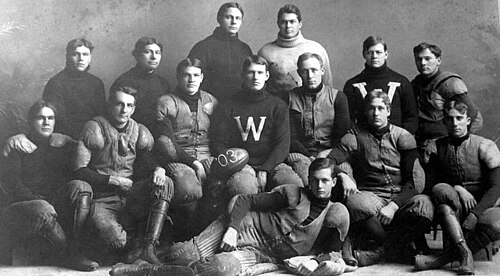
1879年、ミシガン大学はペンシルバニア州西部で初めて大学フットボールチームを設立した。1879年5月30日、シカゴで行われた試合でミシガン大学はラシーン大学を1対0で破った。シカゴ・デイリー・トリビューンはこれを「アレゲニー山脈の西側で行われた最初のラグビーフットボールの試合」と呼んだ。[35]シカゴ大学、ノースウェスタン大学、ミネソタ大学など、中西部の他の大学もすぐにこれに続いた。東部に遠征した最初の西部チームは1881年のミシガンチームで、ハーバード大学、イェール大学、プリンストン大学でプレーした。[36] [37]国内初の大学フットボールリーグである大学間教員代表者会議(ウェスタン・カンファレンスとも呼ばれる)は、ビッグ・テン・カンファレンスの前身であり、1895年に設立された。[38]
フィールディング・H・ヨスト監督の指揮の下、ミシガン大学は「西部」初の強豪校となった。1901年から1905年まで、ミシガン大学は56試合無敗の記録を残し、その中には1902年に初の大学フットボールボウルゲーム(後にローズボウルゲームとなる)に出場したことも含まれている。この記録の間、ミシガン大学は2,831得点を挙げ、失点はわずか40点だった。[39]
組織的な大学対抗フットボールは1882年9月30日にミネソタ州で初めて行われ、ハムラインはミネソタと対戦するよう説得された。ミネソタが2対0で勝利した。 [40]これはミシシッピ川の西側で行われた最初の試合であった。
1905年11月30日、シカゴはミシガンを2対0で破った。「今世紀初の最高の試合」と呼ばれたこの試合は、[41]ミシガンの56試合無敗記録を破り、「1分間に1ポイント」の時代を終わらせた。
南


組織化された大学フットボールは、1873年11月2日、バージニア州とその南部で、ワシントン・アンド・リー大学とVMIの間でレキシントンで初めてプレイされました。ワシントン・アンド・リー大学が4対2で勝利しました。[42]両校の勤勉な学生数名が1869年10月23日に試合を企画しましたが、雨で中止になりました。[43]バージニア大学の学生たちは、1870年には早くもキック式のフットボールのピックアップゲームをプレイしており、1871年にはワシントン・アンド・リー大学との試合を企画したと主張する記録もありますが、この試合のスコアに関する記録は見つかっていません。以前の試合の記録が乏しいため、 1887年11月13日のバージニア対パントップス・アカデミーがバージニアでの最初の試合であると主張する人もいます。
1880年4月9日、ストールフィールドで、トランシルバニア大学(当時はケンタッキー大学と呼ばれていた)がセンターカレッジを13対1で破った。+3 ⁄ 4 –0で勝利したこの試合は、南部で記録された最初の試合とよく考えられている。 [44]南部で最初の「科学的フットボール」の試合は、 1888年の感謝祭の日にノースカロライナ州ローリーのノースカロライナ州立フェアグラウンドで開催されたノースカロライナ大学とデューク大学(当時はトリニティカレッジとして知られていた)間のビクトリーベルライバルの最初の試合であった。 [45]
1887年11月13日、バージニア・キャバリアーズとパントップス・アカデミーは、バージニア州で初めて組織されたフットボールの試合でスコアレスドローに終わった。[46]バージニア大学の学生は、1870年にはすでにキック・スタイルのフットボールのピックアップ・ゲームを行っており、一部の記録では、熱心な学生が1871年にワシントン・アンド・リー大学との試合を組織したとさえ主張している。これは、ラトガース大学とプリンストン大学が1869年に歴史的な初試合を行ったわずか2年後のことである。しかし、この試合のスコアに関する記録は見つかっていない。ワシントン・アンド・リー大学は、1873年にVMIに4対2で勝利したとも主張している。 [42]
1888年10月18日、ウェイクフォレスト大学のデーモンディーコンズがノースカロライナ州で行われた初の大学対抗戦でノースカロライナ大学のタールヒールズを6対4で破った。[47]
1889年12月14日、サウスカロライナ州で行われた初の大学対抗戦で、ウォフォード大学がファーマン大学を5対1で破った。この試合ではユニフォームやポジションはなく、ルールは試合前に策定された。[48]
1892年1月30日、ジョージア・ブルドッグスがハーティ・フィールドでマーサーを50対0で破り、ディープサウスで最初のフットボールの試合が行われた。
現在のサウスイースタン・カンファレンスとアトランティック・コースト・カンファレンスの始まりは1894年である。南部大学体育協会(SIAA)は、1894年12月21日、ヴァンダービルト大学の化学教授ウィリアム・ダドリーによって設立された。[49]当初のメンバーは、アラバマ、オーバーン、ジョージア、ジョージア工科大学、ノースカロライナ、スワニー、ヴァンダービルトであった。クレムソン、カンバーランド、ケンタッキー、ルイジアナ州立大学、マーサー、ミシシッピ、ミシシッピA&M(ミシシッピ州立大学)、サウスウェスタン・プレスビテリアン大学、テネシー、テキサス、チューレーン、ナッシュビル大学は、翌年の1895年に招待会員として加わった。[50]このカンファレンスは、もともと「南部全域の大学スポーツの発展と浄化」のために結成された。[51]
フットボールで最初のフォワードパスは、1895年10月26日のジョージア州とノースカロライナ州の試合で行われたとみられる。ノースカロライナ州のバック、ジョエル・ウィテカーが必死の思いでパントせずにボールを投げ、ジョージ・スティーブンスがキャッチした。[52] 1895年11月9日、ジョン・ハイズマンはクォーターバックのレイノルズ・ティチェナーを使って隠しボールトリックを実行し、ヴァンダービルト大学に6対9で敗れた試合でオーバーン大学の唯一のタッチダウンを決めた。これは南部でフィールドゴールで決着がついた最初の試合だった。[53]ハイズマンは後にポップ・ワーナーのジョージア州チームに対してこのトリックを使った。ワーナーはこのトリックを習得し、後に1897年にコーネル大学対ペンシルベニア州立大学戦で使用した。 [54]その後ワーナーは1903年にカーライル大学対ハーバード大学戦でこのトリックを使用し、全国的な注目を集めた。
1899年のセワニー・タイガースは、このスポーツの黎明期における史上最高のチームの1つである。チームは12勝0敗で、対戦相手を322対10で打ち負かした。「鉄の男たち」として知られる彼らは、わずか13人で6日間の遠征を行い、テキサスA&M、テキサス、テュレーン、ルイジアナ州立大学、オレミスを5試合完封した。「…そして7日目に彼らは休んだ」というフレーズで印象深く回想されている。[55] [56] グラントランド・ライスは彼らを「私が今まで見た中で最も耐久性のあるフットボールチーム」と呼んだ。[57]
組織化された大学間フットボールは、1901年にフロリダ州で初めて開催されました。[58]ステットソンとフォーブスの校内チーム間の7試合シリーズは1894年に開催されました。公式の代表チーム間の最初の大学間試合は1901年11月22日に開催されました。ステットソンは、ジャクソンビルフェアの一環として行われた試合で、フロリダ大学の前身となる4つの大学の1つであるレイクシティのフロリダ農業大学を6対0で破りました。[59]
1902年9月27日、ジョージタウン大学は海軍大学を4対0で破った。ジョージタウン大学当局は、ジャーマニー・シュルツの通常の物語とは対照的に、パーシー・ギブンが立ち上がったとき、史上初の「ロービング・センター」またはラインバッカーが出場した試合だったと主張している。[60]南部初のラインバッカーはフランク・ジュハンであるとよく考えられている。
1903年の感謝祭の日、アラバマ州モンゴメリーで、南部大学体育協会の各地域の最優秀チームによる「SIAAチャンピオンシップゲーム」の試合が予定され、カンバーランドとハイズマンのクレムソンが対戦した。試合は11対11の引き分けに終わり、多くのチームが優勝を主張した。ハイズマンはカンバーランドがチャンピオンの座を獲得するよう強く主張した。これがクレムソンのヘッドコーチとしての最後の試合となった。[61]
1904 年は南部で大物コーチの採用が行われた年で、オーバーン大学のマイク・ドナヒュー、ジョージア工科大学のジョン・ハイズマン、ヴァンダービルト大学のダン・マクギギンが採用された。ドナヒューとマクギギンはともに北部から来たばかりで、ドナヒューはイェール大学、マクギギンはミシガン大学出身で、大学フットボール殿堂入りした最初のメンバーの 1 人だった。1904 年、無敗だったヴァンダービルト大学のチームは、そのシーズンの大学フットボールで最高となる 1 試合平均 52.7 得点を記録し、失点はわずか 4 点だった。
南西
オクラホマ準州で最初の大学フットボールの試合は1895年11月7日に行われ、「オクラホマシティ・テラーズ」がオクラホマ・スーナーズを34対0で破った。テラーズはメソジスト系の大学生と高校生の混合チームだった。[62]スーナーズはファーストダウンを1度も獲得できなかった。翌シーズンまでに、オクラホマのコーチ、ジョン・A・ハーツは北極圏で金鉱探しをするために去っていた。[63] [64]準州で初めて組織的なフットボールが行われたのが1894年11月29日で、オクラホマシティ・テラーズとオクラホマシティ高校の試合だった。高校が24対0で勝利した。[63]
太平洋岸


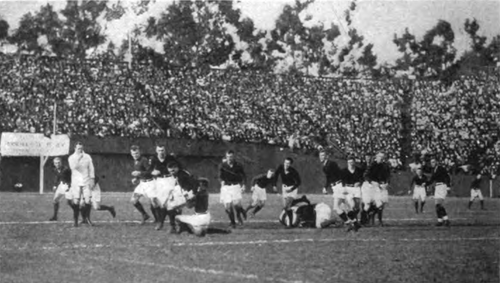
南カリフォルニア大学が初めてアメリカンフットボールチームを編成したのは1888年である。その年の11月14日、アライアンス・アスレチック・クラブとの対戦で初戦を迎え、USCは16対0で勝利した。フランク・サフェルとヘンリー・H・ゴダードがコーチを務めた最初のチームは、クォーターバックのアーサー・キャロルが編成した。キャロルはチームのパンツを自ら志願製作し、後に仕立て屋となった。[65 ]翌年の1889年秋、USCは初めて大学の相手と対戦し、セント・ヴィンセント大学と対戦して40対0で勝利した。[65] 1893年、USCは南カリフォルニア大学フットボール協会(SCIACの前身)に加盟した。この協会は、USC、オクシデンタル大学、スループ工科大学(Caltech)、チャッフィー大学で構成されていた。ポモナ大学が加盟を要請されたが辞退した。ロサンゼルス高校にも招待状が送られた。[66]
1891年、最初のスタンフォード大学のフットボールチームが急遽組織され、1892年1月から正式なヘッドコーチなしで4試合のシーズンを戦った。シーズン終了後、スタンフォード大学のキャプテン、ジョン・ウィットモアはイェール大学のコーチ、ウォルター・キャンプに手紙を書き、スタンフォード大学のコーチを推薦するよう依頼した。ウィットモアの驚いたことに、キャンプはイェール大学でシーズンを終えることを条件に、自らチームのコーチを務めることに同意した。[67]キャンプが遅れて到着したため、スタンフォード大学はサンフランシスコのオリンピック・クラブとライバル校のカリフォルニアとのわずか3試合しか公式戦を戦えなかった。チームはまた、スタンフォード大学が公式結果に含めていないロサンゼルス地域の2チームとのエキシビションゲームも行った。[68] [69]キャンプはシーズン終了後に東海岸に戻り、1894年と1895年にスタンフォード大学のコーチに復帰した。
1894年12月25日、エイモス・アロンゾ・スタッグのシカゴ・マルーンズは、キャンプのスタンフォード大学フットボールチームと、サンフランシスコで初のポストシーズンインターセクショナル試合を行うことに合意した。これは現代のボウルゲームの先駆けとなった。[70] [71]将来の学長ハーバート・フーバーはスタンフォード大学の学生財務管理者であった。[72]シカゴが24対4で勝利した。 [73]スタンフォードは12月29日にロサンゼルスで行われた再戦で12対0で勝利した。[74]
スタンフォードとカリフォルニアのビッグゲームは、西部で最も古い大学フットボールのライバル関係である。最初の試合は1892年3月19日にサンフランシスコのヘイトストリートグラウンドで行われ、スタンフォードが14対10で勝利した。「ビッグゲーム」という用語は、1900年にサンフランシスコで感謝祭の日に行われたときに初めて使用された。その試合中、近くのSFとパシフィックグラスワークスの屋根から観戦していた大勢の男性と少年が、屋根が崩壊したときに建物の燃える内部に落ち、13人が死亡し、78人が負傷した。[75] [76] [77] [78] [79] 1900年12月4日、この惨事の最後の犠牲者(フレッド・リリー)が死亡し、死者数は22人となった。そして今日まで、「感謝祭の惨事」は米国のスポーツイベントで観客を死に至らしめた最悪の事故である。[80]
オレゴン大学は1894年にアメリカンフットボールを始め、1894年3月24日に最初の試合を行い、カル・ヤング監督の下、アルバニー大学を44対3で破った。[81] [82] [83]カル・ヤングは最初の試合後にチームを去り、秋にはJA・チャーチがシーズンの残りを監督の座に就いた。オレゴンはそのシーズンをさらに2敗1引き分けで終えたが、翌シーズンは無敗で、パーシー・ベンソン監督の下、4試合すべてに勝利した。[83] [84] [85] 1899年、オレゴンのフットボールチームは初めて州外へ出て、カリフォルニア州バークレーでカリフォルニア・ゴールデンベアーズと対戦した。[81]
オレゴン州立大学でのアメリカンフットボールは、大学で最初に運動競技が認可されてから間もない1893年に始まりました。1892年5月に同校での運動競技は禁止されましたが、厳格な学長ベンジャミン・アーノルドが亡くなると、ジョン・ブロス学長は禁止を撤回しました。[86]ブロスの息子ウィリアムが最初のチームを率い、コーチとクォーターバックを務めました。[87]チームの最初の試合は、地元のチームであるアルバニー大学に63対0で簡単に負けました。
1900年5月、ヨストはスタンフォード大学のフットボールコーチに採用され、[88]故郷のウェストバージニア州に戻った後、1900年8月21日にカリフォルニア州パロアルトに到着した。 [89]ヨストは1900年のスタンフォードチームを7勝2敗1引き分けに導き、対戦相手を154対20で上回った。翌年の1901年、ヨストはチャールズ・A・ベアードに雇われ、ミシガン大学ウルヴァリンズフットボールチームのヘッドフットボールコーチとなった。 1902年1月1日、ヨストの1901年ミシガン大学ウルヴァリンズフットボールチームは、現在ローズボウルゲームとして知られる第1回「トーナメント東西フットボールゲーム」で、スタンフォード大学の3勝1敗2分けのチームと対戦することに合意したが、スタンフォードのキャプテン、ラルフ・フィッシャーが試合残り8分で退場を要求したため、49対0で敗れた。
1905年シーズンはスタンフォード大学とUSCの初対戦となった。その結果、スタンフォード大学はUSCの最古のライバルとなった。[90] 1905年11月11日に行われたスタンフォード大学とカリフォルニア大学のビッグゲームは、スタンフォードフィールドで初めて行われ、スタンフォード大学が12対5で勝利した。[67]
1906年、カリフォルニア大学やスタンフォード大学を筆頭に、西海岸の大学はアメリカンフットボールの暴力性に対する懸念を理由に、このスポーツをラグビーユニオンに置き換えた。[91]当時、アメリカンフットボールの将来は非常に不透明であり、これらの大学はラグビーユニオンが最終的には全国的に採用されると信じていた。[91]ネバダ大学、セントメリーズ大学、サンタクララ大学、南カリフォルニア大学(1911年)などの他の大学もこれに倣い、切り替えた。 [91]しかし、西海岸のフットボールは東海岸でプレーされているゲームよりも劣っているという認識のため、東海岸と中西部のチームはチームの喪失を気にせず、アメリカンフットボールを続けた。[91]全国的な動きがなかったため、プレーできるラグビーチームの数は少ないままだった。[91]学校は地元のクラブチームとの試合を予定し、オーストラリア、ニュージーランド、特に近隣のカナダのラグビー強豪に働きかけた。スタンフォード大学とカリフォルニア大学の間で毎年行われるビッグゲームはラグビーとして継続され、優勝者はブリティッシュコロンビアラグビー協会からクリスマス休暇中にバンクーバーで開催されるトーナメントに招待され、そのトーナメントの優勝者にはクーパー・キース・トロフィーが贈られた。[91] [92] [93]
スタンフォード大学は、ラグビーユニオンをプレーした12シーズンで、驚くほどの成功を収めた。チームは3シーズン無敗、3シーズン1敗、そして通算成績は94勝20敗3引き分けで勝率は0.816だった。しかし、数年後、同校は新たに採用したスポーツの孤立感を感じ始めた。このスポーツは多くの人が期待したほど普及していなかった。学生や卒業生は、大学間の競争をより広くするために、アメリカンフットボールへの復帰を強く求め始めた。[91]ライバルのカリフォルニア大学からの圧力はより強く(特に同校がビッグゲームで期待したほど成功していなかったため)、1915年にカリフォルニア大学はアメリカンフットボールに復帰した。変更の理由として、同校は、ルールをアメリカンフットボールに戻したこと、アメリカンフットボールをプレーしたいという学生やサポーターの圧倒的な要望、東海岸や中西部の他の大学との試合への関心、そして「アメリカン」な試合をプレーしたいという愛国的な要望を挙げた。[91]カリフォルニアがアメリカンフットボールに復帰したことで、ライバル関係を維持するためにスタンフォードも元に戻らなければならないというプレッシャーが高まった。スタンフォードは1915年、1916年、1917年の「ビッグゲーム」をラグビーユニオンとしてサンタクララと対戦し、カリフォルニアのフットボールの「ビッグゲーム」はワシントンと対戦したが、両校とも古い伝統を復活させたいと望んでいた。[91]アメリカが第一次世界大戦に参戦し始めたことでスタンフォードには逃げ道ができた。1918年、スタンフォードのキャンパスはカリフォルニア、ネバダ、ユタの学生陸軍訓練部隊の本部に指定され、指揮官サム・M・パーカーはアメリカンフットボールが兵士の訓練に適した運動でありラグビーユニオンは廃止されると布告した。[91]
マウンテンウェスト


コロラド大学は1890年にアメリカン フットボールを開始しました。コロラドは初期に大きな成功を収め、コロラド フットボール協会選手権で 8 回優勝しました (1894 ~ 1897 年、1901 ~ 1908 年)。
以下は、 1898 年 12 月 16 日のSilver & Gold新聞から抜粋したものです。コロラド フットボールの誕生を回想したもので、CU の元グリッダーの 1 人であり、同校の 2 番目のキャプテンでもあった John C. Nixon によって書かれました。ここでは元の形式で掲載します。
1990 年秋の最初の学期の初め、カルフォルニア大学のキャンパスにある寮に下宿していた男子たちは、エネルギーが過剰に溜まっていたため、あるいは最近親の保護から逃れて新たに見つけた自由を満喫していたため、他の突飛な計画の中で、運動協会を結成することを決意しました。当時、大学の男子人口の大半を占めていたカーニー、ウィテカー、レイトンらは、古い医学棟でキャンパスの男子の集会を招集しました。ニクソンが協会の会長に、ホールデンが書記に選出されました。
役員らは、いわゆる「アソシエーション フットボール」をプレーするためのユニフォーム スーツを提供する委員会を構成することが決議されました。最終的にフランネルのスーツが調達され、協会のメンバーへの評価と教職員からの寛大な寄付によって支払われました。...
体育協会は、野球チームを活性化し、フットボール チームと同等のレベルにすべきです。そして、それを実行するための資質は確かにあります。U of C は今後、州内、そしておそらく西部のスポーツ界をリードするはずです。...
サッカーのプレースタイルは大きく変化しました。古いルールでは、ボールを持ったランナーの前にいる選手は全員オフサイドでした。そのため、現在のようにバックスを送り込んでボールの前にラインを突破することはできませんでした。当時は悪名高い V 字型が流行しており、重量のあるチームに非常に有利でした。現在ではマス プレーは禁止されているため、サッカー フィールドでは単なる体重や力よりもスキルが求められています。
— ジョン・C・ニクソン、シルバー&ゴールド、1898年12月16日[94]
1909 年、コロラド、コロラド カレッジ、コロラド鉱山学校、コロラド農業大学の4 校が加盟するロッキー マウンテン アスレチック カンファレンスが設立されました。1910年にはデンバー大学とユタ大学がRMAC に加盟しました。最初の 30 年間、RMAC は今日のディビジョン I に相当する主要なカンファレンスとみなされていましたが、その後、7 つの主要メンバーが脱退し、マウンテン ステーツ カンファレンス(スカイライン カンファレンスとも呼ばれる) が結成されました。
暴力、NCAAの設立
大学フットボールは、19 世紀後半から 20 世紀初頭にかけて人気が高まりました。同時に、暴力性も増しました。1890 年から 1905 年にかけて、330 人の大学選手がフットボール競技場での負傷が直接の原因で亡くなりました。これらの死因は、このスポーツの初期の特徴であった集団フォーメーションと集団タックルによるものと考えられます。
簡単に見破られるような不寛容な行為や卑劣な行為が勝利につながるようなスポーツは健全ではない。
ハーバード大学学長チャールズ・ウィリアム・エリオット(1869-1909)は1905年にフットボールに反対した。[95]
1894年のハーバード対イェール戦は「ハンプデン・パークの血の海」として知られ、4人の選手が重傷を負ったため、試合は1897年まで中断された。毎年行われる陸軍対海軍の試合も、同様の理由で1894年から1898年まで中断された。[96]大きな問題の一つは、フライング・ウェッジのような集団フォーメーションが流行したことで、多数の攻撃選手が一丸となって、同様の配置の守備陣に突撃した。その結果生じる衝突は、しばしば重傷や、時には死にさえつながった。[97]ジョージア州のフルバック、リチャード・フォン・アルバード・ギャモンは、1897年にバージニア大学との試合中に受けた脳震盪が原因でフィールド上で死亡したことで有名であり、ジョージア州、ジョージア工科大学、マーサー大学はフットボールのプログラムを中断することになった。
1905年に全国で19人の死亡者が出たことで事態は頂点に達した。伝えられるところによると、セオドア・ルーズベルト大統領は、抜本的な改革が行われなければフットボールを廃止すると脅した。[98]しかし、ルーズベルトによるフットボール廃止の脅しは、スポーツ歴史家の間では異論がある。1905年10月9日、ルーズベルトがハーバード、イェール、プリンストンのフットボール代表者を集めた会議を開いたことは間違いない。彼はけがの撲滅と削減について講演したが、フットボールを禁止すると脅したことは一度もない。また、彼にはフットボールを廃止する権限はなく、実際、彼はこのスポーツのファンであり、それを守りたいと考えていた。当時、大統領の息子たちも大学や中学校でフットボールをプレーしていた。 [99]
一方、ジョン・H・アウトランドはカンザス州ウィチタで実験的な試合を開催し、負傷者を減らすため、ファーストダウンを獲得するためのスクリメージプレーの数を4回から3回に減らした。[100]ロサンゼルス・タイムズ紙は、パントが増加し、ゲームは通常のプレーよりもはるかに安全であるとみなされているが、新しいルールは「スポーツに役立たない」と報じた。[101] 1906年、ルーズベルト大統領は、スポーツをアスリートにとってより安全なものにするための解決策を見つけるために、ホワイトハウスで13の学校長による会議を組織した。大学当局はルールの変更について合意できなかったため、その後の数回の会議で、外部の統括団体が責任を負うべきであると決定された。最終的に、1905年12月28日、62の学校がニューヨーク市に集まり、ゲームをより安全にするためのルール変更について議論した。この会議の結果、1906年に全米大学体育協会が設立されました。IAAUSは大学フットボールの元々のルール制定機関でしたが、その後他のスポーツの選手権を後援するようになりました。IAAUSは1910年に現在の全米大学体育協会(NCAA)に改名され、[102]現在もこのスポーツを統括するルールを制定しています。[102] [103]
ルール委員会は、ゲームを「開放」するために競技場を広げることを検討したが、ハーバード・スタジアム(最初の大きな常設フットボールスタジアム)が多額の費用をかけて最近建設されたばかりで、フィールドが広くなると役に立たなくなるだろう。ルール委員会は代わりにフォワードパスを合法化した。これは何年もあまり使われなかったが、現代のゲームを確立する上で最も重要なルール変更の1つであることがわかった。[104]別のルール変更では、「マス・モメンタム」プレー(その多くは、悪名高い「フライング・ウェッジ」のように、文字通り致命的になることがあった)を禁止した。
近代化と革新(1906年~1930年)
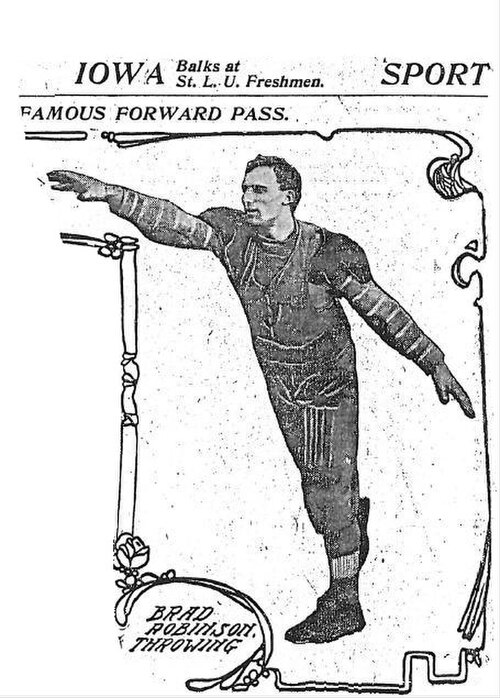
1905年から1906年の改革の結果、マスフォーメーションプレイは違法となり、フォワードパスは合法となった。セントルイス大学で先見の明のあるコーチ、エディ・コッヘムズの下でプレーしていたブラッドベリー・ロビンソンは、1906年9月5日、ウォキショーでのキャロル大学との試合で、初めて合法なパスを投げた。1910年に正式に採用されたその他の重要な変更には、スナップ時に少なくとも7人の攻撃側選手がスクリメージライン上にいなければならないこと、押したり引いたりしてはならないこと、インターロッキング・インターフェアランス(腕を組んだりベルトやユニフォームに手を置いたりすること)は許可されないことなどがあった。これらの変更により、衝突による負傷の可能性が大幅に減少した。[105]これらの抜本的な変更を利用したコーチが数人現れた。エイモス・アロンゾ・スタッグは、ハドル、タックルダミー、スナップ前のシフトなどの革新を導入した。 [106]ポップ・ワーナーやクヌート・ロックネなどの他のコーチは、現在でもゲームの一部として残っている新しい戦略を導入しました。
これらのコーチングの革新に加えて、20世紀の最初の3分の1の間に行われたいくつかのルール変更は、主にパスゲームの開放において、ゲームに大きな影響を与えました。1914年に、最初のパスラフプレーのペナルティが実施されました。1918年には、資格のあるレシーバーに関するルールが緩和され、資格のあるプレーヤーはフィールドのどこでもボールをキャッチできるようになりました。以前は、フィールドの特定のエリアにのみパスを許可する厳格なルールが適用されていました。[107]この時期に得点ルールも変更されました。フィールドゴールは1909年に3ポイントに引き下げられ、 [11]タッチダウンは1912年に6ポイントに引き上げられました。[108]
20世紀初頭に登場したスター選手にはジム・ソープ、レッド・グランジ、ブロンコ・ナガースキーなどがいる。この3人は設立間もないNFLに移籍し、NFLを成功に導くのに貢献した。スポーツライターのグラントランド・ライスは、試合を詩的に描写し、ノートルダム大学の「フォー・ホースマン」バックフィールドやフォーダム大学の「セブン・ブロックス・オブ・グラナイト」として知られるラインマンなど、NFLの主力選手に色鮮やかなニックネームを付けることで、NFLの人気を博した。[109]
1907年、イリノイ州シャンペーンでシカゴ大学とイリノイ大学がハーフタイムショーで初めてマーチングバンドをフィーチャーした試合を行った。[110]シカゴ大学が42対6で勝利した。1911年11月25日、 カンザス大学がミズーリ大学と初のホームカミングフットボールの試合を行った。[ 111 ]この試合は電信でカンザス州ローレンスの少なくとも1,000人のファンに「放送」された。[112]試合は3対3の引き分けに終わった。 1921年10月8日のウェストバージニア大学とピッツバーグ大学の試合では、ハロルド・W・アーリンがフォーブスフィールドで開催されるその年のバックヤード・ブロールをKDKAでアナウンスし、大学フットボールの試合が初めてラジオで生中継された。ピッツバーグ大学が21対13で勝利した。[113] 1922年10月28日、プリンストン大学とシカゴ大学がラジオで全国放送される初の試合を行った。プリンストンは「運命のチーム」と名付けられた激しい試合で21対18で勝利した。[114]
南部の台頭
ある出版物は「南部で最初の偵察は1905年、ヴァンダービルトのダン・マクグギンとキャプテンのイニス・ブラウンがアトランタに行き、セワニーとジョージア工科大学の試合を観戦したときだった」と主張している。[ 115] ファジー・ウッドラフは、1906年にデビッドソンが南部で最初に合法的なフォワードパスを投げたと主張している。翌シーズン、ヴァンダービルトはダブルパスプレイを実行し、 SIAAチャンピオンシップの無敗チーム同士の対戦でセワニーを破るタッチダウンを演出した。グラントランド・ライスは、スポーツ観戦歴の中でこの出来事を最も興奮した出来事として挙げている。[116]ヴァンダービルトのコーチ、ダン・マクグギンは、スポルディングのフットボールガイドのSIAAシーズンの総括で「順位。1位ヴァンダービルト、2位セワニー、かなり良い2位」と書き、オーブリー・ラニエは「パントを受けた後の見事なダッシュでヴァンダービルト戦に勝利しそうになった」と述べている。[117] ボブ・ブレイクはセンターのスタイン・ストーンに最後のパスを投げ、ストーンはゴール近くでディフェンダーの間を縫ってそれをキャッチした。その後ホーナス・クレイグが走り込んで勝ち越しのタッチダウンを決めた。
ハイズマンシフト
ジョン・ハイズマン率いるジョージア工科大学ゴールデントルネードは、 「ジャンプシフト」攻撃を用いて、1916年10月7日、グラントフィールドでカンバーランドに222対0で勝利した。これは大学フットボール史上最も一方的な勝利であった。 [118]この期間、テックは33連勝を記録した。1917年のチームは強力なバックフィールドに率いられ、南部から初の全国チャンピオンとなった。また、ウォーカー・カーペンターおよびエヴェレット・ストラッパーというディープサウスから初のオールアメリカン第1チームに選ばれた2人の選手を擁していた。ポップ・ワーナーのピッツバーグ・パンサーズも無敗であったが、ハイズマンの試合挑戦を断った。ハイズマンが1919年以降テックを去った後も、彼のシフトは弟子のウィリアム・アレクサンダーが引き継いでいた。
注目すべきインターセクショナルゲーム

1906年、ヴァンダービルトはボブ・ブレイクのフィールドゴールによりカーライルを4対0で破った。 [119] [120] 1907年、ヴァンダービルトは海軍と6対6の引き分けに終わった。1910年、ヴァンダービルトは前年の全国チャンピオンであるイェールとスコアレスドローに持ち込んだ。[120]
1917年、ジョージア工科大学の優勝に貢献したオーバーン大学タイガースは、無敗でチック・ハーレー率いるビッグ・テン・カンファレンスのチャンピオンだったオハイオ州立大学を無得点に抑え、その1週間後にジョージア工科大学がタイガースを68対7で破った。翌シーズン、第一次世界大戦により多くの選手が去ったため、ようやくフォーブス・フィールドでピッツバーグ大学との試合が組まれた。1年生のトム・デイビス率いるパンサーズは、ジョージア工科大学を32対0で破った。ジョージア工科大学のセンター、バム・デイは、ウォルター・キャンプによってオールアメリカンのファーストチームに選ばれた南部チーム初の選手となった。
1917年、ケンタッキー州ダンビルのセンターという南部のチームが台頭した。1921年、ボー・マクミラン率いるセンターは、前年度の全国チャンピオンだったハーバードを6対0で破り、大学フットボール史上最大の番狂わせの1つとして広く考えられている。翌年、ヴァンダービルトは、南部で初めて大学フットボール専用に作られたスタジアムであるダドリー・フィールド(現在のヴァンダービルト・スタジアム)での最初の試合で、ミシガンとスコアレスドローに終わった。ミシガンのコーチ、フィールディング・ヨストとヴァンダービルトのコーチ、ダン・マクグギンは義理の兄弟で、後者は前者の弟子だった。この試合は、シーズン最高のディフェンス2チームが登場し、ヴァンダービルトがゴールラインでスタンドして引き分けを維持した。その結果は「スポーツ界にとって大きな驚き」だった。[121]コモドアのファンは、フィールドに約3,000個のシートクッションを投げて祝った。この試合は、ヴァンダービルトの歴史の中で重要な位置を占めている。[122]同年、アラバマはペンシルバニアを9対7で破った。[123]
当時のヴァンダービルトのラインコーチはウォレス・ウェイドで、 1925年にアラバマを南部初のローズボウル優勝に導いた。この試合は「南部を変えた試合」としてよく知られている。[124]ウェイドは翌シーズンも無敗の記録を残し、ローズボウルで引き分けた。ジョージアの1927年の「ドリーム・アンド・ワンダー・チーム」は初めてイェールを破った。ハイズマン賞の弟子 ウィリアム・アレクサンダー率いるジョージア工科大学はドリーム・アンド・ワンダー・チームに唯一の敗北を与え、翌年は全国優勝とローズボウル優勝を果たした。ローズボウルではロイ・リーゲルスの逆走もあった。1929年10月12日、イェールは南部への最初の遠征でサンフォードスタジアムでジョージアに敗れた。ウェイドのアラバマは1930年に再び全国選手権とローズボウルで優勝した。
当時のコーチ
グレン・「ポップ」・ワーナー
グレン・「ポップ」・ワーナーは、キャリアを通じてジョージア大学、コーネル大学、ピッツバーグ大学、スタンフォード大学、アイオワ州立大学、テンプル大学など、いくつかの学校でコーチを務めた。[125]彼の最も有名な在籍期間の1つはカーライル・インディアン・インダストリアル・スクールで、そこでジム・ソープを指導した。ソープは後にナショナル・フットボール・リーグの初代会長、オリンピック金メダリストとなり、歴史上最も優れたアスリートの1人と広く考えられている。[126] [127]ワーナーは、 1927年に出版された、フットボール戦略に関する最初の重要な本の1つである『コーチと選手のためのフットボール』を執筆した。 [128]シフトはスタッグによって発明されたが、ワーナーのシングル・ウイングとダブル・ウイングのフォーメーションはそれを大幅に改良したもので、ほぼ40年間、これらはフットボールで最も重要なフォーメーションの1つであった。ワーナーは、シングルウィングとダブルウィングのフォーメーションの一部として、フォワードパスを効果的に使用した最初のコーチの一人です。彼の他の革新の中には、現代のブロッキングスキーム、スリーポイントスタンス、リバースプレイがあります。[125]ユースフットボールリーグ、ポップワーナーリトルスカラーズは彼に敬意を表して名付けられました。
クヌート・ロックネ
クヌート・ロックニーは1913年、当時ほとんど無名だった中西部のカトリック系大学、ノートルダム大学のエンドとして有名になった。陸軍がノートルダム大学をウォームアップゲームとして予定したとき、彼らはこの小さな大学をあまり重要視していなかった。ロックニーとクォーターバックのガス・ドレイスは、その時点ではまだあまり使われていなかったフォワードパスを革新的に利用し、陸軍を35対13で破り、大学が全国的な強豪校としての地位を確立するのに貢献した。ロックニーは1918年にチームのコーチに復帰し、ワーナーのシングルウィングをベースにした強力なノートルダムボックスオフェンスを考案した。彼は、防御よりも攻撃を重視した最初の主要コーチであるとされている。ロックニーはまた、当時めったに使われなかったフォワードパスを普及させ完成させたことでも知られている。[129] 1924年のチームはフォーホースメンのバックフィールドを特徴としていた。 1927年、彼の複雑なシフトは、ボールをスナップする前にすべての攻撃側の選手が1秒間停止しなければならないというルール変更に直接つながりました。ロックンの「ファイティング・アイリッシュ」は、単なる地域チームではなく、バーンストーミングで有名になり、あらゆる場所のどのチームとも対戦しました。ロックンの在任中に、毎年のノートルダム大学と南カリフォルニア大学のライバル関係が始まりました。彼は1931年に飛行機事故で若くして亡くなるまで、チームを105勝12敗5引き分けの素晴らしい成績に導きました。彼はその時点で非常に有名だったので、彼の葬儀はラジオで全国放送されました。[125] [130]
地域スポーツから国民的スポーツへ(1930年~1958年)

1930年代初頭、大学のフットボールは特に南部で成長を続け、バージニア州とノースカロライナ州の間の「南部最古のライバル関係」や、ジョージア州とオーバーン州の間の「ディープサウス最古のライバル関係」などの激しいライバル関係に支えられた。1920年代半ばまでは、国内の強豪のほとんどは北東部または中西部から来ていたが、南部と西海岸のいくつかのチームが全国的な成功を収めると、傾向は変わった。ウォレス・ウィリアム・ウェイドの1925年のアラバマチームは、初の全国タイトルを獲得した後、1926年のローズボウルで優勝し、ウィリアム・アレクサンダーの1928年のジョージア工科大学チームは、 1929年のローズボウルでカリフォルニアを破った。大学フットボールはすぐに南部で最も人気のある観戦スポーツになった。[131]
この時期には、いくつかの主要な近代的な大学フットボールのカンファレンスが台頭した。サウスウェスト・アスレチック・カンファレンスは1915年に設立された。主にテキサス州の大学で構成され、1938年にテキサスクリスチャン大学(TCU)、 1939年にテキサスA&M大学が連続して全国チャンピオンになった。[132] [133] Pac-12カンファレンス(Pac-12)の前身であるパシフィック・コースト・カンファレンス(PCC)でも、南カリフォルニア大学が1931年と1932年に連続で優勝した。[132]サウスイースタン・カンファレンス(SEC)は1932年に設立され、主にディープサウスの大学で構成されていた。[134]過去数十年と同様に、ビッグテンは1930年代と1940年代も支配を続け、ミネソタは1934年から1941年の間に5つのタイトルを獲得し、ミシガン(1933、1947、1948年)とオハイオ州立(1942年)もタイトルを獲得しました。[132] [135]
1930年代にカレッジフットボールが地域的なつながりを超えて成長すると、全国的な注目が集まるようになった。オレンジボウル、シュガーボウル、 1935年のサンボウル、 1937年のコットンボウルの4つの新しいボウルゲームが作られた。実際の全国選手権の代わりに、これらのボウルゲームは、以前のローズボウルとともに、通常は試合をしない国内の遠方のチームを対戦させる方法を提供した。1936年、AP通信は著名なスポーツ記者による毎週の世論調査を開始し、国内のカレッジフットボールチームすべてをランク付けした。全国選手権はなかったため、AP通信の世論調査の最終版がカレッジフットボールの全国チャンピオンを決定するために使用された。[136]
1930年代にはパスゲームが成長した。テネシー州のロバート・ネイランド将軍など一部のコーチはパスの使用を避け続けたが、ゲームのいくつかのルール変更はチームのボールを投げる能力に大きな影響を与えた。1934年、ルール委員会は2つの大きなペナルティ(ダウンの連続で2回目の不完全パスで5ヤードのロス、エンドゾーンで不完全パスでボールの保持権を失う)を削除し、ボールの円周を縮小して握りやすくし、投げやすくした。より簡単なパスゲームを利用して有名になった選手には、アラバマ州のエンド、ドン・ハットソンやTCUのパサー「スリンギン」サミー・ボーがいる。[137]
1935年、ニューヨーク市のダウンタウン・アスレチック・クラブは、シカゴ大学のハーフバック、ジェイ・バーワンガーに最初のハイズマン賞を授与した。バーワンガーは1936年に史上初のNFLドラフト指名選手でもあった。トロフィーは彫刻家フランク・エリスクがデザインし、ニューヨーク大学の選手エド・スミスをモデルにしている。このトロフィーは、国内で最も優れた大学フットボール選手を表彰するもので、アメリカのスポーツ界で最も切望される賞の一つとなっている。[138]
第二次世界大戦中、大学のフットボール選手は軍隊に入隊し、中にはヨーロッパで戦時中にプレーした者もいた。これらの選手のほとんどは大学在学中に資格が残っていたため、そのうちの何人かはウェストポイント大学に戻り、レッド・ブレイク監督の下で1944年と1945年に陸軍に連続全国タイトルをもたらした。ドック・ブランチャード(通称「ミスター・インサイド」)とグレン・デイビス(通称「ミスター・アウトサイド」)は、1945年と1946年にハイズマン賞を受賞した。1944年から1946年の陸軍チームのコーチ陣には、将来プロフットボール殿堂入りするヴィンス・ロンバルディ監督がいた。[135] [139]
1950 年代には、さらに多くの王朝と強豪プログラムが台頭した。オクラホマは、バド・ウィルキンソン監督の下、10 年間で 3 回の全国タイトル (1950、1955、1956 年) と 10 回すべてのビッグ エイト カンファレンスチャンピオンシップを獲得し、記録的な 47 連勝を記録した。ウッディ・ヘイズはオハイオ州立大学を 1954 年と 1957 年の 2 回の全国タイトルに導き、3 回のビッグ テン タイトルを獲得した。ミシガン州立大学スパルタンズは1950 年代に「フットボール工場」として知られ、クラレンス・マン監督とダフィー・ドーハティ監督は1953 年にビッグ テンに競技者として参加した後、スパルタンズを 2 回の全国タイトルと 2 回のビッグ テン タイトルに導いた。ウィルキンソンとヘイズは、テネシー州のロバート・ネイランドとともに、1950 年代にランニング ゲームの復活を監督した。パス数は1951年の平均18.9回から1955年の13.6回に減少し、チームの平均ランニングプレー数は1試合あたり50回弱となった。1950年代のハイズマン賞受賞者の10人中9人がランナーだった。この10年間で最もパスが上手かったチームの1つであるノートルダムは、成功率が大幅に低下した。1950年代は、1920年から1990年の間でチームが全国タイトルを少なくとも分け合わなかった唯一の10年間だった。しかし、ノートルダムのクォーターバックであるポール・ホーナングは1956年にハイズマン賞を受賞し、負けチームから受賞した唯一の選手となった。[140] [141]
1956年のシュガーボウルは、ジョージア州の人種差別主義者であるグリフィン知事が、南部の大学ボウルゲームにアフリカ系アメリカ人選手が初めて出場することを認めたとしてジョージア工科大学とその学長ブレイク・ヴァン・リアーを公然と脅迫したことでも国際的な注目を集めた。[142]
現代の大学フットボール(1958年以降)

1958年のNFLチャンピオンシップゲームが大成功を収めた後、大学フットボールは少なくとも全国レベルではNFLほどの人気を得られなくなった。どちらのゲームもテレビの登場の恩恵を受けたが、1950年代後半以降、NFLは全国的に人気のあるスポーツとなり、大学フットボールは強い地域的つながりを維持した。[143] [144] [145]
プロフットボールが全国的なテレビ現象となったのと同様に、大学フットボールも同様であった。1950年代、全国的に大きな支持を得ていたノートルダム大学は、試合を放送するために独自のネットワークを設立したが、このスポーツは概して主に地域の支持を維持していた。1952年、NCAAは加盟校の試合のテレビ放映権をすべて主張し、単独でテレビ放映権の交渉を行った。この状況は、1984年に数校がシャーマン反トラスト法に基づいて訴訟を起こすまで続いた。最高裁判所は NCAAに不利な判決を下し、学校は独自のテレビ契約を自由に交渉できるようになった。ABCスポーツは1966年に全国的な「今週の試合」の放送を開始し、初めて全国の視聴者に重要な対戦やライバル関係を届けた。[146]
新しいフォーメーションやプレーセットが開発され続けた。テキサス大学でダレル・ロイヤルのアシスタントコーチを務めていたエモリー・ベラードは、ウィッシュボーンと呼ばれる3バックオプションスタイルのオフェンスを開発した。ウィッシュボーンはラン重視のオフェンスで、いつ誰にボールを渡すか、または投げるかをクォーターバックが土壇場で決定する必要がある。ロイヤルはその後、アラバマ大学のベア・ブライアント、オクラホマ大学のチャック・フェアバンクス、 UCLAのペッパー・ロジャースなど他のコーチにこのオフェンスを教え、彼らは皆、自分の好みに合わせてこのオフェンスを適応させ、発展させていった。[147]ウィッシュボーンの戦略的反対は、1960年代から1970年代にかけてプロや大学のコーチによって開発されたスプレッドオフェンスである。一部の学校ではラン重視のスプレッドバージョンをプレイしているが、最も一般的な使用方法は、フィールドを水平方向と垂直方向の両方に「広げる」ように設計されたパスオフェンスとして使用される。[148]一部のチームは、時代に適応して一貫して勝ち続けている。最も勝利したプログラムのランキングでは、ミシガン、オハイオ州立大学、アラバマが合計勝利数で1位、2位、3位にランクされました。
ボウルゲームの成長
1940年、大学フットボールの最高峰クラスでは、ボウルゲームは5つしかなかった(ローズ、オレンジ、シュガー、サン、コットン)。1950年までに3つがその数に加わり、1970年には、主要な大学ボウルゲームの数は8つにとどまった。その数は1976年に11に増えた。ケーブルテレビやESPNなどのケーブルスポーツネットワークの誕生により、1980年には15のボウルゲームがあった。全国的な会場が増え、利用可能な収益が増加したことにより、ボウルゲームは1980年代から1990年代にかけて爆発的な成長を遂げた。1950年から1980年の30年間で、7つのボウルゲームがスケジュールに追加され、1980年から2008年にかけて、さらに20のボウルゲームがスケジュールに追加されました。[149] [151]しかし、試合数の増加により、より多くの学校の露出と収益が増加し、前向きな展開であると反論する人もいます。[152]ボウルゲームに参加するチームは、ボウルゲームが終了するまで、1日4時間または週20時間まで練習することができます。[153]ボウルシーズン中の練習回数に制限はないため、シーズン後半にプレーするチーム(通常は勝利数が多いチーム)は、シーズン前半にプレーするチームよりも練習する機会が多くなります。このボウルの練習期間は、チームが15回のフィールド練習セッションを行うことができる春の練習スケジュールに似ています。[154]ボウルシーズン後半にプレーするチームの多くは、最初の数回の練習を、スターターを休ませながら若い選手の評価と育成に使用します。[155]
全国チャンピオンの決定
現在、NCAA ディビジョン I のフットボール チームは、「フットボール ボウル サブディビジョン」(FBS) と「フットボール チャンピオンシップ サブディビジョン」(FCS) の 2 つのディビジョンに分かれています。名前からわかるように、FBS チームはポストシーズン ボウルに出場できます。FCS チーム、ディビジョン II、ディビジョン III、全米ジュニア カレッジ チームは、公認トーナメントで年間チャンピオンを決定します。トップレベルのフットボール チームのチャンピオンを決定する NCAA 公認トーナメントは、現在も、また過去も存在しません。
ボウル ゲームの増加に伴い、公平かつ公正な方法で全国チャンピオンを決定することが難しくなりました。カンファレンスが特定のボウル ゲームに契約で縛られるようになると (タイインと呼ばれる状況)、全会一致で全国チャンピオンが決まる対戦はますます稀になりました。
ボウル連合
1992年、7つのカンファレンスと独立系のノートルダム大学がボウル連合を結成し、AP通信の最終投票順位に基づいて毎年1位と2位の対戦を計画した。連合は3年間続いたが、いくつかのスケジュール上の問題であまり成功せず、いくつかのケースでは依然として同組試合が優先された。たとえば、ビッグエイトとSECのチャンピオンは、契約上別のボウルゲームに縛られていたため、決して対戦することはなかった。連合はまた、おそらく国内で最も権威のある試合であるローズボウルと、2つの主要カンファレンスであるPac-10とBig Tenを除外したため、成功は限られていた。
ボウルアライアンス
1995年、CoalitionはBowl Allianceに置き換えられ、全国選手権を開催するボウルゲームの数をFiesta Bowls 、Sugar Bowls、Orange Bowlsの3つに、参加カンファレンスをACC Bowls、SEC Bowls、Southwest Bowls、Big Eight Bowls、Big East Bowlsの5つに減らした。ランキング1位と2位のチームは、以前のボウルゲームでの提携を放棄し、参加する3つのボウルゲームの間で順番に行われる全国選手権で対戦することが保証されることが合意された。このシステムにはBig Ten、Pac-10、Rose Bowlsはまだ含まれておらず、したがって真の全国選手権の正当性に欠けていた。[151] [156]しかし、1つの良い副作用は、シーズンの終わりに全国タイトルを争うチームが3つあり、そのうちの1つがRose Bowlに出場するPac-10 / Big Tenチームである場合、Bowl Allianceの「全国選手権」ボウルにどのチームを配置するかを決定するのに困難がないことであった。Pac-10 / Big Tenチームがローズボウルで優勝し、他のボウルゲームで優勝したチームと同じ成績でシーズンを終えた場合、全国タイトルを分け合うことができます。これはボウルアライアンスの最終年に起こり、ミシガンが1998 年のローズボウルで優勝し、ネブラスカが1998 年のオレンジボウルで優勝しました。Pac -10 / Big Tenチームがボウルゲームに出場しなければ、どの 2 チームが全国タイトルを争うべきかを決めるのは困難です。
ボウルチャンピオンシップシリーズ

In 1998, a new system was put into place called the Bowl Championship Series. For the first time, it included all major conferences (ACC, Big East, Big 12, Big Ten, Pac-10, and SEC) and four major bowl games (Rose, Orange, Sugar and Fiesta). The champions of these six conferences, along with two "at-large" selections, were invited to play in the four bowl games. Each year, one of the four bowl games served as a national championship game. Also, a complex system of human polls, computer rankings, and strength of schedule calculations was instituted to rank schools. Based on this ranking system, the No.1 and No.2 teams met each year in the national championship game. Traditional tie-ins were maintained for schools and bowls not part of the national championship. For example, in years when not a part of the national championship, the Rose Bowl still hosted the Big Ten and Pac-10 champions.[156]
The system continued to change, as the formula for ranking teams was tweaked from year to year. At-large teams could be chosen from any of the Division I-A conferences, though only one selection—Utah in 2005—came from a BCS non-AQ conference. Starting with the 2006 season, a fifth game—simply called the BCS National Championship Game—was added to the schedule, to be played at the site of one of the four BCS bowl games on a rotating basis, one week after the regular bowl game. This opened up the BCS to two additional at-large teams. Also, rules were changed to add the champions of five additional conferences (Conference USA [C-USA], the Mid-American Conference [MAC], the Mountain West Conference [MW], the Sun Belt Conference and the Western Athletic Conference [WAC]), provided that said champion ranked in the top twelve in the final BCS rankings, or was within the top 16 of the BCS rankings and ranked higher than the champion of at least one of the BCS Automatic Qualifying (AQ) conferences.[156] Several times since this rule change was implemented, schools from non-AQ conferences have played in BCS bowl games. In 2009, Boise State played TCU in the Fiesta Bowl, the first time two schools from non-AQ conferences played each other in a BCS bowl game. The last team from the non-AQ ranks to reach a BCS bowl game in the BCS era was Northern Illinois in 2012, which played in (and lost) the 2013 Orange Bowl.
College Football Playoff
The longtime resistance to a playoff system at the FBS level finally ended with the creation of the College Football Playoff (CFP) beginning with the 2014 season. The CFP is a Plus-One system, a concept that became popular as a BCS alternative following controversies in 2003 and 2004. The CFP is a four-team tournament whose participants are chosen and seeded by a 13-member selection committee. The semi-finals are hosted by two of a group of traditional bowl games known as the New Year's Six, with semi-final hosting rotating annually among three pairs of games in the following order: Rose/Sugar, Orange/Cotton, and Fiesta/Peach. The two semifinal winners then advance to the College Football Playoff National Championship, whose host is determined by open bidding several years in advance.
The 10 FBS conferences are formally and popularly divided into two groups:
- Power Five – Five of the six AQ conferences of the BCS era, specifically the ACC, Big Ten, Big 12, Pac-12, and SEC. Each champion of these conferences is assured of a spot in a New Year's Six bowl, though not necessarily in a semi-final game. Notre Dame remains a football independent, but is counted among the Power Five because of its full but non-football ACC membership, including a football scheduling alliance with that conference. In the 2020 season, Notre Dame played as a full-time member of the conference due to the effects that COVID-19 had on the college football season, causing many conferences to play conference-only regular seasons. It has its own arrangement for access to the New Year's Six games should it meet certain standards.
- Group of Five – The remaining five FBS conferences – American, C-USA, MAC, MW, and Sun Belt. The other three current FBS independents, Army, UConn, and UMass, are also considered to be part of this group. One conference champion from this group receives a spot in a New Year's Six game. In the first seven seasons of the CFP, the Group of Five did not place a team in a semi-final. In 2021, Cincinnati, then a member of The American, qualified for the Playoff, becoming the first Group of 5 team to qualify. Of the nine Group of Five teams selected for New Year's Six bowls, four have won their games.
Official rules and notable rule distinctions

Although rules for the high school, college, and NFL games are generally consistent, there are several minor differences. Before 2023, a single NCAA Football Rules Committee determined the playing rules for Division I (both Bowl and Championship Subdivisions), II, and III games (the National Association of Intercollegiate Athletics (NAIA) is a separate organization, but uses the NCAA rules). As part of an NCAA initiative to give each division more autonomy over its governance, separate rules committees have been established for each NCAA division.
- A pass is ruled complete if one of the receiver's feet is inbounds at the time of the catch. In the NFL both feet must be inbounds.[157]
- A player is considered down when any part of his body other than the feet or hands touches the ground or when the ball carrier is tackled or otherwise falls and loses possession of the ball as he contacts the ground with any part of his body, with the sole exception of the holder for field goal and extra point attempts. In the NFL a player is active until he is tackled or forced down by a member of the opposing team (down by contact).
- Before the 2023 season, the clock stopped after the offense completed a first down and began again—assuming it is following a play in which the clock would not normally stop—once the referee declared the ball ready for play. Since 2023, this has only been the case in the last two minutes of a half in NCAA Divisions I and II; Division III will adopt this rule in 2024. In the NFL the clock does not explicitly stop for a first down.
- Overtime was introduced in 1996, eliminating most ties except in the regular season. Since 2021, during each of the first two overtime periods, each team is given one possession from its opponent's 25-yard line with no game clock. The play clock remains in use, and each team is allowed one timeout per period. Any team that scores a touchdown in double overtime must attempt a two-point conversion. Beginning with triple overtime, each team takes possession at the opponent's 3-yard line and can only score by conversion. A coin toss determines which team will have possession first at the start of each overtime period. Play continues until one team leads the other at the end of a period. [In the NFL overtime is decided by a modified sudden-death period of 10 minutes in regular-season games (no overtime in preseason up to 1973 & since 2021) and 15 minutes in playoff games, and regular-season games can still end in a tie if neither team scores.[158] Overtime for regular-season games in the NFL began with the 1974 season; the overtime period for all games was 15 minutes until it was shortened for non-playoff games effective in 2017. In the postseason, if the teams are still tied, teams will play multiple overtime periods until either team scores.]
- A tie game is still possible, per NCAA Rule 3–3–3 (c) and (d). If a game is suspended because of inclement weather while tied, typically in the second half or at the end of regulation, and the game is unable to be continued, the game ends in a tie. Similar to baseball, if one team has scored in its possession and the other team has not completed its possession, the score during the overtime can be wiped out and the game ruled a tie. Some conferences may enforce a curfew for the safety of the players. If, because of numerous overtimes or weather, the game reaches the time-certain finish imposed by the curfew tied, the game is ruled a tie.
- Extra point tries are attempted from the three-yard line. Kicked tries count as one point. Teams can also go for "the two-point conversion" which is when a team will line up at the three-yard line and try to score. If they are successful, they receive two points, if they are not, then they receive zero points. Starting with the 2015 season, the NFL uses the 15-yard line as the line of scrimmage for placekick attempts, but the two-yard line for two-point attempts. The two-point conversion was not implemented in the NFL until 1994, but it had been previously used in the old American Football League (AFL) before it merged with the NFL in 1970.
- The defensive team may score two points on a point-after touchdown attempt by returning a blocked kick, fumble, or interception into the opposition's end zone. In addition, if the defensive team gains possession, but then moves backward into the end zone and is stopped, a one-point safety will be awarded to the offense, although, unlike a real safety, the offense kicks off, opposed to the team charged with the safety. This college rule was added in 1988. The NFL, which previously treated the ball as dead during a conversion attempt—meaning that the attempt ended when the defending team gained possession of the football—adopted the college rule in 2015.
- Through 2023, the two-minute warning was not used in college football, except in rare cases where the scoreboard clock has malfunctioned and is not being used. The NCAA Football Rules Committee recommended that the two-minute warning (under the name "two-minute timeout") be adopted for the 2024 season, with said change expected to be approved.
- There is an option to use instant replay review of officiating decisions. Division I FBS schools use replay in virtually all games; replay is rarely used in lower division games. Every play is subject to booth review with coaches only having one challenge. In the NFL, only scoring plays, turnovers, the final 2:00 of each half and all overtime periods are reviewed, and coaches are issued two challenges (with the option for a 3rd if the first two are successful).
- Since the 2012 season, the ball is placed on the 25-yard line following a touchback on either a kickoff or a free kick following a safety. The NFL adopted this rule in 2018. In all other touchback situations at all levels of the game, the ball is placed on the 20.
- Among other rule changes in 2007, kickoffs were moved from the 35-yard line back five yards to the 30-yard line, matching a change that the NFL had made in 1994. Some coaches and officials questioned this rule change as it could lead to more injuries to the players as there will likely be more kickoff returns.[159] The rationale for the rule change was to help reduce dead time in the game.[160] The NFL returned its kickoff location to the 35-yard line effective in 2011; college football did not do so until 2012.
- Several changes were made to college rules in 2011, all of which differ from NFL practice:[161]
- If a player is penalized for unsportsmanlike conduct for actions that occurred during a play ending in a touchdown by that team, but before the goal line was crossed, the touchdown will be nullified. In the NFL, the same foul would result in a penalty on the conversion attempt or ensuing kickoff, at the option of the non-penalized team.
- If a team is penalized in the final minute of a half and the penalty causes the clock to stop, the opposing team now has the right to have 10 seconds run off the clock in addition to the yardage penalty. The NFL has a similar rule in the final minute of the half, but it applies only to specified violations against the offensive team. The new NCAA rule applies to penalties on both sides of the ball.
- Players lined up outside the tackle box—more specifically, those lined up more than 7 yards from the center—will now be allowed to block below the waist only if they are blocking straight ahead or toward the nearest sideline.
- On placekicks, offensive linemen now can not be engaged by at least three defensive players. They risk a 5-yard penalty upon violation.
- In 2018, the NCAA made a further change to touchback rules that the NFL adopted in 2023; a fair catch on a kickoff or a free kick following a safety that takes place between the receiving team's goal line and 25-yard lines is treated as a touchback, with the ball placed at the 25.
- Yards lost on quarterback sacks are included in individual rushing yardage under NCAA rules. In the NFL, yards lost on sacks are included in team passing yardage, but are not included in individual passing statistics.
Organization
College teams mostly play other similarly sized schools through the NCAA's divisional system. Division I generally consists of the major collegiate athletic powers with larger budgets, more elaborate facilities, and (with the exception of a few conferences such as the Pioneer Football League) more athletic scholarships. Division II primarily consists of smaller public and private institutions that offer fewer scholarships than those in Division I. Division III institutions also field teams, but do not offer any scholarships.
Football teams in Division I are further divided into the Bowl Subdivision (consisting of the largest programs) and the Championship Subdivision. The Bowl Subdivision has historically not used an organized tournament to determine its champion, and instead teams compete in post-season bowl games. That changed with the debut of the four-team College Football Playoff at the end of the 2014 season, However, the NCAA does not operate that tournament, and its winner is not automatically crowned National Champion.
Teams in each of these four divisions are further divided into various regional conferences.
Several organizations operate college football programs outside the jurisdiction of the NCAA:
- The National Association of Intercollegiate Athletics has jurisdiction over more than 80 college football teams, mostly in the Midwest.
- The National Junior College Athletic Association has jurisdiction over two-year institutions, except in California.
- The California Community College Athletic Association governs sports, including football, at that state's two-year institutions. CCCAA members compete for their own championships and do not participate in the NJCAA.
- Club football, a sport in which student clubs run the teams instead of the colleges themselves, is overseen by two organizations: the National Club Football Association and the Intercollegiate Club Football Federation. The two competing sanctioning bodies have some overlap, and several clubs are members of both organizations.
- As of the upcoming 2024 season, 16 schools play sprint football, played under standard NCAA rules but with a requirement that all players must weigh less than the average college student (that threshold is set, as of 2024[update], at 178 pounds (81 kg), with the added requirement of a minimum body fat content of 5%). Nine schools, all in the northeastern quadrant of the U.S., play in the Collegiate Sprint Football League, which has operated since 1934. The Midwest Sprint Football League started play in 2022 with six members, all in the Midwest and Upper South, added two members in that region in 2023, and lost one of its charter members after the 2023 season due to the school's impending closure.
A college that fields a team in the NCAA is not restricted from fielding teams in club or sprint football, and several colleges field two teams, a varsity (NCAA) squad and a club or sprint squad (no schools, as of 2024[update], field both club and sprint teams at the same time).
Coaching
National championships
- College football national championships in NCAA Division I FBS – Overview of systems for determining national champions at the highest level of college football from 1869 to present.
- College Football Playoff – Four-team playoff for determining national champions at the highest level of college football beginning in 2014. After a vote by the College Football Playoff's Board of Managers, the Playoff will be expanded to 12 teams in 2024.[162]
- Bowl Championship Series – The primary method of determining the national champion at the highest level of college football from 1998 to 2013; preceded by the Bowl Alliance (1995–1997) and the Bowl Coalition (1992–1994).
- NCAA Division I Football Championship[163] – Playoff for determining the national champion at the second highest level of college football, Division I FCS, from 1978 to present.
- NCAA Division I FCS Consensus Mid-Major Football National Championship – Awarded by poll from 2001 to 2007 for a subset of the second-highest level of play in college football, FCS.
- NCAA Division II Football Championship – Playoff for determining the national champion at the third highest level of college football from 1973 to present.
- NCAA Division III Football Championship – Playoff for determining the national champion at the fourth highest level of college football from 1973 to present.
- NAIA National Football Championship – Playoff for determining the national champions of college football governed by the National Association of Intercollegiate Athletics.
- NJCAA National Football Championship – Playoff for determining the national champions of college football governed by the National Junior College Athletic Association.
- CSFL Championship – Champions of the Collegiate Sprint Football League, a conference that plays the weight-restricted variant of sprint football.
- MSFL Championship – Launched in 2022 as the championship for the Midwest Sprint Football League, another sprint football league.
Team maps
-
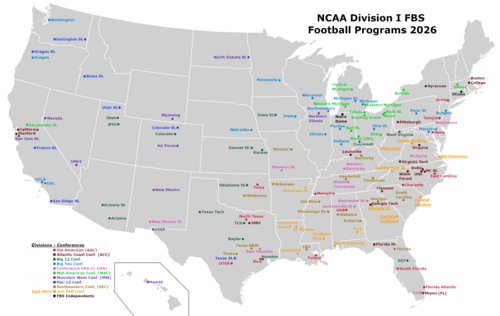 Map of Division I (A) FBS
 -
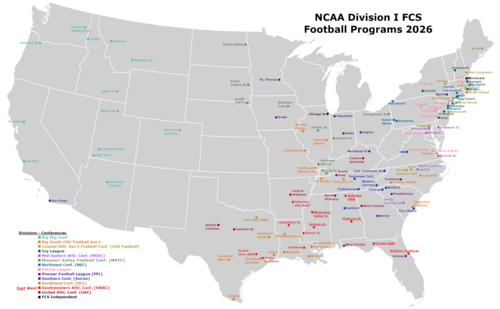 Map of Division I (AA) FCS
 -
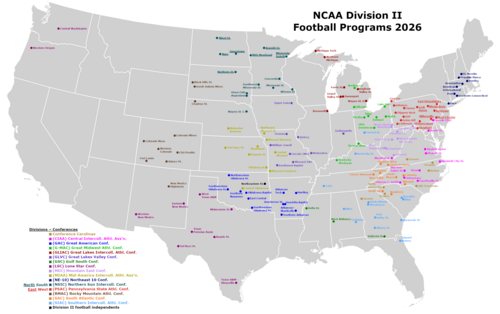 Map of NCAA Division II
 -
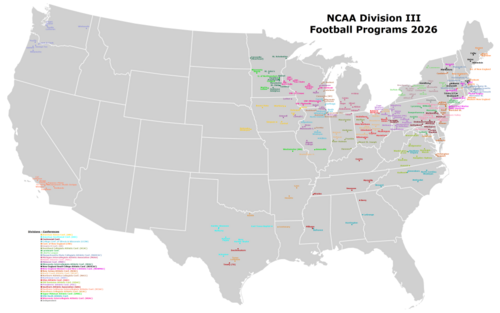 Map of NCAA Division III
 -
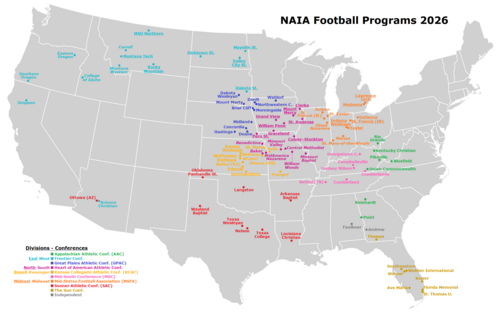 Map of NAIA
 -
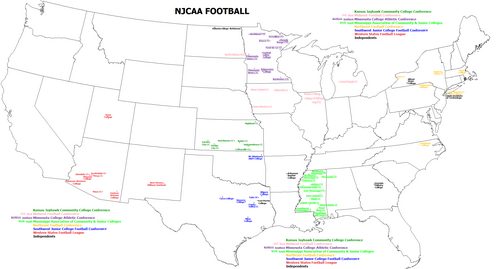 Map of NJCAA
 -
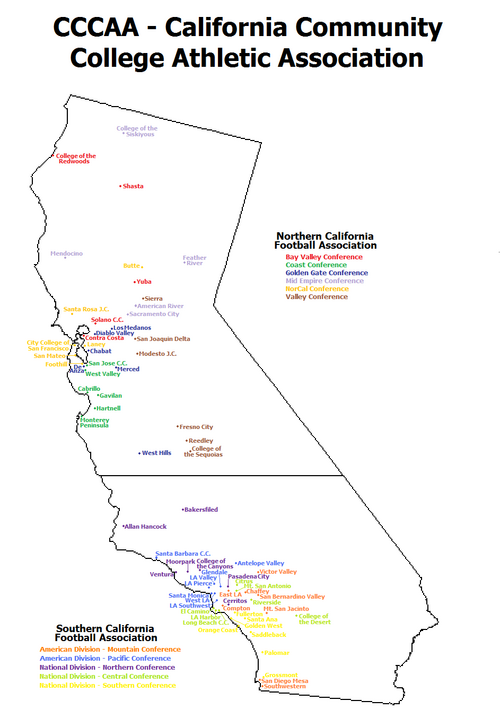 Map of CCCAA
Playoff games
Started in the 2014 season, four Division I FBS teams are selected at the end of regular season to compete in a playoff for the FBS national championship. The inaugural champion was Ohio State University.[164] The College Football Playoff replaced the Bowl Championship Series, which had been used as a selection method to determine the national championship game participants since in the 1998 season. The Michigan Wolverines won the most recent playoff 34–13 over the Washington Huskies in the 2024 College Football Playoff.
At the Division I FCS level, the teams participate in a 24-team playoff (most recently expanded from 20 teams in 2013) to determine the national championship. Under the current playoff structure, the top eight teams are all seeded, and receive a bye week in the first round. The highest seed receives automatic home field advantage. Starting in 2013, non-seeded teams can only host a playoff game if both teams involved are unseeded; in such a matchup, the schools must bid for the right to host the game. Selection for the playoffs is determined by a selection committee, although usually a team must have an 8–4 record to even be considered. Losses to an FBS team count against their playoff eligibility, while wins against a Division II opponent do not count towards playoff consideration. Thus, only Division I wins (whether FBS, FCS, or FCS non-scholarship) are considered for playoff selection. The Division I National Championship game is held in Frisco, Texas.
Division II and Division III of the NCAA also participate in their own respective playoffs, crowning national champions at the end of the season. The National Association of Intercollegiate Athletics also holds a playoff.
Bowl games
Unlike other college football divisions and most other sports—collegiate or professional—the Football Bowl Subdivision, formerly known as Division I-A college football, has historically not employed a playoff system to determine a champion. Instead, it has a series of postseason "bowl games". The annual National Champion in the Football Bowl Subdivision is then instead traditionally determined by a vote of sports writers and other non-players.
This system has been challenged often, beginning with an NCAA committee proposal in 1979 to have a four-team playoff following the bowl games.[165] However, little headway was made in instituting a playoff tournament until 2014, given the entrenched vested economic interests in the various bowls. Although the NCAA publishes lists of claimed FBS-level national champions in its official publications, it has never recognized an official FBS national championship; this policy continues even after the establishment of the College Football Playoff (which is not directly run by the NCAA) in 2014. As a result, the official Division I National Champion is the winner of the Football Championship Subdivision, as it is the highest level of football with an NCAA-administered championship tournament. (This also means that FBS student-athletes are the only NCAA athletes who are ineligible for the Elite 90 Award, an academic award presented to the upper class player with the highest grade-point average among the teams that advance to the championship final site.)
The first bowl game was the 1902 Rose Bowl, played between Michigan and Stanford; Michigan won 49–0. It ended when Stanford requested and Michigan agreed to end it with 8 minutes on the clock. That game was so lopsided that the game was not played annually until 1916, when the Tournament of Roses decided to reattempt the postseason game. The term "bowl" originates from the shape of the Rose Bowl stadium in Pasadena, California, which was built in 1923 and resembled the Yale Bowl, built in 1915. This is where the name came into use, as it became known as the Rose Bowl Game. Other games came along and used the term "bowl", whether the stadium was shaped like a bowl or not.
At the Division I FBS level, teams must earn the right to be bowl eligible by winning at least 6 games during the season (teams that play 13 games in a season, which is allowed for Hawaii and any of its home opponents, must win 7 games). They are then invited to a bowl game based on their conference ranking and the tie-ins that the conference has to each bowl game. For the 2009 season, there were 34 bowl games, so 68 of the 120 Division I FBS teams were invited to play at a bowl. These games are played from mid-December to early January and most of the later bowl games are typically considered more prestigious.
After the Bowl Championship Series, additional all-star bowl games round out the post-season schedule through the beginning of February.
Division I FBS National Championship Games
Partly as a compromise between both bowl game and playoff supporters, the NCAA created the Bowl Championship Series (BCS) in 1998 to create a definitive national championship game for college football. The series included the four most prominent bowl games (Rose Bowl, Orange Bowl, Sugar Bowl, Fiesta Bowl), while the national championship game rotated each year between one of these venues.[166][167] The BCS system was slightly adjusted in 2006, as the NCAA added a fifth game to the series, called the National Championship Game. This allowed the four other BCS bowls to use their normal selection process to select the teams in their games while the top two teams in the BCS rankings would play in the new National Championship Game.
The BCS selection committee used a complicated, and often controversial, computer system to rank all Division I-FBS teams and the top two teams at the end of the season played for the national championship.[168] This computer system, which factored in newspaper polls, online polls, coaches' polls, strength of schedule, and various other factors of a team's season, led to much dispute over whether the two best teams in the country were being selected to play in the National Championship Game.
The BCS ended after the 2013 season and, since the 2014 season, the FBS national champion has been determined[169] by a four-team tournament known as the College Football Playoff (CFP). A selection committee of college football experts decides the participating teams. Six major bowl games known as the New Year's Six (NY6)—the Rose, Sugar, Cotton, Orange, Peach, and Fiesta Bowls—rotate on a three-year cycle as semi-final games, with the winners advancing to the College Football Playoff National Championship.[170] This arrangement was contractually locked in until the 2026 season, but an agreement was reached on CFP expansion to 12 teams effective with the 2024 season.[171]
In the new CFP format, no conferences will receive automatic bids. Playoff berths will be awarded to the top six conference champions in the CFP rankings, plus the top six remaining teams (which may include other conference champions). The top four conference champions receive first-round byes. All first-round games will be played at the home field of the higher seed. The winners of these games advance to meet the top four seeds in the quarterfinals. The NY6 games will host the quarterfinals and semi-finals, rotating so that each bowl game will host two quarterfinals and one semi-final in a three-year cycle. The CFP National Championship will continue to be held at a site determined by open bidding several years in advance.[172]
Controversy
College football is a controversial institution within American higher education, where the amount of money involved—what people will pay for the entertainment provided—is a corrupting factor within universities that they are usually ill-equipped to deal with.[173][174] According to William E. Kirwan, chancellor of the University of Maryland System and co-director of the Knight Commission on Intercollegiate Athletics, "We've reached a point where big-time intercollegiate athletics is undermining the integrity of our institutions, diverting presidents and institutions from their main purpose."[175] Football coaches often make more than the presidents of the universities which employ them.[176] Athletes are alleged to receive preferential treatment both in academics and when they run afoul of the law.[177] Although in theory football is an extra-curricular activity engaged in as a sideline by students, it is widely believed to turn a substantial profit, from which the athletes receive no direct benefit. There has been serious discussion about making student-athletes university employees to allow them to be paid.[178][179][180][181] In reality, the majority of major collegiate football programs operated at a financial loss in 2014.[182]
There had been discussions on changing rules that prohibited compensation for the use of a player's name, image, and likeness (NIL), but change did not start to come until the mid-2010s. This reform first took place in the NAIA, which initially allowed all student-athletes at its member schools to receive NIL compensation in 2014,[183] and beginning in 2020 specifically allowed these individuals to reference their athletic participation in their endorsement deals.[184] The NCAA passed its own NIL reform, very similar to the NAIA's most recent reform, in July 2021, after its hand was forced by multiple states that had passed legislation allowing NIL compensation, most notably California.[185][186]
On June 3 of 2021, "The NCAA's board of directors adopted a temporary rule change that opened the door for NIL activity, instructing schools to set their own policy for what should be allowed with minimal guidelines" (Murphy 2021). On July 1 of 2021, the new rules set in and student athletes could start signing endorsements using their name, image and likeness. "The NCAA has asked Congress for help in creating a federal NIL law. While several federal options have been proposed, it's becoming increasingly likely that state laws will start to go into effect before a nationwide change is made. There are 28 states with NIL laws already in place and multiple others that are actively pursuing legislation" (Murphy 2021).
Charlie Baker called for a ban on all college football betting (and betting on college sports in general) because of prop bets for student athletes. With past scandals and threats to college athletes, Baker requested states with sports betting to adjust their regulations to remove these bet types. While some were quick to do so (including Louisiana, Colorado, Ohio), others rejected the notion and continued to offer sports betting the same way.[187][188]
College football outside the United States
Canadian football, which parallels American football, is played by university teams in Canada under the auspices of U Sports. (Unlike in the United States, no junior colleges play football in Canada, and the sanctioning body for junior college athletics in Canada, CCAA, does not sanction the sport.) However, amateur football outside of colleges is played in Canada, such as in the Canadian Junior Football League. Organized competition in American football also exists at the collegiate level in Mexico (ONEFA), the UK (British Universities American Football League), Japan (Japan American Football Association, Koshien Bowl), and South Korea (Korea American Football Association).
Injuries
According to 2017 study on brains of deceased gridiron football players, 99% of tested brains of NFL players, 88% of CFL players, 64% of semi-professional players, 91% of college football players, and 21% of high school football players had various stages of CTE.[189] The study noted it has limitations due to "selection bias" in that the brains donated are from families who suspected CTE, but "The fact that we were able to gather so many instances of a disease that was previously considered quite rare, in eight years, speaks volumes."[189]
Other common injuries include: injuries of legs, arms, and lower back.[190][191][192][193]
Awards
Division I FBS
- Heisman Trophy
- Maxwell Award
- Walter Camp Award
- Outland Trophy
- Associated Press Player of the Year
- Johnny Rodgers Award
- Fred Biletnikoff Award
- Lou Groza Award
- Lombardi Award
- Bronko Nagurski Trophy
- Dick Butkus Award
- Jim Thorpe Award
- Doak Walker Award
- Campbell Trophy
- Johnny Unitas Golden Arm Award
- Home Depot Award
- Ray Guy Award
- John Mackey Award
- Burlsworth Trophy
- Jet Award
- Paul Hornung Award
- Jon Cornish Trophy
- Patrick Mannelly Award
Division I FCS
See also

- Concussions in American football
- College athletics in the United States
- College athletics
- Helmet stickers
- Homosexuality in American football
- List of nicknamed college football games and plays
- List of sports attendance figures
- Sports injury
References
- ^ "Attendance Records" (PDF). fs.ncaa.org. September 29, 2019. Archived (PDF) from the original on September 29, 2019. Retrieved September 29, 2019.
- ^ "The Electoral map of football: The NFL vs. college football". The Comeback. August 3, 2017. Retrieved November 19, 2017.
- ^ "Football: Probability of competing beyond high school". ncaa.org. April 20, 2020. Retrieved December 4, 2023.
- ^ While Still the Nation's Favorite Sport, Professional Football Drops in Popularity – Baseball and college football are next in popularity Archived September 2, 2007, at the Wayback Machine at the Harris Interactive website, accessed January 28, 2010.
- ^ "The 25 biggest college football stadiums in the country | NCAA.com". www.ncaa.com. Retrieved February 22, 2022.
- ^ "University of Florida Health Science Center Libraries" (PDF). Journals.humankinetics.com.lp.hscl.ufl.edu. Archived (PDF) from the original on May 30, 2013. Retrieved December 18, 2012.
- ^ a b c d e f g "No Christian End!" (PDF). The Journey to Camp: The Origins of American Football to 1889. Professional Football Researchers Association. Archived (PDF) from the original on April 2, 2015. Retrieved January 26, 2010.
- ^ Meacham, Scott (2006). "Old Division Football, The Indigenous Mob Soccer Of Dartmouth College (pdf)" (PDF). dartmo.com. Archived (PDF) from the original on October 9, 2006. Retrieved May 16, 2007.
- ^ "Notre Dame Football :: UND.COM :: The Official Site of Notre Dame Athletics". Archived from the original on December 23, 2015. Retrieved December 23, 2015.
- ^ a b "The History of Football". The History of Sports. Saperecom. 2007. Retrieved May 15, 2007.
- ^ a b c "NFL History3039–1910". NFL.com. NFL Enterprises LLC. 2007. Archived from the original on January 2, 2008. Retrieved May 15, 2007.
- ^ "1800s". Rutgers Through The Years. Rutgers University. Archived from the original on January 20, 2007. Retrieved May 16, 2007.
- ^ Infamous 1874 McGill-Harvard game turns 132 Archived December 6, 2006, at the Wayback Machine at McGill Athletics, published by McGill University (no further authorship information available). This article incorporates text from the McGill University Gazette (April 1874), two issues of The Montreal Gazette (May 14 and 19, 1874). Accessed January 29, 2007.
- ^ a b Parke H. Davis. Football, the American intercollegiate game. p. 64.
- ^ "Spotlight Athletics". Mcgill.ca. May 14, 2012. Archived from the original on October 18, 2012. Retrieved October 22, 2012.
- ^ "Parke H. Davis '93 On Harvard Football". Princeton Alumni Weekly. 16: 583. March 29, 1916 – via Google books.
- ^ Gardner (1996)[full citation needed]
- ^ Dupont, Kevin Paul (September 23, 2004). "Gridiron gridlock: Citing research, Tufts claims football history is on its side". The Boston Globe.
- ^ a b c d e f "Camp and His Followers: American Football 1876–1889" (PDF). The Journey to Camp: The Origins of American Football to 1889. Professional Football Researchers Association. Archived from the original (PDF) on September 29, 2010. Retrieved January 26, 2010.
- ^ "The History of Walter Camp". The Walter Camp Foundation. Archived from the original on December 18, 2007. Retrieved January 16, 2008.
- ^ A compilation of seven sources:
- "History." Archived May 13, 2012, at the Wayback Machine. 2009 Baylor Football Media Almanac. Baylor Athletics (Baylor University). Retrieved October 11, 2009.
- The National Collegiate Athletic Association. "Section 11—Extra Points." Archived December 20, 2008, at the Wayback Machine. 2008 Football Statisticians' Manual. August 2008. Retrieved October 11, 2009.
- Professional Football Researchers Association. "Yale's Walter Camp and 1870s Rugby." Archived July 11, 2010, at the Wayback Machine. The Journey to Camp: The Origins of American Football to 1889. Ivy League Rugby Conference (2009-01-31). Retrieved 2009-10-11.
- Johnson, Greg (2008-08-28). "Two-point conversion turns 50." Archived June 11, 2011, at the Wayback Machine. The NCAA News. Retrieved 2009-10-11.
- "NFL History by Decade: 1869–1910." Archived January 2, 2008, at the Wayback Machine. National Football League. Retrieved 2009-10-11.
- "NFL History by Decade: 1911–1920." Archived January 15, 2008, at the Wayback Machine. National Football League. Retrieved October 11, 2009.
- "College Football Rules Changes". 2015 NCAA Football Records: Football Bowl Subdivision Records (PDF). National Collegiate Athletic Association. p. 186. Archived (PDF) from the original on August 2, 2019. Retrieved January 24, 2016.
- ^ Evans, Harold (August 1940). "College Football in Kansas". Kansas Historical Quarterly. pp. 285–311. Retrieved September 11, 2012.
- ^ John Majors. "College Football". Tennessee Historical Society. Retrieved November 29, 2006.
- ^ "1872 Rutgers Scarlet Knights Schedule and Results". Sports Reference.com. Archived from the original on November 5, 2012. Retrieved April 12, 2011.
- ^ "Timeline of Yale Football". Archived from the original on September 12, 2015. Retrieved March 24, 2015.
{{cite web}}: CS1 maint: bot: original URL status unknown (link) - ^ "Concise Encyclopedia of Tufts History". Archived from the original on December 20, 2014. Retrieved October 16, 2015.
- ^ "Penn Football:Origins To 1901". Archived from the original on September 23, 2015. Retrieved October 16, 2015.
- ^ Mark F. Bernstein (August 22, 2001). Football: The Ivy League Origins of an American Obsession. University of Pennsylvania Press. p. 15. ISBN 978-0-8122-3627-9 – via Google books.
- ^ DeLassus, David. "Yale Yearly Results (1880–1884)". College Football Data Warehouse. Archived from the original on February 13, 2010. Retrieved April 4, 2011.
- ^ DeLassus, David. "Princeton Yearly Results (1880–1884)". College Football Data Warehouse. Archived from the original on October 21, 2012. Retrieved April 4, 2011.
- ^ "College Football Games". The New York Times. November 7, 1886. p. 3. Retrieved March 27, 2015 – via Newspapers.com.
- ^ a b c "Penn State Football History Database". nationalchamps.net.
- ^ "Mansfield, Pennsylvania – It happened one night – First Football under lights – Mansfield PA 1892". Retrieved December 23, 2015.
- ^ "History of the Football Helmet" from Past Time Sports. Accessed March 11, 2015
- ^ Will Perry (1974). The Wolverines: A Story of Michigan Football. The Strode Publishers. ISBN 978-0-87397-055-6.
- ^ "Harvard Football Timeline". TheGame.org. Harvard University Sports Information Office. Archived from the original on August 27, 2008. Retrieved February 18, 2009.
- ^ Nelson (1994), p. 48
- ^ "Big Ten History". Big Ten Conference – Official Athletic Site – Traditions. 2007. Archived from the original on January 13, 2007. Retrieved May 19, 2007.
- ^ Vancil 2000, p. 16.
- ^ Men's Intercollegiate Athletic Department of the University of Minnesota (1981). Ralph Turtinen (ed.). 100 Years of Golden Gopher Football. John Roberts.
- ^ Robin Lester (Summer 1991). "Michigan-Chicago 1905: The First Greatest Game of the Century" (PDF). Journal of Sport History, Vol. 18, No. 2. Archived from the original (PDF) on February 12, 2012. Retrieved October 16, 2015.
- ^ a b "A History of Washington and Lee Athletics". Retrieved February 9, 2015.
- ^ Melvin I. Smith (2008). Evolvements of Early American Foot Ball: Through the 1890/91 Season. AuthorHouse. p. 53. ISBN 978-1-4343-6247-6.
- ^ Becky Riddle, "Stoll Field", ExploreKYHistory, accessed February 4, 2015, http://explorekyhistory.ky.gov/items/show/153.
- ^ Jim L. Sumner (1990). "John Franklin Crowell, Methodism, and the Football Controversy at Trinity College, 1887–1894" (PDF). Journal of Sport History. 17 (1). Archived from the original (PDF) on March 4, 2016. Retrieved October 16, 2015.
- ^ Ratcliffe, Jerry (2008). University of Virginia Football Vault. Atlanta, Ga.: Whitman Publishing, LLC. p. 8. ISBN 978-0-7948-2647-5.
- ^ "Wake Forest: A Look Back".
- ^ "Furman University – 2014 FB Record Book". Archived from the original on December 19, 2014. Retrieved December 23, 2015.
- ^ Greg Roza, Football in the SEC (Southeastern Conference), p. 1, 2007, ISBN 1-4042-1919-6.
- ^ Bailey, John Wendell (1924). Handbook of Southern Intercollegiate Track and Field Athletics. Mississippi Agricultural and Mechanical College. p. 14.
- ^ Southern Inter-Collegiate Athletic Association (PDF). Athens, Georgia: E. D. Stone. 1895. Archived from the original (PDF) on April 4, 2012. Retrieved October 13, 2011.
- ^ "Tarheels Credited With Throwing First Forward Pass". Tar Heel Times. Retrieved January 14, 2013.
- ^ Alan Gould (January 24, 1931). "Sport Slants". Prescott Evening Courier.
- ^ "Ball Under The Jersey". Lincoln Evening Journal. December 18, 1930. p. 21. Retrieved March 13, 2015 – via Newspapers.com.
- ^ Patrick Dorsey (September 23, 2011). "Sewanee, long-lost member of the SEC".
- ^ "On the 7th Day They Rested" (PDF). Archived (PDF) from the original on October 23, 2014.
- ^ "Grantland Rice". Reading Eagle. November 27, 1941.
- ^ "Homecoming 2015". Retrieved December 23, 2015.[permanent dead link]
- ^ "Florida Power:The Early Years". August 17, 1999. Archived from the original on February 4, 2015. Retrieved October 16, 2015.
- ^ Alexander M. Weyand (1962). Football Immortals. p. 128.
- ^ Langum, David J (January 1, 2010). From Maverick to Mainstream: Cumberland School of Law, 1847–1997. University of Georgia Press. p. 95. ISBN 978-0-8203-3618-3.
- ^ Ray Dozier (October 1, 2013). The Oklahoma Football Encyclopedia: 2nd Edition. Sports. p. 12. ISBN 978-1-61321-620-0.
- ^ a b Ray Soldan (September 11, 1994). "A Look Back at High School Football in 1900s Decade".
- ^ Triumph Books (September 2007). Echoes of Oklahoma Sooners Football: The Greatest Stories Ever Told. Triumph Books. p. 179. ISBN 978-1-61749-034-7.
- ^ a b Mal Florence et al., The Trojan Heritage Archived March 3, 2016, at the Wayback Machine, 2004 USC Football Media Guide, USC Athletic Department, pp. 201–209.
- ^ "Intercollegiate Football: The U.S.C. Beats Throop By a Score of 22 to 12 at Pasadena". Los Angeles Times. November 22, 1893.
- ^ a b Migdol, Gary (1997). Stanford: Home of Champions. Sports Publishing LLC. pp. 11–13. ISBN 978-1-57167-116-5. Retrieved May 6, 2014.
- ^ "Seventy-four to nothing". Los Angeles Herald. December 27, 1892. Retrieved May 6, 2014.
- ^ "Stanford Game-by-Game Results; 1892–1895". College Football Data Warehouse. Archived from the original on May 6, 2014. Retrieved May 6, 2014.
- ^ "Amos Alonzo Stagg and Football at Chicago".
- ^ Edwin Pope (1956). Football's Greatest Coaches. Atlanta,: Tupper and Love. p. 232.
- ^ David M. Nelson (1994). The Anatomy of a Game. University of Delaware Press. p. 70. ISBN 978-0-87413-455-1.
- ^ Gary Migdol (1997). Stanford: Home of Champions. Sports Publishing LLC. p. 15. ISBN 978-1-57167-116-5.
- ^ "Stanford Defeats Stagg's Eleven". Chicago Tribune. December 30, 1894. p. 5.
- ^ "A Ghastly Holocaust: Football Spectators Plunged into Molten Glass, The (Adelaide) Advertiser, (Friday 11 January 1901), p. 6". Advertiser. January 11, 1901.
- ^ Twenty Score Persons Make Awful Plunge: Seventeen People Meet Most Awful Death: Two San Jose Men Die Amid Sizzling Shrieking Human Mass in Collapsed Factory at Big Game, The (San Jose) Evening News, (Friday November 30, 1900), p. 1, p. 5.
- ^ "Through a Roof to Death, The (Crawfordsville) Daily News-Review, (Friday, 30 November 1900), p. 2".
- ^ "Spectators Fell Into Molten Glass: Thirteen Dead, One Hundred Injured by Collapse of a Roof Overlooking the Stanford-Berkeley Game at San Francisco, The (Spokane) Spokesman-Review, (Friday 30 November 1900), p. 1".
- ^ "Death Reaps a Dread Harvest of Lives and Plunges City into Gloom, The San Francisco Call, (Friday, 30 November 1900), p. 2".
- ^ Eskanazi, J., "Sudden Death: Boys Fell to Their Doom in S.F.'s Forgotten Disaster" San Francisco Weekly News, August 15, 2012
- ^ a b "Timeline". Retrieved December 23, 2015.
- ^ McCann, Michael C. (1995). Oregon Ducks Football: 100 Years of Glory. Eugene, Oregon: McCann Communications Corp. ISBN 978-0-9648244-7-8.[page needed]
- ^ a b Libby, Brian. Tales from the Oregon Ducks Sideline. Sports Publishing LLC.College Football Data Warehouse: Oregon Yearly Results 1894 Archived October 10, 2014, at the Wayback Machine
- ^ College Football Data Warehouse: Oregon Yearly Results 1894 Archived October 10, 2014, at the Wayback Machine
- ^ College Football Data Warehouse: Oregon Yearly Results 1895 Archived October 10, 2014, at the Wayback Machine
- ^ Forgard, Benjamin. "The Evolution of School Spirit and Tradition at Oregon State University" (PDF). Archived (PDF) from the original on October 17, 2013. Retrieved May 30, 2012.
- ^ Edmonston, George Jr. "The Birth of OSU Football". OSU Alumni Association. Archived from the original on October 17, 2013. Retrieved May 30, 2012.
- ^ "Likes Yost's Manner: President Jordan of Leland Stanford University Gives His Opinion of the Coach". Lawrence Daily Journal. May 8, 1900. p. 4.
- ^ "Stanford's Football Coach Has Arrived". San Francisco Chronicle. August 22, 1900. p. 4.
- ^ "USC Football Heads To Bay Area To Face No. 16 Stanford". USC Trojans. October 3, 2010. Archived from the original on December 8, 2015. Retrieved October 16, 2015.
- ^ a b c d e f g h i j Park, Roberta J (Winter 1984). "From Football to Rugby—and Back, 1906–1919: The University of California–Stanford University Response to the "Football Crisis of 1905"" (PDF). Journal of Sport History. 11 (3): 33. Archived from the original (PDF) on August 7, 2010.
- ^ Goldsmith, A. A (October 1913 – March 1914). "Why California Likes Rugby". Outing. 63: 742–750.
- ^ "History". British Columbia Rugby Union. Archived from the original on April 15, 2012. Retrieved October 20, 2011.
- ^ John C. Nixon (December 16, 1898). "Buff Milestones" (PDF). CUBuffs.com reprint of Silver & Gold article. Archived from the original (PDF) on June 6, 2011. Retrieved June 4, 2007.
- ^ "President Eliot on Football." The School Journal, Volume 70, United Education Company, New York, Chicago, and Boston, February 18, 1905, p. 188.
- ^ Vancil 2000, pp. 16–18.
- ^ Bennett 1976, p. 20.
- ^ Lewis, Guy M. (1969). "Teddy Roosevelt's Role in the 1905 Football Controversy". The Research Quarterly. 40 (4): 717–724. PMID 4903389.
- ^ Watterson, John (2001). "Tiny Maxwell and the Crisis of 1905: The Making of a Gridiron Myth" (PDF). College Football Historical Society: 54–57. Archived from the original (PDF) on August 8, 2010.
- ^ "TEN-YARD RULE A FAILURE.; Only Seven First Downs Made in Test Game in Kansas". The New York Times. December 26, 1905.
- ^ "New Football Rules Tested" Archived March 16, 2013, at the Wayback Machine Los Angeles Times, December 26, 1905
- ^ a b Smith, Rodney (2000). "A Brief History of the National Collegiate Athletic Association's Role in Regulating Intercollegiate Athletics". Marquette Sports Law Review. 11 (1): 9–22.
- ^ "The History of the NCAA". NCAA.org. National Collegiate Athletic Association. Archived from the original on April 30, 2007. Retrieved May 19, 2007.
- ^ Vancil 2000, p. 18.
- ^ John S. Watterson, "Inventing Modern Football" Archived November 19, 2008, at the Wayback Machine, American Heritage magazine, June 1988
- ^ Vancil 2000, p. 17.
- ^ Vancil 2000, p. 22.
- ^ "NFL History 1911–1920". NFL.com. 2007. Archived from the original on January 15, 2008. Retrieved May 15, 2007.
- ^ Vancil 2000, p. 24.
- ^ "Marching Band History". University of Illinois. Archived from the original on May 12, 2011. Retrieved April 6, 2011.
- ^ "The History of Homecoming". ACTIVE.com. October 4, 2007. Archived from the original on October 19, 2012. Retrieved December 23, 2015.
- ^ "100 years ago: Football fans enjoy mechanized reproduction of KU-MU game". Lawrence Journal-World. November 27, 2011. Retrieved December 27, 2011.
- ^ Sciullo, Sam Jr., ed. (1991). 1991 Pitt Football: University of Pittsburgh Football Media Guide. Pittsburgh: University of Pittsburgh Sports Information Office. p. 116.
- ^ "Princeton-Chicago football game is broadcast across the country". Archived from the original on September 24, 2015. Retrieved October 16, 2015.
- ^ George Allen (February 2009). How to Scout Football. Martino. p. 3. ISBN 978-1-57898-729-0.
- ^ "Grantland Rice Tells Of Greatest Thrill In Years Of Watching Sport". Boston Daily Globe. April 27, 1924. ProQuest 497709192.
- ^ Dan McGugin (1907). "Southern Intercollegiate Athletic Association Foot Ball". The Official National Collegiate Athletic Association Football Guide: 71–75.
- ^ Davis, Parke H. (October 15, 1916). "Yellow Jackets-Cumberland Score Was Record One; Tops the List According to Statistics Compiled Showing All Scores Past the Century Mark". The Atlanta Journal-Constitution. p. A3.
- ^ Alex Lynn (November 25, 1906). "Vandy's Great Victory Will Live In History". Atlanta Constitution. p. 5. Retrieved March 24, 2015 – via Newspapers.com.
- ^ a b "Brown Calls Vanderbilt '06 Best Eleven South Ever Had". Atlanta Constitution. February 19, 1911. p. 52. Retrieved March 8, 2015 – via Newspapers.com.
- ^ "Football Squads Begin practice". The Kingsport Times. September 14, 1923.
- ^ cf. Bill Traughber. "CHC- Vandy Ties Michigan in 1922". Archived from the original on February 1, 2016.
- ^ "Alabama vs. Pennsylvania". Archived from the original on April 2, 2015. Retrieved March 7, 2015.
- ^ "The Football Game That Changed the South". The University of Alabama. Archived from the original on May 26, 2008. Retrieved October 6, 2008.
- ^ a b c Bennett 1976, pp. 20–21.
- ^ "ESPN.com: Top N. American athletes of the century". ESPN. 2001. Retrieved May 19, 2007.
- ^ Vancil 2000, p. 20.
- ^ "WorldCat entry for Football for Coaches and Players". WorldCat.org. OCLC 1741453. Retrieved August 23, 2007.
- ^ "Knute Rockne". MSN Encarta. 2007. Archived from the original on August 21, 2009. Retrieved April 6, 2008.
- ^ Vancil 2000, pp. 19–22.
- ^ Vancil 2000, pp. 24–29.
- ^ a b c MacCambridge 1999, p. 124.
- ^ "A Look Back at the Southwest Conference". 2006–2007 Texas Almanac. The Dallas Morning News. 2007. Retrieved July 4, 2018.
- ^ Ours, Robert M. (2007). "Southeastern Conference". College Football Encyclopedia. Augusta Computer Services. Archived from the original on May 10, 2007. Retrieved May 31, 2007.
- ^ a b MacCambridge 1999, p. 148.
- ^ Vancil 2000, p. 30.
- ^ Vancil 2000, pp. 28–30.
- ^ "A Brief History of the Heisman Trophy". Heisman Trophy. heisman.com. 2007. Archived from the original on December 5, 2009. Retrieved May 31, 2007.
- ^ Vancil 2000, p. 39.
- ^ Vancil 2000, pp. 41–45.
- ^ MacCambridge 1999, p. 172.
- ^ Jake Grantl (November 14, 2019). "Rearview Revisited: Segregation and the Sugar Bowl". Georgia Tech. Retrieved November 14, 2019.
- ^ MacCambridge 1999, p. 171.
- ^ Bennett 1976, p. 56.
- ^ Barnidge, Tom (2000). "1958 Colts remember the "Greatest Game"". nfl.com. Archived from the original on June 24, 2007. Retrieved March 21, 2007. reprinted from Official Super Bowl XXXIII Game Program.
- ^ Vancil 2000, pp. 46–48.
- ^ Vancil 2000, p. 56.
- ^ Bennett 1976, pp. 209–217.
- ^ a b Call, Jeff (December 20, 2006). "Changing seasons: Y. reconnects with past, but bowl scene not the same". Deseret News. p. D5.
- ^ "2022–23 Bowl Schedule". BOWL SEASON. Retrieved November 1, 2023.
- ^ a b "College Bowl Games". Hickok Sports. 2006. Archived from the original on February 23, 2002. Retrieved June 1, 2007.
- ^ Celizic, Mike (December 9, 2006). "Too many bowl games? Nonsense". MSNBC. Archived from the original on January 29, 2007. Retrieved June 1, 2007.
- ^ Temple, Jesse. "What Wisconsin extending its bowl streak would mean to Badgers players". The New York Times. Retrieved November 1, 2023.
- ^ "Spring football practice recommendations advance". NCAA.org. January 18, 2022. Retrieved November 1, 2023.
- ^ "Additional practices create balancing act for bowl teams". USA TODAY. Retrieved November 1, 2023.
- ^ a b c "BCS Chronology". FOX Sports on MSN. 2006. Archived from the original on September 15, 2007. Retrieved June 1, 2007.
- ^ "College Football vs. NFL Rules – What's Different?". The Spread. December 12, 2023. Retrieved December 13, 2023.
- ^ "How Does College Football Overtime Work? 2019 Rule Changes, Explained". Sports Illustrated. July 16, 2019. Retrieved December 15, 2023.
- ^ "Kickoffs from 30 yard line could create more returns, injuries". Associated Press. April 16, 2007. Retrieved August 17, 2007.[permanent dead link]
- ^ "NCAA Football Rules Committee Votes To Restore Plays While Attempting To Maintain Shorter Overall Game Time". NCAA. February 14, 2007. Archived from the original on September 30, 2007. Retrieved August 17, 2007.
- ^ "Series of rules changes approved". ESPN. Associated Press. April 15, 2011. Retrieved June 11, 2011.
- ^ Jeyarajah, Shehan; Dodd, Dennis (September 2, 2022). "College Football Playoff expansion: Board agrees to 12-team field with aim to implement as soon as possible". CBS Sports. Retrieved December 12, 2023.
- ^ "NCAA Division I Football Championship". Archived from the original on March 29, 2010. Retrieved December 23, 2015.
- ^ "FBS College Football History". NCAA.com. Retrieved December 23, 2015.
- ^ White, Gordon S. (January 8, 1979). "N.C.A.A. Committee Urges Football Playoff". The New York Times.
- ^ "Man behind creation of BCS pleased with results - USATODAY.com". USA Today. July 6, 2012. Archived from the original on July 6, 2012. Retrieved November 9, 2023.
- ^ "New Formula for Football Championship Announced". Fans Only. June 9, 1998. Archived from the original on March 7, 2000. Retrieved November 9, 2023.
- ^ "ESPN.com – NCF/PREVIEW00 – BCS 101: Understanding how it works". www.espn.com. Retrieved November 8, 2023.
- ^ "Overview". College Football Playoff. Retrieved November 8, 2023.
- ^ "New Year's Six matchups announced | NCAA.com". www.ncaa.com. Retrieved November 8, 2023.
- ^ "Rose Bowl OK's new deal for 12-team CFP in '24". ESPN.com. December 1, 2022. Retrieved November 8, 2023.
- ^ "College Football Playoff expected to keep format for expanded 12-team bracket despite conference realignment". CBSSports.com. September 27, 2023. Retrieved November 8, 2023.
- ^ Salzberg, Steven. "Football is corrupting America's universities: it needs to go". Forbes. Retrieved May 17, 2023.
- ^ "SCHALIN: Time for universities to punt football". The Washington Times. Retrieved May 17, 2023.
- ^ Pappano, Laura (January 20, 2012). "How Big-Time Sports Ate College Life". The New York Times. Archived from the original on January 1, 2022.
- ^ Newman, Jonah (May 16, 2014). "Coaches, Not Presidents, Top Public-College Pay List". Chronicle of Higher Education.
- ^ "Errors in Inquiry on Rape Allegations Against FSU's Jameis Winston". The New York Times. April 16, 2014.
- ^ Gregg Doyel, "Time to pay college football players – changing times, money says so", CBS Sports, September 25, 2013, http://www.cbssports.com/general/writer/gregg-doyel/23838595/its-time-pay-college-football-players----changing-times-money-say-so Archived September 3, 2014, at the Wayback Machine
- ^ "Gilmore: Show the college athletes the money". ESPN.com. January 17, 2007. Retrieved May 17, 2023.
- ^ Branch, Taylor (September 7, 2011). "The Shame of College Sports". The Atlantic. Retrieved May 17, 2023.
- ^ Strauss, Ben; Tracy, Marc (August 8, 2014). "N.C.A.A. Must Allow Colleges to Pay Athletes, Judge Rules". The New York Times.
- ^ Playing in the Red. Washington Post. Retrieved January 9, 2017.
- ^ "Name, Image and Likeness FAQs" (PDF). National Association of Intercollegiate Athletics. September 14, 2020. Retrieved March 11, 2021.
- ^ "NAIA Passes Landmark Name, Image and Likeness Legislation" (Press release). National Association of Intercollegiate Athletics. October 6, 2020. Retrieved March 11, 2021.
- ^ Hale, David M. (March 8, 2021). "Social media stardom: How changes to NIL will benefit athlete-influencers across the NCAA". ESPN. Retrieved March 11, 2021.
- ^ Murphy, Dan (July 1, 2021). "Let's make a deal: NCAA athletes cashing in on name, image and likeness". ESPN. Retrieved July 2, 2021.
- ^ "E-News | NCAA President Charlie Baker urges state lawmakers across the country to ban prop bets on college athletes". enews.wvu.edu. April 4, 2024. Retrieved August 23, 2024.
- ^ "States With College Football Props | What States Have CFB Props". July 26, 2024. Retrieved August 23, 2024.
- ^ a b "BU Researchers Find CTE in 99% of Former NFL Players Studied | The Brink | Boston University". July 26, 2017.
- ^ Willigenburg, N. W.; Borchers, J. R.; Quincy, R.; Kaeding, C. C.; Hewett, T. E. (2016). "Comparison of Injuries in American Collegiate Football and Club Rugby: A Prospective Cohort Study – Nienke W. Willigenburg, James R. Borchers, Richard Quincy, Christopher C. Kaeding, Timothy E. Hewett, 2016". The American Journal of Sports Medicine. 44 (3): 753–60. doi:10.1177/0363546515622389. PMID 26786902. S2CID 21829142.
- ^ "The Common Types of Football Injuries".
- ^ Makovicka, J. L.; Patel, K. A.; Deckey, D. G.; Hassebrock, J. D.; Chung, A. S.; Tummala, S. V.; Hydrick, T. C.; Gulbrandsen, M.; Hartigan, D. E.; Chhabra, A. (2019). "Lower Back Injuries in National Collegiate Athletic Association Football Players: A 5-Season Epidemiological Study". Orthopaedic Journal of Sports Medicine. 7 (6). doi:10.1177/2325967119852625. PMC 6582304. PMID 31245431.
- ^ "reverehealth.com".
Sources
- Bennett, Tom (1976). The Pro Style. Prentice-Hall. ISBN 978-0-13-731604-5.
- MacCambridge, Michael (1999). ESPN SportsCentury. Hyperion. ISBN 978-0-7868-6471-3. OCLC 761166567.
- Vancil, Mark, ed. (2000). ABC Sports College Football: All Time All America Team. Hyperion. ISBN 978-0-7868-6710-3.
Further reading
- "The Invention Of Football". Current Events, 00113492, November 14, 2011, Vol. 111, Issue 8
- Anderson, Christian K., and Amber C. Fallucca, eds. The history of American college football: institutional policy, culture, and reform (Routledge, 2021) online.
- Chiles, Marvin T. "Gideon Edward Smith: The Player and Coach Who Gave Meaning to Black College Football, 1892–1942". Journal of African American Studies (2023): 1–19.
- De Oca, Jeffrey Montez. Discipline and indulgence: College football, media, and the American way of life during the cold war (Rutgers University Press, 2013) online.
- Harrison, Emily A. "The first concussion crisis: head injury and evidence in early American football". American journal of public health 104.5 (2014): 822–833. online
- Hobson, J. Hardin. "Football Culture at New South Universities: Lost Cause and Old South Memory, Modernity, and Martial Manhood". in The History of American College Football ed Christian K. Anderson, and Amber C. Fallucca, (Routledge, 2021) pp. 37–63.
- Hunter, Bob. Saint Woody: The History and Fanaticism of Ohio State Football (U of Nebraska Press, 2022); on Woody Hayes
- Ingrassia, Brian M. The Rise of Gridiron University: Higher Education's Uneasy Alliance with Big-Time Football. Lawrence, Kansas: University Press of Kansas, 2012.
- McGregor, Andrew. "The Anti-Intellectual Coach: The Cultural Politics of College Football Coaching from the New Left to the Present". Journal of Sport and Social Issues (2022): 01937235221098915.
- Nite, Calvin, and Marvin Washington. "Institutional adaptation to technological innovation: Lessons from the NCAA’s regulation of football television broadcasts (1938–1984)". Journal of Sport Management 31.6 (2017): 575–590.
- Rowley, Christopher. The Shared Origins of Football, Rugby, and Soccer (Rowman & Littlefield, 2015) [Rowley, Christopher. The Shared Origins of Football, Rugby, and Soccer. Rowman & Littlefield, 2015. online].
- Smith, Ronald A. "American football becomes the dominant intercollegiate national pastime". International Journal of the History of Sport 31.1–2 (2014): 109–119. online
- Tutka, Patrick, and Chad Seifried. "An Innovation Diffusion Ideal-type on the History of American College Football Stadia". Journal of Issues in Intercollegiate Athletics (2020). online
- VanOverbeke, Marc A. " 'Out of the Quietness, a Clamor: "We Want Football!"’ The California State Colleges, Educational Opportunity, and Athletics". History of Education Quarterly 53.4 (2013): 430–454. online
- Watterson, John Sayle. College football: History, spectacle, controversy (JHU Press, 2000) online in project MUSE.
- White, Derrick E. Blood, sweat, and tears: Jake Gaither, Florida A&M, and the history of black college football (UNC Press Books, 2019).
External links

Wikimedia Commons has media related to College football.

- College football at NCAA, NAIA, CCCAA, NCCAA, NJCAA, USCAA
Statistics
- College Football at Sports-Reference.com Archived April 1, 2018, at the Wayback Machine
- Stassen College Football, comprehensive college football database
- College Football Data Warehouse
Rules
- NCAA Football 2011 and 2012 Rules and Interpretations