
Loading article…
 | |
| 協会 | NCAA |
|---|---|
| 設立 | 1953年5月8日 |
| コミッショナー | ジェームズ・J・フィリップス(2021年2月1日以降) |
| スポーツ競技 |
|
| 分割 | ディビジョン I |
| 細分化 | FBS |
| チーム数 | 18 |
| 本部 | ノースカロライナ州シャーロット |
| 地域 | |
| 公式サイト | このサイトについて |
| 場所 | |
 | |
アトランティックコースト カンファレンス( ACC ) は、アメリカ合衆国にある大学スポーツ カンファレンスです。ノースカロライナ州シャーロットに本部を置くACC の 18 の加盟大学は、全米大学体育協会(NCAA) のディビジョン Iで競い合っています。ACC のフットボールチームは、 NCAA ディビジョン I フットボール ボウル サブディビジョンで競い合っています。ACC は 27 のスポーツの競技を後援しており、加盟校の多くは全国的に高く評価されています。現在のカンファレンスの加盟校は、ボストン カレッジ、カリフォルニア、クレムソン、デューク、フロリダ州立大学、ジョージア工科大学、ルイビル、マイアミ、ノースカロライナ、ノースカロライナ州立大学、ノートルダム、ピッツバーグ、 SMU 、スタンフォード、シラキュース、バージニア、バージニア工科大学、およびウェイクフォレストです。
ACC チームと選手は、カンファレンスの歴史を通じて、複数のスポーツで数十回に及ぶ全国選手権を獲得してきました。一般的に、特定のスポーツにおける ACC のトップ選手とチームは、その年、全米トップの大学競技者とみなされます。さらに、カンファレンスはメディアで広く取り上げられています。2014年にカレッジ フットボール プレーオフが始まったことで、ACC はフットボールのニューイヤーズ シックスボウル ゲームと契約を結んだ「パワー フォー」カンファレンスの 1 つになりました。
ACCは1953年5月8日、南大西洋沿岸諸州にある7つの大学によって設立され、1953年12月初旬にバージニア大学が加盟して会員数は8校となった。[2] 1971年にサウスカロライナ大学が脱退したことにより会員数は7校に減少したが、1979年にジョージア工科大学が非フットボール競技で、1983年にフットボールで加わって再び8校となり、フロリダ州立大学が1991年に非フットボール競技で、1992年にフットボールで加わって会員数は9校に増加した。2000年以降、NCAAの大規模な再編により、さらに10校が加盟し、当初の会員1校(メリーランド州)が脱退したため、現在の会員数は18校となっている。近年の加盟により、カンファレンスの活動範囲は北東部、中西部、西部に広がっている。
加盟大学
現在のメンバー
ACC には 12 の州から 18 の加盟機関があります。ACC の地理的範囲に含まれる 12 の州は、アルファベット順に、カリフォルニア、フロリダ、ジョージア、インディアナ、ケンタッキー、マサチューセッツ、ニューヨーク、ノースカロライナ、ペンシルベニア、サウスカロライナ、テキサス、バージニアです。カンファレンスの地理的範囲は、主に米国大西洋岸に沿った米国南部および北東部ですが、最近のカンファレンスの再編により、カリフォルニアとテキサスにも広がりました。南はフロリダから北はニューヨークまで、西はカリフォルニアから最東はマサチューセッツまで広がっています。
ノートルダム大学がACCに加盟したとき、同大学は独立したフットボールチームであり続けることを選択した。しかし、同大学のフットボールチームは、シーズンごとに5つのACCフットボールチームを順番に選んで対戦する特別なスケジュール取り決めをACCと結んだ。2020年シーズンは、米国でのCOVID-19パンデミックの影響で他のパワーファイブカンファレンスの非カンファレンス戦のほとんどが中止されたため、ACCはノートルダム大学がカンファレンススケジュールの10試合をフルにプレーし、ACCチャンピオンシップに出場する資格を得ることに同意した。[3]
2024 年 8 月 2 日以降、ACC の 18 のメンバーは次のとおりです。
- 注記
- ^ フロリダ州立大学は1991-92年度にほとんどのスポーツでACCに加盟したが、1992年秋季(1992-93年度)までリーグのフットボール選手権に出場することはなかった。[6]
- ^ ジョージア工科大学は1979-80シーズンにACCに加盟したが、1983年秋季(1983-84学年度)までリーグのフットボール選手権に出場することはなかった。[7]
- ^ SMU キャンパスはほぼ全域がテキサス州ユニバーシティ パークに位置しており、隣接するハイランド パーク市とともにダラス市に完全に囲まれている。ただし、米国郵便公社はユニバーシティ パーク内のすべての場所をダラスの住所とみなしている。
元メンバー
1971年、サウスカロライナ大学はACCを離れて独立し、その後1983年にメトロカンファレンスに加盟し、1991年に現在の本拠地であるサウスイースタンカンファレンスに移りました。2014年7月1日、メリーランド大学はビッグテンカンファレンスに移りました。
会員マップ



メンバーシップのタイムライン
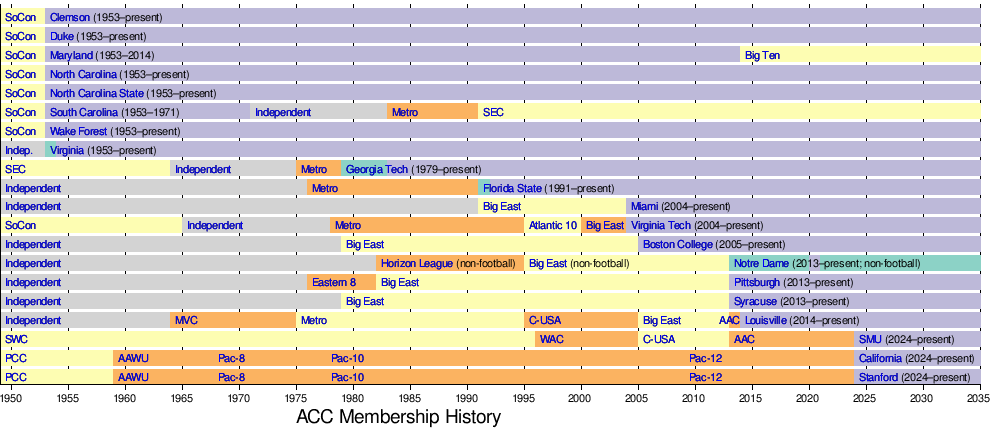
正会員 非サッカー会員 独立系 その他カンファレンス その他カンファレンス
歴史
設立と初期の拡大
ACCは1953年6月14日、サザンカンファレンスの7校が脱退し、独自のカンファレンスを設立したときに設立されました。[n 1] [8]これらの7大学は、クレムソン、デューク、メリーランド、ノースカロライナ、ノースカロライナ州立、サウスカロライナ、およびウェイクフォレストで、ACCのチャーターメンバーになりました。これらの7大学が脱退した理由の1つは、1951年に導入されたサザンカンファレンスのポストシーズンのフットボールの試合禁止でした。(クレムソンとメリーランドは、1951年シーズン後にサザンカンファレンスのボウルルールを無視し、1952年シーズンに他のカンファレンスチームと対戦することを禁止されました。)[9]新しいリーグを設立するための一連の細則を起草した後、7大学は1953年5月8日午前、ノースカロライナ州グリーンズボロのセジフィールドカントリークラブで行われた春の会議でサザンカンファレンスを脱退しました。 1953年6月14日に規約が批准され、新しいカンファレンスが創設された。[10]カンファレンスの役員は8番目のメンバーを追加する希望を示し、候補としてバージニア、VPI、ウェストバージニアが挙げられた。[11] 1953年12月4日、役員はノースカロライナ州グリーンズボロで招集され、1937年以来独立していた元サザンカンファレンスのチャーターメンバーであるバージニアをカンファレンスに加入させた。[12]バージニアの学長コルゲート・ダーデンはACCまたはどのカンファレンスにも加入することに強く反対したが、バージニア大学の体育局長ガス・テベルは賛成した。[13]最終的に、バージニア大学の理事会は6対3の投票でACCへの加入を承認した。[13]
1960年、ACCは入学する学生アスリートの最低SATスコアを750点に設定したが、これはカンファレンスとしては初めてのことである。この最低スコアは1964年に800点に引き上げられたが、最終的には1972年に連邦裁判所によって無効とされた。[14]
1971年7月1日、サウスカロライナはACCを脱退し、独立したチームとなった。
人種統合
1950年代から60年代にかけて、白人だけの大学スポーツチームの人種統合は、この地域の重要な議題だった。平等、人種差別、そして注目度の高い試合に勝つために必要なトップ選手を求める卒業生たちの要求といった問題が絡んでいた。ACCが主導権を握った。[曖昧]まず、北部の人種統合チームをスケジュールし始めた。最終的に、ACCの学校は、後援者や公民権団体からの圧力を受けながら、チームを統合した。[15]卒業生の基盤が地元や州の政治、社会、ビジネスを支配していたため、ACCの旗艦校は成功を収めた。パメラ・グランディが主張するように、彼らは勝ち方を学んでいたのだ。
- スポーツの能力が引き起こした幅広い賞賛は、スポーツ競技場を象徴的な遊びの場から社会変革の力へと変えるのに役立ち、幅広い市民が、自分たちは米国社会に完全に参加するのに値しないという偏見に公然と、時には効果的に異議を唱える場となった。スポーツでの成功は社会から偏見や固定観念をなくすことはできないが、黒人アスリートは人種差別に直面し続けるだろう...[少数派のスター選手は]国家生活のあらゆる分野で地位や影響力を争うための規律、知性、落ち着きを示した。[16]
1978年と1991年の拡張
ACCは、1978年4月3日に発表され、1979年7月1日に発効したメトロカンファレンスからのジョージア工科大学の追加まで、7校の加盟校で運営されていたが、フットボールに関しては例外であり、テックは1983年にACCフットボールに参加するまで独立したままであった。1991年7月1日に、非フットボール部門でメトロカンファレンスに所属していたフロリダ州立大学が加わり、1992年7月1日にフットボール部門で加わったことで、加盟校の総数は9校に達した。これらの学校の追加は、1953年以来初のカンファレンスの展開範囲の拡大となったが、両校とも依然として他のACC校と同様、南大西洋諸州に位置していた。
2004~2005年の拡大
ACCは2005年のカンファレンス再編の際にビッグ・イースト・カンファレンスから3チームを加えた。当初、カンファレンスはボストン・カレッジ、マイアミ、シラキュースをターゲットにしていた。拡大は物議を醸し、コネチカット、ラトガース、ピッツバーグ、ウェスト・バージニア(当初はバージニア工科大学も)が、ビッグ・イースト・カンファレンスを弱体化させるために共謀したとしてACC、マイアミ、ボストン・カレッジを相手に訴訟を起こした。当時のバージニア州知事マーク・ワーナーは、弱体化したビッグ・イーストでバージニア工科大学が取り残されることを恐れ、バージニア大学当局に州内のライバルのためにロビー活動を行うよう圧力をかけた。最終的にバージニア工科大学がシラキュースに代わって拡大ラインナップに入り、ACCの拡大が合意された。マイアミとバージニア工科大学は2004年7月1日に加盟し、ボストン・カレッジは2005年7月1日に加盟し、リーグの12番目のメンバー、北東部からの最初のメンバーとなった。
2010年~現在
2010-2022
ACCチャンピオンの殿堂は2011年3月2日にグリーンズボロ・コロシアムアリーナの隣にオープンし、ACCはサザンカンファレンスに次いで殿堂を持つ2番目の大学スポーツカンファレンスとなった。[17] [n 2]
2011年9月17日、ビッグイーストカンファレンスのメンバーであるシラキュース大学とピッツバーグ大学は、ともにACCへの加盟を申請した。[19]翌日、両校はカンファレンスへの加盟が認められ、以前の拡大と同様に再びカンファレンスの足跡が拡大した。[20]ビッグイーストはピッツバーグ大学とシラキュース大学にリーグ規約で定められた27か月の通知期間を守らせるつもりだったため、ACCへの加盟日(交渉がない限り)は2014年7月1日が最も可能性が高かった。[21]しかし、2012年7月、ビッグイーストはシラキュース大学とピッツバーグ大学と合意に達し、2校は2013年7月1日にビッグイーストを脱退することができた。[22] [23]
2012年9月12日、ノートルダム大学は、アメリカンフットボールと男子アイスホッケーを除くすべてのカンファレンススポーツでACCに加盟することに合意した(ACCは男子アイスホッケーのスポンサーではないため、他のACC加盟大学の中ではボストンカレッジのみが男子アイスホッケーのスポンサーとなっている)。これは、ノートルダム大学がアメリカ中西部で初めてACCに加盟したことになる。合意の一環として、ノートルダム大学は2014年から毎シーズン、ACC加盟校と5試合のフットボール試合を行うことを約束した。[24] 2013年3月12日、ノートルダム大学とビッグイーストは、ノートルダム大学が2013年7月1日付けでACCに加盟することについて合意に達したと発表した。[25]
2012年11月19日、メリーランド大学の理事会は、2014年よりACCを脱退し、ビッグ・テン・カンファレンスに参加することを決議した。[26]翌週、ビッグ・イーストのルイビル大学は、メリーランドに代わって2014年7月1日付けでACCの正会員となるよう招待を受け入れた。[27]
ACCの会長らは2013年4月22日、2014-15年度に同カンファレンスに加盟する全15校がメディア権付与契約(GOR)に署名したと発表した。この契約は即時発効し、2026-27年度まで有効で、当時のカンファレンスとESPNのテレビ契約期間と一致する。この動きは基本的に、ACCが拡大を目指す他のカンファレンスの標的になることを防ぐもので、契約期間中に学校がカンファレンスを脱退した場合、その学校のホームゲームのメディア権から得られる収益はすべてACCのものであり、学校に帰属するものではない。[28]この動きにより、SECはFBSパワーファイブカンファレンスの中でGORを持たない唯一のカンファレンスとなった。 [29]
2016年7月、GORは2035-36学年度まで延長され、ESPNとの新しい20年契約の締結と同時に、当時のアドホックACCネットワークを本格的なネットワークに転換しました。新しいネットワークは、2016-17学年度にデジタルサービスとして、2019年8月にリニアネットワークとして開始されました。[30]
2021年8月24日、ACCはビッグ・テン・カンファレンスおよびパック12カンファレンスと同盟を結んだ。 [31] 2022年、ACCはピッツバーグ大学パンサーズとウェストバージニア大学マウンテニアーズの間のバックヤード・ブロールのような古いライバル関係を復活させた。[32]ピッツバーグ大学パンサーズとジョージア工科大学イエロージャケッツの間の友好的なライバル関係は、 1956年のシュガーボウルとボビー・グリアを記念しており、最後の試合中に俳優のアンソニー・マッキーがグリアとゲームを称えるためにフィールドに登場した。[33] [34]
2024年の拡張
2023年9月1日、カンファレンスは拡大し、カリフォルニア大学、SMU、スタンフォード大学の3つの新メンバーを追加することを決議した。当初、発表は、各校と現在のメンバーとの距離を考えると物議を醸した。[35] SMUは2024年7月1日にアメリカン・アスレチック・カンファレンスから加盟し、カリフォルニア大学とスタンフォード大学は、以前のカンファレンスであるPac-12カンファレンスの会計年度がほとんどのアスレチック・カンファレンスと異なるため、 2024年8月2日にACCから加盟した。
学術とACC
学術ランキング
現在の「パワーファイブカンファレンス」を含む、NCAAディビジョンI FBSフットボールを後援する主要なNCAAアスレチックカンファレンスの中で、ACCはUSニューズ&ワールドレポート[36] [37] [38] [39] [40] [41]とNCAAの学業進歩率に基づいて、最も学術的にランク付けされたメンバーの集まりであると見なされてきました。[42] [43]
アメリカ大学協会には、カリフォルニア大学、デューク大学、ジョージア工科大学、マイアミ大学、ノートルダム大学、ピッツバーグ大学、ノースカロライナ大学、スタンフォード大学、バージニア大学の9つのACC機関が加盟している。 [44] [45]シラキュース大学は2011年まで加盟していたが、連邦政府以外の助成金の計算方法をめぐる論争により自主的に脱退した。[46]
ACCAC と ACC 学術ネットワーク

ACCのメンバーは、加盟大学間の学術的および管理的協力の手段を提供するコンソーシアムであるアトランティック・コースト・カンファレンス・アカデミック・コンソーシアム(ACCAC)に参加しています。1999年に設立されたカンファレンス全体の博士課程学生交換プログラムから成長したACCACは、その範囲を他の国内および国際的な協力へと拡大しました。[59]
ACCACの公言された使命は、「15のACC大学のスポーツ協会とアイデンティティを活用し、加盟大学の教育ミッションを充実させること」である。この目的のために、この共同体は、フェローシップや奨学金プログラム、世界的な研究イニシアチブ、リーダーシップ会議、大規模な留学プログラムなど、さまざまな学術イニシアチブの組織化を支援している。[60]その運営資金の90%は、直接的な学生支援に費やされており、 ACCフットボールチャンピオンシップゲームで得られる収入の一部と、個々の大学からの補助金やさまざまな助成金から得られている。[61]
ACCAC 学術プログラム
ACCAC の下で実施されている主要な学術プログラムは次のとおりです。
- 毎年開催されるMeeting of the Minds(MOM)学部生研究会議。[62]
- 毎年開催される学生リーダーシップ会議。[63]
- 創造性とイノベーションフェローシッププログラムでは、各大学が12,500ドルを受け取り、2〜5人の学部生に研究または創造的なプロジェクトのためのACCACフェローシップを授与します。[64]
- サマー・リサーチ・スカラーズ・プログラムでは、ACC加盟大学はそれぞれ5,000ドルを受け取り、その大学の学部生2名までが夏季に最低10週間、他のACC加盟大学に滞在して研究を行うことを支援します。[65]
- ACCディベート選手権[66]
- ACCインベンチャー賞コンペティションは、ACCの大学の学生チームを対象としたシャークタンクのようなイノベーションコンペティションです。[67]
- ワシントンDCへの学生連邦関係旅行は、ACC大学の学生代表が国の首都を訪問する毎年恒例の旅行です。[68]
- クリエイティビティ・コンペティションは、クリエイティブ・デザインと芸術の活用を重視した、ACC全体のチームベースの学際的なコンペティションとして2017年に開始される予定です。[68]
- 5つのACC大学が優秀な教員をACCACの著名講師として選出する著名講師プログラム。賞金に加え、ACCACは各ACC大学がキャンパス内で「著名講演会」を主催できるよう財政支援を行っている。[69]
- エグゼクティブ・リーダーシップ・シリーズは、ACC大学の学部長、副学長、副総長向けに設計された2日間のスキル向上プログラムです。[68]
- 毎年恒例の学生会長会議。[70]
- 大学向けコーチプログラムは、主に学生アスリートを対象とし、ACCACの支援を受けてデューク大学を通じて運営されており、夏に32人のACCの学生をベトナムに3週間派遣し、数百人の中学生を指導する。[71]
- トラベリング・スカラーズ・プログラムは、ACCキャンパスの博士課程の学生が、他のACC加盟校のキャンパスのコース、研究室、図書館、その他のリソースにアクセスできるようにするものです。[72]
- クリーンエネルギー助成金コンペティションは、米国エネルギー省のクリーンエネルギー助成金を競うために、地理的に定義されたACC大学のクラスターを調整するのに役立ちます。 [72]
- 留学プログラム共同体は、留学プログラムの相互登録を許可し、自校以外のACC大学が後援するプログラムに登録します。[72]留学のための2〜5のACCAC奨学金を授与する学生留学奨学金プログラムは2013年に中止されましたが、2014〜2015年に更新される予定です。[73]
ACCACはまた、メンバー大学で同様の関心と責任を追求する教員、管理職、スタッフの間で、対面会議、ビデオ会議、または電話会議のいずれかの方法で定期的な会議をサポートしています。ACCACのアフィニティグループには、国際担当官、留学担当ディレクター、教育学習センターディレクター、最高情報責任者、最高調達責任者、学部研究会議コーディネーター、学生担当副学長、学生リーダーシップ会議コーディネーター、およびACCの教員スポーツ代表者のためのグループが含まれます。[74]
学校別の運動部収入
総収入には、チケット販売、寄付金や寄贈品、権利やライセンス、学生の授業料、学校基金、テレビ収入、キャンプ収入、売店、ノベルティなどのその他すべての収入源が含まれます。
総費用には、コーチおよびスタッフの給与、奨学金、建物および敷地、メンテナンス、公共料金およびレンタル料、リクルート、チームの移動、用具およびユニフォーム、会議費、保険が含まれます。
以下の表は、2022~23年度の米国教育省のスポーツにおける公平性のウェブサイトに掲載されている、米国教育省への機関報告を示しています。 [75]
以下の表は、プロパブリカがアトランティック・コースト・カンファレンスの税務申告書のスケジュールAを使用して報告した、2023年6月までの会計年度中のアトランティック・コースト・カンファレンスの分配金を示しています[76]
設備
衣服
スポーツ
アトランティック・コースト・カンファレンスは、男子13種目と女子15種のNCAA公認スポーツの選手権大会を主催している。[84]最近追加されたスポーツは、女子体操とフェンシングである。体操は2023-24年度に追加され、クレムソン大学、ノースカロライナ大学、ノースカロライナ州立大学、ピッツバーグ大学が参加する。[85]フェンシングは1980年以来カンファレンスから外れていたが、2014-15年度に追加され、ボストン大学、デューク大学、ノースカロライナ大学、ノートルダム大学が参加する。[86]
現在のACCメンバー(フットボール非加盟のノートルダム大学を含む)はすべてFBSフットボールチームを擁しているため、FBSの学校はNCAA認定の代表スポーツに少なくとも16チームを擁するというNCAAの要件に従う必要がある。しかし、ACC自体は、フットボール、男子バスケットボール、女子バスケットボール、女子サッカーまたは女子バレーボールの4つのスポーツのみのスポンサーシップを義務付けている。[87]ジョージア工科大学を除くすべてのACCメンバーは、女子バレーボールをスポンサーしているが女子サッカーはスポンサーしていない5つのスポーツすべてをスポンサーしている。
学校別男子後援スポーツ
2024~25 学年度の ACC 男子 13 スポーツを会員ごとにスポンサーします。
- ^ abc クレムソン大学は、2020-21年度を最後に陸上競技(クロスカントリーと陸上競技)の男子プログラムを廃止すると発表し、2021年春にその決定を撤回した。[88]
- ^ マイアミは飛び込み競技のみに参加しています。この表では、マイアミの男子飛び込み競技は男子水泳と飛び込み競技の半分をスポンサーしているとみなされています。
- ^ ノートルダムは独立チームとしてフットボールをプレーしています。
- ^ 2024-25年度が始まる直前、ノートルダム大学は男子水泳・飛び込み競技のプログラムを少なくともその年度は中止した。外部調査により、多くのチームメンバーが競技結果に賭けてNCAAの規則に違反していたことが判明した。[89] [90]
- ^ abcd NCAA によって管理または承認されていません。
- ^ ab スタンフォード大学とカリフォルニア大学は、男子ボートチームの新たな提携を発表していない。
学校別女子スポンサースポーツ
2024-25年度のACC女子15競技の会員によるスポンサーシップ。ACCは2023-24年度から女子体操競技のスポンサーシップを開始しました。[85]
- ^ フロリダ州立大学は2025~26年に女子ラクロスを追加する予定である。[92]
現在アトランティック コースト カンファレンスが後援していないが、ACC の学校が参加している女子代表スポーツ:
- ^ abc NCAA によって管理または承認されていません。
現在のチャンピオン
フットボール
ACCはパワーファイブカンファレンスの1つとみなされており、これらのカンファレンスのフットボールチャンピオンはすべて、6つの主要なボウルゲームのいずれかに自動的に参加する。そのメンバーのうち7つは、歴史上フットボールの全国選手権で優勝しており、そのうち2つは1998年から2014年の間に存在していた現在は廃止されたボウルチャンピオンシップシリーズ(BCS)で優勝し、1つは現在のカレッジフットボールプレーオフ(CFP)システムで優勝している。そのメンバーのうち5つは、カレッジフットボールの歴代勝利数上位25プログラムの中にある。[101]フロリダ州立大学、マイアミ大学、クレムソン大学の3つのACCチームは、2000年以降最も成功したフットボールプログラムのトップ10に挙げられている。
部門とスケジュール
2005年、ACCはフットボールでディビジョン制を導入した。当時、ACCはNCAAディビジョンIカンファレンスの中で、ディビジョンが地理的に(例えば、南北、東西)分けられていない唯一のカンファレンスだった[102]。代わりに、大西洋岸と沿岸部に分けられていた(この取り決めは、野球と男子サッカーのスポーツで現在も続いている)。その後、2つのディビジョンリーダーは、ニューイヤーズシックスボウルゲームへの出場権を保証するカンファレンスチャンピオンシップを決定するACCチャンピオンシップゲームで競い合った。最初のチャンピオンシップゲームは、2005年12月3日にフロリダ州ジャクソンビルの当時オールテルスタジアムとして知られていた会場で行われ、フロリダ州立大学がバージニア工科大学を破り、1992年にリーグに参加して以来12回目の優勝を果たした。ノートルダムは2014年から毎年いくつかのACCチームと対戦しているが、フットボールのメンバーとはみなされず、ACCチャンピオンシップゲームに出場する資格はない。[103]
2022年6月28日、ACCは2023年シーズンから発効する予定の新しいフットボールスケジュール形式を承認した。この形式では、カンファレンスはディビジョンを廃止し、代わりに3-5-5形式でプレーする。この形式では、各チームが毎年3つの指定ライバルチームと対戦し、2年ごとに入れ替わる2つの別々の5チームのローテーションで、すべてのチームが4年サイクル(大学選手のキャリアの標準的な長さ)で他のすべてのチームに対して少なくとも1つのホームゲームと1つのアウェイゲームを行う。ACCチャンピオンシップゲームへの参加も、2つのディビジョンの勝者によって決定されなくなり、代わりにカンファレンスの勝率が最も高い2チームが対戦する。[104] [105]このシステムでの指定ライバルは以下のとおりである。
2024年にカリフォルニア大学、SMU、スタンフォード大学が加わったことで、ACCは同シーズンから2030年シーズンまで有効な新しいスケジュールモデルを採用した。合計16の対戦が保護され、2023年モデルから11が保持され、2つ(マイアミ対バージニア工科大学とノースカロライナ州立大学対ウェイクフォレスト)が以前のディビジョン形式から復元され、残りの3つのスロットは3つの新メンバーが埋める。すべてのチームは、サイクル中に少なくとも2回対戦する(1回はホーム、1回はアウェイ)。2024年以前のメンバーはそれぞれ、サイクル中にカリフォルニアで3回プレーし、2シーズン連続でカリフォルニアに遠征するチームはいない。[106]
Additionally, this allows for each team to schedule four non-conference games. Since the 2014 season, one of the four non-conference games is against Notre Dame every two to three years, as Notre Dame plays against five ACC opponents in non-conference games each season. ACC members are also required to play at least one non-conference game each season against a team in the "Power 5" conferences since 2017. Games against Notre Dame also meet the requirement. In January 2015, the conference announced that games against another FBS independent, BYU, would also count toward the requirement.[a][107] This requirement can also be met by scheduling other ACC teams in non-conference games; the first example of this was also announced in January 2015, when North Carolina and Wake Forest announced that they would play a home-and-home non-conference series in 2019 and 2021.[108]
Prior to this, the division format was as follows:
- Six games within its division (three home, three away, one against each opponent).
- One game against a designated permanent rival from the other division (not necessarily the school's closest traditional rival, even within the conference), similar to the SEC setup.
- The permanent cross-division matchups are as follows,[109] with the Atlantic Division member listed first: Boston College–Virginia Tech; Clemson–Georgia Tech; Duke–Wake Forest; Florida State–Miami; Louisville–Virginia; NC State–North Carolina; Syracuse–Pittsburgh.
- One rotating game against a team in the other division, for a total of two cross-division games.
- Non-permanent cross-division opponents face each other in the regular season twice in a span of twelve years.
- Prior to the addition of Syracuse and Pittsburgh in 2013, teams played two rotating cross-division games (for a total of three cross-division games), with a total of eight conference games. The addition of one team to each division meant the loss of one cross-division game per year.[110]
For the 2020 season, changes were made to the football schedule model due to the COVID-19 pandemic. The use of divisions was suspended, with conference games being scheduled on a regional basis. The top two teams by winning percentage against conference opponents advanced to the ACC Championship Game. All teams played 10 conference games and were permitted to play one non-conference game of their choice as long as the game was played in-state. In addition, Notre Dame played an ACC conference schedule and was eligible to (and ultimately did) play in the ACC Championship Game.[3]
Bowl games
Within the College Football Playoff, the Orange Bowl serves as the home of the ACC champion against Notre Dame or another team from the SEC or Big Ten. If the conference's champion is selected for the CFP, another ACC team will be chosen in its place.
The other bowls pick ACC teams in the order set by agreements between the conference and the bowls.
Beginning in 2014, Notre Dame is eligible for selection as the ACC's representative to any of its contracted bowl games. The ACC's bowl selection will no longer be bound by the rigidity of a "one-win rule" but will have a general list of criteria to emphasize regionality and quality matchups on the field. A one-win rule does apply to Notre Dame's participation in the ACC Bowl structure. Notre Dame is now eligible for ACC Bowl selection beginning with the ReliaQuest Bowl (previously named the Outback Bowl) and continuing through the league's bowl selections. However, Notre Dame must be within one win of the ACC available team which has the best overall record, in order to be chosen. In other words, if an ACC team were 9–3, a 7–5 Notre Dame team could not be chosen in its place. Notre Dame would have to be 8–4 to be chosen over a 9–3 league team. For the 2020 season only, Notre Dame competed for the ACC conference championship and was eligible for all games, including the Orange Bowl.
- ^ With BYU's move to the Big 12 in 2023, it will no longer be an independent.
- ^ If the ACC Champion is not in one of the semifinal games it will appear in the Orange Bowl or, if the Orange Bowl is a semifinal site, either the Peach Bowl or the Fiesta Bowl. There is no limit on how many teams the College Football Playoff may choose from a particular conference.
- ^ All have equal selection status.
- ^ Only if the ACC opponent in the Orange Bowl, in a non-semifinal year is a team from the Big Ten, a maximum of three times in six years.
- ^ One ACC school will be selected to play in one of the following games.
National championships
Although the NCAA does not determine an official national champion for Division I FBS football, several ACC members claim national championships awarded by various "major selectors" of national championships as recognized in the official NCAA Football Bowl Subdivision Records.[115] Since 1936 and 1950 respectively, these include what are now the most pervasive and influential selectors, the Associated Press poll and Coaches Poll. In addition, from 1998 to 2013 the Bowl Championship Series (BCS) used a mathematical formula to match the top two teams at the end of the season. The winner of the BCS was contractually awarded the Coaches' Poll national championship and its AFCA National Championship Trophy as well as the MacArthur Trophy from the National Football Foundation. Maryland won one championship as a member of the ACC in 1953.
- Italics denote championships won before the school joined the ACC.
- In addition, non-football member Notre Dame claims 11 national titles. Many sources, however, credit the Fighting Irish with 13. See Notre Dame Fighting Irish football national championships for more details.
- ^ Duke has an NCAA recognized football National Championship from major selector Berryman(QPRS) from 1936, though Duke does not recognize the championship.[116]
- ^ A "list of college football's mythical champions as selected by every recognized authority since 1924" was printed in Sports Illustrated in 1967.[117] Together with the 1976 national championship which would come later, the national championship selections listed by Sports Illustrated have since served as the historical basis of the university's national championship claims.[118] For the 1934 season, the Sports Illustrated article included a selection by Parke Davis, then deceased, which had appeared the 1935 edition of the annual Spalding's Football Guide under Davis' byline. The 1934 selection is not documented in the Official NCAA Football Records Book with the rest of Pitt's claimed seasons, although additional major selections for Pitt, which are not claimed by the university, are listed in 1910, 1980, and 1981.[119] College Football Data Warehouse recognizes nine championships for Pitt (1910, 1915, 1916, 1918, 1929, 1931, 1936, 1937, and 1976)[120] out of the 16 years which it has documented that Pitt was named as a national champion by various selectors.[121]
Intra-conference football rivalries
The members of the ACC have longstanding rivalries with each other, especially on the football field. The following is a list of active rivalries and protected annual matchups in the ACC with totals & records through the completion of the 2023 season.
Interconference football rivalries
Notre Dame is a non-football member of the ACC, but has several rivalries with ACC members.
Basketball
History
The early roots of ACC basketball began primarily thanks to two men: Everett Case and Frank McGuire. Case accepted the head coaching job at North Carolina State. Case's North Carolina State teams dominated the early years of the ACC with a modern, fast-paced style of play. He became the fastest college basketball coach to reach many "games won" milestones. Case became known as The Father of ACC Basketball. Despite his success on the court, he may have been even a better promoter off-the-court. Case realized the need to sell his program and university. State started construction on Reynolds Coliseum in 1941. Case persuaded school officials to expand the arena to 12,400 people. It opened as the new home court for his team in 1949; at the time, it was the largest on-campus arena in the South. As such, it was used as the host site for many Southern Conference tournaments, ACC tournaments, and the Dixie Classic. The Dixie Classic brought in large revenues for all schools involved and soon became one of the premier sporting events in the South.
Partly to counter Case's success, North Carolina convinced Frank McGuire to come to Chapel Hill in 1952. McGuire knew that, largely due to Case's influence, basketball was now the major high school athletic event of the region. He not only tapped the growing market of high school talent in North Carolina, but also brought several recruits from his home territory in New York City as well. Case and McGuire literally invented a rivalry. Both men realized the benefits created through a rivalry between them. It brought more national attention to both of their programs and increased fan support on both sides.
After State was slapped with crippling NCAA sanctions before the 1956–57 season, McGuire's North Carolina team delivered the ACC its first national championship. During the Tar Heels' championship run, Greensboro entrepreneur Castleman D. Chesley noticed the popularity that it generated. He cobbled together a five-station television network to broadcast the Final Four. That network began broadcasting regular season ACC games the following season—the ancestor of the television package from Raycom Sports. From that point on, ACC basketball gained large popularity.
The ACC has been the home of many prominent basketball coaches besides Case and McGuire, including Terry Holland and Tony Bennett of Virginia; Vic Bubas and Mike Krzyzewski of Duke; Press Maravich, Norm Sloan and Jim Valvano of North Carolina State; Dean Smith and Roy Williams of North Carolina; Bones McKinney and Dave Odom of Wake Forest; Lefty Driesell and Gary Williams of Maryland; Bobby Cremins of Georgia Tech; Jim Boeheim of Syracuse; Jim Larrañaga of Miami; and Rick Pitino of Louisville.
Tournament as championship
Possibly Case's most lasting contribution is the ACC tournament, which was first played in 1954 and decides the winner of the ACC title. The ACC is unique in that it is the only Division I college basketball conference that does not recognize a regular season champion. This started when only one school per conference made the NCAA tournament. The ACC representative was determined by conference tournament rather than the regular season result. Therefore, the league eliminated the regular season title in 1961, choosing to recognize only the winner of the ACC tournament as conference champion. Fans and media do claim a regular-season title for the team that finishes first, and the NCAA recognizes a regular-season title winner in order to maintain its system of choosing NIT and NCAA tournament berths based on regular season placement.[122] For the ACC, recognition of a regular season champion is insignificant as a 1975 NCAA rule change allowed more than one team per conference to earn a bid to the NCAA tournament. As a result, the team finishing atop the ACC regular-season standings has invariably been invited to the NCAA tournament even if it did not win the ACC Tournament. Even so, any claim to a regular season "title" remains unofficial and carries no reward other than top seed in the ACC tournament.
Historically, the ACC has been dominated by the four teams from Tobacco Road in North Carolina—North Carolina, Duke, North Carolina State and Wake Forest. Between them, they have won 50 tournament titles. They have also won or shared 59 regular season titles, including all but four since 1981. The Virginia Cavaliers, however, won the regular season titles in 2014 and 2015, becoming the first ACC team besides Duke or North Carolina to solely win back-to-back regular season titles since NC State was undefeated in conference play in 1972–73 and 1973–74. NC State also was undefeated in the ACC Tournament during those two seasons.
Present-day schedule
For 53 years, the ACC employed a double round-robin schedule in the regular season, in which each team played the others twice a season. With the expansion to 12 members by the 2005–2006 season, the ACC schedule could no longer accommodate this format. In the new scheduling format that was agreed to, each team was assigned two permanent partners and nine rotating partners over a three-year period.[123] Teams played their permanent partners in a home-and-away series each year. The rotating partners were split into three groups: three teams played in a home-and-away series, three teams played at home, and three teams played on the road. The rotating partner groups were rotated so that a team would play each permanent partner six times, and each rotating partner four times, over a three-year period.
For the 2012–13 season, the 12-team in-conference schedule expanded to 18. Originally for the 2013–14 season, the expanded 14-team, 18-game schedule was to consist of a home and away game with a "primary partner" while the remaining conference opponents would have rotated in groups of three: one year both home and away, one year at home only, and one year away only.[124] However, when Notre Dame was also added for the 2013–14 season, the now 15-team, 18-game schedule was modified so each school played two "Partners" home and away annually, two home and away, five home, and the other five away.[125] In 2013–14, after 1 year at 18 games, women's basketball went back to a 16-game schedule where each team only plays 2 teams twice, rotating opponents each year over seven years and has no permanent partners. In 2019–2020, with the launch of the ACC Network, the men's schedule expanded to 20 games and the women's schedule expanded to 18 games.
The ACC and the Big Ten Conference have held the ACC–Big Ten Challenge each season since 1999. The competition is a series of regular-season games pitting ACC and Big Ten teams against each other. Each team typically plays one Challenge game each season, except for a few teams from the larger conference that are left out due to unequal conference sizes. The first ACC–Big Ten Women's Challenge was played in 2007, and has the same format as the men's Challenge.
National championships and Final Fours
Over the course of its existence, ACC schools have captured 15 NCAA men's basketball championships while members of the conference. North Carolina has won six, Duke has won five, NC State has won two, and Maryland and Virginia have each won one. Four more national titles were won by current ACC members while in other conferences—three by 2014 arrival Louisville and one by 2013 arrival Syracuse; Louisville was forced to vacate the third national title due to NCAA sanctions. Seven of the 12 pre-2013 members have advanced to the Final Four at least once while members of the ACC. Another pre-2013 member, Florida State, made the Final Four once before joining the ACC. All three schools that entered the ACC in 2013, as well as Louisville, advanced to the Final Four at least once before joining the conference. Two of the three schools that joined in 2024, Bay Area rivals California and Stanford, have each won one NCAA title.
Also notable are earlier national championships from historical eras prior to the dominance of the NCAA-administered championship. The ACC is often credited with forcing the NCAA tournament to expand to allow more than one team per conference, creating the at-large NCAA field common today.[126] The Helms Athletic Foundation selected national champions for seasons predating the beginning of the NCAA tournament (1939), including North Carolina, Notre Dame, Pitt, Syracuse, and future member Stanford. Prior to the at-large era (1975), the National Invitation Tournament championship had prestige comparable to the NCAA championship, and Louisville, North Carolina, Maryland, and Virginia Tech won titles during this period (later NIT titles are not considered consensus national championships).[127]
In women's basketball, ACC members have won three national championships while in the conference, North Carolina in 1994, Maryland in 2006, and Notre Dame in 2018. Notre Dame, which joined in 2013, also previously won the national title in 2001. In 2006, Duke, Maryland, and North Carolina all advanced to the Final Four, the first time a conference placed three teams in the women's Final Four. Both finalists were from the ACC, with Maryland defeating Duke for the title. One of the newest members, Stanford, won three national titles before joining the ACC (1990, 1992, 2021).
Italics denotes honors earned before the school joined the ACC. Women's national championship tournaments prior to 1982 were run by the AIAW.
- ^ Duke has been the men's NCAA runner-up 6 times (1964, 1978, 1986, 1990, 1994, 1999)
- ^ Duke has reached the men's Final Four 17 times (1963, 1964, 1966, 1978, 1986, 1988, 1989, 1990, 1991, 1992, 1994, 1999, 2001, 2004, 2010, 2015, 2022)
- ^ Louisville's third national title, in 2013, was vacated due to NCAA sanctions.
- ^ Louisville has reached the men's Final Four 8 times (1959, 1972, 1975, 1980, 1982, 1983, 1986, 2005). Two Final Four appearances (2012, 2013) were vacated due to NCAA sanctions.
- ^ North Carolina has won the NCAA men's championship six times (1957, 1982, 1993, 2005, 2009, 2017)
- ^ North Carolina has reached the men's Final Four 21 times (1946, 1957, 1967, 1968, 1969, 1972, 1977, 1981, 1982, 1991, 1993, 1995, 1997, 1998, 2000, 2005, 2008, 2009, 2016, 2017, 2022)
- ^ Notre Dame has reached the women's Final Four 7 times (1997, 2001, 2011, 2012, 2013, 2014, 2015, 2018)
- ^ Stanford has reached the women's Final Four 15 times (1990, 1991, 1992, 1995, 1996, 1997, 2008, 2009, 2010, 2011, 2012, 2014, 2017, 2021, 2022)
- ^ Syracuse has reached the men's Final Four six times (1975, 1987, 1996, 2003, 2013, 2016)
Baseball
With the ACC having abandoned football divisions in 2023, baseball is one of only two ACC-sponsored sports with a divisional split (Atlantic and Coastal), with men's soccer being the other. The alignment is shown below:
These divisions paralleled the former divisions of ACC football with the exception of Notre Dame replacing Syracuse, the only ACC school which does not field a baseball team, within the Atlantic Division, giving both divisions seven teams. Louisville replaced Maryland in the Atlantic Division beginning with the 2015 season.
Eight ACC teams were selected to play in the 2024 NCAA Division I baseball tournament, with North Carolina, Florida State, NC State and Virginia advancing to the Men's College World Series. [n 3] The ACC has won the Men's College World Series twice: by Virginia in 2015 and Wake Forest in 1955. In addition, Miami won four titles before joining the ACC,[128] and South Carolina has won two titles since leaving the league. Current member schools have appeared in the Men's College World Series a combined total of 97 times (including appearances before joining the conference). In 2008 and 2016, the ACC was ranked as the top baseball conference by Rating Percentage Index (RPI); the conference has ranked among the top three by this measure each of the past 14 years.[129]
^ Syracuse does not currently field a baseball team but has one appearance in the NCAA baseball tournament prior to joining the conference.
† The count of Men's College World Series appearances includes those made by the school prior to joining the ACC:
- Boston College: 4 appearances
- California: 6 appearances
- Florida State: 11 appearances
- Louisville: 3 appearances
- Miami: 21 appearances
- Notre Dame: 2 appearances
- Stanford: 19 appearances
- Syracuse: 1 appearance
Field hockey
The ACC has won 22 of the 42 NCAA Championships in field hockey. Maryland won 8 as a member of the ACC.
Golf
Of the current ACC members, 14 sponsor both men's and women's golf, Georgia Tech sponsors only men's golf, Miami sponsors only women's golf, and Pitt and Syracuse do not sponsor the sport at all. Four team national championships in men's golf and seven national titles in women's golf have been won by ACC members while in the conference, led by the Duke women's team that has won seven national titles since 1999. In addition, 14 more team national titles, 11 in men's golf and 3 in women's golf, have been won by current ACC members before they joined the conference, led by Stanford (8 men's, 2 women's).
- Italics denote championships won before the school joined the ACC.
- ^ Duke has won the women's golf championship 7 times (1999, 2002, 2005, 2006, 2007, 2014, 2019)
- ^ Stanford has won the men's golf championship 8 times (1938, 1939, 1941, 1942, 1946, 1953, 1994, 2007, 2019)
Lacrosse
Since 1971, when the first men's national champion was determined by the NCAA, the ACC has won 19 NCAA championships, more than any other conference in college lacrosse. Virginia has won seven NCAA Championships, North Carolina has won five, Duke has won three, and Notre Dame has won the past two. Former ACC member Maryland won two NCAA Championships as an ACC member. In addition, prior to the establishment of the NCAA tournament, Maryland had won nine national championships while Virginia won two. Syracuse, which joined the ACC in 2013, won ten NCAA-sponsored national championships, the most ever by any Division I lacrosse program, before joining the conference. Since 1987, the only years in which the national championship game did not feature a current ACC member were 2015, 2017, and 2022.
Women's lacrosse has awarded a national championship since 1982, and the ACC has won more titles than any other conference. In all, the ACC has won 13 women's national championships since the conference began sponsoring the sport in 1997: former ACC member Maryland won seven, North Carolina has won three, Boston College has won two, and Virginia has one one. Additionally, Maryland won four (plus one AIAW title in 1981) and Virginia two before 1997.
Italics denotes championships before it was part of the ACC.
* Syracuse vacated its 1990 championship due to NCAA violations.
Soccer
Before the 2024 arrival of California, SMU, and Stanford, all of which sponsor men's soccer, that sport was one of the two ACC sports split into divisions. The divisional split was eliminated for 2024 and beyond. The final divisional setup was:
Fifteen of the 18 ACC schools sponsor men's soccer — a higher proportion than any of the other Power Four conferences. Only Georgia Tech, Florida State, and Miami do not sponsor soccer. Virginia has won 7 NCAA titles, and more since 1990 than any other university in the country. The ACC overall has won 19 national championships, including 16 of the 31 seasons between 1984 and 2014. Seven of the championships were won by Virginia, with the remaining nine by: Maryland (three times while they were in the ACC), Clemson (four times), North Carolina (twice), Duke, Wake Forest, Notre Dame, and Syracuse. Stanford, which joined in 2024, won three national titles before joining the ACC.
In women's soccer, North Carolina has won 21 of the 39 NCAA titles since the NCAA crowned its first champion, as well as the only Association for Intercollegiate Athletics for Women (AIAW) soccer championship in 1981. The Tar Heels have also won 22 of the 33 ACC tournaments. They lost in the final to North Carolina State in 1988 and Virginia in 2004, both times by penalty kicks. The 2010 tournament was the first in which they failed to make the championship game, falling to eventual champion Wake Forest in the semi-finals. The 2012 ACC tournament saw North Carolina's first quarterfinal loss, to the eventual champion Virginia; however, the Tar Heels went on to win the national title that season. In 2014, Florida State became the first school other than North Carolina to win the national championship as an ACC member. Notre Dame won three NCAA titles before it joined the ACC in 2013. The 2020 NCAA tournament, in which Florida State was national runner-up, was delayed until the spring of 2021 due to the COVID-19 pandemic, but is listed as 2020 to distinguish it from the 2021 season, which was played on the sport's traditional fall schedule. Stanford has won three women's national titles.
- Italics denote championships before the school was part of the ACC.
- ^ North Carolina has won 21 NCAA Championships (1982, 1983, 1984, 1986, 1987, 1988, 1989, 1990, 1991, 1992, 1993, 1994, 1996, 1997, 1999, 2000, 2003, 2006, 2008, 2009, 2012)
Commissioners

NCAA team championships
The North Carolina Tar Heels have the most overall NCAA titles, 47, with 34 of those by women's teams; the Virginia Cavaliers lead the ACC in men's NCAA championships with 23.[136][137] Excluded from these totals and list are any national titles earned outside the scope of NCAA competition, including Division I FBS football titles, women's AIAW championships, equestrian titles, and retroactive Helms Athletic Foundation titles. Unofficial NCAA boxing championships are also excluded, though they were earned inside the scope of NCAA competition.
Capital One Cup standings
The Capital One Cup is an award given annually to the best men's and women's Division I college athletics programs in the United States. Points are earned throughout the year based on final standings of NCAA Championships and final coaches' poll rankings.
Notre Dame (2014, 2022, 2024) has finished first three times, and Virginia (2015 and 2019) has finished first twice for men's sports. North Carolina (2013) has once finished first on the women's side.
The following table displays ACC top 25 finishes in the Capital One Cup, counting teams that participated in the ACC during that ranking year. T = tie.
Media
Former
- Raycom Sports (1982–2019)[150]
- ACC Network (syndication package) (1982–2019)
- ACC on Regional Sports Networks (2011–2023)[151]
Current
- ESPN
- ACC Network (Launched in 2019)[152]
- ACC on The CW (Started 2023;[153] signed through spring 2027[154])
See also
- ACC Athlete of the Year
- Atlantic Coast Conference Men's Basketball Player of the Year
- List of Atlantic Coast Conference football champions
- List of Atlantic Coast Conference men's basketball regular season champions
- List of Atlantic Coast Conference business schools
- List of NCAA conferences
- ACC Women's Basketball regular season
- Atlantic Coast Rugby League
Notes
- ^ It was the second major conference that evolved from the Southern Conference, following the departure of Alabama, Auburn, Florida, Georgia, Georgia Tech, Kentucky, LSU, Mississippi, Mississippi State, Sewanee, Tennessee, Tulane, and Vanderbilt to form the Southeastern Conference.
- ^ The Southern Conference Hall of Fame opened in 2009.[18]
- ^ The official name of the final phase of the Division I baseball tournament has been "Men's College World Series" since no later than 2008. However, the NCAA did not use the word "Men's" in the event branding until the 2022 edition.
References
- ^ "This Is the ACC". TheACC.com. Archived from the original on December 31, 2010. Retrieved January 8, 2011.
- ^ Schlosser, Jim (June 28, 1998). "Depression Kept Sedgefield from Intended Course". News & Record. p. A1.
- ^ a b "ACC sets 11-game slate, includes Notre Dame". ESPN.com. July 30, 2020. Retrieved August 8, 2020.
- ^ "College Navigator".
- ^ As of June 30, 2023. "U.S. and Canadian 2023 NCSE Participating Institutions Listed by Fiscal Year 2023 Endowment Market Value, Change in Market Value from FY22 to FY23, and FY23 Endowment Market Values Per Full-time Equivalent Student" (XLSX). National Association of College and University Business Officers (NACUBO). February 15, 2024. Archived from the original on May 23, 2024. Retrieved May 23, 2024.
- ^ "History of FSU Football" (PDF). 2017 Florida State Football Media Guide. p. 153. Archived (PDF) from the original on January 22, 2018. Retrieved January 22, 2018.
- ^ "Georgia Tech Football Timeline". 2017 Georgia Tech Football Information Guide. July 31, 2017. p. 146. Archived from the original on January 6, 2018. Retrieved January 5, 2018.
- ^ "SEC History". Archived from the original on April 2, 2019.
- ^ "Maryland, Clemson can't play in SC: Terps, Tigers on year probation". Asheville Citizen. December 15, 1951. Archived from the original on April 30, 2019. Retrieved April 18, 2019.
- ^ "Founding of the ACC". Archived from the original on May 17, 2013.
- ^ "Seven schools quit SC to form own conference: Tebell says Virginia might join; No state schools in new lineup". Newport News Daily Press. May 9, 1953. Archived from the original on April 30, 2019. Retrieved April 17, 2019.
- ^ "Atlantic Coast Conference brings Virginia into fold: Plan to admit West Virginia is turned down; Conference decides to operate as eight-school organization for indefinite period". Petersburg Progress Index. Archived from the original on April 30, 2019. Retrieved April 17, 2019.
- ^ a b Watterson, John. "University of Virginia Football 1951–1961: A Perfect Gridiron Storm" (PDF). Journal of Sports History. James Madison University. Archived (PDF) from the original on August 30, 2012. Retrieved November 7, 2019.
- ^ "ACC Basketball". UNC Press. Archived from the original on December 8, 2011. Retrieved February 17, 2014.
- ^ Martin, Charles H. (1999). "The Rise and Fall of Jim Crow in Southern College Sports: The Case of the Atlantic Coast Conference". The North Carolina Historical Review. 76 (3): 253–284. ISSN 0029-2494. JSTOR 23522657. Archived from the original on April 18, 2016. Retrieved January 20, 2020.
- ^ Grundy, Pamela (2003). "Learning to win: Sports, education, and social change in twentieth-century North Carolina". University of North Carolina Press. p. 297. Archived from the original on December 15, 2018. Retrieved January 25, 2022.
- ^ "ACC Hall of Champions Debuts". SlamOnline.com. Source Interlink Magazines, LLC. March 2, 2011. Archived from the original on March 4, 2011. Retrieved March 5, 2011.
- ^ "Southern Conference Announces Inaugural Hall of Fame Class". Southern Conference. January 28, 2009. Archived from the original on July 23, 2011. Retrieved January 28, 2009.
- ^ Thamel, Pete (September 17, 2011). "Big East Exit Is Said to Begin for Syracuse and Pittsburgh". The New York Times. Archived from the original on September 17, 2011. Retrieved September 17, 2011.
- ^ Clarke, Liz (September 18, 2011). "ACC expands to 14 with addition of Syracuse, Pittsburgh". The Washington Post. Archived from the original on November 13, 2012. Retrieved September 18, 2011.
- ^ Taylor, John (September 20, 2011). "Big East to force Pitt, Syracuse to stay until 2014". College Football Talk. NBC Sports. Archived from the original on September 25, 2011. Retrieved September 26, 2011.
- ^ "SU, BIG EAST Reach Agreement for Orange to Move to ACC in 2013". Syracuse Athletics. July 16, 2012. Archived from the original on July 24, 2012. Retrieved July 16, 2012.
- ^ "BIG EAST Conference, University of Pittsburgh Reach Agreement on Pittsburgh Departure From The BIG EAST". Archived from the original on July 22, 2012. Retrieved September 12, 2012.
- ^ Taylor, John (September 12, 2012). "Sources: Notre Dame to ACC". College Football Talk. ESPN. Archived from the original on September 12, 2012. Retrieved September 12, 2012.
- ^ McMurphy, Brett (March 12, 2013). "Big East, Notre Dame agree on exit". ESPN. Archived from the original on March 12, 2013. Retrieved March 12, 2013.
- ^ Prewitt, Alex (November 19, 2012). "Maryland moving to Big Ten". The Washington Post. Archived from the original on November 29, 2014. Retrieved November 19, 2012.
- ^ "ACC snags Louisville as replacement for Maryland". CBS News. November 28, 2012. Retrieved March 8, 2020.
- ^ McMurphy, Brett (April 24, 2013). "Media deal OK'd to solidify ACC". ESPN.com. Archived from the original on April 24, 2013. Retrieved April 24, 2013.
- ^ Adelson, Andrea (April 22, 2013). "You want stability? Look at the ACC". ACC Blog. ESPN.com. Archived from the original on April 23, 2013. Retrieved April 22, 2013.
- ^ McMurphy, Brett (July 19, 2016). "Sources: ACC Network to launch by August 2019". ESPN.com. Archived from the original on July 22, 2016. Retrieved July 21, 2016.
- ^ "ACC, Big Ten and Pac-12 Announce Alliance". August 24, 2021. Retrieved October 13, 2021.
- ^ "Backyard Brawl sets Pittsburgh sports attendance record". Pittsburgh Post-Gazette.
- ^ "Grier Family Announces Project and Celebrated Juneteenth in Atlanta". AFRICAN SPORTS MONTHLY.
- ^ Grier, Rob (October 1, 2022). "Bobby Grier Enshrined in Hall of Fame at Pitt GT Game". Bowl Game Armageddon.
- ^ "ACC votes to add Stanford, Cal, SMU: Conference presidents approve expansion to 18 schools". CBSSports.com. September 1, 2023. Retrieved September 1, 2023.
- ^ Somers, D.; Moody, J. (May 21, 2019). "See the Best Colleges Rankings of ACC Schools". US News. Archived from the original on July 21, 2019.
Academically, the ACC boasts the most highly ranked schools across the Power 5 conferences, which compete at the top tier of college athletics, with Duke University leading the way for the conference in a tie at No. 8 in the 2019 U.S. News National Universities rankings.
- ^ Travis, Clay (September 20, 2012). "U.S. News Rankings of Top Six Football Conferences". Outkick The Coverage. Archived from the original on May 7, 2013. Retrieved June 24, 2013.
- ^ "U.S. News 'Best College' rankings spotlight academic strength of ACC". OrangeAndWhite.com. September 20, 2012. Archived from the original on October 19, 2013. Retrieved June 24, 2013.
- ^ Teel, David (September 14, 2011). "Teel Time: Texas, 45th in U.S. News rankings, fits ACC's academic profile". Daily Press. Hampton Roads, Virginia. Archived from the original on March 26, 2013. Retrieved June 24, 2013.
- ^ Bain, John (September 27, 2011). "College Football Rankings: Best BCS Conferences Based on Academics". Bleacher Report. Archived from the original on October 24, 2013. Retrieved June 24, 2013.
- ^ "ACC Continues to Lead FBS Conferences in 'Best Colleges' Rankings". theACC.com. September 11, 2019. Archived from the original on October 24, 2019. Retrieved September 15, 2019.
- ^ Norlander, Matt (June 19, 2013). "Study: How and why the APR is improving major-program academics". CBSSports.com. Retrieved June 24, 2013.
- ^ Young, Jim (June 12, 2013). "Analyzing The ACC's APR". ACC Sports Journal. Archived from the original on June 16, 2013. Retrieved June 24, 2013.
- ^ "Member Institutions and Years of Admission". Association of American Universities. Archived from the original (PDF) on October 26, 2014. Retrieved August 25, 2021.
- ^ "Six Leading Research Universities Join the Association of American Universities" (Press release). Association of American Universities. May 31, 2023. Retrieved June 1, 2023.
- ^ Selingo, Jeffrey J. (May 2, 2011). "Facing an Ouster From an Elite Group of Universities, Syracuse U. Says It Will Withdraw". Chronicle of Higher Education. Archived from the original on May 4, 2011. Retrieved August 25, 2021.
- ^ "U.S. and Canadian Institutions Listed by Fiscal Year (FY) 2021 Endowment Market Value, and Change* in Endowment Market Value from FY20 to FY21". NACUBO. National Association of College and University Business Officers and TIAA. February 18, 2022. Archived from the original on July 12, 2022. Retrieved August 28, 2023.
- ^ "2023–2024 Best Colleges National University Rankings". U.S. News & World Report. September 19, 2023. Retrieved September 20, 2023.
- ^ "2023 National University Rankings". Washington Monthly. 2023. Retrieved August 2, 2024.
- ^ "2017 – Overall Ranking : Top Universities in USA". National Taiwan University. October 10, 2017. Archived from the original on April 8, 2018. Retrieved April 7, 2018.
- ^ "CWTS Leiden Ranking 2023". Netherlands: Centre for Science and Technology Studies, Leiden University. 2023. Retrieved September 3, 2023.
- ^ "SCIMAGO Institutions Ranking". Scimago Lab. 2017. Archived from the original on September 1, 2017. Retrieved September 2, 2023.
- ^ "University Ranking by Academic Performance – United States of America". URAP Research Laboratory, Middle East Technical University. October 30, 2017. Archived from the original on April 8, 2018. Retrieved April 7, 2018.
- ^ "Academic Ranking of World Universities 2023". ShanghaiRanking Consultancy. June 2023. Retrieved September 2, 2023.
- ^ "QS World University Rankings 2024". Quacquarelli Symonds. June 23, 2023. Retrieved September 2, 2023.
- ^ Lombardi, John V.; Capaldi Phillips, Elizabeth D.; Abbey, Craig W.; Craig, Diane D. (2017). The Top American Research Universities 2016 Annual Report (PDF). The Center for Measuring University Performance. pp. 206–209. ISBN 9780985617066. Archived from the original (PDF) on November 16, 2017. Retrieved April 7, 2018.
Faculty Awards in the Arts, Humanities, Science, Engineering, and Health Source: Directories or web-based listings for multiple agencies or organizations. For this category, we collect data from several prominent grant and fellowship programs in the arts, humanities, science, engineering, and health fields. (see pages 227–228)
- ^ "The Princeton Review's College Ratings". The Princeton Review. Archived from the original on March 25, 2015. Retrieved April 7, 2018.
- ^ "University of Notre Dame Financial Information". University of Notre Dame. March 14, 2023. Archived from the original on July 21, 2019.
Notre Dame's operating budget for the fiscal year 2021–22 is $1.5 billion, and the market value of its endowment is approximately $13.3 billion.
- ^ McKindra, Leilana (March 13, 2006). "ACC takes worldwide approach to academic programs". The NCAA News. Archived from the original on August 22, 2012. Retrieved June 24, 2013.
- ^ Yanda, Steve (July 14, 2008). "ACC's Forward Progress Limited; Expanded Conference Rates Mixed Reviews at 5-Year Mark". The Washington Post. Archived from the original on June 28, 2013. Retrieved June 26, 2013.
- ^ Brown, David G. (2009). "About the ACCIAC". Archived from the original on December 17, 2013. Retrieved April 24, 2013.
- ^ Brown, David G. (2009). "MOM: Meeting of the Minds Conferences". Archived from the original on December 17, 2013. Retrieved April 24, 2013.
- ^ Brown, David G. (2009). "Student Leadership Conference". Archived from the original on December 17, 2013. Retrieved April 24, 2013.
- ^ Brown, David G. (2009). "Creativity & Innovation Fellowships". Archived from the original on December 17, 2013. Retrieved April 24, 2013.
- ^ Brown, David G. (2013). "Summer Research Scholars". Archived from the original on September 2, 2014. Retrieved September 6, 2013.
- ^ "Second Annual ACC Debate Championship Set for April 15–17". University of North Carolina at Chapel Hill. 2016. Archived from the original on April 19, 2016. Retrieved April 15, 2016.
- ^ "ACC Inventure Prize". Georgia Tech. 2016. Archived from the original on April 12, 2016. Retrieved April 15, 2016.
- ^ a b c Brown, David G. (2015). "Other Collaborative Initiatives". Archived from the original on April 22, 2016. Retrieved April 15, 2016.
- ^ Brown, David G. (2015). "Distinguished Lecturers". acciac.org. Archived from the original on May 5, 2016. Retrieved April 15, 2016.
- ^ Inaugural ACC Student President Conference (YouTube video). Pitt Student Affairs. September 12, 2013. Archived from the original on June 17, 2014. Retrieved September 14, 2013.
- ^ Brown, David G. (2009). "Coach for College". Archived from the original on December 17, 2013. Retrieved April 24, 2013.
- ^ a b c Brown, David G. (2009). "Other Collaborative Initiatives". Archived from the original on December 17, 2013. Retrieved April 24, 2013.
- ^ Brown, David G. (2013). "Student Study Abroad Scholarships". Archived from the original on December 17, 2013. Retrieved September 6, 2013.
- ^ Brown, David G. (2009). "Other Groups and Committees". Archived from the original on May 14, 2015. Retrieved April 24, 2013.
- ^ "Equity in Athletics Data Analysis". U.S. Department of Education.
- ^ "Atlantic Coast Conference; Full text of "Full Filing" for fiscal year ending June 2023". ProPublica. May 9, 2013.
- ^ "CalBears.com – University of California Official Athletic Site". www.calbears.com. Archived from the original on January 19, 2012. Retrieved January 22, 2012.
- ^ "CalBears.com – University of California Official Athletic Site". www.calbears.com. Archived from the original on February 23, 2012. Retrieved January 22, 2012.
- ^ "James T. Valvano Arena at William Neal Reynolds Coliseum". Facilities. NC State University Athletics. Archived from the original on March 7, 2018. Retrieved March 7, 2018.
- ^ "Facilities Stanford Stadium – GoStanford.com – Stanford University". gostanford.com. Archived from the original on September 15, 2012. Retrieved September 20, 2015.
- ^ "Facilities – GoStanford.com – Stanford University". gostanford.com. Archived from the original on April 24, 2013. Retrieved September 20, 2015.
- ^ "GoStanford.com – Stanford Athletics". www.gostanford.com. Archived from the original on July 27, 2011. Retrieved January 22, 2012.
- ^ "Cal Athletics Enters Into New Partnership With Nike".
- ^ ACC (October 30, 2015). "Official Athletics Site". ACC. Archived from the original on June 16, 2006. Retrieved November 19, 2015.
- ^ a b "ACC to Sponsor Women's Gymnastics Beginning in 2023–24 Academic Year; Clemson to Add Women's Lacrosse and Women's Gymnastics" (Press release). Atlantic Coast Conference. June 17, 2021. Retrieved July 21, 2022.
- ^ "Fencing Back In ACC Mix" (Press release). Atlantic Coast Conference. September 27, 2013. Archived from the original on October 2, 2013. Retrieved October 1, 2013.
- ^ Gutierrez, Matthew (February 21, 2017). "Despite rich history, Syracuse baseball is unlikely in near future". The Daily Orange. Syracuse, NY. Archived from the original on February 9, 2018. Retrieved February 9, 2018.
- ^ "Clemson to Discontinue Men's Track and Field and Cross Country Program" (Press release). Clemson Tigers. November 5, 2020. Retrieved November 5, 2020.
- ^ "Men's Swimming Program Suspended For A Minimum Of One Academic Year" (Press release). Notre Dame Fighting Irish. August 15, 2024. Retrieved August 15, 2024.
- ^ Russo, Ralph D. (August 15, 2024). "Notre Dame suspends men's swim team for one year after review finds NCAA gambling violations". Associated Press News. Retrieved August 15, 2024.
- ^ a b "Virginia Wins MASC Championship Title". February 9, 2020. Retrieved May 31, 2021.
- ^ "Florida State to Add Women's Lacrosse as Scholarship Sport" (Press release). Florida State Seminoles. October 3, 2023. Retrieved December 5, 2023.
- ^ "NC State Women, North Carolina Men Claim 2023 ACC Cross Country Championships" (Press release). Atlantic Coast Conference. October 27, 2023. Retrieved November 9, 2023.
- ^ "North Carolina Wins Seventh Straight ACC Field Hockey Title" (Press release). Atlantic Coast Conference. November 3, 2023. Retrieved November 9, 2023.
- ^ "Clemson Wins 2023 ACC Men's Soccer Championship" (Press release). Atlantic Coast Conference. November 12, 2023. Retrieved December 5, 2023.
- ^ "Florida State Wins Fourth Consecutive ACC Women's Soccer Title" (Press release). Atlantic Coast Conference. November 5, 2023. Retrieved November 9, 2023.
- ^ "Five ACC Teams Headed to 2023 NCAA Championship" (Press release). Atlantic Coast Conference. November 26, 2023. Retrieved December 5, 2023.
- ^ "North Carolina Men, Notre Dame Women Win 2024 ACC Fencing Team Championships" (Press release). Atlantic Coast Conference. February 25, 2024. Retrieved March 10, 2024.
- ^ "Virginia, NC State Secure 2024 ACC Swimming and Diving Championships" (Press release). Atlantic Coast Conference. February 24, 2024. Retrieved March 10, 2024.
- ^ "Virginia Tech Women, North Carolina Men Win 2024 ACC Indoor Track & Field Championships" (Press release). Atlantic Coast Conference. February 24, 2024. Retrieved March 10, 2024.
- ^ "Division I-A All-Time Wins". College Football Data Warehouse. Archived from the original on August 28, 2013. Retrieved July 2, 2013.
- ^ "2021 College Football Standings". ESPN. Retrieved January 25, 2022.
- ^ Chip Patterson (December 20, 2013). "Notre Dame sets ACC schedule for 2014–16". CBSSports.com. Archived from the original on April 28, 2014. Retrieved April 28, 2014.
- ^ "ACC football schedule: League approves 3–5–5 format with all teams in one division starting in 2023". CBS Sports. June 28, 2022. Retrieved June 28, 2022.
- ^ "ACC Announces Football Schedule Model for 2023–26" (Press release). Atlantic Coast Conference. June 28, 2022. Retrieved June 28, 2022.
- ^ "ACC Announces Future Conference Football Schedule Model" (Press release). Atlantic Coast Conference. October 30, 2023. Retrieved October 30, 2023.
- ^ McMurphy, Brett (January 29, 2015). "ACC: BYU to count as Power 5 team". ESPN.com. Archived from the original on February 3, 2015. Retrieved February 3, 2015.
- ^ Adelson, Andrea (January 26, 2015). "UNC, Wake agree to non-ACC series". ESPN.com. Archived from the original on February 4, 2015. Retrieved February 3, 2015.
- ^ "ACC Unveils Future League Seal, Divisional Names" (Press release). Atlantic Coast Conference. October 18, 2004. Archived from the original on May 25, 2013. Retrieved October 18, 2009.
- ^ "ACC sticks with 8-game schedule". espn. October 2, 2012. Archived from the original on October 4, 2012. Retrieved October 2, 2012.
- ^ a b "ACC Announces Bowl Agreements for 2020–25". July 11, 2019.
- ^ "Bowl Selection Process". SECSports.com.
- ^ "ACC finalizes bowl lineup for 2014 through 2019". Card Chronicle. August 8, 2013. Archived from the original on July 11, 2015. Retrieved November 19, 2015.
- ^ "Pac-12 Conference – 2014 Football Media Guide". Catalog.e-digitaleditions.com. Archived from the original on December 18, 2014. Retrieved November 19, 2015.
- ^ 2011 NCAA Football Bowl Subdivision Records (PDF). Indianapolis: The National Collegiate Athletic Association. August 2011. pp. 70–75. Archived (PDF) from the original on July 19, 2012. Retrieved October 17, 2011.
- ^ 2012 NCAA Football Bowl Subdivision Records (PDF). Indianapolis, IN: The National Collegiate Athletic Association. August 2012. pp. 71–73. Archived (PDF) from the original on October 4, 2018. Retrieved December 28, 2012.
- ^ Jenkins, Dan (September 11, 1967). "This Year The Fight Will Be In The Open". Sports Illustrated. Vol. 27, no. 11. Chicago: Time, Inc. pp. 30–33. Archived from the original on June 2, 2016. Retrieved March 4, 2013.
- ^ Borghetti, E.J.; Nestor, Mendy; Welsh, Celeste, eds. (2008). 2008 Pitt Football Media Guide (PDF). Pittsburgh: University of Pittsburgh. p. 156. Archived (PDF) from the original on May 23, 2011. Retrieved July 7, 2010.
- ^ 2012 NCAA Football Bowl Subdivision Records (PDF). Indianapolis, IN: The National Collegiate Athletic Association. August 2012. pp. 71–73. Archived (PDF) from the original on October 4, 2018. Retrieved December 28, 2012.
- ^ "Pittsburgh Recognized National Championships". College Football Data Warehouse. Archived from the original on August 19, 2016.
- ^ "Pittsburgh Total National Championships". College Football Data Warehouse. Archived from the original on November 5, 2016.
- ^ "March Madness Swells as NCAA Pumps Up NIT Tournament". Bloomberg. March 14, 2006. Retrieved March 21, 2013.
- ^ The Triangle teams' original partners, which have since been varied (for example, Duke's original partners were North Carolina and Maryland and, as reflected in the table in the body of the article, are now North Carolina and Wake Forest) can be found here: "USATODAY.com – ACC releases 12-team basketball schedule". usatoday30.usatoday.com. April 2, 2015. Retrieved January 25, 2022.
- ^ "ACC Announces Future Regular-Season Scheduling Formats". Atlantic Coast Conference. February 3, 2012. Archived from the original on May 19, 2012. Retrieved February 7, 2012.
- ^ Katz, Andy (October 4, 2012). "Expanding ACC sets primary partners". ESPN.com. Archived from the original on September 21, 2013. Retrieved September 20, 2013.
- ^ Free, Bill (February 9, 1999). "This overtime lasts 25 years; N.C. State-Terps: The 1974 ACC tourney final remains a fresh memory for players of both teams. After all, the classic decided a national title". The Baltimore Sun. Archived from the original on September 12, 2017. Retrieved March 31, 2017.
- ^ "MARCH MADNESS: Growth of NCAA Tournament". March 11, 2003. Archived from the original on March 20, 2017. Retrieved March 31, 2017.
- ^ "Virginia's 4–2 Win Over Vandy Gives ACC 1st Title Since 1955". ABC News. Archived from the original on June 27, 2015. Retrieved July 5, 2015.
- ^ "Conference RPI". WarrenNolan.com. Archived from the original on July 21, 2019. Retrieved December 9, 2019.
- ^ "Athletic Official Taken by Death". Spokane Daily Chronicle.Associated Press. July 11, 1970. Retrieved January 30, 2020.
- ^ "Robert James, ACC Commissioner, Dead at 66". AP NEWS. Retrieved January 30, 2020.
- ^ Ensslin, Paul; Asher, Mark (October 9, 1997). "North Carolina Coach Dean Smith to Retire Today". The Washington Post. Retrieved July 2, 2020.
- ^ "ACC Commissioner John Swofford Announces Plans for Retirement" (Press release). Greensboro, North Carolina: theacc.com. June 25, 2020. Retrieved July 1, 2020.
- ^ "ACC Selects James J. Phillips as Conference's Next Commissioner". www.theacc.com. December 14, 2020. Retrieved December 17, 2020.
- ^ DeCock, Luke (December 14, 2020). "In hiring Jim Phillips, the ACC broke with 70 years of tradition. It was time". The News & Observer. Retrieved March 9, 2021.
- ^ "Championship Summary (through January 1, 2022)" (PDF). Retrieved May 29, 2022.
- ^ "Championship history (through January 10, 2014)" (PDF). Archived from the original (PDF) on March 20, 2014. Retrieved May 20, 2015.
- ^ "Download 2010–2011 Full Standings" (PDF). Archived (PDF) from the original on June 11, 2017. Retrieved March 25, 2018.
- ^ "Download 2011–2012 Full Standings" (PDF). Archived (PDF) from the original on June 11, 2017. Retrieved March 25, 2018.
- ^ "Download 2012–2013 Full Standings" (PDF). Archived (PDF) from the original on June 11, 2017. Retrieved March 25, 2018.
- ^ "Download 2013–2014 Full Standings" (PDF). Archived (PDF) from the original on June 11, 2017. Retrieved March 25, 2018.
- ^ "Download 2014–2015 Full Standings" (PDF). Archived (PDF) from the original on June 11, 2017. Retrieved March 25, 2018.
- ^ "Download 2015–2016 Full Standings" (PDF). Archived (PDF) from the original on November 7, 2017. Retrieved March 25, 2018.
- ^ "Download 2016–2017 Full Standings" (PDF). Archived (PDF) from the original on November 7, 2017. Retrieved March 25, 2018.
- ^ "Download 2017–2018 Full Standings" (PDF). Archived (PDF) from the original on October 23, 2018. Retrieved October 22, 2018.
- ^ "Download 2018–2019 Full Standings" (PDF). Archived (PDF) from the original on October 23, 2018. Retrieved October 22, 2018.
- ^ "Download 2020–2021 Full Standings" (PDF). Archived from the original (PDF) on June 3, 2021. Retrieved August 7, 2021.
- ^ "COMPLETE CAPITAL ONE CUP STANDINGS" (PDF). ecm.capitalone.com.
- ^ "COMPLETE CAPITAL ONE CUP STANDINGS" (PDF). ecm.capitalone.com.
- ^ "Raycom Sports: An Illustrated History". Raycom Sportshistory.com. Retrieved June 10, 2016.
- ^ "ACC on Regional Sports Networks Schedule". TheACC.com. Atlantic Coast Conference. Archived from the original on December 6, 2018. Retrieved December 5, 2018.
- ^ "ACC Network Launches Tonight at 7 p.m." TheACC.com. Atlantic Coast Conference. August 19, 2017. Retrieved March 22, 2021.
- ^ "ACC Football and Basketball Coming to The CW Network This Fall". TheACC.com. Atlantic Coast Conference. July 13, 2023. Retrieved July 14, 2023.
- ^ "ACC Inks Media Deal with the CW for Football, Basketball". July 13, 2023.
Further reading
- Walker, J. Samuel, ACC Basketball: The Story of the Rivalries, Traditions, and Scandals of the First Two Decades of the Atlantic Coast Conference. Chapel Hill, North Carolina: University of North Carolina Press, 2011.
External links
 Media related to Atlantic Coast Conference at Wikimedia Commons
- Official website
- ACC Academic Consortium