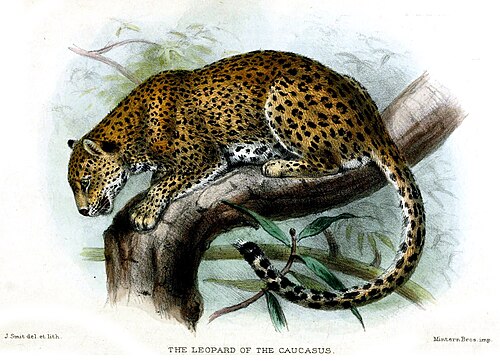
Panthera pardus sindica was proposed by Pocock in 1930 for a single skin and two skulls from the Kirthar Mountains in Balochistan; the skin closely resembled Persian leopard and Asia Minor leopard skins, but its colour differed from the colour of the Indian leopard (P. p. fusca).[7] It was subsumed to P. p. saxicolor based on molecular genetic analysis in 1996.[8][9]
In the 19th and 20th centuries, the Anatolian leopard was considered a distinct leopard subspecies that occurred only in western Turkey. The leopard specimens available in zoological museum collections do not differ significantly in the sizes and shapes of skulls. Therefore, the subspecific namestulliana, ciscaucasica and saxicolor are currently considered synonyms.[10][11]
The Indus River is thought to form a topographical barrier to the dispersal of this subspecies.[12][13] An analysis of leopard samples from Afghanistan revealed that they were of P. p. saxicolor, but intergraded with the Indian leopard.[14] A genetic analysis of 49 leopard skin samples collected in the Azad Jammu Kashmir and Galyat regions of northern Pakistan corroborated this intergradation; these samples revealed haplotypes of both Persian and Indian leopards.[15]
In 2017, the Persian leopard population was subsumed to P. p. tulliana, which is the oldest available name for the leopard subspecies in West Asia.[16]
P. p. tulliana は灰色がかったやや赤みがかった毛皮を持ち、脇腹と背中には大きなロゼット、肩と上肢には小さなロゼット、頭と首には斑点があります。[ 2 ]体色は様々で、イランでは淡色と濃色の個体が見られます。[ 19 ]平均体長は158 cm (62インチ)、頭蓋骨の長さは192 mm (7.6インチ) 、尾の長さは94 cm (37インチ)です。 [ 4 ]体重は最大60 kg (130ポンド)になります。[ 20 ] 1945 年に収集された成体の雄ヒョウの頭蓋骨と皮は、体長が125 cm (49インチ) 、乾燥した尾の長さが105 cm (41インチ)でした。その頭蓋骨は、顆基底長が207.4 mm (8.17インチ)、頬骨幅が135.2 mm (5.32インチ)であり、上顎歯列は体長は78.2 mm (3.08インチ)で、比較シリーズで測定された他のコーカサス地方のヒョウの標本よりもわずかに大きかった。[ 21 ]
P. p. tulliana は、ステップ地帯を除いてコーカサス全域に分布していた可能性が高い。大コーカサスの北麓は、その歴史的な分布域の北の境界を形成していた。2001年から2005年にかけて実施された調査では、大コーカサス西部でヒョウは記録されておらず、東部のいくつかの場所にのみ生き残っていた可能性が高い。[ 23 ] アルメニアでは、先史時代から人とヒョウが共存しており、20世紀半ばにはヒョウは同国の山岳地帯で比較的よく見られた。[ 56 ]
The leopard population in southern Russia had been reduced to two small and isolated populations by the 1950s, and by 2007, there were fewer than 50 individuals in the region.[23] Since 1954, leopards were thought to be extirpated in Georgia, following killing by hunters.[63] The political and social changes caused by the breakup of the Soviet Union in 1992 caused a severe economic crisis and weakening of formerly effective protection systems; wildlife habitats were severely fragmented, leopards were persecuted and wild ungulates were hunted. In addition, inadequate baseline data and lack of monitoring programmes made it difficult to evaluate declines of mammalian prey species.[64] In the winter of 2003, zoologists found footprints of a leopard in Vashlovani National Park in southeastern Georgia. Camera traps recorded one young male individual several times.[65] The individual was not recorded again between 2009 and 2014,[35] and a survey in 2019 found no leopards.[66]
Leopards also survived in northwestern Azerbaijan in the Akhar-Bakhar section of the Ilisu State Reserve in the foothills of the Greater Caucasus, but in 2007 numbers were thought to be extremely low.[33] In November 1945, an adult male leopard was found trapped inside a dry, 5m (16ft) deep vertical limestone well near Bilgəh on the Absheron Peninsula, roughly 25km (16mi) east of Baku. It had likely moved along the rugged, forested corridors of the Greater Caucasus mountains to reach the peninsula and had fallen into the well during a blizzard ten days prior. It was killed by local people. This remains the only documented occurrence of a leopard on the Absheron Peninsula, and the complete skeleton and mounted specimen were deposited in the Hasanbey Zardabi Natural History Museum.[21][67]
1 2ヴァランシエンヌ、A. (1856)。「Sur une nouvelles espèce de Panthère tué par M. Tchihatcheff à Ninfi, village situé à huit lieues est de Smyrne」 [スミルナから8リーグ離れた村ニンフィでチハッチェフ氏によって殺された新種のパンサーについて]。科学アカデミーの会合を完了します。42 : 1035–1039 .
↑ Lydekker, R. (1899). 「コーカサスのヒョウについて」 .ロンドン動物学会紀要(6月):795–796。
1 2サトゥーニン、KA (1914)。 「Leopardus pardus ciscaucasicus、Satunin」。Conspectus Mammalium Imperii Rossici I。ティフリス: Tipografiâ Kancelârii Namestnika EIV na Kavkaz。159~ 160ページ。
↑サトゥーニン、KA (1914)。ロシア帝国の哺乳類の鍵(ロシア語)。 Vol. 1:翼手目、昆虫目、食肉目。ティフリス: Tipografīi︠a︡ Kant︠s︡eli︠a︡rīi nami︠e︡stnika EIV na Kavkazi︠e︡。
↑ Pocock, RI (1927). 「ヒョウの2つの亜種の記述」. Annals and Magazine of Natural History . Series 9. 20 (116): 213– 214. doi : 10.1080/00222932708655586 .
↑ Бабаева、З. (2007)。「Представителю Бакинского офиса Всемирного Фонда охраны дикой природы удалось впервые сфотографировать в」 Азербайджане живого леопарда" [ WWFバクー事務所の代表者によれば、アゼルバイジャンで初めてヒョウの写真撮影が可能となったという]。日(ロシア語)。
↑ Исабалаева、И. (2012年)。「В Гирканском национальном парке Азербайджана обнаружен еще один кавказский леопард」[アゼルバイジャンのヒルカン国立公園で白人ヒョウ一頭が再び発見]。ノーボスチ(ロシア語)。 2012 年 12 月 2 日のオリジナルからアーカイブ。
↑アヴガン、B.イスマイロフ、A.ファトゥラエフ、P.フセイナリ、TT; E. アスケロフ & U. ブライテンモーザー (2012)。「ナヒチェヴァンにおけるヒョウの最初の確かな証拠」。猫ニュース(57):33.
↑ブライテンモーザー、アメリカ;アスケロフ、E。スーフィ、M。ブライテンモーザー・ヴュルステン、C.ハイデルベルク、A. Manvelyan, K. & Zazanashvili, N. (2017)。「小コーカサスとアルボルズ山脈における国境を越えたヒョウの保護」。猫ニュース(65): 24–25 .
↑ Al-Sheikhly, OF (2012). 「イラクにおける絶滅危惧哺乳類の狩猟」。Wildlife Middle East (6): 2–3。
↑ Kabir, M.; Awan, MS; Anwar, M. (2013). 「アザド・ジャンムー・カシミール州マチアラ国立公園内および周辺におけるヒョウ(Panthera pardus )の分布範囲と個体群状況」。Conservation Science . 4 (1): 107–118 .
↑Shehzad, W.; Nawaz, M. A.; Pompanon, F.; Coissac, E.; Riaz, T.; Shah, S. A. & Taberlet, P. (2015). "Forest without prey: livestock sustain a leopard Panthera pardus population in Pakistan". Oryx. 49 (2): 248–253. doi:10.1017/S0030605313001026.
↑Shakula, V. (2004). "First record of leopard (Panthera pardus) in Kazakhstan". Cat News (41): 11–12.
↑Pestov, M. V.; Nurmukhambetov, Z. E.; Mukhashov, A. T.; Terentyev, V. A. & Rosen, T. (2019). "First camera trap record of Persian leopard in Ustyurt State Nature Reserve, Kazakhstan". Cat News (69): 14–16.
↑Khorozyan, I. (2003). "The Persian leopard in Armenia: research and conservation". Proceedings of Regional Scientific Conference "Wildlife Research and Conservation in South Caucasus", 7 – 8 October 2003, Yerevan, Armenia. Yerevan. pp.161–163.
↑Sekercioglu, C.; Anderson, S.; Akcay, E.; Bilgin, R.; Can, O. & Semiz, G. (2011). "Turkey's Globally Important Biodiversity in Crisis"(PDF). Biological Conservation. 144 (12): 2752–2769. Bibcode:2011BCons.144.2752S. doi:10.1016/j.biocon.2011.06.025. S2CID18094317.
↑Masseti, M. (2009). "Carnivores of Syria". In Neubert, E.; Amr, Z.; Taiti, S.; Gümüs, B. (eds.). Animal Biodiversity in the Middle East. First Middle Eastern Biodiversity Congress, Aqaba, Jordan, 20 – 23 October 2008. ZooKeys 31. pp.229–252. doi:10.3897/zookeys.31.170.
↑Borner M. (1977). "Leopards in western Turkey". Oryx. 14 (1): 26–30. doi:10.1017/S0030605300014769.
12Ullrich, B. & Riffel, M. (1993). "New evidence for the occurrence of the Anatolian Leopard, Panthera pardus tulliana (Valenciennes, 1856), in Western Turkey". Zoology in the Middle East. 8 (1): 5–14. doi:10.1080/09397140.1993.10637631.
↑ Farhadinia, MS; Nezami, B.; Hosseini-Zavarei, F. & Valizadeh, M. (2009). "イラン北東部の緩衝地帯におけるペルシャヒョウの存続" (PDF) . Cat News (51): 34– 36.
↑Khorozyan, I.; Malkhasyan, A. & Asmaryan, S. (2005). "The Persian leopard prowls its way to survival"(PDF). Endangered Species Update. 22 (2): 51–60. Archived from the original(PDF) on 3 July 2013.
↑Sanei, A.; Zakaria, M. & Hermidas, S. (2011). "Prey composition in the Persian leopard distribution range in Iran". Asia Life Sciences. Supplement 7: 19–30. Archived from the original on 27 December 2013. Retrieved 27 July 2012.
↑Schwartzstein, P. (2014). "For Leopards in Iran and Iraq, Land Mines Are a Surprising Refuge". National Geographic. Archived from the original on 19 December 2014. Retrieved 18 March 2015.
↑Crisp, W. (2020). "Last chance for the Persian leopard: the fight to save Iraqi Kurdistan's forests". The Guardian. Retrieved 11 April 2021.
↑Manati, A. R. (2009). "The trade in Leopard and Snow Leopard skins in Afghanistan". TRAFFIC Bulletin. 22 (2): 57–58.
↑Khorozyan, I.; Malkhazyan, A. G. & Abramov, A. (2008). "Presence – absence surveys of prey and their use in predicting leopard (Panthera pardus) densities: a case study from Armenia"(PDF). Integrative Zoology. 2008 (3): 322–332. doi:10.1111/j.1749-4877.2008.00111.x. PMID21396082. Archived from the original(PDF) on 31 July 2013. Retrieved 18 November 2012.
↑Farhadinia, M.S.; Rostro-García, S.; Feng, L.; Kamler, J.F.; Spalton, A.; Shevtsova, E.; Khorozyan, I.; Al-Duais, M.; Ge, J. & Macdonald, D.W. (2020). "Big cats in borderlands: challenges and implications for transboundary conservation of Asian leopards". Oryx. 55 (3): 452–460. doi:10.1017/S0030605319000693.
↑ハーバー7。「Bilim adamları leopar bilgisini gizli tutuyordu」[科学者はヒョウの情報を秘密にしている]。Haber7 (トルコ語) 。2021 年3 月 3 日に取得。{{cite web}}: CS1 maint: 数値名: 著者リスト (リンク)
↑ Rozhnov, VV; Pshegusov, RH; Hernandez-Blanco, JA; Chistopolova, MD; Pkhitikov, AB; Trepet, SA; Dronova, NA; Naidenko, SV & Yachmennikova, AA (2020). "MaxEnt modeling for predicting suitable habitats in the North Caucasus (Russian Part) for Persian Leopard ( P. p. ciscaucasica ) based on GPS Data from collared and released animals". Izvestiya, Atmospheric and Oceanic Physics . 56 (9): 1090– 1106. Bibcode : 2020IzAOP..56.1090R . doi : 10.1134/S0001433820090212 . S2CID 232052406。
↑ Erön、A. (2020)。「Thyateira/Hastane Höyüğü'nde Bulunan Anadolu Parsı Heykel Parçası Üzerine Düşünceler」[ティアテイラ/ハスタネ塚のアナトリアのヒョウ像の断片についての感想]。アルカイア・アナトリカ。アナトリア考古学研究ジャーナル(トルコ語)。3 : 82–97 . doi : 10.32949/Arkhaia.2020.16。
↑アクソイ、E. (2021)。「Pars (Leopar) postunun mitolojik olarak İncelenmesi ve Anadolu dokumalarında kullanımı」[ヒョウ皮の神話的研究とアナトリア織物におけるその使用]。ハジラン・サイファ(トルコ語): 35 – 62。
↑マルクス・トゥリウス・キケロ。Epistulae ad Familiares 8.2; 8.4; 8.6; 8.9 [知人への手紙]。
↑マルクス・トゥリウス・キケロ。Epistulae ad Familiares 2.11 [知人への手紙]。
1 2 Κρητικίδης、Ε。 Ⅰ. (1869年)。Τοπογραφία Αρχαία και Σημερινή της Σάμου [サモス島の古代と現代の地誌] (ギリシャ語)。 Εν Ερμουπόλει: Ρενιέρη Πρίντεζη。