Invented a better fireman's respirator, a hood that filtered smoke and noxious gas from air (1871, 1874).[37]
In the late 1860s and early 1870s he wrote an introductory book about sound propagation in air, and was a participant in a large-scale British project to develop a better foghorn. In laboratory demonstrations motivated by foghorn issues, Tyndall established that sound is partially reflected (i.e. partially bounced back like an echo) at the location where an air mass of one temperature meets another air mass of a different temperature; and more generally when a body of air contains two or more air masses of different densities or temperatures, the sound travels poorly because of reflections occurring at the interfaces between the air masses, and very poorly when many such interfaces are present. (He then argued, though inconclusively, that this is the usual main reason why the same distant sound, e.g. foghorn, can be heard stronger or fainter on different days or at different times of day.)[38]
An index of 19th-century scientific research journals has John Tyndall as the author of more than 147 papers in science research journals, with practically all of them dated between 1850 and 1884, which is an average of more than four papers a year over that 35-year period.[39]
In his lectures at the Royal Institution Tyndall put a great value on, and was talented at producing, lively, visible demonstrations of physics concepts.[40] In one lecture, Tyndall demonstrated the propagation of light down through a stream of falling water via total internal reflection of the light. It was referred to as the "light fountain". It is historically significant today because it demonstrates the scientific foundation for modern fibre optic technology. During second half of the 20th century Tyndall was usually credited with being the first to make this demonstration. However, Jean-Daniel Colladon published a report of it in Comptes Rendus in 1842, and there's some suggestive evidence that Tyndall's knowledge of it came ultimately from Colladon and no evidence that Tyndall claimed to have originated it himself.[41]
Molecular physics of radiant heat
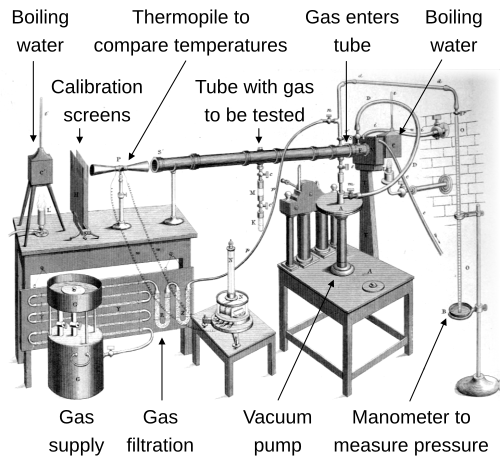
With this setup Tyndall observed new chemical reactions produced by high frequency light waves acting on certain vapours. The main scientific interest here from his point of view was the additional hard data it lent to the grand question of the mechanism by which molecules absorb radiant energy.
In his last years Tyndall often took chloral hydrate to treat his insomnia. When bedridden and ailing, he died from an accidental overdose[79] of this drug in 1893 at the age of 73, and was buried at Haslemere.[80] The overdose was administered by his wife Louisa. "My darling," said Tyndall when he realized what had happened, "you have killed your John."[81]
Afterwards, Tyndall's wife took possession of his papers and assigned herself supervisor of an official biography of him. She procrastinated on the project, however, and it was still unfinished when she died in 1940 aged 95.[82] The book eventually appeared in 1945, written by A. S. Eve and C. H. Creasey, whom Louisa Tyndall had authorised shortly before her death.
John Tyndall is commemorated by a memorial (the Tyndalldenkmal) erected at an elevation of 2,340 metres (7,680ft) on the mountain slopes above the village of Belalp, where he had his holiday home, and in sight of the Aletsch Glacier, which he had studied.[83]
Legacy and Commemorations
The Tyndall National Institute in Cork, Ireland, is named after Tyndall. It is a leading European research centre in integrated ICT materials, devices and systems and is partnered with University College Cork.
There is a school dedicated to John Tyndall located in his home county of Carlow: Tyndall College is a co-educational post-primary educational institution located along the Kilkenny Road in County Carlow. The institution started its operations in 2017 following the merger of the Carlow Vocational School, and the name of the institution was given in recognition of Tyndall’s contributions to science and Irish heritage. Tyndall College is a multi-denominational educational institution run by the Department of Education in the Republic of Ireland that offers education to the student population in County Carlow.
A lecture theatre in the University of Galway Science Block is named after Tyndall.
John Tyndall's books
Tyndall, J. (1860), The glaciers of the Alps, Being a narrative of excursions and ascents, an account of the origin and phenomena of glaciers and an exposition of the physical principles to which they are related, (1861 edition) Ticknor and Fields, Boston
↑Michael Faraday advocated for Tyndall's appointment at the Royal Institution. As part of that, in a letter to the managers of the Royal Institution on 23 May 1853, Faraday praised Tyndall's abilities as a lecturer: "I have heard him on two or three occasions, when his manner of expounding nature by discourse and experiment was in my judgement excellent". Source: Emily Hankin (2008), "John Tyndall's Lecture Courses at the Royal Institution and their Reception"Archived 4 March 2016 at the Wayback Machine.
↑According to the account in Tyndall's book The Glaciers of the Alps (1860), Tyndall in 1858 reached the summit of Monte Rosa solo carrying only a ham sandwich for sustenance. The first ascent of Monte Rosa had taken place only in 1855. He had already reached the summit of Monte Rosa in a guided group on 10 August 1858 but he made an unplanned second ascent solo on 17 August 1858 after breakfast: "the waiter then provided me with a ham sandwich, and, with my scrip thus frugally furnished, I thought the heights of Monte Rosa might be won...." (continued at pages 151–157 of Glaciers of the Alps). Besides Tyndall's own books, information about Tyndall as a mountaineer is available at A History of Mountaineering in the Alps by Claire Eliane Engel and The Victorian Mountaineers by Ronald Clark.
↑That quotation from Tyndall appears in Chisholm (1911). For Forbes' view of the issue see "Appendix A" (plus Chapter XV) of Life and Letters of James David Forbes.
↑"Geographic Names Information System". edits.nationalmap.gov. Retrieved 28 July 2022.
↑Brewer, William H. (1873). "Discovery of Mount Tyndall". The Popular Science Monthly. 2: 739–741.
1 2 Jackson, Roland (2020年3月5日). 「温室効果を発見したのは誰か?」 . The Royal Institution: Science Lives Here . 2020年3月12日取得。注:1856年にユーニス・フットが太陽光線がガスを加熱する仕組みに関する実験を発表し、二酸化炭素と水蒸気が熱を吸収する証拠を示し、それらの比率の変化が気候に影響を与える可能性があると推測していたことは現在では認識されているが、彼女は赤外線による熱の影響を区別していなかった。
↑ Jackson, Roland (20 March 2020). "Eunice Foote、John Tyndall、および優先権の問題" . Notes and Records: The Royal Society Journal of the History of Science . 74 (1): 105– 118. doi : 10.1098/rsnr.2018.0066 . S2CID 186208096 .
1 2 1859 年にガスによる赤外線吸収の測定を行った後、ティンダルは 1860 年に広帯域赤外線放射に関してガスによる赤外線放射を測定した。彼はこれをさまざまなガスについて行い、ガスを放射能でランク付けすると、その順位は吸収能でランク付けした場合と同じであった。1861 年 2 月に彼が書いた論文「ガスと蒸気による熱の吸収と放射、および放射、吸収、伝導の物理的関連について」は、 Philosophical Transactions of the Royal Society of London、第 151 巻、1 ~ 36 ページ、1861 年に掲載され、後に書籍Contributions to Molecular Physics in the Domain of Radiant Heat、第 1 章に再掲載された。また、同じ書籍の第 2 章第 11 節 (1862 年) と第 9 章第 6 節 (1865 年) にもさらに詳しい記述がある。ティンダルによる「気体における吸収と放射の相互関係」に関するこれらの実験は、1858年と1859年にバルフォア・スチュワートが固体で行った実験に基づいていた。バルフォア・スチュワートによる関連する2つの論文は、1901年に『放射と吸収の法則:プレヴォー、スチュワート、キルヒホフ、ブンゼンの回想録』として再掲載され、オンラインで閲覧できる。
1 2 1850年代後半、バルフォア・スチュワートは、岩塩は他のあらゆる種類の熱源からの放射線を非常に弱く吸収するにもかかわらず、冷たい岩塩は熱い岩塩からの放射線を非常に強く吸収することを示した。1860年代初頭までに、これは科学文献において、あらゆる種類の化学物質は、同じ種類の化学物質の別の物体から来る放射線を非常に強く吸収するという原理として一般化された。ティンダルの言葉を借りれば、これは「スペクトル分析の基礎となる原理、すなわち、熱であろうと光であろうと、あらゆる光線を放出する能力のある物体は、同じ程度にその光線を吸収する能力がある」という原理である(1866)。ティンダルは、この原理が正しいという仮定から始めて、1863年頃にいくつかの独創的な観察を行った。以下は、そのうちの1つの要約である。当時、一酸化炭素の燃焼炎では、一酸化炭素が空気中の酸素と化学的に結合して二酸化炭素と熱を生成することはよく知られていた。ティンダルは、冷たい、あるいは室温の二酸化炭素の塊を炎の近くに置くと、「この冷たいガスは、この特定の炎からの放射に対しては非常に不透明である(つまり、非常に強く吸収する)が、他のあらゆる種類の熱に対しては非常に透明である(つまり、非常に弱くしか吸収しない)」ことを観察した。したがって、一酸化炭素の炎の熱の大部分は二酸化炭素の放射スペクトルに合致し、その熱は新たに生成された二酸化炭素分子からの放射であることを示唆している。ティンダルは、中間体や過渡的な分子がほとんど生成されないという意味で化学的に単純な炎として知られる水素の燃焼炎でも同様の結果を得た。これは、化学反応で放出される熱が、新しい分子内部で物理的に発生することを初めて実証したものと思われる。ティンダルのこの実験に関する報告は、1864 年発行の『放射熱の領域における分子物理学への貢献』第 VI 章の 11 ~ 17 節にあります。関連する実験は、1863 年発行の第 V 章の 3 ~ 8 節にあります。また、1866 年発行のティンダルの『科学断片』第 I巻第 III 章でも議論されています。一酸化炭素炎の熱源に関する現代的な分析については、 RN Dixon (1963)「一酸化炭素炎帯」Proceedings of the Royal Society of London. Series A . 275 (1362): 431– 446. Bibcode : 1963RSPSA.275..431D . doi : 10.1098/rspa.1963.0178 . JSTOR 2414583 を参照してください。S2CID 98444207。ティンダルはまた、一酸化炭素の炎について、二酸化炭素のスペクトルプロファイルは室温と炎の温度である2000℃を超える温度で変化しないことを示していると解釈した。水素炎の生成物についても同様である。これは、炭素や白金などの固体では温度上昇に伴ってスペクトルプロファイルがより速い周波数側にシフトするという、容易に観察できる事実とは対照的であった。
↑James W. Gentry; Lin Jui-Chen (1996). "The Legacy of John Tyndall in Aerosol Science". Journal of Aerosol Science. 27: S503–S504. Bibcode:1996JAerS..27S.503G. doi:10.1016/0021-8502(96)00324-2. Tyndall's primary contributions were...[among other things]... the design of experiments which increased the deflections of the galvanometer by two orders of magnitude from the earlier measurements for double refraction (by Knoblauch) and the Faraday effect (by de la Provostaye and Desains). Tyndall's presentation of the subject begins under the heading "The Identity of Light and Radiant Heat" in his 1873 tutorial book Six Lectures on Light.
↑Michael B. Jaffe (2008). "Infrared Measurement of Carbon Dioxide in the Human Breath: Breathe-Through Devices from Tyndall to the Present Day"(PDF). Anesthesia & Analgesia. 107 (3): 890–904. doi:10.1213/ane.0b013e31817ee3b3. PMID18713902. S2CID15610449. See also John Tyndall, Contributions to Molecular Physics in the Domain of Radiant Heat, §4 of Chapter II (dated 1862) and §13 of Chapter VI (dated 1864).
↑Tyndall's experiment on ozone is in sections 17–19 of "Further Researches on the Absorption and Radiation of Heat by Gaseous Matter", dated January 1862; online. Some biographical sketches of Tyndall state that Tyndall "showed that ozone was an oxygen cluster rather than a hydrogen compound" (this statement is at Today in Science History and The Encyclopedia of Earth, for example). But it is an overstatement, because other researchers had already shown at an earlier date that ozone was an oxygen cluster. Tyndall's experiment just helped to reaffirm it by a different method. For background historical context see "The History of Ozone 1839– 1868"Archived 11 April 2008 at the Wayback Machine, by Mordecai B. Rubin (2001).
↑ Maria Yamalidou (1999). "John Tyndall, The Rhetorician of Molecularity. Part One. Crossing the Boundary towards the Invisible". Notes and Records of the Royal Society of London . 53 (2): 231– 242. doi : 10.1098/rsnr.1999.0077 . S2CID 145674374 .Maria Yamalidou (1999). 「分子論の修辞学者ジョン・ティンダル。パート2。自然に投げかけられた問い」。ロンドン王立協会紀要、 53 ( 3): 319–331。doi : 10.1098/rsnr.1999.0085。S2CID 144929561。ティンダルの一般向けエッセイ集『新断片』に収録されている、ティンダルの人気エッセイ「原子、分子、エーテル波」(1882年)も参照のこと。
↑The UK publisher was Longmans. The US publisher was Appleton. Longmans kept the book in print until sometime after 1908 and Appleton until sometime after 1915. See Worldcat.org. The German publisher, Braunschweig, introduced a renewed German edition in 1894; and the French publisher, Gauthier-Villars, in 1887. In Russian the first edition was in 1864 (ref) and an updated edition came out in Russian in 1888 (ref).
↑J. Clerk Maxwell (1871, 1872) Theory of Heat, preface page vi (publisher: Longmans, Green & Co).
↑A review of how Tyndall demarcated science from religion, marshalling quotes from Tyndall, is in Gieryn, Thomas F. (1999). "John Tyndall's Double Boundary-Work". Cultural Boundaries of Science. The University of Chicago Press. pp.37–64.