Loading article…
A vector-valued function, also referred to as a vector function, is a mathematical function of one or more variables whose range is a set of multidimensional vectors or infinite-dimensional vectors. The input of a vector-valued function could be a scalar or a vector (that is, the dimension of the domain could be 1 or greater than 1); the dimension of the function's domain has no relation to the dimension of its range.
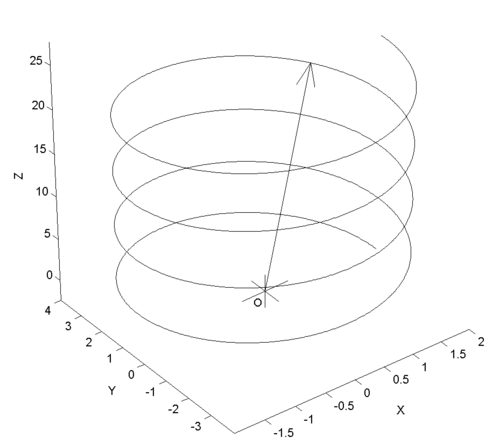
A common example of a vector-valued function is one that depends on a single real parameter t, often representing time, producing a vectorv(t) as the result. In terms of the standard unit vectorsi, j, k of Cartesian 3-space, these specific types of vector-valued functions are given by expressions such as where f(t), g(t) and h(t) are the coordinate functions of the parameter t, and the domain of this vector-valued function is the intersection of the domains of the functions f, g, and h. It can also be referred to in a different notation: The vector r(t) has its tail at the origin and its head at the coordinates evaluated by the function.
The vector shown in the graph to the right is the evaluation of the function near t =19.5 (between 6π and 6.5π; i.e., somewhat more than 3 rotations). The helix is the path traced by the tip of the vector as t increases from zero through 8π.
In 2D, we can analogously speak about vector-valued functions as: or
In the linear case the function can be expressed in terms of matrices: ここで、yはn × 1 の出力ベクトル、xはk × 1の入力ベクトル、Aはn × kのパラメータ行列である。これと密接に関連しているのがアフィン変換の場合(平行移動を除いて線形)で、関数は次の形式をとる。 ここで、b''はn × 1のパラメータベクトルである。
線形ケースは、例えば多重回帰分析などでよく発生し、例えばn × 1ベクトル従属変数の予測値のk × 1ベクトルは線形的に表現される。モデルパラメータの推定値 ( k < n ) について: ここで、X (前述の一般的な形式におけるAの役割を果たす)は、固定された(経験に基づいた)数値からなるn × k行列である。
曲面とは、(最も一般的には)3次元空間に埋め込まれた2次元の点の集合です。曲面を表す方法の一つに、媒介変数表示を用いる方法があります。この表示では、2つのパラメータsとtによって、曲面上の任意の点の 3つの直交座標が決定されます。 ここでFはベクトル値関数である。n次元空間に埋め込まれた曲面の場合、同様に表現は次のようになる。
スカラー値関数と同様に、多くのベクトル値関数は、デカルト座標系で成分を微分するだけで 微分できます。したがって、 ベクトル値関数である場合、 ベクトル微分は、次のような物理的解釈が可能である。r ( t )が粒子の位置を表す場合、微分は粒子の 速度を表す。 同様に、速度の導関数は加速度である。
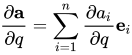
ベクトル関数aのスカラー変数qに関する偏微分は次のように定義されます[ 1 ] ここでa iは、 e iの方向におけるaのスカラー成分です。これは、aとe iの方向余弦、またはそれらの内積とも呼ばれます。ベクトルe 1、e 2、e 3は、微分が取られる参照フレームに固定された正規直交基底を形成します。
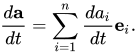
a を時間tなどの単一のスカラー変数のベクトル関数とみなすと、上記の式はtに関するaの一次常微分に帰着します。[ 1 ]
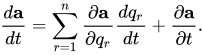
ベクトルa がn個のスカラー変数q r ( r = 1, ..., n )の関数であり、各q rが時間tのみの関数である場合、 tに関するaの通常の微分は、全微分として知られる形式で次のように表すことができます[ 1 ]
一部の著者は、 D / Dtのように、全微分演算子を示すために大文字のDを使用することを好みます。全微分は、変数q rの時間変動によるaの変化を考慮する点で、時間偏微分とは異なります。
スカラー値関数の場合、参照フレームは1つしか存在しないのに対し、ベクトル値関数の導関数を求めるには、参照フレームを選択する必要があります(少なくとも、固定されたデカルト座標系が暗黙的に指定されていない場合)。参照フレームが選択されると、ベクトル値関数の導関数は、スカラー値関数の導関数を計算するのと同様の手法を用いて計算できます。一般的に、異なる参照フレームを選択すると、導関数も異なります。異なる参照フレームにおける導関数には、特定の運動学的関係があります。
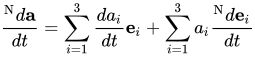
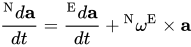
上記のベクトル関数の導関数の公式は、基底ベクトルe 1、e 2、e 3が定数、つまりaの導関数が取られる参照系で固定されているという仮定に基づいており、したがってe 1、e 2、e 3の導関数はそれぞれ恒等的にゼロになります。これは、固定座標系におけるベクトル場を扱う問題や、物理学の単純な問題ではしばしば当てはまります。しかし、多くの複雑な問題では、複数の移動参照系におけるベクトル関数の導関数が関係しており、基底ベクトルが必ずしも定数であるとは限りません。基底ベクトルe 1、e 2、e 3が参照系 E では固定されているが、参照系 N では固定されていないような場合、参照系 N におけるベクトルの通常の時間微分に対するより一般的な公式は[ 1 ]です。 ここで、微分演算子の左にある上付き文字 N は、微分が取られる参照系を示します。前述のように、右辺の第 1 項は、e 1、e 2、e 3が定数である参照系 E におけるaの微分に等しくなります。また、右辺の第 2 項は、 2 つの参照系の相対角速度にベクトルa自体をクロス乗算したものに等しくなることも示せます。 [ 1 ] したがって、代入後、2 つの参照系におけるベクトル関数の微分を関連付ける式は次のようになります。[ 1 ] ここで、NωEは基準座標系Eの基準座標系Nに対する角速度である。
この公式がよく使われる例の一つは、ロケットなどの宇宙物体の速度を、地上に対するロケットの速度測定値を用いて慣性座標系で求める場合です。位置r Rにあるロケット R の慣性座標系 N における速度N v Rは、次の公式を用いて求めることができます 。 ここで、NωEは慣性系Nに対する地球の角速度である。速度は位置の微分であるため、NvRとEvRはそれぞれ参照系NとEにおけるrRの微分である。代入により 、 ここで、E v Rは、地球に固定された基準座標系 E から測定したロケットの速度ベクトルです。
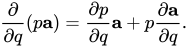
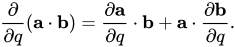
ベクトル関数の積の導関数は、スカラー関数の積の導関数と同様の挙動を示します。[ a ]具体的には、ベクトルのスカラー乗算 の場合、 p がqのスカラー変数関数である場合、[ 1 ]
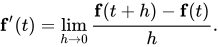
実数tの関数fで、その値は空間内にあります。次のように書くことができますその導関数は f が複数の変数の関数である 場合、例えばすると、fの成分の偏微分は、fのヤコビ行列と呼ばれる行列。
関数fの値が、ヒルベルト空間などの無限次元ベクトル空間Xに含まれる場合、f は無限次元ベクトル関数と呼ばれることがあります。
fの引数が実数であり、X がヒルベルト空間である場合、点tにおけるfの導関数は、有限次元の場合と同様に定義できる。 有限次元の場合の結果のほとんどは、必要な変更 を加えれば無限次元の場合にも当てはまります。微分は、複数の変数の関数 (例:あるいは(ここで、Yは無限次元ベクトル空間である)。
注: Xがヒルベルト空間である場合、任意の導関数(およびその他の極限)は成分ごとに計算できることが容易に示されます。 (つまり、、どこは空間Xの正規直交基底であり、存在するならば、 しかし、成分ごとの微分が存在するからといって、微分が存在するとは限らない。ヒルベルト空間における成分ごとの収束は、ヒルベルト空間の実際の位相 に関して収束することを保証するものではないからである。
上記のほとんどのことは、他の位相ベクトル空間Xでも同様に当てはまります。しかし、バナッハ空間の設定では、古典的な結果の多くが成り立たない場合があります。例えば、適切なバナッハ空間に値をとる絶対連続関数は、どこにも導関数を持たない場合があります。さらに、ほとんどのバナッハ空間の設定では、正規直交基底は存在しません。
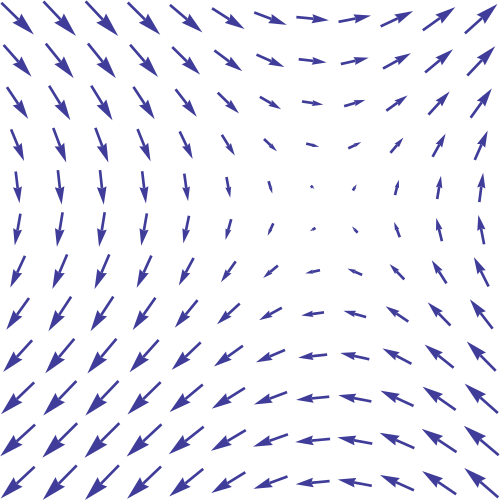
ベクトル解析と物理学において、ベクトル場とは、空間(最も一般的にはユークリッド空間)の各点にベクトルを割り当てることである。[ 2 ]平面 上のベクトル場は、それぞれが平面上の点に結び付けられた、大きさと方向が与えられた矢印の集合として視覚化できます。ベクトル場は、多くの場合、測定単位(例えば、メートル毎時またはキロメートル毎時)を持ち、ベクトル物理量を形成します。例えば、風などの3次元空間を移動する流体の速度と方向、または磁力や重力などの力が1点から別の点に変化する際の強さと方向をモデル化するために使用できます。
The elements of differential and integral calculus extend naturally to vector fields. When a vector field represents force, the line integral of a vector field represents the work done by a force moving along a path, and under this interpretation conservation of energy is exhibited as a special case of the fundamental theorem of calculus. Vector fields can usefully be thought of as representing the velocity of a moving flow in space, and this physical intuition leads to notions such as the divergence (which represents the rate of change of volume of a flow) and curl (which represents the rotation of a flow).
A vector field is a special case of a vector-valued function, whose domain's dimension has no relation to the dimension of its range; for example, the position vector of a space curve is defined only for smaller subset of the ambient space. Likewise, n coordinates, a vector field on a domain in n-dimensional Euclidean space can be represented as a vector-valued function that associates an n-tuple of real numbers to each point of the domain. This representation of a vector field depends on the coordinate system, and there is a well-defined transformation law (covariance and contravariance of vectors) in passing from one coordinate system to the other.
Vector fields are often discussed on open subsets of Euclidean space, but also make sense on other subsets such as surfaces, where they associate an arrow tangent to the surface at each point (a tangent vector). More generally, vector fields are defined on differentiable manifolds, which are spaces that look like Euclidean space on small scales, but may have more complicated structure on larger scales. In this setting, a vector field gives a tangent vector at each point of the manifold (that is, a section of the tangent bundle to the manifold). Vector fields are one kind of tensor field.