Loading article…

幾何学において、位置または位置ベクトル(位置ベクトルまたは半径ベクトルとも呼ばれる)は、空間内の点Pを表すユークリッドベクトルです。その長さは任意の基準原点Oに対する距離を表し、その方向は与えられた基準軸に対する角度を表します。通常x、r、またはsで表され、 OからPまでの直線セグメントに対応します。言い換えれば、それは原点をPに写像する変位または平行移動です。[ 1 ]
位置ベクトルという用語は、主に微分幾何学、力学、そして時折ベクトル解析の分野で使用されます。これは、2次元または3次元空間でよく使用されますが、任意の次元のユークリッド空間やアフィン空間に容易に一般化できます。[ 2 ]
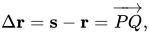
点Qの点Pに対する相対位置は、2つの絶対位置ベクトル(それぞれ原点に対する位置)の差によって得られるユークリッドベクトルである。
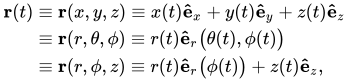
3次元空間では、任意の3次元座標とその対応する基底ベクトルを用いて、空間内の点の位置を定義することができる。その際、最も単純な方法を用いることができる。
一般的には、おなじみのデカルト座標系、あるいは球面極座標系、円筒座標系が用いられる。
ここでtはパラメータであり、直交または円形の対称性によるものです。これらの異なる座標と対応する基底ベクトルは、同じ位置ベクトルを表します。代わりに、より一般的な曲線座標を使用することもできます。これは、連続体力学や一般相対性理論などの文脈で使用されています(後者の場合は、追加の時間座標が必要です)。
線形代数では、 n次元の位置ベクトルを抽象化することができます。位置ベクトルは、基底ベクトルの線形結合として表現できます。 [ 3 ] [ 4 ]
すべての位置ベクトルの集合は位置空間(要素が位置ベクトルであるベクトル空間)を形成します。なぜなら、位置は加算(ベクトル加算)や長さのスケーリング(スカラー乗算)によって、空間内の別の位置ベクトルを得ることができるからです。「空間」という概念は直感的です。各x i ( i = 1, 2, …, n ) は任意の値をとることができ、値の集合が空間内の点を定義します。
位置空間の次元は n です( dim ( R ) = n とも表記されます)。基底ベクトルe iに関するベクトルrの座標はx iです。座標ベクトルは、座標ベクトルまたはnタプル( x 1 , x 2 , …, x n )を形成します。
各座標x i は、複数のパラメータtでパラメータ化できます。1 つのパラメータx i ( t ) は曲線の 1 次元パスを表し、2 つのパラメータx i ( t 1 , t 2 ) は曲線の 2 次元表面を表し、3 つのx i ( t 1 , t 2 , t 3 ) は曲線の 3 次元空間を表し、以下同様です。
The linear span of a basis set B = {e1, e2, …, en} equals the position space R, denoted span(B) = R.
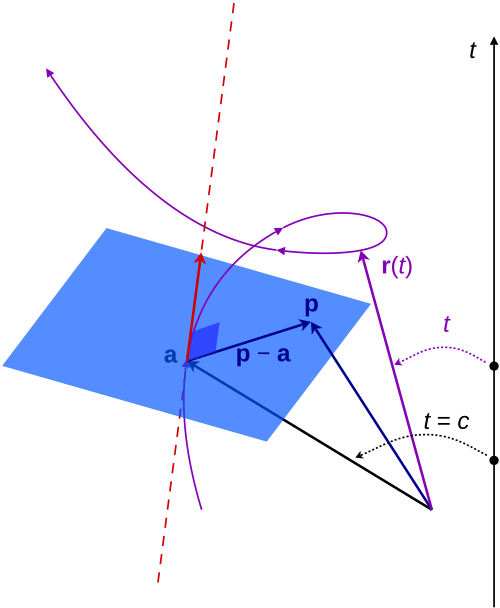
Position vector fields are used to describe continuous and differentiable space curves, in which case the independent parameter needs not be time, but can be (e.g.) arc length of the curve.
In any equation of motion, the position vector r(t) is usually the most sought-after quantity because this function defines the motion of a particle (i.e. a point mass) – its location relative to a given coordinate system at some time t.
To define motion in terms of position, each coordinate may be parametrized by time; since each successive value of time corresponds to a sequence of successive spatial locations given by the coordinates, the continuum limit of many successive locations is a path the particle traces.
In the case of one dimension, the position has only one component, so it effectively degenerates to a scalar coordinate. It could be, say, a vector in the x direction, or the radial r direction. Equivalent notations include

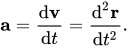
For a position vector r that is a function of time t, the time derivatives can be computed with respect to t. These derivatives have common utility in the study of kinematics, control theory, engineering and other sciences.
These names for the first, second and third derivative of position are commonly used in basic kinematics.[5] By extension, the higher-order derivatives can be computed in a similar fashion. Study of these higher-order derivatives can improve approximations of the original displacement function. Such higher-order terms are required in order to accurately represent the displacement function as a sum of an infinite sequence, enabling several analytical techniques in engineering and physics.
 ウィキメディア・コモンズにある位置(幾何学)に関連するメディア