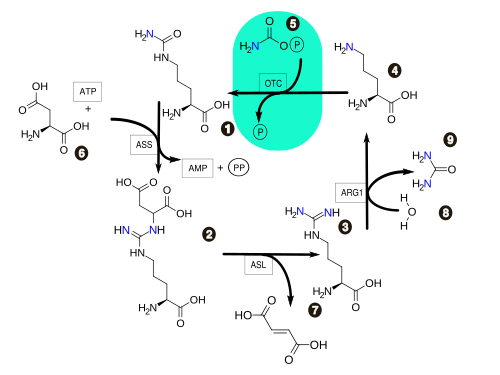
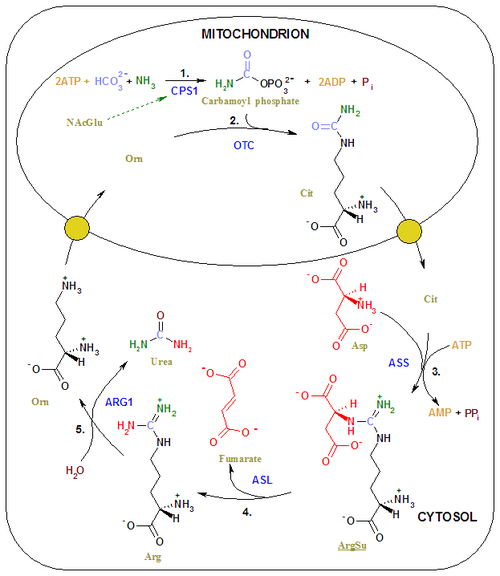
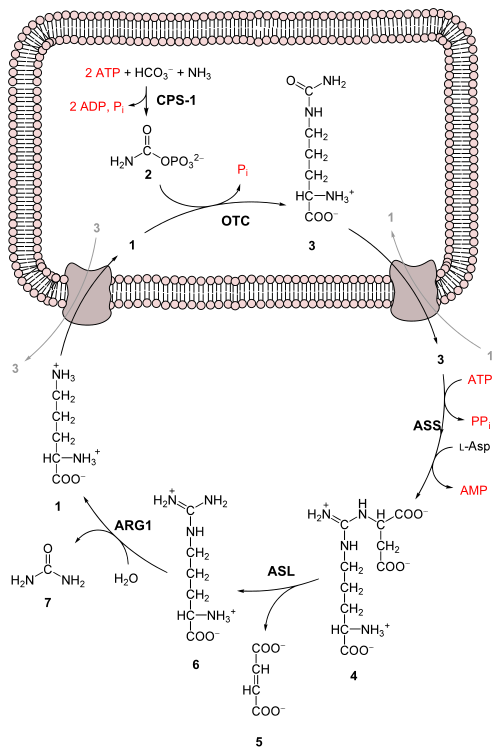
Before the urea cycle begins ammonia is converted to carbamoyl phosphate. The reaction is catalyzed by carbamoyl phosphate synthetase I and requires the use of two ATP molecules.[1] The carbamoyl phosphate then enters the urea cycle.
Steps of the urea cycle
Carbamoyl phosphate is converted to citrulline. With catalysis by ornithine transcarbamylase, the carbamoyl phosphate group is donated to ornithine and releases a phosphate group.[1]
Arginine is cleaved by arginase to form urea and ornithine. The ornithine is then transported back to the mitochondria to begin the urea cycle again.[1][7]
Overall reaction equation
In the first reaction, NH+4 + HCO−3 is equivalent to NH3 + CO2 + H2O.
Since fumarate is obtained by removing NH3 from aspartate (by means of reactions 3 and 4), and PPi + H2O → 2 Pi, the equation can be simplified as follows:
Note that reactions related to the urea cycle also cause the production of 2 NADH, so the overall reaction releases slightly more energy than it consumes. The NADH is produced in two ways:
The remaining enzymes of the cycle are controlled by the concentrations of their substrates. Thus, inherited deficiencies in cycle enzymes other than ARG1 do not result in significant decreases in urea production (if any cycle enzyme is entirely missing, death occurs shortly after birth). Rather, the deficient enzyme's substrate builds up, increasing the rate of the deficient reaction to normal.
The anomalous substrate buildup is not without cost, however. The substrate concentrations become elevated all the way back up the cycle to NH+4, resulting in hyperammonemia (elevated [NH+4]P).
Although the root cause of NH+4 toxicity is not completely understood, a high [NH+4] puts an enormous strain on the NH+4-clearing system, especially in the brain (symptoms of urea cycle enzyme deficiencies include intellectual disability and lethargy). This clearing system involves GLUD1 and GLUL, which decrease the 2-oxoglutarate (2OG) and Glu pools. The brain is most sensitive to the depletion of these pools. Depletion of 2OG decreases the rate of TCAC, whereas Glu is both a neurotransmitter and a precursor to GABA, another neurotransmitter.[12]
Link with the citric acid cycle
The urea cycle and the citric acid cycle are independent cycles but are linked. One of the nitrogen atoms in the urea cycle is obtained from the transamination of oxaloacetate to aspartate.[13] The fumarate that is produced in step three is also an intermediate in the citric acid cycle and is returned to that cycle.[13]
Urea cycle disorders
Urea cycle disorders are rare and affect about one in 35,000 people in the United States.[14]Genetic defects in the enzymes involved in the cycle can occur, which usually manifest within a few days after birth.[5] The recently born child will typically experience varying bouts of vomiting and periods of lethargy.[5] Ultimately, the infant may go into a coma and develop brain damage.[5] New-borns with UCD are at a much higher risk of complications or death due to untimely screening tests and misdiagnosed cases. The most common misdiagnosis is neonatal sepsis. Signs of UCD can be present within the first 2 to 3 days of life, but the present method to get confirmation by test results can take too long.[15] This can potentially cause complications such as coma or death.[15]
Urea cycle disorders may also be diagnosed in adults, and symptoms may include delirium episodes, lethargy, and symptoms similar to that of a stroke.[16] On top of these symptoms, if the urea cycle begins to malfunction in the liver, the patient may develop cirrhosis.[17] This can also lead to sarcopenia (the loss of muscle mass).[17] Mutations lead to deficiencies of the various enzymes and transporters involved in the urea cycle, and cause urea cycle disorders.[1] If individuals with a defect in any of the six enzymes used in the cycle ingest amino acids beyond what is necessary for the minimum daily requirements, then the ammonia that is produced will not be able to be converted to urea. These individuals can experience hyperammonemia, or the build-up of a cycle intermediate.
↑クレブス、ハンス・アドルフ;クルト・ヘンセライト(1932年)。 「Untersuchungen uber die Harnstoffbildung im Tierkörper」。クリニシェ・ヴォッヘンシュリフト。11 (18): 757–759 .土井: 10.1007/bf01757657。
↑クレブス、ハンス・アドルフ;クルト・ヘンセライト(1932年)。 「Untersuchungen über die Harnstoffbildung im Tierkörper. II」。クリニシェ・ヴォッヘンシュリフト。11 (27): 1137–1139。土井: 10.1007/BF01758220。
↑クレブス、ハンス・アドルフ;クルト・ヘンセライト(1932年)。 「Untersuchungen uber die Harnstoffbildung im Tierkörper」。ホッペ・セイラーの「生理化学的時代」。210 ( 1–2 ): 33– 66. doi : 10.1515/bchm2.1932.210.1-2.33。
1 2 3 4 Tymoczko, John L.; Berg, Jeremy M.; Stryer, Lubert (2013).生化学入門コース. WH Freeman and Company, New York. p. 529. ISBN978-1-4292-8360-1。
1 2 Mew, Nicholas Ah; Pappa, Maria Belen; Gropman, Andrea L. (2015-01-01), "第57章 - 尿素サイクル障害" , Rosenberg, Roger N.; Pascual, Juan M. (編), Rosenberg's Molecular and Genetic Basis of Neurological and Psychiatric Disease (第5版) , Boston: Academic Press, pp. 633–647 , doi : 10.1016/b978-0-12-410529-4.00057-7 , ISBN978-0-12-410529-42020年11月10日取得
1 2 3 Walker, Valerie (2014-01-01)、Makowski, Gregory S. (編)、「第3章 - アンモニア代謝と高アンモニア血症」、Advances in Clinical Chemistry、67、Elsevier: 73–150、doi : 10.1016/bs.acc.2014.09.002、PMID 25735860、2020-11-10に取得
1 2 Pearl, Phillip L. (2017-01-01)、「76 - 遺伝性代謝性てんかん」、Swaiman, Kenneth F.、Ashwal, Stephen、Ferriero, Donna M.、Schor, Nina F. (編)、Swaiman's Pediatric Neurology (第6版)、Elsevier、pp. 594–599、doi : 10.1016/b978-0-323-37101-8.00076-x、ISBN978-0-323-37101-82020年11月10日取得
↑ Hall, Leo M.; Metzenberg, Robert Lee ; Cohen, Philip Pacy (1958). "カルバミルリン酸生合成の天然由来補因子の単離と特性評価" . Journal of Biological Chemistry . 230 (2): 1013– 1021. doi : 10.1016/S0021-9258(18)70523-1 . PMID 13525417 .
↑ Shigesada, Katsuya; Tatibana, Masamiti (1971). "Enzymatic synthesis of acetylglutamate by mammalian liver preparations and its stimulation by arginine". Biochemical and Biophysical Research Communications . 44 (5): 1117– 1124. Bibcode : 1971BBRC...44.1117S . doi : 10.1016/S0006-291X(71)80201-2 . PMID 5160402 .
↑ Ah Mew, Nicholas; Caldovic, Ljubica (2011). "N-アセチルグルタミン酸シンターゼ欠損症:遺伝学、疫学、病態生理学、および治療に関する考察" . The Application of Clinical Genetics . 4 : 127– 135. doi : 10.2147/tacg.s12702 . PMC 3681184 . PMID 23776373 .
↑ヴォート、ドナルド。ヴォート、ジュディス G. (1995)。生化学。 Hauptbd (2. rev. ed.)。ニューヨーク: ワイリー。 p. 734.ISBN978-0-471-58651-7。
12Shambaugh, G. E. (1977-12-01). "Urea biosynthesis I. The urea cycle and relationships to the citric acid cycle". The American Journal of Clinical Nutrition. 30 (12): 2083–2087. doi:10.1093/ajcn/30.12.2083. ISSN0002-9165. PMID337792.
↑Summar, Marshall L.; Koelker, Stefan; Freedenberg, Debra; Le Mons, Cynthia; Haberle, Johannes; Lee, Hye-Seung; Kirmse, Brian (2013). "The incidence of urea cycle disorders". Molecular Genetics and Metabolism. 110 (1–2): 179–180. doi:10.1016/j.ymgme.2013.07.008. ISSN1096-7192. PMC4364413. PMID23972786.
12Merritt, J. L.; Brody, L. L.; Pino, G.; Rinaldo, P. (2018). "Newborn screening for proximal urea cycle disorders: Current evidence supporting recommendations for newborn screening". Molecular Genetics and Metabolism. 124 (2): 109–113. doi:10.1016/j.ymgme.2018.04.006. PMID29703588. S2CID13858458.
12Qiu, Jia (July 9, 2013). "Hyperammonemia in cirrhosis induces transcriptional regulation of myostatin by an NF-κB–mediated mechanism". Proceedings of the National Academy of Sciences of the United States of America. 110 (45). National Academy of Sciences: 18162–18167. Bibcode:2013PNAS..11018162Q. doi:10.1073/pnas.1317049110. JSTOR23754730. PMC3831479. PMID24145431.
↑Smith, L. D.; Garg, U. (2017-01-01), "Chapter 5: Urea cycle and other disorders of hyperammonemia", in Garg, Uttam; Smith, Laurie D. (eds.), Biomarkers in Inborn Errors of Metabolism, San Diego: Elsevier, pp.103–123, doi:10.1016/b978-0-12-802896-4.00004-3, ISBN978-0-12-802896-4, retrieved 2020-11-10