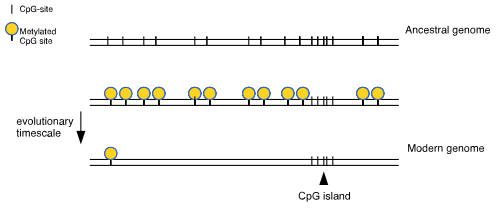
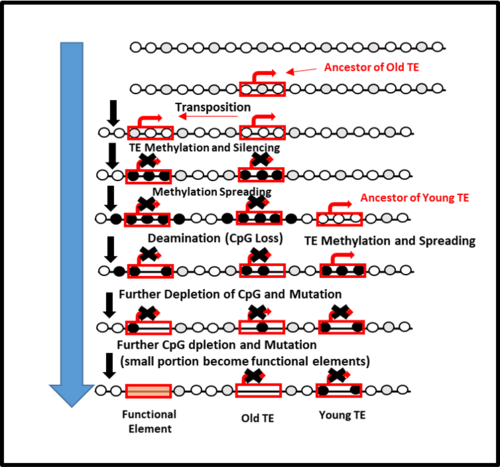
CpG アイランドは、脊椎動物では、特にハウスキーピング遺伝子の転写開始部位またはその近傍によく見られます。[ 14 ] AC (シトシン) 塩基の直後に G (グアニン) 塩基 (CpG) が続く構造は、脊椎動物の DNA ではまれです。これは、このような構造のシトシンがメチル化される傾向があるためです。このメチル化は、新しく合成された DNA 鎖を親鎖から区別するのに役立ち、複製後の DNA 校正の最終段階を助けます。しかし、時間が経つにつれて、メチル化されたシトシンは自然脱アミノ化によりチミンに変化する傾向があります。ヒトには、T/G ミスマッチから T を特異的に置き換える特別な酵素 (チミン-DNA グリコシラーゼ、または TDG)があります。しかし、CpG はまれであるため、ジヌクレオチドの急速な突然変異を防ぐには不十分であると考えられています。 CpGアイランドの存在は通常、そのゲノム領域における比較的高いCpG含有量または低いメチル化レベルに対する選択力の存在によって説明され、おそらく遺伝子発現の調節に関係している。2011年の研究では、ほとんどのCpGアイランドは非選択力の結果であることが示された。[ 21 ]
↑ Jin B 、Robertson KD (2013) 「DNAメチルトランスフェラーゼ、DNA損傷修復、および癌」。発癌におけるエピジェネティック変化。実験医学および生物学の進歩。第754巻、 3~ 29ページ。doi : 10.1007 /978-1-4419-9967-2_1。ISBN978-1-4419-9966-5. PMC 3707278 . PMID 22956494 .
↑Muvarak N, Kelley S, Robert C, Baer MR, Perrotti D, Gambacorti-Passerini C, etal. (2015). "c-MYC Generates Repair Errors via Increased Transcription of Alternative-NHEJ Factors, LIG3 and PARP1, in Tyrosine Kinase-Activated Leukemias". Mol. Cancer Res. 13 (4): 699–712. doi:10.1158/1541-7786.MCR-14-0422. PMC4398615. PMID25828893.
↑Newman EA, Lu F, Bashllari D, Wang L, Opipari AW, Castle VP (2015). "Alternative NHEJ Pathway Components Are Therapeutic Targets in High-Risk Neuroblastoma". Mol. Cancer Res. 13 (3): 470–82. doi:10.1158/1541-7786.MCR-14-0337. PMID25563294.
↑Mego M, Cierna Z, Svetlovska D, Macak D, Machalekova K, Miskovska V, etal. (2013). "PARP expression in germ cell tumours". J. Clin. Pathol. 66 (7): 607–12. doi:10.1136/jclinpath-2012-201088. PMID23486608. S2CID535704.
↑Newman RE, Soldatenkov VA, Dritschilo A, Notario V (2002). "Poly(ADP-ribose) polymerase turnover alterations do not contribute to PARP overexpression in Ewing's sarcoma cells". Oncol. Rep. 9 (3): 529–32. doi:10.3892/or.9.3.529. PMID11956622.
↑Singh P, Yang M, Dai H, Yu D, Huang Q, Tan W, Kernstine KH, Lin D, Shen B (2008). "Overexpression and hypomethylation of flap endonuclease 1 gene in breast and other cancers". Mol. Cancer Res. 6 (11): 1710–7. doi:10.1158/1541-7786.MCR-08-0269. PMC2948671. PMID19010819.
↑Lam JS, Seligson DB, Yu H, Li A, Eeva M, Pantuck AJ, Zeng G, Horvath S, Belldegrun AS (2006). "Flap endonuclease 1 is overexpressed in prostate cancer and is associated with a high Gleason score". BJU Int. 98 (2): 445–51. doi:10.1111/j.1464-410X.2006.06224.x. PMID16879693. S2CID22165252.
↑Kim JM, Sohn HY, Yoon SY, Oh JH, Yang JO, Kim JH, etal. (2005). "Identification of gastric cancer-related genes using a cDNA microarray containing novel expressed sequence tags expressed in gastric cancer cells". Clin. Cancer Res. 11 (2 Pt 1): 473–82. doi:10.1158/1078-0432.473.11.2. PMID15701830.
↑Wang K, Xie C, Chen D (2014). "Flap endonuclease 1 is a promising candidate biomarker in gastric cancer and is involved in cell proliferation and apoptosis". Int. J. Mol. Med. 33 (5): 1268–74. doi:10.3892/ijmm.2014.1682. PMID24590400.
↑Krause A, Combaret V, Iacono I, Lacroix B, Compagnon C, Bergeron C, etal. (2005). "Genome-wide analysis of gene expression in neuroblastomas detected by mass screening"(PDF). Cancer Lett. 225 (1): 111–20. doi:10.1016/j.canlet.2004.10.035. PMID15922863. S2CID44644467.
↑Iacobuzio-Donahue CA, Maitra A, Olsen M, Lowe AW, van Heek NT, Rosty C, etal. (2003). "Exploration of global gene expression patterns in pancreatic adenocarcinoma using cDNA microarrays". Am. J. Pathol. 162 (4): 1151–62. doi:10.1016/S0002-9440(10)63911-9. PMC1851213. PMID12651607.
↑Nikolova T, Christmann M, Kaina B (2009). "FEN1 is overexpressed in testis, lung and brain tumors". Anticancer Res. 29 (7): 2453–9. PMID19596913.
↑Kastan MB (2008). "DNA damage responses: mechanisms and roles in human disease: 2007 G.H.A. Clowes Memorial Award Lecture". Mol. Cancer Res. 6 (4): 517–24. doi:10.1158/1541-7786.MCR-08-0020. PMID18403632.
↑Bernstein, C; Prasad, AR; Nfonsam, V; Bernstein, H. (2013). "Chapter 16: DNA Damage, DNA Repair and Cancer". In Chen, Clark (ed.). New Research Directions in DNA Repair. BoD – Books on Demand. p.413. ISBN978-953-51-1114-6.
↑O'Hagan HM, Mohammad HP, Baylin SB (2008). "Double strand breaks can initiate gene silencing and SIRT1-dependent onset of DNA methylation in an exogenous promoter CpG island". PLOS Genetics. 4 (8) e1000155. doi:10.1371/journal.pgen.1000155. PMC2491723. PMID18704159.
↑Cuozzo C, Porcellini A, Angrisano T, etal. (July 2007). "DNA damage, homology-directed repair, and DNA methylation". PLOS Genetics. 3 (7) e110. doi:10.1371/journal.pgen.0030110. PMC1913100. PMID17616978. (Retracted,see doi:10.1371/journal.pgen.1011921,PMID41144352,Retraction Watch)
↑Field, Adam E.; Robertson, Neil A.; Wang, Tina; Havas, Aaron; Ideker, Trey; Adams, Peter D. (September 2018). "DNA Methylation Clocks in Aging: Categories, Causes, and Consequences". Molecular Cell. 71 (6): 882–895. doi:10.1016/j.molcel.2018.08.008. PMC6520108.
↑Ramirez-Ortiz ZG, Specht CA, Wang JP, Lee CK, Bartholomeu DC, Gazzinelli RT, Levitz SM (2008). "Toll-like receptor 9-dependent immune activation by unmethylated CpG motifs in Aspergillus fumigatus DNA". Infect. Immun. 76 (5): 2123–2129. doi:10.1128/IAI.00047-08. PMC2346696. PMID18332208.
↑Ziller MJ, Müller F, Liao J, Zhang Y, Gu H, Bock C, etal. (December 2011). "Genomic distribution and inter-sample variation of non-CpG methylation across human cell types". PLOS Genet. 7 (12) e1002389. doi:10.1371/journal.pgen.1002389. PMC3234221. PMID22174693.
12Fasolino M, Zhou Z (May 2017). "The Crucial Role of DNA Methylation and MeCP2 in Neuronal Function". Genes (Basel). 8 (5): 141. doi:10.3390/genes8050141. PMC5448015. PMID28505093.
12Duke CG, Kennedy AJ, Gavin CF, Day JJ, Sweatt JD (July 2017). "Experience-dependent epigenomic reorganization in the hippocampus". Learn. Mem. 24 (7): 278–288. doi:10.1101/lm.045112.117. PMC5473107. PMID28620075.
↑Halder R, Hennion M, Vidal RO, Shomroni O, Rahman RU, Rajput A, etal. (January 2016). "DNA methylation changes in plasticity genes accompany the formation and maintenance of memory". Nat. Neurosci. 19 (1): 102–10. doi:10.1038/nn.4194. PMC4700510. PMID26656643.
123Zhou X, Zhuang Z, Wang W, He L, Wu H, Cao Y, Pan F, Zhao J, Hu Z, Sekhar C, Guo Z (September 2016). "OGG1 is essential in oxidative stress induced DNA demethylation". Cell. Signal. 28 (9): 1163–71. doi:10.1016/j.cellsig.2016.05.021. PMID27251462.
↑Bayraktar G, Kreutz MR (2018). "The Role of Activity-Dependent DNA Demethylation in the Adult Brain and in Neurological Disorders". Front Mol Neurosci. 11: 169. doi:10.3389/fnmol.2018.00169. PMC5975432. PMID29875631.
↑Massaad CA, Klann E (May 2011). "Reactive oxygen species in the regulation of synaptic plasticity and memory". Antioxid. Redox Signal. 14 (10): 2013–54. doi:10.1089/ars.2010.3208. PMC3078504. PMID20649473.
↑Beckhauser TF, Francis-Oliveira J, De Pasquale R (2016). "Reactive Oxygen Species: Physiological and Physiopathological Effects on Synaptic Plasticity". J Exp Neurosci. 10 (Suppl 1): 23–48. doi:10.4137/JEN.S39887. PMC5012454. PMID27625575.
123Zhou, Wanding; Liang, Gangning; Molloy, Peter L.; Jones, Peter A. (11 August 2020). "DNA methylation enables transposable element-driven genome expansion". Proceedings of the National Academy of Sciences of the United States of America. 117 (32): 19359–19366. Bibcode:2020PNAS..11719359Z. doi:10.1073/pnas.1921719117. ISSN1091-6490. PMC7431005. PMID32719115.
↑Zhou, Wanding; Liang, Gangning; Molloy, Peter L.; Jones, Peter A. (11 August 2020). "DNA methylation enables transposable element-driven genome expansion". Proceedings of the National Academy of Sciences of the United States of America. 117 (32): 19359–19366. Bibcode:2020PNAS..11719359Z. doi:10.1073/pnas.1921719117. ISSN1091-6490. PMC7431005. PMID32719115.