
Loading article…
Alexandra David-Néel (born Louise Eugénie Alexandrine Marie David; 24 October 1868 – 8 September 1969) was a French explorer, spiritualist, Buddhist, anarchist, opera singer, and writer.[a][b][c] She is most known for her 1924 visit to Lhasa, Tibet, when it was forbidden to foreigners. David-Néel wrote over 30 books about Eastern religion, philosophy, and her travels, including Magic and Mystery in Tibet, which was published in 1929. Her teachings influenced the beat writers Jack Kerouac and Allen Ginsberg, the popularisers of Eastern philosophy Alan Watts and Ram Dass, and the esotericistBenjamin Creme.

In 1871, when David-Néel was two years old, her father Louis David, appalled by the execution of the last Communards, took her to see the Communards' Wall at the Père-Lachaise cemetery in Paris; she never forgot this early encounter with the face of death, from which she first learned of the ferocity of humans. Two years later, the Davids emigrated to Belgium.[5]
Since before the age of 15, she had been exercising austerities such as fasting and corporal torments drawn from biographies of ascetic saints found in the library of one of her female relatives, to which she refers in Sous des nuées d'orage, published in 1940.[6]
At the age of 15, spending her holidays with her parents at Ostend, she ran away and reached the port of Vlissingen in the Netherlands to try and embark for England. Lack of money forced her to give up.[7]
At the age of 18, David-Néel had already visited England, Switzerland and Spain on her own, and she was studying in Madame Blavatsky's Theosophical Society. "She joined various secret societies – she would reach the thirtieth degree in the mixed Scottish Rite of Freemasonry – while feminist and anarchist groups greeted her with enthusiasm... Throughout her childhood and adolescence, she was associated with the French geographer and anarchist Elisée Reclus (1820–1905). This led her to become interested in the anarchistic ideas of the time and in feminism, that inspired her to publish Pour la vie (For Life) in 1898. In 1899, she composed an anarchist treatise with a preface by Reclus. Publishers did not dare to publish the book, though her friend Jean Haustont printed copies himself and it was eventually translated into five languages." In 1891, she visited India for the first time, and met her spiritual preceptor, Swami Bhaskarananda Saraswati of Varanasi.[8]
According to Raymond Brodeur, she converted to Buddhism in 1889, which she noted in her diary that was published under the title La Lampe de sagesse (The Lamp of Wisdom) in 1896. She was 21 years old. That same year, to refine her English, an indispensable language for an orientalist's career, she went to London where she frequented the library of the British Museum, and met several members of the Theosophical Society. The following year, back in Paris, she introduced herself to Sanskrit and Tibetan and followed different instructions at the Collège de France and at the Ecole pratique des hautes Etudes (practical school of advanced studies) without ever passing an exam there.[9] According to Jean Chalon, her vocation to be an orientalist and Buddhist originated at the Guimet Museum.[10]
At the suggestion of her father, David-Néel attended the Conservatoire royal de Bruxelles (Royal Conservatory of Brussels), where she studied piano and singing.[11] To help her parents who were experiencing setbacks, David-Néel, who had obtained a first prize for singing, took the position of first singer at the Hanoi Opera House (Indochina) during the seasons 1895–1896 and 1896–1897 under the name Alexandra Myrial.[d]
彼女はジュゼッペ・ヴェルディ作曲の『椿姫』でヴィオレッタ役を演じ、その後ヴィクトル・マッセ作曲の『ジャンネットの結婚』、シャルル・グノー作曲の『ファウスト』と『ミレイユ』、レオ・ドリーブ作曲の『ラクメ』 、ジョルジュ・ビゼー作曲の『カルメン』、ジュール・マスネ作曲の『タイス』を歌った。当時、彼女はフレデリック・ミストラルやマスネと文通を続けていた。 [ 13 ]
1897年から1900年にかけて、彼女はパリでギタリストのジャン・ハウストンと暮らし、彼と共に一幕の叙情悲劇『リディア』を執筆した。この作品の音楽はハウストンが、台本はダヴィッド=ネールが担当した。彼女は1899年11月から1900年1月までアテネ歌劇場で歌うためにパリを離れた。その後、同年7月にチュニス歌劇場へ行った。チュニスに到着して間もなく、遠い親戚でチュニジア鉄道の主任技師であり、後に夫となるフィリップ・ネールと出会った。1902年の夏、ジャン・ハウストンがチュニスに滞在していた間、彼女は歌手としてのキャリアを諦め、数ヶ月間チュニスのカジノの芸術監督を務めながら、知的活動を続けた。[ 13 ]
1904年8月4日、36歳でフィリップ・ネール・ド・サン=ソヴールと結婚した[ 14 ]。彼女は1900年9月15日から彼の恋人だった。二人の生活は時に波乱に満ちていたが、互いに尊敬し合っていた。1911年8月9日、彼女は3度目のインド旅行(1911年~1925年)(2度目は歌のツアーのため)に単身出発し、その生活は中断された。彼女は子供を望んでおらず、母親になることは独立心と教育への意欲と相容れないと認識していた[ 6 ] 。彼女は19か月後にフィリップのもとに戻ると約束したが、二人が再会したのは14年後の1925年5月で、数日後に別れた。ダヴィッド=ネールは、探検のパートナーである若いラマ僧アプル・ヨンデンと共に帰国し、1929年に彼を養子にした。[ 15 ] [ 6 ]伝説では、彼女の夫も彼女の後援者であったと言われている。真実は恐らく全く異なる。彼女は結婚当時、自身の財産を持っていた。[ 16 ]
その間、彼女は雑誌に寄稿したり、ヨーロッパの都市で物議を醸すテーマについて講演したりした。彼女は仏教、シオニズム、急進的フェミニズムを支持した。旅行で夫と離れ離れになることが多かったため、彼女の結婚生活は破綻し始めた。[ 17 ]

アレクサンドラ・デイヴィッド=ネールは、仏教研究を深めるため、二度目のインド旅行に出かけた。1912年、彼女はシッキムの王立僧院に到着し、そこでこの王国(後にインドの州となる)の君主(チョギャル)の長男であるマハラジャ・クマール(皇太子)シドケオン・トゥルク・ナムギャルと親交を深め、仏教の知識を深めるために多くの仏教僧院を巡った。1914年、彼女はこれらの僧院の一つで、後に養子となる15歳のアプル・ヨンデンと出会った。二人は、シッキム北部の標高4,000メートル(13,000フィート)を超える洞窟にある隠遁所で隠遁生活を送ることを決めた。
当時シッキムの精神的指導者であったシドケオンは、1912年4月にガントク駐在の英国人からアレクサンドラ・デイヴィッド=ネールの到着を知らされた父であるシッキムのマハラジャによって、彼女との会見に派遣された。この最初の出会いの際、二人はすぐに相互理解に至った。改革を熱望していたシドケオンはアレクサンドラ・デイヴィッド=ネールの助言に耳を傾け、仕事に戻る前にラマ・カジ・ダワ・サムドゥプを案内役、通訳、チベット語の教授として残した。その後、シドケオンはアレクサンドラ・デイヴィッド=ネールに、父が異母兄弟に王位を譲ってほしいと望んでいることを打ち明けた。[ 18 ] [ 19 ]
ラマ・カジ・ダワ・サムドゥプはアレクサンドラ・ダヴィッド=ネールに同行してカリンポンへ行き、そこで彼女は亡命中の第13世ダライ・ラマと面会した。彼女は1912年4月15日に謁見し、待合室で川口慧海と会った。彼女は後に日本で川口と再会することになる。ダライ・ラマは通訳を伴って彼女を歓迎し、チベット語を学ぶよう強く勧めた。彼女はその助言に従った。彼女は祝福を受け、その後ダライ・ラマは対話を始め、彼女がどのようにして仏教徒になったのかを尋ねた。ダヴィッド=ネールはパリで唯一の仏教徒だと主張して彼を笑わせ、チベットの聖典であるギャチェル・ロルパがコレージュ・ド・フランスの教授フィリップ=エドゥアール・フーコーによって翻訳されたことを告げて彼を驚かせた。彼女はさらに多くの説明を求め、ダライ・ラマは彼女のすべての質問に書面で答えることを約束して、できる限りの説明を試みた。[ 20 ]
5月下旬、彼女はラチェンに行き、そこで町の僧院の長老(ゴムチェン)であるラチェン・ゴムチェン・リンポチェと、不在のカジ・ダワ・サムドゥプの代わりに通訳を務めたM・オーウェン(EH・オーウェン)という僧侶と会った。 [ 21 ]ラチェンでは、彼女は数年間、自分が教えを受ける特権に恵まれた最も偉大なゴムチェンの一人の近くに住み、何よりも、あらゆる困難を乗り越えて2度チベット国境を越えたチベット国境に非常に近かった。
彼女は隠遁生活を送る洞窟でチベットヨガを実践した。彼女は時折ツァム、つまり誰にも会わずに数日間隠遁生活を送り、内なるエネルギーを動員して熱を生み出すトゥンモの技法を学んだ。この修行の結果、彼女の師であるラチェンのゴムチェンは彼女に「知恵の灯」を意味するイェシェ・トメという宗教名を与えた。この名前は彼女にとって非常に貴重なものとなり、その後、彼女はアジアの各地で仏教の権威者たちに知られるようになった。[ 22 ]
アレクサンドラ・デイヴィッド=ネールは、ラチェン・ゴムチェン・リンポチェと行動を共にしていた際、1912年5月29日にラチェンで視察旅行中にシドケオンと再会した。ゴムチェンが宣言したように、仏教界のこの3人の人物は再会し、仏教の改革と拡大について熟考し、協力した。[ 23 ]デイヴィッド=ネールのために、シドケオンは7月1日から始まる標高5,000メートル(16,000フィート)のシッキム高地への1週間の遠征を組織した。[ 24 ]
シドケオンとアレクサンドラ・デイヴィッド=ネールの間には書簡のやり取りがあった。1912年10月8日にガントクで書かれたシドケオンの手紙の中で、彼は彼女が送ってくれた瞑想法に感謝している。10月9日、彼は彼女に同行してダージリンに行き、そこで一緒に僧院を訪れた。その間、彼女はカルカッタに戻る準備をしていた。[ 25 ]別の手紙の中で、シドケオンはデイヴィッド=ネールに、1913年3月にカルカッタでフリーメイソンに入会できたことを伝えている。彼はベンガル総督からの紹介状をもらい、会員として認められた。これは二人の間のさらなる繋がりである。彼はこの団体の会員になれた喜びを彼女に伝えた。[ 26 ]
父が死にそうになったとき、シドケオンはアレクサンドラ・デイヴィッド=ネールに助けを求め、権力を握ったらシッキムで実施したいと考えていた仏教改革を実現するための助言を求めた。[ 27 ]ダージリンとシリグリを経由してガントクに戻ったデイヴィッド=ネールは、1913年12月3日にシドケオンから儀仗兵に迎えられ、公人として扱われた。[ 28 ]
1914年1月4日、彼は新年の贈り物として、仏教の儀式に従って清められたラマ僧(女性ラマ)の衣装を彼女に贈った。ダヴィッド=ネールは、その衣装に黄色の帽子を合わせた彼女の写真を撮った。[ 29 ] [ 30 ]
1914年2月10日、マハラジャが亡くなり、シドケオンが後を継いだ。宗教改革運動が始まり、南仏の僧侶カリ・クマールと、当時ビルマに住んでいたシーラチャラ(イギリス人)が参加するよう招かれた。マー・ラット(テイクティン・マー・ラット)も同じ国出身で、デイヴィッド=ネールは彼女と文通しており、シドケオンはマー・ラットと結婚し、アレクサンドラ・デイヴィッド=ネールはマハラジャの結婚相談員となった。[ 31 ]
ダヴィッド=ネールは、シドケオンが住職を務めるフォドン寺院に滞在していた際、改革は失敗するだろうと告げる声を聞いたと主張した。[ 32 ]
1914年11月11日、ゴムチェンに会いに行ったシッキムの洞窟を後にしたデイヴィッド=ネールは、ラチェン僧院でシドケオンに迎えられた。[ 33 ] 1か月後、彼女はシドケオンの突然の死を知り、その知らせは彼女に衝撃を与え、毒殺を疑わせた。[ 34 ]
On 13 July 1916, without asking for permission, Alexandra David-Néel left for Tibet, accompanied by Yongden and a monk. She planned to visit two great religious centers close to her Sikkim retreat: the monastery of Chorten Nyima and Tashilhunpo Monastery, close to Shigatse, one of the biggest cities of southern Tibet. At the monastery of Tashilhunpo, where she arrived on 16 July, she was allowed to consult the Buddhist scriptures and visit various temples. On the 19th, she met with the Panchen Lama, by whom she received blessings and a charming welcome: he introduced her to his entourage's persons of rank, to his professors, and to his mother (with whom David-Néel tied bonds of friendship and who suggested to her to reside in a convent). The Panchen Lama bade and proposed her to stay at Shigatse as his guest, which she declined, leaving the town on 26 July, not without having received the honorary titles of a Lama and a doctor in Tibetan Buddhism and having experienced hours of great bliss.[e]
Upon her return to Sikkim, the British colonial authorities, pushed by missionaries exasperated by the welcome afforded David-Néel by the Panchen Lama and annoyed by her having ignored their ban of entering Tibet, informed her that she was to be deported for violating the no-entry edict.[f][36]
As it was impossible to return to Europe during World War I, Alexandra David-Néel and Yongden left Sikkim for India and then Japan. There she met the philosopher Ekai Kawaguchi who had managed to stay for eighteen months in Lhasa as a Chinese monk in disguise a few years earlier. David-Néel and Yongden subsequently left for Korea and then Beijing, China. From there, they chose to cross China from east to west, accompanied by a colourful Tibetan Lama. Their journey took several years through the Gobi, Mongolia, before a break of three years (1918–1921) at Kumbum Monastery in Tibet, where David-Néel, helped by Yongden, translated the famous Prajnaparamita.[6]
David-Néel preferred to eat vegetarian food throughout her life but whilst traveling in Tibet would often eat meat dishes as a guest at monasteries.[37][38]
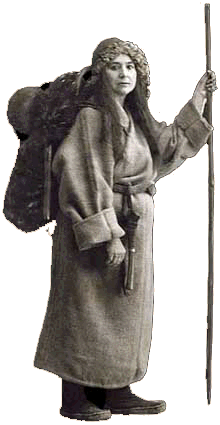
Disguised as a beggar and a monk, respectively, and carrying a backpack as discreet as possible, Alexandra David-Néel and Yongden then left for the Forbidden City. In order not to betray her status as a foreigner, David-Néel did not dare to take a camera and survey equipment, she hid, however, under her rags a compass, a pistol, and a purse with money for a possible ransom. Finally, they reached Lhasa in 1924, merged with a crowd of pilgrims coming to celebrate the Monlam Prayer Festival.[39] They stayed in Lhasa for two months visiting the holy city and the large surrounding monasteries: Drepung, Sera, Ganden, Samye, and met Swami Asuri Kapila (Cesar Della Rosa Bendio). Foster Stockwell pointed out that neither the Dalai Lama nor his assistants welcomed David-Néel, that she was neither shown the treasures of lamasery nor awarded a diploma.[35]Jacques Brosse states more precisely that she knew the Dalai Lama well, but he didn't know that she was in Lhasa and she could not reveal her identity. She found "nothing very special" in Potala, of which she remarked that the interior design was "entirely Chinese-style".[g][41][42] Despite her face smeared with soot, her yak wool mats, and her traditional fur hat,[35] she was finally unmasked (due to too much cleanliness – she went to wash herself every morning at the river) and denounced to Tsarong Shape, the Governor of Lhasa. By the time the latter took action, David-Néel and Yongden had already left Lhasa for Gyantse. They were told about the story only later, by letters of Ludlow and David Macdonald (the British sales representative in Gyantse).[h]
In May 1924, the explorer, exhausted, "without money and in rags", was accommodated together with her companion at the Macdonald home for a fortnight. She managed to reach Northern India through Sikkim thanks partly to the 500 rupees she borrowed from Macdonald and to the necessary papers that he and his son-in-law, captain Perry, obtained for her.[44][45][43] In Calcutta, dressed in the new Tibetan outfit Macdonald had bought for her, she got herself photographed in a studio.[i]
帰国後、1925年5月10日にル・アーブルに到着した時から、彼女は自分の大胆さがもたらした驚くべき名声を評価することができた。彼女は新聞の一面を飾り、彼女の肖像は雑誌に掲載された。[ 39 ]彼女の冒険の記録は『ラサへの旅』という本の題材となり、 1927年にパリ、ロンドン、ニューヨークで出版されたが、[ 46 ]空中浮揚やトゥンモ(寒さに耐えるために体温を上げる)などの行為に関する話は、批評家から信じてもらえなかった。[ 47 ]
1972年、かつてダヴィッド=ネールの図書館員として働いていたジャンヌ・ドニは、『Alexandra David-Néel au Tibet: une supercherie dévoilée』(おおよそ「チベットのアレクサンドラ・ダヴィッド=ネール:トリックの暴露」)という本を出版した。この本は、ダヴィッド=ネールがラサに入っていないことを証明すると主張し、ちょっとしたセンセーションを巻き起こした。[ 47 ] [ 48 ]ジャンヌ・ドニは、チベット人の友人がポタラ宮の前でダヴィッド=ネールとアフルが座っている写真は合成写真だと主張した。[ 49 ]彼女は、ダヴィッド=ネールの両親は家でイディッシュ語を話す質素なユダヤ人の店主だったと偽った。彼女はさらに、ダヴィッド=ネールが旅行や研究の記録を捏造したと非難した。[ j ]
1975年、ジャンヌ・ドニスの論文は、マドリードを拠点とする科学研究評議会の機関誌「Arbor」でジャン・マルケス=リヴィエールによって取り上げられ、発展させられた。彼はジャンヌ・ドニスの著書に対するスペイン語の書評で、アレクサンドラ・ダヴィッド=ネールはチベットに行ったことはなく、1917年から1924年まで中国に住んでいたと述べている。彼女の役割は、北京・漢城鉄道と甘粛省の鉱山を搾取するフランス・ベルギーの利益を監視することだったとされている。[ 51 ]この書評はベルナール・デュバンによってフランス語に翻訳され、2003年に雑誌「Charis. Archives de l'unicorne 」に死後再掲載された。[ 52 ]
フランスに戻ったアレクサンドラ・ダヴィッド=ネールはトゥーロンの丘に小さな家を借り、日当たりが良く、近所に人があまりいない家を探していた。 1928年、マルセイユの不動産会社がプロヴァンスのディーニュ=レ=バンにある小さな家を彼女に勧めた。日当たりの良い場所を探していた彼女は、嵐の中その家を訪れたが、その場所を気に入り、購入した。4年後、彼女はサムテン=ゾン、つまり「瞑想の要塞」と呼ばれるその家を拡張し始めた。レイモン・ブロデューによれば、ここはフランスで最初の隠遁所であり、ラマ教の聖地である。[ 6 ]そこで彼女は、さまざまな旅行について記述した本を何冊か書いた。1929年、彼女は最も有名で愛されている作品『チベットの神秘家と魔術師』を出版した。
1937年、69歳になったアレクサンドラ・ダヴィッド=ネールは、永登とともにブリュッセル、モスクワ、シベリア鉄道を経由して中国へ旅立つことを決意した。彼女の目的は古代道教を研究することだった。彼女は日中戦争の真っ只中に身を置くことになり、戦争、飢饉、疫病の惨禍を目の当たりにした。戦闘から逃れ、彼女はわずかな予算で中国を放浪した。中国での旅は北京、五台山、漢口、成都を巡り、1年半に及んだ。1938年6月4日、彼女は5年間の隠遁生活のため、チベットのタチエンルに戻った。1941年に夫の死の知らせを受け、彼女は深く心を痛めた。[ k ]
One minor mystery relating to Alexandra David-Néel has a solution. In Forbidden Journey, p. 284, the authors wonder how Mme. David-Néel's secretary, Violet Sydney, made her way back to the West in 1939 after Sous des nuées d'orage (Storm Clouds) was completed in Tachienlu. Peter Goullart's Land of the Lamas (not in Forbidden Journey's bibliography), on pp. 110–113 gives an account of his accompanying Ms. Sydney partway back, then putting her under the care of Lolo bandits to continue the journey to Chengdu. While in Eastern Tibet David-Néel and Yongden completed circumambulation of the holy mountain Amnye Machen.[54] In 1945, Alexandra David-Néel went back to India thanks to Christian Fouchet, French Consul at Calcutta, who became a friend; they stayed in touch until David-Néel's death. She finally left Asia with Aphur Yongden by airplane, departing from Calcutta in June 1946. On 1 July, they arrived at Paris, where they stayed until October, when they went back to Digne-les-Bains.[55]
At 78, Alexandra David-Néel returned to France to arrange the estate of her husband, then she started writing from her home in Digne.
Between 1947 and 1950, Alexandra David-Néel came across Paul Adam – Venerable Aryadeva, she commended him because he took her place on short notice, at a conference held at the Theosophical Society in Paris.[56]
In 1952, she published the Textes tibétains inédits ("unpublished Tibetan writings"), an anthology of Tibetan literature including, among other things, the erotic poems attributed to the 6th Dalai Lama. In 1953, a newspiece followed, Le vieux Tibet face à la Chine nouvelle, in which she gave "a certain and documented opinion" on the tense situation in the regions once visited by her.[42]
Yongden died suddenly on 7 October 1955.[5] According to Jacques Brosse, Yongden, seized by a strong fever and sickness, which David-Néel attributed to a simple indigestion, fell into a coma during the night[42] and died carried off by kidney failure according to the doctor's diagnosis.[57] Just having turned 87, David-Néel found herself alone. Yongden's ashes were kept safe in the Tibetan oratory of Samten Dzong, awaiting to be thrown into the Ganges, together with those of David-Néel after her death.[42] With age, David-Néel suffered more and more from articular rheumatism that forced her to walk with crutches. "I walk on my arms", she used to say.[42] Her work rhythm slowed down: she did not publish anything in 1955 and 1956, and, in 1957, only the third edition of the Initiations lamaïques.[5]
In April 1957, she left Samten Dzong in order to live at Monaco with a friend who had typed her manuscripts. She decided to live alone in a hotel, going from one establishment to the next, until June 1959, when she was introduced to a young woman, Marie-Madeleine Peyronnet, who she took as her personal secretary.[42] She would stay with the old lady until the end,[5] "watching over her like a daughter over her mother – and sometimes like a mother over her unbearable child – but also like a disciple at the service of her guru", according to the words of Jacques Brosse.[42]

In 1925, she won the Award Monique Berlioux of the Académie des sports. Although she was not a sportswoman in a strict sense, she is part of the list of the 287 Gloires du sport français (English: Glories of French sport).[58]

In 2006, Priscilla Telmon paid tribute to Alexandra David-Néel through an expedition on foot and alone across the Himalaya. She recounted her predecessor's journey from Vietnam to Calcutta via Lhasa. A movie, Au Tibet Interdit (English: Into Forbidden Tibet), was shot on that expedition.[59]
アレクサンドラ・デイヴィッド=ニールの著書の多くは、フランス語と英語でほぼ同時に出版された。
 Media related to Alexandra David-Néel at Wikimedia Commons
 Quotations related to Alexandra David-Néel at Wikiquote