積分は 積分学 における基本的な操作です 。 微分 には単純な 規則があり、複雑な 関数 の導関数は 、そのより単純な構成要素の関数を微分することによって求めることができますが、積分にはそのような規則がないため、既知の積分の表が役立つことがよくあります。このページでは、最も一般的な 不定積分 をいくつか示します。
積分の歴史的発展 積分の一覧 (Integraltafeln) と積分法の技法をまとめたものが、ドイツの数学者マイヤー・ヒルシュ (Meyer Hirsch) [de] (別名 Meyer Hirsch) によって 1810 年に出版されました。 [1] これらの表は 1823 年にイギリスで再出版されました。より広範な表は、1858 年にオランダの数学者 David Bierens de Haanによって Tables d'intégrales définies のために編集され 、 1864 年頃に Supplément aux tables d'intégrales définiesによって補足されました。1867 年には Nouvelles tables d'intégrales définies というタイトルで新版が出版されました 。
これらの表は主に初等関数の積分を含んでおり、20 世紀中頃まで使用されていました。その後、 Gradshteyn と Ryzhik のより広範な表に置き換えられました。Gradshteyn と Ryzhik では、Bierens de Haan の本に由来する積分は BI で表されます。
すべての 閉じた形式の式 が閉じた形式の原始積分を持つわけではありません。この研究は 微分ガロア理論 の主題を形成します。この理論は1830 年代から 1840 年代にかけて ジョセフ・リウヴィル によって最初に開発され、どの式が閉じた形式の原始積分を持つかを分類する リウヴィルの定理 につながりました。閉じた形式の原始積分を持たない関数の簡単な例は e − x 2 で、その原始積分は (定数を除いて) 誤差関数 です。
1968 年以来、通常は コンピュータ代数システムを使用して、 基本関数 で表現できる不定積分を決定するための Risch アルゴリズム があります。基本関数を使用して表現できない積分は 、Meijer G 関数 などの一般関数を使用して記号的に操作できます 。
積分のリスト 積分 のリスト については、次のページをご覧ください 。
Gradshteyn 、 Ryzhik 、 Geronimus 、 Tseytlin 、Jeffrey、Zwillinger、および Moll (GR) の Table of Integrals, Series, and Products には、 膨大な結果のコレクションが含まれています。さらに大規模で複数巻からなる表は、 Prudnikov 、 Brychkov 、および Marichev による Integrals and Series です(第 1 巻から第 3 巻には積分と 基本 関数および 特殊関数の級数がリストされ、第 4 巻から第 5 巻には ラプラス変換 の表があります )。よりコンパクトなコレクションは、たとえば Brychkov、Marichev、Prudnikov の Tables of Indefinite Integrals や、Zwillinger の CRC Standard Mathematical Tables and Formulae や Bronshtein と Semendyayev の Guide Book to Mathematics 、 Handbook of Mathematics または Users' Guide to Mathematics などの数学ハンドブックの章として見つけることができます。
その他の有用なリソースには、 Abramowitz と Stegun および Bateman Manuscript Project があります。どちらの作品にも、特定の積分に関する多くの恒等式が含まれていますが、これらは別の表にまとめられるのではなく、最も関連性の高いトピックで整理されています。Bateman Manuscript の 2 巻は、積分変換に特化しています。
積分表やオンデマンド積分を掲載した Web サイトがいくつかあります。Wolfram Alpha では 結果を表示でき、簡単な式の場合は積分の途中ステップも表示できます。Wolfram Research では 、別のオンライン サービスである Mathematica Online Integrator も運営しています。
単純な関数の積分 C は 、ある時点での積分値について何かがわかっている場合にのみ決定できる 任意の積分定数 に使用されます。したがって、各関数には無限の数の 原始導関数 があります。
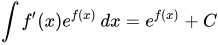
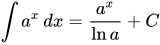
これらの式は、導関数表の 主張を別の形で述べているだけです 。
特異点を持つ積分 積分される関数に 特異点 があり、その関数の原点積分が未定義になるか、またはある点(特異点)でそうなる場合、 C は 特異点の両側で同じである必要はありません。以下の形式では通常、 C の値の特異点の周りの コーシー主値 を想定するのですが、これは一般的には必須ではありません。たとえば、では
0 に特異点があり、そこで 原点 積分は無限大になります。上記の積分を使用して -1 と 1 の間の定積分を計算すると、間違った答え 0 が得られます。ただし、これは特異点の周りの積分のコーシー主値です。積分が複素平面で行われる場合、結果は原点の周りの経路に依存します。この場合、特異点は原点より上の経路を使用する場合は - i π に寄与し、原点より下の経路を使用する場合は i πに寄与します。実数直線上の関数は、次のように原点の両側で C のまったく異なる値を使用できます 。 [2]
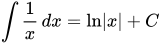
∫
1
x
d
x
=
ln
|
x
|
+
C
{\displaystyle \int {1 \over x}\,dx=\ln \left|x\right|+C}
∫
1
x
d
x
=
ln
|
x
|
+
{
A
if
x
>
0
;
B
if
x
<
0.
{\displaystyle \int {1 \over x}\,dx=\ln |x|+{\begin{cases}A&{\text{if }}x>0;\\B&{\text{if }}x<0.\end{cases}}}
有理関数
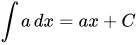
∫
a
d
x
=
a
x
+
C
{\displaystyle \int a\,dx=ax+C}
次の関数はn≤ −1 に対して0で積分不可能な特異点を持つ 。
∫
x
n
d
x
=
x
n
+
1
n
+
1
+
C
(for
n
≠
−
1
)
{\displaystyle \int x^{n}\,dx={\frac {x^{n+1}}{n+1}}+C\qquad {\text{(for }}n\neq -1{\text{)}}}
( カバリエリの求積公式 )
∫
(
a
x
+
b
)
n
d
x
=
(
a
x
+
b
)
n
+
1
a
(
n
+
1
)
+
C
(for
n
≠
−
1
)
{\displaystyle \int (ax+b)^{n}\,dx={\frac {(ax+b)^{n+1}}{a(n+1)}}+C\qquad {\text{(for }}n\neq -1{\text{)}}}
∫
1
x
d
x
=
ln
|
x
|
+
C
{\displaystyle \int {1 \over x}\,dx=\ln \left|x\right|+C}
より一般的には、 [3]
∫
1
x
d
x
=
{
ln
|
x
|
+
C
−
x
<
0
ln
|
x
|
+
C
+
x
>
0
{\displaystyle \int {1 \over x}\,dx={\begin{cases}\ln \left|x\right|+C^{-}&x<0\\\ln \left|x\right|+C^{+}&x>0\end{cases}}}
∫
c
a
x
+
b
d
x
=
c
a
ln
|
a
x
+
b
|
+
C
{\displaystyle \int {\frac {c}{ax+b}}\,dx={\frac {c}{a}}\ln \left|ax+b\right|+C}
指数関数
対数
∫
ln
x
d
x
=
x
ln
x
−
x
+
C
=
x
(
ln
x
−
1
)
+
C
{\displaystyle \int \ln x\,dx=x\ln x-x+C=x(\ln x-1)+C}
∫
log
a
x
d
x
=
x
log
a
x
−
x
ln
a
+
C
=
x
ln
a
(
ln
x
−
1
)
+
C
{\displaystyle \int \log _{a}x\,dx=x\log _{a}x-{\frac {x}{\ln a}}+C={\frac {x}{\ln a}}(\ln x-1)+C}
三角関数
∫
sin
x
d
x
=
−
cos
x
+
C
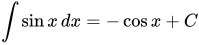
{\displaystyle \int \sin {x}\,dx=-\cos {x}+C}
∫
cos
x
d
x
=
sin
x
+
C
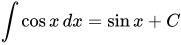
{\displaystyle \int \cos {x}\,dx=\sin {x}+C}
∫
tan
x
d
x
=
ln
|
sec
x
|
+
C
=
−
ln
|
cos
x
|
+
C
{\displaystyle \int \tan {x}\,dx=\ln {\left|\sec {x}\right|}+C=-\ln {\left|\cos {x}\right|}+C}
∫
cot
x
d
x
=
−
ln
|
csc
x
|
+
C
=
ln
|
sin
x
|
+
C
{\displaystyle \int \cot {x}\,dx=-\ln {\left|\csc {x}\right|}+C=\ln {\left|\sin {x}\right|}+C}
∫
sec
x
d
x
=
ln
|
sec
x
+
tan
x
|
+
C
=
ln
|
tan
(
x
2
+
π
4
)
|
+
C
{\displaystyle \int \sec {x}\,dx=\ln {\left|\sec {x}+\tan {x}\right|}+C=\ln \left|\tan \left({\dfrac {x}{2}}+{\dfrac {\pi }{4}}\right)\right|+C}
( セカント関数の積分 を参照してください。この結果は 17 世紀によく知られた予想でした。)
∫
csc
x
d
x
=
−
ln
|
csc
x
+
cot
x
|
+
C
=
ln
|
csc
x
−
cot
x
|
+
C
=
ln
|
tan
x
2
|
+
C
{\displaystyle \int \csc {x}\,dx=-\ln {\left|\csc {x}+\cot {x}\right|}+C=\ln {\left|\csc {x}-\cot {x}\right|}+C=\ln {\left|\tan {\frac {x}{2}}\right|}+C}
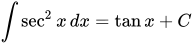
∫
sec
2
x
d
x
=
tan
x
+
C
{\displaystyle \int \sec ^{2}x\,dx=\tan x+C}
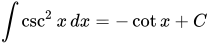
∫
csc
2
x
d
x
=
−
cot
x
+
C
{\displaystyle \int \csc ^{2}x\,dx=-\cot x+C}
∫
sec
x
tan
x
d
x
=
sec
x
+
C
{\displaystyle \int \sec {x}\,\tan {x}\,dx=\sec {x}+C}
∫
csc
x
cot
x
d
x
=
−
csc
x
+
C
{\displaystyle \int \csc {x}\,\cot {x}\,dx=-\csc {x}+C}
∫
sin
2
x
d
x
=
1
2
(
x
−
sin
2
x
2
)
+
C
=
1
2
(
x
−
sin
x
cos
x
)
+
C
{\displaystyle \int \sin ^{2}x\,dx={\frac {1}{2}}\left(x-{\frac {\sin 2x}{2}}\right)+C={\frac {1}{2}}(x-\sin x\cos x)+C}
∫
cos
2
x
d
x
=
1
2
(
x
+
sin
2
x
2
)
+
C
=
1
2
(
x
+
sin
x
cos
x
)
+
C
{\displaystyle \int \cos ^{2}x\,dx={\frac {1}{2}}\left(x+{\frac {\sin 2x}{2}}\right)+C={\frac {1}{2}}(x+\sin x\cos x)+C}
∫
tan
2
x
d
x
=
tan
x
−
x
+
C
{\displaystyle \int \tan ^{2}x\,dx=\tan x-x+C}
∫
cot
2
x
d
x
=
−
cot
x
−
x
+
C
{\displaystyle \int \cot ^{2}x\,dx=-\cot x-x+C}
∫
sec
3
x
d
x
=
1
2
(
sec
x
tan
x
+
ln
|
sec
x
+
tan
x
|
)
+
C
{\displaystyle \int \sec ^{3}x\,dx={\frac {1}{2}}(\sec x\tan x+\ln |\sec x+\tan x|)+C}
∫
csc
3
x
d
x
=
1
2
(
−
csc
x
cot
x
+
ln
|
csc
x
−
cot
x
|
)
+
C
=
1
2
(
ln
|
tan
x
2
|
−
csc
x
cot
x
)
+
C
{\displaystyle \int \csc ^{3}x\,dx={\frac {1}{2}}(-\csc x\cot x+\ln |\csc x-\cot x|)+C={\frac {1}{2}}\left(\ln \left|\tan {\frac {x}{2}}\right|-\csc x\cot x\right)+C}
∫
sin
n
x
d
x
=
−
sin
n
−
1
x
cos
x
n
+
n
−
1
n
∫
sin
n
−
2
x
d
x
{\displaystyle \int \sin ^{n}x\,dx=-{\frac {\sin ^{n-1}{x}\cos {x}}{n}}+{\frac {n-1}{n}}\int \sin ^{n-2}{x}\,dx}
∫
cos
n
x
d
x
=
cos
n
−
1
x
sin
x
n
+
n
−
1
n
∫
cos
n
−
2
x
d
x
{\displaystyle \int \cos ^{n}x\,dx={\frac {\cos ^{n-1}{x}\sin {x}}{n}}+{\frac {n-1}{n}}\int \cos ^{n-2}{x}\,dx}
逆三角関数
∫
arcsin
x
d
x
=
x
arcsin
x
+
1
−
x
2
+
C
,
for
|
x
|
≤
1
{\displaystyle \int \arcsin {x}\,dx=x\arcsin {x}+{\sqrt {1-x^{2}}}+C,{\text{ for }}\vert x\vert \leq 1}
∫
arccos
x
d
x
=
x
arccos
x
−
1
−
x
2
+
C
,
for
|
x
|
≤
1
{\displaystyle \int \arccos {x}\,dx=x\arccos {x}-{\sqrt {1-x^{2}}}+C,{\text{ for }}\vert x\vert \leq 1}
∫
arctan
x
d
x
=
x
arctan
x
−
1
2
ln
|
1
+
x
2
|
+
C
,
for all real
x
{\displaystyle \int \arctan {x}\,dx=x\arctan {x}-{\frac {1}{2}}\ln {\vert 1+x^{2}\vert }+C,{\text{ for all real }}x}
∫
arccot
x
d
x
=
x
arccot
x
+
1
2
ln
|
1
+
x
2
|
+
C
,
for all real
x
{\displaystyle \int \operatorname {arccot} {x}\,dx=x\operatorname {arccot} {x}+{\frac {1}{2}}\ln {\vert 1+x^{2}\vert }+C,{\text{ for all real }}x}
∫
arcsec
x
d
x
=
x
arcsec
x
−
ln
|
x
(
1
+
1
−
x
−
2
)
|
+
C
,
for
|
x
|
≥
1
{\displaystyle \int \operatorname {arcsec} {x}\,dx=x\operatorname {arcsec} {x}-\ln \left\vert x\,\left(1+{\sqrt {1-x^{-2}}}\,\right)\right\vert +C,{\text{ for }}\vert x\vert \geq 1}
∫
arccsc
x
d
x
=
x
arccsc
x
+
ln
|
x
(
1
+
1
−
x
−
2
)
|
+
C
,
for
|
x
|
≥
1
{\displaystyle \int \operatorname {arccsc} {x}\,dx=x\operatorname {arccsc} {x}+\ln \left\vert x\,\left(1+{\sqrt {1-x^{-2}}}\,\right)\right\vert +C,{\text{ for }}\vert x\vert \geq 1}
双曲線関数
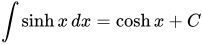
∫
sinh
x
d
x
=
cosh
x
+
C
{\displaystyle \int \sinh x\,dx=\cosh x+C}
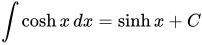
∫
cosh
x
d
x
=
sinh
x
+
C
{\displaystyle \int \cosh x\,dx=\sinh x+C}
∫
tanh
x
d
x
=
ln
(
cosh
x
)
+
C
{\displaystyle \int \tanh x\,dx=\ln \,(\cosh x)+C}
∫
coth
x
d
x
=
ln
|
sinh
x
|
+
C
,
for
x
≠
0
{\displaystyle \int \coth x\,dx=\ln |\sinh x|+C,{\text{ for }}x\neq 0}
∫
sech
x
d
x
=
arctan
(
sinh
x
)
+
C
{\displaystyle \int \operatorname {sech} \,x\,dx=\arctan \,(\sinh x)+C}
∫
csch
x
d
x
=
ln
|
coth
x
−
csch
x
|
+
C
=
ln
|
tanh
x
2
|
+
C
,
for
x
≠
0
{\displaystyle \int \operatorname {csch} \,x\,dx=\ln |\operatorname {coth} x-\operatorname {csch} x|+C=\ln \left|\tanh {x \over 2}\right|+C,{\text{ for }}x\neq 0}
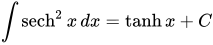
∫
sech
2
x
d
x
=
tanh
x
+
C
{\displaystyle \int \operatorname {sech} ^{2}x\,dx=\tanh x+C}
∫
csch
2
x
d
x
=
−
coth
x
+
C
{\displaystyle \int \operatorname {csch} ^{2}x\,dx=-\operatorname {coth} x+C}
∫
sech
x
tanh
x
d
x
=
−
sech
x
+
C
{\displaystyle \int \operatorname {sech} {x}\,\operatorname {tanh} {x}\,dx=-\operatorname {sech} {x}+C}
∫
csch
x
coth
x
d
x
=
−
csch
x
+
C
{\displaystyle \int \operatorname {csch} {x}\,\operatorname {coth} {x}\,dx=-\operatorname {csch} {x}+C}
逆双曲線関数
∫
arcsinh
x
d
x
=
x
arcsinh
x
−
x
2
+
1
+
C
,
for all real
x
{\displaystyle \int \operatorname {arcsinh} \,x\,dx=x\,\operatorname {arcsinh} \,x-{\sqrt {x^{2}+1}}+C,{\text{ for all real }}x}
∫
arccosh
x
d
x
=
x
arccosh
x
−
x
2
−
1
+
C
,
for
x
≥
1
{\displaystyle \int \operatorname {arccosh} \,x\,dx=x\,\operatorname {arccosh} \,x-{\sqrt {x^{2}-1}}+C,{\text{ for }}x\geq 1}
∫
arctanh
x
d
x
=
x
arctanh
x
+
ln
(
1
−
x
2
)
2
+
C
,
for
|
x
|
<
1
{\displaystyle \int \operatorname {arctanh} \,x\,dx=x\,\operatorname {arctanh} \,x+{\frac {\ln \left(\,1-x^{2}\right)}{2}}+C,{\text{ for }}\vert x\vert <1}
∫
arccoth
x
d
x
=
x
arccoth
x
+
ln
(
x
2
−
1
)
2
+
C
,
for
|
x
|
>
1
{\displaystyle \int \operatorname {arccoth} \,x\,dx=x\,\operatorname {arccoth} \,x+{\frac {\ln \left(x^{2}-1\right)}{2}}+C,{\text{ for }}\vert x\vert >1}
∫
arcsech
x
d
x
=
x
arcsech
x
+
arcsin
x
+
C
,
for
0
<
x
≤
1
{\displaystyle \int \operatorname {arcsech} \,x\,dx=x\,\operatorname {arcsech} \,x+\arcsin x+C,{\text{ for }}0<x\leq 1}
∫
arccsch
x
d
x
=
x
arccsch
x
+
|
arcsinh
x
|
+
C
,
for
x
≠
0
{\displaystyle \int \operatorname {arccsch} \,x\,dx=x\,\operatorname {arccsch} \,x+\vert \operatorname {arcsinh} \,x\vert +C,{\text{ for }}x\neq 0}
2次導関数に比例する関数の積
∫
cos
a
x
e
b
x
d
x
=
e
b
x
a
2
+
b
2
(
a
sin
a
x
+
b
cos
a
x
)
+
C
{\displaystyle \int \cos ax\,e^{bx}\,dx={\frac {e^{bx}}{a^{2}+b^{2}}}\left(a\sin ax+b\cos ax\right)+C}
∫
sin
a
x
e
b
x
d
x
=
e
b
x
a
2
+
b
2
(
b
sin
a
x
−
a
cos
a
x
)
+
C
{\displaystyle \int \sin ax\,e^{bx}\,dx={\frac {e^{bx}}{a^{2}+b^{2}}}\left(b\sin ax-a\cos ax\right)+C}
∫
cos
a
x
cosh
b
x
d
x
=
1
a
2
+
b
2
(
a
sin
a
x
cosh
b
x
+
b
cos
a
x
sinh
b
x
)
+
C
{\displaystyle \int \cos ax\,\cosh bx\,dx={\frac {1}{a^{2}+b^{2}}}\left(a\sin ax\,\cosh bx+b\cos ax\,\sinh bx\right)+C}
∫
sin
a
x
cosh
b
x
d
x
=
1
a
2
+
b
2
(
b
sin
a
x
sinh
b
x
−
a
cos
a
x
cosh
b
x
)
+
C
{\displaystyle \int \sin ax\,\cosh bx\,dx={\frac {1}{a^{2}+b^{2}}}\left(b\sin ax\,\sinh bx-a\cos ax\,\cosh bx\right)+C}
絶対値関数 f を、 最大で 1 つの 零点を持つ 連続関数 と します 。 f が 零点を持つ場合、 g を f の根で零となる唯一の f の原始関数とします。 それ以外の
場合、 g を f の原始関数とします 。すると、
sgn( x ) は 符号関数 であり、 x が 負、零、正のときにそれぞれ −1、0、1 の値を取ります 。
∫
|
f
(
x
)
|
d
x
=
sgn
(
f
(
x
)
)
g
(
x
)
+
C
,
{\displaystyle \int \left|f(x)\right|\,dx=\operatorname {sgn}(f(x))g(x)+C,}
これは、 g の条件が積分の連続性を保証するためのものである
ことを考慮に入れて、式の右辺の導関数を計算することによって証明できます。
これにより、次の式が得られます( a ≠ 0 )。これは、 f が連続する任意の区間で有効です (より大きな区間では、定数 C を 区分定数 関数に置き換える必要があります )。
∫
|
(
a
x
+
b
)
n
|
d
x
=
sgn
(
a
x
+
b
)
(
a
x
+
b
)
n
+
1
a
(
n
+
1
)
+
C
{\displaystyle \int \left|(ax+b)^{n}\right|\,dx=\operatorname {sgn}(ax+b){(ax+b)^{n+1} \over a(n+1)}+C}
n が奇数のとき 、 。
n
≠
−
1
{\displaystyle n\neq -1}
∫
|
tan
a
x
|
d
x
=
−
1
a
sgn
(
tan
a
x
)
ln
(
|
cos
a
x
|
)
+
C
{\displaystyle \int \left|\tan {ax}\right|\,dx=-{\frac {1}{a}}\operatorname {sgn}(\tan {ax})\ln(\left|\cos {ax}\right|)+C}
ある 整数 n に対して、
a
x
∈
(
n
π
−
π
2
,
n
π
+
π
2
)
{\textstyle ax\in \left(n\pi -{\frac {\pi }{2}},n\pi +{\frac {\pi }{2}}\right)}
∫
|
csc
a
x
|
d
x
=
−
1
a
sgn
(
csc
a
x
)
ln
(
|
csc
a
x
+
cot
a
x
|
)
+
C
{\displaystyle \int \left|\csc {ax}\right|\,dx=-{\frac {1}{a}}\operatorname {sgn}(\csc {ax})\ln(\left|\csc {ax}+\cot {ax}\right|)+C}
ある 整数 n に対して、
a
x
∈
(
n
π
,
n
π
+
π
)
{\displaystyle ax\in \left(n\pi ,n\pi +\pi \right)}
∫
|
sec
a
x
|
d
x
=
1
a
sgn
(
sec
a
x
)
ln
(
|
sec
a
x
+
tan
a
x
|
)
+
C
{\displaystyle \int \left|\sec {ax}\right|\,dx={\frac {1}{a}}\operatorname {sgn}(\sec {ax})\ln(\left|\sec {ax}+\tan {ax}\right|)+C}
ある 整数 n に対して、
a
x
∈
(
n
π
−
π
2
,
n
π
+
π
2
)
{\textstyle ax\in \left(n\pi -{\frac {\pi }{2}},n\pi +{\frac {\pi }{2}}\right)}
∫
|
cot
a
x
|
d
x
=
1
a
sgn
(
cot
a
x
)
ln
(
|
sin
a
x
|
)
+
C
{\displaystyle \int \left|\cot {ax}\right|\,dx={\frac {1}{a}}\operatorname {sgn}(\cot {ax})\ln(\left|\sin {ax}\right|)+C}
ある 整数 n に対して、
a
x
∈
(
n
π
,
n
π
+
π
)
{\displaystyle ax\in \left(n\pi ,n\pi +\pi \right)}
関数 fに、 f の零点で値 0 を取る連続的な原始関数がない場合 (正弦関数と余弦関数の場合)、 sgn( f ( x )) ∫ f ( x ) dxは、 f が零でないすべての 区間 で f の原始関数になりますが、 f ( x ) = 0 の点で不連続になることがあります。連続原始関数を得るには、適切に選択された ステップ関数 を追加する必要があります。正弦関数と余弦関数の絶対値が周期 π で周期的であるという事実も使用すると 、次の式が得られます。
∫
|
sin
a
x
|
d
x
=
2
a
⌊
a
x
π
⌋
−
1
a
cos
(
a
x
−
⌊
a
x
π
⌋
π
)
+
C
{\displaystyle \int \left|\sin {ax}\right|\,dx={2 \over a}\left\lfloor {\frac {ax}{\pi }}\right\rfloor -{1 \over a}\cos {\left(ax-\left\lfloor {\frac {ax}{\pi }}\right\rfloor \pi \right)}+C}
[ 要出典 ]
∫
|
cos
a
x
|
d
x
=
2
a
⌊
a
x
π
+
1
2
⌋
+
1
a
sin
(
a
x
−
⌊
a
x
π
+
1
2
⌋
π
)
+
C
{\displaystyle \int \left|\cos {ax}\right|\,dx={2 \over a}\left\lfloor {\frac {ax}{\pi }}+{\frac {1}{2}}\right\rfloor +{1 \over a}\sin {\left(ax-\left\lfloor {\frac {ax}{\pi }}+{\frac {1}{2}}\right\rfloor \pi \right)}+C}
[ 要出典 ]
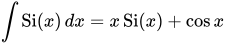
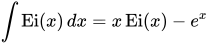
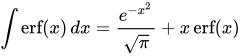
特殊機能 Ci 、 Si : 三角積分 、 Ei : 指数積分 、 li : 対数積分関数 、 erf : 誤差関数
∫
Ci
(
x
)
d
x
=
x
Ci
(
x
)
−
sin
x
{\displaystyle \int \operatorname {Ci} (x)\,dx=x\operatorname {Ci} (x)-\sin x}
∫
Si
(
x
)
d
x
=
x
Si
(
x
)
+
cos
x
{\displaystyle \int \operatorname {Si} (x)\,dx=x\operatorname {Si} (x)+\cos x}
∫
Ei
(
x
)
d
x
=
x
Ei
(
x
)
−
e
x
{\displaystyle \int \operatorname {Ei} (x)\,dx=x\operatorname {Ei} (x)-e^{x}}
∫
li
(
x
)
d
x
=
x
li
(
x
)
−
Ei
(
2
ln
x
)
{\displaystyle \int \operatorname {li} (x)\,dx=x\operatorname {li} (x)-\operatorname {Ei} (2\ln x)}
∫
li
(
x
)
x
d
x
=
ln
x
li
(
x
)
−
x
{\displaystyle \int {\frac {\operatorname {li} (x)}{x}}\,dx=\ln x\,\operatorname {li} (x)-x}
∫
erf
(
x
)
d
x
=
e
−
x
2
π
+
x
erf
(
x
)
{\displaystyle \int \operatorname {erf} (x)\,dx={\frac {e^{-x^{2}}}{\sqrt {\pi }}}+x\operatorname {erf} (x)}
閉形式 では不定積分を表現 できない 関数がいくつかあります 。ただし、これらの関数のいくつかについては、いくつかの共通区間での定積分の値を計算できます。以下に、いくつかの便利な積分を示します。
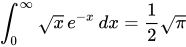
∫
0
∞
x
e
−
x
d
x
=
1
2
π
{\displaystyle \int _{0}^{\infty }{\sqrt {x}}\,e^{-x}\,dx={\frac {1}{2}}{\sqrt {\pi }}}
(ガンマ関数 も参照 )
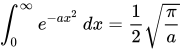
∫
0
∞
e
−
a
x
2
d
x
=
1
2
π
a
{\displaystyle \int _{0}^{\infty }e^{-ax^{2}}\,dx={\frac {1}{2}}{\sqrt {\frac {\pi }{a}}}}
a > 0 の場合 ( ガウス積分 )
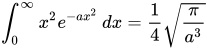
∫
0
∞
x
2
e
−
a
x
2
d
x
=
1
4
π
a
3
{\displaystyle \int _{0}^{\infty }{x^{2}e^{-ax^{2}}\,dx}={\frac {1}{4}}{\sqrt {\frac {\pi }{a^{3}}}}}
a > 0 の場合
∫
0
∞
x
2
n
e
−
a
x
2
d
x
=
2
n
−
1
2
a
∫
0
∞
x
2
(
n
−
1
)
e
−
a
x
2
d
x
=
(
2
n
−
1
)
!
!
2
n
+
1
π
a
2
n
+
1
=
(
2
n
)
!
n
!
2
2
n
+
1
π
a
2
n
+
1
{\displaystyle \int _{0}^{\infty }x^{2n}e^{-ax^{2}}\,dx={\frac {2n-1}{2a}}\int _{0}^{\infty }x^{2(n-1)}e^{-ax^{2}}\,dx={\frac {(2n-1)!!}{2^{n+1}}}{\sqrt {\frac {\pi }{a^{2n+1}}}}={\frac {(2n)!}{n!2^{2n+1}}}{\sqrt {\frac {\pi }{a^{2n+1}}}}}
a > 0 の場合 、 n は 正の整数であり、 !!は 二重階乗 です 。
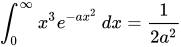
∫
0
∞
x
3
e
−
a
x
2
d
x
=
1
2
a
2
{\displaystyle \int _{0}^{\infty }{x^{3}e^{-ax^{2}}\,dx}={\frac {1}{2a^{2}}}}
a > 0の とき
∫
0
∞
x
2
n
+
1
e
−
a
x
2
d
x
=
n
a
∫
0
∞
x
2
n
−
1
e
−
a
x
2
d
x
=
n
!
2
a
n
+
1
{\displaystyle \int _{0}^{\infty }x^{2n+1}e^{-ax^{2}}\,dx={\frac {n}{a}}\int _{0}^{\infty }x^{2n-1}e^{-ax^{2}}\,dx={\frac {n!}{2a^{n+1}}}}
a > 0 の 場合 、 n = 0, 1, 2, ....
∫
0
∞
x
e
x
−
1
d
x
=
π
2
6
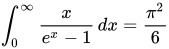
{\displaystyle \int _{0}^{\infty }{\frac {x}{e^{x}-1}}\,dx={\frac {\pi ^{2}}{6}}}
(ベルヌーイ数 も参照 )
∫
0
∞
x
2
e
x
−
1
d
x
=
2
ζ
(
3
)
≈
2.40
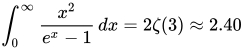
{\displaystyle \int _{0}^{\infty }{\frac {x^{2}}{e^{x}-1}}\,dx=2\zeta (3)\approx 2.40}
∫
0
∞
x
3
e
x
−
1
d
x
=
π
4
15
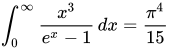
{\displaystyle \int _{0}^{\infty }{\frac {x^{3}}{e^{x}-1}}\,dx={\frac {\pi ^{4}}{15}}}
∫
0
∞
sin
x
x
d
x
=
π
2
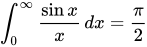
{\displaystyle \int _{0}^{\infty }{\frac {\sin {x}}{x}}\,dx={\frac {\pi }{2}}}
( sinc関数 と ディリクレ積分を 参照)
∫
0
∞
sin
2
x
x
2
d
x
=
π
2
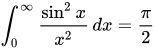
{\displaystyle \int _{0}^{\infty }{\frac {\sin ^{2}{x}}{x^{2}}}\,dx={\frac {\pi }{2}}}
∫
0
π
2
sin
n
x
d
x
=
∫
0
π
2
cos
n
x
d
x
=
(
n
−
1
)
!
!
n
!
!
×
{
1
if
n
is odd
π
2
if
n
is even.
{\displaystyle \int _{0}^{\frac {\pi }{2}}\sin ^{n}x\,dx=\int _{0}^{\frac {\pi }{2}}\cos ^{n}x\,dx={\frac {(n-1)!!}{n!!}}\times {\begin{cases}1&{\text{if }}n{\text{ is odd}}\\{\frac {\pi }{2}}&{\text{if }}n{\text{ is even.}}\end{cases}}}
( n が 正の整数で、!! が 二重階乗 の場合)。
∫
−
π
π
cos
(
α
x
)
cos
n
(
β
x
)
d
x
=
{
2
π
2
n
(
n
m
)
|
α
|
=
|
β
(
2
m
−
n
)
|
0
otherwise
{\displaystyle \int _{-\pi }^{\pi }\cos(\alpha x)\cos ^{n}(\beta x)dx={\begin{cases}{\frac {2\pi }{2^{n}}}{\binom {n}{m}}&|\alpha |=|\beta (2m-n)|\\0&{\text{otherwise}}\end{cases}}}
( α 、 β 、 m 、 nは 整数で、 β ≠0 かつm、n≥0 。 二 項 係数 も 参照 )
∫
−
t
t
sin
m
(
α
x
)
cos
n
(
β
x
)
d
x
=
0
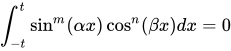
{\displaystyle \int _{-t}^{t}\sin ^{m}(\alpha x)\cos ^{n}(\beta x)dx=0}
( α 、 βは 実数、 nは 負でない整数、 mは 奇数の正の整数。被積分関数は 奇数 なので)
∫
−
π
π
sin
(
α
x
)
sin
n
(
β
x
)
d
x
=
{
(
−
1
)
(
n
+
1
2
)
(
−
1
)
m
2
π
2
n
(
n
m
)
n
odd
,
α
=
β
(
2
m
−
n
)
0
otherwise
{\displaystyle \int _{-\pi }^{\pi }\sin(\alpha x)\sin ^{n}(\beta x)dx={\begin{cases}(-1)^{\left({\frac {n+1}{2}}\right)}(-1)^{m}{\frac {2\pi }{2^{n}}}{\binom {n}{m}}&n{\text{ odd}},\ \alpha =\beta (2m-n)\\0&{\text{otherwise}}\end{cases}}}
( α 、 β 、 m 、 nは 整数で、 β ≠0 かつm、n≥0 。 二 項 係数 も 参照 )
∫
−
π
π
cos
(
α
x
)
sin
n
(
β
x
)
d
x
=
{
(
−
1
)
(
n
2
)
(
−
1
)
m
2
π
2
n
(
n
m
)
n
even
,
|
α
|
=
|
β
(
2
m
−
n
)
|
0
otherwise
{\displaystyle \int _{-\pi }^{\pi }\cos(\alpha x)\sin ^{n}(\beta x)dx={\begin{cases}(-1)^{\left({\frac {n}{2}}\right)}(-1)^{m}{\frac {2\pi }{2^{n}}}{\binom {n}{m}}&n{\text{ even}},\ |\alpha |=|\beta (2m-n)|\\0&{\text{otherwise}}\end{cases}}}
( α 、 β 、 m 、 nは 整数で、 β ≠0 かつm、n≥0 。 二 項 係数 も 参照 )
∫
−
∞
∞
e
−
(
a
x
2
+
b
x
+
c
)
d
x
=
π
a
exp
[
b
2
−
4
a
c
4
a
]
{\displaystyle \int _{-\infty }^{\infty }e^{-(ax^{2}+bx+c)}\,dx={\sqrt {\frac {\pi }{a}}}\exp \left[{\frac {b^{2}-4ac}{4a}}\right]}
(ここで exp[ u ]は 指数関数 e u であり、 a > 0 である 。)
∫
0
∞
x
z
−
1
e
−
x
d
x
=
Γ
(
z
)
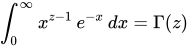
{\displaystyle \int _{0}^{\infty }x^{z-1}\,e^{-x}\,dx=\Gamma (z)}
( ガンマ関数 はここ )
Γ
(
z
)
{\displaystyle \Gamma (z)}
∫
0
1
(
ln
1
x
)
p
d
x
=
Γ
(
p
+
1
)
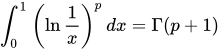
{\displaystyle \int _{0}^{1}\left(\ln {\frac {1}{x}}\right)^{p}\,dx=\Gamma (p+1)}
∫
0
1
x
α
−
1
(
1
−
x
)
β
−
1
d
x
=
Γ
(
α
)
Γ
(
β
)
Γ
(
α
+
β
)
{\displaystyle \int _{0}^{1}x^{\alpha -1}(1-x)^{\beta -1}dx={\frac {\Gamma (\alpha )\Gamma (\beta )}{\Gamma (\alpha +\beta )}}}
( Re( α )>0 および Re( β )>0については ベータ関数 を参照 )
∫
0
2
π
e
x
cos
θ
d
θ
=
2
π
I
0
(
x
)
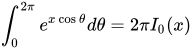
{\displaystyle \int _{0}^{2\pi }e^{x\cos \theta }d\theta =2\pi I_{0}(x)}
(ここで、 I 0 ( x ) は第一種 修正 ベッセル関数である)
∫
0
2
π
e
x
cos
θ
+
y
sin
θ
d
θ
=
2
π
I
0
(
x
2
+
y
2
)
{\displaystyle \int _{0}^{2\pi }e^{x\cos \theta +y\sin \theta }d\theta =2\pi I_{0}\left({\sqrt {x^{2}+y^{2}}}\right)}
∫
−
∞
∞
(
1
+
x
2
ν
)
−
ν
+
1
2
d
x
=
ν
π
Γ
(
ν
2
)
Γ
(
ν
+
1
2
)
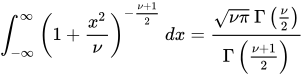
{\displaystyle \int _{-\infty }^{\infty }\left(1+{\frac {x^{2}}{\nu }}\right)^{-{\frac {\nu +1}{2}}}\,dx={\frac {{\sqrt {\nu \pi }}\ \Gamma \left({\frac {\nu }{2}}\right)}{\Gamma \left({\frac {\nu +1}{2}}\right)}}}
( ν > 0の場合、これは スチューデントの t 分布 の 確率密度関数 に関係します ) 関数 f が 区間 [ a , b ]上で 有界な変化を 持つ場合 、 枯渇法 によって積分の式が得られます。
∫
a
b
f
(
x
)
d
x
=
(
b
−
a
)
∑
n
=
1
∞
∑
m
=
1
2
n
−
1
(
−
1
)
m
+
1
2
−
n
f
(
a
+
m
(
b
−
a
)
2
−
n
)
.
{\displaystyle \int _{a}^{b}{f(x)\,dx}=(b-a)\sum \limits _{n=1}^{\infty }{\sum \limits _{m=1}^{2^{n}-1}{\left({-1}\right)^{m+1}}}2^{-n}f(a+m\left({b-a}\right)2^{-n}).}
「 二年生の夢 」:
ヨハン・ベルヌーイ
の言葉 。
∫
0
1
x
−
x
d
x
=
∑
n
=
1
∞
n
−
n
(
=
1.29128
59970
6266
…
)
∫
0
1
x
x
d
x
=
−
∑
n
=
1
∞
(
−
n
)
−
n
(
=
0.78343
05107
1213
…
)
{\displaystyle {\begin{aligned}\int _{0}^{1}x^{-x}\,dx&=\sum _{n=1}^{\infty }n^{-n}&&(=1.29128\,59970\,6266\dots )\\[6pt]\int _{0}^{1}x^{x}\,dx&=-\sum _{n=1}^{\infty }(-n)^{-n}&&(=0.78343\,05107\,1213\dots )\end{aligned}}}
参照
参考文献
^ ハーシュ、マイヤー (1810)。インテグラルターフェルン: oder、Sammlung vonintegralformeln (ドイツ語)。ダンカーとハンブロット。 ^ セルジュ・ラング 『 微積分入門』第 5 版、p. 290 ^ 「読者アンケート: log|x| + C」、トム・レンスター、 The n -category Café 、2012年3月19日
さらに読む
外部リンク
積分の表 ポールのオンライン数学ノート A. ディークマン、積分表(楕円関数、平方根、逆正接、その他の特殊な関数):不定積分 定積分 数学専攻: 積分の表 オブライエン、フランシス J. ジュニア「500 の基本関数と特殊関数の積分」。 指数関数、対数関数、特殊関数の導出積分。 ルールベースの積分 広範囲の積分対象をカバーする正確に定義された不定積分ルール マサー、リチャード J. (2012)。「積分のもう一つの表」。arXiv : 1207.5845 [ math.CA]。
派生語 ヴィクトル・ユーゴー・モル『グラッシュタインとリジークの積分』
オンラインサービス
オープンソースプログラム 多くの数学の問題を記号的および数値的に解決するための wxmaxima GUI
ビデオ 存在する最も強力な積分テクニック。 対称性に関する Flammable Maths の YouTube ビデオ





































































![{\displaystyle \int _{-\infty }^{\infty }e^{-(ax^{2}+bx+c)}\,dx={\sqrt {\frac {\pi }{a}}}\exp \left[{\frac {b^{2}-4ac}{4a}}\right]}](https://wikimedia.org/api/rest_v1/media/math/render/svg/9aac3de5d20ec70a35c8d52bafaa6a82c148b566)




![{\displaystyle {\begin{aligned}\int _{0}^{1}x^{-x}\,dx&=\sum _{n=1}^{\infty }n^{-n}&&(=1.29128\,59970\,6266\dots )\\[6pt]\int _{0}^{1}x^{x}\,dx&=-\sum _{n=1}^{\infty }(-n)^{-n}&&(=0.78343\,05107\,1213\dots )\end{aligned}}}](https://wikimedia.org/api/rest_v1/media/math/render/svg/3eb1c1f34b4606f5ebf9e88ecdb80a7681b8fcce)