Loading article…
This is a list of limits for common functions such as elementary functions. In this article, the terms a, b and c are constants with respect to x.
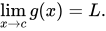
if and only if. This is the (ε, δ)-definition of limit.
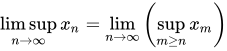
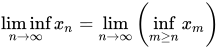
The limit superior and limit inferior of a sequence are defined as and .
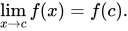
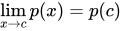
A function, , is said to be continuous at a point, c, if
If then:
In general, if g(x) is continuous at L and then
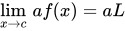
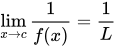
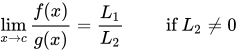
If and then:
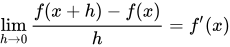
In these limits, the infinitesimal change is often denoted or . If is differentiable at ,
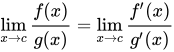
If and are differentiable on an open interval containing c, except possibly c itself, and , L'Hôpital's rule can be used:
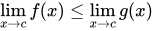
If for all x in an interval that contains c, except possibly c itself, and the limit of and both exist at c, then[5]
If and for all x in an open interval that contains c, except possibly c itself, これはスクイーズ定理として知られています。[ 1 ] [ 2 ]これは、 f ( x )とg ( x )がcで異なる値をとる場合、またはcで不連続な場合にも適用されます。
一般的に、もしは多項式であるため、多項式の連続性により、[ 5 ]これは有理関数にも当てはまります。なぜなら、有理関数は定義域で連続だからです。[ 5 ]
b > 1 の場合、
b < 1 の場合、
どちらのケースも以下のように一般化できる。
どこそしてヘヴィサイド階段関数は
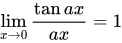
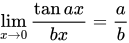
もしラジアンで表されます。
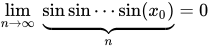
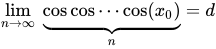
これらの限界はどちらも、sinとcosの連続性から導かれる。
一般に、無限級数はその部分和の極限である。例えば、解析関数は、収束半径内におけるテイラー級数の極限である。
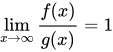
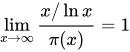
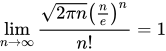
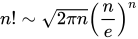
漸近的等価性、の場合、真となります。したがって、これらは極限として再定義することもできます。注目すべき漸近等価性には以下のようなものがあります。
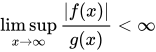
ビッグオー記法で記述される関数の挙動は、極限によっても記述できます。例えば



![{\displaystyle \lim _{x\to c}\,[f(x)\pm a]=L\pm a}](https://wikimedia.org/api/rest_v1/media/math/render/svg/7e1d3ef86a2d1c54fd7e6cfe84ecc0c4a8809cd8)

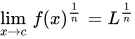
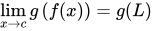
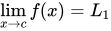
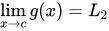
![{\displaystyle \lim _{x\to c}\,[f(x)\pm g(x)]=L_{1}\pm L_{2}}](https://wikimedia.org/api/rest_v1/media/math/render/svg/2cb00a9174f995bae626da947886d0229d14b275)
![{\displaystyle \lim _{x\to c}\,[f(x)g(x)]=L_{1}\cdot L_{2}}](https://wikimedia.org/api/rest_v1/media/math/render/svg/3d647c43494eb14a2ce635004699c5202efb03fe)


![{\displaystyle \lim _{h\to 0}{f\circ g(x+h)-f\circ g(x) \over h}=f'[g(x)]g'(x)}](https://wikimedia.org/api/rest_v1/media/math/render/svg/944fd47861a57a16f9c7b8156471af391e361a2d)












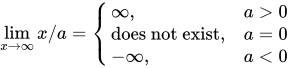


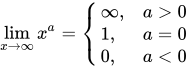
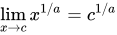
![\displaystyle \lim _{x\to \infty }x^{1/a}=\lim _{x\to \infty }{\sqrt[{a}]{x}}=\infty {\text{任意の }}a>0 に対して}](https://wikimedia.org/api/rest_v1/media/math/render/svg/e27677c268640e9d57d259ea3b52b566edc03b38)
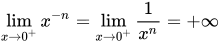




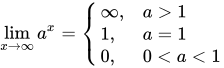
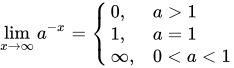
![{\displaystyle \lim _{x\to \infty }{\sqrt[{x}]{a}}=\lim _{x\to \infty }{a}^{1/x}={\begin{cases}1,&a>0\\0,&a=0\\{\text{存在しない}},&a<0\end{cases}}}](https://wikimedia.org/api/rest_v1/media/math/render/svg/257587de98c10b53ea0f58512ac1955779cf57d1)
![{\displaystyle \lim _{x\to \infty }{\sqrt[{x}]{x}}=\lim _{x\to \infty }{x}^{1/x}=1}](https://wikimedia.org/api/rest_v1/media/math/render/svg/aa1a821ef69483eecca48841d2b536f92682b8d6)
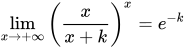
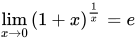
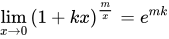
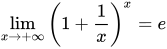
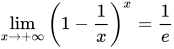
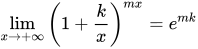

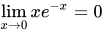

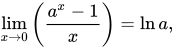
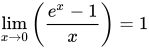
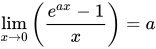
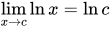

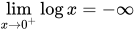
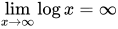
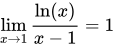
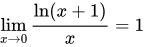

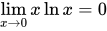

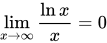
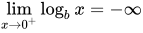

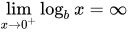
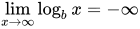




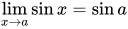

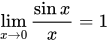
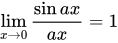

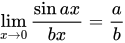
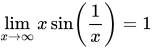

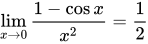
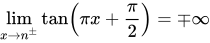
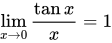
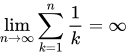
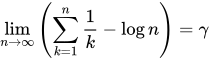
![{\displaystyle \lim _{n\to \infty }{\frac {n}{\sqrt[{n}]{n!}}}=e}](https://wikimedia.org/api/rest_v1/media/math/render/svg/9e67d9f7e2588c9b3d418f1107e9ea27b8f330ed)