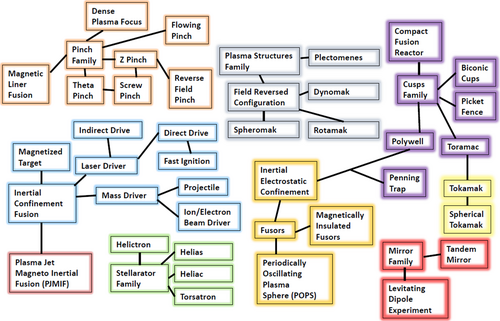
当時、Scylla I は機密扱いの装置だったため、その成果は一般には知られていなかった。従来のZ ピンチでは、プラズマの中心に電流を流し、その電流がプラズマの周囲に磁力を発生させ、プラズマを核融合条件まで圧縮する。Scylla I はθ ピンチであり、重水素を使用して円筒の周囲に電流を流し、中心に磁力を発生させた。[ 36 ] [ 37 ] Scylla I の成功後、ロスアラモス研究所はその後数年間で複数のピンチ装置を建造した。
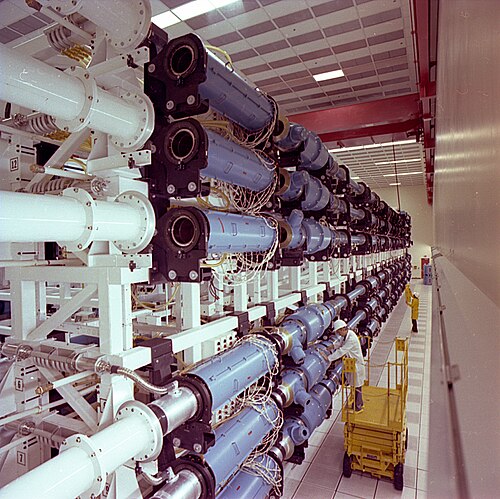
On November 8, in an invited talk to the 63rd Annual Meeting of the APS Division of Plasma Physics,[285] the National Ignition Facility claimed[286] to have triggered fusion ignition in the laboratory on August 8, 2021, for the first time in the 60+ year history of the ICF program.[287][288] The shot yielded 1.3 MJ of fusion energy, an over 8X improvement on tests done in spring of 2021.[286] NIF estimates that 230kJ of energy reached the fuel capsule, which resulted in an almost 6-fold energy output from the capsule.[286] A researcher from Imperial College London stated that the majority of the field agreed that ignition had been demonstrated.[286]
In November 2021, Helion Energy reported receiving $500 million in Series E funding for its seventh-generation Polaris device, designed to demonstrate net electricity production, with an additional $1.7billion of commitments tied to specific milestones,[289] while Commonwealth Fusion Systems raised an additional $1.8billion in Series B funding to construct and operate its SPARC tokamak, the single largest investment in any private fusion company.[290]
In April 2022, First Light announced that their hypersonic projectile fusion prototype had produced neutrons compatible with fusion. Their technique electromagnetically fires projectiles at Mach 19 at a caged fuel pellet. The deuterium fuel is compressed at Mach 204, reaching pressure levels of 100 TPa.[291]
On December 13, 2022, the US Department of Energy reported that researchers at the National Ignition Facility had achieved a net energy gain from a fusion reaction. The reaction of hydrogen fuel at the facility produced about 3.15 MJ of energy while consuming 2.05 MJ of input. However, while the fusion reactions may have produced more than 3 megajoules of energy—more than was delivered to the target—NIF's 192 lasers consumed 322 MJ of grid energy in the conversion process.[292][293][294][295]
2023 年 5 月、米国エネルギー省(DOE) は、核融合発電所の設計と研究活動を支援するため、7 州の 8 社に 4,600 万ドルの助成金を提供しました。この資金は、マイルストーンベースの核融合開発プログラムの下で、10 年以内にパイロット規模の核融合を実証し、2050 年までに核融合をカーボン ニュートラルなエネルギー源として開発するという目標に合致しています。助成金を受けた企業は、今後 5 ~ 10 年で実現可能な核融合パイロットプラントの設計を作成するための科学的および技術的な課題に取り組むことが求められています。助成金を受けた企業には、Commonwealth Fusion Systems、Focused Energy Inc.、Princeton Stellarators Inc.、Realta Fusion Inc.、Tokamak Energy Inc.、Type One Energy Group、Xcimer Energy Inc.、および Zap Energy Inc. が含まれます。[ 296 ]
Claims of commercially viable fusion power being relatively imminent have often attracted ridicule within the scientific community.[303] A common joke is that human-engineered fusion has always been promised as 30 years away since the concept was first discussed,[304] or that it has been "20 years away for 50 years".[305]
In 2024, Commonwealth Fusion Systems announced plans to build the world's first grid-scale commercial nuclear fusion power plant at the James River Industrial Center in Chesterfield County, Virginia, which is part of the Greater Richmond Region. The plant is designed to produce about 400 MW of electric power, and is intended to come online in the early 2030s.[306][307][308]
In 2025, Helion Energy, a startup company backed by OpenAI, announced plans to build a fusion power plant in Malaga, Washington to supply power to Microsoft data centers by 2028. It will use extant grid infrastructure for the nearby Rock Island Dam hydroelectric plant.[309]
In January 2026, Type One Energy announced plans to build a 350MWe fusion power plant using a stellarator fusion reactor.[310]
↑Staff (August 6, 2023). "US scientists achieve net energy gain for second time in nuclear fusion reaction". The Guardian. ISSN0261-3077. Retrieved July 25, 2025.
↑"Scientists achieve net energy gain in nuclear fusion". The Independent. December 13, 2022. Retrieved July 25, 2025.
↑"Fusion "Breakthrough" Won't Lead to Practical Fusion Energy – IEEE Spectrum". spectrum.ieee.org. Retrieved November 2, 2025.
↑"Fuelling the fusion reaction". Iter. Retrieved June 23, 2024.
12Gan, Y; Hernandez, F (2017). "Thermal Discrete Element Analysis of EU Solid Breeder Blanket Subjected to Neutron Irradiation"(PDF). Fusion Science and Technology. 66 (1): 83–90. arXiv:1406.4199. doi:10.13182/FST13-727. hdl:1959.4/unsworks_60819. Retrieved March 24, 2024– via HAL archives ouvertes.
↑Reinders, L. J. (2021). The Fairy Tale of Nuclear Fusion. Cham: Springer International Publishing. p.ix. doi:10.1007/978-3-030-64344-7. ISBN978-3-030-64343-0.
↑"Fission and fusion can yield energy". Hyperphysics.phy-astr.gsu.edu. Retrieved October 30, 2014.
12Miley, G. H.; Towner, H.; Ivich, N. (June 17, 1974). Fusion cross sections and reactivities (Technical Report). doi:10.2172/4014032. OSTI4014032– via Osti.gov.
12345Lawson, J. D. (December 1, 1956). "Some Criteria for a Power Producing Thermonuclear Reactor". Proceedings of the Physical Society. Section B. 70 (1). IOP Publishing: 6–10. Bibcode:1957PPSB...70....6L. doi:10.1088/0370-1301/70/1/303. ISSN0370-1301.
↑Wurzel, Samuel E., and Scott C. Hsu. "Progress toward fusion energy breakeven and gain as measured against the Lawson criterion." arXiv preprint arXiv:2105.10954 (2021).
↑"Lawson's three criteria". EFDA. February 25, 2013. Archived from the original on September 11, 2014. Retrieved August 24, 2014.
↑"Triple product". EFDA. June 20, 2014. Archived from the original on September 11, 2014. Retrieved August 24, 2014.
↑Chiocchio, Stefano. "ITER and the International ITER and the International Scientific Collaboration"(PDF).
↑"Laser Inertial Fusion Energy". Life.llnl.gov. Archived from the original on September 15, 2014. Retrieved August 24, 2014.
12Barr, W. L.; Moir, R. W.; Hamilton, G. W. (1982). "Experimental results from a beam direct converter at 100 kV". Journal of Fusion Energy. 2 (2). Springer Science and Business Media LLC: 131–143. Bibcode:1982JFuE....2..131B. doi:10.1007/bf01054580. ISSN0164-0313. S2CID120604056.
↑Fitzpatrick, Richard (2014). Plasma physics: an introduction. Boca Raton, Florida: CRC Press, Taylor & Francis Group. ISBN978-1-4665-9426-5. OCLC900866248.
↑Alfvén, H. (1942). "Existence of electromagnetic-hydrodynamic waves". Nature. 150 (3805): 405–406. Bibcode:1942Natur.150..405A. doi:10.1038/150405d0. S2CID4072220.
↑Sijoy, C. D.; Chaturvedi, Shashank (2012). "An Eulerian MHD model for the analysis of magnetic flux compression by expanding diamagnetic fusion plasma sphere". Fusion Engineering and Design. 87 (2): 104–117. Bibcode:2012FusED..87..104S. doi:10.1016/j.fusengdes.2011.10.012. ISSN0920-3796.
↑Post, R. F. (1958). United Nations International Conference on the Peaceful Uses of Atomic Energy (ed.). Proceedings of the second United Nations International Conference on the Peaceful Uses of Atomic Energy held in Geneva 1 September – 13 September 1958. Vol.32. Geneva, Switzerland: United Nations. OCLC643589395.
↑"All-the-Worlds-Tokamaks". www.tokamak.info. Retrieved October 11, 2020.
↑"The first plasma: the Wendelstein 7-X fusion device is now in operation". www.ipp.mpg.de. Retrieved October 11, 2020.
↑Chandler, David (March 19, 2008). "MIT tests unique approach to fusion power". MIT News | Massachusetts Institute of Technology. Retrieved October 11, 2020.
12Post, R. F. (January 1, 1970). "Mirror systems: fuel cycles, loss reduction and energy recovery". Nuclear fusion reactors. Proceedings of a conference held at UKAEA Culham Laboratory, Abingdon on 17–19 September 1969. Thomas Telford Publishing. pp.99–111. doi:10.1680/nfr.44661. ISBN978-0-7277-4466-1. Retrieved October 11, 2020.
↑Berowitz, J. L; Grad, H.; Rubin, H. (1958). Proceedings of the second United Nations International Conference on the Peaceful Uses of Atomic Energy. Vol.31. Geneva: United Nations. OCLC840480538.
↑Bagryansky, P. A.; Shalashov, A. G.; Gospodchikov, E. D.; Lizunov, A. A.; Maximov, V. V.; Prikhodko, V. V.; Soldatkina, E. I.; Solomakhin, A. L.; Yakovlev, D. V. (May 18, 2015). "Threefold Increase of the Bulk Electron Temperature of Plasma Discharges in a Magnetic Mirror Device". Physical Review Letters. 114 (20) 205001. arXiv:1411.6288. Bibcode:2015PhRvL.114t5001B. doi:10.1103/physrevlett.114.205001. ISSN0031-9007. PMID26047233. S2CID118484958.
↑Freidberg, Jeffrey P. (2007). Plasma Physics and Fusion Energy. Cambridge University Press. ISBN978-0-521-85107-7.
↑Dolan, Thomas J., ed. (2013). Magnetic Fusion Technology. Lecture Notes in Energy. Vol.19. London, England: Springer London. pp.30–40. doi:10.1007/978-1-4471-5556-0. ISBN978-1-4471-5555-3. ISSN2195-1284.
↑D. A. Sutherland, T. R. Jarboe et al., "The dynomak: An advanced spheromak reactor concept with imposed-dynamo current drive and next-generation nuclear power technologies", Fusion Engineering and Design, Volume 89, Issue 4, April 2014, pp. 412–425.
↑Jarboe, T. R., et al. "Spheromak formation by steady inductive helicity injection." Physical Review Letters 97.11 (2006): 115003
↑Jarboe, T. R., et al. "Recent results from the HIT-SI experiment." Nuclear Fusion 51.6 (2011): 063029
↑Nuckolls, John; Wood, Lowell; Thiessen, Albert; Zimmerman, George (1972). "Laser Compression of Matter to Super-High Densities: Thermonuclear (CTR) Applications". Nature. 239 (5368): 139–142. Bibcode:1972Natur.239..139N. doi:10.1038/239139a0. S2CID45684425.
↑Turrell, Arthur (2021). How to Build a Star: the science of nuclear fusion and the quest to harness its power. Place of publication not identified: Weidenfeld & Nicolson. ISBN978-1-4746-1159-6. OCLC1048447399.
↑Thio, Y. C. F. (April 1, 2008). "Status of the US program in magneto-inertial fusion". Journal of Physics: Conference Series. 112 (4) 042084. IOP Publishing. Bibcode:2008JPhCS.112d2084T. doi:10.1088/1742-6596/112/4/042084. ISSN1742-6596.
↑Sharp, W. M.; etal. (2011). Inertial Fusion Driven by Intense Heavy-Ion Beams(PDF). Proceedings of 2011 Particle Accelerator Conference. New York, New York, USA. p.1386. Archived from the original(PDF) on November 26, 2017. Retrieved August 3, 2019.
12Seife, Charles (2008). Sun in a bottle: the strange history of fusion and the science of wishful thinking. New York: Viking. ISBN978-0-670-02033-1. OCLC213765956.
12Phillips, James (1983). "Magnetic Fusion". Los Alamos Science: 64–67. Archived from the original on December 23, 2016. Retrieved April 4, 2013.
↑"Flow Z-Pinch Experiments". Aeronautics and Astronautics. November 7, 2014. Retrieved October 11, 2020.
↑"Zap Energy". Zap Energy. Archived from the original on February 13, 2020. Retrieved February 13, 2020.
↑"Board of Directors". Zap Energy. Retrieved September 8, 2020.
↑"Chevron announces investment in nuclear fusion start-up Zap Energy". Power Technology: Energy News and Market Analysis. August 13, 2020. Retrieved September 8, 2020.
↑Srivastava, Krishna M.; Vyas, D. N. (1982). "Non-linear analysis of the stability of the Screw Pinch". Astrophysics and Space Science. 86 (1). Springer Nature: 71–89. Bibcode:1982Ap&SS..86...71S. doi:10.1007/bf00651831. ISSN0004-640X. S2CID121575638.
↑US patent 5,160,695, Robert W. Bussard, "Method and apparatus for creating and controlling nuclear fusion reactions", issued November 3, 1992
↑Taccetti, J. M.; Intrator, T. P.; Wurden, G. A.; Zhang, S. Y.; Aragonez, R.; Assmus, P. N.; Bass, C. M.; Carey, C.; deVries, S. A.; Fienup, W. J.; Furno, I. (September 25, 2003). "FRX-L: A field-reversed configuration plasma injector for magnetized target fusion". Review of Scientific Instruments. 74 (10): 4314–4323. Bibcode:2003RScI...74.4314T. doi:10.1063/1.1606534. ISSN0034-6748.
↑Hsu, S. C.; Awe, T. J.; Brockington, S.; Case, A.; Cassibry, J. T.; Kagan, G.; Messer, S. J.; Stanic, M.; Tang, X.; Welch, D. R.; Witherspoon, F. D. (2012). "Spherically Imploding Plasma Liners as a Standoff Driver for Magnetoinertial Fusion". IEEE Transactions on Plasma Science. 40 (5): 1287–1298. Bibcode:2012ITPS...40.1287H. doi:10.1109/TPS.2012.2186829. ISSN1939-9375. S2CID32998378.
12Clynes, Tom (2020). "5 Big ideas for fusion power: Startups, universities, and major companies are vying to commercialize a nuclear fusion reactor". IEEE Spectrum. 57 (2): 30–37. Bibcode:2020IEEES..57b..30C. doi:10.1109/MSPEC.2020.8976899. ISSN0018-9235. S2CID211059641.
↑Baramsai, Bayardadrakh; Benyo, Theresa; Forsley, Lawrence; Steinetz, Bruce (February 27, 2022). "NASA's New Shortcut to Fusion Power". IEEE Spectrum.
↑Steinetz, Bruce M.; Benyo, Theresa L.; Chait, Arnon; Hendricks, Robert C.; Forsley, Lawrence P.; Baramsai, Bayarbadrakh; Ugorowski, Philip B.; Becks, Michael D.; Pines, Vladimir; Pines, Marianna; Martin, Richard E.; Penney, Nicholas; Fralick, Gustave C.; Sandifer, Carl E. (April 20, 2020). "Novel nuclear reactions observed in bremsstrahlung-irradiated deuterated metals". Physical Review C. 101 (4) 044610. Bibcode:2020PhRvC.101d4610S. doi:10.1103/physrevc.101.044610. S2CID219083603.
↑Tripathi, Aman (January 21, 2026). "Billion-times more efficient nuclear fusion could be unlocked with low-frequency lasers". Interesting Engineering. Retrieved January 23, 2026.
↑Rider, Todd H. (1995). "A general critique of inertial-electrostatic confinement fusion systems". Physics of Plasmas. 2 (6). AIP Publishing: 1853–1872. Bibcode:1995PhPl....2.1853R. doi:10.1063/1.871273. hdl:1721.1/29869. ISSN1070-664X. S2CID12336904.
↑Clynes, Tom (February 14, 2012). "The Boy Who Played With Fusion". Popular Science. Retrieved August 3, 2019.
↑"Plasma Physics". Government Reports Announcements. 72: 194. 1972.
↑Degrave, J.; Felici, F. (2022). "Magnetic control of tokamak plasmas through deep reinforcement learning". Nature. 602 (7897): 414–419. Bibcode:2022Natur.602..414D. doi:10.1038/s41586-021-04301-9. PMC8850200. PMID35173339.
12Katwala, Amit (February 16, 2022). "DeepMind Has Trained an AI to Control Nuclear Fusion". Wired. ISSN1059-1028. Retrieved February 17, 2022.
↑Kim, S. K.; Shousha, R.; Yang, S. M.; Hu, Q.; Hahn, S. H.; Jalalvand, A.; Park, J.-K.; Logan, N. C.; Nelson, A. O.; Na, Y.-S.; Nazikian, R.; Wilcox, R.; Hong, R.; Rhodes, T.; Paz-Soldan, C. (May 11, 2024). "Highest fusion performance without harmful edge energy bursts in tokamak". Nature Communications. 15 (1): 3990. doi:10.1038/s41467-024-48415-w. ISSN2041-1723. PMC11088687. PMID38734685.
↑Jalalvand, Azarakhsh; Kim, SangKyeun; Seo, Jaemin; Hu, Qiming; Curie, Max; Steiner, Peter; Nelson, Andrew Oakleigh; Na, Yong-Su; Kolemen, Egemen (September 26, 2025). "Multimodal super-resolution: discovering hidden physics and its application to fusion plasmas". Nature Communications. 16 (1): 8506. doi:10.1038/s41467-025-63492-1. ISSN2041-1723. PMC12475251. PMID41006246.
↑"New AI enhances the view inside fusion energy systems | Princeton Plasma Physics Laboratory". www.pppl.gov. Retrieved February 3, 2026.
↑Miley, George H. (2013). Inertial electrostatic confinement (IEC) fusion: fundamentals and applications. Murali, S. Krupakar. Dordrecht: Springer. ISBN978-1-4614-9338-9. OCLC878605320.
↑Kunkel, W. B. (1981). "Neutral-beam injection". In Teller, E. (ed.). Fusion. Lawrence Livermore National Laboratory. ISBN978-0-12-685241-7.
↑Erckmann, V; Gasparino, U (December 1, 1994). "Electron cyclotron resonance heating and current drive in toroidal fusion plasmas". Plasma Physics and Controlled Fusion. 36 (12): 1869–1962. Bibcode:1994PPCF...36.1869E. doi:10.1088/0741-3335/36/12/001. ISSN0741-3335. S2CID250897078.
↑Ono, Y.; Tanabe, H.; Yamada, T.; Gi, K.; Watanabe, T.; Ii, T.; Gryaznevich, M.; Scannell, R.; Conway, N.; Crowley, B.; Michael, C. (May 1, 2015). "High power heating of magnetic reconnection in merging tokamak experiments". Physics of Plasmas. 22 (5): 055708. Bibcode:2015PhPl...22e5708O. doi:10.1063/1.4920944. hdl:1885/28549. ISSN1070-664X.
↑Yamada, M.; Chen, L.-J.; Yoo, J.; Wang, S.; Fox, W.; Jara-Almonte, J.; Ji, H.; Daughton, W.; Le, A.; Burch, J.; Giles, B. (December 6, 2018). "The two-fluid dynamics and energetics of the asymmetric magnetic reconnection in laboratory and space plasmas". Nature Communications. 9 (1): 5223. Bibcode:2018NatCo...9.5223Y. doi:10.1038/s41467-018-07680-2. ISSN2041-1723. PMC6283883. PMID30523290.
↑McGuire, Thomas. Heating Plasma for Fusion Power Using Magnetic Field Oscillations. Baker Botts LLP, assignee. Issued: 4/2/14, Patent 14/243,447. N.d. Print.
↑Park, Jaeyoung; Krall, Nicholas A.; Sieck, Paul E.; Offermann, Dustin T.; Skillicorn, Michael; Sanchez, Andrew; Davis, Kevin; Alderson, Eric; Lapenta, Giovanni (June 1, 2014). "High Energy Electron Confinement in a Magnetic Cusp Configuration". Physical Review X. 5 (2) 021024. arXiv:1406.0133. Bibcode:2015PhRvX...5b1024P. doi:10.1103/PhysRevX.5.021024. S2CID118478508.
↑Mott-Smith, H. M.; Langmuir, Irving (September 1, 1926). "The Theory of Collectors in Gaseous Discharges". Physical Review. 28 (4). American Physical Society (APS): 727–763. Bibcode:1926PhRv...28..727M. doi:10.1103/physrev.28.727. ISSN0031-899X.
↑Esarey, Eric; Ride, Sally K.; Sprangle, Phillip (September 1, 1993). "Nonlinear Thomson scattering of intense laser pulses from beams and plasmas". Physical Review E. 48 (4). American Physical Society (APS): 3003–3021. Bibcode:1993PhRvE..48.3003E. doi:10.1103/physreve.48.3003. ISSN1063-651X. PMID9960936.
↑Kantor, M. Yu; Donné, A. J. H.; Jaspers, R.; van der Meiden, H. J. (February 26, 2009). "Thomson scattering system on the TEXTOR tokamak using a multi-pass laser beam configuration". Plasma Physics and Controlled Fusion. 51 (5) 055002. Bibcode:2009PPCF...51e5002K. doi:10.1088/0741-3335/51/5/055002. ISSN0741-3335. S2CID123495440.
↑Tsoulfanidis, Nicholas (1995). Measurement and detection of radiation. Library Genesis. Washington, DC: Taylor & Francis. ISBN978-1-56032-317-4.
↑Knoll, Glenn F. (2010). Radiation detection and measurement (4thed.). Hoboken, NJ: John Wiley. ISBN978-0-470-13148-0. OCLC612350364.
↑Larmor, Joseph (January 1, 1897). "IX. A dynamical theory of the electric and luminiferous medium. Part III. relations with material media". Philosophical Transactions of the Royal Society of London. Series A, Containing Papers of a Mathematical or Physical Character. 190: 205–300. Bibcode:1897RSPTA.190..205L. doi:10.1098/rsta.1897.0020.
↑Stott PE, Gorini G, Prandoni P, Sindoni E, eds. (1998). Diagnostics for experimental thermonuclear fusion reactors 2. New York: Springer. ISBN978-1-4615-5353-3. OCLC828735433.
↑Ishiyama, Shintaro; Muto, Yasushi; Kato, Yasuyoshi; Nishio, Satoshi; Hayashi, Takumi; Nomoto, Yasunobu (March 1, 2008). "Study of steam, helium and supercritical CO2 turbine power generations in prototype fusion power reactor". Progress in Nuclear Energy. 50 (2): 325–332. doi:10.1016/j.pnucene.2007.11.078. ISSN0149-1970.
↑Anklam, T.; Simon, A. J.; Powers, S.; Meier, W. R. (December 2, 2010). "LIFE: The Case for Early Commercialization of Fusion Energy"(PDF). Lawrence Livermore National Laboratory, LLNL-JRNL-463536. Archived from the original(PDF) on September 4, 2015. Retrieved October 30, 2014.
↑Hanaor, D. A. H.; Kolb, M. H. H.; Gan, Y.; Kamlah, M.; Knitter, R. (2014). "Solution based synthesis of mixed-phase materials in the Li2TiO3–Li4SiO4 system". Journal of Nuclear Materials. 456: 151–161. arXiv:1410.7128. Bibcode:2015JNuM..456..151H. doi:10.1016/j.jnucmat.2014.09.028. S2CID94426898.
↑Barr, William L.; Moir, Ralph W. (January 1, 1983). "Test Results on Plasma Direct Converters". Nuclear Technology – Fusion. 3 (1): 98–111. Bibcode:1983NucTF...3...98B. doi:10.13182/FST83-A20820. ISSN0272-3921.
↑"American Elements Creates Detection Window for EPFL Fusion Reactor". American Elements. Retrieved February 16, 2023.
↑Molodyk, A., et al. "Development and large volume production of extremely high current density YBa2Cu3O7 superconducting wires for fusion." Scientific Reports 11.1 (2021): 1–11.
12"Thermal response of nanostructured tungsten". Shin Kajita, et al., January 2014, Nuclear Fusion 54 (2014) 033005 (10 pp.)
↑Gilbert, Mark (2013). "Neutron-induced dpa, transmutations, gas production, and helium embrittlement of fusion materials". Journal of Nuclear Materials. 442 (1–3): S755–S760. arXiv:1311.5079. Bibcode:2013JNuM..442S.755G. doi:10.1016/j.jnucmat.2013.03.085.
↑Neu, R.; etal. (2005). "Tungsten: an option for divertor and main chamber plasma facing components in future fusion devices". Nuclear Fusion. 45 (3): 209–218. Bibcode:2005NucFu..45..209N. doi:10.1088/0029-5515/45/3/007. S2CID56572005.
↑Philipps, V.; etal. (2011). "Tungsten as material for plasma-facing components in fusion devices". Journal of Nuclear Materials. 415 (1): S2–S9. Bibcode:2011JNuM..415S...2P. doi:10.1016/j.jnucmat.2011.01.110.
↑Neu, R.; etal. (2016). "Advanced tungsten materials for plasma-facing components of DEMO and fusion power plants". Fusion Engineering and Design. 109–111: 1046–1052. Bibcode:2016FusED.109.1046N. doi:10.1016/j.fusengdes.2016.01.027. hdl:11858/00-001M-0000-002B-3142-7.
↑Coenen, J.W. (2020). "Fusion Materials Development at Forschungszentrum Jülich". Advanced Engineering Materials. 22 (6) 1901376. doi:10.1002/adem.201901376.
↑Brezɩnsek, S.; etal. (December 2, 2021). "Plasma–surface interaction in the stellarator W7-X: Conclusions drawn from operation with graphite plasma-facing components". Nuclear Fusion. 62 (1): 016006. doi:10.1088/1741-4326/ac3508. S2CID240484560.
↑Mayer, M.; Balden, M.; Behrisch, R. (1998). "Deuterium retention in carbides and doped graphites". Journal of Nuclear Materials. 252 (1): 55–62. Bibcode:1998JNuM..252...55M. doi:10.1016/S0022-3115(97)00299-7.
↑Koller, Markus T.; Davis, James W.; Goodland, Megan E.; Abrams, Tyler; Gonderman, Sean; Herdrich, Georg; Frieß, Martin; Zuber, Christian (2019). "Deuterium retention in silicon carbide, SiC ceramic matrix composites, and SiC coated graphite". Nuclear Materials and Energy. 20 100704. Bibcode:2019NMEne..2000704K. doi:10.1016/j.nme.2019.100704.
↑Su, Ranran (2023). "Helium-driven element depletion and phase transformation in irradiated Ti3SiC2 at high temperature". Journal of the European Ceramic Society. 43 (8): 3104–3111. doi:10.1016/j.jeurceramsoc.2023.01.048.
↑Myat-Hyun, Myat (2022). "Tailoring mechanical and in vitro biological properties of calcium‒silicate based bioceramic through iron doping in developing future material". Journal of the Mechanical Behavior of Biomedical Materials. 128 105122. doi:10.1016/j.jmbbm.2022.105122. PMID35168129.
↑Stauffer, Nancy (August 19, 2024). "More durable metals for fusion power reactors". MIT News.
↑Hoedl, Seth A. (2022). "Achieving a social license for fusion energy". Physics of Plasmas. 29 (9) 092506. Bibcode:2022PhPl...29i2506H. doi:10.1063/5.0091054. ISSN1070-664X. S2CID252454077.
123McCracken, Garry; Stott, Peter (2012). Fusion: The Energy of the Universe. Academic Press. pp.198–199. ISBN978-0-12-384656-3. Retrieved August 18, 2012.
↑Dulon, Krista (2012). "Who is afraid of ITER?". iter.org. Archived from the original on November 30, 2012. Retrieved August 18, 2012.
↑Angelo, Joseph A. (2004). Nuclear Technology. Greenwood Publishing Group. p.474. ISBN978-1-57356-336-9. Retrieved August 18, 2012.
↑ Pearson, Richard J.; Nuttall, William J. (2020). "Pioneers of commercial fusion". Commercialising Fusion Energy . IOP Publishing. doi : 10.1088/978-0-7503-2719-0ch7 . ISBN978-0-7503-2719-0. S2CID 234528929 .
1 2レイモンド・ジョン、クリス・バックリー、キース・ブラッドシャー、ハリー・スティーブンス(2025年12月13日) 「クリーンで無限のエネルギーは存在する。中国はそれを活用するための競争に大きく乗り出している」ニューヨーク・タイムズ。2025年12月5日までのデータ。その他の国には、ドイツ、イギリス、カナダ、日本、フランス、イスラエル、スウェーデン、オーストラリアが含まれる。出典:Fusion Energy Base
↑ Donn, Jeff (2011年6月21日) 「米国の48の核施設で放射性トリチウムの漏洩が発見される」NBCニュース。2020年11月11日のオリジナルからアーカイブ。 2023年7月4日閲覧。
↑ Abdou, M.; et al. (2020). "重水素-三重水素燃料サイクルの物理学および技術的考察と三重水素燃料の自給条件" . Nuclear Fusion . 61 (1): 013001. doi : 10.1088/1741-4326/abbf35 . S2CID 229444533 .
↑ Hof, Barbara (2025), "Fusion divided: What prevents European collaboration on controlled thermonuclear fusion in 1958", The British Journal for the History of Science , 58 (3): 483– 501, arXiv : 2410.15969 , doi : 10.1017/S0007087425101088 , PMID 40799004
↑ Stix, TH (1998). "プリンストン大学における初期のステラレータ研究のハイライト" . Helical System Research : 3– 8.
↑ Johnson, John L. (2001年11月16日).プリンストン大学におけるステラレータ理論の進化(技術報告書)。doi : 10.2172 /792587 . OSTI 792587 .
↑ Journal、Jennifer Hiller | 写真:Tony Luong for The Wall Street (2021年12月1日)。「WSJニュース独占記事|核融合スタートアップ企業が18億ドルを調達、投資家はスターパワーを追い求める」。ウォール・ストリート・ジャーナル。ISSN 0099-9660。2021年12月17日取得。
↑ブレイン、ロズ(2022年4月6日)「オックスフォード大学のスピンオフ企業が世界初の極超音速「飛翔体核融合」を実証」「 . New Atlas . 2022年4月6日取得.







 ウィキメディア・コモンズにある核融合炉関連のメディア
 Wikidataにある核融合発電に関するデータ





