
Loading article…

Kathryn Dwyer Sullivan (born October 3, 1951) is an American geologist, oceanographer, and former NASA astronaut and US Navy officer. She was a crew member on three Space Shuttle missions.
A graduate of University of California, Santa Cruz, in the United States, and Dalhousie University in Nova Scotia, Canada—where she earned a Doctor of Philosophy degree in geology in 1978—Sullivan was selected as one of the six women among the 35 astronaut candidate in NASA Astronaut Group 8, the first group to include women. During her training, she became the first woman to be certified to wear a United States Air Forcepressure suit, and on July 1, 1979, she set an unofficial sustained American aviation altitude record for women. During her first mission, STS-41-G, Sullivan performed the first extra-vehicular activity (EVA) by an American woman. On her second, STS-31, she helped deploy the Hubble Space Telescope. On the third, STS-45, she served as Payload Commander on the first Spacelab mission dedicated to NASA's Mission to Planet Earth.
Sullivan was Under Secretary of Commerce for Oceans and Atmosphere and Administrator of the National Oceanic and Atmospheric Administration (NOAA) after being confirmed by the US Senate on March 6, 2014. Her tenure ended on January 20, 2017, after which she was designated as the 2017 Charles A. Lindbergh Chair of Aerospace History at the Smithsonian Institution's National Air and Space Museum, and also served as a Senior Fellow at the Potomac Institute for Policy Studies. On June 7, 2020, Sullivan became the first woman to dive into the Challenger Deep in the Mariana Trench, the deepest part of Earth's oceans. In September 2021, President Joe Biden appointed her to the President's Council of Advisors on Science and Technology.
キャスリン・ドワイヤー・サリバンは、1951年10月3日、ニュージャージー州パターソンで、ドナルド・ポール・サリバンと妻バーバラ(旧姓ケリー)の娘として生まれた。[ 1 ] [ 2 ]彼女にはグラントという兄弟がいる。[ 3 ] 1958年、一家はカリフォルニア州サンフェルナンドバレーに引っ越し、父親はマーカート社で航空宇宙産業に従事した。[ 4 ]彼女はヘイブンハースト小学校の1年生で、サリー・ライドが同級生だったが、学校は1958年にヴァン・ナイス空港建設のために閉校となり、二人は互いに会った記憶がない。[ 5 ]彼女は学生時代にガールスカウトだった。[ 4 ] [ 6 ]
Sullivan graduated from William Howard Taft High School in the Woodland Hills district of Los Angeles, California, in 1969.[1] She took both French and German in high school, and resolved to have a career in the foreign service. She chose to enter the University of California, Santa Cruz (UCSC), on account of its renowned Russian studies program. The university required that humanities students take three science classes and vice versa.[7] She chose to take courses in marine biology, topology and oceanography. She enjoyed these, and altered her course to take in more science subjects. She was an exchange student at the University of Bergen in Norway for the 1971–1972 school year and the two summers around it, and decided to change her major to oceanography.[4] She was awarded a Bachelor of Science degree in Earth Sciences from UCSC in 1973, and a Doctor of Philosophy in geology from Dalhousie University and the Bedford Institute of Oceanography in Nova Scotia, Canada, in 1978,[1][7] writing her doctoral thesis on The structure and evolution of the Newfoundland Basin under the supervision of Michael John Keen.[8] While at Dalhousie, she participated in several oceanographic expeditions that studied the floors of the Atlantic and Pacific oceans.[9]
1976年のクリスマスにサリバンが実家を訪れた際、航空宇宙エンジニアで企業ジェット機のパイロットでもある兄のグラントから、アメリカ航空宇宙局(NASA)が新たな宇宙飛行士の募集を開始したと聞かされた。NASAは女性の採用に関心があることを公言しており、グラントはサリバンに応募するよう勧めた。グラント自身もパイロットとミッションスペシャリストの両方の職に応募していた。ノバスコシアに戻ったサリバンは、科学雑誌に掲載されたNASAの広告を見て応募することにした。スペースシャトルは一種の研究船だと考えたが、彼女の夢はやはり潜水艇で海底に潜ることだった。コロンビア大学ラモント・ドハティ地球観測所のウィリアム・B・F・ライアンから、潜水艇DSVアルビンで海洋探査を行うチームへの参加を打診されたことで、その夢は現実味を帯びてきた。ライアンは1967年にNASA宇宙飛行士グループ6の最終選考に残ったものの落選しており、彼女にNASAからの連絡を待つように助言した。二人とも採用される可能性は低いと感じていたが、サリバンは選考結果を待つ間、ライアンのチームには加わらなかった。[ 10 ]
グラントの応募は不採用だったが、キャスリンは1977年11月14日から始まる1週間の面接と身体検査のためにジョンソン宇宙センター(JSC)に招待された。彼女はこの25人の最終候補者グループの中で唯一の女性だった。[ 11 ] 1週間にわたって身体検査と心理検査を受け、ジョージ・アビーが議長を務める選考委員会による面接を受けた。彼女は合格し、 NASA宇宙飛行士グループ8の35人のメンバーのうち6人の女性の1人として選ばれたことが1978年1月16日に公表された。 [ 12 ]これは女性を含む最初の宇宙飛行士グループだった。サリバンは、大学卒業後、NASAの宇宙飛行士が初めてのフルタイムの有給の仕事となる3人のメンバー(他の2人はサリー・ライドとスティーブ・ホーレー)のうちの1人だった。 [ 13 ]

On August 31, 1979, NASA announced that the 35 astronaut candidates had completed their training and evaluation, and were now officially astronauts, qualified for selection on space flight crews.[14] To mark the occasion the Chief of the Astronaut Office, John Young, presented each of them with a silver NASA astronaut pin; they would become eligible for a gold one after they had flown in space.[15] Like other astronaut groups before them, each was given a particular assignment.[16] Sullivan helped develop systems management checklists for the first Space Shuttle flights. To give the newcomers more experience, they were periodically rotated to different jobs, so after nine months she became a mission manager at NASA's High Altitude Research Project, based at nearby Ellington Air Force Base. She became the first woman to be certified to wear a United States Air Forcepressure suit,[15] and on July 1, 1979, she set an unofficial sustained American aviation altitude record for women of 19,000 metres (63,000 ft) during a four-hour flight in a NASA WB-57F reconnaissance aircraft.[17]
For the first Space Shuttle mission, STS-1, Sullivan was assigned to media support, working with Vic Ratner and Bob Walker on ABC News Radio. For the STS-2 mission she flew in the back seat of a NASA Northrop T-38 Talon chase plane piloted by fellow astronaut Hoot Gibson, photographing the Space Shuttle tiles to verify that none had been damaged. She was then assigned to the support crew at the Kennedy Space Center (KSC), along with fellow astronauts Steve Hawley, Loren Shriver and Don Williams, for the next four Space Shuttle missions.[18]

In July 1983 Sullivan joined the Mission Development group, which organised and supervised the development of payloads for future missions that did not yet have a crew assigned to them. She was assigned to the Office of Space and Terrestrial Applications' OSTA-3 satellite and the Orbital Refueling System (ORS). The objective of the latter was to demonstrate that the Space Shuttle could be used to refuel a satellite in orbit, thereby extending its useful life. For this the aging Landsat 4 satellite was chosen. In September 1983 she was officially assigned to this mission, which was designated STS-41-G.[19]
Sally Ride was also assigned to this mission, so it became the first time that two women were in space together. The mission lifted off from the KSC in the Space ShuttleChallenger on October 5, 1984.[20] Sullivan performed the first extra-vehicular activity (EVA) by an American woman on October 11, 1984. With fellow mission specialist David Leestma, she performed a 3.5-hour spacewalk in which they operated the ORS to show that a satellite could be refueled in orbit.[20] They installed a valve into a satellite propulsion system that mimicked that of Landsat 4 and transferred 59 kilograms (130 lb) of hydrazine to it using the ORS. This demonstrated that the procedure could be performed with a real satellite.[21]
During the eight-day mission, the crew also deployed the Earth Radiation Budget Satellite, conducted scientific observations of Earth with the OSTA-3 pallet (including the SIR-B radar, FILE, and MAPS experiments) and large format camera (LFC), and conducted several in-cabin experiments as well as activating eight "Getaway Special" canisters. STS-41G completed 132 orbits of Earth in 197.5 hours, before landing back at the KSC on October 13, 1984.[20]

In September 1985 Sullivan was assigned to the STS-61-J mission, which was scheduled to deploy the Hubble Space Telescope (HST) in August 1986.[22] The original intention was that the HST would be periodically retrieved by the Space Shuttle and returned to Earth for maintenance, although some components were designed for servicing in-orbit. In 1984 NASA management decided this would be too dangerous and too costly, and that the HST would instead be maintained in-orbit by periodic servicing missions for up to fifteen years.[23] Convinced that NASA would attempt to fix any component that jeopardized the HST's mission whether it had been designated as serviceable or not, Sullivan pressed for as many components as possible to be replaceable or amenable to in-orbit servicing. Working with fellow astronaut Bruce McCandless II and NASA and Lockheed Corporation engineers, she ensured that there would be a complete set of tools and procedures for as many HST maintenance missions as possible.[24]
The STS-61-J mission was cancelled after the January 1986 Space Shuttle Challenger disaster, but the crew continued to work on the mission objectives. At this point, just fourteen systems were designated as "on-orbit maintainable". There were up to twelve units in each one, so forty-three were designated as Block I "on-orbit replaceable units" (ORUs). Lockheed produced two lists of additional units that could be modified to be serviceable; there were twenty-six systems and fifty-one units in Block II and eight systems and sixteen units in Block III. With more time available, an attempt was now made to work through these.[25] Meanwhile, Sullivan served as capsule communicator (CAPCOM) for STS-26, the Space Shuttle's October 1988 return-to-flight mission.[26] She chose the wakeup music, including a contribution from Robin Williams, who provided a pastiche of his Good Morning, Vietnam radio greeting. She continued working as CAPCOM on the STS-27 and STS-29 missions.[27]

At the end of March 1989, Sullivan returned to working on the HST mission, which was now designated STS-31. The crew was the same, except that Loren Shriver replaced Young as mission commander.[28] STS-31 was launched from KSC, on April 24, 1990. During this five-day mission, crew members aboard the Space ShuttleDiscovery deployed the HST, and conducted middeck experiments involving the study of protein crystal growth, polymer membrane processing, and the effects of weightlessness and magnetic fields on an ion arc. They also operated several cameras, including the IMAX cargo bay camera, for Earth observations. Their apogee of 617 kilometers (333 nmi) above Earth was the highest yet achieved by a Space Shuttle orbiter. (It was later exceeded by the STS-82 HST servicing mission.)[29][30]
The HST was deployed on the second day using Discovery's Canadarm with the Shuttle doors opened towards the ground. In case McCandless and Sullivan had to perform an EVA, the Shuttle's cabin pressure was lowered from 101 kilopascals (14.7 psi) to 28 kilopascals (4.1 psi).[31] At one point McCandless and Sullivan donned their space suits and entered the airlock to perform an emergency EVA to help deploy the Hubble's solar arrays, but this was not required, as the engineers were able to deploy them with a series of commands from Earth.[32]Discovery followed the HST for the next two days in case intervention was required.[33] After making 76 orbits of Earth in 121 hours, Discovery landed at Edwards Air Force Base in California, on April 29, 1990.[29]
Sullivan served as Payload Commander on STS-45, the first Spacelab mission dedicated to NASA's Mission to Planet Earth. It lifted off in the Atlantis on March 24, 1992. During this nine-day mission, the crew operated the twelve experiments that constituted the Atmospheric Laboratory for Applications and Science cargo.[34] This was the first of several flights designed to study the composition of the mid-atmosphere and its variations over an eleven-year solar cycle, the regular period of energetic activity by the Sun. The mission also included the Shuttle Solar Backscatter Ultraviolet Instrument (SSBUV) to measure the ozone layer in concert with other measurements taken by satellites.[35] The mission also carried the Oscar statuette for the Irving G. Thalberg Memorial Award that film maker George Lucas received on March 30, the presentation being made by the STS-45 crew from Earth orbit.[36] Sullivan had special responsibility for a dose-response experiment that involved firing an electron pulse into the upper atmosphere and recording the luminosity induced with a special camera.[37]Atlantis landed at the Kennedy Space Center on April 2, 1992.[34]
Sullivan left NASA in 1993 having flown on three Space Shuttle missions and logged 532 hours in space.[1][38]
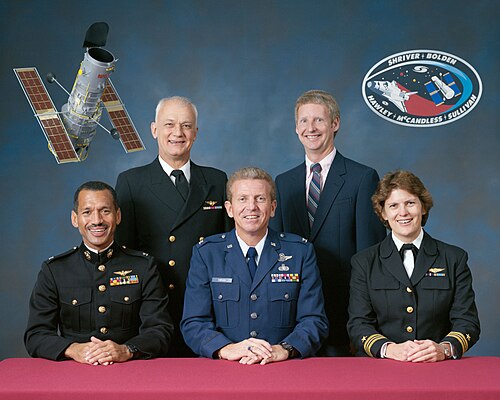
Sullivan became an adjunct professor of geology at Rice University in Houston in 1985.[39] In this role she joined an oceanographic research cruise in 1988, where she met Andreas Rechnitzer, a US Navy oceanographer, and she started thinking about joining the US Naval Reserve (USNR) as an oceanography officer. She spoke to McCandless about it; he said he was having lunch with the Secretary of the Navy and would raise the matter. Later that year, Sullivan became a direct commission officer in the USNR with the rank of lieutenant commander.[26]
In October 1990 she assumed command of a small specialized unit of oceanographers and meteorologists. Based at Naval Air Station Dallas, it provided support to the Naval Meteorology and Oceanography Command center on Guam. The unit was sent to Guam on January 13, 1991, four days before the start of Operation Desert Storm, and stayed for thirty days to augment the regular component responsible for the Western Pacific to free it to concentrate on the Persian Gulf.[40] She retired from the USNR with the rank of captain in 2006.[41]
While she was still working on preparations for STS-45, Sullivan received a call from Sylvia Earle, the chief scientist of the National Oceanic and Atmospheric Administration (NOAA).[42] In 1981 Earle and Sullivan had been part of the first group of women admitted to the Explorers Club.[43] Earle was stepping down from the role at the NOAA, and asked Sullivan if she was interested in taking over. With the permission of her STS-45 mission commander, Charles Bolden, Sullivan flew to Washington, DC, where she was interviewed by the Administrator of the NOAA, John A. Knauss.[42] Her nomination was forwarded to the US Senate for confirmation, and she arranged to be seconded from NASA to NOAA as acting chief scientist from August 17, 1992.[44]
Before she could be confirmed, President George H. W. Bush lost the 1992 United States presidential election and was succeeded by Bill Clinton, and the nomination was withdrawn. Sullivan still wanted the job, so she lobbied for it, enlisting the help of the outgoing Secretary of Commerce, Barbara Franklin, and senators Barbara Mikulski and Bill Nelson. The incoming Secretary of Commerce, Ronald H. Brown, forwarded her nomination to the Senate again in April, and she was confirmed on May 28, 1993.[45] As chief scientist at NOAA, she oversaw a diverse portfolio which included ranging research into climate change, the use of satellites for oceanography, and marine biodiversity.[1]
サリバンは、1996年から2006年まで、オハイオ州コロンバスにあるインタラクティブ科学センター、COSIの社長兼CEOを務めた。[ 1 ] 2006年から2011年までは、オハイオ州立大学のバテル数学科学教育政策センターの所長を務め、同時にCOSIのボランティア科学アドバイザーも務めた。[ 1 ] 2004年には、ジョージ・W・ブッシュ大統領によって全米科学委員会の副委員長に任命された。 [ 46 ] 2009年には、アメリカ科学振興協会の科学・工学一般関心部門の委員長に3年の任期で選出された。[ 47 ]

2011年1月、バラク・オバマ大統領はサリバン氏を商務次官補に指名し、上院に送付した。サリバン氏は2010年12月に初めて指名されたが、会期終了前に上院が承認しなかったため、ホワイトハウスは指名を改めて行った。2011年5月4日、サリバン氏は上院の全会一致の同意を得て承認され、オバマ大統領によって商務次官補(環境観測予測担当)兼海洋大気庁副長官に任命された。[ 48 ]サリバン氏は、ジェーン・ラブチェンコ氏の辞任に伴い、2013年2月28日に商務次官(海洋大気担当)代行兼海洋大気庁長官代行となった。[ 49 ]オバマ大統領は2013年8月1日にサリバンを商務省海洋大気担当次官兼NOAA長官に指名し、2014年3月6日に上院で承認された。[ 50 ] [ 49 ]彼女の任期は2017年1月20日に終了した。[ 51 ]

Sullivan was named the 2017 Charles A. Lindbergh Chair of Aerospace History, a competitive twelve-month fellowship at the National Air and Space Museum. During her residence in the museum, Sullivan's research focused on the Hubble Space Telescope.[52] She has also served as a Senior Fellow at the Potomac Institute for Policy Studies.[53] Her book Handprints on Hubble: An Astronaut's Story of Invention was released from MIT Press in November 2019. It recounted her experience as part of the team that launched, rescued, repaired, and maintained the Hubble Space Telescope.[54][55]
In June 2020 Sullivan traveled on an expedition aboard the Triton SubmarinesDSV Limiting Factor to the bottom of the Challenger Deep in the Mariana Trench, becoming the first woman and eighth person to reach the deepest known point in Earth's oceans,[56][57][58] and the first person to travel both to Challenger Deep and into space.[59] In November 2020 Sullivan was named a volunteer member of Joe Biden's presidential transition Agency Review Team to support transition efforts related to the Department of Commerce,[60] and he appointed her to the President's Council of Advisors on Science and Technology in September 2021.[61]
Sullivan's awards from NASA included the NASA Space Flight Medal in 1984, 1990 and 1992; the NASA Exceptional Service Medal in 1988 and 1991, the NASA Outstanding Leadership Medal in 1992, and a Certificate of Appreciation in 1996.[62] She received the Haley Space Flight Award in 1991,[63] the Gold Medal of the Society of Woman Geographers in 1993,[64][65] the Golden Plate Award of the American Academy of Achievement in 1994,[66] and the Adler Planetarium Women in Space Science Award in 2004.[67]

2014年、サリバンは世界で最も影響力のある人物を毎年選出するタイム誌の「タイム100」リストに選ばれた。ジョン・グレンは彼女の紹介文にこう書いている。
キャシーは象牙の塔にこもった科学者ではありません。彼女は1978年に選抜されたNASA初の女性宇宙飛行士の一員であり、その後3回のスペースシャトルミッションに参加しました。彼女は宇宙遊泳を行った最初のアメリカ人女性であり、ハッブル宇宙望遠鏡を軌道に乗せたミッションにも参加しました。人類が外の世界に目を向けるのを助けるというその役割は、彼女が地球に目を向けることを妨げませんでした。地球は、少なくとも部分的には気候変動の結果として、干ばつ、洪水、台風、竜巻など、ますます深刻な激変に見舞われています。私の親友であるキャシーは、まさにこの時期にこの仕事に就くのにふさわしい人物だと私は信じています。[ 68 ]
サリバンは、2013年にウィラメット大学から卒業式でのスピーチと併せて名誉理学博士号を授与され[ 69 ] 、2015年5月にはブラウン大学から「科学、教育、公共の利益への多大な貢献、そして未来の世代のために地球の状態を改善するための継続的な取り組み」を理由に名誉理学博士号を授与された[ 47 ] [ 70 ] 。 2015年9月には、ワシントンDCのスミソニアン国立航空宇宙博物館でジョン・H・グレン宇宙史講演会シリーズで「地球を見る:宇宙飛行士の旅」と題した講演を行い、探査と発見の人生、幼い頃の夢を叶えること、そしてNOAAによる地球の研究が今日の環境問題の理解にどのように役立つかについて語った[ 71 ] 。
サリバンは2004年に宇宙飛行士殿堂入りし[ 72 ] 、 2016年に全米技術アカデミー[ 73 ]、2017年にアメリカ芸術科学アカデミー[74]に選出された。2020年にはアメリカ地理学会から名誉地理学者に任命された[ 75 ] 。 2020年11月23日に発表されたBBCの「100人の女性」リストにも名を連ねた[ 76 ]。 2023年9月にはオハイオ州デイトンにある全米航空殿堂入りを果たした[ 77 ]。
 この記事には、米国航空宇宙局(NASA)のパブリックドメイン資料が含まれています。