Loading article…


Pottery was produced in enormous quantities in ancient Rome, mostly for utilitarian purposes. It is found all over the former Roman Empire and beyond. Monte Testaccio is a huge waste mound in Rome made almost entirely of broken amphorae used for transporting and storing liquids and other products – in this case probably mostly Spanish olive oil, which was landed nearby, and was the main fuel for lighting, as well as its use in the kitchen and washing in the baths.
It is usual to divide Roman domestic pottery broadly into coarse wares and fine wares, the former being the everyday pottery jars, dishes and bowls that were used for cooking or the storage and transport of foods and other goods, and in some cases also as tableware, and which were often made and bought locally. Fine wares were serving vessels or tableware used for more formal dining, and are usually of more decorative and elegant appearance. Some of the most important of these were made at specialised pottery workshops, and were often traded over substantial distances, not only within, but also between, different provinces of the Roman Empire. For example, dozens of different types of British coarse and fine wares were produced locally,[1] yet many other classes of pottery were also imported from elsewhere in the Empire. The manufacture of fine wares such as terra sigillata took place in large workshop complexes that were organised along industrial lines and produced highly standardised products that lend themselves well to precise and systematic classification.
There is no direct Roman equivalent to the artistically central vase-painting of ancient Greece, and few objects of outstanding artistic interest have survived, but there is a great deal of fine tableware, and very many small figures, often incorporated into oil lamps or similar objects, and often with religious or erotic themes. Roman burial customs varied over time and space, so vessels deposited as grave goods, the usual source of complete ancient pottery vessels, are not always abundant, though all Roman sites produce plenty of broken potsherds. "Fine" rather than luxury pottery is the main strength of Roman pottery, unlike Roman glass, which the elite often used alongside gold or silver tableware, and which could be extremely extravagant and expensive. It is clear from the quantities found that fine pottery was used very widely in both social and geographic terms. The more expensive pottery tended to use relief decoration, usually moulded, rather than colour, and often copied shapes and decoration from the more prestigious metalwork. Especially in the Eastern Empire, local traditions continued, hybridizing with Roman styles to varying extents. From the 3rd century the quality of fine pottery steadily declined, partly because of economic and political disturbances, and because glassware was replacing pottery for drinking cups (the rich had always preferred silver in any case).
Fired clay or terracotta was also widely employed in the Roman period for architectural purposes, as structural bricks and tiles, and occasionally as architectural decoration, and for the manufacture of small statuettes and lamps. These are not normally classified under the heading 'pottery' by archaeologists, but the terracottas and lamps will be included in this article. Pottery is a key material in the dating and interpretation of archaeological sites from the Neolithic period onwards, and has been minutely studied by archaeologists for generations.
Over the centuries the different manufacturing techniques have changed, from initial pottery modelled by hand, to the introduction of the tome and later the use of molds. The decorations as well as the backing techniques have been also changed over the centuries, making possible to use the pottery to date the age of an archeological area.[2] In the Roman period, ceramics were produced and used in enormous quantities, and the literature on the subject, in numerous languages, is very extensive.

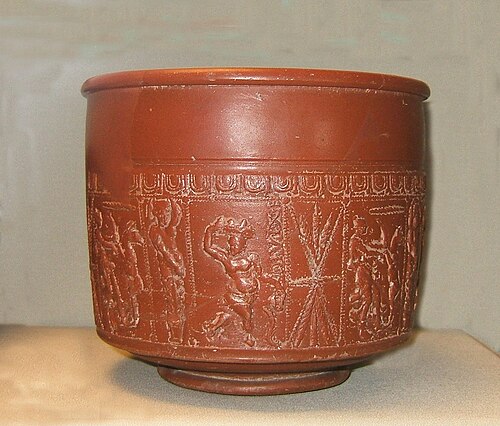
The designation 'fine wares' is used by archaeologists for Roman pottery intended for serving food and drink at table, as opposed to those designed for cooking and food preparation, storage, transport and other purposes. Although there were many types of fine pottery, for example drinking vessels in very delicate and thin-walled wares, and pottery finished with vitreous lead glazes, the major class is the Roman red-gloss ware of Italy and Gaul make, and widely traded, from the 1st century BC to the late 2nd century AD, and traditionally known as terra sigillata or samian ware. These vessels have fine, fairly hard and well-fired buff to pink fabrics, with a naturally glossy surface slip ranging in colour from light orange to quite a bright red. The variations in the colour and texture of both body fabric and slip, as well as the vessel-shapes and the designs on the decorated forms can enable a trained student to identify source, date and often individual workshop quite accurately. Arretine ware, made at Arezzo in Tuscany, was the pre-eminent type of fine pottery in the 1st century BC and early 1st century AD, and was succeeded by samian ware, manufactured in a number of centres in Gaul, modern France and Germany. However the definition of all these terms has varied and evolved over the many generations during which the material has been studied.[3] Technically, red-gloss wares have much in common with earlier Greek painted pottery, but the decorated forms employ raised, relief decoration rather than painting.
African Red Slip (ARS) ware belonged to the same tradition, and continued to be made much later than Italian and Gaulish sigillata, right through to the Islamic conquest.[4] ARS in turn influenced the production of Phocaean red slip, which is common in the Eastern Mediterranean and also appeared occasionally as far west as Southern France and Britain.
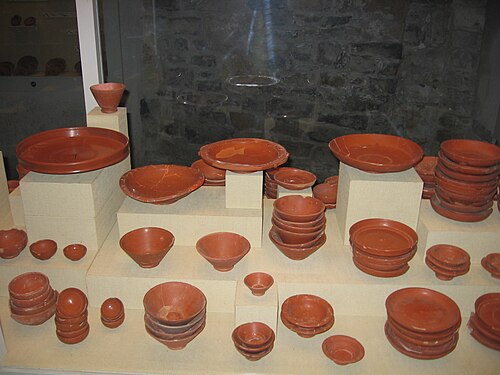
同様の種類の陶器は小アジアや帝国の東部地域(東部シギラタ陶器)でも生産されており、イベリア半島の諸州にもガリアの製品と類似点のあるテラ・シギラタ・ヒスパニカを生産する地元の産業が存在していた。
これらの陶器のほとんどは広く流通し、工業規模で生産されていました(最大の窯では一度に最大40,000個の陶器を焼成できました[ 5 ])。そして、工房内では高度な専門化が行われていたことは間違いありません。多くの陶工や工場主の名前は、上質な陶器によく見られる陶工の刻印から知ることができ、非常に有益な情報となります。クナイウス・アテイウスはアレッツォで特に著名な生産者でしたが、彼の刻印のある陶器は、粘土の現代的な分析により、トスカーナのピサ、そして現在のフランスのリヨンとラ・グロフェセンクにある支社で生産されたことが示されています。しかし、名前の刻印の解釈は、一見したよりも複雑な場合があります。装飾された部分に見られる太字の刻印は工場の名前を宣伝しているが、無地の器には陶器工房で働く個々の職人、つまり鉢職人の名前が記されており、装飾された鉢の型には型職人が手書きで署名することもあったし、完成した器にもその署名が見られることがある。理論的には、装飾された器には型職人の名前、鉢職人または仕上げ職人の名前(例えば縁に)、そして装飾の中に工場の「ブランド名」が記されている可能性がある。[ 6 ]イタリアの工房で奴隷労働が使われていたことは証明されていないが、確かにリベルティ(解放奴隷、つまり解放された元奴隷)の名前もいくつかある。南ガリアのミヨー近郊にあるラ・グラウフェセンク遺跡は広範囲にわたって調査され、発掘されている。[ 7 ]その製品は西暦1世紀後半に非常に広範囲に流通し、インドからスーダン、スコットランドまで陶片が発見されている。[ 8 ]

1895年、ドイツの学者ハンス・ドラゲンドルフは、ローマ時代の赤光沢陶器の器形の分類を発表し、それは現在でも使用されている(例えば、小さな両凸型のカップを指す「Drag. 27」または「Dr.27」など)。[ 9 ]他の学者は彼の番号付き形態を追加し、特定の製造地の製品や重要な発掘調査からの発見を研究している考古学者の中には独自の類型を始めた者もいるため、現在では、アフリカの赤スリップの形態に対するヘイズ番号など、他の種類のローマ陶器と同様に、アレティーヌとサミアンにも多くの分類システムが存在する。イタリアとガリアのシギラタに使用されている他の番号付けシステムには、デシェレット、クノール、カーレ、ウォルターズ、ロシュケ、リッターリング、ルドウィチなどがある。[ 10 ]
テラシジラータ製の開口部のある器の表面に浮き彫りの装飾を施す最も一般的な方法は、最終的な器の外側の望ましい形状に対応する内側の輪郭を持つ陶器の鉢を成形することであった。次に、内側の表面は、通常は焼成粘土で作られた個々のポジティブスタンプ(ポワンソン)または、装飾の上部の縁を形成することが多いオボロ(卵と舌)のデザインなどの繰り返しモチーフが刻まれた小さなろくろを使用して装飾された。細部はスタイラスで手作業で追加することもできた。内側の凹版装飾が完成したら、型は通常の方法で乾燥および焼成され、その後、鉢の成形に使用された。鉢が乾燥すると十分に収縮し、型から取り外せるようになり、その後、高輪の成形または追加、縁の仕上げなどの仕上げ工程が行われた。細部は形状によって異なった。[ 11 ]完成した鉢は、その後、スリップを塗り、再び乾燥させ、焼成することができた。水差しや壺などの閉じた形状の器は、型を用いて浮き彫り装飾を施すことは稀であったが、ラ・グラウフェセンクでは、この種の器の一部は、上部と下部を型で別々に作り、最も直径の広い部分で接合して作られていた。背の高い花瓶や壺の浮き彫り装飾は、通常、型で作ったアップリケ模様(小枝)や、バルボティーヌ装飾(スリップトレーリング)を用いて行われた。後者の技法は、ラインツァベルンの東ガリアの工房で特に人気があり、他の種類の陶器にも広く用いられた。

大きな大皿、さまざまなサイズの浅い皿、やや深めのボウル、小さなカップなどを含む、無地の印章付きテーブルウェアは、さまざまな型を使用して非常に精密な形状を作り出すために、ろくろで作られました。サイズも標準化されており、これにより、製造された膨大な数の焼成、保管、輸送が容易になったと考えられます。形状の進化は、同時代の銀やガラスのテーブルウェアに見られるものと多くの点で一致しており、正確な形状は年代をかなり正確に特定できる場合もあります。考古学的に「無地」に分類される形状には、皿の平らな内側の底面にルーレットのリングのような単純な装飾が施されている場合もあります。無地のウェアには、名前の刻印があることもよくあります。[ 12 ]
ARS(アフリカン・レッド・スリップ)陶器は、ローマ時代後期にシギラタ様式で最も広く普及した陶器でした。(5~6世紀には遠く離れたイギリスでもARSの輸入が見つかっています。[ 13 ])アフリカ・プロコンスラリス属州(現在のチュニジア付近)で製造され、同様の形状と生地は、ローマ時代に独自の非常に活発で多様な陶器の伝統を持っていたエジプトで、より地域的に流通するために作られました。ARSでは、さまざまな鉢、皿、フラスコが作られましたが、型を使って浮彫装飾を施した器全体を作る技術は廃止されました。[ 14 ]代わりに、浮彫装飾が必要な場所では、アップリケのモチーフが頻繁に使用され、乾燥と焼成の前に別々に作られて器に貼り付けられました。スタンプのモチーフも好まれた装飾形式で、後世にはキリスト教の主題やシンボルがよく見られます。



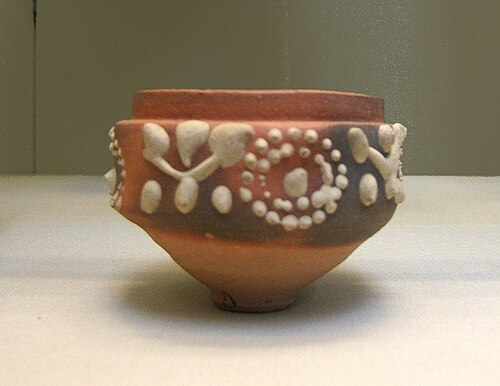
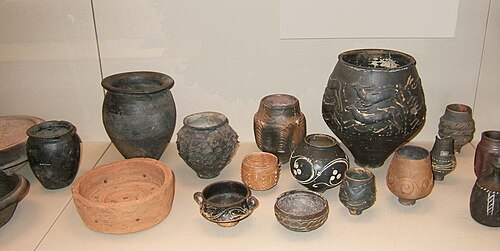
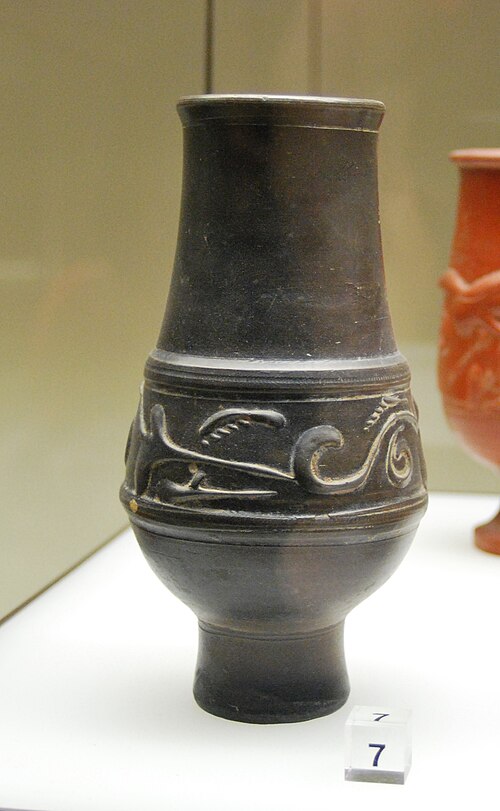
Some of the shapes of Arretine plain wares were quite closely copied in the later 1st century BC and early 1st century AD in a class of pottery made in north-east Gaul and known as Gallo-Belgic ware.[15] Many of these plates and dishes in red-slipped (terra rubra) and black-slipped (terra nigra) fabrics bear potters' stamps. Other fine, thin-walled flagons, drinking beakers, bowls and dishes were made locally in most regions of the Roman Empire, including frontier provinces such as Britain: for example, Romano-British 'colour-coated' (slipped) wares made at Colchester and in the Nene Valley belong to that classification. Several of the pots to the right of the group photograph in the lead section of this article are Nene Valley wares, including the large black beaker decorated with a lively hunting scene of hounds and hares in the barbotine technique.[16] Many decorative techniques were used to beautify pottery tableware, including the use of coloured slips, painting, and various textured surfaces. Painted decoration did not, however, continue the Greek and Etruscan traditions as a specialised technique used for elaborate luxury tablewares, though simpler painted designs do appear on many pottery types, both coarse and fine, throughout the Empire. The dividing lines between 'fine' and 'coarse' wares, or tablewares and cooking wares, become a little blurred in the case of some of the local, provincial products, because pottery is often multi-purpose.

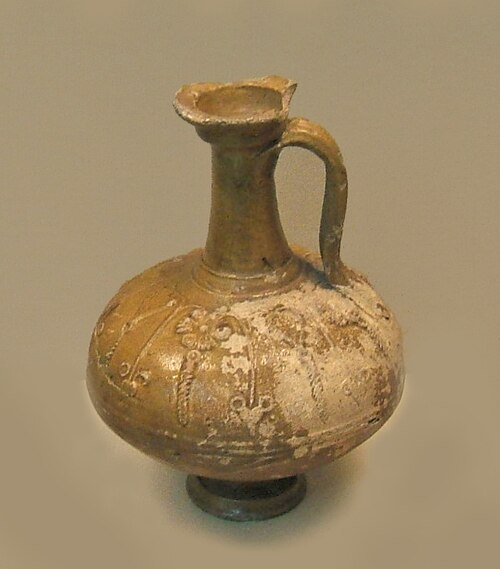
Lead-glazed pottery was made in many regions of the Roman Empire, including Gaul, Italy and the eastern provinces. This type of vitreous glaze was most often used for small, decorative items of tableware, including mould-made cups with relief decoration, lamps and zoomorphic containers.[17] The glazes vary in colour from amber to brown and many shades of green.
鮮やかな青、ターコイズ、または緑で釉薬をかけたエジプトのファイアンス製の食器は、ローマ時代を通じてエジプトで製造され続け、紀元前1世紀と紀元後1世紀のこれらのファイアンス器の形状の一部は、アレッティン器に直接影響を受けていました。非常に精巧で装飾された多色ファイアンス器も製造されました。エジプトのファイアンス、フリット、またはエジプト学者によってしばしば「釉薬組成物」と呼ばれるものは、粘土以外のセラミック材料であるため、技術的には陶器よりもガラス製造と共通点が多いです。[ 18 ]
陶器の器とテラコッタの置物の境界線も必ずしも明確ではない。なぜなら、油注ぎ口のような小型の容器の中には、人物などを象った形に成形されたものもあるからだ。



古代において、陶器は料理に不可欠でした。ローマ時代には青銅や鉄製の金属製の調理器具が広く普及していましたが、シンプルで実用的な土器のボウル、鍋、キャセロール、壺は、どの家庭の台所にも安価で標準的な調理器具として備えられていました。ブリテン島からエジプト、スペインからシリアまで、広大な帝国の隅々まで、シンプルな調理器具におけるローマ以前の土器の伝統は、何世紀にもわたって大きな変化なく受け継がれてきました。そのため、ローマの調理用鍋は地域ごとに研究する必要があります。[ 19 ]通常の調理用ボウルや鍋に加えて、陶器の調理器具は、上記のブリテン島出土のローマ陶器の集合写真の左側に示されている小型のチーズプレスなど、多くの特殊な用途のために作られました。同じ写真に写っているチーズプレスの後ろ、左側にある2つの黒い壺は、ローマ時代のブリテンで最初に作られた黒色磨き陶器の例です。この陶器はローマ征服以前の鉄器時代後期にイングランド南西部で初めて作られ、ローマ時代を通じて人気を保ち、ローマの影響下ではより大量に生産され、より広く販売されました。ローマ時代のブリテンで作られた他の陶器には、クランベック陶器、ハントクリフ陶器、そしてしばしば装飾が施されたネネ渓谷彩色陶器などがあります。
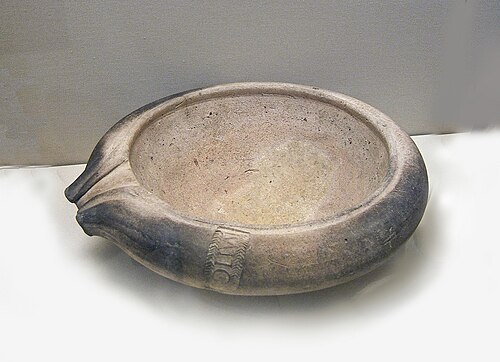
しかし、食品調理に使用された容器の一種で、ローマ文化とローマ料理の普及と密接に関係していたのがモルタリウムです。これは、持ちやすくするために厚く外側に湾曲した縁を持つ頑丈な浅いボウルで、注ぎ口が付いていることが多く、製造時に意図的に砂や粗い砂で内面を粗くしていました。これは、手の込んだ丁寧に味付けされたローマ料理を作るために、すりこぎで材料をすりつぶしたり粉砕したりするのに使用されました。ローマの料理の伝統では、ハーブやスパイスが広く使われていました。モルタリウムはローマ版のフードプロセッサーであり、「ローマ化」の真の指標です。[ 20 ]ブリテンでは、最初のモルタリウムは西暦43年にブリテンがローマの属州になる1世代以上前にガリアから輸入されており、鉄器時代後期のブリテン南部におけるローマ文化の影響力の増大、そしておそらくガリアからの移民の実際の存在を示しています。その後、地方のさまざまな地域の専門陶器工房で生産された地元のモルタリアが、輸入品に加えてイギリス全土で入手可能になった。ポール・タイアーズは、イギリスで発見されたローマ・ブリテンおよび大陸の少なくとも16の異なる製造元からのモルタリアについて論じている。[ 21 ]他の多くの専門的なローマ陶器製品と同様に、多くのモルタリアにも縁に工房または製造者の刻印があり、その年代と分布に注目することで、考古学者は交易パターンとローマ経済を理解するのに役立つ。
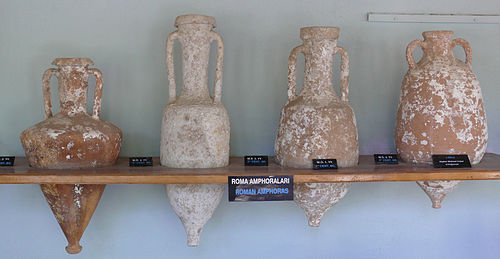
アンフォラは、ローマ時代に食料を長距離または短距離輸送するために使用されました。内容物は一般的に液体で、ほとんどの場合オリーブオイルやワインでしたが、人気の魚醤であるガルムやフルーツソースも含まれていました。容器としてのアンフォラは、丈夫で重すぎず、船内での保管に適した形状で、同時に最終目的地に到着した後の取り扱いにも便利なものでなければなりませんでした。通常、アンフォラは球形または円筒形の本体、さまざまな形状の縁、そして突起のある、またはまれに平らな底面を持つ、取っ手が2つ付いたテラコッタ製の容器です。突起は船内での安定した保管に適しており、容器を空にする際には3つ目の取っ手として機能しました。
The first systematic classification of amphorae types was undertaken by the German scholar Heinrich Dressel. Following the exceptional amphorae deposit uncovered in Rome in Castro Pretorio at the end of the 1800s, he collected almost 200 inscriptions from amphorae and included them in the Corpus Inscriptionum Latinarum. In his studies of the amphorae deposit he was the first one to elaborate a classification of types, the so-called Dressel table,[22] which is still used today for many types. Subsequent studies on Roman amphorae have produced more detailed classifications which are usually named after the scholar who studied them. For the neo-Phoenician types see the work by Maña published in 1951,[23] and the revised classification by van der Werff in 1977–1978.[24] The Gallic amphorae have been studied by Laubenheimer in a study published in 1989,[25] whereas the Cretan amphorae have been analyzed by Marangou-Lerat.[26] Beltràn studied the Spanish types in 1970.[27] Adriatic types have been studied by Lamboglia in 1955.[28] For a general analysis of the Western Mediterranean types see Panella,[29] and Peacock and Williams.[30]

アンフォラは、ろくろで成形したテラコッタ製の容器です。製造工程では、まず本体を作り、部分的に乾燥させます。[ 31 ]次に、粘土のコイルを加えて、首、縁、取っ手を作ります。[ 32 ]アンフォラが完成すると、液体の貯蔵性能を向上させるために、内部に樹脂を塗布します。[ 33 ]これらの製造段階の復元は、主に東地中海のいくつかの地域における現代のアンフォラ製造の研究から得られた民族誌的データに基づいています。[ 34 ]アンフォラには、さまざまなスタンプや落書きが付けられていることがよくあります。これらのスタンプの機能は、容器の生涯全体に関連しています。スタンプ、落書き、碑文は、製造サイクルから内容物、販売に至るまでの情報を提供します。スタンプは通常、部分的に乾燥した段階でアンフォラに付けられ、多くの場合、フィグリナ(工房)の名前や工房の所有者の名前を示しています。彩色された印章、ティトゥリ・ピクティは、アンフォラが完成した際に施され、容器の重量と内容物に関する情報を示した。
ローマ時代のアンフォラの最初のタイプであるドレッセル1は、紀元前2世紀後半にイタリア中部で出現しました。[ 35 ]このタイプは壁が厚く、特徴的な赤い布地が使われていました。非常に重かったものの、丈夫でもありました。紀元前1世紀半ば頃には、いわゆるドレッセル2-4が広く使われるようになりました。[ 36 ]このタイプのアンフォラは、軽量で壁が薄いという利点がありました。船には約4,500個のドレッセル1を積むことができたのに対し、同じスペースに6,000個のドレッセル2-4を積むことができたと計算されています。[ 37 ]ドレッセル2-4は、ドレッセル1の製造に使われていたのと同じ工房で作られることが多かったのですが、ドレッセル1はほぼ突然使用されなくなりました。[ 38 ]同じ頃、クーマ(イタリア南部)では、カディイ・クマニ型(ドレッセル21-22)の製造が始まりました。これらの容器は主に果物の輸送に使用され、中期帝政時代まで使用されました。同時期に、イタリア中部では、いわゆるスペッロ・アンフォラと呼ばれる小型容器がワインの輸送用に生産されました。アドリア海沿岸では、古いタイプはランボリア2型に取って代わられ、これは紀元前2世紀末から1世紀にかけて一般的に生産されたワイン用アンフォラです。このタイプは後にドレッセル6A型へと発展し、アウグストゥス時代に主流となりました。[ 39 ]
ガリア属州では、ローマ時代のアンフォラの最初の例は、ドレッセル 1、ドレッセル 2〜4、パスクアル 1、ハルテルン 70 などの既存のタイプの地元での模倣品でした。より典型的なガリアの生産は、アウグストゥス時代後期にマルセイユの陶器工房で始まりました。オベラデン 74 型は、イタリアのいくつかのタイプの生産に影響を与えるほど大量に生産されました。 [ 40 ]スペインのアンフォラは、共和政後期の生産の繁栄のおかげで特に人気がありました。ヒスパニア バエティカとヒスパニア タラコネンシス地域 (スペイン南西部と東部) は、退役軍人への土地分配と新しい植民地の建設のおかげで、紀元前 2 世紀から 1 世紀にかけて主要な生産地域でした。スペインのアンフォラは、帝政初期に地中海に広く普及しました。最も一般的なタイプはすべてベティカ地方で生産されており、その中には典型的なオリーブオイル容器であるドレッセル20、ガルム用のドレッセル7~13、そしてデフルトゥム(フルーツソース)用のハルテルン70などがあった。タラコネンシス地方では、ドレッセル1を模したワイン用アンフォラであるパスクアル1が最も一般的で、ドレッセル2~4の模倣品も存在した。
North-African production was based on ancient tradition which could be traced back to the Phoenician colony of Carthage.[41] Phoenician amphorae had characteristic small handles attached directly onto the upper body. This feature becomes the distinctive mark of late-Republican/early imperial productions which are then called neo-Phoenician. The types produced in Tripolitania and Northern Tunisia are the Maña C1 and C2, later renamed van Der Werff 1, 2, and 3.[42] In the Aegean area the types from the island of Rhodes were quite popular starting from the 3rd century BC thanks to the local wine production which flourished for long time. This types developed into the Camulodunum 184, an amphora used for the transportation of the Rhodian wine all over the empire. Imitations of the Dressel 2–4 were produced in the island of Cos for the transportation of wine from the 4th BC until the middle imperial times.[43] Cretan containers were also popular for the transportation of wine and can be found in the Mediterranean from the Augustan times until the 3rd century AD.[44] During the late empire north-African types dominated the amphorae production. The so-called African I and II were widely used from the 2nd until the late 4th century AD. Other types from the eastern Mediterranean (Gaza), such as the so-called Late Roman 4, became very popular between the 4th and the 7th century AD, while Italic productions ceased to exist.

Artificial lighting was commonplace in the Roman world. Candles made from beeswax or tallow were used, but seldom survive archaeologically. Lamps fueled with olive oil and other vegetable oils survive in great numbers, however, and have been studied in minute detail.[45] Some Roman lamps were made of metal, and could be of highly elaborate forms incorporating statuettes and multiple nozzles, but fired clay was the most usual material, and the majority of small, probably inexpensive, clay lamps had a single nozzle for one wick, and therefore one flame.
これらの粘土製のランプのほとんどは、標準化された製品を大量生産する工房で型を使って成形されました。最も人気のある形状のいくつかは、中央に円盤状の部分(通常直径4~6cm程度 )があり、そこに充填用の穴が設けられ、浅浮き彫りの絵画的なモチーフで装飾されていました。装飾の範囲は、異教の神々、神話や伝説、日常生活の風俗画、動物、狩猟、剣闘士の戦いや戦車競走などの公共の娯楽、エロティックな出会い[ 46 ] 、そしてローマ時代後期にはキリスト教の象徴など、ローマの装飾芸術に登場するあらゆる主題を網羅していました(メノラーなどのシンボルが描かれたユダヤ教のランプも見られます)。[ 47 ]
イタリアの帝国の中心で始まった様式や装飾は、他の地方の工房で作られた製品にもしばしば模倣された。ランプは、粘土で手作業で原型を作るのではなく、既存のランプを原型として型を作るシュルムラージュと呼ばれる方法で直接複製することができた。 [ 48 ]
石膏型を用いた高度に組織化された製造方法、生産量、そして貿易と広範な流通は、いずれもアレティーヌやサミアンなどの赤光沢陶器の製造といくつかの点で共通しており、ランプの一部に刻印された名前の存在も同様である。製造者または工房の名前は通常ランプの底面に記され、通常は装飾のないフィルマランプ(「工場ランプ」)として知られるランプによく見られる。このタイプのランプは、西暦2世紀にローマ北西部属州の軍事地域で人気があった。よく知られた名前の1つにフォルティスがあり、彼の製品は明らかにイタリアにある彼の工房以外でも模倣されていたか、あるいはフォルティスが属州に独自の支店工場を持っていたのかもしれない。隣の写真にあるロンドンで発見されたガリアのフィルマランプには、台座に製造者アティメトゥスの名前が刻印されている。
丸みを帯びた、あるいは卵形の本体に、一つまたは複数の突起状のノズル、そして時には取っ手が付いた、多くの基本的なランプの形状に加え、テラコッタ製のランプは、動物、グロテスクな頭部、足、その他多くの形を模した、はるかに奇抜な形状でも作られました。これらは伝統的にプラスチックランプ(「プラスチック」とは「成形された、または型取りされた」という意味)として知られています。
形状、製造者の刻印、装飾などを詳細に研究することで得られる、年代や分布に関する詳細な情報は、ローマ時代のランプを考古学的遺跡における重要かつ有用な発見物たらしめている。ローマ時代のランプは、ガリアを含む帝国各地の遺跡ほどブリテン島のローマ遺跡では大量には発見されていないが、これはおそらくブリタニアでは輸入オリーブオイルがより高価だったためであろう。
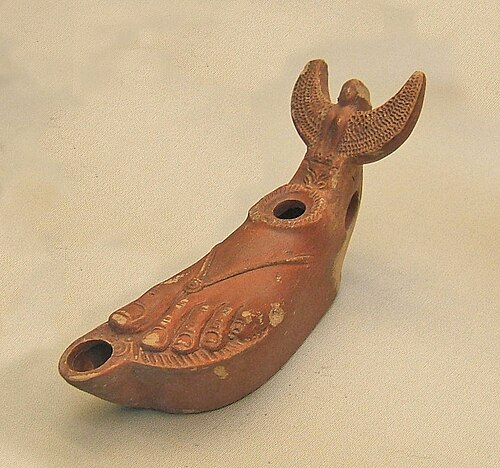


テラコッタ像や彫像においては、陶器に比べてイタリア様式の影響は帝国全体にほとんど及ばなかった。ここでは、ギリシャのテラコッタ像、エジプト、そして帝国の東部諸州の長年の伝統が支配的な影響力を持っていた。ガリアやゲルマニアなどの北部諸州では、鉄器時代にテラコッタ像を作る伝統はなかったが、ローマの影響下で、上質な白いパイプクレイで型取りした像を製造する新しい産業が発展した。より高価な品物であったであろう青銅像と同様に、小さなテラコッタ像は一般的に、神殿への奉納、家庭の祭壇への展示、あるいは死者とともに納められる副葬品など、儀式や宗教的な目的で作られた。しかし、特定の目的のために作られたものではないにせよ、テラコッタ像の中には子供のおもちゃとして使われたものもあった。[ 49 ]小さなテラコッタ像のほとんどは型を使って大量に製造されたもので、新品の頃は鮮やかな色で彩色されていたと考えられます。焼成後に塗布されたこれらの顔料は、小さく色あせた部分を除いて、埋葬後に残ることはほとんどありません。

帝国の各地域では、それぞれ独自の地域様式でテラコッタが生産されたが、主題の範囲はどれもかなり似通っており、中でも神々や女神、そしてそれらの属性といった標準的な宗教的主題が中心であった。鳥や動物の表現は特定の神々と結び付けられることが多いが、宗教的または儀式的な目的を持たずに作られた動物像もある。宗教的主題には、しばしば地域の伝統や信仰が含まれる。例えば、ローマ・エジプトのテラコッタ作品には、ハルポクラテスやホルス神のギリシャ・ローマ版といったエジプトの神々が含まれている一方、アリエ渓谷を中心とする中央ガリアの産業やケルンのラインラントの産業で作られた作品には、ケルトの神々が登場する。
ケルトの母なる女神が1人、あるいは時には2人の乳児に授乳している像は、中央ガリアで最も人気のあるタイプの1つである[ 50 ]。ただし、ガリアではヴィーナスも非常に頻繁に表現されていた。母なる女神の小像は、ガリアとブリテン島で一般的だったと思われる背もたれの高い籠細工の椅子に座っている姿で描かれている。アリエ渓谷とケルンからの小像には、モデラーや型職人の署名が見られることがある[ 51 ] 。ガリアのサミアン陶器の場合と同様に、製作者の名前、様式、テーマはすべて、地元の伝統と地中海の伝統の融合を示している。


ローマ建築において、2つの製造材料が非常に重要でした。それは、構造用レンガやタイルの形をしたコンクリートと焼成粘土、そして程度は低いものの建築装飾です。これらの材料はローマ帝国全土の建物で使用され、多くの地域ではローマ時代以降再び使用されなくなり、数世紀後に再発見されました。他の大量生産されたローマの陶器製品と同様に、レンガやタイルには、製造者、または製造された組織や権威(軍事または民間)を示す銘文が刻まれていることがよくありました。[ 52 ]
The Roman bricks used for building walls are often referred to as 'tiles', because they are rather thin, flat squares, made in standard sizes, often related to the Roman foot (c.11 inches or 280 millimetres), from around 20 cm to about 58 cm square, and about 5–7 cm thick.[53] Even stone-built walls frequently incorporated horizontal tile-courses. Brick-built walls were finished with various types of facing, rendering or plastering on both exterior and interior surfaces, so that the bricks themselves were not visible.
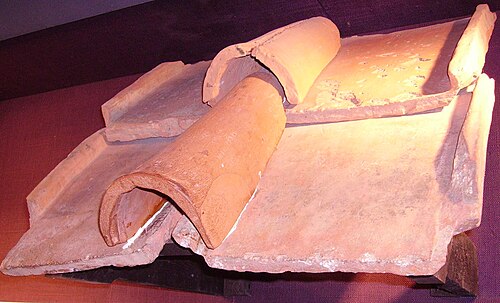
Tiles used for roofing were intended to be seen, however. Roof-tiles were of distinctive shapes, the tegula (pl. tegulae), which was a large, thin tile, almost square, with upturned flanges on its longer sides, and the imbrex (pl. imbrices), of slightly tapered half-cylindrical form. The imbrices, interlocking because of their tapered form, were laid over the raised flanges of the tegulae, and together formed the characteristic ridged tiled roof still to be seen in Italy and southern France today. The pitch of such a roof has to be fairly low, not more than about 30 degrees. The roof was finished with a series of plain ridge-tiles, and often with decorative finials, which could also be of terracotta, at the gable.
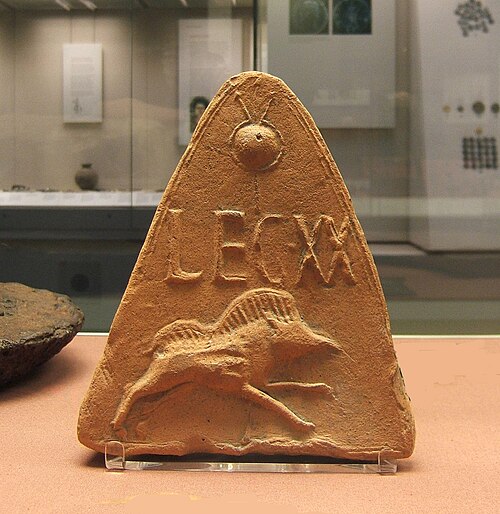
Some buildings also featured antefixes, vertical ornaments of triangular or rounded shape that were placed along the edge of the roof. They, too, were often made of terracotta, and could be decorated with pictorial motifs intended to avert ill-luck, or with inscriptions: those made in military tileries attached to legionary forts bore the number and symbol of the relevant legion.
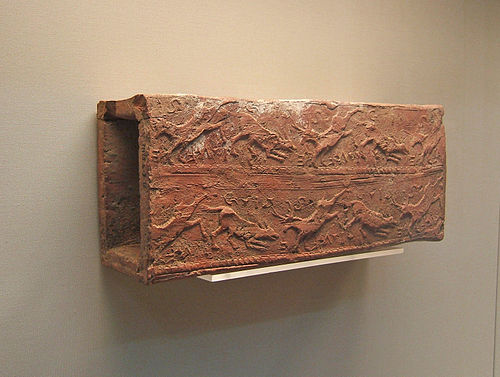
Roman hypocaust heating systems made extensive use of fired clay elements: The space beneath the floor of a room to be heated was supported on robust pillars (pilae), usually made of small, square bricks mortared together, so that the heat from the adjacent furnace could circulate freely. In public and private bath-houses (essential to the Roman way of life), heat was also carried up through the walls in flues made of interlocking box-tiles. Though these were covered up by wall facings both inside and out, they were sometimes manufactured with quite elaborate geometric and even figural decoration. Pipes for water and drainage were also often made of fired clay.
Ceramic tiles were not normally used for flooring in Roman buildings, though opus signinum, a favoured flooring material, was composed of concrete and crushed tile, and carefully cut small squares from tiles were often used in mosaic floors, tesserae about 2–3 cm. square being used for plain borders, and smaller squares, about 1 cm., where a red colour was required in a pictorial mosaic with multi-coloured geometric or figural designs.
The edge of a roof might be embellished with plaques called antefixes, as mentioned above, and some pottery relief "revetment" panels with figurative scenes for setting into walls emulate the marble friezes of grand temples. These are still often called "Campana reliefs", after Giampietro Campana, the 19th-century Italian scholar and collector who first studied them. They were developed from about 50 BC and were used almost entirely in Italy between Tuscany and Campania – areas once in the ambit of the Etruscan culture of which they seem a continuation. Initially used on small temples, they are later found on a wide range of public and private buildings. Usually between 22 and 50 cm high and 27 to 48 cm wide, plaques were perhaps typically arranged in bands or friezes. Subjects are usually drawn from mythology. They cease to be found after the middle of the 2nd century; they had to compete with moulded stucco as well as wall-paintings.[54]
In archaeology, bricks and tiles, especially when encountered only in fragmentary form, are often classified under the generic term ceramic building material or CBM.