
Loading article…
Purine metabolism refers to the metabolic pathways to synthesize and break down purines that are present in many organisms.
Purines are biologically synthesized as nucleotides and in particular as ribotides, i.e. bases attached to ribose 5-phosphate. Both adenine and guanine are derived from the nucleotide inosine monophosphate (IMP), which is the first compound in the pathway to have a completely formed purine ring system.
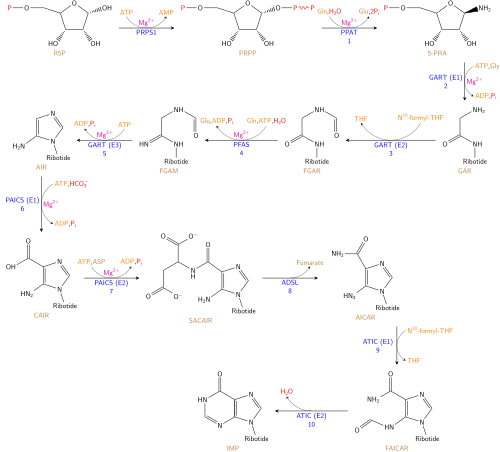
Inosine monophosphate is synthesized on a pre-existing ribose-phosphate through a complex pathway (as shown in the figure on the right). The source of the carbon and nitrogen atoms of the purine ring, 5 and 4 respectively, come from multiple sources. The amino acid glycine contributes all its carbon (2) and nitrogen (1) atoms, with additional nitrogen atoms from glutamine (2) and aspartic acid (1), and additional carbon atoms from formyl groups (2), which are transferred from the coenzymetetrahydrofolate as 10-formyltetrahydrofolate, and a carbon atom from bicarbonate (1). Formyl groups build carbon-2 and carbon-8 in the purine ring system, which are the ones acting as bridges between two nitrogen atoms.
A key regulatory step is the production of 5-phospho-α-D-ribosyl 1-pyrophosphate (PRPP) by ribose-phosphate diphosphokinase, which is activated by inorganic phosphate and inactivated by purine ribonucleotides. It is not the committed step to purine synthesis because PRPP is also used in pyrimidine synthesis and salvage pathways.
The first committed step is the reaction of PRPP, glutamine and water to 5'-phosphoribosylamine (PRA), glutamate, and pyrophosphate - catalyzed by amidophosphoribosyltransferase, which is activated by PRPP and inhibited by AMP, GMP and IMP.
第2段階では、ホスホリボシルアミン-グリシンリガーゼ(GARシンテターゼ)によって触媒され、 PRA、グリシン、ATPが反応してGAR、ADP、ピロリン酸が生成される。PRAはpH 7.5、37℃で半減期が38秒と化学的に不安定であるため、研究者らは、この化合物が生体内でアミドホスホリボシルトランスフェラーゼからGARシンテターゼに送られると示唆している。[ 1 ]
ステップ3から10は、以下の酵素によって触媒されます。
3.ホスホリボシルグリシンアミドホルミルトランスフェラーゼ。
7.ホスホリボシルアミノイミダゾールスクシノカルボキサミドシンターゼ。
生成物であるAICARとフマル酸は、それぞれ異なる経路へと進みます。AICARは第9段階の反応物として機能し、フマル酸はクエン酸回路へと運ばれ、二酸化炭素発生段階を省略してリンゴ酸を生成します。フマル酸からリンゴ酸への変換は、フマラーゼによって触媒されます。このようにして、フマル酸はプリン合成とクエン酸回路を結びつけます。[ 2 ]
9.ホスホリボシルアミノイミダゾールカルボキサミドホルミルトランスフェラーゼ。
10.イノシン一リン酸シンターゼ。
真核生物では、第2、第3、および第5段階は、GART遺伝子によってコードされる三機能性プリン生合成タンパク質であるアデノシン-3によって触媒される。
第9段階と第10段階は、ATIC遺伝子によってコードされる二機能性プリン生合成タンパク質PURHと呼ばれる単一のタンパク質によって実行される。
プリン体はいくつかの酵素によって代謝される。
PRPPアミノトランスフェラーゼによって触媒されるグルタミンとPRPPからの5'-ホスホリボシルアミンの生成は、プリン合成の調節点である。この酵素はアロステリック酵素であるため、IMP、GMP、AMPが高濃度で結合すると酵素を阻害する一方、PRPPが大量に結合すると酵素を活性化する。つまり、IMP、GMP、AMPは阻害剤であり、PRPPは活性化剤である。5'-ホスホリボシル、アミノイミダゾール、IMPの生成の間には、既知の調節段階はない。
細胞内核酸の代謝回転(または食物由来)で得られたプリン塩基も回収され、新たなヌクレオチドに再利用されることがある。
When a defective gene causes gaps to appear in the metabolic recycling process for purines and pyrimidines, these chemicals are not metabolised properly, and adults or children can suffer from any one of twenty-eight hereditary disorders, possibly some more as yet unknown. Symptoms can include gout, anaemia, epilepsy, delayed development, deafness, compulsive self-biting, kidney failure or stones, or loss of immunity.
Purine metabolism can have imbalances that can arise from harmful nucleotide triphosphates incorporating into DNA and RNA which further lead to genetic disturbances and mutations, and as a result, give rise to several types of diseases. Some of the diseases are:
Modulation of purine metabolism has pharmacotherapeutic value.
Purine synthesis inhibitors inhibit the proliferation of cells, especially leukocytes. These inhibitors include azathioprine, an immunosuppressant used in organ transplantation, autoimmune disease such as rheumatoid arthritis or inflammatory bowel disease such as Crohn's disease and ulcerative colitis.
Mycophenolate mofetil is an immunosuppressant drug used to prevent rejection in organ transplantation; it inhibits purine synthesis by blocking inosine monophosphate dehydrogenase (IMPDH).[5]Methotrexate also indirectly inhibits purine synthesis by blocking the metabolism of folic acid (it is an inhibitor of the dihydrofolate reductase).
Allopurinol is a drug that inhibits the enzyme xanthine oxidoreductase and, thus, lowers the level of uric acid in the body. This may be useful in the treatment of gout, which is a disease caused by excess uric acid, forming crystals in joints.
生命がどのように発生したかを理解するためには、生命の主要な構成要素の形成を可能にする化学経路を、もっともらしい前生物的条件下で知る必要がある。Nam ら[ 6 ]は、水性微小液滴中でプリン塩基とピリミジン塩基がリボースと直接縮合してリボヌクレオシドを生成することを実証した。これは RNA 形成につながる重要なステップである。また、プリンリボヌクレオシドを合成するもっともらしい前生物的プロセスが Becker ら[ 7 ]によって提示された。
生命の3つのドメイン、真核生物、細菌、古細菌の生物はすべて、プリンのde novo生合成を行うことができます。この能力は、生命にとってプリンが不可欠であることを反映しています。合成の生化学的経路は、真核生物と細菌種では非常に似ていますが、古細菌種間ではより多様です。[ 8 ] 研究された65種の古細菌種のうち58種では、プリン生合成に必要な遺伝子のほぼ完全なセット、または完全なセットが存在することが判明しました。[ 8 ] しかし、プリンをコードする遺伝子が完全に、またはほぼ完全に欠落している7種の古細菌種も確認されました。プリンを合成できない古細菌種は、成長のために外因性プリンを獲得できることが明らかになっている[ 8 ] 。そのため、成長のために外因性プリンを必要とする子嚢菌類Neurospora crassaのプリン変異体[ 9 ]など、真核生物のプリン変異体と類似している。