
Loading article…
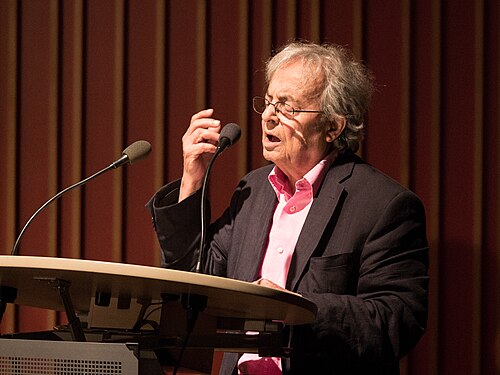
Ali Ahmad Said Esber (Arabic: علي أحمد سعيد إسبر, North LevantineArabic:[ˈʕaliˈʔaħmadsaˈʕiːdˈʔesbeɾ]; born 1 January 1930), also known by the pen nameAdonis or Adunis (أدونيس[ʔadoːˈniːs]), is a Syrian poet, essayist and translator. Maya Jaggi, writing for The Guardian stated "He led a modernist revolution in the second half of the 20th century, "exerting a seismic influence" on Arabic poetry comparable to T.S. Eliot's in the anglophone world."[2]
Adonis's publications include twenty volumes of poetry and thirteen of criticism. His dozen books of translation to Arabic include the poetry of Saint-John Perse and Yves Bonnefoy, and the first complete Arabic translation of Ovid's "Metamorphoses" (2002). His multi-volume anthology of Arabic poetry ("Dīwān ash-shi'r al-'arabī"), covering almost two millennia of verse, has been in print since its publication in 1964.
He is an occasional contender for the Nobel Prize in Literature.[3][4][5]
Born to a modest Alawite farming family[6] in 1930, Adonis hails from the village of al-Qassabin near the city of Latakia in northwestern Syria. He was unable to afford formal schooling for most of his childhood, and his early education consisted of learning the Quran in the local kuttab (mosque-affiliated school) and memorizing classical Arabic poetry, to which his father had introduced him.
In 1944, despite the animosity of the village chief and his father's reluctance, the young poet managed to recite one of his poems before Shukri al-Quwatli, the president of the newly-established Republic of Syria, who was on a visit to al-Qassabin. After admiring the boy's verses, al-Quwatli asked him if there was anything he needed help with. "I want to go to school," responded the young poet, and his wish was soon fulfilled in the form of a scholarship to the French lycée at Tartus. The school, the last French Lycée school in Syria at the time, was closed in 1945, and Adonis was transferred to other national schools before graduating in 1949. He was a good student, and managed to secure a government scholarship. In 1950 Adonis published his first collection of verse, Dalila, as he joined the Syrian University (now Damascus University) to study law and philosophy, graduating in 1954 with a BA in philosophy.[7] He later earned a doctoral degree in Arabic literature from Saint Joseph University in 1973.[8]
While serving in the military in 1955–56, Adonis was imprisoned for his membership in the Syrian Social Nationalist Party (following the assassination of Adnan al-Malki), Led by Antoun Saadeh, the SSNP had opposed European colonization of Greater Syria and its partition into smaller nations. The party advocated a secular, national (not strictly Arab) approach toward transforming Greater Syria into a progressive society governed by consensus and providing equal rights to all, regardless of ethnicity or sect.
The name "Adonis" (pronounced ah-doh-NEES) was picked up by Adonis himself at age 17, after being rejected by a number of magazines under his real name, to "alert napping editors to his precocious talent and his pre-Islamic, pan-Mediterranean muses".[9]
Adonis was married in 1956 to literary critic Khalida Said (née Saleh),[9] who assisted in editing roles in both Shiʿr and Mawaqif. They have two daughters: Arwad and Ninar Esber.[10][2]As of 2026, Arwad serves as the director of the Maison des Cultures du Monde[11] and Ninar, an artist, lives and works in Paris.[12] Adonis has lived in Paris, France, since 1975.
In his book Identité inachevée he expresses opposition to "religion as an institution imposed on the whole of society" but support of individual religious freedom. He describes himself as a "paganmystic", elaborating:
Mysticism, to my sense, is founded on the following elements: firstly, that reality is comprehensive, boundless, unrestricted; it is both what is revealed and visible to us, and what is invisible and concealed. Secondly, that which is visible and revealed to us is not necessarily an actual expression of truth; it is perhaps an expression of a superficial, transitory, ephemeral aspect of truth. To be able to truthfully express reality, one must also seek to see that which is concealed. Thirdly, truth is not ready-made, prefabricated. ... We don't learn the truth from books! Truth is to be sought out, dug up, discovered. Consequently, the world is not finished business. It is in constant flashes of revelation, creation, construction, and renewal of imageries, relationships, languages, words, and things.[13]
In an interview at the occasion of the release of his new book Adoniada in France he stated that, in his view, religion and poetry were contradictory because "religion is an ideology, it is an answer whereas poetry remains always a question".[14]
In 1956, Adonis fled Syria for Beirut, Lebanon. He joined a vibrant community of artists, writers, and exiles; Adonis settled abroad and has made his career largely in Lebanon and France, where in 1957 he cofounded the magazine Majallat Shiʿr ("Poetry Magazine"). The magazine, though arguably the most influential Arab literary journal, met with strong criticism for its publication of experimental poetry.[15]Majallat Shiʿr temporarily ceased publication in 1964, and Adonis did not rejoin the Shiʿr editors when they resumed publication in 1967. He wrote a manifesto dated 5 June 1967 which he published in Al Adab, a Lebanese magazine, and in Souffles, a Moroccan magazine.[16] A French translation of his manifesto appeared in the French magazine Esprit.[16]
In Lebanon, his intense Arab nationalist convictions found their outlet in the Beirut newspaper Lisan al-Hal and eventually in his founding of another literary periodical in 1968 titled Mawāqif, in which he again published experimental poetry.[17] He was also one of the contributors to Lotus which was launched in 1968 and financed by Egypt and the Soviet Union.[18]

Adonis's poems continued to express his nationalistic views combined with his mystical outlook. With his use of Sufi terms (the technical meanings of which were implied rather than explicit), Adonis became a leading exponent of the Neo-Sufi trend in modern Arabic poetry, which took hold in the 1970s.[19]
Adonis received a scholarship to study in Paris from 1960–61. From 1970–85 he was professor of Arabic literature at the Lebanese University. In 1976, he was a visiting professor at the University of Damascus. In 1980, he emigrated to Paris to escape the Lebanese Civil War. In 1980–81, he was professor of Arabic in Paris. From 1970 to 1985 he taught Arabic literature at the Lebanese University; he also has taught at the University of Damascus, Sorbonne (Paris III), and, in the United States, at Georgetown and Princeton universities. In 1985, he moved with his wife and two daughters to Paris, which has remained their primary residence.
While in Syria, Adonis helped edit the cultural supplement of the newspaper Al-Thawra, but pro-government writers clashed with his agenda and forced him to flee the country.[20]
Adonis joined the Syrian-Lebanese poet Yusuf al-Khal in editing Majallat Shiʿr (English: "Poetry Magazine"), a modernist Arabic poetry magazine, which Al-Khal established in 1957. His name appeared as editor from the magazine's fourth edition. By 1962, the magazine appeared with both Adonis and Al-Khal's names side by side as "Owners and Editors in Chief".[21] While at Shiʿr, Adonis played an important role in the evolution of free verse in Arabic. Adonis and al-Khal asserted that modern verse needed to go beyond the experimentation of "al-shiʿr al-hadith" (modern, or free, verse), which had appeared nearly two decades earlier.
Also responding to a growing mandate that poetry and literature be committed to the immediate political needs of the Arab nation and the masses, Adonis and Shiʿr energetically opposed the recruitment of poets and writers into propagandist efforts. In rejecting "al-ʾadab al-iltizām" ('politically committed literature'), Adonis opposed the suppression of the individual's imagination and voice for the sake of the group. Poetry, he argued, must remain a realm in which language and ideas are examined, reshaped, and refined, in which the poet refuses to descend to the level of daily expediencies.
Shiʿr was published for ten years and was arguably the most influential Arab literary journal ever;[22] it was recognized as the main platform and prime mover for the modernism movement in Arabic literature, it featured and helped bring to light poets such as Ounsi el-Hajj, Saadi Yousef and many others.[23]
Adonis later started another poetry magazine, titled Mawaqif (English: "Positions"); the magazine was first published in 1968, considered a significant literary and cultural quarterly. Adonis wanted in Mawqaif to enlarge the focus of Shiʿr by addressing the politics and the illusions of the Arab nations after their defeat in the Six-Day War, believing that literature by itself cannot achieve the renewal of society and that it should be related to a more comprehensive revolutionary movement of renovation on all levels.
A number of literary figures later joined and contributed to Mawaqif, including Elias Khoury, Hisham Sharabi and Palestinian poet Mahmoud Darwish among others.
Due to its revolutionary nature and free-thinking outlook, Mawaqif had to overcome some problems, including censorship by governments less open than Lebanon's, financial difficulties that its independent nature entailed, and the problems that came in the wake of the Lebanese War. However, in spite of these difficulties, it continued to be in print until 1994.[24]
Adonis also founded and edited Al-Akhar (English: "The Other"), a magazine dedicated to publishing original content as well as numerous literary translations of contemporary essays on philosophy and Arabism.[25] The magazine published myriad essays on contemporary Arab thought and interrogated the relationship between political and religious thought. It expressed concern with structural impediments to the spreading of progress and freedom in the Arab world, and included writers such as Ahmed Barqawi and Mustafa Safwan. The magazine was published in Beirut from 2011 to 2013.
The magazine contained essays and was published by the Syrian businessman Hares Youssef.[26]
More than an olive tree, more than a river, more than a breeze bounding and rebounding, more than an island, more than a forest, a cloud that skims across his leisurely path all and more in their solitude are reading his book.
Published in 1961, this is Adonis's third book of poetry, "The Songs of Mihyar of Damascus" (or the Damascene in different translation) marked a definitive disruption of existing poetics and a new direction in poetic language. In a sequence of 141 mostly short lyrics arranged in seven sections (the first six sections begin with 'psalms' and the final section is a series of seven short elegies) the poet transposes an icon of the early eleventh century, Mihyar of Daylam (in Iran), to contemporary Damascus in a series, or vortex, of non-narrative 'fragments' that place character deep "in the machinery of language", and he wrenches lyric free of the 'I' while leaving individual choice intact. The whole book has been translated by Adnan Haydar and Michael Beard as Mihyar of Damascus: His Songs (BOA Editions, NY 2008)
Some of the poems included in this collection:
And other poems.
The collection has been claimed to have "reshaped the possibilities of Arabic lyric poetry".[28]
A child stammers, the face of Jaffa is a child How can withered trees blossom? A time between ashes and roses is coming When everything shall be extinguished When everything shall begin
In 1970 Adonis published "A Time Between Ashes and Roses" as a volume consisting of two long poems 'An Introduction to the History of the Petty Kings' and 'This Is My Name' and in the 1972 edition augmented them with 'A Grave For New York.' These three poems, written in response to the crises in Arabic society and culture following the 1967 Six-Day War, opened a new path for contemporary poetry. The whole book, in its augmented 1972 edition has a complete English translation by Shawkat M. Toorawa as A Time Between Ashes and Roses (Syracuse University Press 2004).
Written in 1969, the poem was first published in 1970 with two long poems, then reissued two years later with an additional poem ("A Grave for New York"), in A Time Between Ashes and Roses collection of poems.
In the poem, Adonis, spurred by the Arabs' shock and bewilderment after the Six-Day War, renders a claustrophobic yet seemingly infinite apocalypse. Adonis is hard at work undermining the social discourse that has turned catastrophe into a firmer bond with dogma and cynical defeatism throughout the Arab world. To mark this ubiquitous malaise, the poet attempts to find a language that matches it, and he fashions a vocal arrangement that swerves and beguiles.
The poem was the subject of wide study in the Arab literary community due to its mysterious rhythmic regime and its influence on the poetry movement in the 1960s and 70s after its publication.,[30][31][32]
Also translated as "The Funeral of New York", this poem was written after a trip to New York in 1971 during which Adonis participated in the International Poetry Forum in Pittsburgh, PA. The poem was published by Actes Sud in 1986, nearly two decades before it appeared in English, and depicts the desolation of New York City as emblematic of empire, described as a violently anti-American,[33] in the poem Walt Whitman the known American poet, as the champion of democracy, is taken to task, particularly in Section 9, which addresses Whitman directly.[34]
Picture the earth as a pear or breast. Between such fruits and death survives an engineering trick: New York, Call it a city on four legs heading for murder while the drowned already moan in the distance.
Adonis wrote the poem in spring 1971 after a visit to the United States. Unlike his poem "The Desert", where Adonis presented the pain of war and siege without naming and anchoring the context, in this poem he refers explicitly to a multitude of historical figures and geographical locations. He pits poets against politicians, and the righteous against the exploitative. The English translation of this long poem from Arabic skips some short passages of the original (indicated by ellipses), but the overall effect remains intact. The poem is made up of 10 sections, each denouncing New York City in a different way. It opens by presenting the beastly nature of the city and by satirizing the Statue of Liberty.
"A Grave for New York" is an obvious example of Adonis's larger project of reversing the Orientalist paradigm to re-claim what he terms 'eastern' values as positive.[36]
Al-Kitab means "the book" in Arabic. Adonis worked on this book, a three-volume epic that adds up to almost two thousand pages, from 1995 to 2003. In Al-Kitab, the poet travels on land and through the history and politics of Arab societies, beginning immediately after the death of Muhammad and progressing through the ninth century, which he considers the most significant period of Arab history, an epoch to which he repeatedly alludes. Al-Kitab provides a large lyric-mural rather than an epic that attempts to render the political, cultural, and religious complexity of almost fifteen centuries of Arab civilization. The book was translated into French by Houria Abdelouahed and published in 2013.[37]
Translated from Arabic by Khaled Mattawa and described as "a genuine overview of the span of Adonis's",[38] this collection contains a number of poems of between five and fifteen or so pages in length.
Adonis: Selected Poems includes selected poems from the following poetry collections:
In 2011, Khaled Mattawa translation of Adonis: Selected Poems was Selected as a finalist for the 2011 Griffin Poetry Prize sponsored by the Griffin Trust for Excellence in Poetry[39]
In the same year (2011) translation of Selected Poems by Adonis won the Saif Ghobash-Banipal Prize for Arabic Literary Translation in which the Judges deemed it "destined to become a classic."[40]
Adonis is often portrayed as entirely dismissive of the intellectual heritage of Arabic culture.[41] Yet in al-Thābit wa-l-Mutaḥawwil 'The Immutable and the Transformative', his emphasis on the plurality of Arabic heritage posits the richness of Arabic Islamic heritage and the deficiency of tradition as defined by imitation (taqlīd). He views culture as dynamic rather than immutable and transcendent, challenging the traditionalist homogenizing tendency within heritage.
In studying the Arabic cultural system, Adonis emphasizes that the concept of heritage is understood as a unified repertoire grounded in a consistent cultural essence that preconditions the rupture between heritage and modernity.
Adonis's critique of Arab culture did not merely call for the adoption of Western values, paradigms, and lifestyles. Science, which has evolved greatly in Western societies, with its "intuitions and practical results," should be acknowledged as the "most revolutionary development in the history of mankind," argues Adonis. The truths that science offers "are not like those of philosophy or of the arts. They are truths which everyone must of necessity accept, because they are proven in theory and practice." But science is guided by dynamics that make it insufficient as an instrument for human fulfilment and meaning: science's reliance on transcending the past to achieve greater progress is not applicable to all facets of human activity. "What does progress mean in poetry?" asks Adonis. "Nothing." Progress in the scientific sense seeks to apprehend a phenomenon, pursuing uniformity, predictability, and repeatability. As such, the idea of progress in science is "quite separate from artistic achievement." Poetry and the other arts seek a kind of progress that affirms difference, elation, movement, and variety in life.[42]
まず批判すべきは、遺産そのものの定義の仕方である。 概念の曖昧さに加え、主流となっている同調主義的な考え方では、 遺産はあらゆる後続の文化産物の本質あるいは起源であると定義されている。私の意見では、遺産は アラブの歴史を形作った 文化的・社会的闘争という視点から捉えるべきであり、そうすることで、 アラブの遺産は一つであると主張するのは誤りとなる。むしろ、 特定の時代における特定の秩序に関連した、特定の文化的産物が存在するのだ。私たちが遺産と呼ぶものは 、時に相反する 無数の文化的・歴史的産物に他ならない。
『静的と動的:アラブ人の創造性と模倣に関する研究』(アラビア語:Al-Thabit wa al-mutahawwil)は、1974年から1978年にかけてDar al-Saqi社から出版された(アラビア語版は現在も第8版で出版されている)。この本は、副題にあるように「アラブ人の創造性と模倣に関する研究」と説明されている4巻からなる研究である。アドニスは、セントジョセフ大学在学中に博士論文としてこのプロジェクトに関するオリジナルの執筆を開始した。知的および文学的な論争の対象となっているこの研究[ 44 ]において、アドニスはアラビア文学の分析を提供し、アラビア詩には保守的なものと革新的なものの2つの主要な流れが作用してきたと理論づけている。彼によれば、アラビア詩の歴史は、文学と社会に対する保守的なビジョン(アル=サービト)の歴史であり、詩的な実験や哲学的・宗教的な思想(アル=ムタハウィル)を抑圧してきた。アル=サービト、すなわち静的な流れは、ナクル(伝達)がアクル(独創的で独立した思考)に勝利すること、文学を宗教のしもべにしようとする試み、そして言語と詩学が本質的にクルアーンに由来し、したがって変化の対象とならないという過去への敬意に表れている。
Adonis devoted much attention to the question of "the modern" in Arabic literature and society,[45] he surveyed the entire Arabic literary tradition and concludes that, like the literary works themselves, attitudes to and analyses of them must be subject to a continuing process of reevaluation. Yet what he actually sees occurring within the critical domain is mostly static and unmoving. The second concern, that of particularity (khuṣūṣiyya), is a telling reflection of the realization among writers and critics throughout the Arabic-speaking world that the region they inhabited was both vast and variegated (with Europe to the north and west as a living example). Debate over this issue, while acknowledging a sense of Arab unity, revealed the need for each nation and region to investigate the cultural demands of the present in more local, particular terms. A deeper knowledge of the relationship between the local present and its own unique version of the past promises to furnish a sense of identity and particularity that, when combined with similar entities from other Arabic-speaking regions, will illustrate the immensely rich and diverse tradition of which 21st-century litterateurs are the heirs.
In An Introduction to Arab Poetics (2001), Adonis examines the oral tradition of pre-Islamic Arabic poetry, the relationship between poetry and the Quran, and between poetry and thought. He also assesses the challenges of modernism and the impact of Western culture on the Arab poetic tradition.
Adonis started making images using calligraphy, colour and figurative gestures around the year 2002.[46] In 2012, a major tribute to Adonis, including an exhibition of his drawings and a series of literary events was organized in The Mosaic Rooms in West London.[47]
On 19 May 2014 Salwa Zeidan Gallery in Abu Dhabi, was home to another noted exhibition by Adonis: Muallaqat[48] (in reference to the original pre-Islamic era literary works Mu'allaqat), consisted of 10 calligraphy drawings of big format (150x50cm).
On 27 January 1995, Adonis was expelled from the Arab Writers Union for having met with Israelis at an UNESCO sponsored meeting in Granada, Spain, in 1993. His expulsion generated bitter debate among writers and artists across the Middle East. Two of Syria's leading writers, Saadallah Wannous and Hanna Mina, resigned from the union in solidarity with Adonis.[49]
A known critic of Islamic religious values and traditions, who describes himself as a non-religious person,[50] Adonis has previously received a number of death threats in consequence of his denouncement by the well-known Egyptian Salafi sheikh Mohamad Said Raslan who accused him of leaving his Muslim name (Ali) and taking a pagan name, in a circulated video[51] he accused him as well of being a warrior against Islam and demanded his books to be banned describing him as a thing and an infidel.[52]
In May 2012, in a statement issued on one of the Syrian opposition's Facebook pages, supporters of the Syrian opposition argued that the literary icon deserved to die on three counts. First, he is Alawite. Second, he is also opposed to the Muslim religion. Third, he criticizes the opposition and rejects foreign military intervention in Syria.[53][54]
In May 2012, a group of Lebanese and Syrian intellectuals issued an online condemnation in the wake of the call.[53]
In 2013, Islamic scholar fr:Abdelfattah Hamadache called for Adonis's books to be burned[55][56] following a poem allegedly attributed to him. This came after the Salafi leader listened to the poem on social networks. He then issued a fatwa calling for the burning Adonis's books in Algeria and in the Arab World.[57]
The poem was later proven to be a forgery (it is very weak in linguistic structure and differs greatly from Adonis's literary style). Adonis commented:[58] "I am sorry that I am discussing a counterfeiting at this level. I hope that the source of the so-called poem is published. This is a shame for an Islamic scholar, the Arabic language and the entire Arab poem heritage."
He added, "I am not sad about the burning of my books because this is an old phenomenon in our history. We are fighting to found a dialogue and a debate in a peaceful way. Founding differences in opinions is a source wealth. This counterfeiting humiliates Arabic."[59]
On 14 June 2011, amid the bloody crackdown on the Syrian uprising, Adonis wrote an open letter[60] to Syria's President Bashar al-Assad in the Lebanese newspaper As-Safir- "as a citizen" he stresses. Describing Syria as a brutal police state, he attacked the ruling Ba'ath Party, called on the president to step down, and warned that "you cannot imprison an entire nation". He was nonetheless taken to task for addressing a tyrant as an elected president, and criticising the "violent tendencies" of some of his opponents.
That's why I said I'm not like the revolutionaries" he says. "I'm with them, but I don't speak the same language. They're like school teachers telling you how to speak, and to repeat the same words. Whereas I left Syria in 1956 and I've been in conflict with it for more than 50 years. I've never met either Assad [Bashar or his father, Hafez]. I was among the first to criticise the Ba'ath Party, because I'm against an ideology based on a singleness of ideas.
Adonis said on the subject:
What's really absurd is that the Arab opposition to dictators refuses any critique; it's a vicious circle. So someone who is against despotism in all its forms can't be either with the regime or with those who call themselves its opponents. The opposition is a regime avant la lettre." He adds: "In our tradition, unfortunately, everything is based on unity – the oneness of God, of politics, of the people. We can't ever arrive at democracy with this mentality, because democracy is based on understanding the other as different. You can't think you hold the truth, and that nobody else has it.
In August 2011, Adonis called in an interview in the Kuwaiti newspaper "Al Rai" for the Syrian PresidentBashar al-Assad to step down because of his role in the Syrian civil war.[61] He has also called upon the opposition to shun violence and engage in dialogue with the regime.[62]
ノーベル文学賞の常連候補であるアドニスは、1988年以来、定期的に同賞にノミネートされている。[ 3 ] 2011年にドイツの主要な賞であるゲーテ賞を受賞した後、ノーベル賞の有力候補として浮上したが、[ 63 ]代わりにスウェーデンの詩人トーマス・トランストレーメルが受賞し、スウェーデン・アカデミーの常任秘書であるピーター・エングルンドは、この賞には政治的な側面はなく、そのような考えは「文学入門」だとコメントした。[ 64 ]
アドニスは、朗読会に同行するなどして、アラブ世界でトマス・トランストレーメルの名声を広めるのに貢献した。[ 65 ]また、トランストレーメルの全作品をアラビア語に初めて翻訳したもの(ベダヤット出版社刊、イラク人カセム・ハマディ訳)の序文も執筆し、次のように述べている。
トランスストレーマー[ sic ]は、詩という芸術を通して状況を明らかにし、詩で自身の人間性を表現しようと試みている。彼のルーツは古典的、象徴的、そしてリズミカルな側面を持つ詩の地に深く根ざしているが、彼は一つの流派に属するとは分類できない。彼は一つであり、同時に多数でもある。彼の詩を通して、見えるものと見えないものが混ざり合って彼の詩を創造している様子を観察させてくれる。まるでその本質が世界の花のそれであるかのように。[ 65 ]
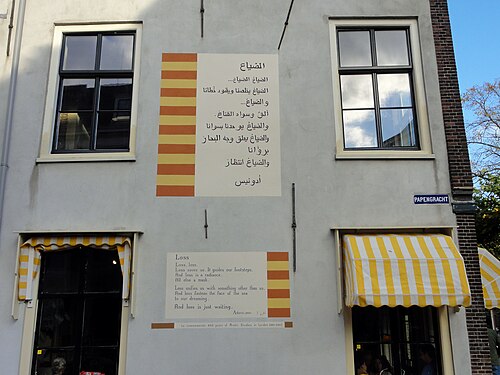
アドニスの詩と批評は、「古典詩に深く根ざしながらも、現代アラブ社会の苦境と反応を伝えるために用いられる、新しい詩的言語とリズム」の創造を含め、「アラブ詩の発展に広範な影響」を与えたと評価されている。[ 66 ]ミレーヌ・ゴセインによれば、「アドニスが現代アラブ詩にもたらした主な貢献の一つは自由、つまり詩的ビジョンの独自性を通して、テーマに対する自由、言葉そのものに対する自由である」[ 67 ] 。
アドニスは、英語圏の詩におけるT・S・エリオットに匹敵する役割をアラブ近代主義において果たしたと考えられている。 [ 68 ]コロンビア大学の教授で文学・文化評論家のエドワード・サイードは、彼を「今日最も大胆で挑発的なアラブの詩人」と呼んだ。アドニスの詩集『昼と夜のページ』を翻訳した詩人のサミュエル・ジョン・ハゾは、「アドニス以前のアラビア詩と、アドニス以降のアラビア詩がある」と述べた。
In 2007, Arabian Business named Adonis No. 26 in its 100 most powerful Arabs 2007[69] stating "Both as a poet and a theorist on poetry, and as a thinker with a radical vision of Arab culture, Adonis has exercised a powerful influence both on his contemporaries and on younger generations of Arab poets. His name has become synonymous with the Hadatha (modernism) which his poetry embodies. Critical works such as "Zamān al-shi'r" (1972) are landmarks in the history of literary criticism in the Arab world."
In 2017, the judges' panel for the PEN/Nabokov Award cited "Through the force of his language, boldness of his innovation, and depth of his feeling, Ali Ahmad Said Esber, known as 'Adonis,' has helped make Arabic, one of the world's oldest poetic languages, vibrant and urgent. A visionary who has profound respect for the past, Adonis has articulated his cherished themes of identity, memory and exile in achingly beautiful verse, while his work as critic and translator makes him a living bridge between cultures. His great body of work is a reminder that any meaningful definition of literature in the 21st century must include contemporary Arabic poetry."[70]
...He led a modernist revolution in the second half of the 20th century, exerting a seismic influence on Arabic poetry comparable to TS Eliot's in the anglophone world
Every year around this time the name of the Syrian poet Adonis pops up in newspapers and in betting shops. Adonis (pronounced ah-doh-NEES), a pseudonym adopted by Ali Ahmad Said Esber in his teens as an attention getter, is a perennial favorite to win the Nobel Prize in Literature.
Last month, Adonis was robbed again of a Nobel Prize, after first being nominated in 1988.
each autumn is credibly tipped for the Nobel in literature
{{cite news}}: CS1 maint: deprecated archival service (link)After winning Germany's major award the Goethe prize earlier this year, Syrian poet Adonis has emerged as the frontrunner to be crowned Nobel literature laureate next month.
Before Thursday's announcement, there had also been much speculation that the committee would choose to honor the Syrian poet Adonis in a gesture towards the Arab spring. Englund dismissed the notion that there was a political dimension to the prize; such an approach, he said, was "literature for dummies".