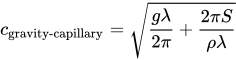
For example,[10] if we assume a flat sea surface (Beaufort state 0), and a sudden wind flow blows steadily across the sea surface, the physical wave generation process follows the sequence:
Turbulent wind forms random pressure fluctuations at the sea surface. Ripples with wavelengths in the order of a few centimeters are generated by the pressure fluctuations. (The Phillips mechanism[8])
The winds keep acting on the initially rippled sea surface causing the waves to become larger. As the waves grow, the pressure differences get larger causing the growth rate to increase. Finally, the shear instability expedites the wave growth exponentially. (The Miles mechanism[8])
The interactions between the waves on the surface generate longer waves[11] and the interaction will transfer wave energy from the shorter waves generated by the Miles mechanism to the waves which have slightly lower frequencies than the frequency at the peak wave magnitudes, then finally the waves will be faster than the crosswind speed (Pierson & Moskowitz[12]).
Types
Surf on a rocky irregular bottom. Porto Covo, west coast of Portugal
Three different types of wind waves develop over time:
Capillary waves, or ripples, dominated by surface tension effects.
Gravity waves, dominated by gravitational and inertial forces.
Seas, raised locally by the wind.
Swells, which have traveled away from where they were raised by the wind, and have to a greater or lesser extent dispersed.
Ripples appear on smooth water (i.e. glassy[13]) when the wind blows, but will die quickly if the wind stops. The restoring force that allows them to propagate is surface tension. Sea waves are larger-scale, often irregular motions that form under sustained winds. These waves tend to last much longer, even after the wind has died, and the restoring force that allows them to propagate is gravity. As waves propagate away from their area of origin, they naturally separate into groups of common direction and wavelength. The sets of waves formed in this manner are known as swells. The Pacific Ocean is 19,800km (12,300mi) from Indonesia to the coast of Colombia and, based on an average wavelength of 76.5m (251ft), would have ~258,824 swells over that width.
It is sometimes alleged that out of a set of waves, the seventh wave in a set is always the largest; while this isn't the case, the waves in the middle of a given set tend to be larger than those before and after them.[14]
In linear plane waves of one wavelength in deep water, parcels near the surface move not plainly up and down but in circular orbits: forward above and backward below (compared to the wave propagation direction). As a result, the surface of the water forms not an exact sine wave, but more a trochoid with the sharper curves upwards—as modeled in trochoidal wave theory. Wind waves are thus a combination of transversal and longitudinal waves.
When waves propagate in shallow water, (where the depth is less than half the wavelength) the particle trajectories are compressed into ellipses.[30][31]
In reality, for finite values of the wave amplitude (height), the particle paths do not form closed orbits; rather, after the passage of each crest, particles are displaced slightly from their previous positions, a phenomenon known as Stokes drift.[32][33]
As the depth below the free surface increases, the radius of the circular motion decreases. At a depth equal to half the wavelength λ, the orbital movement has decayed to less than 5% of its value at the surface. The phase speed (also called the celerity) of a surface gravity wave is—for pure periodic wave motion of small-amplitude waves—well approximated by
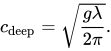
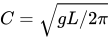
In deep water, where , so and the hyperbolic tangent approaches , the speed approximates
In SI units, with in m/s, , when is measured in metres. This expression tells us that waves of different wavelengths travel at different speeds. The fastest waves in a storm are the ones with the longest wavelength. As a result, after a storm, the first waves to arrive on the coast are the long-wavelength swells.
If the wavelength is very long compared to the water depth, the phase speed (by taking the limit of c when the wavelength approaches infinity) can be approximated by
Surfers are very interested in the wave forecasts. There are many websites that provide predictions of the surf quality for the upcoming days and weeks. Wind wave models are driven by more general weather models that predict the winds and pressures over the oceans, seas, and lakes.
Wind wave models are also an important part of examining the impact of shore protection and beach nourishment proposals. For many beach areas there is only patchy information about the wave climate, therefore estimating the effect of wind waves is important for managing littoral environments.
A wind-generated wave can be predicted based on two parameters: wind speed at 10 m above sea level and wind duration, which must blow over long periods of time to be considered fully developed. The significant wave height and peak frequency can then be predicted for a certain fetch length.[36]
Seismic signals
Ocean water waves generate seismic waves that are globally visible on seismographs.[37] There are two principal constituents of the ocean wave-generated seismic microseism.[38] The strongest of these is the secondary microseism which is created by ocean floor pressures generated by interfering ocean waves and has a spectrum that is generally between approximately 6–12 s periods, or at approximately half of the period of the responsible interfering waves. The theory for microseism generation by standing waves was provided by Michael Longuet-Higgins in 1950 after in 1941 Pierre Bernard suggested this relation with standing waves on the basis of observations.[39][40] The weaker primary microseism, also globally visible, is generated by dynamic seafloor pressures of propagating waves above shallower (less than several hundred meters depth) regions of the global ocean. Microseisms were first reported in about 1900, and seismic records provide long-term proxy measurements of seasonal and climate-related large-scale wave intensity in Earth's oceans [41] including those associated with anthropogenic global warming.[42][43][44]
↑Tolman, H. L. (23 June 2010). Mahmood, M.F. (ed.). CBMS Conference Proceedings on Water Waves: Theory and Experiment(PDF). Howard University, US, 13–18 May 2008: World Scientific Publications. ISBN978-981-4304-23-8.{{cite book}}: CS1 maint: location (link)
↑Lorenz, R. D.; Hayes, A. G. (2012). "The Growth of Wind-Waves in Titan's Hydrocarbon Seas". Icarus. 219 (1): 468–475. Bibcode:2012Icar..219..468L. doi:10.1016/j.icarus.2012.03.002.
↑Barnes, Jason W.; Sotin, Christophe; Soderblom, Jason M.; Brown, Robert H.; Hayes, Alexander G.; Donelan, Mark; Rodriguez, Sebastien; Mouélic, Stéphane Le; Baines, Kevin H.; McCord, Thomas B. (2014-08-21). "Cassini/VIMS observes rough surfaces on Titan's Punga Mare in specular reflection". Planetary Science. 3 (1): 3. Bibcode:2014PlSci...3....3B. doi:10.1186/s13535-014-0003-4. ISSN2191-2521. PMC4959132. PMID27512619.
↑ Heslar, Michael F.; Barnes, Jason W.; Soderblom, Jason M.; Seignovert, Benoît; Dhingra, Rajani D.; Sotin, Christophe (2020-08-14). "カッシーニVIMS太陽グリッター観測によるクラーケン海峡の潮流検出" . The Planetary Science Journal . 1 (2): 35. arXiv : 2007.00804 . Bibcode : 2020PSJ.....1...35H . doi : 10.3847/PSJ/aba191 . ISSN 2632-3338 . S2CID 220301577 .
↑ Young, IR (1999). Wind generated ocean waves . Elsevier. p. 83. ISBN978-0-08-043317-2。
↑ハッセルマン、K.;他。 (1973年)。「北海共同波プロジェクト(JONSWAP)中の風波の成長とうねりの減衰の測定」。Ergnzungsheft zur Deutschen Hydrographischen Zeitschrift Reihe A。8 (12): 95.hdl : 10013 /epic.20654。
↑Pierson, Willard J.; Moskowitz, Lionel (15 December 1964). "A proposed spectral form for fully developed wind seas based on the similarity theory of S. A. Kitaigorodskii". Journal of Geophysical Research. 69 (24): 5181–5190. Bibcode:1964JGR....69.5181P. doi:10.1029/JZ069i024p05181.
↑"Beaufort Scale". National Weather Service. National Oceanic and Atmospheric Administration.
↑Holliday, Naomi P.; Yelland, Margaret J.; Pascal, Robin; Swail, Val R.; Taylor, Peter K.; Griffiths, Colin R.; Kent, Elizabeth (2006). "Were extreme waves in the Rockall Trough the largest ever recorded?". Geophysical Research Letters. 33 (L05613) 2005GL025238. Bibcode:2006GeoRL..33.5613H. doi:10.1029/2005GL025238.
↑P. C. Liu; H. S. Chen; D.-J. Doong; C. C. Kao; Y.-J. G. Hsu (11 June 2008). "Monstrous ocean waves during typhoon Krosa". Annales Geophysicae. 26 (6): 1327–1329. Bibcode:2008AnGeo..26.1327L. doi:10.5194/angeo-26-1327-2008.
↑Munk, Walter H. (1950). "Proceedings 1st International Conference on Coastal Engineering". Coastal Engineering Proceedings (1). Long Beach, California: ASCE: 1–4. doi:10.9753/icce.v1.1.
↑Tom Garrison (2009). Oceanography: An Invitation to Marine Science (7thed.). Yolanda Cossio. ISBN978-0495391937.
↑International Towing Tank Conference (ITTC), retrieved 11 November 2010
↑International Ship and Offshore Structures Congress
↑Pierson, W. J.; Moscowitz, L. (1964), "A proposed spectral form for fully developed wind seas based on the similarity theory of S A Kitaigorodskii", Journal of Geophysical Research, 69 (24): 5181–5190, Bibcode:1964JGR....69.5181P, doi:10.1029/JZ069i024p05181
↑ Elfouhaily, T.; Chapron, B.; Katsaros, K.; Vandemark, D. (1997年7月15日). "風によって駆動される長波と短波の統一方向スペクトル" (PDF) . Journal of Geophysical Research . 102 (C7): 15781– 15796. Bibcode : 1997JGR...10215781E . doi : 10.1029/97jc00467 .
↑ Jefferys, ER (1987), "方向のある海はエルゴード的であるべきである", Applied Ocean Research , 9 (4): 186– 191, Bibcode : 1987AppOR...9..186J , doi : 10.1016/0141-1187(87)90001-0
↑ Longuet-Higgins, MS ; Stewart, RW (1964). "水波における放射応力; 物理的考察と応用". Deep-Sea Research . 11 (4): 529– 562. Bibcode : 1964DSRA...11..529L . doi : 10.1016/0011-7471(64)90001-4 .
↑ Gulrez, Tauseef; Hassanien, Aboul Ella (2011-11-13). Advances in Robotics and Virtual Reality . Springer Science & Business Media. ISBN9783642233630。
↑ RJ Dean および RA Dalrymple (2002). Coastal processes with engineering applications . Cambridge University Press. ISBN978-0-521-60275-4。96~97ページ。
↑ Phillips, OM (1957). "乱流風による波の発生について". Journal of Fluid Mechanics . 2 (5): 417–445 . Bibcode : 1957JFM.....2..417P . doi : 10.1017/S0022112057000233 . S2CID 116675962 .
↑完全非線形周期波における粒子の軌跡の解と、粒子が経験するラグランジュ波周期は、例えば、 JM Williams (1981)「有限深度水中の重力波の限界」Philosophical Transactions of the Royal Society A. 302 (1466): 139– 188. Bibcode : 1981RSPTA.302..139W . doi : 10.1098 /rsta.1981.0159 . S2CID 122673867に見出すことができます。JMウィリアムズ(1985)。進行性重力波の表。ピットマン。ISBN978-0-273-08733-5。
↑ Carl Nordling、Jonny Östermalm (2006)。科学と工学のための物理学ハンドブック(第8版)。Studentliteratur。p. 263。ISBN978-91-44-04453-8。
↑ Aster, Richard C.; McNamara, Daniel E.; Bromirski, Peter D. (2008). "Multidecadal climate-induced variability in microseisms". Seismological Research Letters . 79 (2): 94– 202. Bibcode : 2008SeiRL..79..194A . doi : 10.1785/gssrl.79.2.194 .
↑ Bromirski, Peter (2023). "気候変動による10年規模の海洋波高変動(微動による):1931~2021年" . Journal of Geophysical Research: Oceans . 128 (8) e2023JC019722. Bibcode : 2023JGRC..12819722B . doi : 10.1029/2023JC019722 .
↑ Aster, Richard C.; Ringler, Adam T.; Anthony, Robert E.; Lee, Thomas A. (2023). "20世紀後半以降、地球の地震波場で観測される海洋波エネルギーの増加" . Nature Communications . 14 (1): 6984. doi : 10.1038/s41467-023-42673-w . PMC 10620394 . PMID 37914695 .
アーティストによる水面波の描写
科学的
G. G. Stokes (1880). Mathematical and Physical Papers, Volume I. Cambridge University Press. pp.197–229.
Phillips, O. M. (1977). The dynamics of the upper ocean (2nded.). Cambridge University Press. ISBN978-0-521-29801-8.
Holthuijsen, Leo H. (2007). Waves in oceanic and coastal waters. Cambridge University Press. ISBN978-0-521-86028-4.
Janssen, Peter (2004). The interaction of ocean waves and wind. Cambridge University Press. ISBN978-0-521-46540-3.
Other
Rousmaniere, John (1989). The Annapolis Book of Seamanship (2nd reviseded.). Simon & Schuster. ISBN978-0-671-67447-2.
Carr, Michael (October 1998). "Understanding Waves". Sail. pp.38–45.
External links
Current global map of peak wave periods
Current global map of significant wave heights
Categories:
Coastal geography
Physical oceanography
Water waves
Oceanographical terminology
Surface waves
Hidden categories:
Articles with short description
Short description is different from Wikidata
CS1 maint: location
Wikipedia articles needing factual verification from May 2024
All articles with unsourced statements
Articles with unsourced statements from February 2021
Wikipedia articles needing clarification from May 2023



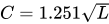






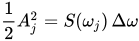
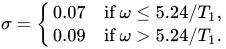
![{\displaystyle {\frac {S(\omega )}{H_{1/3}^{2}T_{1}}}={\frac {0.11}{2\pi }}\left({\frac {\omega T_{1}}{2\pi }}\right)^{-5}\mathrm {exp} \left[-0.44\left({\frac {\omega T_{1}}{2\pi }}\right)^{-4}\right]}](https://wikimedia.org/api/rest_v1/media/math/render/svg/00832fedd4c0464ad4b04e1eafa386eb70a1e5b5)
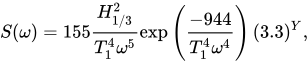
![{\displaystyle Y=\exp \left[-\left({\frac {0.191\omega T_{1}-1}{2^{1/2}\sigma }}\right)^{2}\right]}](https://wikimedia.org/api/rest_v1/media/math/render/svg/74984b4d06dba6b2b92c6d7d855c782df2ad3d5a)