Processing power of computers. See also Moore's law and technological singularity. (Under exponential growth, there are no singularities. The singularity here is a metaphor, meant to convey an unimaginable future. The link of this hypothetical concept with exponential growth is most vocally made by futurist Ray Kurzweil.)
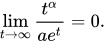
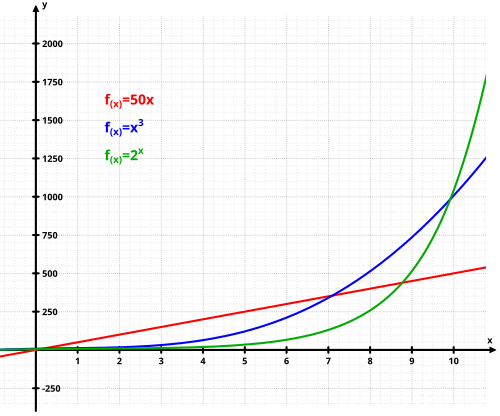
In computational complexity theory, computer algorithms of exponential complexity require an exponentially increasing amount of resources (e.g. time, computer memory) for only a constant increase in problem size. So for an algorithm of time complexity 2x, if a problem of size x = 10 requires 10 seconds to complete, and a problem of size x = 11 requires 20 seconds, then a problem of size x = 12 will require 40 seconds. This kind of algorithm typically becomes unusable at very small problem sizes, often between 30 and 100 items (most computer algorithms need to be able to solve much larger problems, up to tens of thousands or even millions of items in reasonable times, something that would be physically impossible with an exponential algorithm). Also, the effects of Moore's Law do not help the situation much because doubling processor speed merely increases the feasible problem size by a constant. E.g. if a slow processor can solve problems of size x in time t, then a processor twice as fast could only solve problems of size x + constant in the same time t. So exponentially complex algorithms are most often impractical, and the search for more efficient algorithms is one of the central goals of computer science today.
Internet phenomena
Internet contents, such as internet memes or videos, can spread in an exponential manner, often said to "go viral" as an analogy to the spread of viruses.[8] With media such as social networks, one person can forward the same content to many people simultaneously, who then spread it to even more people, and so on, causing rapid spread.[9] For example, the video Gangnam Style was uploaded to YouTube on 15 July 2012, reaching hundreds of thousands of viewers on the first day, millions on the twentieth day, and was cumulatively viewed by hundreds of millions in less than two months.[8][10]
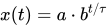
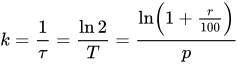
The percent increase r (a dimensionless number) in a period p.
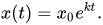
The quantities k, τ, and T, and for a given p also r, have a one-to-one connection given by the following equation (which can be derived by taking the natural logarithm of the above): where k = 0 corresponds to r = 0 and to τ and T being infinite.
If p is the unit of time the quotient t/p is simply the number of units of time. Using the notation t for the (dimensionless) number of units of time rather than the time itself, t/p can be replaced by t, but for uniformity this has been avoided here. In this case the division by p in the last formula is not a numerical division either, but converts a dimensionless number to the correct quantity including unit.
A popular approximated method for calculating the doubling time from the growth rate is the rule of 70, that is, .
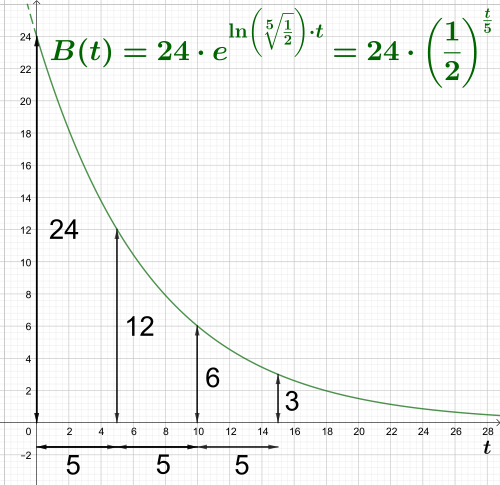
Graphs comparing doubling times and half lives of exponential growths (bold lines) and decay (faint lines), and their 70/t and 72/t approximations. In the SVG version, hover over a graph to highlight it and its complement.
Reformulation as log-linear growth
If a variable x exhibits exponential growth according to , then the log (to any base) of xgrows linearly over time, as can be seen by taking logarithms of both sides of the exponential growth equation:
This allows an exponentially growing variable to be modeled with a log-linear model. For example, if one wishes to empirically estimate the growth rate from intertemporal data on x, one can linearly regresslog x on t.
According to legend, vizier Sissa Ben Dahir presented an Indian King Sharim with a beautiful handmade chessboard. The king asked what he would like in return for his gift and the courtier surprised the king by asking for one grain of rice on the first square, two grains on the second, four grains on the third, and so on. The king readily agreed and asked for the rice to be brought. All went well at first, but the requirement for 2n−1 grains on the nth square demanded over a million grains on the 21st square, more than a million million (a.k.a.trillion) on the 41st and there simply was not enough rice in the whole world for the final squares. (From Swirski, 2006)[14]
The "second half of the chessboard" refers to the time when an exponentially growing influence is having a significant economic impact on an organization's overall business strategy.
Water lily
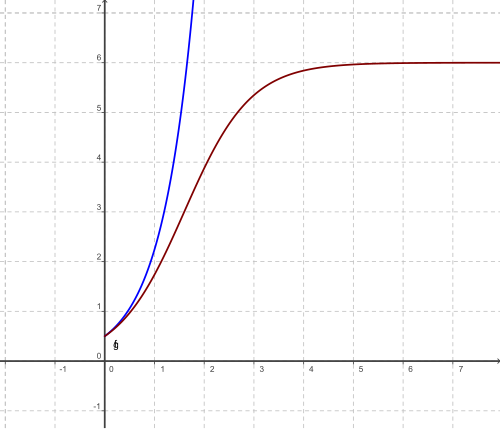
French children are offered a riddle, which appears to be an aspect of exponential growth: "the apparent suddenness with which an exponentially growing quantity approaches a fixed limit". The riddle imagines a water lily plant growing in a pond. The plant doubles in size every day and, if left alone, it would smother the pond in 30 days killing all the other living things in the water. Day after day, the plant's growth is small, so it is decided that it won't be a concern until it covers half of the pond. Which day will that be? The 29th day, leaving only one day to save the pond.[15][14]



















![{\displaystyle {\begin{aligned}{\frac {dx}{dt}}&=kx\\[5pt]{\frac {dx}{x}}&=k\,dt\\[5pt]\int _{x_{0}}^{x(t)}{\frac {dx}{x}}&=k\int _{0}^{t}\,dt\\[5pt]\ln {\frac {x(t)}{x_{0}}}&=kt.\end{aligned}}}](https://wikimedia.org/api/rest_v1/media/math/render/svg/9edfd8a55aac251d0d778e9f63f9bad93c584033)