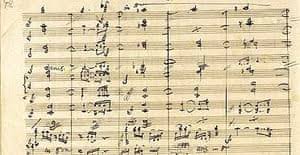
An autograph or holograph is a manuscript or document written in its author's or composer's hand. The meaning of "autograph" as a document penned entirely by the author of its content (as opposed to a typeset document or one written by a copyist or scribe other than the author) overlaps with that of "holograph".
Autograph manuscripts are studied by scholars (such as historians and paleographers), and can become collectable objects. Holographic documents have, in some jurisdictions, a specific legal standing.
Related terms include archetype (the hypothesised form of an autograph), and protograph (the common ancestor of two closely related witnesses which ultimately descended from the same autograph). For example, the Novgorodsko-Sofiysky Svod is the hypothetical protograph of the Novgorod Fourth Chronicle (NPL) and Sofia First Chronicle, both of which are extant textual witnesses of the lost archetype, the Primary Chronicle (PVL). A paradosis is a proposed best-reading, postulated when attempting to reconstruct the autograph.
Terminology
According to The Oxford English Minidictionary, an autograph is, apart from its meaning as a signature, a "manuscript in the author's handwriting", while a holograph is a "(document) written wholly in the handwriting of the person in whose name it appears".[2]
In the 1911 edition of the Encyclopædia Britannica, Edward Maunde Thompson gives two common meanings of the word autograph as it applies to documents: "a document signed by the person from whom it emanates" and "one written entirely in the hand of such a person", noting that the latter is "more technically described as a holograph".[3]
(DB) Mus.ms. Bach P 180 写本の参照として使用されているRISMページが、そのオブジェクトを「自筆譜」(ヨハン・セバスチャン・バッハによる)と記述している場合、その修飾語は自筆譜に変更されません。文脈は明確であり、つまり J. S. バッハによって書かれ、作曲されたものです[ 10 ]。たとえこの手書きの楽譜が 1786 年に作曲家の息子 C. P. E. バッハによって演奏用に部分的に変更され、完成されたとしてもです。 [ 9 ]
19世紀後半、ヴィルヘルム・ルストは、一部がJ.S.バッハの手による18世紀の複合写本から、マルコ受難曲「Jesus Christus ist um unsrer Missetat willen verwundet」の楽譜を編纂した。バッハ・デジタルとRISMのウェブサイトにある説明では、これらの18世紀と19世紀の写本のいずれも、自筆またはホログラフとして、バッハによるものでもルストによるものでも、別の作曲家「カイザー」の作品のバージョンとして分類されていない。[ 11 ]ただし、この受難曲のヴァイマル版に関するバッハ・デジタルのページによると、18世紀の写本は「オリジナル資料」として示すことができる。[ 12 ]
↑ DB Mus.ms. 11471/1およびDB Mus.ms. DB N.Mus.ms. 10624 ( Bach Digitalウェブサイト); RISM 452028310
↑ Passion pasticcio "Jesus Christus ist um unsrer Missetat willen verwundet" (Marks Passion、ワイマール版) BNB I/K/1 (Weimar Fassung); BWV のディースト。 BC D 5a ( Bach Digital Web サイト)
↑ 「BACH, Johann Sebastian (1685–1750): 自筆楽譜、タイトルおよび署名は自筆で「Prelude [ -- Fuga – Allegro ] pour la Luth. ò Cembal. Par JS Bach、変ホ長調のリュートまたは鍵盤楽器のための前奏曲、フーガ、アレグロ、BWV 998、日付不明 (c.1735–1740)」。クリスティーズ。2016年7月13日。 2019年12月4日取得。
↑ Stroh, Patricia (2007 年 3 月). 「オークション市場におけるベートーヴェン: 20 年間のレビュー」. Notes . II. 63 (3). Music Library Association : 533– 564. doi : 10.1353/not.2007.0043 . JSTOR 4487822 . S2CID 192468809 .