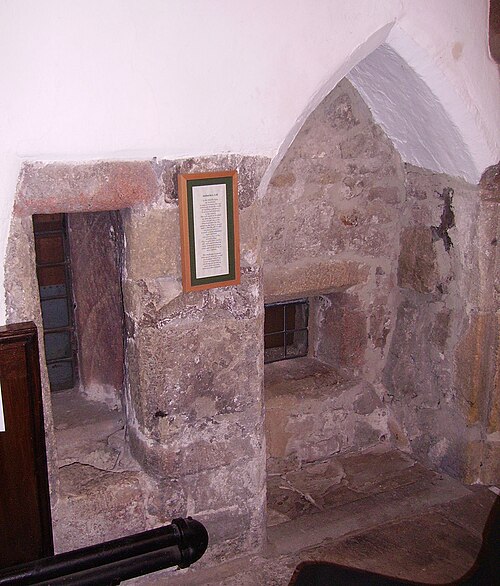
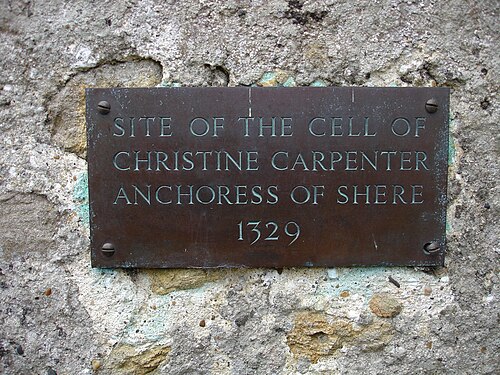
The anchoritic life became widespread during the early and high Middle Ages.[12] Examples of the dwellings of anchorites and anchoresses survive, a large number of which are in England. They tended to be a simple cell (also called anchorhold) built against one of the walls of the local village church.[13]
In Germanic-speaking areas, from at least the tenth century it was customary for the bishop to say the Office of the Dead as the anchorite entered their cell, to signify the anchorite's death to the world and rebirth to a spiritual life of solitary communion with God and the angels. Sometimes, if the anchorite was walled up inside the cell, the bishop would put his seal upon the wall to stamp it with his authority. Some anchorites, however, freely moved between their cells and the adjoining churches.[14]
Most anchorholds were small, perhaps at most 3.7 to 4.6m (12 to 15ft) square, with three windows. Viewing the altar, hearing Mass, and receiving the Eucharist were possible through one small, shuttered window in the common wall facing the sanctuary, called a "hagioscope" or "squint". Anchorites provided spiritual advice and counsel to visitors through these windows, gaining a reputation for wisdom.[15] Another small window allowed access to those who saw to the anchorite's physical needs. A third window, often facing the street but covered with translucent cloth, allowed light into the cell.[16]:348
Anchorites committed to a life of uncompromising enclosure. Those who considered leaving possibly believed their souls might be damned for spiritual dereliction.[17]:93[a] Some refused to leave their cells even when pirates or looters were pillaging their towns and consequently burned to death when the church was torched.[18] They ate frugal meals, spending their days both in contemplative prayer and interceding on behalf of others. Their body waste was managed using a chamber pot.[19]
隠遁所の中には、小さな部屋や付属の庭がいくつかあるところもあった。召使いは隠遁者の基本的なニーズを満たし、食料や水を提供し、排泄物を処理した。例えば、ノリッジのジュリアンは、サラやアリスを含む数人の女中を雇っていたことが知られている。リーヴォーのエルレッドは、隠遁生活を送っていた妹のために、1161年頃に『 De Institutione Inclusarum』という隠遁生活の規則書を書いた。[ 20 ]その中で彼は、話し相手兼門番として年配の女性と、家事使用人として若い女中以外には同居人を置いてはならないと提案した。[ 21 ]
↑メアリー・ポール・マクファーソンによる『De Institutione Inclusarum』の翻訳は、 『Treatises and the Pastoral Prayer』、シトー会修道士シリーズ2(カラマズー、1971年)に収録されている。英語では、この作品は『The Eremitical Life』、『The Rule of Life for a Recluse』、または『The Training of Anchoresses 』など様々なタイトルで出版されている。
↑ Jones, EA (2019). Hermits and anchorites in England, 1200–1550 . Manchester: Manchester University Press. p. 7.
↑ Erler, MC (2013).修道院解散期の読書と執筆:修道士、托鉢僧、尼僧 1530–1558 . Cambridge: Cambridge University Press, pp. 32–37 .
↑ Jones, EA (2019). Hermits and anchorites in England, 1200–1550 . Manchester: Manchester University Press. p. 7.
↑ Hughes-Edwards, M., (2010). "Anchoritism: the English Tradition", in McAvoy, LH [ed.] Anchoritic Traditions of Medieval Europe . Suffolk: Boydell Press, p. 143 .
↑ Grimmer, M. (2006年1月)「ベーダとアウグスティヌスの樫の木会議:初期アングロ・サクソン時代のイングランドにおける英英教会間の交流への示唆」、オーストラリア初期中世協会誌、第2号、103-119頁。