
Loading article…
構文において、動詞-第二語順(V2)[ 1 ]は、文または節の有限動詞が節の第二の位置に配置され、動詞の前に単一の単語または単語のグループ(単一の構成要素)が置かれる文構造である。
英語におけるV2の例は以下のとおりです(括弧は単一の構成要素を示します)。
もし英語があらゆる状況でV2を用いるとしたら、次のような文が見られるだろう。
V2語順はゲルマン語派で一般的であり、北東コーカサスのイングーシ語、ユト・アステカのオオダム語、そして断片的にレト・ロマンス語派とフィン・ウゴル語派のエストニア語にも見られる。[ 2 ]ゲルマン語族の中で、英語は例外的にV2ではなくSVO語順が主流であるが、V2現象の痕跡も残っている。
ゲルマン語派のほとんどの言語は、例外はいくつかあるものの、埋め込み節では通常V2語順を使用しません。特に、ドイツ語、オランダ語、アフリカーンス語は、補文標識の後にはVF(動詞末尾)語順に戻ります。しかし、イディッシュ語とアイスランド語は、主節、埋め込み節、従属節を含むすべての平叙文節でV2語順を許容します。カシミール語(インド・アーリア語派)は、「平叙文節」ではV2語順ですが、関係節ではVF語順です。
(1)のドイツ語の例文は、第2の位置に定形動詞があれば、どの構成要素でも第1の位置を占めることができるというV2の原則を示しています。(1a)から(1d)までの文では、第2の位置に定形動詞spielten「演奏した」があり、第1の位置にはさまざまな構成要素があります。(1a)では主語が第1の位置にあり、(1b)では目的語が第1の位置にあり、(1c)では時間修飾語が第1の位置にあり、(1d)では場所修飾語が第1の位置にあります。
死ぬ
ザ・ノム・プル
キンダー
子供 -名詞- PL
遊ぶ
プレイ - PRET - 3PL
vor
前に
ダー
DAT - SG
学校
学校 - DAT - SG
私は
DAT - SGにて
公園
パーク-DAT - SG
サッカー。
サッカー - ACC - SG。
Die Kinder spielten vor der Schule im Park Fußball。
NOM-PL 子供 NOM-PLは、DAT-SG 学校 (DAT-SG) の前の公園でサッカーをします。
子供たちは登校前に公園でサッカーをした。
サッカー
サッカー - ACC - SG
遊ぶ
プレイ - PRET - 3PL
死ぬ
ノム・PL
キンダー
子供 -名詞- PL
vor
前に
ダー
DAT - SG
学校
学校 - DAT - SG
私は
DAT - SGにて
公園。
パーク-DAT - SG。
公園でサッカーを楽しみましょう。
サッカー/サッカー-ACC-SG は、学校-DAT-SG の前に公園-DAT-SG で子供-NOM-PL を遊びます。
子供たちは登校前に公園でサッカーをした。
ヴォー
前に
ダー
DAT - SG
学校
学校 - DAT - SG
遊ぶ
プレイ - PRET - 3PL
死ぬ
ノム・PL
キンダー
子供 -名詞- PL
私は
DAT - SGにて
公園
パーク-DAT - SG
サッカー。
サッカー - ACC - SG。
公園サッカーボールを楽しみましょう。
DAT-SG 学校 DAT-SGが PRET-3PL で PRET-3PL をする前に、NOM-PL の子供が DAT-SG 公園でサッカーをします。
子供たちは登校前に公園でサッカーをした。
私は
DAT - SGでは
公園
パーク-DAT - SG
遊ぶ
プレイ - PRET - 3PL
死ぬ
ノム・PL
キンダー
子供 -名詞- PL
vor
前に
ダー
学校
学校 - DAT - SG
サッカー。
サッカー - ACC - SG。
私は幼稚園でサッカーをしています。
{DAT-SG}公園で、 {}学校に行く前に子供はサッカーをします。
子供たちは登校前に公園でサッカーをした。
この例では、英語を北ゲルマン語と比較する方が簡単です。同じ語順の倒置は北ゲルマン語、そしてオランダ語でも頻繁に見られますが、英語は語順の倒置が一般的に使われなくなったことを除けば、北ゲルマン語の語順を使用しています。ノルウェー語の同じ例を、語順をそのままにして英語に翻訳した場合:
バルナ
子供- DEF - PL
スピルテ
プレイ-PRET
サッカー
サッカー
私
で
公園
パーク-DEF - SG
のために
前に
スコレティド。
学校時間 - SG。
Barna spilteフットボール、私は skoletid のために公園にいます。
子供は学校が始まる前に公園でサッカーをする。
子供たちは登校前に公園でサッカーをした。
フットボール
サッカー
スピルテ
プレイ-PRET
バルナ
子供- DEF - PL
私
で
公園
パーク-DEF - SG
のために
前に
スコレティド。
学校時間 - SG。
サッカースピリテ バルナ、私はスコレティドのために公園にいます。
サッカーをする子供 - 学校が始まる前の公園で - シンガポール。
子供たちは登校前に公園でサッカーをして遊んでいた。
のために
前に
スコレティド
学校時間
スピルテ
プレイ-PRET
バルナ
子供- DEF - PL
サッカー
サッカー
私
で
パークン。
パーク-DEF - SG。
スコレティド・スピルテ・バルナ・フットボールのために私はパークする。
登校前に公園でサッカーをする子供。
登校前に子供たちは公園でサッカーをして遊んだ。
私
で
公園
パーク-DEF - SG
スピルテ
プレイ-PRET
バルナ
子供- DEF - PL
サッカー
サッカー
のために
前に
スコレティド。
学校の時間。
私はスコレティドのためにバルナフットボールを楽しんでいます。
学校が始まる前に公園で遊ぶ子供。
公園では、子供たちが登校前にサッカーをして遊んでいた。
ここで注意すべき点は(ドイツ語とは異なり)、文法的な格を持たない言語では、目的語が先に来る形式(2b)は、目的語が主語と明確に区別できる場合(例えば、人称代名詞の場合)、またはこの例のように意味的に主語になり得ない場合に限り、曖昧さなく使用できるということです。話し言葉では、このような倒置は通常強調されます。文法的な文脈で必須となる倒置(例えば、「jeg tenker, derfor er jeg」(我思う、ゆえに我あり))を除いて、強調以外の理由で倒置が行われ、それが曖昧さを生む可能性がある場合、動詞の前の強調された位置にある単語も話し言葉では通常強調されます。
V2原則は、有限動詞の位置のみを規定し、非有限動詞(不定詞、分詞など)への影響は間接的です。V2言語における非有限動詞の位置は、言語によって異なります。例えば、ドイツ語とオランダ語では、非有限動詞は主節の節末位置(OV順)で目的語(存在する場合)の後に現れます。一方、スウェーデン語とアイスランド語では、非有限動詞は有限動詞の後、目的語(存在する場合)の前に現れます(VO順)。つまり、V2原則は有限動詞のみに作用するのです。
(以下の例では、動詞の定形は太字、非定形は斜体、主語は下線で示されています。)
ゲルマン語派は、埋め込み節におけるV2語順の適用において多様であり、3つのグループに分類される。
これらの言語では、節の語順は一般的に慣習的に番号付けされた位置の 2 つのパターンに固定されています。[ 3 ]どちらも (5) 非定形動詞、(6) 目的語、(7) 副詞句の位置で終わります。
主節では、V2制約が成り立ちます。定動詞は位置(2)に、文副詞は位置(4)に置かなければなりません。後者には、「~ない」「常に」などの意味を持つ語が含まれます。主語は位置(1)に置くことができますが、主題表現がその位置を占める場合は、主語は位置(3)に置かれます。
埋め込み節では、V2制約は存在しません。接続詞の後には、主語がすぐ後に続く必要があり、主題表現で置き換えることはできません。したがって、最初の4つの位置は、(1)接続詞、(2)主語、(3)文副詞、(4)定形動詞という固定された順序になります。
文副詞の位置は、それらを節内の大きな構成要素の開始を示すものとみなす理論家にとって重要である。したがって、埋め込み節では定形動詞はその構成要素の内側に位置するが、V2主節ではその構成要素の外側に位置すると考えられる。
スウェーデン語
主節 前置動詞 定形動詞 主語 文副詞 __ 非定形動詞 目的語 副詞句 埋め込み節 __ 接続詞 主語 文副詞 定形動詞 非定形動詞 目的語 副詞句 主節 (a) 今日は ロッテ に 新聞 を読まないでほしいと思った 「ロッテは今日は新聞を読みたくなかった。」 埋め込み条項 (b) att ロッテ インテ ヴィル コカ カフェ イ ダグ ロッテは 今日コーヒーを淹れたくない 「ロッテは今日はコーヒーを入れたくなかったんだ。」
デンマーク語
いわゆるペルケルダンスクは、上記の例に当てはまらない品種の一例である。
ノルウェー語 (複数の副詞句と複数の非定形動詞を含む、2つの変種)
フェロー語では 、大陸スカンジナビア諸語とは異なり、埋め込み節では文副詞は定形動詞の前または後に置かれることがあります。次の文副詞の選択肢のために、ここに(3a)のスロットが挿入されます。
主節では、V2制約が成り立ちます。他のゲルマン語派と同様に、定形動詞は必ず2番目の位置に置かなければなりません。ただし、非定形動詞は必ず文末に置かなければなりません。主語は最初の位置に置くこともできますが、主題表現がその位置を占める場合は、主語は定形動詞の後ろに置かれます。
埋め込み節では、V2制約は成り立ちません。節末尾の非定形動詞には、必ず定形動詞が隣接していなければなりません。
ドイツ語の文法学者は伝統的に文を「フィールド」に分けます。主節の前に来る従属節は第一フィールド(Vorfeld)、主節の後に続く節は最終フィールド(Nachfeld)にあるとされます。 中央フィールド(Mittelfeld)には節の大部分または全部が含まれ、左括弧(Linke Satzklammer)と右括弧(Rechte Satzklammer)で囲まれています。
主節では、最初の要素(主語または主題表現)が最初の欄に、V2動詞形が左括弧に、動詞形が右括弧内に置かれる。埋め込み節では、接続詞が左括弧に、動詞形が右括弧内に置かれる。ドイツ語の埋め込み節では、動詞形が動詞形に続いて非動詞形が現れる。
ドイツ語[ 4 ]
主節ではV2語順が用いられ、定形動詞は必ず2番目の位置に置かなければなりません。しかし、従属節では動詞クラスターの語順は2通り考えられます。
主要節:
オランダ語[ 5 ]
この分析は、主節のV2定形と埋め込み節の接続詞との間に密接な類似性があることを示唆している。それぞれがその節タイプの導入として見なされ、この機能は現代の学者の中には指定詞の概念と同一視する者もいる。この分析は、オランダ語の話し言葉における接語代名詞の主語の位置によって裏付けられている。zeのような形式は、完全な形式であるzijとは異なり、単独では存在できない。それらが付加される可能性のある語は、主節のV2形式、または埋め込み節の接続詞という、導入語と同じである。[ 6 ]
従属節:
オランダ語の従属節では、動詞クラスターに 2 つの語順が可能で、「赤」の語順: omdat ik heb gewerkt、「私は働いたから」: 英語と同様に助動詞が過去分詞の前に来る。「緑」の語順: omdat ik gewerkt heb、「私は働いたから」: ドイツ語と同様に過去分詞が助動詞の前に来る。[ 7 ]オランダ語では、緑の語順が話し言葉で最もよく使われ、赤の語順が書き言葉、特にジャーナリズムの文章で最もよく使われるが、話し言葉と同様に書き言葉でも緑が使われる。ただし、英語とは異なり、形容詞と副詞は動詞の前に来なければならない。「dat het boek groen is」、「その本は緑である」。
これらの言語は、埋め込み節においてV2順序を自由に許容する。
アイスランド 語の語順パターンは、大陸スカンジナビア語とほぼ同様である。ただし、主節では、Þaðが先頭に来る場合に備えて、追加のスロットが必要となる。これらの節では、主語は任意の文副詞の後に続く。埋め込み節では、文副詞は定形動詞の後に続く(フェロー語では任意の語順)。[ 8 ]
他のゲルマン語とは大きく異なり、接続詞の後にV2の語順(前置詞-定形動詞-主語)が続く埋め込み節には、3つ目のパターンが存在する。[ 9 ]
イディッシュ語は 標準ドイツ語とは異なり、通常は動詞の形が目的語の前にあり(SVO の語順)、埋め込み節では接続詞の後に V2 の語順が続く。[ 10 ]
接続詞の後にV2が続く埋め込み節の一種は、ゲルマン語派全体に見られるが、言語によって頻度に差がある。これらは根節と呼ばれ、宣言的な内容節であり、いわゆるブリッジ動詞の直接目的語であり、文を引用するものとして理解される。そのため、直接引用の場合と同様にV2の語順を示す。
デンマーク語 では、主題以外の項目は先頭に表示してもよい。
スウェーデン 語では、主語以外の項目が文頭に置かれることが時折認められる。一般的に、その文は話し手が同意する内容でなければならない。
発言者が同意しない内容については、この命令は適用できません。
ノルウェー語
ドイツ語の語幹節のV2語順は、接続詞dass が省略された 場合にのみ可能です。このような場合、動詞の形が直説法と明確に区別できる場合は、形式的な用法では動詞を現在接続法(ドイツ語接続法I)に置きます。区別できない場合は、過去接続法(ドイツ語接続法II)を使用します。
dass の後の通常の embed-clause の順序を比較してください
英語と同様の特定の語用論的効果のために動詞の埋め込み移動を可能にするV2言語は限られています。これは話者の視点によるものです。ドイツ語やスウェーデン語などの言語には動詞の埋め込みがあります。これらの言語における動詞の埋め込みは、通常「橋渡し動詞」の後に現れます。[ 11 ]
(ブリッジ動詞とは、「言う」「考える」「知る」など、会話や思考を表す一般的な動詞のことで、これらの動詞の後には「that」は必要ありません。例:I think he is coming.)
ジャガー
私
スカ
意思
サーガ
言う
掘る
あなた
属性
それ
ジャグ
私
är
午前
インター
ない
エット
1
ダッグ
露
intresserad.
興味がある。
(スウェーデン語)
ジャグ・スカ・サガ・ディグ・アット・ジャグ・アー・インテ・ダッグ・イントレセラド。
私は露に関心がないと申し上げておきます。
「私はあなたに、私は少しも興味がないと伝えます。」 → この文では、「tell」が橋渡し動詞で、「am」は埋め込み動詞です。
主張理論に基づくと、埋め込みV2節では話し手の視点が再確認される。埋め込み節におけるV2に対する話し手のコミットメントや責任感は、埋め込み節にV2がない場合よりも大きい。[ 12 ]これはV2の特性の結果である。以下の例に示すように、V2が存在する場合、埋め込み節の真実性に対するコミットメントは大きくなる。
マリア
マリア - NOM - SG
デンクト、
考え- PRES - 3SG、
ダス
それ
ピーター
ピーター - NOM - SG
幸せ
ハッピー
です。
be- PRES - 3SG
マリア・デンクト、ダス・ピーター・グリュックリッヒ。
Maria-NOM-SG think-PRES-3SG、Peter-NOM-SG は幸せです-PRES-3SG
→ V2以外の埋め込み節では、話し手は「マリアは考えている…」という文の真偽のみを保証している。
マリア
マリア - NOM - SG
デンクト、
考え- PRES - 3SG、
ピーター
ピーター - NOM - SG
は
be- PRES - 3SG
glücklich.
ハッピー。
マリア・デンクト、ピーター・イスト・グリュックリッヒ。
マリアは考える、ピーターは幸せになる。
→ V2埋め込み節では、話し手は「マリアは考えている …」という文の真実性と、「ピーターは幸せだ」という命題の真実性を確信している。
V2語順の変形であるV1語順(動詞が語頭に来る語順)、V3語順、V4語順などは、多くの初期ゲルマン語派や中世ロマンス語派の言語で広く確認されている。これらの言語ではこうした変形は可能であるが、特定の文脈に厳しく限定されている。
V1(動詞先行語順)とは、定形動詞が節の先頭要素として含まれる構造の一種です。つまり、動詞が文の主語と目的語の前に現れます。
(a) Max y-il [ s no' tx;i;] [ o naq Lwin]。 (マヤ語) PFV A3-CLF犬CLFペドロを参照 「犬はペドロを見た。」
V3(動詞-3番目の語順)は、V2の変形であり、有限動詞が3番目の位置にあり、その前に2つの構成要素がある。[ 13 ]
V3では、V2の語順と同様に、有限動詞の前に来る構成要素はカテゴリー的に制限されておらず、DP、PP、CPなどになり得る。[ 14 ]
[ DP]
ジェデス
毎
[年]
年
[ Pn]
ich]
私
購入
購入。PRS。1SG
ミル
私。DAT。SG
ベイ
で
ダイヒマン
ダイヒマン。DAT。SG
(標準以下のドイツ語、「Kiezdeutsch」)
[ DP Jedes Jahr] [ Pn ich] カウフ ミルベイダイヒマン
毎年{}私はDeichmannでPRS.1SG me.DAT.SGを購入します。
「毎年、ダイヒマンで靴を買っています」
[ PP
アブ
から
[getzt]
今
[ Pn]
ich]
私
クリーク
ゲット。PRS。SG
浸す
いつも
ツヴァンツィヒ
二十
ユーロ
ユーロ。ACC。PL
(標準以下のドイツ語)
[ PP Ab Jetzt] [ Pn ich] krieg immer zwanzig Euro
{} 今から {} 私は常に 20 ユーロを受け取ります。PRS.SG。ACC.PL
「これからは、いつも20ユーロもらえるんだ」
V2は基本的に文レベルでの形態論的な義務的指数効果から派生しています。左端充填トリガー(LEFT)効果は、ゲルマン語や古ロマンス語などの古典的なV2言語でよく見られます。左端充填トリガーは、EPP効果が語内部レベルで見られるように、形態論で独立してアクティブです。義務的指数は、屈折形態論における絶対的変位、能格変位、能格重複から派生しています。さらに、接語第二言語の第二位置規則は、LEFT移動の統語後規則を示しています。ブルトン語を例にとると、時制前の句動詞がないと、時制が先になるのを避けるためにLEFTが発生します。LEFT移動は統語規則から自由であり、これは統語後現象の証拠です。LEFT移動により、以下の例に示すようにV2語順が得られます。[ 15 ]
ベズ
エクスプローラー
'nevo
終了[持つ]
ヘネックス
彼
トラウ
もの
(ブルトン語)
Bez 'nevo hennex traou
EXPL 最終[彼は物を持っているだろう]
「彼は商品を持っているだろう」
このブルトン語の例では、定形語頭は音韻的に実現され、先行する要素のカテゴリーと一致しています。前置詞「Bez」は定形動詞の前に置かれ、V2語順になっています(定形動詞「nevo」は太字で示されています)。
V2パターンは統語的現象であり、そのため許容される環境と許容されない環境が存在すると言われている。統語的には、V2は、占有された指定子を持つ左周辺ヘッド(通常はC)と、そのヘッドに最上位の動詞助動詞を上げることを必要とする。V2は通常、これらの要件の共起として分析され、これらは「トリガー」とも呼ばれる。V2の効果を引き起こす要件である左周辺ヘッドは、先頭位置を占める句XPにさらなる要件を設定し、この句XPが常に特定の特徴を持つことができるようにしている。[ 16 ]
現代英語は語順において他の現代ゲルマン語派とは大きく異なるが、初期の英語は多くの類似点を共有していた。このため、一部の学者はV2制約を標準とする古英語の記述を提案している。したがって、英語の統語論の歴史は制約の喪失の過程と見なされている。[ 17 ]
これらの例では、動詞の定形は緑色、非定形はオレンジ色、主語は青色で示されています。
Se
の
メッセプレオスト
マス司祭
スケル
シャル
マナム
人々
ボディアン
説教
1つ
の
ソサン
真実
ジェリーファン
信仰
あなたの健康を守るために、自分自身の身体を守るために、ジェリーファンを守りましょう
司祭は人々に真の信仰を説く
「ミサの司祭は、人々に真の信仰を説くべきである。」
フィ
なぜ
ウォルデ
だろう
神
神
スワ
それで
ライトルズ
小さい
シングス
もの
彼
彼
フォーワーマン
拒否
フィ・ウォルデ・ゴッド・スワ・ライトルズ・ジンゲス・彼・フォーワーマン
神はなぜ、そんな小さなことを否定するのだろうか
「なぜ神は彼にそんな小さなことを拒むのだろうか?」
の上
で
トワム
二
þingum
もの
ヘフデ
もっている
神
神
þæs
の
マンネス
男性の
のこぎり
魂
ジオドドッド
寄付された
トゥワム・イングム・ハフデ神イエス・マンネス・ソール・ジオドドッドについて
神は人の魂に二つのものを与えた
「神は人間の魂に二つのものを授けた。」
þa
それから
ワス
だった
þæt
の
フォーク
人々
þæs
の
ミックラン
素晴らしい
ウェラン
繁栄
ウンゲメトリチェ
過度に
ブルセンデ
参加する
ミクラン・ウェラン・ウンゲメトリス・ブルセンデを思い出し た
その時、大繁栄の人々は過剰に享受していた
「そして人々は、その大きな繁栄を過剰に享受していた。」
ネ
ない
スケル
シャル
彼
彼
ナート
何もない
ウナリーフデス
違法
ドン
する
Ne sceal he naht unaliefedes don
彼は違法なことをしてはならない
「彼は違法な行為をしてはならない。」
ダス
これら
ðreo
三つ
ðing
もの
forgifð
与える
神
神
彼
彼の
gecorenum
選ばれた
Ðas ðreo ðing forgifð神、彼は gecorenum
これら三つのものが神に選ばれし者を与える
神が選ばれた者に与えるこの三つのもの
例b、c 、 dでは、節の目的語が非定形動詞の前に来ています。表面的には、構造は動詞-主語-目的語-動詞です。統語論や言語類型論の研究者は、一般性を把握するために、これらを基本的に主語-目的語-動詞(SOV) 構造に V2 制約を加えたものとして扱います。したがって、古英語はある程度 SOV 言語に分類されます。しかし、例a は、非定形動詞の後に目的語が続く古英語の節を多数示しており、表面的な構造は動詞-主語-動詞-目的語です。より多くの節は、単一の定形動詞の後に目的語が続く構造で、表面的には動詞-主語-目的語です。ここでも、一般性を把握するために、これらをV2 によって修正された主語-動詞-目的語(SVO) として記述します。したがって、古英語は SOV 言語 (ドイツ語やオランダ語など) と SVO 言語 (スウェーデン語やアイスランド語など) の中間的な言語として記述できます。
節の主語が人称代名詞の場合、V2は必ずしも機能するとは限らなかった。
フォーソン
したがって
私たちは
私たちは
スクーラン
しなければならない
中
と
全員
全て
モジュール
心
&
そして
メゲネ
力
に
に
ゴデ
神
ゲシラン
振り向く
我々は、ミッド・エール・モッドとメージェネからゴデ・ゲシランへのseolanを実行します
したがって、私たちは全精神と全力を尽くして神に頼らなければならない
「だから、私たちは全知全能の心で神に立ち返らなければならない。」
しかし、V2動詞-主語倒置は、疑問詞や否定語neの後では例外なく発生し、代名詞主語の場合でもþaの後ではごくわずかな例外で発生した。
のために
のために
ファン
何
最古
不要
þu
あなた
ðe sylfe
あなた自身
自分
自分
gecyðan
周知させる
þæt...
それ...
一番古いþu {ðe sylfe} 私gecyðan þætのために...
あなたが望んでいないことを私に知らせるために...
「なぜあなたは私に直接知らせようとしないのですか…」
ネ
ない
スケル
シャル
彼
彼
ナート
何もない
ウナリーフデス
違法
ドン
する
Ne sceal he naht unaliefedes don
彼は違法なことをしてはならない
「彼は違法な行為をしてはならない。」
þa
それから
フォーラム
航海した
こんにちは
彼らは
中
と
þrim
三つ
スキパム
船
だが
外
þa foron hie mid þrim scipum ut
そして彼らは3隻の船で出航した
「それから彼らは3隻の船で出航した。」
直接引用の後には主語代名詞の倒置が頻繁に起こった。 [ 18 ]
"自分
私にとって
は、"
は
cwæð
言った
ヘオ
彼女
"薄い
あなたの
サイメ
来る
の上
で
ミクラム
多くの
一度
感謝
「私は」cwæð hēo " Þīn cyme on miclum ðonce"
彼女は私に、あなたが来てくれたことにとても感謝していると言いました。
「あなたが来てくれて、とても嬉しいです」と彼女は言った。
代名詞を主語とする埋め込み節はV2倒置の対象とならなかった。名詞を主語とする場合でも、V2倒置は起こらなかった。
...þa ða
...いつ
彼の
彼の
leorningcnichtas
弟子たち
ひな
彼
アクソドン
尋ねた
のために
のために
フワエス
だれの
シナム
罪
s
の
男
男
ウルデ
になった
スワ
したがって
盲目
盲目
聖別された
...þa ða his leorningcnichtas hine axodon for hwæs synnum se man wurde swa blane acenned
弟子たちが、その男が誰の罪のために盲目になったのかと尋ねたとき
「弟子たちが、この男がこのように盲目に生まれたのは誰の罪によるのかと尋ねたとき」
同様の節パターンでは、はい・いいえ疑問文の動詞の定形が最初の位置を占める。
トゥルワスト
信頼
ðu
あなた
ヌ
今
þe
あなた
セルファム
自己
そして
そして
þinum
あなたの
ゲフェルム
仲間たち
ベット
より良い
ソネ
よりも
ダム
の
使徒…?
使徒たち
Truwast ðu nu þe selfum と þinum geferum bet þonne ðam apostolum...?
今では、使徒たちよりもあなた自身とあなたの仲間たちの方があなたを信頼しています
「あなたは今、使徒たちよりも自分自身と仲間たちを信頼しているのですか…?」
初期中英語では、名詞を主語とする節において、一般的にV2構造が保持されていた。
の上
で
これ
これ
ゲール
年
ウォルデ
指名手配
þe
の
王
王
ステファン
スティーブン
tæcen
奪う
ロドバート
ロバート
ステフネ・テセン・ロッドバート王 について
この年、スティーブン王はロバートを捕らえようとした。
「この年、スティーブン王はロバートを捕らえようとした。」
ヌー
今
まるで
見て
ユーリッヒ
毎
男
男
向かって
に
ヒムセレウン
彼自身
Nu loke euerich manに向かって
さあ、各自自分の姿を見てみよう
「今こそ、一人ひとりが自らを省みる時だ。」
古英語と同様に、V2倒置は代名詞を主語とする節には適用されなかった。
ビ
による
これ
これ
ȝe
あなた
マヘン
5月
ソン
見る
アリ
そして
ウィテン...
知る
私はこれからもずっとずっと...
これにより、あなたは見て知ることができる
すべて
全て
これら
それらの
ベボデス
戒律
IC
私
ハッベ
持っている
ihealde
保たれた
フレーム
から
子供
子供時代
すべては子供の頃から私に元気を与えてくれます
私は幼い頃からそれらの戒律をすべて守ってきました
14世紀から15世紀にかけての後期中英語の文献では、V2に関連する倒置のない節の出現頻度が増加していることが示されている。
ソテリー
本当に
s
の
ライトワイズ
正義の
セキス
求める
þe
の
ロイ
喜び
そして...
そして...
sothely se ryghtwyse sekys þe loye そして...
真に義人は喜びと…を求める。
そして
そして
による
による
これ
これ
同じ
同じ
スカイル
スキル
ホップ
希望
そして
そして
痛み
悲しみ
シュル
シャル
ジュゲン
裁判官
私たち
私たち
そしてこの同じスカイルホップとソレシュールジュゲンウスによって
そして、希望と悲しみは、まさにこの同じ技量によって私たちを裁くだろう。
否定節はもはやne(またはna)を最初の要素として形成されなくなった。否定節における倒置は他の原因によるものと考えられた。
なぜ
なぜ
定められた
叙任された
神
神
ない
ない
そのような
そのような
オーダー
注文
なぜ神はそのような秩序を定めなかったのか
なぜ神はそのような秩序を定めなかったのか
「なぜ神はそのような秩序を定めなかったのか?」(notは名詞句の主語の後に続く)
なぜ
なぜ
シュルデ
すべき
彼
彼
ない...
ない
(代名詞の主語の前には置かないでください)
なぜ彼がそうしては いけないのか…
なぜそうしてはいけないのか
そこ
そこには
ニューヨーク州
ではない
ナット
ない
ウーン
1つ
カン
できる
戦争
わかっている
による
による
他の
他の
なれ
なれ
Ther nys nat oon kan war by other be
他者によって認識されることはない
「他人の失敗から学ぶ人は一人もいない」
彼
彼
だった
だった
絶望した;
絶望の中で。
何もない
何もない
ドルステ
あえて
彼
彼
seye
言う
彼は 絶望した。
彼は絶望していた。何も口にすることができなかった。
As in earlier periods, Modern English normally has subject-verb order in declarative clauses and inverted verb-subject order[19] in interrogative clauses. However these norms are observed irrespective of the number of clause elements preceding the verb.
Inversion in Old English sentences with a combination of two verbs could be described in terms of their finite and non-finite forms. The word which participated in inversion was the finite verb; the verb which retained its position relative to the object was the non-finite verb. In most types of Modern English clause, there are two verb forms, but the verbs are considered to belong to different syntactic classes. The verbs which participated in inversion have evolved to form a class of auxiliary verbs which may mark tense, aspect and mood; the remaining majority of verbs with full semantic value are said to constitute the class of lexical verbs. The exceptional type of clause is that of declarative clause with a lexical verb in a present simple or past simple form.
Like Yes/No questions, interrogative Wh- questions are regularly formed with inversion of subject and auxiliary. Present Simple and Past Simple questions are formed with the auxiliary do, a process known as do-support.
In certain patterns similar to Old and Middle English, inversion is possible. However, this is a matter of stylistic choice, unlike the constraint on interrogative clauses.
negative or restrictive adverbial first
comparative adverb or adjective first
After the preceding classes of adverbial, only auxiliary verbs, not lexical verbs, participate in inversion
locative or temporal adverb first
prepositional phrase first
After the two latter types of adverbial, only one-word lexical verb forms (Present Simple or Past Simple), not auxiliary verbs, participate in inversion, and only with noun-phrase subjects, not pronominal subjects.
When the object of a verb is a verbatim quotation, it may precede the verb, with a result similar to Old English V2. Such clauses are found in storytelling and in news reports.
Corresponding to the above examples, the following clauses show the normal Modern English subject-verb order.
Declarative equivalents
Equivalents without topic fronting
Modern French is a subject-verb-object (SVO) language like other Romance languages (though Latin was a subject-object-verb language). However, V2 constructions existed in Old French and were more common than in other early Romance language texts. It has been suggested that this may be due to influence from the Germanic Frankish language.[20] Modern French has vestiges of the V2 system similar to those found in modern English.
The following sentences have been identified as possible examples of V2 syntax in Old French:[21]
Similarly to Modern French, Old French allows a range of constituents to precede the finite verb in the V2 position.
Il
He
oste
removes.3sg
ses
his
armes
weapons
Il oste ses armes
He removes.3sg his weapons
'He removes his weapons'
A language that is compared to Old French is Old Occitan, which is said to be the sister of Old French. Although the two languages are thought to be sister languages, Old Occitan exhibits a relaxed V2 whereas Old French has a much more strict V2. However, the differences between the two languages extend past V2 and also differ in a variation of V2, which is V3. In both language varieties, occurrence of V3 can be triggered by the presence of an initial frame-setting clause or adverbial (1).
Car
For
s'il
if-he
ne
NEG
me
me.CL=
garde
look.3SG
de
of
pres,
close
je
I
ne
NEG
dout
doubt.1SG
mie
NEG
Car s'il ne me garde de pres, je ne dout mie
For if-he NEG me.CL= look.3SG of close I NEG doubt.1SG NEG
'Since he watches me so closely, I do not doubt'
In his 1976 three-volume study of two languages of Himachal Pradesh, Hendriksen reports on two intermediate cases: Kotgarhi and Kochi. Although neither language shows a regular V2 pattern, they have evolved to the point that main and subordinate clauses differ in word order and auxiliaries may separate from other parts of the verb:
hyunda-baassie
winter-after
jaa
goes
gõrmi
summer
hõ-i
become-GER
(in Kotgarhi)
hyunda-baassie jaa gõrmi hõ-i
winter-after goes summer become-GER
"After winter comes summer." (Hendriksen III:186)
Hendriksen reports that relative clauses in Kochi show a greater tendency to have the finite verbal element in clause-final position than matrix clauses do (III:188).
In Ingush, "for main clauses, other than episode-initial and other all-new ones, verb-second order is most common. The verb, or the finite part of a compound verb or analytic tense form (i.e. the light verb or the auxiliary), follows the first word or phrase in the clause."[22]
muusaa
Musa
vy
V.PROG
hwuona
2sg.DAT
telefon
telephone
jettazh
striking
muusaa vy hwuona telefon jettazh
Musa V.PROG 2sg.DAT telephone striking
'Musa is telephoning you.'
O'odham has relatively free V2 word order within clauses; for example, all of the following sentences mean "the boy brands the pig":[23]
ceoj ʼo g ko:jĭ ceposid ko:jĭ ʼo g ceoj ceposid ceoj ʼoceposid g ko:jĭ ko:jĭ ʼoceposid g ceoj ceposidʼo g ceoj g ko:jĭ ceposidʼo g ko:jĭ g ceoj
The finite verb is "'o" and appears after a constituent in the second position.
Despite the general freedom of sentence word order, O'odham is fairly strictly V2 in its placement of the auxiliary verb (in the sentences above, it is ʼo; in the sentences below, it is ʼañ):
Affirmative: cipkanʼañ = "I am working" Negative: pi ʼañcipkan = "I am not working" [not *pi cipkanʼañ]
Among dialects of the Romansh, V2 word order is limited to Sursilvan, the insertion of entire phrases between auxiliary verbs and participles occurs, as in 'Cun Mariano Tschuor ha Augustin Beeli discurriu ' ('Mariano Tschuor has spoken with Augustin Beeli'), as compared to Engadinese 'Cun Rudolf Gasser hadiscurrü Gion Peider Mischol' ('Rudolf Gasser has spoken with Gion Peider Mischol'.)[24]
The constituent that is bounded by the auxiliary, ha, and the participle, discurriu, is known as a Satzklammer or 'verbal bracket'.
In Estonian, V2 is the norm in main clauses in the literate register, as illustrated in (1).
Kiiresti
quickly
lahku-s-id
leave-PST-3PL
õpilase-d
student-NOM.PL
koolimaja-st.
schoolhouse-ELA
Kiiresti lahku-s-id õpilase-d koolimaja-st.
quickly leave-PST-3PL student-NOM.PL schoolhouse-ELA
'The students departed quickly from the schoolhouse.'
However, there are frequent deviations from V2 in the spoken register. Even in the written register, V2 does not apply to embedded clauses. In addition, Estonian differs from Germanic V2 languages in not using V2 in certain main clauses such as wh-interrogatives (2), exclamatives (3), and non-subject-initial negative clauses (4).[25]
Kes
who.NOM
mei-le
we-ALL
täna
today
külla
village/visit.ILL
tule-b?
come-PRS.3SG
Kes mei-le täna külla tule-b?
who.NOM we-ALL today village/visit.ILL come-PRS.3SG
'Who will visit us today?'
Küll
EMP
ta
s/he.NOM
täna
today
tule-b.
come-PRS.3SG
Küll ta täna tule-b.
EMP s/he.NOM today come-PRS.3SG
'S/he's sure to come today!'
Täna
today
ta
s/he.NOM
mei-le
we-ALL
külla
village/visit.ILL
ei
not
tule.
come
Täna ta mei-le külla ei tule.
today s/he.NOM we-ALL village/visit.ILL not come
'Today s/he won't come to visit us.'
In Welsh, V2 word order is found in Middle Welsh but not in Old and Modern Welsh, which have only verb-initial order.[26] Middle Welsh displays three characteristics of V2 grammar:
(1) A finite verb in the C-domain (2) The constituent preceding the verb can be any constituent (often driven by pragmatic features). (3) Only one constituent preceding the verb in subject position
As can be seen in the following examples of V2 in Welsh, there is only one constituent preceding the finite verb, but any kind of constituent (such as a noun phrase NP, adverb phrase AP and preposition phrase PP) can occur in this position.
[DP
'r
the
guyrda
nobles
a]
PRT
doethant
came
y gyt.
together.
[DP 'r guyrda a] doethant {y gyt}.
{} the nobles PRT came together.
"The nobles came together" → This sentence has a constituent with a subject, followed by the verb in second position.
[DP
deu
two
drws
door
a]
PRT
welynt
saw
yn
PRED
agoret.
open.
[DP deu drws a] welynt yn agoret.
{} two door PRT saw PRED open.
"They saw two doors that were open" → This sentence has a constituent with an object, followed by the verb in second position.
[AdvP
yn
PRED
diannot
immediate
y]
PRT
doeth
came
tan
fire
o
from
r
the
nef.
heaven.
[AdvP yn diannot y] doeth tan o r nef.
{} PRED immediate PRT came fire from the heaven.
"Immediately there came fire from the heavens" → This sentence has a constituent that is an adverb phrase, followed by the verb in second position.
[PP
y
to
r
the
neuad
hall
y]
PRT
kyrchyssant.
went.
[PP y r neuad y] kyrchyssant.
{} to the hall PRT went.
"They made for the hall" → This sentence has a constituent that is a preposition phrase, followed by the verb in second position.
Middle Welsh can also exhibit variations of V2 such as cases of V1 (verb-initial word order) and V3 orders. However, these variations are restricted to specific contexts, such as in sentences with impersonal verbs, imperatives, answers or direct responses to questions or commands and idiomatic sayings. A preverbal particle can also precede the verb in V2, but such sentences are limited as well.
Wymysorys is classified as a West Germanic language but can exhibit various Slavonic characteristics. It is argued that Wymysorys enables its speaker to operate between two word order system, which represent both forces driving its grammar: Germanic and Slavonic. The Germanic system is not as flexible and allows for V2 to exist in it form, but the Slavonic system is relatively free. The rigid word order in the Germanic system causes the placement of the verb to be determined by syntactic rules in which V2 is commonly respected.[27]
Wymysorys, like with other languages that exhibit V2, has the finite verb in second position, and a constituent of any category precedes the verb such as DP, PP, AP and so on.
[DP
Der
The
klop]
man
kuzt
speaks
wymyioerys.
Wymysorys.
[DP Der klop] kuzt wymyioerys.
{} The man speaks Wymysorys.
"The man speaks Wymysorys" → This sentence has a constituent with a subject, followed by the verb in second position.
[DP
Dos
This
bihɫa]
book
hot
had
yh
I
gyśrejwa.
written.
[DP Dos bihɫa] hot yh gyśrejwa.
{} This book had I written.
"I had written that book" → This sentence has a constituent with an object, followed by the verb in second position.
[PP
Fjyr
For
ejn]
him
ej
is
do.
this.
[PP Fjyr ejn] ej do.
{} For him is this.
"This is for him" → This sentence has a preposition phrase, followed by the verb in second position.
V2 word order existed in Classical Portuguese much longer than in other Romance languages. Although Classical Portuguese was a V2 language, V1 occurred more frequently and so it is argued whether or not Classical Portuguese really is a V2-like language. However, Classical Portuguese was a relaxed V2 language, and V2 co-exist with its variations: V1 and V3. Classical Portuguese had a strong relationship between V1 and V2 since V2 clauses were derived from V1 clauses.
In languages where both V1 and V2 exist, both patterns depend on the movement of the verb to a high position of the CP layer. The difference is whether or not a phrase is moved to a preverbal position.[28]
Although V1 occurred more frequently in Classical Portuguese, V2 was more frequently found in matrix clauses. Post-verbal subjects could also occupy a high position in the clause and precede VP adverbs. In (1) and (2), it can be seen that the adverb 'bem' could be before or after the post-verbal subject.
E
and
nos
in-the
gasalhados
welcome
e
and
abraços
greetings
mostraram
showed
os
the
cardeais
cardinals
legados
delegates
E nos gasalhados e abraços mostraram os cardeais legados
and in-the welcome and greetings showed the cardinals delegates
'In the welcome and greetings the cardinal delegates showed this satisfaction well.'
E
and
quadra-lhe
fits-CL.3.DAT
bem
well
o
the
nome
name
de
of
Piemonte...
Piemonte
E quadra-lhe bem o nome de Piemonte...
and fits-CL.3.DAT well the name of Piemonte
'And the name of Piemonte fits it well...'
In (2), the post-verbal subject is understood as an informational focus, but the same cannot be said for (1) because the different positions determine how the subject is interpreted.
Various structural analyses of V2 have been developed, including within the model of dependency grammar and generative grammar.
Dependency grammar (DG) can accommodate the V2 phenomenon simply by stipulating that one and only one constituent must be a predependent of the finite verb (i.e. a dependent which precedes its head) in declarative (matrix) clauses (in this, Dependency Grammar assumes only one clausal level and one position of the verb, instead of a distinction between a VP-internal and a higher clausal position of the verb as in Generative Grammar, cf. the next section).[29] On this account, the V2 principle is violated if the finite verb has more than one predependent or no predependent at all. The following DG structures of the first four German sentences above illustrate the analysis (the sentence means 'The kids play soccer in the park before school'):
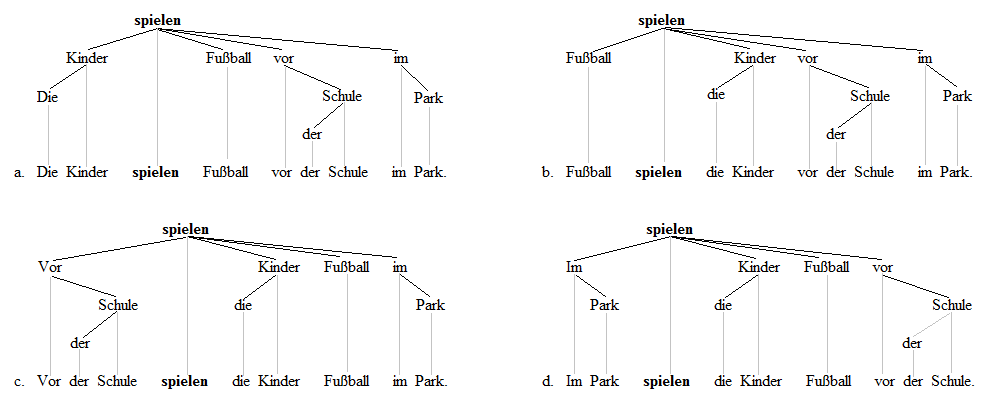
The finite verb spielen is the root of all clause structure. The V2 principle requires that this root have a single predependent, which it does in each of the four sentences.
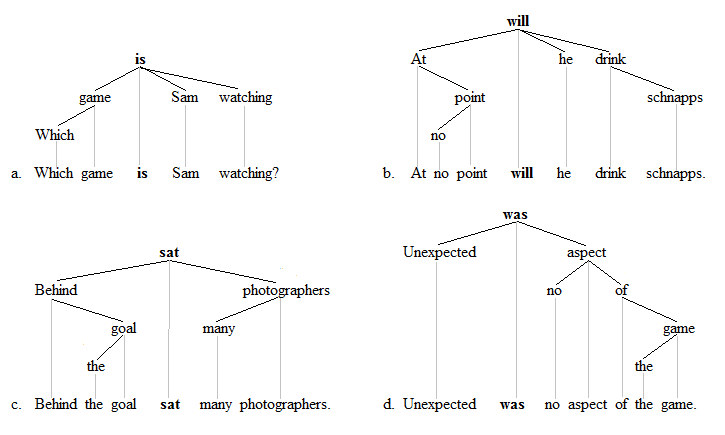
The four English sentences above involving the V2 phenomenon receive the following analyses:
In the theory of Generative Grammar, the verb second phenomenon has been described as an application of X-bar theory. The combination of a first position for a phrase and a second position for a single verb has been identified as the combination of specifier and head of a phrase. The part after the finite verb is then the complement. While the sentence structure of English is usually analysed in terms of three levels, CP, IP, and VP, in German linguistics the consensus has emerged that there is no IP in German.[30]
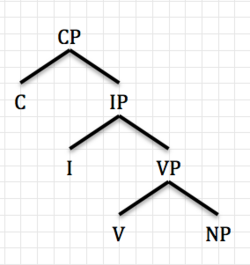
The VP (verb phrase) structure assigns position and functions to the arguments of the verb. Hence, this structure is shaped by the grammatical properties of the V (verb) which heads the structure. The CP (complementizer phrase) structure incorporates the grammatical information which identifies the clause as declarative or interrogative, main or embedded. The structure is shaped by the abstract C (complementiser) which is considered the head of the structure. In embedded clauses the C position accommodates complementizers. In German declarative main clauses, C hosts the finite verb. Thus the V2 structure is analysed as
In embedded clauses, the C position is occupied by a complementizer. In most Germanic languages (but not in Icelandic or Yiddish), this generally prevents the finite verb from moving to C.
This analysis does not provide a structure for the instances in some language of root clauses after bridge verbs.
The solution is to allow verbs such as ved to accept a clause with a second (recursive) CP.[31]