A card attracting a bonus score or side payment, usually to the player or team for holding and declaring them, but sometimes for capturing them in play.[67] From the French honneur. See matador.
In Bridge, the Ace, King, Queen, Jack or Ten in a suit.[68]
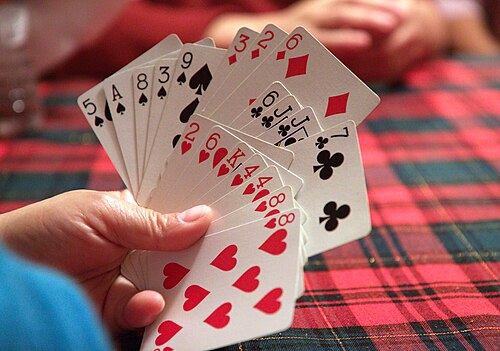
The number or letter printed in the corner of a playing card, so that it may be read when held in a fan.[64]
in turn
A player, or an action, is said to be in turn if that player is expected to act next under the rules. Jerry said "check" while he was in turn, so he's not allowed to raise.
Wooden counters. Jetons are round, fiches are long and contrats are short and rectangular.
jan, jann
The equivalent of lurch or schneider in north German or Scandinavian games. It may mean losing without taking a trick, as in games of the Bruus family, or scoring less than 1/4 of the points, as in games of the Sjavs family.
A circular counter which forms the basic unit of scoring or payment, especially in French card games. Often used along with fiches and contrats which are worth more.[37] See also chip.
To bid higher than an earlier bidder. May take the form of a suit overcall (bid a higher-value suit e.g. in Preference), majority overcall (bid to take a higher number of tricks e.g. in Fipsen) or value overcall (bid to win more card points e.g. in Binokel)[67] The name of such a bid.[79]
The stage of the game during which the players' hands are depleted by plays to tricks or to a common pile, etc.[82] The "rules of play" are the rules for playing tricks, etc. e.g. stating that players must follow suit if able, otherwise may play any card (as at Whist).
May refer either to card points or to game points. Not to be confused with rank and face value. For example, in Briscola, the 3-face valued card is ranked between the Ace and King, and is worth 10 points.
pone
US term for non-dealer in some two-player card games e.g. Colonel[51] or the player on the dealer's right, who cuts the cards.[d][89]
The priority a player has by virtue of his position in relation to the dealer and direction of play. Normally forehand or eldest hand has the highest priority, followed by the other players in the order of play. So, for example, in an auction if two players bid the same ranking contract and play is clockwise, the player nearest the dealer's left hand usually has priority.
A virapulla - traditional Swedish tin for holding gaming counters. The pot for gaming chips is in the reversible lid.
pot
A container into which money or chips are paid initially and during a game and from which the winnings are paid out.[90]
The contents of the pot. An accumulation of chips, antes, bets, forfeits, etc., to win which is the object of the game.[91]
American term for a blind or skat.[122] Hand of cards dealt face down on the table at the start of play that may subsequently be used by players to exchange cards.[109]
↑The term is frequently used, for example, by David Parlett in this sense e.g. "...details of play vary from circle to circle...", "Some circles play with winking...", "Many circles proscribe jokers in initial melds..", "One of the most popular of the 'fancy' games in domestic circles...", "Bridge-playing circles", "Poker circles".[31]
↑For example, see Medley (2019), Learn to Play Bridge, "to underlead the ace means you have the ace in your hand, but you lead a lower-ranking card of the same suit."
Ausführliche anleitung zum Deutschtarokspielen. Munich: Cäsar Fritsch. 1881.
Arnold, Peter (1988) [1995]. The Book of Card Games. New York: Barnes and Noble. ISBN1-56619-950-6.
Arnold, Peter (2007). Chambers Card Games: 100 Great Games Illustrated and Explained. Edinburgh: Chambers. ISBN978-0550103369. Retrieved 12 December 2022– via Open Library.
Arnold, Peter (2011). Card Games for One. London: Chambers. ISBN978-0550-10201-0.
Cavendish (1876). The Laws and Principles of Whist. 5th edn. London: De La Rue.
Crawley, Rawdon (1866). Beeton's Handy Book of Games. London: Beeton.
Dawson, L. (2013) [1923]. Hoyles Card Games. London: Routledge.
* Dummett, Michael (1980). The Game of Tarot. London: Duckworth.
Dummett, Michael; McLeod, John (2003). A History of Games Played with the Tarot Pack: The Game of Triumphs. Vol.1. Lewiston, NY / Lampeter, Wales / Queenston, Ontario: Edwin Mellen.
Dyche, Thomas; Pardon, William (1740). A New General English Dictionary (Thirded.). London: Ware.
Forbes-Lindsay, Charles Harcourt Ainslie; Bergholt, Ernest (1902). The Principles and Practice of Whist. H.T. Coates.
Foster, Robert Frederick (1897). Foster's Complete Hoyle (Thirded.). New York / London: Frederick A. Stokes.
Gibson, Walter B. (1974). Hoyle's Modern Encyclopedia of Card Games: Rules of All the Basic Games and Popular Variations. Garden City, NY: Dolphin Books. ISBN978-0385076807.
Golick, Margie (1998). Card Games for Smart Kids. New York: Sterling. ISBN978-0-8069-4887-4.
Goren, Charles (1950). Goren's Hoyle. New York: Greystone.
Greer, Alec (1979). New Comprehensive Mathematics for 'O' Level. Cheltenham: Stanley Thomas.
Heinsius, Theodor (1828). Vollständiges Wörterbuch, A–F, Volume 1. Vienna: Christian Friedrich Schade.
Jackson, Robin (2001). Solitaire. Barnes & Noble.
Kansil, Joli Quentin, ed. (2001). Official Rules of Card Games (90thed.). Cincinnati: Bicycle. ISBN978-1-889752-06-8.
Mahmood, Zia and Audrey Grant (2014). Bridge for Beginners.
モス、ウィリアム A. (1995). 10分カードゲーム. ニューヨーク: スターリング. ISBN978-0-8069-3847-9。