Loading article…
| Lingonberry | |
|---|---|
 | |
| Vaccinium vitis-idaea var. vitis-idaea surrounded by reindeer lichen | |
Scientific classification | |
| Kingdom: | Plantae |
| Clade: | Embryophytes |
| Clade: | Tracheophytes |
| Clade: | Spermatophytes |
| Clade: | Angiosperms |
| Clade: | Eudicots |
| Clade: | Asterids |
| Order: | Ericales |
| Family: | Ericaceae |
| Genus: | Vaccinium |
| Species: | V. vitis-idaea |
| Binomial name | |
| Vaccinium vitis-idaea L. 1753 | |
| Synonyms[3] | |
Synonymy
| |
Vaccinium vitis-idaea is a small evergreen shrub in the heath family, Ericaceae. It is known colloquially as the lingonberry, partridgeberry,[a]foxberry, mountain cranberry, or cowberry. It is native to the boreal forest and Arctic tundra throughout the Northern Hemisphere. The edible berries are picked in the wild and used in Nordic cuisine, and among many other cuisines around the world; the berries are also commercially cultivated in the United States Pacific Northwest[4] and the Netherlands.[5]
Vaccinium vitis-idaea spreads by underground stems to form dense clonal colonies.[6] Slender and brittle roots grow from the underground stems. The stems are rounded in cross-section and grow from 10 to 40 cm (4 to 16 in) in height. Leaves grow alternately and are oval, 5–30 mm (1⁄4–1+1⁄8 in) long, with a slightly wavy margin, and sometimes with a notched tip.
The flowers are bell-shaped, white to pale pink, 3–8 mm (1⁄8–3⁄8 in) long.[7]V. vitis-idaea begins to produce flowers from five to ten years of age.[8] They are pollinated by multiple insect species, including Andrena lapponica and several species of bumblebee.[8]
The fruit is a red berry6–10 mm (1⁄4–3⁄8 in) across, with an acidic taste, ripening in late summer to autumn.[9] While bitter early in the season, they sweeten if left on the branch through winter.[10] Cytology is 2n = 24.[11] Its fruit persists for an average of 13.4 days, and bears an average of 11.2 seeds per fruit. Fruits average 84.9% water, and their dry weight includes 15.4% carbohydrates and 1.5% lipids.[12]
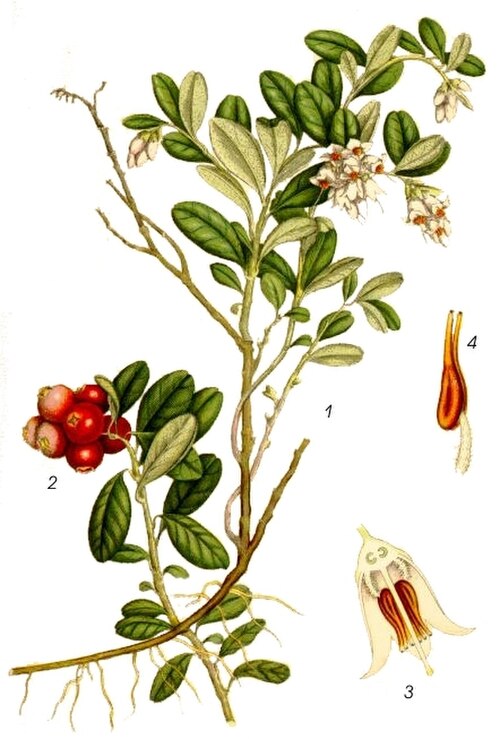


Vaccinium vitis-idaea differs from the related cranberries in having white flowers with petals partially enclosing the stamens and stigma, rather than pink flowers with petals reflexed backwards, and rounder, less pear-shaped berries.Vaccinium oxycoccos is similar.[13]
Hybrids between Vaccinium vitis-idaea and V. myrtillus, named Vaccinium × intermediumRuthe, are occasionally found in Europe.

There are two regional varieties or subspecies of V. vitis-idaea, one in Eurasia and one in North America, differing in leaf size:
Vaccinium vitis-idaea is most commonly known in English as 'lingonberry' or 'cowberry'.[14][15][16] The name 'lingonberry' originates from the Swedish name lingon ([ˈlɪŋɔn]ⓘ) for the species deriving from Old Norselyngr, a cognate (thus also a doublet) to 'ling'.[17]
The genus nameVaccinium is a classical Latin name for a plant, possibly the bilberry or hyacinth, and may be derived from the Latin bacca, 'berry'.[18][19] The specific name is derived from Latin vitis ('vine') and idaea, the feminine form of idaeus (literally 'from Mount Ida', used in reference to raspberries Rubus idaeus).[20][21]
Worldwide, Vaccinium vitis-idaea is known by at least 25 other common English names, including:[14]
スノキ(Vaccinium vitis-idaea)は、最も寒い年でも冬の間ずっと葉を保ちます。これは広葉植物 としては珍しい特徴ですが、自生地では通常、積雪によって厳しい寒さから守られています。非常に耐寒性が高く、-45 ℃(-50 °F)以下の低温にも耐えますが、夏が暑い地域では生育が悪くなります。日陰(森林の樹冠など)と、常に湿った酸性土壌 を好みます。栄養分の少ない土壌にも耐えられますが、アルカリ性土壌には適しません。
この植物はミシガン州で絶滅危惧種に指定されている。[ 23 ]マイナス亜種は特別懸念種に指定されており、コネチカット州では絶滅したと考えられている。[ 24 ] [ 25 ]
リンゴンベリーは1960年代からオランダ、ドイツ、スウェーデン、ポーランド、アメリカ、ラトビアで商業的に栽培されている。 [ 5 ]
観賞用として栽培される品種もあり、食用としての価値は低い。イギリスでは、コラルグループが王立園芸協会のガーデンメリット賞を受賞している。[ 26 ] [ 27 ]
生のリンゴンベリーは、水分が86%、炭水化物が13%、タンパク質が1%で、脂肪はごくわずかしか含まれていません。[ 28 ] 100グラム(3.5オンス)の基準量では、リンゴンベリーは54kcalを供給し、ビタミンC、ビタミンB群、および食物性ミネラルの低~中程度の供給源です。[ 28 ]
The berries collected in the wild are a popular fruit in northern, central and eastern Europe, notably in the Nordic countries,[29] the Baltic states, central and northern Europe. In some areas, they can be picked legally on both public and private lands in accordance with the freedom to roam.[30]
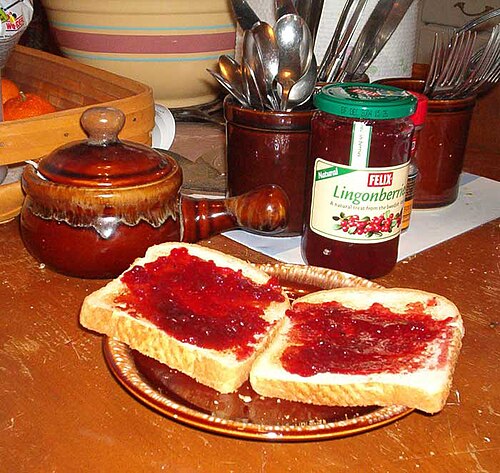
The berries are quite tart, so they are often cooked and sweetened before eating as lingonberry jam, compote, juice, smoothie or syrup. The raw fruits are also frequently simply mashed with sugar. Fruit served this way or as compote often accompanies game and liver dishes.
In Sweden the traditional Swedish meatballs are served with lingonberry jam alongside boiled or mashed potatoes and gravy sauce. In Sweden, Finland and Norway, reindeer and elk steaks are traditionally served with gravy and lingonberry sauce. Preserved fruit is commonly eaten with meatballs, as well as potato pancakes. A traditional Swedish dessert is lingonpäron (literally 'lingonberry pears'), consisting of fresh pears which are peeled, boiled and preserved in lingondricka (lingonberry juice) and is commonly eaten during Christmas. This was very common in old times, because it was an easy way to preserve pears. In Sweden and Russia, when sugar was still a luxury item, the berries were usually preserved simply by putting them whole into bottles of water. This was known as vattlingon (watered lingonberries); the procedure preserved them until next season. This was also a home remedy against scurvy.
This traditional Russian soft drink, known as "lingonberry water", is mentioned by Alexander Pushkin in Eugene Onegin. In Russian folk medicine, lingonberry water was used as a mild laxative. A traditional Finnish dish is sautéed reindeer (poronkäristys) with mashed potatoes and lingonberries on the side, either raw, thawed or as a jam. In Finland, whipped semolina pudding flavored with lingonberry (puolukkapuuro) is also popular. In Poland, the berries are often mixed with pears to create a sauce served with poultry or game. The berries can also be used to replace redcurrants when creating Cumberland sauce.
The berries are also popular as a wild picked fruit or fruit crop in Newfoundland and Labrador, where they are locally known as partridgeberries or redberries. In this region they are incorporated into jams, syrups, fruit wines, cocktail bitters, sauces, and baked goods, such as pies, scones, cakes, and muffins.[31]
In Sweden lingonberries are often sold as jam and juice, and as a key ingredient in dishes. They are used to make Lillehammer berry liqueur; and, in East European countries, lingonberry vodka is sold, and vodka with lingonberry juice or mors is a cocktail.
The berries are an important food for bears and foxes, and many fruit-eating birds. Caterpillars of the case-bearer moths Coleophora glitzella, Coleophora idaeella and Coleophora vitisella are obligate feeders on V. vitis-idaea leaves.
Alaska natives mix the berries with rose hip pulp and sugar to make jam, cook the berries as a sauce, and store the berries for future use.[32] The Dakelh use the berries to make jam.[33] The Koyukon freeze the berries for winter use.[34]Inuit dilute and sweeten the juice to make a beverage, freeze and store the berries for spring, and use the berries to make jams and jellies.[35] The Iñupiat use the berries to make two different desserts, one in which the berries are whipped with frozen fish eggs and eaten, and one in which raw berries are mashed with canned milk and seal oil. They also make a dish of the berries cooked with fish eggs, fish (whitefish, sheefish or pike) and blubber.[36]
The Upper Tanana boil the berries with sugar and flour to thicken; eat the raw berries, either plain or mixed with sugar, grease or a combination of the two; fry them in grease with sugar or dried fish eggs; or make them into pies, jam, and jelly. They also preserve the berries alone or in grease and store them in a birchbark basket in an underground cache, or freeze them.[37]
アンティコスティの人々は、この果実を使ってジャムやゼリーを作ります。[ 38 ]ニヒサワク・クリー族は、冬の間、ベリーを屋外で凍らせて保存し、茹でた魚卵、レバー、浮き袋、脂肪と混ぜて食べたり、生でスナックとして食べたり、魚や肉と一緒に煮たりします。[ 39 ]ネルソン島のイヌピアット族はベリーを食べます。[ 40 ]北ベーリング海とアラスカの北極圏のイヌピアット族も同様です。[ 41 ]また、イヌヴィアルイト族も同様です。[ 42 ]ハイダ族、ヘスキアット・ファースト・ネーション、ウィキヌク族、ツィムシアン族は皆、ベリーを食用としています。[ 43 ]
伝統医学では、V. vitis-idaeaは食前酒や収斂剤として使用されていました。[ 44 ]上タナナ族は、その実を食べたり、ジュースを使って軽度の呼吸器疾患を治療していました。[ 37 ]
ニヒサワク・クリー族は、マイナス亜種の果実をヤマアラシの針の色付けに使用し、固く熟した果実を紐に通してネックレスとして身につける。[ 39 ]西カナダのイヌイットは、マイナス亜種をタバコの添加物または代用品として使用する。 [ 42 ]
ニューファンドランド・ラブラドール州では、リンゴンベリーやリンゴンベリーエキスが手作り石鹸やキャンドルによく使われている。

 ウィキメディア・コモンズのスノキ属 vitis-idaeaに関連するメディア