Eligibility for GAHT may require an assessment for gender dysphoria or persistent gender incongruence; many medical institutions now use an informed consent model, which ensures patients are informed of the procedure process, including possible benefits and risks, while removing many of the historical barriers needed to start hormone therapy. Treatment guidelines for therapy have been developed by several medical associations. However, many transgender people of all ages safely obtain and administer hormone therapy to themselves (DIY transgender hormone therapy) without recourse to institutional 'gatekeepers'. This helps them to overcome legal barriers to care, and to obtain higher, more effective dosages and a wide range of medications.
Non-binary people may also engage in hormone therapy in order to achieve a desired balance of sex hormones or to help align their bodies with their gender identities.[1] Many transgender people obtain hormone replacement therapy from a licensed health care provider, while others obtain and self-administer hormones.
For transgender youth, the Dutch protocol existed as among the earlier guidelines for hormone therapy by delaying puberty until age 16.[10][11] The World Professional Association for Transgender Health (WPATH) and the Endocrine Society later formulated guidelines that created a foundation for health care providers to care for transgender patients.[12][13]UCSF guidelines are also sometimes used.[4] There is no generally agreed-upon set of guidelines, however.[14]
National and regional guidance also exists in several countries. In Canada, Rainbow Health Ontario publishes primary-care guidelines for gender-affirming care with trans and non-binary patients.[15] In Australia, the Australian Informed Consent Standards of Care for Gender Affirming Hormone Therapy are recognised as an Accepted Clinical Resource by the Royal Australian College of General Practitioners.[16] In New Zealand, adult primary-care initiation guidelines for gender-affirming hormone therapy were released in 2023 and endorsed by the Royal New Zealand College of General Practitioners.[17] France's Haute Autorité de santé has published practice guidelines for the care of transgender adults.[18] In German-speaking countries, adult care may refer to the AWMF S3 guideline on gender incongruence, gender dysphoria and trans health.[19] In Japan, the Japanese Society of Psychiatry and Neurology issues guidelines on the diagnosis and treatment of gender incongruence.[20]
Delaying puberty in adolescents
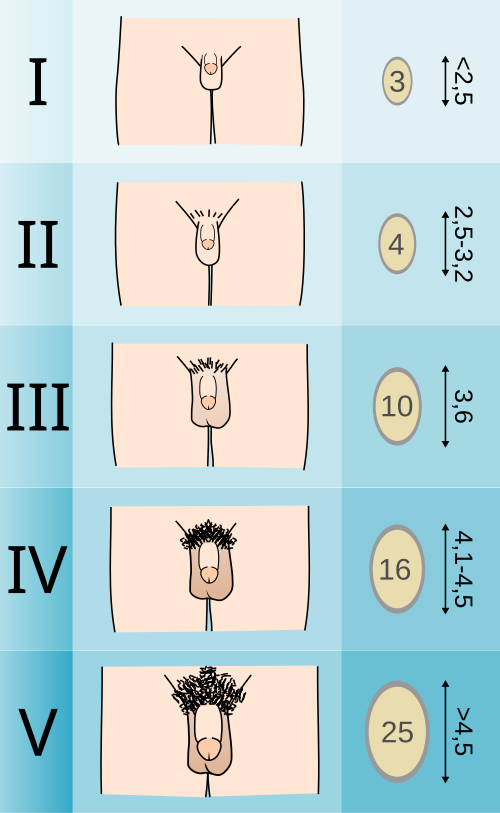
Tanner stages for female sexual characteristicsTanner stages for male sexual characteristics
The desired effects of feminizing hormone therapy focus on the development of feminine secondary sex characteristics. These desired effects include: breast tissue development, redistribution of body fat, decreased body hair, reduction of muscle mass, and more.[26] The table below summarizes some of the effects of feminizing hormone therapy in transgender women:
Unlike feminizing hormone therapy, individuals undergoing masculinizing hormone therapy do not usually require additional hormone suppression such as estrogen suppression. Therapeutic doses of testosterone are usually sufficient to inhibit the production of estrogen to desired physiologic levels.[22]
The desired effects of masculinizing hormone therapy focus on the development of masculine secondary sex characteristics. These desired effects include: increased muscle mass, increased bone turnover,[42] development of facial hair, voice deepening, increase and thickening of body hair, and more.[43]
Safety
Hormone therapy for transgender individuals has been shown in medical literature to be generally safe, when supervised by a qualified medical professional.[52] There are potential risks with hormone treatment that will be monitored through screenings and lab tests such as blood count (hemoglobin), kidney and liver function, blood sugar, potassium, and cholesterol.[41][25] Taking more medication than directed may lead to health problems such as increased risk of cancer, heart attack from thickening of the blood, blood clots, and elevated cholesterol.[41][53] Hormone therapy has been shown to improve the psychosocial well-being, and lower levels of distress among transgender individuals.[54]
Cardiovascular risks vary by hormone regimen, dose, route of administration, age, smoking status, and other individual risk factors. Estrogen therapy is associated with concern about venous thromboembolism, while testosterone therapy may affect cardiovascular risk factors such as blood pressure, lipids, weight, and erythrocytosis.[55] A 2025 Dutch cohort study found that cardiovascular risk patterns differed between transgender women and transgender men receiving gender-affirming hormone therapy: transgender women did not have increased arterial cardiovascular risk compared with general-population men, but had increased venous thromboembolism risk, while transgender men had increased risks of myocardial infarction and ischaemic cerebrovascular accident compared with general-population women.[56]
Feminizing hormone therapy
The Standards of Care published by the World Professional Association for Transgender Health (WPATH) summarize many of the risks associated with feminizing hormone therapy (outlined below).[7]
Masculinizing hormone therapy
The Standards of Care published by the World Professional Association for Transgender Health (WPATH) summarize many of the risks associated with masculinizing hormone therapy (outlined below).[7]
A study presented at ENDO 2019 (the Endocrine Society's conference) shows that even after one year of treatment with testosterone, a transgender man can preserve his fertility potential.[59] A 2015 study demonstrated normal spermatogenesis in some transgender women who were long-term estrogen therapy patients.[60] In other cases, there is some research showing effective restoration of fertility by alternative means than HRT cessation alone. Dr. Will Powers has demonstrated the effectiveness of clomifene in restoring spermatogenesis in trans women.[61] His study also includes an in-depth description of other methods for fertility restoration.[61]
Gene expression
Some molecular biology research suggests that GAHT induces a "unique molecular profile" with potential relevance to the recipient's immune system, or (in)susceptibility to certain health conditions (which are sometimes sexually dimorphic in people); one 2022 analysis found that GAHT (both feminizing and masculinizing) influenced gene expression.[62][63][64] The study's lead author stated that they observed "changes [to] the epigenetic landscape of DNA" in some regions but not others, and that of the observed "epigenetic changes in regions of DNA that were distinct between sexes before hormone therapy, these regions consistently shifted towards the profile of the affirmed gender after 12 months of hormone therapy."[62] A 2023 molecular study on the breast tissue of transgender men found that adding androgens induced such changes, appearing to silence genes across the breast tissue, including a suppression of genes linked to breast cancer.[65][66]
Counterfeit products
Some online scammers have been targeting trans consumers with products that do not contain any hormones or contain ones that are opposite of what is advertised. [67]
Treatment eligibility
Many providers use informed consent, whereby someone seeking hormone therapy can sign a statement of informed consent and begin treatment without much gatekeeping. For other providers, eligibility is determined using major diagnostic tools such as ICD-11 or the Diagnostic and Statistical Manual of Mental Disorders (DSM) to classify a patient with gender dysphoria. The Endocrine Society requires physicians that diagnose gender dysphoria and gender incongruence to be trained in psychiatric disorders with competency in ICD-11 and DSM-5. The healthcare provider should also obtain a thorough assessment of the patient's mental health and identify potential psychosocial factors that can affect therapy.[68]
WPATH Standards of Care
The WPATH Standards of Care, most recently published in 2022, outlines a series of guidelines which should be met before a patient should be allowed gender-affirming hormone therapy:[55]
Gender incongruence is marked and sustained
Patient meets diagnostic criteria for gender incongruence prior to gender-affirming hormone treatment in regions where a diagnosis is necessary to access health care
Patient has capacity to consent to hormone therapy treatment
Other possible causes of apparent gender incongruence have been identified and excluded
Mental health and physical conditions that could negatively impact the outcome of treatment have been assessed
Understands the effect of gender-affirming hormone treatment on reproduction and they have explored reproductive options
The WPATH standards of care distinguish between gender-affirming hormone therapy, and hormone replacement therapy, with the latter referring to the replacement of endogenous hormones after a gonadectomy to prevent cardiovascular and musculoskeletal issues.[55]
Readiness
Some organizations—but fewer than in the past—require that patients spend a certain period of time living in their desired gender role before starting hormone therapy. This period is sometimes called real-life experience (RLE).
In Sweden, for instance, patients seeking to access gender affirming healthcare must first undergo extended evaluations with psychiatric professionals, during which they must—without any form of medical transition—successfully live for one full year as their desired gender in all professional, social, and personal matters. Gender clinics are recommended to provide patients with wigs and breast prostheses for the endeavor. The evaluation additionally involves, if possible, meetings with family members and/or other individuals close to the patient. Patients may be denied care for any number of "psychosocial dimensions", including their choice of job or their marital status.[69][70]
↑Olson-Kennedy J, Cohen-Kettenis PT, Kreukels BP, Meyer-Bahlburg HF, Garofalo R, Meyer W, etal. (April 2016). "Research priorities for gender nonconforming/transgender youth: gender identity development and biopsychosocial outcomes". Current Opinion in Endocrinology, Diabetes, and Obesity. 23 (2): 172–179. doi:10.1097/MED.0000000000000236. PMC4807860. PMID26825472.
↑Shumer DE, Spack NP (January 2015). "Paediatrics: Transgender medicine--long-term outcomes from 'the Dutch model'". Nature Reviews. Urology. 12 (1): 12–13. doi:10.1038/nrurol.2014.316. ISSN1759-4820. PMC4349440. PMID25403246.
↑Delemarre-van de Waal HA, Cohen-Kettenis PT (November 2006). "Clinical management of gender identity disorder in adolescents: a protocol on psychological and paediatric endocrinology aspects". European Journal of Endocrinology. 155 (suppl_1): S131–S137. doi:10.1530/eje.1.02231. ISSN0804-4643.
↑Hembree WC, Cohen-Kettenis P, Delemarre-van de Waal HA, Gooren LJ, Meyer WJ, Spack NP, etal. (1 September 2009). "Endocrine Treatment of Transsexual Persons:An Endocrine Society Clinical Practice Guideline". The Journal of Clinical Endocrinology & Metabolism. 94 (9): 3132–3154. doi:10.1210/jc.2009-0345. ISSN0021-972X. PMID19509099.
↑Unger CA (December 2016). "Hormone therapy for transgender patients". Translational Andrology and Urology. 5 (6): 877–884. doi:10.21037/tau.2016.09.04. PMC5182227. PMID28078219.
↑Houssayni S, Nilsen K (28 February 2018). "Transgender Competent Provider: Identifying Transgender Health Needs, Health Disparities, and Health Coverage". Kansas Journal of Medicine. 11 (1): 15–19. doi:10.17161/kjm.v11i1.8679. PMC5834239. PMID29844850.
↑"Guidelines for gender-affirming primary care with trans and non-binary patients"(PDF). Rainbow Health Ontario. Retrieved 2 May 2026.
↑"Gender Affirming Hormone Therapy". Royal Australian College of General Practitioners. Retrieved 2 May 2026.
↑"NZ and International Clinical Guidelines". Professional Association for Transgender Health Aotearoa. Retrieved 2 May 2026.
↑"Care for transgender adults". Haute Autorité de santé. 18 July 2025. Retrieved 2 May 2026.
↑"Geschlechtsinkongruenz und Geschlechtsdysphorie". Austrian Federal Ministry of Labour, Social Affairs, Health, Care and Consumer Protection. Retrieved 2 May 2026.
↑"性別不合に関する診断と治療のガイドライン" (in Japanese). Japanese Society of Psychiatry and Neurology. Retrieved 2 May 2026.
↑Emmanuel M, Bokor BR (2021). "Tanner Stages". StatPearls. Treasure Island (FL): StatPearls Publishin. PMID29262142. Archived from the original on 10 February 2022. Retrieved 12 November 2021.
12Bangalore Krishna K, Fuqua JS, Rogol AD, Klein KO, Popovic J, Houk CP, etal. (2019). "Use of Gonadotropin-Releasing Hormone Analogs in Children: Update by an International Consortium". Hormone Research in Paediatrics. 91 (6): 357–372. doi:10.1159/000501336. PMID31319416. S2CID197664792.
↑Matt Lavietes (26 January 2025). "Less than 0.1% of U.S. minors take gender-affirming medication, study finds". NBC News.
↑"Hormone Use for Non-Binary People". GenderGP. Archived from the original on 3 May 2022. Retrieved 18 October 2020.
12"Information on Estrogen Hormone Therapy". Transgender Care. transcare.ucsf.edu. Archived from the original on 3 May 2022. Retrieved 7 August 2019.
123"Overview of feminizing hormone therapy". Gender Affirming Health Program. transcare.ucsf.edu. Retrieved 12 November 2021.
↑Defreyne J, Elaut E, Kreukels B, Daphne Fisher A, Castellini G, Staphorsius A, etal. (April 2020). "Sexual Desire Changes in Transgender Individuals Upon Initiation of Hormone Treatment: Results From the Longitudinal European Network for the Investigation of Gender Incongruence". The Journal of Sexual Medicine. 17 (4): 812–825. doi:10.1016/j.jsxm.2019.12.020. hdl:1854/LU-8723420. PMID32008926.
↑Elliott S, Latini DM, Walker LM, Wassersug R, Robinson JW (September 2010). "Androgen deprivation therapy for prostate cancer: recommendations to improve patient and partner quality of life". The Journal of Sexual Medicine. 7 (9): 2996–3010. doi:10.1111/j.1743-6109.2010.01902.x. PMID20626600.
↑Higano CS (October 2012). "Sexuality and intimacy after definitive treatment and subsequent androgen deprivation therapy for prostate cancer". Journal of Clinical Oncology. 30 (30): 3720–3725. doi:10.1200/JCO.2012.41.8509. PMID23008326.
↑Nieschlag E, Behre H (29 June 2013). Andrology: Male Reproductive Health and Dysfunction. Springer Science & Business Media. pp.54–. ISBN978-3-662-04491-9.
↑Hembree WC, Cohen-Kettenis PT, Gooren L, Hannema SE, Meyer WJ, Murad MH, etal. (November 2017). "Endocrine Treatment of Gender-Dysphoric/Gender-Incongruent Persons: An Endocrine Society Clinical Practice Guideline". The Journal of Clinical Endocrinology and Metabolism. 102 (11): 3869–3903. doi:10.1210/jc.2017-01658. PMID28945902. S2CID3726467.
↑Bourns A (2015). "Guidelines and Protocols for Comprehensive Primary Care for Trans Clients"(PDF). Sherbourne Health Centre. Archived(PDF) from the original on 10 May 2020. Retrieved 15 August 2018.
↑Fabris B, Bernardi S, Trombetta C (March 2015). "Cross-sex hormone therapy for gender dysphoria". Journal of Endocrinological Investigation. 38 (3): 269–282. doi:10.1007/s40618-014-0186-2. hdl:11368/2831597. PMID25403429. S2CID207503049.
↑Moore E, Wisniewski A, Dobs A (August 2003). "Endocrine treatment of transsexual people: a review of treatment regimens, outcomes, and adverse effects". The Journal of Clinical Endocrinology and Metabolism. 88 (8): 3467–3473. doi:10.1210/jc.2002-021967. PMID12915619.
↑Asscheman H, Gooren LJ (1993). "Hormone Treatment in Transsexuals". Journal of Psychology & Human Sexuality. 5 (4): 39–54. doi:10.1300/J056v05n04_03. ISSN0890-7064. S2CID144580633.
↑Levy A, Crown A, Reid R (October 2003). "Endocrine intervention for transsexuals". Clinical Endocrinology. 59 (4): 409–418. doi:10.1046/j.1365-2265.2003.01821.x. PMID14510900. S2CID24493388.
↑de Blok C, Klaver M, Nota N, Dekker M, den Heijer M (2016). "Breast development in male-to-female transgender patients after one year cross-sex hormonal treatment". Endocrine Abstracts. 41. doi:10.1530/endoabs.41.GP146. ISSN1479-6848.
↑de Blok CJ, Klaver M, Wiepjes CM, Nota NM, Heijboer AC, Fisher AD, etal. (February 2018). "Breast Development in Transwomen After 1 Year of Cross-Sex Hormone Therapy: Results of a Prospective Multicenter Study". The Journal of Clinical Endocrinology and Metabolism. 103 (2): 532–538. doi:10.1210/jc.2017-01927. PMID29165635. S2CID3716975.
↑"Masculinizing hormone therapy - Mayo Clinic". www.mayoclinic.org. Archived from the original on 16 July 2019. Retrieved 2 August 2019.
1234"Information on Testosterone Hormone Therapy". Transgender Care. transcare.ucsf.edu. Archived from the original on 22 November 2019. Retrieved 7 August 2019.
↑Van Caenegem E, Wierckx K, Taes Y, Schreiner T, Vandewalle S, Toye K, etal. (February 2015). "Body composition, bone turnover, and bone mass in trans men during testosterone treatment: 1-year follow-up data from a prospective case–controlled study (ENIGI)". European Journal of Endocrinology. 172 (2): 163–171. doi:10.1530/eje-14-0586. ISSN0804-4643. PMID25550352.
↑Deutsch MB (17 June 2016). "Overview of masculinizing hormone therapy". UCSF Gender Affirming Health Program. San Francisco, CA: The University of California. Archived from the original on 19 June 2023. Retrieved 12 November 2021.
12345678"HRT Timeline and Effects: Hormone Replacement Therapy Info". GenderGP. 13 July 2021. Retrieved 15 August 2025.
↑ Pathoulas JT、Flanagan KE、Walker CJ、Pupo Wiss IM、Marks D、Senna MM (2022)。「トランスジェンダー男性における性同一性および性表現における顔の毛の役割の特徴付け」。Journal of the American Academy of Dermatology。87:228–230。doi: 10.1016 / j.jaad.2021.07.060。PMID 34363904。
↑Weinand JD, Safer JD (June 2015). "Hormone therapy in transgender adults is safe with provider supervision; A review of hormone therapy sequelae for transgender individuals". Journal of Clinical & Translational Endocrinology. 2 (2): 55–60. doi:10.1016/j.jcte.2015.02.003. PMC5226129. PMID28090436.
↑"A randomized, double-blind study of two combined oral contraceptives containing the same progestogen, but different estrogens. World Health Organization Task Force on Oral Contraception". Contraception. 21 (5): 445–459. May 1980. doi:10.1016/0010-7824(80)90010-4. PMID7428356.
↑Doyle DM, Lewis TO, Barreto M (August 2023). "A systematic review of psychosocial functioning changes after gender-affirming hormone therapy among transgender people". Nature Human Behaviour. 7 (8): 1320–1331. doi:10.1038/s41562-023-01605-w. ISSN2397-3374. PMC10444622. PMID37217739.
12345Coleman E, Radix AE, Bouman WP, Brown GR, de Vries AL, Deutsch MB, etal. (19 August 2022). "Standards of Care for the Health of Transgender and Gender Diverse People, Version 8". International Journal of Transgender Health. 23 (Suppl 1): S1–S259. doi:10.1080/26895269.2022.2100644. PMC9553112. PMID36238954.
↑van Zijverden LM, Thijs A, van Diemen JJ, Wiepjes CM, den Heijer M (4 November 2025). "Transgender persons receiving gender-affirming hormone therapy: risk of acute cardiovascular events in a Dutch cohort study". European Heart Journal ehaf837. doi:10.1093/eurheartj/ehaf837.
12T'Sjoen G, Van Caenegem E, Wierckx K (December 2013). "Transgenderism and reproduction". Current Opinion in Endocrinology, Diabetes, and Obesity. 20 (6): 575–579. doi:10.1097/01.med.0000436184.42554.b7. PMID24468761. S2CID205398449.
12De Sutter P (April 2001). "Gender reassignment and assisted reproduction: present and future reproductive options for transsexual people". Human Reproduction. 16 (4): 612–614. doi:10.1093/humrep/16.4.612. PMID11278204.
↑"Ovary function is preserved in transgender men at one year of testosterone therapy". Endocrine Society. 23 March 2019. Archived from the original on 22 May 2022. Retrieved 25 March 2019.
↑Jones CA, Reiter L, Greenblatt E (2 April 2016). "Fertility preservation in transgender patients". International Journal of Transgenderism. 17 (2): 76–82. doi:10.1080/15532739.2016.1153992. ISSN1553-2739. S2CID58849546.
12Powers WJ (20 March 2024). "A Gender-Affirming Approach to Fertility Care for Transgender and Gender-Diverse Patients"(PDF). Lippincott. Retrieved 8 July 2024.
12Henderson E (28 February 2022). "Study shows the impact of gender-affirming hormone therapy on epigenetic signature of genes". News-Medical. AZoNetwork.
↑Shepherd R, Bretherton I, Pang K, Mansell T, Czajko A, Kim B, etal. (2022). "Gender-affirming hormone therapy induces specific DNA methylation changes in blood". Clinical Epigenetics. 14 (1): 24. doi:10.1186/s13148-022-01236-4. ISSN1868-7083. PMC8851870. PMID35177097.
↑"Gender-affirming hormone therapy can influence gene activity". Murdoch Children's Research Institute. Austin Health, The Walter and Eliza Hall Institute of Medical Research and The Royal Children's Hospital. 1 March 2022.{{cite news}}: CS1 maint: others (link)
↑Barker PhD H (15 March 2023). "Hormone Therapy Triggers Male Gene Patterns in Transgender Men's Cells". The Scientist. Retrieved 28 July 2025.
↑Raths F, Karimzadeh M, Ing N, Martinez A, Yang Y, Qu Y, etal. (8 March 2023). "The molecular consequences of androgen activity in the human breast". Cell Genomics. 3 (3) 100272. doi:10.1016/j.xgen.2023.100272. ISSN2666-979X. PMC10025454. PMID36950379.
↑Xiang C (14 June 2023). "A Sketchy Website Advertised Fake Hormone Pills to Trans People. Then, It Disappeared". Vice. Archived from the original on 25 July 2024. Retrieved 2 June 2024.
↑"CORRIGENDUM FOR "Endocrine Treatment of Gender-Dysphoric/Gender-Incongruent Persons: An Endocrine Society Clinical Practice Guideline"". The Journal of Clinical Endocrinology and Metabolism. 103 (7): 2758–2759. July 2018. doi:10.1210/jc.2018-01268. PMID29905821.
↑Linander I, Lauri M (2021). "Two Steps Forward, One Step Back: A Policy Analysis of the Swedish Guidelines for Trans-Specific Healthcare". Sexuality Research and Social Policy. 18 (2): 309–320. doi:10.1007/s13178-020-00459-5. S2CID256073192.
↑"God vård av vuxna med könsdysfori"(PDF). Archived(PDF) from the original on 25 July 2024. Retrieved 7 February 2024.
↑Bornstein K (2013). My Gender Workbook, Updated: How to Become a Real Man, a Real Woman, the Real You, or Something Else Entirely (2nded.). New York: Routledge. ISBN978-0-415-53865-7.
↑Coleman E, Radix AE, Bouman WP, Brown GR, de Vries AL, Deutsch MB, etal. (19 August 2022). "Standards of Care for the Health of Transgender and Gender Diverse People, Version 8". International Journal of Transgender Health. 23 (sup1): S1–S259. doi:10.1080/26895269.2022.2100644. ISSN2689-5269. PMC9553112. PMID36238954.
↑Kennedy CE, Yeh PT, Byrne J, van der Merwe LL, Ferguson L, Poteat T, etal. (2021). "Self-administration of gender-affirming hormones: A systematic review of effectiveness, cost, and values and preferences of end-users and health workers". Sexual and Reproductive Health Matters. 29 (3) 2045066. doi:10.1080/26410397.2022.2045066. PMC8942532. PMID35312467.
↑"Survey of Patient Satisfaction with Transgender Services"(PDF). The Audit Information & Analysis Unit. National Health Service. Archived from the original(PDF) on 4 March 2016. Retrieved 8 January 2016.
↑Becerra Fernández A, de Luis Román DA, Piédrola Maroto G (October 1999). "[Morbidity in transsexual patients with cross-gender hormone self-treatment]"[Morbidity in transsexual patients with cross-gender hormone self-treatment](PDF). Medicina Clinica (in Spanish). 113 (13): 484–487. PMID10604171. Archived from the original(PDF) on 8 December 2017. Retrieved 11 November 2018.
Categories:
Endocrine procedures
Gender transition and medicine
Medical treatments
Hidden categories:
Articles with short description
Short description is different from Wikidata
Articles containing Neapolitan-language text
Use dmy dates from May 2026
All articles with unsourced statements
Articles with unsourced statements from May 2025
CS1 Japanese-language sources (ja)
Articles with unsourced statements from August 2024