When players are primarily playing for the stakes in a pot, this is a separate payment directly from one player's pocket to another, for example to reward a bonus.
side pot
A pot that is separate from the main pot,[104] either for specific bonuses or used when the main pot reaches a certain limit.
side strength
A player with side strength has high cards in side suits.[104]
Any convention of play whereby the team members properly give each other information as allowed by the rules.[102][104]
Any permitted physical sign or gesture, such as winking or tapping the table when playing a card, that conveys information to one's partner(s).
single, singly
The basic, usually lowest, value of a game is described as 'single'. A game is won 'singly' if its value is not increased by bonus factors such as winning schneider which would double the score or winning schwarz which might quadruple it.[e]
single-ended, single-figured, single-headed
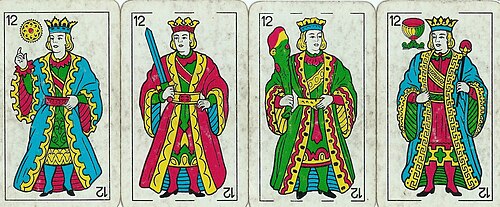
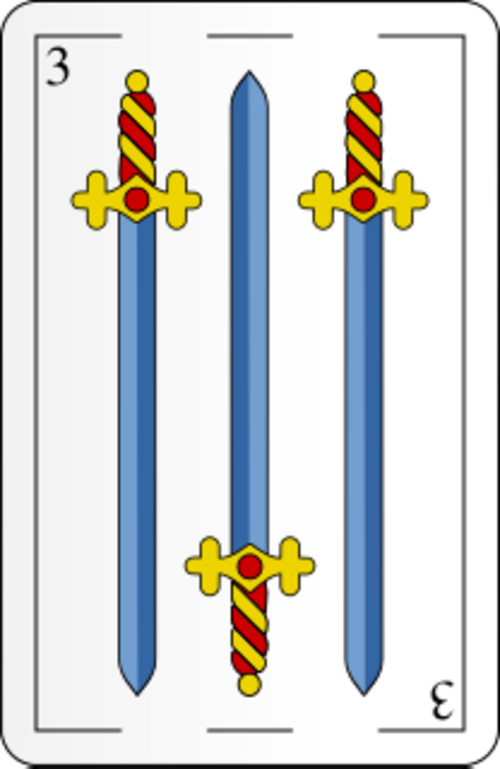
Of a playing card, being designed so that it can only be properly read one way up. There are usually no indices and the courts depict full length figures. Today they have been largely replaced by double-ended or reversible cards.
Widow; extra cards dealt to the table which may be used for exchanging later. Also blind.[102]
Note that, in German, 'skat' can also mean void i.e. lacking any cards of a given suit and therefore 'seeking the skat' means looking for an opponent's void suit.[106]
A game played for 'soft score' – as opposed to hard score is one played for anything other than money, usually points. The score may be chalked on a slate, recorded with pencil and paper. Equally, counters, tokens or chips or even matches may be used.
A pile of cards, face down, which are left over after setting up the rest of the game (i.e. dealing hands, setting up other layout areas) and will be used in the rest of the game.[110] Also talon.
stop, stop card
A card which, when played, ends a sequence of cards on the table or a card that is undealt whose absence prevents the completion of a sequence. Gives its name to the Stops family of games.[107]
An additional stake anted to the pot in Poker to encourage players to stay in the game.[112]
A small bet in Poker not meant to cause an opponent to fold but to build up the pot.[113]
An agreed amount that everyone pays into the pot following an auction in which all passed e.g. in Schafkopf. The pot goes to the next player to win a bid.[114]
sweep
In fishing games to clear the table by capturing all the table cards upon it at that time. Usually earns a bonus.
The undealt portion of the pack which will be used in the rest of the game.[110] Also stock.[109]
Hand of Tarock cards
tariff
The scale of values, either in units or money, on which payments are based for the various contracts in a game. For example, if the tariff is 10 cents; winning double would earn 20 cents and winning triple 30 cents. Games like Schafkopf have a double or triple tariff, e.g. a tariff of 10/50 means that the normal game earns 10 cents from each opponent and a soloist game earns 50 cents.
A combination of high cards not in sequence. Major tenace: A-Q (or K-C in Tarock games); minor tenace: K-J (or Q-J in Tarock games); double tenace: A-Q-10 (or K-C-10/A in Tarock games).[115]
throw in
To return cards to the dealer if, for example, no-one makes a bid or if the cards are misdealt.
To throw up one's cards is to discard them to the table either because you believe the game is decided or nullified, or you wish to drop out of the current hand.
A privileged suit in which, in the current deal, all its cards rank higher than any plain (=non-trump) card.[115]
turn the corner
Said of a sequence of cards when the top card (typically the Ace or King) is preceded by high cards on one side and low cards on the other e.g. 3-2-A-K-Q-J.
Winning the last trick with the lowest trump[117] or, sometimes, with a King.
unchosen suit
In games of the Karnöffel Group, a suit, usually ranking in the natural order, most of all of whose cards have no special privileges, in contrast to the chosen suits. Sometimes called an unselected suit.[30]
underforce or under-force
To answer a card with one of the same suit, but inferior value to those remaining in hand; e.g. putting the nine of clubs on the ten, having the ace in hand.[118] Also under-force, under-play or sous-forcer.[119]
underlead
To lead a low card when holding the top card or cards in a suit.[f]
American term for a blind or skat.[122] Hand of cards dealt face down on the table at the start of play that may subsequently be used by players to exchange cards.[109]
↑The term is frequently used, for example, by David Parlett in this sense e.g. "...details of play vary from circle to circle...", "Some circles play with winking...", "Many circles proscribe jokers in initial melds..", "One of the most popular of the 'fancy' games in domestic circles...", "Bridge-playing circles", "Poker circles".[31]
↑For example, see Medley (2019), Learn to Play Bridge, "to underlead the ace means you have the ace in your hand, but you lead a lower-ranking card of the same suit."
Ausführliche anleitung zum Deutschtarokspielen. Munich: Cäsar Fritsch. 1881.
Arnold, Peter (1988) [1995]. The Book of Card Games. New York: Barnes and Noble. ISBN1-56619-950-6.
Arnold, Peter (2007). Chambers Card Games: 100 Great Games Illustrated and Explained. Edinburgh: Chambers. ISBN978-0550103369. Retrieved 12 December 2022– via Open Library.
Arnold, Peter (2011). Card Games for One. London: Chambers. ISBN978-0550-10201-0.
Cavendish (1876). The Laws and Principles of Whist. 5th edn. London: De La Rue.
Crawley, Rawdon (1866). Beeton's Handy Book of Games. London: Beeton.
Dawson, L. (2013) [1923]. Hoyles Card Games. London: Routledge.
* Dummett, Michael (1980). The Game of Tarot. London: Duckworth.
Dummett, Michael; McLeod, John (2003). A History of Games Played with the Tarot Pack: The Game of Triumphs. Vol.1. Lewiston, NY / Lampeter, Wales / Queenston, Ontario: Edwin Mellen.
Dyche, Thomas; Pardon, William (1740). A New General English Dictionary (Thirded.). London: Ware.
Forbes-Lindsay, Charles Harcourt Ainslie; Bergholt, Ernest (1902). The Principles and Practice of Whist. H.T. Coates.
Foster, Robert Frederick (1897). Foster's Complete Hoyle (Thirded.). New York / London: Frederick A. Stokes.
Gibson, Walter B. (1974). Hoyle's Modern Encyclopedia of Card Games: Rules of All the Basic Games and Popular Variations. Garden City, NY: Dolphin Books. ISBN978-0385076807.
Golick, Margie (1998). Card Games for Smart Kids. New York: Sterling. ISBN978-0-8069-4887-4.
Goren, Charles (1950). Goren's Hoyle. New York: Greystone.
Greer, Alec (1979). New Comprehensive Mathematics for 'O' Level. Cheltenham: Stanley Thomas.
Heinsius, Theodor (1828). Vollständiges Wörterbuch, A–F, Volume 1. Vienna: Christian Friedrich Schade.
Jackson, Robin (2001). Solitaire. Barnes & Noble.
Kansil, Joli Quentin, ed. (2001). Official Rules of Card Games (90thed.). Cincinnati: Bicycle. ISBN978-1-889752-06-8.
Mahmood, Zia and Audrey Grant (2014). Bridge for Beginners.
モス、ウィリアム A. (1995). 10分カードゲーム. ニューヨーク: スターリング. ISBN978-0-8069-3847-9。













 or
or