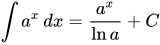
積分は 積分計算 における基本的な演算です。微分には、複雑な 関数 の導関数を、その構成要素となるより単純な関数を微分することで求めることができるという明確な規則 がありますが、積分にはそのような規則がないため、既知の積分表がしばしば役立ちます。このページでは、最も一般的な原始関数 をいくつか紹介します。
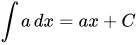
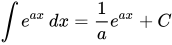
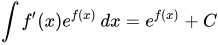
単純関数の積分 Cは 任意の積分定数を 表すために使用され、その定数は、ある時点での積分値に関する情報が分かっている場合にのみ決定できます。したがって、各関数は無限個の原始関数 を持ちます。
これらの式は、導関数表の 主張を別の形で述べているにすぎない。
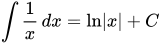
特異点を持つ積分 積分対象の関数に特異点 があり、ある点(特異点)で原始関数が定義されなくなる場合、C は 特異点の両側で同じである必要はありません。以下の形式は通常、C の値の特異点の周りのコーシー主値 を仮定していますが、一般にはこれは必須ではありません。例えば、 ∫ 1 x d x = ln | x | + C {\displaystyle \int {1 \over x}\,dx=\ln \left|x\right|+C} 原始関数 は無限大になります。上記の積分を使用して −1 から 1 までの定積分を計算すると、誤った答え 0 が得られます。ただし、これは特異点の周りの積分のコーシー主値です。複素平面で積分を実行すると、結果は原点の周りの経路に依存します。この場合、原点より上の経路を使用すると特異点が − i π寄与し、原点より下の経路を使用すると i π 寄与します。実数直線上の関数は、次の例のように、原点の両側でC のまったく異なる値を使用できます。 [ 2 ] ∫ 1 x d x = ln | x | + { A もし x > 0 ; B もし x < 0. {\displaystyle \int {1 \over x}\,dx=\ln |x|+{\begin{cases}A&{\text{if }}x>0;\\B&{\text{if }}x<0.\end{cases}}}
対数 ∫ ln x d x = x ln x − x + C = x ( ln x − 1 ) + C {\displaystyle \int \ln x\,dx=x\ln x-x+C=x(\ln x-1)+C} ∫ ログ 1 x d x = x ログ 1 x − x ln 1 + C = x ln 1 ( ln x − 1 ) + C {\displaystyle \int \log _{a}x\,dx=x\log _{a}x-{\frac {x}{\ln a}}+C={\frac {x}{\ln a}}(\ln x-1)+C}
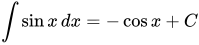
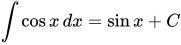
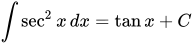
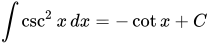
三角関数 ∫ 罪 x d x = − コス x + C {\displaystyle \int \sin x\,dx=-\cos x+C} ∫ コス x d x = 罪 x + C {\displaystyle \int \cos x\,dx=\sin x+C} ∫ タン x d x = ln | 秒 x | + C = − ln | コス x | + C {\displaystyle \int \tan x\,dx=\ln \left|\sec x\right|+C=-\ln \left|\cos x\right|+C} ∫ ベビーベッド x d x = − ln | csc x | + C = ln | 罪 x | + C {\displaystyle \int \cot x\,dx=-\ln \left|\csc x\right|+C=\ln \left|\sin x\right|+C} ∫ 秒 x d x = ln | 秒 x + タン x | + C = ln | タン ( x 2 + π 4 ) | + C {\displaystyle \int \sec x\,dx=\ln \left|\sec x+\tan x\right|+C=\ln \left|\tan \left({\dfrac {x}{2}}+{\dfrac {\pi }{4}}\right)\right|+C} ∫ csc x d x = − ln | csc x + ベビーベッド x | + C = ln | csc x − ベビーベッド x | + C = ln | タン x 2 | + C {\displaystyle \int \csc x\,dx=-\ln \left|\csc x+\cot x\right|+C=\ln \left|\csc x-\cot x\right|+C=\ln \left|\tan {\frac {x}{2}}\right|+C} ∫ 秒 2 x d x = タン x + C {\displaystyle \int \sec ^{2}x\,dx=\tan x+C} ∫ csc 2 x d x = − ベビーベッド x + C {\displaystyle \int \csc ^{2}x\,dx=-\cot x+C} ∫ 秒 x タン x d x = 秒 x + C {\displaystyle \int \sec x\,\tan x\,dx=\sec x+C} ∫ csc x ベビーベッド x d x = − csc x + C {\displaystyle \int \csc x\,\cot x\,dx=-\csc x+C} ∫ 罪 2 x d x = 1 2 ( x − 罪 2 x 2 ) + C = 1 2 ( x − 罪 x コス x ) + C {\displaystyle \int \sin ^{2}x\,dx={\frac {1}{2}}\left(x-{\frac {\sin 2x}{2}}\right)+C={\frac {1}{2}}(x-\sin x\cos x)+C} ∫ コス 2 x d x = 1 2 ( x + 罪 2 x 2 ) + C = 1 2 ( x + 罪 x コス x ) + C {\displaystyle \int \cos ^{2}x\,dx={\frac {1}{2}}\left(x+{\frac {\sin 2x}{2}}\right)+C={\frac {1}{2}}(x+\sin x\cos x)+C} ∫ タン 2 x d x = タン x − x + C {\displaystyle \int \tan ^{2}x\,dx=\tan x-x+C} ∫ ベビーベッド 2 x d x = − ベビーベッド x − x + C {\displaystyle \int \cot ^{2}x\,dx=-\cot x-x+C} ∫ 秒 3 x d x = 1 2 ( 秒 x タン x + ln | 秒 x + タン x | ) + C {\displaystyle \int \sec ^{3}x\,dx={\frac {1}{2}}(\sec x\tan x+\ln \left|\sec x+\tan x\right|)+C} ∫ csc 3 x d x = 1 2 ( − csc x ベビーベッド x + ln | csc x − ベビーベッド x | ) + C = 1 2 ( ln | タン x 2 | − csc x ベビーベッド x ) + C {\displaystyle \int \csc ^{3}x\,dx={\frac {1}{2}}(-\csc x\cot x+\ln \left|\csc x-\cot x\right|)+C={\frac {1}{2}}\left(\ln \left|\tan {\frac {x}{2}}\right|-\csc x\cot x\right)+C} ∫ 罪 n x d x = − 罪 n − 1 x コス x n + n − 1 n ∫ 罪 n − 2 x d x {\displaystyle \int \sin ^{n}x\,dx=-{\frac {\sin ^{n-1}x\cos x}{n}}+{\frac {n-1}{n}}\int \sin ^{n-2}x\,dx} ∫ コス n x d x = コス n − 1 x 罪 x n + n − 1 n ∫ コス n − 2 x d x {\displaystyle \int \cos ^{n}x\,dx={\frac {\cos ^{n-1}x\sin x}{n}}+{\frac {n-1}{n}}\int \cos ^{n-2}{x}\,dx}
逆三角関数 ∫ arcsin x d x = x arcsin x + 1 − x 2 + C 、 のために | x | ≤ 1 {\displaystyle \int \arcsin {x}\,dx=x\arcsin {x}+{\sqrt {1-x^{2}}}+C,{\text{ for }}\vert x\vert \leq 1} ∫ アルコス x d x = x アルコス x − 1 − x 2 + C 、 のために | x | ≤ 1 {\displaystyle \int \arccos {x}\,dx=x\arccos {x}-{\sqrt {1-x^{2}}}+C,{\text{ for }}\vert x\vert \leq 1} ∫ アークタン x d x = x アークタン x − 1 2 ln | 1 + x 2 | + C 、 すべての現実のために x {\displaystyle \int \arctan {x}\,dx=x\arctan {x}-{\frac {1}{2}}\ln {\vert 1+x^{2}\vert }+C,{\text{ for all real }}x} ∫ アークコット x d x = x アークコット x + 1 2 ln | 1 + x 2 | + C 、 すべての現実のために x {\displaystyle \int \operatorname {arccot} {x}\,dx=x\operatorname {arccot} {x}+{\frac {1}{2}}\ln {\vert 1+x^{2}\vert }+C,{\text{ for all real }}x} ∫ アークセグ x d x = x アークセグ x − ln | x ( 1 + 1 − x − 2 ) | + C 、 のために | x | ≥ 1 {\displaystyle \int \operatorname {arcsec} {x}\,dx=x\operatorname {arcsec} {x}-\ln \left\vert x\,\left(1+{\sqrt {1-x^{-2}}}\,\right)\right\vert +C,{\text{ for }}\vert x\vert \geq 1} ∫ アークスク x d x = x アークスク x + ln | x ( 1 + 1 − x − 2 ) | + C 、 のために | x | ≥ 1 {\displaystyle \int \operatorname {arccsc} {x}\,dx=x\operatorname {arccsc} {x}+\ln \left\vert x\,\left(1+{\sqrt {1-x^{-2}}}\,\right)\right\vert +C,{\text{ for }}\vert x\vert \geq 1}
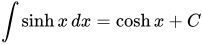
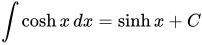
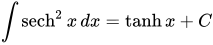
双曲線関数 ∫ シン x d x = コッシュ x + C {\displaystyle \int \sinh x\,dx=\cosh x+C} ∫ コッシュ x d x = シン x + C {\displaystyle \int \cosh x\,dx=\sinh x+C} ∫ タン x d x = ln ( コッシュ x ) + C {\displaystyle \int \tanh x\,dx=\ln(\cosh x)+C} ∫ 布 x d x = ln | シン x | + C 、 のために x ≠ 0 {\displaystyle \int \coth x\,dx=\ln \left|\sinh x\right|+C,{\text{ for }}x\neq 0} ∫ セック x d x = アークタン ( シン x ) + C {\displaystyle \int \operatorname {sech} x\,dx=\arctan(\sinh x)+C} ∫ csch x d x = ln | 布 x − csch x | + C = ln | タン x 2 | + C 、 のために x ≠ 0 {\displaystyle \int \operatorname {csch} \,x\,dx=\ln \left|\operatorname {coth} x-\operatorname {csch} x\right|+C=\ln \left|\tanh {x \over 2}\right|+C,{\text{ for }}x\neq 0} ∫ セック 2 x d x = タン x + C {\displaystyle \int \operatorname {sech} ^{2}x\,dx=\tanh x+C} ∫ csch 2 x d x = − 布 x + C {\displaystyle \int \operatorname {csch} ^{2}x\,dx=-\operatorname {coth} x+C} ∫ セック x タン x d x = − セック x + C {\displaystyle \int \operatorname {sech} x\,\operatorname {tanh} x\,dx=-\operatorname {sech} x+C} ∫ csch x 布 x d x = − csch x + C {\displaystyle \int \operatorname {csch} x\,\operatorname {coth} x\,dx=-\operatorname {csch} x+C}
逆双曲線関数 ∫ arcsinh x d x = x arcsinh x − x 2 + 1 + C 、 すべての現実のために x {\displaystyle \int \operatorname {arcsinh} \,x\,dx=x\,\operatorname {arcsinh} \,x-{\sqrt {x^{2}+1}}+C,{\text{ for all real }}x} ∫ アークコッシュ x d x = x アークコッシュ x − x 2 − 1 + C 、 のために x ≥ 1 {\displaystyle \int \operatorname {arccosh} \,x\,dx=x\,\operatorname {arccosh} \,x-{\sqrt {x^{2}-1}}+C,{\text{ for }}x\geq 1} ∫ アークタン x d x = x アークタン x + ln ( 1 − x 2 ) 2 + C 、 のために | x | < 1 {\displaystyle \int \operatorname {arctanh} \,x\,dx=x\,\operatorname {arctanh} \,x+{\frac {\ln \left(\,1-x^{2}\right)}{2}}+C,{\text{ for }}\vert x\vert <1} ∫ アークコット x d x = x アークコット x + ln ( x 2 − 1 ) 2 + C 、 のために | x | > 1 {\displaystyle \int \operatorname {arccoth} \,x\,dx=x\,\operatorname {arccoth} \,x+{\frac {\ln \left(x^{2}-1\right)}{2}}+C,{\text{ for }}\vert x\vert >1} ∫ アークセック x d x = x アークセック x + arcsin x + C 、 のために 0 < x ≤ 1 {\displaystyle \int \operatorname {arcsech} \,x\,dx=x\,\operatorname {arcsech} \,x+\arcsin x+C,{\text{ for }}0<x\leq 1} ∫ アークシュ x d x = x アークシュ x + | arcsinh x | + C 、 のために x ≠ 0 {\displaystyle \int \operatorname {arccsch} \,x\,dx=x\,\operatorname {arccsch} \,x+\left|\operatorname {arcsinh} \,x\right|+C,{\text{ for }}x\neq 0}
関数の積は、その関数の2階導関数に比例する。 ∫ コス 1 x e b x d x = e b x 1 2 + b 2 ( 1 罪 1 x + b コス 1 x ) + C {\displaystyle \int \cos ax\,e^{bx}\,dx={\frac {e^{bx}}{a^{2}+b^{2}}}\left(a\sin ax+b\cos ax\right)+C} ∫ 罪 1 x e b x d x = e b x 1 2 + b 2 ( b 罪 1 x − 1 コス 1 x ) + C {\displaystyle \int \sin ax\,e^{bx}\,dx={\frac {e^{bx}}{a^{2}+b^{2}}}\left(b\sin ax-a\cos ax\right)+C} ∫ コス 1 x コッシュ b x d x = 1 1 2 + b 2 ( 1 罪 1 x コッシュ b x + b コス 1 x シン b x ) + C {\displaystyle \int \cos ax\,\cosh bx\,dx={\frac {1}{a^{2}+b^{2}}}\left(a\sin ax\,\cosh bx+b\cos ax\,\sinh bx\right)+C} ∫ 罪 1 x コッシュ b x d x = 1 1 2 + b 2 ( b 罪 1 x シン b x − 1 コス 1 x コッシュ b x ) + C {\displaystyle \int \sin ax\,\cosh bx\,dx={\frac {1}{a^{2}+b^{2}}}\left(b\sin ax\,\sinh bx-a\cos ax\,\cosh bx\right)+C}
絶対値関数 f を 連続関数 とし、零点を 最大で 1 つ持つとする。fが g を f の g を f ∫ | f ( x ) | d x = サイン ( f ( x ) ) g ( x ) + C 、 {\displaystyle \int \left|f(x)\right|\,dx=\operatorname {sgn}(f(x))g(x)+C,} sgn( x )は 符号関数 であり、 x
これは、積分の連続性を保証するためにg
これにより、次の式が得られます(ただし、a ≠ 0 )。これらの式は、 f C を 区分的定数 関数に置き換える必要があります)。
関数fが、 f sgn( f ( x )) ∫ f ( x ) dxは、 f が 区間 でf f ( x ) = 0 の点では不連続になる可能性があります。連続な原始関数を持つためには、適切に選択された階段関数を追加する必要があります。また、正弦関数と余弦関数の絶対値が周期 π で周期的であるという事実も利用すると、次のようになります。
∫ | 罪 1 x | d x = 2 1 ⌊ 1 x π ⌋ − 1 1 コス ( 1 x − ⌊ 1 x π ⌋ π ) + C {\displaystyle \int \left|\sin {ax}\right|\,dx={2 \over a}\left\lfloor {\frac {ax}{\pi }}\right\rfloor -{1 \over a}\cos {\left(ax-\left\lfloor {\frac {ax}{\pi }}\right\rfloor \pi \right)}+C} ∫ | コス 1 x | d x = 2 1 ⌊ 1 x π + 1 2 ⌋ + 1 1 罪 ( 1 x − ⌊ 1 x π + 1 2 ⌋ π ) + C {\displaystyle \int \left|\cos {ax}\right|\,dx={2 \over a}\left\lfloor {\frac {ax}{\pi }}+{\frac {1}{2}}\right\rfloor +{1 \over a}\sin {\left(ax-\left\lfloor {\frac {ax}{\pi }}+{\frac {1}{2}}\right\rfloor \pi \right)}+C}
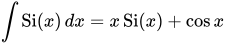
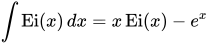
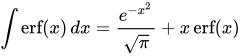
関数の中には、原始関数を閉じた形 で表現できない ものがあります。しかし、これらの関数の中には、いくつかの一般的な区間における定積分値を計算できるものがあります。以下に、いくつかの有用な積分を示します。
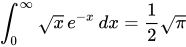
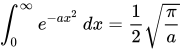
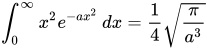
∫ 0 ∞ x e − x d x = 1 2 π {\displaystyle \int _{0}^{\infty }{\sqrt {x}}\,e^{-x}\,dx={\frac {1}{2}}{\sqrt {\pi }}} (ガンマ関数 も参照)∫ 0 ∞ e − 1 x 2 d x = 1 2 π 1 {\displaystyle \int _{0}^{\infty }e^{-ax^{2}}\,dx={\frac {1}{2}}{\sqrt {\frac {\pi }{a}}}} a > 0 のガウス積分 )∫ 0 ∞ x 2 e − 1 x 2 d x = 1 4 π 1 3 {\displaystyle \int _{0}^{\infty }{x^{2}e^{-ax^{2}}\,dx}={\frac {1}{4}}{\sqrt {\frac {\pi }{a^{3}}}}} a > 0 の 場合∫ 0 ∞ x 2 n e − 1 x 2 d x = 2 n − 1 2 1 ∫ 0 ∞ x 2 ( n − 1 ) e − 1 x 2 d x = ( 2 n − 1 ) ! ! 2 n + 1 π 1 2 n + 1 = ( 2 n ) ! n ! 2 2 n + 1 π 1 2 n + 1 {\displaystyle \int _{0}^{\infty }x^{2n}e^{-ax^{2}}\,dx={\frac {2n-1}{2a}}\int _{0}^{\infty }x^{2(n-1)}e^{-ax^{2}}\,dx={\frac {(2n-1)!!}{2^{n+1}}}{\sqrt {\frac {\pi }{a^{2n+1}}}}={\frac {(2n)!}{n!2^{2n+1}}}{\sqrt {\frac {\pi }{a^{2n+1}}}}}
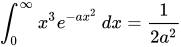
a > 0n !!は 2 階乗 です。∫ 0 ∞ x 3 e − 1 x 2 d x = 1 2 1 2 {\displaystyle \int _{0}^{\infty }{x^{3}e^{-ax^{2}}\,dx}={\frac {1}{2a^{2}}}} a > 0 の 場合∫ 0 ∞ x 2 n + 1 e − 1 x 2 d x = n 1 ∫ 0 ∞ x 2 n − 1 e − 1 x 2 d x = n ! 2 1 n + 1 {\displaystyle \int _{0}^{\infty }x^{2n+1}e^{-ax^{2}}\,dx={\frac {n}{a}}\int _{0}^{\infty }x^{2n-1}e^{-ax^{2}}\,dx={\frac {n!}{2a^{n+1}}}}
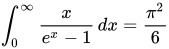
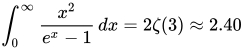
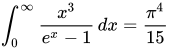
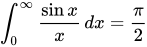
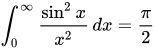
a > 0 のn = 0, 1, 2, ....∫ 0 ∞ x n e − 1 x b d x = 1 b 1 − n + 1 b Γ ( n + 1 b ) {\displaystyle \int _{0}^{\infty }x^{n}e^{-ax^{b}}dx={\frac {1}{b}}\ a^{-{\frac {n+1}{b}}}\Gamma \left({\frac {n+1}{b}}\right)} ∫ 0 ∞ x e x − 1 d x = π 2 6 {\displaystyle \int _{0}^{\infty }{\frac {x}{e^{x}-1}}\,dx={\frac {\pi ^{2}}{6}}} (ベルヌーイ数 も参照)∫ 0 ∞ x 2 e x − 1 d x = 2 ζ ( 3 ) ≈ 2.40 {\displaystyle \int _{0}^{\infty }{\frac {x^{2}}{e^{x}-1}}\,dx=2\zeta (3)\approx 2.40} ∫ 0 ∞ x 3 e x − 1 d x = π 4 15 {\displaystyle \int _{0}^{\infty }{\frac {x^{3}}{e^{x}-1}}\,dx={\frac {\pi ^{4}}{15}}} (物理学におけるプランクの法則 の導出に用いられる)∫ 0 ∞ x n e x − 1 d x = Γ ( n + 1 ) ζ ( n + 1 ) {\displaystyle \int _{0}^{\infty }{\frac {x^{n}}{e^{x}-1}}\,dx=\Gamma (n+1)\zeta (n+1)} n > 0 {\displaystyle n>0} (リーマンゼータ関数 も参照)∫ 0 ∞ 罪 x x d x = π 2 {\displaystyle \int _{0}^{\infty }{\frac {\sin {x}}{x}}\,dx={\frac {\pi }{2}}} ( sinc関数 とディリクレ積分を 参照)∫ 0 ∞ 罪 2 x x 2 d x = π 2 {\displaystyle \int _{0}^{\infty }{\frac {\sin ^{2}{x}}{x^{2}}}\,dx={\frac {\pi }{2}}} ∫ 0 π 2 罪 n x d x = ∫ 0 π 2 コス n x d x = ( n − 1 ) ! ! n ! ! × { 1 もし n 奇妙だ π 2 もし n 均等です。 {\displaystyle \int _{0}^{\frac {\pi }{2}}\sin ^{n}x\,dx=\int _{0}^{\frac {\pi }{2}}\cos ^{n}x\,dx={\frac {(n-1)!!}{n!!}}\times {\begin{cases}1&{\text{if }}n{\text{ is odd}}\\{\frac {\pi }{2}}&{\text{if }}n{\text{ is even.}}\end{cases}}}
( n !!が2階乗 である場合)。∫ − π π コス ( α x ) コス n ( β x ) d x = { 2 π 2 n ( n m ) | α | = | β ( 2 m − n ) | 0 さもないと {\displaystyle \int _{-\pi }^{\pi }\cos(\alpha x)\cos ^{n}(\beta x)dx={\begin{cases}{\frac {2\pi }{2^{n}}}{\binom {n}{m}}&|\alpha |=|\beta (2m-n)|\\0&{\text{otherwise}}\end{cases}}}
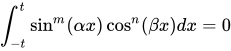
(α 、β 、m 、n β≠0かつm、n≥0 の 場合二 項係数 の こと。)∫ − t t 罪 m ( α x ) コス n ( β x ) d x = 0 {\displaystyle \int _{-t}^{t}\sin ^{m}(\alpha x)\cos ^{n}(\beta x)dx=0}
(α 、βは nは mは 奇数の正整数とする。被積分関数は奇数 であるため)∫ − π π 罪 ( α x ) 罪 n ( β x ) d x = { ( − 1 ) ( n + 1 2 ) ( − 1 ) m 2 π 2 n ( n m ) n 奇数 、 α = β ( 2 m − n ) 0 さもないと {\displaystyle \int _{-\pi }^{\pi }\sin(\alpha x)\sin ^{n}(\beta x)dx={\begin{cases}(-1)^{\left({\frac {n+1}{2}}\right)}(-1)^{m}{\frac {2\pi }{2^{n}}}{\binom {n}{m}}&n{\text{ odd}},\ \alpha =\beta (2m-n)\\0&{\text{otherwise}}\end{cases}}}
(α 、β 、m 、n β≠0かつm、n≥0 の 場合二 項係数 の こと。)∫ − π π コス ( α x ) 罪 n ( β x ) d x = { ( − 1 ) ( n 2 ) ( − 1 ) m 2 π 2 n ( n m ) n 平 、 | α | = | β ( 2 m − n ) | 0 さもないと {\displaystyle \int _{-\pi }^{\pi }\cos(\alpha x)\sin ^{n}(\beta x)dx={\begin{cases}(-1)^{\left({\frac {n}{2}}\right)}(-1)^{m}{\frac {2\pi }{2^{n}}}{\binom {n}{m}}&n{\text{ even}},\ |\alpha |=|\beta (2m-n)|\\0&{\text{otherwise}}\end{cases}}}
(α 、β 、m 、n β≠0かつm、n≥0 の 場合二 項係数 の こと。)∫ − ∞ ∞ e − ( 1 x 2 + b x + c ) d x = π 1 exp [ b 2 − 4 1 c 4 1 ] {\displaystyle \int _{-\infty }^{\infty }e^{-(ax^{2}+bx+c)}\,dx={\sqrt {\frac {\pi }{a}}}\exp \left[{\frac {b^{2}-4ac}{4a}}\right]}
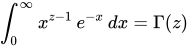
(ここで、exp[ u ] は指数関数 e u a > 0で∫ 0 ∞ x z − 1 e − x d x = Γ ( z ) {\displaystyle \int _{0}^{\infty }x^{z-1}\,e^{-x}\,dx=\Gamma (z)}
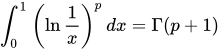
(どこΓ ( z ) {\displaystyle \Gamma (z)} ガンマ関数 )∫ 0 1 ( ln 1 x ) p d x = Γ ( p + 1 ) {\displaystyle \int _{0}^{1}\left(\ln {\frac {1}{x}}\right)^{p}\,dx=\Gamma (p+1)} ∫ 0 1 x α − 1 ( 1 − x ) β − 1 d x = Γ ( α ) Γ ( β ) Γ ( α + β ) {\displaystyle \int _{0}^{1}x^{\alpha -1}(1-x)^{\beta -1}dx={\frac {\Gamma (\alpha )\Gamma (\beta )}{\Gamma (\alpha +\beta )}}}
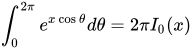
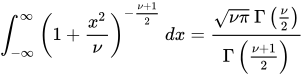
(Re( α ) > 0 かつRe( β ) > 0 の場合、ベータ関数を 参照)∫ 0 2 π e x コス θ d θ = 2 π 私 0 ( x ) {\displaystyle \int _{0}^{2\pi }e^{x\cos \theta }d\theta =2\pi I_{0}(x)} I 0 ( x )ベッセル関数である) ∫ 0 2 π e x コス θ + y 罪 θ d θ = 2 π 私 0 ( x 2 + y 2 ) {\displaystyle \int _{0}^{2\pi }e^{x\cos \theta +y\sin \theta }d\theta =2\pi I_{0}\left({\sqrt {x^{2}+y^{2}}}\right)} ∫ − ∞ ∞ ( 1 + x 2 ν ) − ν + 1 2 d x = ν π Γ ( ν 2 ) Γ ( ν + 1 2 ) {\displaystyle \int _{-\infty }^{\infty }\left(1+{\frac {x^{2}}{\nu }}\right)^{-{\frac {\nu +1}{2}}}\,dx={\frac {{\sqrt {\nu \pi }}\ \Gamma \left({\frac {\nu }{2}}\right)}{\Gamma \left({\frac {\nu +1}{2}}\right)}}}
(ν > 0スチューデントの t 分布 の確率密度関数 に関連しています。)関数f [ a , b ] 上で有界変動 を持つ場合、攀限法 によって積分の公式が得られます。 ∫ 1 b f ( x ) d x = ( b − 1 ) ∑ n = 1 ∞ ∑ m = 1 2 n − 1 ( − 1 ) m + 1 2 − n f ( 1 + m ( b − 1 ) 2 − n ) 。 {\displaystyle \int _{a}^{b}{f(x)\,dx}=(b-a)\sum \limits _{n=1}^{\infty }{\sum \limits _{m=1}^{2^{n}-1}{\left({-1}\right)^{m+1}}}2^{-n}f(a+m\left({b-a}\right)2^{-n}).}
「2年生の夢 」: ∫ 0 1 x − x d x = ∑ n = 1 ∞ n − n ( = 1.29128 59970 6266 … ) ∫ 0 1 x x d x = − ∑ n = 1 ∞ ( − n ) − n ( = 0.78343 05107 1213 … ) {\displaystyle {\begin{aligned}\int _{0}^{1}x^{-x}\,dx&=\sum _{n=1}^{\infty }n^{-n}&&(=1.29128\,59970\,6266\dots )\\[6pt]\int _{0}^{1}x^{x}\,dx&=-\sum _{n=1}^{\infty }(-n)^{-n}&&(=0.78343\,05107\,1213\dots )\end{aligned}}} ヨハン・ベルヌーイ に帰せられる。
参考文献 ↑ ハーシュ、マイヤー (1810)。インテグラルターフェルン: oder、Sammlung vonintegralformeln (ドイツ語)。ダンカーとハンブロット。 ↑ セルジュ・ラング著 『微積分入門』 第5版、290ページ↑ 「読者アンケート:log| x | + C 」、トム・レインスター 、 The n -category Café 、2012年3月19日
外部リンク
積分表 ポールのオンライン数学ノート A. ディークマン著『積分表(楕円関数、平方根、逆正接関数、その他の特殊関数):不定積分定積分』 数学専攻:積分表 オブライエン、フランシス・J・ジュニア「500の基本関数と特殊関数の積分」。 ルールベース積分幅広い被積分関数を網羅する、厳密に定義された不定積分ルール Mathar, Richard J. (2012). 「また別の積分表」. arXiv : 1207.5845 [ math.CA ].
派生 ヴィクトル・ユーゴー・モル、『グラドシュテインとリジクの積分』
オープンソースプログラム wxmaxima GUIは、多くの数学的問題を記号的および数値的に解くためのツールです。
動画 現存する中で最も強力な積分手法。 対称性に関するFlammable MathsのYouTube動画

































































![{\displaystyle \int _{-\infty }^{\infty }e^{-(ax^{2}+bx+c)}\,dx={\sqrt {\frac {\pi }{a}}}\exp \left[{\frac {b^{2}-4ac}{4a}}\right]}](https://wikimedia.org/api/rest_v1/media/math/render/svg/9aac3de5d20ec70a35c8d52bafaa6a82c148b566)




![{\displaystyle {\begin{aligned}\int _{0}^{1}x^{-x}\,dx&=\sum _{n=1}^{\infty }n^{-n}&&(=1.29128\,59970\,6266\dots )\\[6pt]\int _{0}^{1}x^{x}\,dx&=-\sum _{n=1}^{\infty }(-n)^{-n}&&(=0.78343\,05107\,1213\dots )\end{aligned}}}](https://wikimedia.org/api/rest_v1/media/math/render/svg/3eb1c1f34b4606f5ebf9e88ecdb80a7681b8fcce)