
Loading article…


フランスの噴水は、フランスの古代ローマ都市の住民や中世のフランスの修道院や村に飲料水を供給していました。後に、噴水はフランス王の庭園で王権と威厳の象徴となりました。今日では、もはや飲料水を供給するものではありませんが、フランスの都市や町の広場や公園を飾っています。
ローマの噴水

フランスで最初に発見された噴水は、紀元1世紀から2世紀にかけて、グラヌム、ヴェゾン・ラ・ロメーヌ、ニーム、プロヴァンス地方のその他の町にローマの技術者によって建てられたものである。ローマの噴水と同様に、これらの噴水には遠くの湖や川の水道橋から水が供給されており、噴水から50キロ以上離れた場所から水が供給されていることもあった。水道橋の遺跡は、アヴィニョン、アルル、エクス・アン・プロヴァンス、グラヌム、その他のローマの町の郊外で見ることができる。
水が都市に到着すると、鉛管に導かれて街路の噴水に配水されたり、ローマ浴場や別荘に直接配水されたりしました。これらの噴水の例は、グラヌムの遺跡やヴェゾン・ラ・ロメーヌの博物館で見ることができます。
ローマの街路噴水は、通りの下の鉛管に接続された独立した石のブロックでした。水は、パイプを通ってブロックの噴出口まで上昇し、水源の高いところから水圧で押され、蛇口から流れ出る水のサイフォン効果で引き込まれました。水は、動物や人間の顔の形をした仮面の口から出ていました。水は絶え間なく流れ、壺や瓶に集められ、家に持ち帰られました。
5世紀初頭、フランスへの蛮族の侵略とともに、ローマの噴水システムは崩壊し始めた。水道は破壊されたり廃墟となったりし、都市は放棄され、噴水は破壊や放置により機能しなくなった。フランスの都市は18世紀まで信頼できる給水システムを持つことができなかった。[1]
-
 プロヴァンスのヴェゾン・ラ・ロメーヌにあるローマ時代の街路噴水の石(紀元 1 世紀または 2 世紀)
 -
 パリのルーブル美術館にある古代ローマの噴水のヴァスク
 -
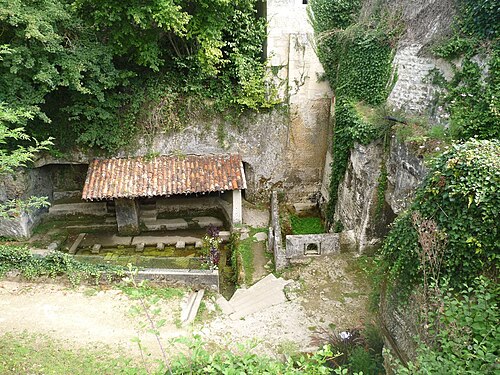 フランス南西部、シャラント マリティーム、ヴェネランにあるローマの噴水
 -
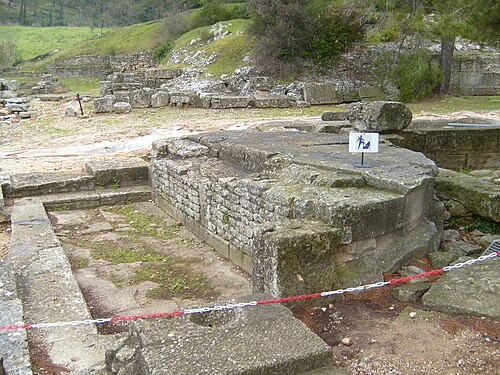 グラヌムのフォーラム近くにある記念碑的なローマの噴水の遺跡(紀元前 20 年頃)
フランス中世の噴水
中世には、ローマの水道橋は破壊されたり朽ちたりし、フランスの多くの噴水は機能しなくなったため、噴水は主に芸術や文学の中、または人里離れた修道院や宮殿の庭園の中に存在していました。
中世の噴水は、生命の源、純粋さ、知恵、無垢、そしてエデンの園と関連付けられていました。[2] 『ベリー公爵の三富な時間』 (1411-1416年)などの装飾写本では、エデンの園は中央に優美なゴシック様式の噴水を備えて描かれています(図を参照)。
修道院の回廊は、外界から守られたエデンの園のレプリカであると考えられていました。プロヴァンスのル・トロネ修道院などの中世の修道院には、洗面所と呼ばれるシンプルな噴水が設置されており、宗教的な儀式や食事の前に体を洗うために使用されていました。[3]
噴水は、中世の囲まれた庭園「ジャルダン・ダムール」(「宮廷愛の庭園」)にも見られました。これは求愛や休息のために使われた装飾庭園です。中世のロマンス小説「バラ物語」には、囲まれた庭園の中央に噴水があり、花や新鮮なハーブで縁取られた小川に水が流れている様子が描かれています。
中世の噴水は娯楽にもなりました。1295年に建てられたエルダン城のアルトワ伯爵の庭園には、驚いた訪問者をびしょ濡れにするために噴水を動かす「レ・メルヴェイユ・ド・エルダン」と呼ばれる有名な噴水がありました。 [4]
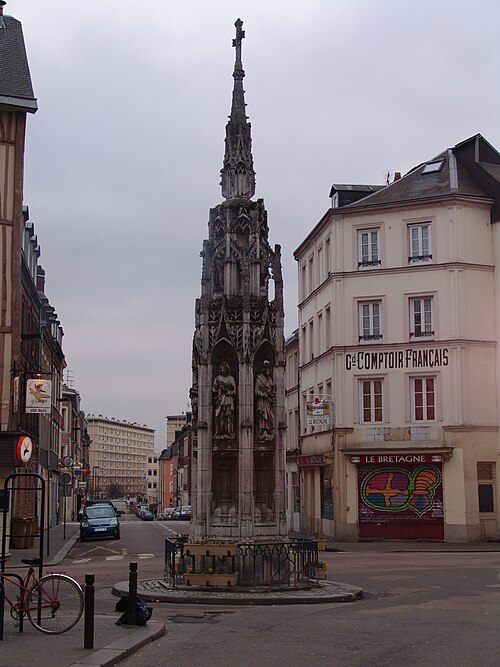
ルーアンのクロワ・ド・ピエールの噴水は、フランスに現存する数少ない中世の噴水のひとつです。1197年に地元の司教が建てた石の十字架の隣に1517年に建てられました。1562年にカルヴァン派によって破壊されましたが、再建されました。1792年のフランス革命中に、上部の十字架はマラーの胸像に置き換えられましたが、これは1795年に撤去されました。1872年に噴水は元の設計に従って再建されました。元の噴水はルーアン古代博物館の庭園で見ることができます。[5]
-
 ベリー公爵の三大富豪の絵画(1411-1416年)に描かれたエデンの園。中央に噴水がある。
 -
-
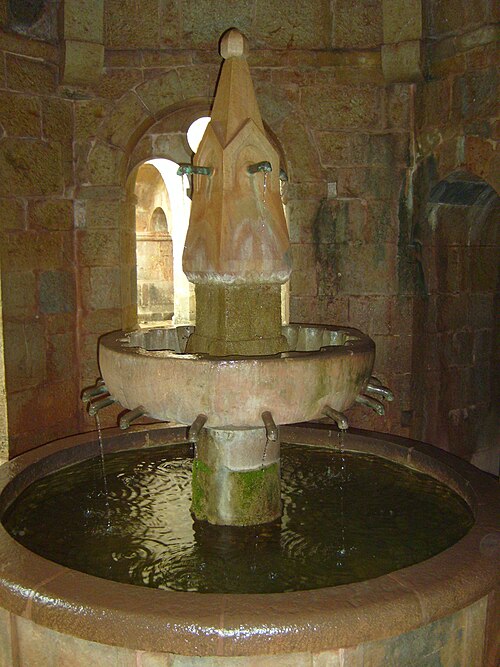
 12 世紀後半の回廊の噴水のヴァスク。フランス、ラングドック地方のサン ミシェル ド グランデモン修道院のもの。(パリ、クリュニー美術館)
 -
 噴水の横にトリスタンとイゾルデを描いた象牙の棺の彫刻 (1340-50年)(ルーブル美術館)
 -
 ヴィオレ=ル=デュクが描いた 15 世紀の噴水
 -
 ヴィオレ=ル=デュクが描いた中世の田舎の噴水
 -
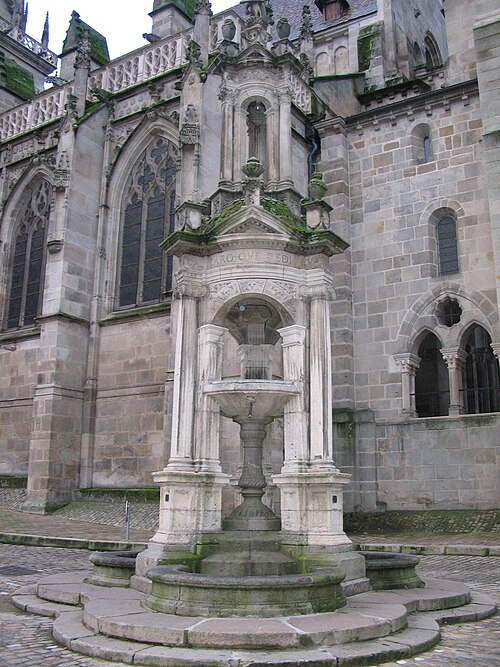 オータン(ソーヌ・エ・ロワール)のフォンテーヌ・サン・ラザール(1543年)
フランスの村の噴水
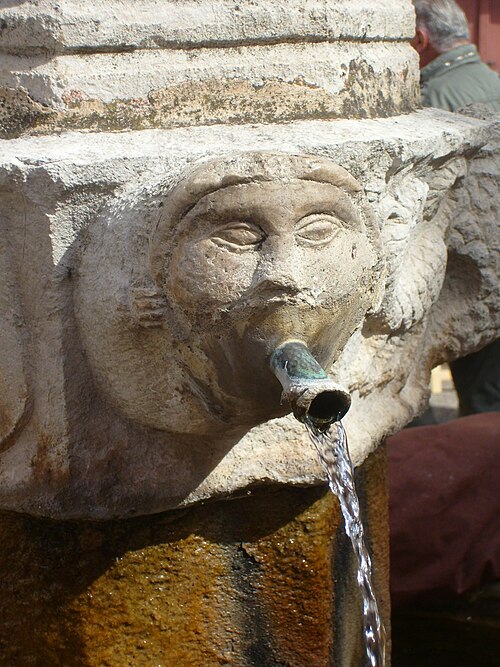
フランスの都市では水は通常川や井戸から直接引かれていたため、噴水はほとんど作られませんでしたが、多くの噴水は村、特にプロヴァンスに作られました。これらの噴水はもともと、村のすぐ外や入り口、泉のそば、または近くにあり、地下の回廊でつながっていました。それらは以前のローマの噴水と同じ場所に作られることが多く、中世から 19 世紀まで同じ基本設計が使用されていました。 壁面噴水は 泉のそば、または建物の壁に沿って作られました。重力で満たされる貯水池があり、水は噴出口、つまり大砲から流れ出ました。噴出口は、人間、動物、または怪物の頭の形をしたマスカロン、つまり仮面で飾られることが多かったです。
その後、16世紀には、古代ローマの街路噴水のデザインを基にした、より洗練された壁面噴水が登場しました。これらの新しい噴水は、町や村の富と名声を示すものでした。そして通常、教会の近くの中央広場に設置されていました。ビュッフェ、つまり噴水の後ろの壁の内側には、basin de repartitionと呼ばれる中空の部屋があり、パイプで下の水源につながっていました。噴水のキャノンは水盤とつながっており、その入り口は水盤の水位のすぐ下にあります。水がキャノンから流れ出ると、サイフォンが形成され、パイプを通って水が引き上げられ、basin de repartitionが満たされ続けます。[6]
水が大峡谷から流れ出ると、土器の壺に集められ、家に持ち帰られました。このようにして取られなかった水は、石造りのabreuvoirまたは水盤に流され、牛、羊、馬が飲めるようにされました。あふれた水は、別の水盤、lavoirに流され、そこで洗濯に使用されました。あふれた水は、その後、庭の灌漑に使用されました。村の伝統的な洗濯方法は、洗剤としてカリウムを豊富に含む木の燃え殻を使用することだったので、洗濯水は庭の効率的な肥料になりました。
16 世紀に始まった村の噴水でよく見られるようになったもう 1 つのデザインは、フォンテーヌ ロンド アフュット(樽型噴水)です。このタイプの噴水は、紀元前 6 世紀の古代ギリシャの花瓶に描かれています。噴水は、広場の中央に独立して設置されていました。円形の石造りの水盤で構成され、その中央には石の柱があり、その中央には水盤用の空洞があり、 1 つまたは複数の大砲につながっていました。水が大砲から注がれると、サイフォン効果によって下のパイプから水が引き込まれ、水盤が満たされた状態が保たれました。噴水の上部は石の蓋 (クヴェルクル) で覆われており、噴水のメンテナンスのために取り外すことができました。[7]
村の噴水の 3 番目に一般的なタイプは、フォンテーヌ ア ブルブ、または球根噴水です。球根噴水は、樽噴水と同じように機能しますが、通常は球根の形をした別の石の容器に仕切りがあり、柱の上に置かれている点が異なります。噴水のキャノンは、柱ではなく球根に取り付けられていました。水が流れるマスクは、球根の石に直接彫られることが多かったです。
-
 トゥルトワラック (ドルドーニュ県) の噴水。ローマ時代かそれ以前に遡ると思われます。住民は泉の周りに壁を築きました。
 -
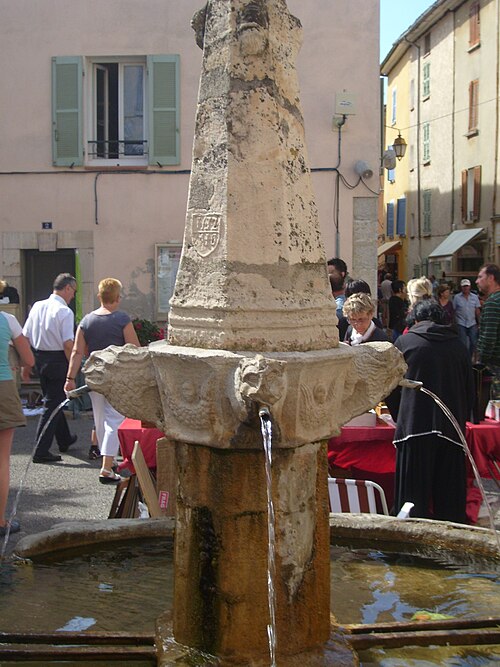 バッス=シュル=イソルの樽噴水(1542 年)。噴水の上の鉄の棒は、上から大砲から注がれる水で満たされた壺や水差しを支えるために設計されました。
 -
 ヴォークリューズ県の丘の上の村クレステの噴水(1588年)
 -
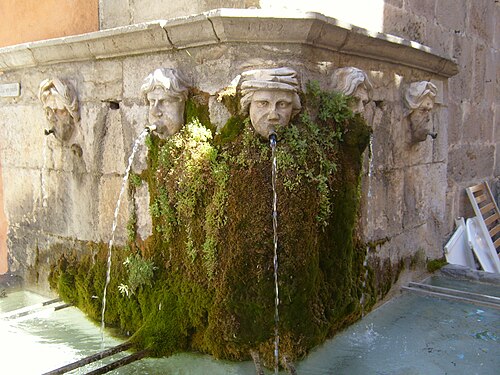 トゥルヴ(ヴァール県)の教会の角壁にある噴水。1792 年に造られた。
 -
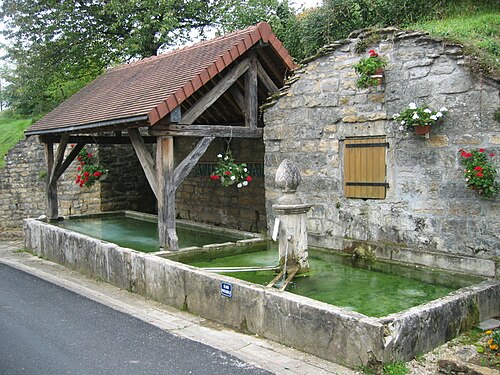 サン・ロタン(ジュラ)の村の噴水と洗面台
フランスルネサンス
イタリアのルネサンスは、 ヨーロッパに新しいタイプの噴水をもたらしました。そこでは、噴水から供給される水と同じくらい、彫刻や装飾が重要視されました。噴水は単なる工学作品ではなく、芸術作品となりました。
1546年から1549年にかけて、パリの商人たちは、フランス国王アンリ2世の入城を記念して、パリ初のルネッサンス様式の噴水である「アンノサンの噴水」を建設した。この噴水はもともと聖なるアンノサン教会の壁に沿って建てられていたが、何度か移設・再建され、現在はレ・アール近くの広場に立っている。パリ最古の噴水である。[8]
アンリは、愛妾のディアナ・ド・ポワチエのために、シュノンソー城(1556年 - 1559年)の隣に垂直に水を噴き出す噴水のあるイタリア風庭園を造った。王家のフォンテーヌブロー城にも、狩猟の女神ディアナのブロンズ像のある噴水を造ったが、これはディアナ・ド・ポワチエをモデルにしている。[9]
その後、アンリ2世の死後、その未亡人カトリーヌ・ド・メディシスは、ダイアナ・ド・ポワチエをシュノンソー城から追放し、そこに自らの噴水と庭園を造った。
フランス国王アンリ4世は、プラタリーノの別荘の噴水を手がけたイタリアの水力技術者 トマソ・フランチーニを招き、フランスで噴水を作ることで、フランスの噴水に重要な貢献をした。フランチーニは1600年にフランス国籍を取得し、メディチ家の噴水を建設した。また、若きルイ13世の統治下では、世襲制の王の噴水総監に昇格した。彼の子孫は、ルイ13世とルイ14世のヴェルサイユ宮殿の噴水設計者となった。[10]
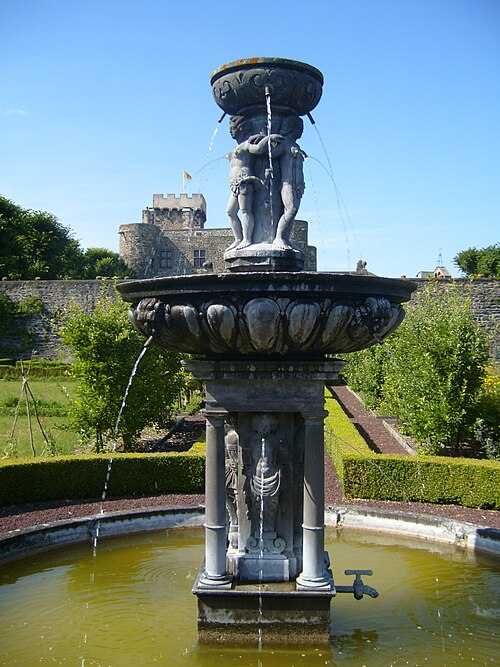
貴族や宮廷の人々が城をルネッサンス様式の邸宅に改築し、庭園や噴水を設けたことで、ルネッサンス様式はフランス中に広まりました。その一例が、クレルモン=フェラン近郊のオーヴェルニュにあるオップム城です。この城には、ルイ13世の財務官がジャン・アンドルーエ・デュ・セルソーの設計による庭園と噴水を造っています。
1630年、もう一人のメディチ家 出身でアンリ4世の未亡人であるマリー・ド・メディシスが、パリのリュクサンブール宮殿の庭園に、メディチの噴水という記念碑的な噴水を建設した。この噴水は、1866年に追加された長い水盤と彫像とともに、現在も残っている。[11]
-
 パリのアンノサンの泉(1546-1549年)の正面図と側面図(当初の姿)
 -

-
 メディチの噴水、パリ(1630年)
フランスのバロック様式の噴水
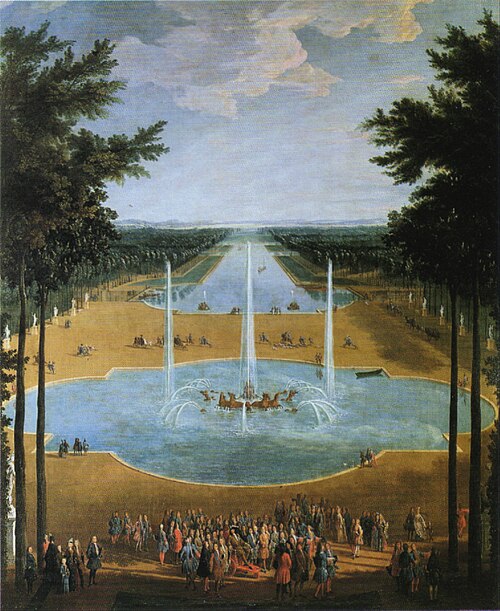
1662年、フランス国王ルイ14世は、ヴェルサイユ宮殿に新しいタイプの庭園、フランス式庭園(ガーデン・ア・ラ・フランセーズ)、つまりフランス式整形庭園の建設を開始しました。この庭園では、噴水が中心的な役割を果たしました。ルイ14世は噴水を利用して、自然に対する人間の力を示し、自らの統治の壮大さを表現しました。ヴェルサイユ庭園では、水は自然に水盤に落ちるのではなく、空に向かって噴射されたり、扇や花束の形にされたりしました。踊る水は、音楽や花火と組み合わされ、壮大な光景を作り上げました。これらの噴水は、アンリ4世の時代にフランスに渡り、メディチ家の噴水やフォンテーヌブロー宮殿のダイアナの噴水を建設したイタリアの水力技術者、トマーゾ・フランチーニの子孫の作品でした。
ヴェルサイユ庭園の目玉は2つの噴水で、どちらもルイ14世の象徴である太陽神アポロンの神話から取られており、どちらも彼の力を象徴している。アンドレ・ル・ノートルが設計し、ガスパールとバルタザール・マルシーが彫刻したラトーネの噴水(1668-70)は、リュキアの農民がラトーネとその子供たちであるダイアナとアポロを苦しめ、カエルに変えられるという罰を与えた物語を表現している。これは、 1650年代のフロンドの乱と呼ばれる反乱の際にフランスの農民がルイ14世の母アンヌ・ドートリッシュを虐待したことを思い起こさせるものだった。噴水が作動すると、農民に水しぶきが降り注ぎ、農民は生き物に変えられて狂乱する。[12]
庭園のもう一つの目玉は、ヴェルサイユ庭園の主軸の交差点にあるアポロンの噴水 (1668-71) です。シャルル・ル・ブランが設計し、ジャン・バティスト・テュビーが彫刻しました。この彫像は、ヴェルサイユ宮殿の鏡の間の装飾画にも描かれているテーマを示しています。それは、貝殻のラッパを吹くトリトンが告げる、水から昇ろうとする馬車に乗ったアポロンの姿です。歴史家のメアリー・アン・コネリとマリリン・シムズは、「劇的な効果と王へのお世辞を狙って設計されたこの噴水は、自然とは相反して、太陽神が西から昇り、東の城に向かって進むように配置されています」と書いています。[12]
この 2 つの記念碑的な噴水のほかにも、この庭園には長年にわたって数十の噴水が設置されてきました。その中には、ジャン・ド・ラ・フォンテーヌの寓話を描いた迷路にある 39 個の動物噴水も含まれています。
ヴェルサイユには噴水が多すぎて、一度にすべてを動かすのは不可能だった。ルイ14世が散歩をするとき、噴水番は前方の噴水を動かし、後方の噴水を止めた。ルイは、セーヌ川から300フィート水を汲み上げるために、14の水車と253のポンプを備えた巨大なポンプ場、マシーン・ド・マルリーを建設し、ウール川の水を迂回させて噴水に水を供給しようとしたが、水の供給は決して十分ではなかった。[13]
(ヴェルサイユ宮殿の庭園を参照)
-
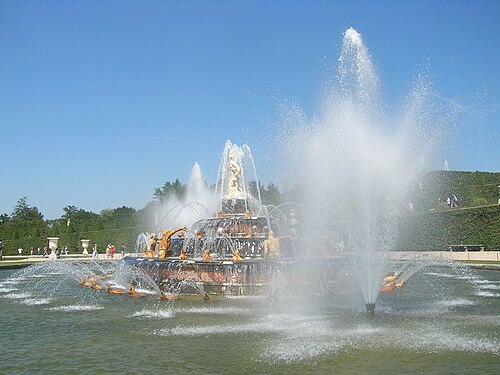 ヴェルサイユ宮殿庭園のラトーネの噴水(1668-70年)
 -
 冬を象徴するサトゥルヌスの噴水、フランソワ・ジラルドン作(1672-77年)
 -
 春を象徴するフロール川の噴水、ジャン=バティスト・テュビー作(1672~74年)
 -
 フォンテーヌ・ド・ランセラード、b ガスパール・マルシー (1675-1676)
 -
 ボスケ ドゥ ラルク ドゥ 凱旋門の噴水
 -
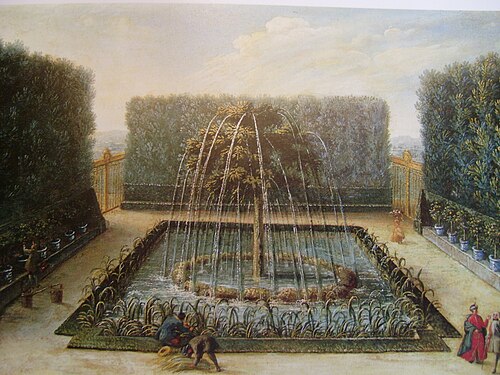 マレの森の噴水
 -
 オランジュリーの噴水、ヴェルサイユ
 -
 ヴェルサイユ宮殿の三つの噴水の森
 -
 エクス・アン・プロヴァンスの三オルモーの噴水(1625年または1632年)、エクス・アン・プロヴァンスの最も古い素晴らしい噴水。
 -
 エクスアンプロヴァンスのマザラン地区にある「4頭のイルカの噴水」(1667年)
 -
 イルカはバロック様式の噴水で人気のあった題材でした。トゥーロンのポール・コント広場にあるドーファンの噴水。(1668 年以前)
 -
 フォンテーヌ・デ・バニエ、ルー・デ・シャプリエ、エクス・アン・プロヴァンス(1687)
.jpg/500px-Fran%C3%A7ois_Girardon,_Bassin_de_Saturne,_Mus%C3%A9e_national_des_chateaux_de_Versailles_et_de_Trianon,_Versailles,_France_(1672%E2%80%931677).jpg)
_-_20100407.jpg/500px-Gaspard_Marsy,_Fontaine_de_l%E2%80%99Encelade,_Mus%C3%A9e_national_des_ch%C3%A2teaux_de_Versailles_et_de_Trianon,_Versailles,_France_(1675%E2%80%931676)_-_20100407.jpg)
18世紀

18世紀にはパリで30の新しい噴水が建設され、そのうち14が現在も残っている。また、大きな建物の中に貯水池があるシャトー・ドーが3つ建てられた。[14]これらの噴水の多くは、1692年から1740年まで王の勅令によりパリ市の建築物管理官を務めたジャン・ボージール の作品である。彼の噴水は通常小さく、壁に沿って設置され、小さな水盤に水を注ぐ壁龕と単一の注ぎ口を備えていたが、貝殻や神話の人物像で飾られ、時には洞窟の石灰化した壁を模して自然の泉を模したものもあった。
In the middle of the 18th century Voltaire and other critics began to demand more open squares and more ornamental fountains. In Les Embellisements de Paris, written in 1749, Voltaire wrote, "We have only two fountains in good taste, and they should certainly be better placed. All the others are worthy of a village."[15] The government responded to these demands for grander fountains by commissioning the Fontaine des Quatre-Saisons (1739) and by an even grander project for a square with fountains, Place Louis XV, which became the Place de la Concorde.[16]
-
 The massive Fontaine des Quatre-Saisons on the rue de Grenelle (7th arr.) (1739), by sculptor Edme Bouchardon, had a crowd of monumental statues but only two faucets, and irritated the philosopher Voltaire because of its large scale on the narrow street.
 -
 The Fontaine des Neuf-Canons, one of the two moss fountains in the Cours Mirabeau in Aix-en-Provence (18th century).
 -
 Fontaine de la place des Tanneurs, Aix-en -Provence. (1761). By the sculptor Chastel. It was rebuilt in 1861. The urn on top is from the original version.
 -
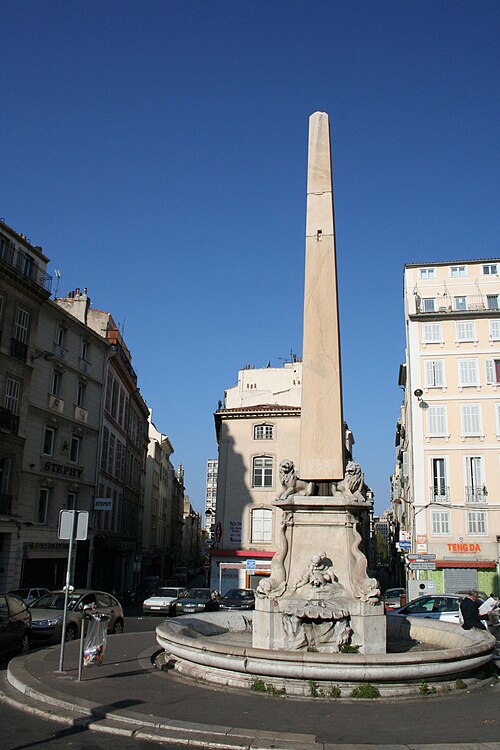 The Fontaine Fossati, in Place des Capucines, Marseille, features an obelisk and four dolphins. (1778).
 -
 Fontaine aux Abeilles (Fountain of the Bees) in Haguenau, Alsace (18th century.) The fountain was originally in the Cistercian convent of Neubourg at Dauendorf.
19th Century


The 19th century was the golden age of the French fountain. At the beginning the century, Napoleon Bonaparte began the construction of a new canal to Paris to supply water for drinking and for fountains, restored dozens of earlier fountains, including the Medici Fountain, and constructed fifteen new fountains, including the Fontaine du Palmier in Place du Chatelet. King Louis-Philippe (1830–1848) built more monumental fountains, including the Fontaines de la Concorde (1836–1840) on the Place de la Concorde. The Emperor Louis Napoleon (1851–1870) rebuilt many older fountains, including the Medici Fountain, and built new ones, including the Fontaine Saint-Michel (1860).
Outside of Paris, the major cities of France competed to build the most majestic monumental fountains.
In 1862, the city of Aix-en-Provence built the Fontaine de la Rotonde at the crossroads of the major roads coming into the city. It was built on the site of an earlier fountain, from 1697. The central element is a bronze vasque eight meters in diameter. Water flows from the vasque through bronze masquerons down into a stone basin ornamented with bronze children riding on swans. Sculpted dolphins on the base of the vasque shoot outwards to a lower basin, 32 meters in diameter, decorated with twelve bronze lions, and at the top, on a pedestal in the center of the vasque, are three statues of women representing agriculture, justice, and the arts.[17]
In Marseille, the Palais Longchamp was constructed to mark the end of a new aqueduct which brought clean water from the Durance River to Marseille, ending a long water shortage; the fountain, opened in 1869, was the work of Henri Espérandieu, the architect of the major church of Marseille, Notre-Dame-de-la-Garde. The basins of the fountain were placed in the center of a double colonnade, which also housed the city's art museum and museum of natural history. The fountain was an allegorical group of sculptures, representing the Durance bringing well-being the Vine and Wheat, symbols of abundance.[17]
The end of the 19th century saw a competition between the major cities of France to construct the most elaborate monumental fountains, composed of groups of allegorical figures.
The City of Toulon built a monumental fountain, the Fontaine de la Fédération, in 1890, to commemorate (a year late) the centennial of the French Revolution. It was the work of two brothers from Toulon, Stanislas Gaudensi Allar, the architect, and André-Joseph Allar, the sculptor. The fountain represents the person of France, in a boat, holding the torch of civilization in one hand, and the table of the Rights of Man and of the Citizen in her other and. At her feet are two figures representing Force and Justice. The boat seems to be riding on a cascade of water from which rise two spouts of water.[18]
In 1890 the family of a wealthy Marseille merchant, Estrangin, donated another monumental fountain, the Fontaine Estrangin, a group of allegorical statues depicting Marseille seated upon a throne atop the prows of four ships, representing four continents, made by the Toulon sculptor André Allar.[19]
The city of Nice built monumental fountain in 1891 to honor its native son, Garibaldi, the hero of Italian independence, who was born in Nice in 1807. The fountain features Garibaldi himself, and bronze figures of France and Italy.
The city of Bordeaux originally commissioned a monumental fountain for the 100th anniversary of the French Revolution from Frédéric Auguste Bartholdi, the sculptor who had made the State of Liberty. The statue was finished in 1889, and displayed at the Exposition Internationale in Paris in that year. Bordeaux decided in the end not to fund it, and the fountain instead was placed in Place des terreaux in Lyon in September 1892. The Fontaine Bartholdi shows France as a woman driving a chariot drawn by four horses, representing the four great rivers of France.
The improved technology of cast iron allowed mass production of fountains for the first time – the most famous example was the Wallace fountain, which appeared first in Paris, then in other cities around France. In 1872 a British millionaire, temperance advocate and philanthropist, Sir Richard Wallace, who had spent much of his youth in Paris and had lived there during the 1870 war, recognizing the difficulty and cost of finding drinking water in Paris after the 1870 war, and following a program he had already begun in London, donated fifty cast-iron drinking fountains to the city of Paris. The sculptor of the fountains was Charles-Auguste Lebourg, a student of François Rude. He designed two models, one free-standing and the other to be attached to a wall, and in 1881, added a third, simpler version. The fountains were a popular success, and new ones were still being installed until the beginning of the First World War.[20]
-
 Palais Longchamp in Marseille (1869 marked the terminus of the new aqueduct which brought water from the Durance River to Marseille)
 -
 Fontaine de la Federation in the Place de la liberte, Toulon (1890)
 -
 Fontaine des Tritons, in the Jardins Albert I in Nice, (1827).
 -
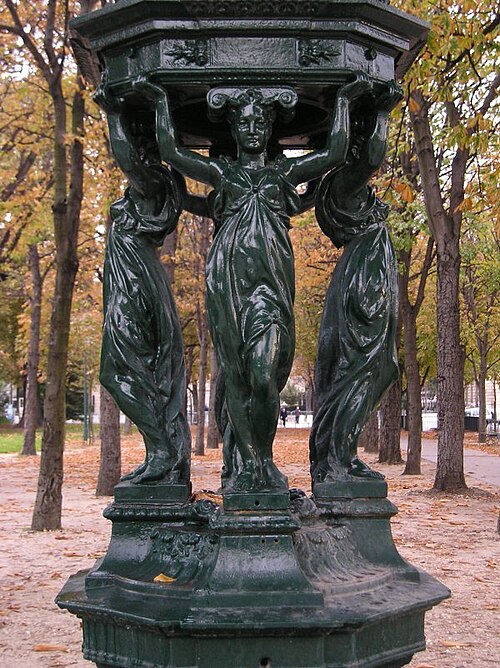 A cast-iron Wallace fountain, one of dozens installed in French cities by millionaire Sir Richard Wallace to provide an alternative to liquor for the working classes
Twentieth century
Relatively few new fountains were built in France in the 20th century. Fountains were no longer needed to supply drinking water, and two World Wars interrupted the creation of purely decorative architecture.
The fountains of the first half of the century were largely in the classical styles of the previous century. In the second half of the century, fountain designs became as diverse as the styles of modern art, using new materials and new technologies.
From 1911 to 1913 the city of Marseille built an exceptional monumental fountain, the Fontaine Contini, donated by the stone merchant Jules Cantini, made by the Toulon sculptor Andre Allar. It was made entirely of white Carrara marble, and was in the form of a group of allegoritical statues, surrounding a column thirty meters high. At the top of the column was an allegorical statue of Marseille, holding a ship in her hand, and passionate figures around the base representing the Rhone River, the Mediterranean, the Torrent and the Spring.[21]


Only a handful of fountains were built in Paris between 1940 and 1980. The most important ones built during that period were on the edges of the city, on the west, just outside the city limits, at La Défense, and to the east at the Bois de Vincennes.
Between 1981 and 1995, during the terms of President François Mitterrand and Culture Minister Jack Lang, and of Mitterrand's bitter political rival, Paris Mayor Jacques Chirac (Mayor from 1977 until 1995), the city experienced a program of monumental fountain building that exceeded that of Napoleon Bonaparte or Louis Philippe. More than one hundred fountains were built in Paris in the 1980s and 1990s, mostly in the neighborhoods outside the center of Paris, where there had been few fountains before.[22] The Stravinsky Fountain, the Fountain of the Pyramid of the Louvre, the Buren Fountain and Les Sphérades fountain in the Palais Royale, the Fontaine du Parc Andre Citroën, and new fountains at Les Halles, the Jardin de Reuilly, and beside the Gare Maine-Montparnasse were all built under President Mitterrand and Mayor Chirac.
The Mitterrand-Chirac fountains had no single style or theme. Many of the fountains were designed by famous sculptors or architects, such as Jean Tinguely, I.M. Pei, Claes Oldenburg and Daniel Buren, who had radically different ideas of what a fountain should be. Some of them, like the Pyramide de Louvre fountain, had glistening sheets of water; while in the Buren Fountain in the Palais Royale, the water was invisible, hidden under the pavement of the fountain. Some of the new fountains were designed with the help of noted landscape architects and used natural materials, such as the fountain in the Parc Floral in the Bois de Vincennes by landscape architect Daniel Collin and sculptor François Stahly. Some were solemn, and others were whimsical. Most made little effort to blend with their surroundings - they were designed to attract attention.[23]
-
 Fontaine Cantini, Marseille, detail of 'The Torrent" (1911)
Contemporary French fountains
Contemporary French fountains use a wide variety of new materials (plastic, stainless steel, glass) and are often designed to make a statement. Water is always present (otherwise they wouldn't be fountains) but sometimes it plays a minor or supporting role to the sculptural element.
Few new fountains have been built in Paris since 2000. The most notable is La Danse de la fontaine emergente, located on Place Augusta-Holmes, rue Paul Klee, in the 13th arrondissement. It was designed by the French-Chinese sculptor Chen Zhen, shortly before his death in 2000, and finished by his widow and collaborator Xu Min in 2008. It shows a dragon, in stainless steel, glass and plastic, emerging and submerging from the pavement of the square. Water under pressure flows through the transparent skin of the dragon.[24][25]
-
 Place des fontaines in Contrexéville, Vosges, Lorraine
 -
 Fountain in Place Charles De Gaulle, Orléans
See also
Sources and citations
- ^ Plantier, pg. 42
- ^ Psalms 36:9; Proverbs 13:14; Revelation 22:1; Dante's Paradisio XXV 1-9.
- ^ Molina, Nathalie, 1999: Le Thoronet Abbey, Monum - Editions du patrimoine.
- ^ Allain and Christiany, L'art des jardins en Europe This type of "water joke" later became popular in Renaissance and baroque gardens.
- ^ Article on the Fontaine de la Croix-de-Pierre in French Wikipedia
- ^ Plantier, pg. 57
- ^ Plantier, pg. 79.
- ^ Marion Boudon, "La fontaine des Innocents", in Paris et ses fontaines, de la Renaissance à nos jours, 1995.
- ^ Le Guide du Patrimoine en France, Editions du Patrmoine, Centre des Monuments Nationaux, 2009
- ^ A. Muesset, Les Francinis, Paris, 1930, cited in Luigi Gallo, La présence italianne au 17e siècle, in Paris et ses fontaines de la Renaissance à nos jours, Collection Paris et son patrimoine, (1995).
- ^ Luigi Gallo, La présence italianne au 17e siècle, in Paris et ses fontaines de la Renaissance à nos jours, Collection Paris et son patrimoine,
- ^ a b Allain and Christiany, L'art des jardins en Europe
- ^ Robert W. Berger, The Chateau of Louis XIV, University Park, Pennsylvania. 1985, and Gerald van der Kemp, Versailles, New York, 1978.
- ^ Christophe Morin, Le 18e siècle, Les fontaines de pierre, in Paris et ses fontaines, pg. 80.
- ^ Cited by P. Lavadan, Histoire de l'urbanism a Paris (1975), 1993, p. 304. Translation by D.R. Siefkin.
- ^ Janine Barrier, Fontaines et embellissements de Paris, in Paris et ses fontaines, pg. 125.
- ^ a b Plantier, pg. 218
- ^ Plantier, pg. 219
- ^ Plantier, pg. 211-214
- ^ Elie Frebault, Les fontaines de sir Richard Wallace, l'Illustration, August 17, 1872, pg. 103-105. Cited in Beatrice Lamoitier, Paris et ses Fontaines, page 188
- ^ Plantier, pg. 213-215. Plantier notes that the torrent and spring were named as the subjects at the time of the opening of the fountain; today the figures are commonly described as the two tributaries of the Rhone River, the Durance and the Gardeon.
- ^ André Hoffman, La création contemporaine, in Paris et ses fontaines. Pg. 266,
- ^ André Hoffman, La création contemporaine, in Paris et ses fontaines. Pg. 266.
- ^ "Fontane di design, le piu belle al mondo". Designmag (in Italian). Retrieved 31 August 2015.
- ^ "Le dragon fontaine de Chen Zhen". Paris Pépites (in French). 2 May 2014. Archived from the original on 27 September 2015. Retrieved 2 September 2015.
Bibliography
- マリリン・シムズ(編)、『噴水 - 水しぶきとスペクタクル - ルネッサンスから現代までの水とデザイン』、テムズ・アンド・ハドソン、スミソニアン協会クーパー・ヒューイット国立デザイン博物館と協力(1998 年)。
- Louis Plantier、『Fontaines de Provence et de Côte d'Azur』、Edisud Publishers、Les Editions de La Lesse、エクス アン プロヴァンス、2007 年 ( ISBN 978-2-7449-0708-1 )
- 『パリとルネッサンスの日々』、ベアトリス・デ・アンディア、ドミニク・マスーニー、ポーリーヌ・プレヴォスト=マルシルハシー、ダニエル・ラブロー編集、パリとパトリモワンヌのコレクションより、パリ、1995年。
- ルイ・プランティエ、プロヴァンスの泉とコート・ド・アズール、エディス、エクス・アン・プロヴァンス、2007
- フレデリック・コープとタザルテス・マウリツィア、『ローマの泉フォンテーヌ』、城塞とマゼノッド版、2004
- アンドレ ジャン タルディ、『Fontaines Toulonnaises』、Les Editions de la Nerthe、2001 年。ISBN 2-913483-24-0
- オルテンス・リヨン、ラ・フォンテーヌ・ストラヴィンスキー、バカロレア芸術塑像コレクション 2004、国立教育資料センター
- Congès、Anne Roth (2000)、Glanum- De l"oppidum salyen à la cité latine、パリ: Editions du Patrimoine、Centre des Monuments Nationaux、( ISBN 978-2-7577-0079-2 )