An example of Dirichlet character mod 7. In analytic number theory and related branches of mathematics, a complex-valued arithmetic function χ : Z → C {\displaystyle \chi :\mathbb {Z} \rightarrow \mathbb {C} } Dirichlet character of modulus m {\displaystyle m} (where m {\displaystyle m} a {\displaystyle a} b {\displaystyle b} [ 1]
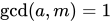
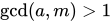
1. χ ( a b ) = χ ( a ) χ ( b ) ; {\displaystyle \chi (ab)=\chi (a)\chi (b);} χ {\displaystyle \chi } completely multiplicative . 2. χ ( a ) = 0 ⟺ gcd ( a , m ) > 1 {\displaystyle \chi (a)=0\iff \gcd(a,m)>1} 3. χ ( a + m ) = χ ( a ) {\displaystyle \chi (a+m)=\chi (a)} χ {\displaystyle \chi } m {\displaystyle m} The simplest possible character, called the principal character and usually denoted χ 0 \displaystyle \chi _{0}} [ 2]
χ 0 ( a ) = { 0 if gcd ( a , m ) > 1 1 if gcd ( a , m ) = 1. {\displaystyle \chi _{0}(a)={\begin{cases}0&{\text{if }}\gcd(a,m)>1\\1&{\text{if }}\gcd(a,m)=1.\end{cases}}} Dirichlet characters were named after German mathematician Peter Gustav Lejeune Dirichlet , who introduced these functions in his 1837 paper on primes in arithmetic progressions .[ 3] [ 4] character in mathematics.
Notation ϕ ( n ) {\displaystyle \phi (n)} Euler's totient function .[ 5]
ζ n \displaystyle \zeta _{n}} n-th root of unity :
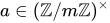
ζ n n = 1 , {\displaystyle \zeta _{n}^{n}=1,} ζ n ≠ 1 , ζ n 2 ≠ 1 , . . . ζ n n − 1 ≠ 1. {\displaystyle \zeta _{n}\neq 1,\zeta _{n}^{2}\neq 1,...\zeta _{n}^{n-1}\neq 1.} ( Z / m Z ) × {\displaystyle (\mathbb {Z} /m\mathbb {Z} )^{\times }} group of units mod m {\displaystyle m} . It has order ϕ ( m ) . {\displaystyle \phi (m).}
( Z / m Z ) × ^ {\displaystyle {\widehat {(\mathbb {Z} /m\mathbb {Z} )^{\times }}}} m {\displaystyle m}
p , p k , {\displaystyle p,p_{k},} prime numbers .
( m , n ) {\displaystyle (m,n)} [ 6] [ 7] gcd ( m , n ) {\displaystyle \gcd(m,n)}
χ ( a ) , χ ′ ( a ) , χ r ( a ) , {\displaystyle \chi (a),\chi '(a),\chi _{r}(a),} Greek letter chi for "character")
There is no standard notation for Dirichlet characters that includes the modulus. In many contexts (such as in the proof of Dirichlet's theorem) the modulus is fixed. In other contexts, such as this article, characters of different moduli appear. Where appropriate this article employs a variation of Conrey labeling (introduced by Brian Conrey and used by the LMFDB).
In this labeling characters for modulus m {\displaystyle m} χ m , t ( a ) {\displaystyle \chi _{m,t}(a)} t {\displaystyle t} the group of characters below. In this labeling, χ m , _ ( a ) {\displaystyle \chi _{m,\_}(a)} χ m , 1 ( a ) {\displaystyle \chi _{m,1}(a)} m {\displaystyle m}
Relation to group characters The word "character " is used several ways in mathematics. In this section it refers to a homomorphism from a group G {\displaystyle G}
η : G → C × , η ( g h ) = η ( g ) η ( h ) , η ( g − 1 ) = η ( g ) − 1 . {\displaystyle \eta :G\rightarrow \mathbb {C} ^{\times },\;\;\eta (gh)=\eta (g)\eta (h),\;\;\eta (g^{-1})=\eta (g)^{-1}.} The set of characters is denoted G ^ . {\displaystyle {\widehat {G}}.} η θ ( a ) = η ( a ) θ ( a ) , {\displaystyle \eta \theta (a)=\eta (a)\theta (a),} η 0 ( a ) = 1 {\displaystyle \eta _{0}(a)=1} η − 1 ( a ) = η ( a ) − 1 {\displaystyle \eta ^{-1}(a)=\eta (a)^{-1}} G ^ {\displaystyle {\widehat {G}}} [ 8 ]
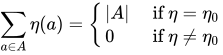
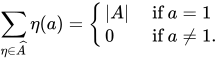
もしA {\displaystyle A} が有限アーベル群 である場合、[ 9 ] 同型 が存在するA ≅ A ^ {\displaystyle A\cong {\widehat {A}}} [ 10 ]
∑ 1 ∈ A η ( 1 ) = { | A | もし η = η 0 0 もし η ≠ η 0 {\displaystyle \sum _{a\in A}\eta (a)={\begin{cases}|A|&{\text{ if }}\eta =\eta _{0}\\0&{\text{ if }}\eta \neq \eta _{0}\end{cases}}} そして ∑ η ∈ A ^ η ( 1 ) = { | A | もし 1 = 1 0 もし 1 ≠ 1. {\displaystyle \sum _{\eta \in {\widehat {A}}}\eta (a)={\begin{cases}|A|&{\text{ if }}a=1\\0&{\text{ if }}a\neq 1.\end{cases}}} 有限アーベル群の要素( Z / m Z ) × {\displaystyle (\mathbb {Z} /m\mathbb {Z} )^{\times }} [ 1 ] = { x : x ≡ 1 ( モジュール m ) } {\displaystyle [a]=\{x:x\equiv a{\pmod {m}}\}} ( 1 、 m ) = 1. {\displaystyle (a,m)=1.}
グループキャラクターρ : ( Z / m Z ) × → C × {\displaystyle \rho :(\mathbb {Z} /m\mathbb {Z} )^{\times }\rightarrow \mathbb {C} ^{\times }} は χ : Z → C {\displaystyle \chi :\mathbb {Z} \rightarrow \mathbb {C} }
χ ( 1 ) = { 0 もし [ 1 ] ∉ ( Z / m Z ) × つまり ( 1 、 m ) > 1 ρ ( [ 1 ] ) もし [ 1 ] ∈ ( Z / m Z ) × つまり ( 1 、 m ) = 1 、 {\displaystyle \chi (a)={\begin{cases}0&{\text{if }}[a]\not \in (\mathbb {Z} /m\mathbb {Z} )^{\times }&{\text{i.e. }}(a,m)>1\\\rho ([a])&{\text{if }}[a]\in (\mathbb {Z} /m\mathbb {Z} )^{\times }&{\text{i.e. }}(a,m)=1,\end{cases}}} 逆に、ディリクレのキャラクターMODm {\displaystyle m} ( Z / m Z ) × 。 {\displaystyle (\mathbb {Z} /m\mathbb {Z} )^{\times }.}
ダベンポート[ 11 ]
基本的な事実 4) なぜなら gcd ( 1 、 m ) = 1 、 {\displaystyle \gcd(1,m)=1,} χ ( 1 ) ≠ 0 {\displaystyle \chi (1)\neq 0} χ ( 1 ) χ ( 1 ) = χ ( 1 × 1 ) = χ ( 1 ) {\displaystyle \chi (1)\chi (1)=\chi (1\times 1)=\chi (1)}
χ ( 1 ) = 1. {\displaystyle \chi (1)=1.} [ 12 ] 5) 特性3)は以下と同等である
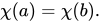
もし1 ≡ b ( モジュール m ) {\displaystyle a\equiv b{\pmod {m}}} それからχ ( 1 ) = χ ( b ) 。 {\displaystyle \chi (a)=\chi (b).} 6) 性質1)は、任意の正の整数に対して、n {\displaystyle n}
χ ( 1 n ) = χ ( 1 ) n 。 {\displaystyle \chi (a^{n})=\chi (a)^{n}.} 7)オイラーの定理 によれば、gcd ( 1 、 m ) = 1 {\displaystyle \gcd(a,m)=1} 1 ϕ ( m ) ≡ 1 ( モジュール m ) 。 {\displaystyle a^{\phi (m)}\equiv 1{\pmod {m}}.}
χ ( 1 ) ϕ ( m ) = χ ( 1 ϕ ( m ) ) = χ ( 1 ) = 1. {\displaystyle \chi (a)^{\phi (m)}=\chi (a^{\phi (m)})=\chi (1)=1.} つまり、ゼロでない値はχ ( 1 ) {\displaystyle \chi (a)} ϕ ( m ) {\displaystyle \phi (m)} 乗根 :
χ ( 1 ) = { 0 もし gcd ( 1 、 m ) > 1 ζ ϕ ( m ) r もし gcd ( 1 、 m ) = 1 {\displaystyle \chi (a)={\begin{cases}0&{\text{if }}\gcd(a,m)>1\\\zeta _{\phi (m)}^{r}&{\text{if }}\gcd(a,m)=1\end{cases}}} ある整数に対してr {\displaystyle r} χ 、 ζ 、 {\displaystyle \chi ,\zeta ,} 1 {\displaystyle a}
8) もしχ {\displaystyle \chi } χ ′ {\displaystyle \chi '} χ χ ′ 、 {\displaystyle \chi \chi ',}
χ χ ′ ( 1 ) = χ ( 1 ) χ ′ ( 1 ) {\displaystyle \chi \chi '(a)=\chi (a)\chi '(a)} (χ χ ′ {\displaystyle \chi \chi '} [ 13 ] 主人公はアイデンティティである。
χ χ 0 ( 1 ) = χ ( 1 ) χ 0 ( 1 ) = { 0 × 0 = χ ( 1 ) もし gcd ( 1 、 m ) > 1 χ ( 1 ) × 1 = χ ( 1 ) もし gcd ( 1 、 m ) = 1. {\displaystyle \chi \chi _{0}(a)=\chi (a)\chi _{0}(a)={\begin{cases}0\times 0&=\chi (a)&{\text{if }}\gcd(a,m)>1\\\chi (a)\times 1&=\chi (a)&{\text{if }}\gcd(a,m)=1.\end{cases}}} 9)1 − 1 {\displaystyle a^{-1}} 1 {\displaystyle a} ( Z / m Z ) × {\displaystyle (\mathbb {Z} /m\mathbb {Z} )^{\times }}
χ ( 1 ) χ ( 1 − 1 ) = χ ( 1 1 − 1 ) = χ ( 1 ) = 1 、 {\displaystyle \chi (a)\chi (a^{-1})=\chi (aa^{-1})=\chi (1)=1,} χ ( 1 − 1 ) = χ ( 1 ) − 1 、 {\displaystyle \chi (a^{-1})=\chi (a)^{-1},} 1の根の複素共役は逆数でもある(詳細はここを参照)。 したがって 、( 1 、 m ) = 1 {\displaystyle (a,m)=1}
χ ¯ ( 1 ) = χ ( 1 ) − 1 = χ ( 1 − 1 ) 。 {\displaystyle {\overline {\chi }}(a)=\chi (a)^{-1}=\chi (a^{-1}).} (χ ¯ {\displaystyle {\overline {\chi }}} したがって、すべての整数に対して1 {\displaystyle a}
χ ( 1 ) χ ¯ ( 1 ) = { 0 もし gcd ( 1 、 m ) > 1 1 もし gcd ( 1 、 m ) = 1 ; {\displaystyle \chi (a){\overline {\chi }}(a)={\begin{cases}0&{\text{if }}\gcd(a,m)>1\\1&{\text{if }}\gcd(a,m)=1\end{cases}};} 言い換えると χ χ ¯ = χ 0 {\displaystyle \chi {\overline {\chi }}=\chi _{0}} 10) 8)で定義された乗算と恒等演算、および9)で定義された反転演算により、与えられた法に対するディリクレ指標の集合が有限アーベル群 に変換されます。
登場人物のグループ グループによって3つの異なるケースがあります( Z / m Z ) × {\displaystyle (\mathbb {Z} /m\mathbb {Z} )^{\times }} m {\displaystyle m} 素数のべき乗 の積である。[ 14 ]
奇素数のべき乗 もしq = p k {\displaystyle q=p^{k}} ( Z / q Z ) × {\displaystyle (\mathbb {Z} /q\mathbb {Z} )^{\times }} ϕ ( q ) {\displaystyle \phi (q)} 原始ルート modと呼ばれるq {\displaystyle q} 15 ] g q {\displaystyle g_{q}} ( 1 、 q ) = 1 {\displaystyle (a,q)=1} ν q ( 1 ) {\displaystyle \nu _{q}(a)} インデックス 1 {\displaystyle a}
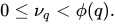
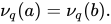
1 ≡ g q ν q ( 1 ) ( モジュール q ) 、 {\displaystyle a\equiv g_{q}^{\nu _{q}(a)}{\pmod {q}},} 0 ≤ ν q < ϕ ( q ) 。 {\displaystyle 0\leq \nu _{q}<\phi (q).} のために( 1 b 、 q ) = 1 、 1 ≡ b ( モジュール q ) {\displaystyle (ab,q)=1,\;\;a\equiv b{\pmod {q}}} ν q ( 1 ) = ν q ( b ) 。 {\displaystyle \nu _{q}(a)=\nu _{q}(b).}
χ ( 1 ) = χ ( g q ν q ( 1 ) ) = χ ( g q ) ν q ( 1 ) 、 {\displaystyle \chi (a)=\chi (g_{q}^{\nu _{q}(a)})=\chi (g_{q})^{\nu _{q}(a)},} χ {\displaystyle \chi } g q 。 {\displaystyle g_{q}.} させてω q = ζ ϕ ( q ) {\displaystyle \omega _{q}=\zeta _{\phi (q)}} ϕ ( q ) {\displaystyle \phi (q)} χ ( g q ) {\displaystyle \chi (g_{q})} ω q 、 ω q 2 、 。 。 。 ω q ϕ ( q ) = 1. {\displaystyle \omega _{q},\omega _{q}^{2},...\omega _{q}^{\phi (q)}=1.} ϕ ( q ) {\displaystyle \phi (q)} q 。 {\displaystyle q.} ( r 、 q ) = 1 {\displaystyle (r,q)=1} χ q 、 r ( 1 ) {\displaystyle \chi _{q,r}(a)}
χ q 、 r ( 1 ) = { 0 もし gcd ( 1 、 q ) > 1 ω q ν q ( r ) ν q ( 1 ) もし gcd ( 1 、 q ) = 1. {\displaystyle \chi _{q,r}(a)={\begin{cases}0&{\text{if }}\gcd(a,q)>1\\\omega _{q}^{\nu _{q}(r)\nu _{q}(a)}&{\text{if }}\gcd(a,q)=1.\end{cases}}} それから( r s 、 q ) = 1 {\displaystyle (rs,q)=1} 1 {\displaystyle a} b {\displaystyle b}
χ q 、 r ( 1 ) χ q 、 r ( b ) = χ q 、 r ( 1 b ) 、 {\displaystyle \chi _{q,r}(a)\chi _{q,r}(b)=\chi _{q,r}(ab),} χ q 、 r {\displaystyle \chi _{q,r}} χ q 、 r ( 1 ) χ q 、 s ( 1 ) = χ q 、 r s ( 1 ) 、 {\displaystyle \chi _{q,r}(a)\chi _{q,s}(a)=\chi _{q,rs}(a),} ( Z / p k Z ) × ^ ≅ ( Z / p k Z ) × 。 {\displaystyle {\widehat {(\mathbb {Z} /p^{k}\mathbb {Z} )^{\times }}}\cong (\mathbb {Z} /p^{k}\mathbb {Z} )^{\times }.}
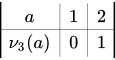
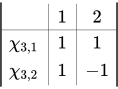
m = 3、5、7、92は原始根mod 3である 。ϕ ( 3 ) = 2 {\displaystyle \phi (3)=2}
2 1 ≡ 2 、 2 2 ≡ 2 0 ≡ 1 ( モジュール 3 ) 、 {\displaystyle 2^{1}\equiv 2,\;2^{2}\equiv 2^{0}\equiv 1{\pmod {3}},} そのため、ν 3 {\displaystyle \nu _{3}}
1 1 2 ν 3 ( 1 ) 0 1 {\displaystyle {\begin{array}{|c|c|c|c|c|c|c|}a&1&2\\\hline \nu _{3}(a)&0&1\\\end{array}}} 文字の非ゼロ値は mod 3 で表すと次のようになります。
1 2 χ 3 、 1 1 1 χ 3 、 2 1 − 1 {\displaystyle {\begin{array}{|c|c|c|c|c|c|c|}&1&2\\\hline \chi _{3,1}&1&1\\\chi _{3,2}&1&-1\\\end{array}}} 2は原始ルートmod 5です 。ϕ ( 5 ) = 4 {\displaystyle \phi (5)=4}
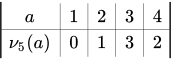
2 1 ≡ 2 、 2 2 ≡ 4 、 2 3 ≡ 3 、 2 4 ≡ 2 0 ≡ 1 ( モジュール 5 ) 、 {\displaystyle 2^{1}\equiv 2,\;2^{2}\equiv 4,\;2^{3}\equiv 3,\;2^{4}\equiv 2^{0}\equiv 1{\pmod {5}},} そのため、ν 5 {\displaystyle \nu _{5}}
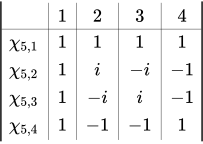
1 1 2 3 4 ν 5 ( 1 ) 0 1 3 2 {\displaystyle {\begin{array}{|c|c|c|c|c|c|c|}a&1&2&3&4\\\hline \nu _{5}(a)&0&1&3&2\\\end{array}}} 文字の非ゼロ値は mod 5 で表すと次のようになります。
1 2 3 4 χ 5 、 1 1 1 1 1 χ 5 、 2 1 私 − 私 − 1 χ 5 、 3 1 − 私 私 − 1 χ 5 、 4 1 − 1 − 1 1 {\displaystyle {\begin{array}{|c|c|c|c|c|c|c|}&1&2&3&4\\\hline \chi _{5,1}&1&1&1&1\\\chi _{5,2}&1&i&-i&-1\\\chi _{5,3}&1&-i&i&-1\\\chi _{5,4}&1&-1&-1&1\\\end{array}}} 3は7を法とする原始ルートです 。ϕ ( 7 ) = 6 {\displaystyle \phi (7)=6}
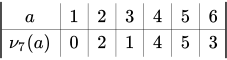
3 1 ≡ 3 、 3 2 ≡ 2 、 3 3 ≡ 6 、 3 4 ≡ 4 、 3 5 ≡ 5 、 3 6 ≡ 3 0 ≡ 1 ( モジュール 7 ) 、 {\displaystyle 3^{1}\equiv 3,\;3^{2}\equiv 2,\;3^{3}\equiv 6,\;3^{4}\equiv 4,\;3^{5}\equiv 5,\;3^{6}\equiv 3^{0}\equiv 1{\pmod {7}},} そのため、ν 7 {\displaystyle \nu _{7}}
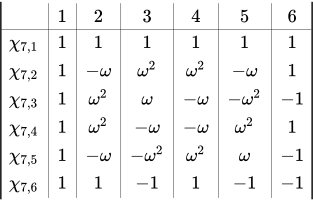
1 1 2 3 4 5 6 ν 7 ( 1 ) 0 2 1 4 5 3 {\displaystyle {\begin{array}{|c|c|c|c|c|c|c|}a&1&2&3&4&5&6\\\hline \nu _{7}(a)&0&2&1&4&5&3\\\end{array}}} 文字の mod 7 の非ゼロ値は (ω = ζ 6 、 ω 3 = − 1 {\displaystyle \omega =\zeta _{6},\;\;\omega ^{3}=-1}
1 2 3 4 5 6 χ 7 、 1 1 1 1 1 1 1 χ 7 、 2 1 − ω ω 2 ω 2 − ω 1 χ 7 、 3 1 ω 2 ω − ω − ω 2 − 1 χ 7 、 4 1 ω 2 − ω − ω ω 2 1 χ 7 、 5 1 − ω − ω 2 ω 2 ω − 1 χ 7 、 6 1 1 − 1 1 − 1 − 1 {\displaystyle {\begin{array}{|c|c|c|c|c|c|c|}&1&2&3&4&5&6\\\hline \chi _{7,1}&1&1&1&1&1&1\\\chi _{7,2}&1&-\omega &\omega ^{2}&\omega ^{2}&-\omega &1\\\chi _{7,3}&1&\omega ^{2}&\omega &-\omega &-\omega ^{2}&-1\\\chi _{7,4}&1&\omega ^{2}&-\omega &-\omega &\omega ^{2}&1\\\chi _{7,5}&1&-\omega &-\omega ^{2}&\omega ^{2}&\omega &-1\\\chi _{7,6}&1&1&-1&1&-1&-1\\\end{array}}} 2は原始根mod 9である 。ϕ ( 9 ) = 6 {\displaystyle \phi (9)=6}
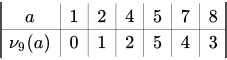
2 1 ≡ 2 、 2 2 ≡ 4 、 2 3 ≡ 8 、 2 4 ≡ 7 、 2 5 ≡ 5 、 2 6 ≡ 2 0 ≡ 1 ( モジュール 9 ) 、 {\displaystyle 2^{1}\equiv 2,\;2^{2}\equiv 4,\;2^{3}\equiv 8,\;2^{4}\equiv 7,\;2^{5}\equiv 5,\;2^{6}\equiv 2^{0}\equiv 1{\pmod {9}},} そのため、ν 9 {\displaystyle \nu _{9}}
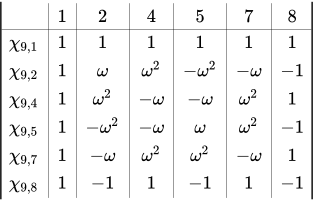
1 1 2 4 5 7 8 ν 9 ( 1 ) 0 1 2 5 4 3 {\displaystyle {\begin{array}{|c|c|c|c|c|c|c|}a&1&2&4&5&7&8\\\hline \nu _{9}(a)&0&1&2&5&4&3\\\end{array}}} 文字の mod 9 の非ゼロ値は (ω = ζ 6 、 ω 3 = − 1 {\displaystyle \omega =\zeta _{6},\;\;\omega ^{3}=-1}
1 2 4 5 7 8 χ 9 、 1 1 1 1 1 1 1 χ 9 、 2 1 ω ω 2 − ω 2 − ω − 1 χ 9 、 4 1 ω 2 − ω − ω ω 2 1 χ 9 、 5 1 − ω 2 − ω ω ω 2 − 1 χ 9 、 7 1 − ω ω 2 ω 2 − ω 1 χ 9 、 8 1 − 1 1 − 1 1 − 1 {\displaystyle {\begin{array}{|c|c|c|c|c|c|c|}&1&2&4&5&7&8\\\hline \chi _{9,1}&1&1&1&1&1&1\\\chi _{9,2}&1&\omega &\omega ^{2}&-\omega ^{2}&-\omega &-1\\\chi _{9,4}&1&\omega ^{2}&-\omega &-\omega &\omega ^{2}&1\\\chi _{9,5}&1&-\omega ^{2}&-\omega &\omega &\omega ^{2}&-1\\\chi _{9,7}&1&-\omega &\omega ^{2}&\omega ^{2}&-\omega &1\\\chi _{9,8}&1&-1&1&-1&1&-1\\\end{array}}}
2のべき乗 ( Z / 2 Z ) × {\displaystyle (\mathbb {Z} /2\mathbb {Z} )^{\times }} は、要素が1つだけの自明な群 です。( Z / 4 Z ) × {\displaystyle (\mathbb {Z} /4\mathbb {Z} )^{\times }} ≡ 1 ( モジュール 4 ) {\displaystyle \equiv 1{\pmod {4}}} ≡ 3 ( モジュール 4 ) 。 {\displaystyle \equiv 3{\pmod {4}}.} [ 16 ]
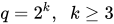
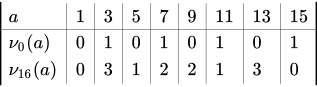
5 1 ≡ 5 、 5 2 ≡ 5 0 ≡ 1 ( モジュール 8 ) {\displaystyle 5^{1}\equiv 5,\;5^{2}\equiv 5^{0}\equiv 1{\pmod {8}}} 5 1 ≡ 5 、 5 2 ≡ 9 、 5 3 ≡ 13 、 5 4 ≡ 5 0 ≡ 1 ( モジュール 16 ) {\displaystyle 5^{1}\equiv 5,\;5^{2}\equiv 9,\;5^{3}\equiv 13,\;5^{4}\equiv 5^{0}\equiv 1{\pmod {16}}} 5 1 ≡ 5 、 5 2 ≡ 25 、 5 3 ≡ 29 、 5 4 ≡ 17 、 5 5 ≡ 21 、 5 6 ≡ 9 、 5 7 ≡ 13 、 5 8 ≡ 5 0 ≡ 1 ( モジュール 32 ) 。 {\displaystyle 5^{1}\equiv 5,\;5^{2}\equiv 25,\;5^{3}\equiv 29,\;5^{4}\equiv 17,\;5^{5}\equiv 21,\;5^{6}\equiv 9,\;5^{7}\equiv 13,\;5^{8}\equiv 5^{0}\equiv 1{\pmod {32}}.} させてq = 2 k 、 k ≥ 3 {\displaystyle q=2^{k},\;\;k\geq 3} ( Z / q Z ) × {\displaystyle (\mathbb {Z} /q\mathbb {Z} )^{\times }} は、位数 2 の巡回群 (−1 によって生成される) と位数 の巡回群の直積である。ϕ ( q ) 2 {\displaystyle {\frac {\phi (q)}{2}}} 1 {\displaystyle a} ν 0 {\displaystyle \nu _{0}} ν q {\displaystyle \nu _{q}}
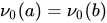
1 ≡ ( − 1 ) ν 0 ( 1 ) 5 ν q ( 1 ) ( モジュール q ) 、 {\displaystyle a\equiv (-1)^{\nu _{0}(a)}5^{\nu _{q}(a)}{\pmod {q}},} 0 ≤ ν 0 < 2 、 0 ≤ ν q < ϕ ( q ) 2 。 {\displaystyle 0\leq \nu _{0}<2,\;\;0\leq \nu _{q}<{\frac {\phi (q)}{2}}.} 奇数の場合1 {\displaystyle a} b 、 1 ≡ b ( モジュール q ) {\displaystyle b,\;\;a\equiv b{\pmod {q}}} ν 0 ( 1 ) = ν 0 ( b ) {\displaystyle \nu _{0}(a)=\nu _{0}(b)} ν q ( 1 ) = ν q ( b ) 。 {\displaystyle \nu _{q}(a)=\nu _{q}(b).} 1 {\displaystyle a} χ ( 1 ) {\displaystyle \chi (a)} χ ( − 1 ) {\displaystyle \chi (-1)} χ ( 5 ) 。 {\displaystyle \chi (5).}
させてω q = ζ ϕ ( q ) 2 {\displaystyle \omega _{q}=\zeta _{\frac {\phi (q)}{2}}} ϕ ( q ) 2 {\displaystyle {\frac {\phi (q)}{2}}} χ ( ( − 1 ) ν 0 ( 1 ) 5 ν q ( 1 ) ) {\displaystyle \chi ((-1)^{\nu _{0}(a)}5^{\nu _{q}(a)})} ± ω q 、 ± ω q 2 、 。 。 。 ± ω q ϕ ( q ) 2 = ± 1. {\displaystyle \pm \omega _{q},\pm \omega _{q}^{2},...\pm \omega _{q}^{\frac {\phi (q)}{2}}=\pm 1.} ϕ ( q ) {\displaystyle \phi (q)} q 。 {\displaystyle q.} r {\displaystyle r} χ q 、 r ( 1 ) {\displaystyle \chi _{q,r}(a)}
χ q 、 r ( 1 ) = { 0 もし 1 さえ ( − 1 ) ν 0 ( r ) ν 0 ( 1 ) ω q ν q ( r ) ν q ( 1 ) もし 1 奇妙だ 。 {\displaystyle \chi _{q,r}(a)={\begin{cases}0&{\text{if }}a{\text{ is even}}\\(-1)^{\nu _{0}(r)\nu _{0}(a)}\omega _{q}^{\nu _{q}(r)\nu _{q}(a)}&{\text{if }}a{\text{ is odd}}.\end{cases}}} 奇数の場合はr {\displaystyle r} s {\displaystyle s} 1 {\displaystyle a} b {\displaystyle b}
χ q 、 r ( 1 ) χ q 、 r ( b ) = χ q 、 r ( 1 b ) {\displaystyle \chi _{q,r}(a)\chi _{q,r}(b)=\chi _{q,r}(ab)} χ q 、 r {\displaystyle \chi _{q,r}} χ q 、 r ( 1 ) χ q 、 s ( 1 ) = χ q 、 r s ( 1 ) {\displaystyle \chi _{q,r}(a)\chi _{q,s}(a)=\chi _{q,rs}(a)} ( Z / 2 k Z ) × ^ ≅ ( Z / 2 k Z ) × 。 {\displaystyle {\widehat {(\mathbb {Z} /2^{k}\mathbb {Z} )^{\times }}}\cong (\mathbb {Z} /2^{k}\mathbb {Z} )^{\times }.}
m = 2、4、8、16唯一のキャラクターmod 2は主人公ですχ 2 、 1 {\displaystyle \chi _{2,1}}
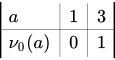
−1 は 4 を法とする原始ルートです (ϕ ( 4 ) = 2 {\displaystyle \phi (4)=2}
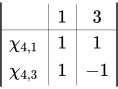
1 1 3 ν 0 ( 1 ) 0 1 {\displaystyle {\begin{array}{|||}a&1&3\\\hline \nu _{0}(a)&0&1\\\end{array}}} 文字の非ゼロ値は mod 4 で表すと次のようになります。
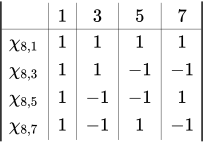
1 3 χ 4 、 1 1 1 χ 4 、 3 1 − 1 {\displaystyle {\begin{array}{|c|c|c|c|c|c|c|}&1&3\\\hline \chi _{4,1}&1&1\\\chi _{4,3}&1&-1\\\end{array}}} −1 は 5 であり、単位 mod 8 を生成します (ϕ ( 8 ) = 4 {\displaystyle \phi (8)=4}
1 1 3 5 7 ν 0 ( 1 ) 0 1 0 1 ν 8 ( 1 ) 0 1 1 0 {\displaystyle {\begin{array}{|||}a&1&3&5&7\\\hline \nu _{0}(a)&0&1&0&1\\\nu _{8}(a)&0&1&1&0\\\end{array}}} 文字の非ゼロ値は mod 8 で表すと次のようになります。
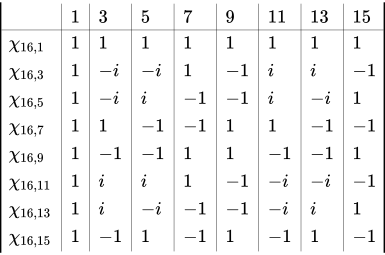
1 3 5 7 χ 8 、 1 1 1 1 1 χ 8 、 3 1 1 − 1 − 1 χ 8 、 5 1 − 1 − 1 1 χ 8 、 7 1 − 1 1 − 1 {\displaystyle {\begin{array}{|c|c|c|c|c|c|c|}&1&3&5&7\\\hline \chi _{8,1}&1&1&1&1\\\chi _{8,3}&1&1&-1&-1\\\chi _{8,5}&1&-1&-1&1\\\chi _{8,7}&1&-1&1&-1\\\end{array}}} −1 と 5 は mod 16 の単位を生成します (ϕ ( 16 ) = 8 {\displaystyle \phi (16)=8}
1 1 3 5 7 9 11 13 15 ν 0 ( 1 ) 0 1 0 1 0 1 0 1 ν 16 ( 1 ) 0 3 1 2 2 1 3 0 {\displaystyle {\begin{array}{|||}a&1&3&5&7&9&11&13&15\\\hline \nu _{0}(a)&0&1&0&1&0&1&0&1\\\nu _{16}(a)&0&3&1&2&2&1&3&0\\\end{array}}} 文字の非ゼロ値は mod 16 で次のようになります。
1 3 5 7 9 11 13 15 χ 16 、 1 1 1 1 1 1 1 1 1 χ 16 、 3 1 − 私 − 私 1 − 1 私 私 − 1 χ 16 、 5 1 − 私 私 − 1 − 1 私 − 私 1 χ 16 、 7 1 1 − 1 − 1 1 1 − 1 − 1 χ 16 、 9 1 − 1 − 1 1 1 − 1 − 1 1 χ 16 、 11 1 私 私 1 − 1 − 私 − 私 − 1 χ 16 、 13 1 私 − 私 − 1 − 1 − 私 私 1 χ 16 、 15 1 − 1 1 − 1 1 − 1 1 − 1 {\displaystyle {\begin{array}{|||}&1&3&5&7&9&11&13&15\\\hline \chi _{16,1}&1&1&1&1&1&1&1&1\\\chi _{16,3}&1&-i&-i&1&-1&i&i&-1\\\chi _{16,5}&1&-i&i&-1&-1&i&-i&1\\\chi _{16,7}&1&1&-1&-1&1&1&-1&-1\\\chi _{16,9}&1&-1&-1&1&1&-1&-1&1\\\chi _{16,11}&1&i&i&1&-1&-i&-i&-1\\\chi _{16,13}&1&i&-i&-1&-1&-i&i&1\\\chi _{16,15}&1&-1&1&-1&1&-1&1&-1\\\end{array}}}
主要勢力の産物 させてm = p 1 m 1 p 2 m 2 ⋯ p k m k = q 1 q 2 ⋯ q k {\displaystyle m=p_{1}^{m_{1}}p_{2}^{m_{2}}\cdots p_{k}^{m_{k}}=q_{1}q_{2}\cdots q_{k}} p 1 < p 2 < ⋯ < p k {\displaystyle p_{1}<p_{2}<\dots <p_{k}} m {\displaystyle m} m {\displaystyle m} q 私 {\displaystyle q_{i}} [ 17 ]
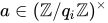
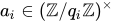
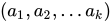
( Z / m Z ) × ≅ ( Z / q 1 Z ) × × ( Z / q 2 Z ) × × ⋯ × ( Z / q k Z ) × 。 {\displaystyle (\mathbb {Z} /m\mathbb {Z} )^{\times }\cong (\mathbb {Z} /q_{1}\mathbb {Z} )^{\times }\times (\mathbb {Z} /q_{2}\mathbb {Z} )^{\times }\times \dots \times (\mathbb {Z} /q_{k}\mathbb {Z} )^{\times }.} これは、1) と1 ∈ ( Z / m Z ) × {\displaystyle a\in (\mathbb {Z} /m\mathbb {Z} )^{\times }} k {\displaystyle k} ( 1 1 、 1 2 、 … 、 1 k ) {\displaystyle (a_{1},a_{2},\dots ,a_{k})} 1 私 ∈ ( Z / q 私 Z ) × {\displaystyle a_{i}\in (\mathbb {Z} /q_{i}\mathbb {Z} )^{\times }} m {\displaystyle m} k {\displaystyle k}
1 b ≡ c ( モジュール m ) {\displaystyle ab\equiv c{\pmod {m}}} ( 1 1 、 1 2 、 … 、 1 k ) × ( b 1 、 b 2 、 … 、 b k ) = ( c 1 、 c 2 、 … 、 c k ) {\displaystyle (a_{1},a_{2},\dots ,a_{k})\times (b_{1},b_{2},\dots ,b_{k})=(c_{1},c_{2},\dots ,c_{k})} c 私 ≡ 1 私 b 私 ( モジュール q 私 ) 。 {\displaystyle c_{i}\equiv a_{i}b_{i}{\pmod {q_{i}}}.} 中国剰余定理 (CRT)は、1 私 {\displaystyle a_{i}} 1 私 ≡ 1 ( モジュール q 私 ) 。 {\displaystyle a_{i}\equiv a{\pmod {q_{i}}}.}
サブグループが存在するG 私 < ( Z / m Z ) × {\displaystyle G_{i}<(\mathbb {Z} /m\mathbb {Z} )^{\times }} [ 18 ]
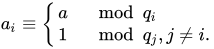
G 私 ≅ ( Z / q 私 Z ) × {\displaystyle G_{i}\cong (\mathbb {Z} /q_{i}\mathbb {Z} )^{\times }} G 私 ≡ { ( Z / q 私 Z ) × モジュール q 私 { 1 } モジュール q j 、 j ≠ 私 。 {\displaystyle G_{i}\equiv {\begin{cases}(\mathbb {Z} /q_{i}\mathbb {Z} )^{\times }&\mod q_{i}\\\{1\}&\mod q_{j},j\neq i.\end{cases}}} それから( Z / m Z ) × ≅ G 1 × G 2 × 。 。 。 × G k {\displaystyle (\mathbb {Z} /m\mathbb {Z} )^{\times }\cong G_{1}\times G_{2}\times ...\times G_{k}} 1 ∈ ( Z / m Z ) × {\displaystyle a\in (\mathbb {Z} /m\mathbb {Z} )^{\times }} k {\displaystyle k} タプル ( 1 1 、 1 2 、 。 。 。 1 k ) {\displaystyle (a_{1},a_{2},...a_{k})} 1 私 ∈ G 私 {\displaystyle a_{i}\in G_{i}} 1 私 ≡ 1 ( モジュール q 私 ) 。 {\displaystyle a_{i}\equiv a{\pmod {q_{i}}}.} 1 ∈ ( Z / m Z ) × {\displaystyle a\in (\mathbb {Z} /m\mathbb {Z} )^{\times }} 1 = 1 1 1 2 。 。 。 1 k 。 {\displaystyle a=a_{1}a_{2}...a_{k}.} [ 19 ] [ 20 ]
もしχ m 、 _ {\displaystyle \chi _{m,\_}} m 、 {\displaystyle m,} G 私 {\displaystyle G_{i}} χ q 私 、 _ {\displaystyle \chi _{q_{i},\_}} q 私 {\displaystyle q_{i}}
χ m 、 _ ( 1 ) = χ m 、 _ ( 1 1 1 2 。 。 。 ) = χ m 、 _ ( 1 1 ) χ m 、 _ ( 1 2 ) 。 。 。 = χ q 1 、 _ ( 1 1 ) χ q 2 、 _ ( 1 2 ) 。 。 。 、 {\displaystyle \chi _{m,\_}(a)=\chi _{m,\_}(a_{1}a_{2}...)=\chi _{m,\_}(a_{1})\chi _{m,\_}(a_{2})...=\chi _{q_{1},\_}(a_{1})\chi _{q_{2},\_}(a_{2})...,} すべてのキャラクターMODを示していますm {\displaystyle m} q 私 {\displaystyle q_{i}}
のために( t 、 m ) = 1 {\displaystyle (t,m)=1} [ 21 ]
χ m 、 t = χ q 1 、 t χ q 2 、 t 。 。 。 {\displaystyle \chi _{m,t}=\chi _{q_{1},t}\chi _{q_{2},t}...} それから( r s 、 m ) = 1 {\displaystyle (rs,m)=1} 1 {\displaystyle a} b {\displaystyle b} [ 22 ]
χ m 、 r ( 1 ) χ m 、 r ( b ) = χ m 、 r ( 1 b ) 、 {\displaystyle \chi _{m,r}(a)\chi _{m,r}(b)=\chi _{m,r}(ab),} χ m 、 r {\displaystyle \chi _{m,r}} χ m 、 r ( 1 ) χ m 、 s ( 1 ) = χ m 、 r s ( 1 ) 、 {\displaystyle \chi _{m,r}(a)\chi _{m,s}(a)=\chi _{m,rs}(a),} ( Z / m Z ) × ^ ≅ ( Z / m Z ) × 。 {\displaystyle {\widehat {(\mathbb {Z} /m\mathbb {Z} )^{\times }}}\cong (\mathbb {Z} /m\mathbb {Z} )^{\times }.}
:m = 15、24、40( Z / 15 Z ) × ≅ ( Z / 3 Z ) × × ( Z / 5 Z ) × 。 {\displaystyle (\mathbb {Z} /15\mathbb {Z} )^{\times }\cong (\mathbb {Z} /3\mathbb {Z} )^{\times }\times (\mathbb {Z} /5\mathbb {Z} )^{\times }.}
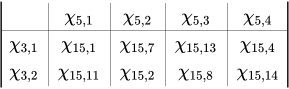
文字の因数分解 mod 15 は
χ 5 、 1 χ 5 、 2 χ 5 、 3 χ 5 、 4 χ 3 、 1 χ 15 、 1 χ 15 、 7 χ 15 、 13 χ 15 、 4 χ 3 、 2 χ 15 、 11 χ 15 、 2 χ 15 、 8 χ 15 、 14 {\displaystyle {\begin{array}{|c|c|c|c|c|c|c|}&\chi _{5,1}&\chi _{5,2}&\chi _{5,3}&\chi _{5,4}\\\hline \chi _{3,1}&\chi _{15,1}&\chi _{15,7}&\chi _{15,13}&\chi _{15,4}\\\chi _{3,2}&\chi _{15,11}&\chi _{15,2}&\chi _{15,8}&\chi _{15,14}\\\end{array}}} 文字の非ゼロ値は mod 15 で次のようになります。
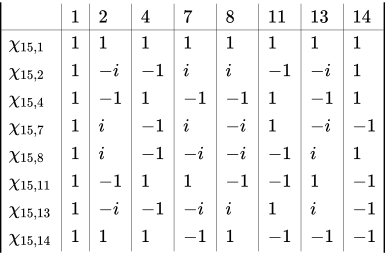
1 2 4 7 8 11 13 14 χ 15 、 1 1 1 1 1 1 1 1 1 χ 15 、 2 1 − 私 − 1 私 私 − 1 − 私 1 χ 15 、 4 1 − 1 1 − 1 − 1 1 − 1 1 χ 15 、 7 1 私 − 1 私 − 私 1 − 私 − 1 χ 15 、 8 1 私 − 1 − 私 − 私 − 1 私 1 χ 15 、 11 1 − 1 1 1 − 1 − 1 1 − 1 χ 15 、 13 1 − 私 − 1 − 私 私 1 私 − 1 χ 15 、 14 1 1 1 − 1 1 − 1 − 1 − 1 {\displaystyle {\begin{array}{|||}&1&2&4&7&8&11&13&14\\\hline \chi _{15,1}&1&1&1&1&1&1&1&1\\\chi _{15,2}&1&-i&-1&i&i&-1&-i&1\\\chi _{15,4}&1&-1&1&-1&-1&1&-1&1\\\chi _{15,7}&1&i&-1&i&-i&1&-i&-1\\\chi _{15,8}&1&i&-1&-i&-i&-1&i&1\\\chi _{15,11}&1&-1&1&1&-1&-1&1&-1\\\chi _{15,13}&1&-i&-1&-i&i&1&i&-1\\\chi _{15,14}&1&1&1&-1&1&-1&-1&-1\\\end{array}}} ( Z / 24 Z ) × ≅ ( Z / 8 Z ) × × ( Z / 3 Z ) × 。 {\displaystyle (\mathbb {Z} /24\mathbb {Z} )^{\times }\cong (\mathbb {Z} /8\mathbb {Z} )^{\times }\times (\mathbb {Z} /3\mathbb {Z} )^{\times }.}
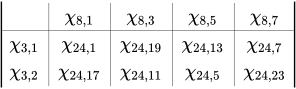
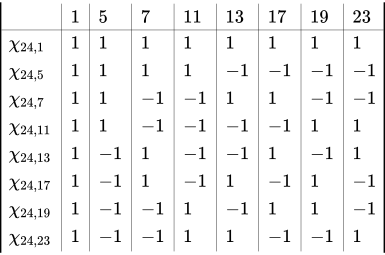
χ 8 、 1 χ 8 、 3 χ 8 、 5 χ 8 、 7 χ 3 、 1 χ 24 、 1 χ 24 、 19 χ 24 、 13 χ 24 、 7 χ 3 、 2 χ 24 、 17 χ 24 、 11 χ 24 、 5 χ 24 、 23 {\displaystyle {\begin{array}{|c|c|c|c|c|c|c|}&\chi _{8,1}&\chi _{8,3}&\chi _{8,5}&\chi _{8,7}\\\hline \chi _{3,1}&\chi _{24,1}&\chi _{24,19}&\chi _{24,13}&\chi _{24,7}\\\chi _{3,2}&\chi _{24,17}&\chi _{24,11}&\chi _{24,5}&\chi _{24,23}\\\end{array}}} 文字の非ゼロ値は mod 24 で次のようになります。
1 5 7 11 13 17 19 23 χ 24 、 1 1 1 1 1 1 1 1 1 χ 24 、 5 1 1 1 1 − 1 − 1 − 1 − 1 χ 24 、 7 1 1 − 1 − 1 1 1 − 1 − 1 χ 24 、 11 1 1 − 1 − 1 − 1 − 1 1 1 χ 24 、 13 1 − 1 1 − 1 − 1 1 − 1 1 χ 24 、 17 1 − 1 1 − 1 1 − 1 1 − 1 χ 24 、 19 1 − 1 − 1 1 − 1 1 1 − 1 χ 24 、 23 1 − 1 − 1 1 1 − 1 − 1 1 {\displaystyle {\begin{array}{|||}&1&5&7&11&13&17&19&23\\\hline \chi _{24,1}&1&1&1&1&1&1&1&1\\\chi _{24,5}&1&1&1&1&-1&-1&-1&-1\\\chi _{24,7}&1&1&-1&-1&1&1&-1&-1\\\chi _{24,11}&1&1&-1&-1&-1&-1&1&1\\\chi _{24,13}&1&-1&1&-1&-1&1&-1&1\\\chi _{24,17}&1&-1&1&-1&1&-1&1&-1\\\chi _{24,19}&1&-1&-1&1&-1&1&1&-1\\\chi _{24,23}&1&-1&-1&1&1&-1&-1&1\\\end{array}}} ( Z / 40 Z ) × ≅ ( Z / 8 Z ) × × ( Z / 5 Z ) × 。 {\displaystyle (\mathbb {Z} /40\mathbb {Z} )^{\times }\cong (\mathbb {Z} /8\mathbb {Z} )^{\times }\times (\mathbb {Z} /5\mathbb {Z} )^{\times }.}
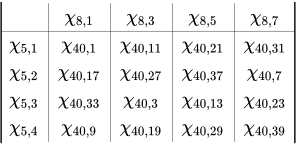
χ 8 、 1 χ 8 、 3 χ 8 、 5 χ 8 、 7 χ 5 、 1 χ 40 、 1 χ 40 、 11 χ 40 、 21 χ 40 、 31 χ 5 、 2 χ 40 、 17 χ 40 、 27 χ 40 、 37 χ 40 、 7 χ 5 、 3 χ 40 、 33 χ 40 、 3 χ 40 、 13 χ 40 、 23 χ 5 、 4 χ 40 、 9 χ 40 、 19 χ 40 、 29 χ 40 、 39 {\displaystyle {\begin{array}{|c|c|c|c|c|c|c|}&\chi _{8,1}&\chi _{8,3}&\chi _{8,5}&\chi _{8,7}\\\hline \chi _{5,1}&\chi _{40,1}&\chi _{40,11}&\chi _{40,21}&\chi _{40,31}\\\chi _{5,2}&\chi _{40,17}&\chi _{40,27}&\chi _{40,37}&\chi _{40,7}\\\chi _{5,3}&\chi _{40,33}&\chi _{40,3}&\chi _{40,13}&\chi _{40,23}\\\chi _{5,4}&\chi _{40,9}&\chi _{40,19}&\chi _{40,29}&\chi _{40,39}\\\end{array}}} 文字の非ゼロ値は mod 40 で次のようになります。
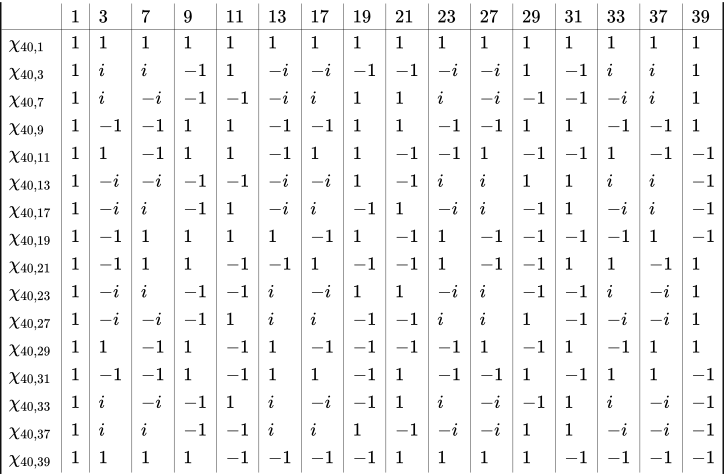
1 3 7 9 11 13 17 19 21 23 27 29 31 33 37 39 χ 40 、 1 1 1 1 1 1 1 1 1 1 1 1 1 1 1 1 1 χ 40 、 3 1 私 私 − 1 1 − 私 − 私 − 1 − 1 − 私 − 私 1 − 1 私 私 1 χ 40 、 7 1 私 − 私 − 1 − 1 − 私 私 1 1 私 − 私 − 1 − 1 − 私 私 1 χ 40 、 9 1 − 1 − 1 1 1 − 1 − 1 1 1 − 1 − 1 1 1 − 1 − 1 1 χ 40 、 11 1 1 − 1 1 1 − 1 1 1 − 1 − 1 1 − 1 − 1 1 − 1 − 1 χ 40 、 13 1 − 私 − 私 − 1 − 1 − 私 − 私 1 − 1 私 私 1 1 私 私 − 1 χ 40 、 17 1 − 私 私 − 1 1 − 私 私 − 1 1 − 私 私 − 1 1 − 私 私 − 1 χ 40 、 19 1 − 1 1 1 1 1 − 1 1 − 1 1 − 1 − 1 − 1 − 1 1 − 1 χ 40 、 21 1 − 1 1 1 − 1 − 1 1 − 1 − 1 1 − 1 − 1 1 1 − 1 1 χ 40 、 23 1 − 私 私 − 1 − 1 私 − 私 1 1 − 私 私 − 1 − 1 私 − 私 1 χ 40 、 27 1 − 私 − 私 − 1 1 私 私 − 1 − 1 私 私 1 − 1 − 私 − 私 1 χ 40 、 29 1 1 − 1 1 − 1 1 − 1 − 1 − 1 − 1 1 − 1 1 − 1 1 1 χ 40 、 31 1 − 1 − 1 1 − 1 1 1 − 1 1 − 1 − 1 1 − 1 1 1 − 1 χ 40 、 33 1 私 − 私 − 1 1 私 − 私 − 1 1 私 − 私 − 1 1 私 − 私 − 1 χ 40 、 37 1 私 私 − 1 − 1 私 私 1 − 1 − 私 − 私 1 1 − 私 − 私 − 1 χ 40 、 39 1 1 1 1 − 1 − 1 − 1 − 1 1 1 1 1 − 1 − 1 − 1 − 1 {\displaystyle {\begin{array}{|||}&1&3&7&9&11&13&17&19&21&23&27&29&31&33&37&39\\\hline \chi _{40,1}&1&1&1&1&1&1&1&1&1&1&1&1&1&1&1&1\\\chi _{40,3}&1&i&i&-1&1&-i&-i&-1&-1&-i&-i&1&-1&i&i&1\\\chi _{40,7}&1&i&-i&-1&-1&-i&i&1&1&i&-i&-1&-1&-i&i&1\\\chi _{40,9}&1&-1&-1&1&1&-1&-1&1&1&-1&-1&1&1&-1&-1&1\\\chi _{40,11}&1&1&-1&1&1&-1&1&1&-1&-1&1&-1&-1&1&-1&-1\\\chi _{40,13}&1&-i&-i&-1&-1&-i&-i&1&-1&i&i&1&1&i&i&-1\\\chi _{40,17}&1&-i&i&-1&1&-i&i&-1&1&-i&i&-1&1&-i&i&-1\\\chi _{40,19}&1&-1&1&1&1&1&-1&1&-1&1&-1&-1&-1&-1&1&-1\\\chi _{40,21}&1&-1&1&1&-1&-1&1&-1&-1&1&-1&-1&1&1&-1&1\\\chi _{40,23}&1&-i&i&-1&-1&i&-i&1&1&-i&i&-1&-1&i&-i&1\\\chi _{40,27}&1&-i&-i&-1&1&i&i&-1&-1&i&i&1&-1&-i&-i&1\\\chi _{40,29}&1&1&-1&1&-1&1&-1&-1&-1&-1&1&-1&1&-1&1&1\\\chi _{40,31}&1&-1&-1&1&-1&1&1&-1&1&-1&-1&1&-1&1&1&-1\\\chi _{40,33}&1&i&-i&-1&1&i&-i&-1&1&i&-i&-1&1&i&-i&-1\\\chi _{40,37}&1&i&i&-1&-1&i&i&1&-1&-i&-i&1&1&-i&-i&-1\\\chi _{40,39}&1&1&1&1&-1&-1&-1&-1&1&1&1&1&-1&-1&-1&-1\\\end{array}}}
まとめ させてm = p 1 k 1 p 2 k 2 ⋯ = q 1 q 2 ⋯ {\displaystyle m=p_{1}^{k_{1}}p_{2}^{k_{2}}\cdots =q_{1}q_{2}\cdots } p 1 < p 2 < … {\displaystyle p_{1}<p_{2}<\dots } m {\displaystyle m} ( r s 、 m ) = 1. {\displaystyle (rs,m)=1.}
があるϕ ( m ) {\displaystyle \phi (m)} m 。 {\displaystyle m.} χ m 、 r 、 {\displaystyle \chi _{m,r},} χ m 、 r = χ m 、 s {\displaystyle \chi _{m,r}=\chi _{m,s}} r ≡ s ( モジュール m ) 。 {\displaystyle r\equiv s{\pmod {m}}.} χ m 、 r ( 1 ) χ m 、 s ( 1 ) = χ m 、 r s ( 1 ) {\displaystyle \chi _{m,r}(a)\chi _{m,s}(a)=\chi _{m,rs}(a)\;} ( Z / m Z ) × ^ ≅ ( Z / m Z ) × 。 {\displaystyle {\widehat {(\mathbb {Z} /m\mathbb {Z} )^{\times }}}\cong (\mathbb {Z} /m\mathbb {Z} )^{\times }.} [ 23 ]
各キャラクターMODm {\displaystyle m} m {\displaystyle m}
χ m 、 r = χ q 1 、 r χ q 2 、 r 。 。 。 {\displaystyle \chi _{m,r}=\chi _{q_{1},r}\chi _{q_{2},r}...} もしm = m 1 m 2 、 ( m 1 、 m 2 ) = 1 {\displaystyle m=m_{1}m_{2},(m_{1},m_{2})=1} χ m 1 、 r χ m 2 、 s {\displaystyle \chi _{m_{1},r}\chi _{m_{2},s}} χ m 、 t {\displaystyle \chi _{m,t}} t {\displaystyle t} t ≡ r ( モジュール m 1 ) {\displaystyle t\equiv r{\pmod {m_{1}}}} t ≡ s ( モジュール m 2 ) 。 {\displaystyle t\equiv s{\pmod {m_{2}}}.}
また、[ 24 ] [ 25 ] χ m 、 r ( s ) = χ m 、 s ( r ) {\displaystyle \chi _{m,r}(s)=\chi _{m,s}(r)}
直交性 2つの直交関係は[ 26 ]
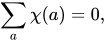
∑ 1 ∈ ( Z / m Z ) × χ ( 1 ) = { ϕ ( m ) もし χ = χ 0 0 もし χ ≠ χ 0 {\displaystyle \sum _{a\in (\mathbb {Z} /m\mathbb {Z} )^{\times }}\chi (a)={\begin{cases}\phi (m)&{\text{ if }}\;\chi =\chi _{0}\\0&{\text{ if }}\;\chi \neq \chi _{0}\end{cases}}} そして ∑ χ ∈ ( Z / m Z ) × ^ χ ( 1 ) = { ϕ ( m ) もし 1 ≡ 1 ( モジュール m ) 0 もし 1 ≢ 1 ( モジュール m ) 。 {\displaystyle \sum _{\chi \in {\widehat {(\mathbb {Z} /m\mathbb {Z} )^{\times }}}}\chi (a)={\begin{cases}\phi (m)&{\text{ if }}\;a\equiv 1{\pmod {m}}\\0&{\text{ if }}\;a\not \equiv 1{\pmod {m}}.\end{cases}}} これらの関係は対称形式で記述できる。
∑ 1 ∈ ( Z / m Z ) × χ m 、 r ( 1 ) = { ϕ ( m ) もし r ≡ 1 0 もし r ≢ 1 {\displaystyle \sum _{a\in (\mathbb {Z} /m\mathbb {Z} )^{\times }}\chi _{m,r}(a)={\begin{cases}\phi (m)&{\text{ if }}\;r\equiv 1\\0&{\text{ if }}\;r\not \equiv 1\end{cases}}} そして ∑ r ∈ ( Z / m Z ) × χ m 、 r ( 1 ) = { ϕ ( m ) もし 1 ≡ 1 0 もし 1 ≢ 1. {\displaystyle \sum _{r\in (\mathbb {Z} /m\mathbb {Z} )^{\times }}\chi _{m,r}(a)={\begin{cases}\phi (m)&{\text{ if }}\;a\equiv 1\\0&{\text{ if }}\;a\not \equiv 1.\end{cases}}} 最初の関係は簡単に証明できます。χ = χ 0 {\displaystyle \chi =\chi _{0}} ϕ ( m ) {\displaystyle \phi (m)} χ ≠ χ 0 {\displaystyle \chi \neq \chi _{0}} [ 27 ] 1 * 、 ( 1 * 、 m ) = 1 、 χ ( 1 * ) ≠ 1. {\displaystyle a^{*},\;(a^{*},m)=1,\;\chi (a^{*})\neq 1.} それから
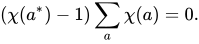
χ ( 1 * ) ∑ 1 ∈ ( Z / m Z ) × χ ( 1 ) = ∑ 1 χ ( 1 * ) χ ( 1 ) = ∑ 1 χ ( 1 * 1 ) = ∑ 1 χ ( 1 ) 、 {\displaystyle \chi (a^{*})\sum _{a\in (\mathbb {Z} /m\mathbb {Z} )^{\times }}\chi (a)=\sum _{a}\chi (a^{*})\chi (a)=\sum _{a}\chi (a^{*}a)=\sum _{a}\chi (a),} [ 28 ] 意味する( χ ( 1 * ) − 1 ) ∑ 1 χ ( 1 ) = 0. {\displaystyle (\chi (a^{*})-1)\sum _{a}\chi (a)=0.} 最初の因数で割ると∑ 1 χ ( 1 ) = 0 、 {\displaystyle \sum _{a}\chi (a)=0,} χ m 、 r ( s ) = χ m 、 s ( r ) {\displaystyle \chi _{m,r}(s)=\chi _{m,s}(r)} ( r s 、 m ) = 1 {\displaystyle (rs,m)=1} 2番目の関係も同様の方法で直接証明できますが、補題[ 29 ]が必要です。
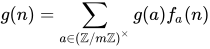
与えられた1 ≢ 1 ( モジュール m ) 、 ( 1 、 m ) = 1 、 {\displaystyle a\not \equiv 1{\pmod {m}},\;(a,m)=1,} χ * 、 χ * ( 1 ) ≠ 1. {\displaystyle \chi ^{*},\;\chi ^{*}(a)\neq 1.} 2番目の関係には重要な帰結がある。( 1 、 m ) = 1 、 {\displaystyle (a,m)=1,}
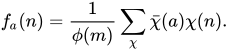
f 1 ( n ) = 1 ϕ ( m ) ∑ χ χ ¯ ( 1 ) χ ( n ) 。 {\displaystyle f_{a}(n)={\frac {1}{\phi (m)}}\sum _{\chi }{\bar {\chi }}(a)\chi (n).} それからf 1 ( n ) = 1 ϕ ( m ) ∑ χ χ ( 1 − 1 ) χ ( n ) = 1 ϕ ( m ) ∑ χ χ ( 1 − 1 n ) = { 1 、 n ≡ 1 ( モジュール m ) 0 、 n ≢ 1 ( モジュール m ) 、 {\displaystyle f_{a}(n)={\frac {1}{\phi (m)}}\sum _{\chi }\chi (a^{-1})\chi (n)={\frac {1}{\phi (m)}}\sum _{\chi }\chi (a^{-1}n)={\begin{cases}1,&n\equiv a{\pmod {m}}\\0,&n\not \equiv a{\pmod {m}},\end{cases}}} それはf 1 = 1 [ 1 ] {\displaystyle f_{a}=\mathbb {1} _{[a]}} 関数 [ 1 ] = { x : x ≡ 1 ( モジュール m ) } {\displaystyle [a]=\{x:\;x\equiv a{\pmod {m}}\}} [ 30 ] [ 31 ]
文字の分類
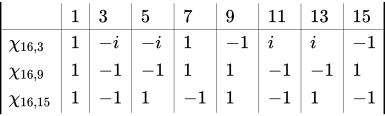
プライムパワーを修正するキャラクターは、それより大きなパワーを修正するキャラクターでもあります。たとえば、mod 16 [ 32 ]
1 3 5 7 9 11 13 15 χ 16 、 3 1 − 私 − 私 1 − 1 私 私 − 1 χ 16 、 9 1 − 1 − 1 1 1 − 1 − 1 1 χ 16 、 15 1 − 1 1 − 1 1 − 1 1 − 1 {\displaystyle {\begin{array}{|||}&1&3&5&7&9&11&13&15\\\hline \chi _{16,3}&1&-i&-i&1&-1&i&i&-1\\\chi _{16,9}&1&-1&-1&1&1&-1&-1&1\\\chi _{16,15}&1&-1&1&-1&1&-1&1&-1\\\end{array}}} χ 16 、 3 {\displaystyle \chi _{16,3}} χ 16 、 9 {\displaystyle \chi _{16,9}} χ 16 、 15 {\displaystyle \chi _{16,15}} χ 16 、 9 = χ 8 、 5 {\displaystyle \chi _{16,9}=\chi _{8,5}} χ 16 、 15 = χ 8 、 7 = χ 4 、 3 。 {\displaystyle \chi _{16,15}=\chi _{8,7}=\chi _{4,3}.}
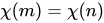
キャラクターχ {\displaystyle \chi } q {\displaystyle q} 準周期を 持つd {\displaystyle d} χ ( m ) = χ ( n ) {\displaystyle \chi (m)=\chi (n)} m {\displaystyle m} n {\displaystyle n} q {\displaystyle q} m ≡ n {\displaystyle m\equiv n} d {\displaystyle d} 33 ]、 χ 2 、 1 {\displaystyle \chi _{2,1}} 2 {\displaystyle 2} 1 {\displaystyle 1} 、 1 {\displaystyle 1} 2 {\displaystyle 2} χ {\displaystyle \chi } 導体 であるχ {\displaystyle \chi } [ 34 ] χ 2 、 1 {\displaystyle \chi _{2,1}} 1 {\displaystyle 1}
指揮者χ 16 、 3 {\displaystyle \chi _{16,3}} χ 16 、 9 {\displaystyle \chi _{16,9}} χ 16 、 15 {\displaystyle \chi _{16,15}} χ 8 、 7 {\displaystyle \chi _{8,7}} 原始的 であり、そうでない場合は非原始的 です。非原始的な文字は、最小のモジュラスの文字によって誘導されます。 χ 16 、 9 {\displaystyle \chi _{16,9}} χ 8 、 5 {\displaystyle \chi _{8,5}} χ 16 、 15 {\displaystyle \chi _{16,15}} χ 8 、 7 {\displaystyle \chi _{8,7}} χ 4 、 3 {\displaystyle \chi _{4,3}}
素数の積を法とする数値でも同様の現象が起こり得る。その非ゼロ値は、 より短い周期で周期的になる可能性がある。
例えば、mod 15、
1 2 3 4 5 6 7 8 9 10 11 12 13 14 15 χ 15 、 8 1 私 0 − 1 0 0 − 私 − 私 0 0 − 1 0 私 1 0 χ 15 、 11 1 − 1 0 1 0 0 1 − 1 0 0 − 1 0 1 − 1 0 χ 15 、 13 1 − 私 0 − 1 0 0 − 私 私 0 0 1 0 私 − 1 0 {\displaystyle {\begin{array}{|||}&1&2&3&4&5&6&7&8&9&10&11&12&13&14&15\\\hline \chi _{15,8}&1&i&0&-1&0&0&-i&-i&0&0&-1&0&i&1&0\\\chi _{15,11}&1&-1&0&1&0&0&1&-1&0&0&-1&0&1&-1&0\\\chi _{15,13}&1&-i&0&-1&0&0&-i&i&0&0&1&0&i&-1&0\\\end{array}}} 非ゼロ値χ 15 、 8 {\displaystyle \chi _{15,8}} χ 15 、 11 {\displaystyle \chi _{15,11}} χ 15 、 13 {\displaystyle \chi _{15,13}}
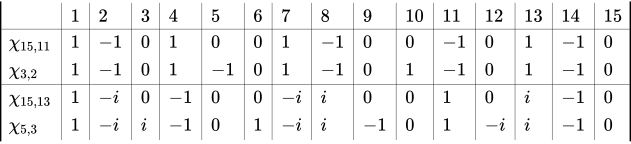
1 2 3 4 5 6 7 8 9 10 11 12 13 14 15 χ 15 、 11 1 − 1 0 1 0 0 1 − 1 0 0 − 1 0 1 − 1 0 χ 3 、 2 1 − 1 0 1 − 1 0 1 − 1 0 1 − 1 0 1 − 1 0 χ 15 、 13 1 − 私 0 − 1 0 0 − 私 私 0 0 1 0 私 − 1 0 χ 5 、 3 1 − 私 私 − 1 0 1 − 私 私 − 1 0 1 − 私 私 − 1 0 {\displaystyle {\begin{array}{|||}&1&2&3&4&5&6&7&8&9&10&11&12&13&14&15\\\hline \chi _{15,11}&1&-1&0&1&0&0&1&-1&0&0&-1&0&1&-1&0\\\chi _{3,2}&1&-1&0&1&-1&0&1&-1&0&1&-1&0&1&-1&0\\\hline \chi _{15,13}&1&-i&0&-1&0&0&-i&i&0&0&1&0&i&-1&0\\\chi _{5,3}&1&-i&i&-1&0&1&-i&i&-1&0&1&-i&i&-1&0\\\end{array}}} キャラクターMODの場合m = q r 、 ( q 、 r ) = 1 、 q > 1 、 r > 1 {\displaystyle m=qr,\;\;(q,r)=1,\;\;q>1,\;\;r>1}
χ m 、 _ ( 1 ) = { 0 もし gcd ( 1 、 m ) > 1 χ q 、 _ ( 1 ) もし gcd ( 1 、 m ) = 1 {\displaystyle \chi _{m,\_}(a)={\begin{cases}0&{\text{ if }}\gcd(a,m)>1\\\chi _{q,\_}(a)&{\text{ if }}\gcd(a,m)=1\end{cases}}} 同等にχ m 、 _ = χ q 、 _ χ r 、 1 、 {\displaystyle \chi _{m,\_}=\chi _{q,\_}\chi _{r,1},} その非ゼロ値は文字modによって決定されますq {\displaystyle q} q {\displaystyle q}
非ゼロ値の最小周期が文字の導体 です。たとえば、χ 15 、 8 {\displaystyle \chi _{15,8}} χ 15 、 11 {\displaystyle \chi _{15,11}} χ 15 、 13 {\displaystyle \chi _{15,13}}
素数べき乗の場合と同様に、導体が法と等しい場合、特性は原始的 であり、そうでない場合は非原始的で ある。非原始的である場合、それはより小さい法を持つ特性から誘導される 。たとえば、χ 15 、 11 {\displaystyle \chi _{15,11}} χ 3 、 2 {\displaystyle \chi _{3,2}} χ 15 、 13 {\displaystyle \chi _{15,13}} χ 5 、 3 {\displaystyle \chi _{5,3}}
主人公は原始的ではない。[ 35 ]
キャラクターχ m 、 r = χ q 1 、 r χ q 2 、 r 。 。 。 {\displaystyle \chi _{m,r}=\chi _{q_{1},r}\chi _{q_{2},r}...} 場合に限る。 [ 36 ]
プリミティブ文字は、L関数 [ 37 ] モジュラー形式 の理論において、しばしば式を簡略化(または可能にする)します。
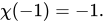
パリティ χ ( 1 ) {\displaystyle \chi (a)} χ ( − 1 ) = 1 {\displaystyle \chi (-1)=1} 奇妙 だχ ( − 1 ) = − 1. {\displaystyle \chi (-1)=-1.}
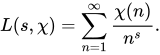
この区別は、ディリクレL関数 の関数方程式 に現れる。
実在の人物 χ ( 1 ) {\displaystyle \chi (a)} すべての値が実数である場合、実数 または二次関数 である(それらは0 、 ± 1 {\displaystyle 0,\;\pm 1} 複雑 または想像上のものとなる。
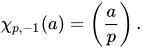
χ {\displaystyle \chi } χ 2 = χ 0 {\displaystyle \chi ^{2}=\chi _{0}} χ m 、 k {\displaystyle \chi _{m,k}} k 2 ≡ 1 ( モジュール m ) {\displaystyle k^{2}\equiv 1{\pmod {m}}} χ m 、 − 1 {\displaystyle \chi _{m,-1}} [ 38 ]
ディリクレの元の証明はL ( 1 、 χ ) ≠ 0 {\displaystyle L(1,\chi )\neq 0} χ {\displaystyle \chi } 類数公式 に基づいていた。[ 39 ] [ 40 ]
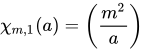
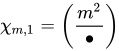
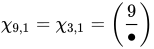
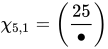
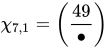
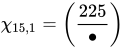
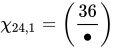
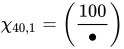
実際の文字はクロネッカー記号 です。[ 41 ] [ 42 ] χ m 、 1 = ( m 2 ・ ) {\displaystyle \chi _{m,1}=\left({\frac {m^{2}}{\bullet }}\right)}
例に登場する実在の人物は以下のとおりです。
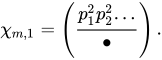
主要 もしm = p 1 k 1 p 2 k 2 。 。 。 、 p 1 < p 2 < 。 。 。 {\displaystyle m=p_{1}^{k_{1}}p_{2}^{k_{2}}...,\;p_{1}<p_{2}<\;...} [ 43 ] χ m 、 1 = ( p 1 2 p 2 2 。 。 。 ・ ) 。 {\displaystyle \chi _{m,1}=\left({\frac {p_{1}^{2}p_{2}^{2}...}{\bullet }}\right).}
χ 16 、 1 = χ 8 、 1 = χ 4 、 1 = χ 2 、 1 = ( 4 ・ ) {\displaystyle \chi _{16,1}=\chi _{8,1}=\chi _{4,1}=\chi _{2,1}=\left({\frac {4}{\bullet }}\right)} χ 9 、 1 = χ 3 、 1 = ( 9 ・ ) {\displaystyle \chi _{9,1}=\chi _{3,1}=\left({\frac {9}{\bullet }}\right)} χ 5 、 1 = ( 25 ・ ) {\displaystyle \chi _{5,1}=\left({\frac {25}{\bullet }}\right)} χ 7 、 1 = ( 49 ・ ) {\displaystyle \chi _{7,1}=\left({\frac {49}{\bullet }}\right)} χ 15 、 1 = ( 225 ・ ) {\displaystyle \chi _{15,1}=\left({\frac {225}{\bullet }}\right)} χ 24 、 1 = ( 36 ・ ) {\displaystyle \chi _{24,1}=\left({\frac {36}{\bullet }}\right)} χ 40 、 1 = ( 100 ・ ) {\displaystyle \chi _{40,1}=\left({\frac {100}{\bullet }}\right)}
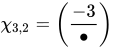
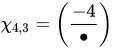
原生的 法が 基本判別式 の絶対値である場合、実数の原始指標が存在する(法が8の倍数の場合は2つ存在する)。そうでない場合、原始指標が存在する場合は、それらは虚数である[ 36 ] [ 44 ]
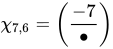
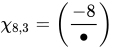
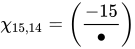
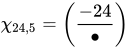
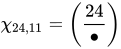
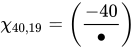
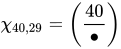
χ 3 、 2 = ( − 3 ・ ) {\displaystyle \chi _{3,2}=\left({\frac {-3}{\bullet }}\right)} χ 4 、 3 = ( − 4 ・ ) {\displaystyle \chi _{4,3}=\left({\frac {-4}{\bullet }}\right)} χ 5 、 4 = ( 5 ・ ) {\displaystyle \chi _{5,4}=\left({\frac {5}{\bullet }}\right)} χ 7 、 6 = ( − 7 ・ ) {\displaystyle \chi _{7,6}=\left({\frac {-7}{\bullet }}\right)} χ 8 、 3 = ( − 8 ・ ) {\displaystyle \chi _{8,3}=\left({\frac {-8}{\bullet }}\right)} χ 8 、 5 = ( 8 ・ ) {\displaystyle \chi _{8,5}=\left({\frac {8}{\bullet }}\right)} χ 15 、 14 = ( − 15 ・ ) {\displaystyle \chi _{15,14}=\left({\frac {-15}{\bullet }}\right)} χ 24 、 5 = ( − 24 ・ ) {\displaystyle \chi _{24,5}=\left({\frac {-24}{\bullet }}\right)} χ 24 、 11 = ( 24 ・ ) {\displaystyle \chi _{24,11}=\left({\frac {24}{\bullet }}\right)} χ 40 、 19 = ( − 40 ・ ) {\displaystyle \chi _{40,19}=\left({\frac {-40}{\bullet }}\right)} χ 40 、 29 = ( 40 ・ ) {\displaystyle \chi _{40,29}=\left({\frac {40}{\bullet }}\right)}
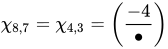
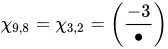
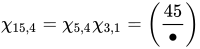
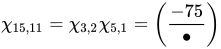
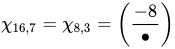
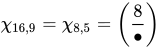
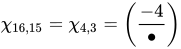
原始的ではない χ 8 、 7 = χ 4 、 3 = ( − 4 ・ ) {\displaystyle \chi _{8,7}=\chi _{4,3}=\left({\frac {-4}{\bullet }}\right)} χ 9 、 8 = χ 3 、 2 = ( − 3 ・ ) {\displaystyle \chi _{9,8}=\chi _{3,2}=\left({\frac {-3}{\bullet }}\right)} χ 15 、 4 = χ 5 、 4 χ 3 、 1 = ( 45 ・ ) {\displaystyle \chi _{15,4}=\chi _{5,4}\chi _{3,1}=\left({\frac {45}{\bullet }}\right)} χ 15 、 11 = χ 3 、 2 χ 5 、 1 = ( − 75 ・ ) {\displaystyle \chi _{15,11}=\chi _{3,2}\chi _{5,1}=\left({\frac {-75}{\bullet }}\right)} χ 16 、 7 = χ 8 、 3 = ( − 8 ・ ) {\displaystyle \chi _{16,7}=\chi _{8,3}=\left({\frac {-8}{\bullet }}\right)} χ 16 、 9 = χ 8 、 5 = ( 8 ・ ) {\displaystyle \chi _{16,9}=\chi _{8,5}=\left({\frac {8}{\bullet }}\right)} χ 16 、 15 = χ 4 、 3 = ( − 4 ・ ) {\displaystyle \chi _{16,15}=\chi _{4,3}=\left({\frac {-4}{\bullet }}\right)}
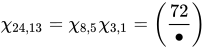
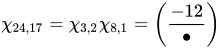
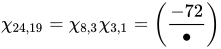
χ 24 、 7 = χ 8 、 7 χ 3 、 1 = χ 4 、 3 χ 3 、 1 = ( − 36 ・ ) {\displaystyle \chi _{24,7}=\chi _{8,7}\chi _{3,1}=\chi _{4,3}\chi _{3,1}=\left({\frac {-36}{\bullet }}\right)} χ 24 、 13 = χ 8 、 5 χ 3 、 1 = ( 72 ・ ) {\displaystyle \chi _{24,13}=\chi _{8,5}\chi _{3,1}=\left({\frac {72}{\bullet }}\right)} χ 24 、 17 = χ 3 、 2 χ 8 、 1 = ( − 12 ・ ) {\displaystyle \chi _{24,17}=\chi _{3,2}\chi _{8,1}=\left({\frac {-12}{\bullet }}\right)} χ 24 、 19 = χ 8 、 3 χ 3 、 1 = ( − 72 ・ ) {\displaystyle \chi _{24,19}=\chi _{8,3}\chi _{3,1}=\left({\frac {-72}{\bullet }}\right)} χ 24 、 23 = χ 8 、 7 χ 3 、 2 = χ 4 、 3 χ 3 、 2 = ( 12 ・ ) {\displaystyle \chi _{24,23}=\chi _{8,7}\chi _{3,2}=\chi _{4,3}\chi _{3,2}=\left({\frac {12}{\bullet }}\right)}
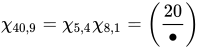
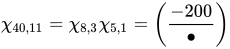
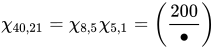
χ 40 、 9 = χ 5 、 4 χ 8 、 1 = ( 20 ・ ) {\displaystyle \chi _{40,9}=\chi _{5,4}\chi _{8,1}=\left({\frac {20}{\bullet }}\right)} χ 40 、 11 = χ 8 、 3 χ 5 、 1 = ( − 200 ・ ) {\displaystyle \chi _{40,11}=\chi _{8,3}\chi _{5,1}=\left({\frac {-200}{\bullet }}\right)} χ 40 、 21 = χ 8 、 5 χ 5 、 1 = ( 200 ・ ) {\displaystyle \chi _{40,21}=\chi _{8,5}\chi _{5,1}=\left({\frac {200}{\bullet }}\right)} χ 40 、 31 = χ 8 、 7 χ 5 、 1 = χ 4 、 3 χ 5 、 1 = ( − 100 ・ ) {\displaystyle \chi _{40,31}=\chi _{8,7}\chi _{5,1}=\chi _{4,3}\chi _{5,1}=\left({\frac {-100}{\bullet }}\right)} χ 40 、 39 = χ 8 、 7 χ 5 、 4 = χ 4 、 3 χ 5 、 4 = ( − 20 ・ ) {\displaystyle \chi _{40,39}=\chi _{8,7}\chi _{5,4}=\chi _{4,3}\chi _{5,4}=\left({\frac {-20}{\bullet }}\right)}
アプリケーション
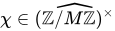
ディリクレ指標は、モジュラー形式と関数の理論のいくつかの箇所に現れる。典型的な例は[ 45 ]である。
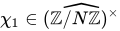
させてχ ∈ ( Z / M Z ) × ^ {\displaystyle \chi \in {\widehat {(\mathbb {Z} /M\mathbb {Z} )^{\times }}}} χ 1 ∈ ( Z / N Z ) × ^ {\displaystyle \chi _{1}\in {\widehat {(\mathbb {Z} /N\mathbb {Z} )^{\times }}}}
もし
f ( z ) = ∑ 1 n z n ∈ M k ( M 、 χ ) {\displaystyle f(z)=\sum a_{n}z^{n}\in M_{k}(M,\chi )} [ 46 ] 定義する
f χ 1 ( z ) = ∑ χ 1 ( n ) 1 n z n {\displaystyle f_{\chi _{1}}(z)=\sum \chi _{1}(n)a_{n}z^{n}} 47 ] それから
f χ 1 ( z ) ∈ M k ( M N 2 、 χ χ 1 2 ) {\displaystyle f_{\chi _{1}}(z)\in M_{k}(MN^{2},\chi \chi _{1}^{2})} f {\displaystyle f} 尖点形式 なので、f χ 1 。 {\displaystyle f_{\chi _{1}}.} 別の例については、ディリクレ指標のシータ級数を 参照してください。
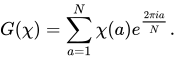
ガウス和 ディリクレ指標のガウス和(法 N )は
G ( χ ) = ∑ 1 = 1 N χ ( 1 ) e 2 π 私 1 N 。 {\displaystyle G(\chi )=\sum _{a=1}^{N}\chi (a)e^{\frac {2\pi ia}{N}}.} これはディリクレL関数 の関数方程式 に現れる。
ヤコビ和 もし χ {\displaystyle \chi } ψ {\displaystyle \psi } p {\displaystyle p} ヤコビ和 は
J ( χ 、 ψ ) = ∑ 1 = 2 p − 1 χ ( 1 ) ψ ( 1 − 1 ) 。 {\displaystyle J(\chi ,\psi )=\sum _{a=2}^{p-1}\chi (a)\psi (1-a).} ヤコビ和はガウス和の積に因数分解できる。
十分な条件 関数がディリクレ指標であることを示すために、定義特性1)~3)を確立する必要はありません。
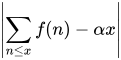
ディリクレ指標は完全乗法関数である。f : N → C {\displaystyle f:\mathbb {N} \rightarrow \mathbb {C} } f {\displaystyle f} f {\displaystyle f} α ∈ C {\displaystyle \alpha \in \mathbb {C} }
| ∑ n ≤ x f ( n ) − α x | {\displaystyle \left|\sum _{n\leq x}f(n)-\alpha x\right|}
は一様に有界であり、x → ∞ {\displaystyle x\rightarrow \infty } このディリクレ指標の同等の定義は、1956年にチュダコフ[ 51 ] [ 52 ] 。
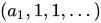
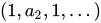
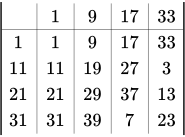
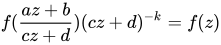
注記 ↑ これは標準的な定義です。例:Davenport p.27、Landau p.109、Ireland and Rosen p.253 ↑ 法 1 の特殊なケースに注意してください。法 1 の一意の文字は定数 1 です。他のすべての文字は 0 で 0 になります。 ↑ ダベンポート p.1 ↑ 英語訳は外部リンクにあります ↑ Weisstein, Eric W. "Totient Function" . mathworld.wolfram.com . 2025-02-09 に取得. ↑ ダベンポート、ランダウ、アイルランド、ローゼンで使用 ↑ ( r s 、 m ) = 1 {\displaystyle (rs,m)=1} gcd ( r 、 m ) = gcd ( s 、 m ) = 1 {\displaystyle \gcd(r,m)=\gcd(s,m)=1} ↑ 乗法文字 を参照 ↑ アイルランドとローゼン、253-254ページ ↑ 文字グループ#文字の直交性 を参照 ↑ ダベンポート p.27 ↑ これらの性質は、この主題に関するすべての入門書で導出されています。例えば、Davenport p. 27、Landau p. 109。 ↑ 一般的に、キャラクターMODの製品はm {\displaystyle m} n {\displaystyle n} 最小公倍数 ( m 、 n ) {\displaystyle \operatorname {lcm} (m,n)} ↑ 修正されたコンリーのラベル付けの使用を除き、このセクションはダベンポートの1~3ページ、27~30ページに準拠しています。 ↑ 原始的なルートモッドがありますp {\displaystyle p} p 2 {\displaystyle p^{2}} p {\displaystyle p} ↑ ランダウ著、107-108ページ ↑ 詳細は ユニット群を 参照してください ↑ 構築するためにG 私 、 {\displaystyle G_{i},} 1 ∈ ( Z / q 私 Z ) × {\displaystyle a\in (\mathbb {Z} /q_{i}\mathbb {Z} )^{\times }} 1 私 ∈ ( Z / m Z ) × {\displaystyle a_{i}\in (\mathbb {Z} /m\mathbb {Z} )^{\times }} 1 私 ≡ { 1 モジュール q 私 1 モジュール q j 、 j ≠ 私 。 {\displaystyle a_{i}\equiv {\begin{cases}a&\mod q_{i}\\1&\mod q_{j},j\neq i.\end{cases}}} ↑ 想定する1 {\displaystyle a} ( 1 1 、 1 2 、 。 。 。 ) {\displaystyle (a_{1},a_{2},...)} 1 1 {\displaystyle a_{1}} ( 1 1 、 1 、 1 、 。 。 。 ) {\displaystyle (a_{1},1,1,...)} 1 2 {\displaystyle a_{2}} ( 1 、 1 2 、 1 、 。 。 。 ) {\displaystyle (1,a_{2},1,...)} ( 1 1 、 1 2 、 。 。 。 ) 。 {\displaystyle (a_{1},a_{2},...).} ↑ 例えばm = 40 、 q 1 = 8 、 q 2 = 5. {\displaystyle m=40,q_{1}=8,q_{2}=5.} G 1 = { 1 、 11 、 21 、 31 } {\displaystyle G_{1}=\{1,11,21,31\}} G 2 = { 1 、 9 、 17 、 33 } 。 {\displaystyle G_{2}=\{1,9,17,33\}.} ( Z / 40 Z ) × {\displaystyle (\mathbb {Z} /40\mathbb {Z} )^{\times }} 1 9 17 33 1 1 9 17 33 11 11 19 27 3 21 21 29 37 13 31 31 39 7 23 {\displaystyle {\begin{array}{|c|c|c|c|c|c|c|}&1&9&17&33\\\hline 1&1&9&17&33\\11&11&19&27&3\\21&21&29&37&13\\31&31&39&7&23\\\end{array}}} ↑ コンリーラベルを 参照してください。 ↑ これらの公式は各要素に対して成り立つからです。 ↑ これはすべての有限アーベル群に当てはまります。A ≅ A ^ {\displaystyle A\cong {\hat {A}}} ↑ なぜなら、χ {\displaystyle \chi } r {\displaystyle r} s {\displaystyle s} ↑ これは、ゼロ以外の値の表のn番目の列とn番目の行が同じであると言うことと同じです。 ↑ 上記の「グループ文字との関係」 を参照してください。 ↑ 定義によりχ 0 {\displaystyle \chi _{0}} ↑ なぜなら、群のすべての要素に定数を掛けても、単に要素の順序が入れ替わるだけだからです。群(数学)を参照してください。 ↑ ダベンポート p. 30 (言い換え) [2 番目の関係] を証明するには、構成で使用したアイデア [この記事やランダウ pp. 109-114 のように] を使用するか、アーベル群の基底定理 [アイルランド & ローゼン pp. 253-254 のように] に訴える必要があります。 ↑ ダベンポート著、第1章、第4章。ランダウ著、114ページ。 ↑ 注意してg : ( Z / m Z ) × → C {\displaystyle g:(\mathbb {Z} /m\mathbb {Z} )^{\times }\rightarrow \mathbb {C} } g ( n ) = ∑ 1 ∈ ( Z / m Z ) × g ( 1 ) f 1 ( n ) {\displaystyle g(n)=\sum _{a\in (\mathbb {Z} /m\mathbb {Z} )^{\times }}g(a)f_{a}(n)} 有限群のフーリエ変換#有限アーベル群のフーリエ変換を参照 ↑ このセクションは、Davenport の 35-36 ページに続くものです。 ↑ Platt, Dave. "Dirichlet characters Def. 11.10" (PDF) . 2024年 4月5日 取得 。 ↑ 「ディリクレ特性の指揮者(レビュー済み)」 。 LMFDB 。 2024年 4月5日 取得 。 ↑ ダベンポートはそれを原始的でも非原始的でもないと分類している。LMFDBはそれを以下から誘導する。χ 1 、 1 。 {\displaystyle \chi _{1,1}.} 1 2 注意すべき点m {\displaystyle m} m = 2 r {\displaystyle m=2r} m {\displaystyle m} χ m 、 _ = χ r 、 _ χ 2 、 1 {\displaystyle \chi _{m,\_}=\chi _{r,\_}\chi _{2,1}} ↑ 例えば、関数方程式L ( s 、 χ ) {\displaystyle L(s,\chi )} χ {\displaystyle \chi } ↑ 実際、素数の法則ではp χ p 、 − 1 {\displaystyle p\;\;\chi _{p,-1}} はルジャンドル記号 です。χ p 、 − 1 ( 1 ) = ( 1 p ) 。 {\displaystyle \chi _{p,-1}(a)=\left({\frac {a}{p}}\right).\;} ν p ( − 1 ) = p − 1 2 、 ω ν p ( − 1 ) = − 1 、 ν p ( 1 ) {\displaystyle \nu _{p}(-1)={\frac {p-1}{2}},\;\;\omega ^{\nu _{p}(-1)}=-1,\;\;\nu _{p}(a)} ↑ ダベンポート、第 1 章、第 4 章。 ↑ アイルランドとローゼンの証明は、すべての法則に有効であり、これら2つのケースも含まれている。259ページ以降 ↑ ダベンポート p.40 ↑ 表記法χ m 、 1 = ( m 2 ・ ) {\displaystyle \chi _{m,1}=\left({\frac {m^{2}}{\bullet }}\right)} χ m 、 1 ( 1 ) = ( m 2 1 ) {\displaystyle \chi _{m,1}(a)=\left({\frac {m^{2}}{a}}\right)} ↑ 素数の積は、次の場合にゼロになることを保証しますgcd ( m 、 ・ ) > 1 {\displaystyle \gcd(m,\bullet )>1} ↑ ダベンポート著、38-40ページ ↑ コブリッツ、命題17b、127ページ ↑ f ( z ) ∈ M k ( M 、 χ ) {\displaystyle f(z)\in M_{k}(M,\chi )} f ( 1 z + b c z + d ) ( c z + d ) − k = f ( z ) {\displaystyle f({\frac {az+b}{cz+d}})(cz+d)^{-k}=f(z)} 1 d − b c = 1 {\displaystyle ad-bc=1} 1 ≡ d ≡ 1 、 c ≡ 0 ( モジュール M ) 。 {\displaystyle a\equiv d\equiv 1,\;\;c\equiv 0{\pmod {M}}.} f ( 1 z + b c z + d ) ( c z + d ) − k = χ ( d ) f ( z ) {\displaystyle f({\frac {az+b}{cz+d}})(cz+d)^{-k}=\chi (d)f(z)} 1 d − b c = 1 {\displaystyle ad-bc=1} c ≡ 0 ( モジュール M ) 。 {\displaystyle c\equiv 0{\pmod {M}}.} ↑ ひねり f {\displaystyle f} χ 1 {\displaystyle \chi _{1}} ↑ Kloosterman 合計の LMFDB 定義 ↑ ダベンポート p.30 ↑ サルコジ ↑ チュダコフ ↑ クルーマン 1 2 3 Sloane, N. J. A. (編). "数列 A102476 ( 1 の平方根の2 n 個 を含む最小法 )" . オンライン 整数列百科事典 . OEIS Foundation. ↑ Sloane, N. J. A. (編). "数列 A396479 (λ(k) が原始根を持たない数 k、λ は縮約トーシェント関数)" . オンライン 整数列百科事典 . OEIS Foundation. ↑ Sloane, N. J. A. (編). "数列 A396481 (p-1 が原始根を持たない素数 p)" . オンライン 整数列百科事典 . OEIS Foundation. ↑ Sloane, N. J. A. (編). "数列 A396554 (φ(λ(k)) が 2 のべき乗でない数 k、λ は縮約トーシェント関数)" . オンライン 整数列百科事典 . OEIS Foundation. ↑ Sloane, N. J. A. (編). "数列 A396555 (φ(p-1) が 2 のべき乗でない素数 p)" . オンライン 整数列百科事典 . OEIS Foundation. 1 2 3 Sloane, N. J. A. (編). "数列 A143407 (縮約トーシェント関数が 1, 2, 4, 6, ... を取る最大の数 k)" . オンライン 整数列百科事典 . OEIS Foundation. ↑ Sloane, N. J. A. (編). "数列 A396477 (Q(ζ_{λ(k)}) のクラス番号が 1 より大きい数 k 、λ は縮約トーシェント関数)" . オンライン 整数列百科事典 . OEIS Foundation.
参考文献 Chudakov, NG「数半群の指標の理論」J. Indian Math. Soc . 20 : 11–15 . ダベンポート、ハロルド (1967)。乗法数論 。高等数学講義。第1巻。シカゴ :マーカム。Zbl 0159.06303 。 アイルランド、ケネス、ローゼン、マイケル(1990)『現代数論への古典的入門(第2版) 』ニューヨーク:シュプリンガー 、ISBN 0-387-97329-X Klurman, Oleksiy; Mangerel, Alexander P. (2017). "乗法関数の剛性定理". Math. Ann . 372 (1): 651–697 . arXiv : 1707.07817 . Bibcode : 2017arXiv170707817K . doi : 10.1007/s00208-018-1724-6 . S2CID 119597384 . コブリッツ、ニール (1993)。楕円曲線とモジュラー形式入門 。大学院数学テキスト。第97巻( 第2版改訂 版)。シュプリンガー・フェルラーク 。ISBN 0-387-97966-2 。ランドー、エドモンド(1966)、『初等整数論』 、ニューヨーク:チェルシー サルコジ、アンドラス。「線形漸化式を満たす乗法算術関数について」。Studia Sci. Math. Hung . 13 ( 1–2 ): 79–104 。
外部リンク ディリクレが1837年に発表した、等差数列における素数に関する論文の英訳 LMFDBには、モジュラスが10,000までの30,397,486個のディリクレ指標とそのL関数がリストされています。
























![{\displaystyle [a]=\{x:x\equiv a{\pmod {m}}\}}](https://wikimedia.org/api/rest_v1/media/math/render/svg/97895229f8665b6247e81a10e45268c103674552)


![{\displaystyle \chi (a)={\begin{cases}0&{\text{if }}[a]\not \in (\mathbb {Z} /m\mathbb {Z} )^{\times }&{\text{ie }}(a,m)>1\\\rho ([a])&{\text{if }}[a]\in (\mathbb {Z} /m\mathbb {Z} )^{\times }&{\text{ie }}(a,m)=1,\end{cases}}}](https://wikimedia.org/api/rest_v1/media/math/render/svg/0e63216fd11801a3183ccac899e4a141b3481071)




































































































































![{\displaystyle f_{a}=\mathbb {1} _{[a]}}](https://wikimedia.org/api/rest_v1/media/math/render/svg/3a71d26b055c9ccac96ac65a510774281c300484)
![{\displaystyle [a]=\{x:\;x\equiv a{\pmod {m}}\}}](https://wikimedia.org/api/rest_v1/media/math/render/svg/b7d3edc6591d12f58392b7d3ea17454d5f802644)

















































![{\displaystyle \mathbb {Z} [\alpha ]}](https://wikimedia.org/api/rest_v1/media/math/render/svg/28420682be585a0ee588c7eb13e7971e01cb1283)