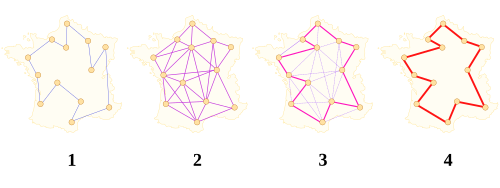
The algorithm of Christofides and Serdyukov follows a similar outline but combines the minimum spanning tree with a solution of another problem, minimum-weight perfect matching. This gives a TSP tour which is at most 1.5 times the optimal. It was one of the first approximation algorithms, and was in part responsible for drawing attention to approximation algorithms as a practical approach to intractable problems. As a matter of fact, the term "algorithm" was not commonly extended to approximation algorithms until later; the Christofides algorithm was initially referred to as the Christofides heuristic.[10]
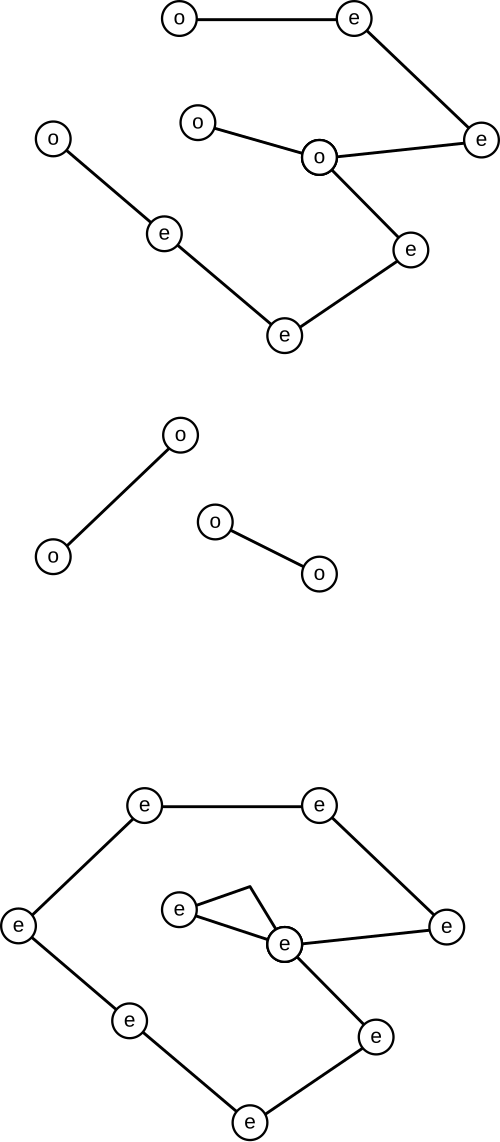
This algorithm looks at things differently by using a result from graph theory which helps improve on the lower bound of the TSP which originated from doubling the cost of the minimum spanning tree. Given an Eulerian graph, we can find an Eulerian tour in time,[6] so if we had an Eulerian graph with cities from a TSP as vertices, then we can easily see that we could use such a method for finding an Eulerian tour to find a TSP solution. By the triangle inequality, we know that the TSP tour can be no longer than the Eulerian tour, and we therefore have a lower bound for the TSP. Such a method is described below.
Find a minimum spanning tree for the problem.
Create duplicates for every edge to create an Eulerian graph.
Find an Eulerian tour for this graph.
Convert to TSP: if a city is visited twice, then create a shortcut from the city before this in the tour to the one after this.
To improve the lower bound, a better way of creating an Eulerian graph is needed. By the triangle inequality, the best Eulerian graph must have the same cost as the best travelling salesman tour; hence, finding optimal Eulerian graphs is at least as hard as TSP. One way of doing this is by minimum weight matching using algorithms with a complexity of .[6]
Making a graph into an Eulerian graph starts with the minimum spanning tree; all the vertices of odd order must then be made even, so a matching for the odd-degree vertices must be added, which increases the order of every odd-degree vertex by 1.[6] This leaves us with a graph where every vertex is of even order, which is thus Eulerian. Adapting the above method gives the algorithm of Christofides and Serdyukov:
Find a minimum spanning tree for the problem.
Create a matching for the problem with the set of cities of odd order.
k -opt法の中で最もよく知られているのは、1965年にベル研究所のシェン・リンによって導入された3-opt法です。3 -opt法の特殊なケースとして、辺が互いに分離していない場合(2つの辺が隣接している場合)があります。実際には、削除する辺のうち2つが隣接しているこの特殊な部分集合に3-変更を限定することで、一般的な3-opt法のような組み合わせコストをかけずに、2-opt法よりも大幅に改善できることがよくあります。このいわゆる2.5-opt法は、得られるツアーの質とツアーの達成に必要な時間の両方において、2-opt法と3-opt法のほぼ中間に位置します。
サイズを2倍にするには、グラフ内の各ノードを複製して、2番目のゴーストノードを作成します。このゴーストノードは、非常に低い(場合によっては負の)重みを持つ「ゴースト」エッジで元のノードに接続され、ここでは − wと表記されます。(あるいは、ゴーストエッジの重みは0で、他のすべてのエッジに重み w が追加されます。)上に示した元の 3×3 行列は左下に表示され、元の行列の転置行列は右上に表示されます。行列のどちらのコピーも、対角線が − wで表される低コストのホップパスに置き換えられています。新しいグラフでは、元のノードを直接リンクするエッジはなく、ゴーストノードを直接リンクするエッジもありません。
ゴーストノードと対応する元のノードを結ぶ「ゴースト」エッジの重み − w は、すべてのゴーストエッジが新しいグラフ上の任意の最適な対称 TSP 解に属することを保証するために十分に小さくなければなりません ( w = 0 が常に十分に小さくなるわけではありません)。結果として、最適な対称ツアーでは、各元のノードがゴーストノードの隣に現れます (たとえば、可能なパスは A → A ′ → C → C ′ → B → B ′ → A です)。そして、元のノードとゴーストノードを再びマージすることで、元の非対称問題の (最適な) 解が得られます (この例では、A → C → B → A です)。
HeldとKarpは、数値的な下限値を提供する多項式時間アルゴリズムを開発した。、したがってこれらは約 1% まで良好であると思われる。[ 48 ] [ 49 ]特に、David S. Johnson はコンピュータ実験により下限値を得た。[ 50 ]
ここで、0.522 は、隣接点が少ない正方形境界付近の点から得られた値であり、Christine L. Valenzuela とAntonia J. Jones は次の別の数値下限値を得ました: [ 51 ]
。
計算複雑性
The problem has been shown to be NP-hard (more precisely, it is complete for the complexity class FPNP; see function problem), and the decision problem version ("given the costs and a number x, decide whether there is a round-trip route cheaper than x") is NP-complete. The bottleneck travelling salesman problem is also NP-hard. The problem remains NP-hard even for the case when the cities are in the plane with Euclidean distances, as well as in a number of other restrictive cases. Removing the condition of visiting each city "only once" does not remove the NP-hardness, since in the planar case there is an optimal tour that visits each city only once (otherwise, by the triangle inequality, a shortcut that skips a repeated visit would not increase the tour length).
If the distances are restricted to 1 and 2 (but still are a metric), then the approximation ratio becomes 8/7.[56] In the asymmetric case with triangle inequality, in 2018, a constant factor approximation was developed by Svensson, Tarnawski, and Végh.[57] An algorithm by Vera Traub and Jens Vygen achieves a performance ratio of .[58] This factor was further improved to .[59] The best known inapproximability bound is 75/74.[60]
The corresponding maximization problem of finding the longest travelling salesman tour is approximable within 63/38.[61] If the distance function is symmetric, then the longest tour can be approximated within 4/3 by a deterministic algorithm[62] and within by a randomized algorithm.[63]
A 2011 study in animal cognition titled "Let the Pigeon Drive the Bus," named after the children's book Don't Let the Pigeon Drive the Bus!, examined spatial cognition in pigeons by studying their flight patterns between multiple feeders in a laboratory in relation to the travelling salesman problem. In the first experiment, pigeons were placed in the corner of a lab room and allowed to fly to nearby feeders containing peas. The researchers found that pigeons largely used proximity to determine which feeder they would select next. In the second experiment, the feeders were arranged in such a way that flying to the nearest feeder at every opportunity would be largely inefficient if the pigeons needed to visit every feeder. The results of the second experiment indicate that pigeons, while still favoring proximity-based solutions, "can plan several steps ahead along the route when the differences in travel costs between efficient and less efficient routes based on proximity become larger."[75] These results are consistent with other experiments done with non-primates, which have proven that some non-primates were able to plan complex travel routes. This suggests non-primates may possess a relatively sophisticated spatial cognitive ability.
Natural computation
Humans are not the only species to show excellent efficiency. For example, when presented with a spatial configuration of food sources, the amoeboidPhysarum polycephalum adapts its morphology to create an efficient path between the food sources, which can also be viewed as an approximate solution to TSP.[76] Similarly, honey bees and bumblebees have been shown to be very adept at maximising efficiency to a very high degree of accuracy when collecting nectar and pollen by using collective intelligence.[77][78]
Benchmarks
For benchmarking of TSP algorithms, TSPLIB[79] is a library of sample instances of the TSP and related problems. Many of them are lists of actual cities and layouts of actual printed circuits.[80]
Popular culture
Travelling Salesman, by director Timothy Lanzone, is the story of four mathematicians hired by the U.S. government to solve the most elusive problem in computer-science history: P vs. NP.[81]
Solutions to the problem are used by mathematician Robert A. Bosch in a subgenre called TSP art.[82]
↑「Der Handlungsreisende – wie er sein soll und was er zu tun hat, um Aufträge zu erhalten und eines glücklichen Erfolgs in seinen Geschäften gewiß zu sein – von einem alten Commis-Voyageur」コミッションを獲得し、彼のビジネスが幸せに成功することを確信してください – 古い委員会航海者による)
↑ Schrijver (2005)で引用および英語訳。ドイツ語原文:「Wir bezeichnen als Botenproblem (weil diese Frage in der Praxis von jedem Postboten, übrigens auch von vielen Reisenden zu lösen ist) die Aufgabe, für endlich viele Punkte, deren paarweise Abstände bekannt sind, den kürzesten die Punkte verbindenden」 Weg zu finden. Dieses は、Regeln の自然な状態を示し、Anzahl der Versuche unter die Anzahl der Permutationen der gegebenen Punkte herunterdrücken würden、sind nicht bekannt です。ツム・ネクストゲレゲネンPunkt, dann zu dem dieem nächstgelegenen Punkt gehen usw., liefert im allgemeinen nicht den kürzesten Weg.」
1 2 3 4 5 6 7 8 Lawler, EL (1985). The Travelling Salesman Problem: A Guided Tour of Combinatorial Optimization (Repr. with corrections. ed.). John Wiley & Sons. ISBN978-0-471-90413-7。
↑ Karlin, Anna R. ; Klein, Nathan; Gharan, Shayan Oveis (2021), "メトリックTSPのための(わずかに)改善された近似アルゴリズム", Khuller, Samir ; Williams, Virginia Vassilevska (eds.), STOC '21: 53rd Annual ACM SIGACT Symposium on Theory of Computing, Virtual Event, Italy, June 21-25, 2021 , pp. 32– 45, arXiv : 2007.01409 , doi : 10.1145/3406325.3451009 , ISBN978-1-4503-8053-9
1 2 Rego, César; Gamboa, Dorabela; Glover, Fred; Osterman, Colin (2011), "Traveling salesman problem heuristics: leading methods, implementations and latest advances", European Journal of Operational Research , 211 (3): 427– 441, doi : 10.1016/j.ejor.2010.09.010 , MR 2774420。
↑Behzad, Arash; Modarres, Mohammad (2002), "New Efficient Transformation of the Generalized Traveling Salesman Problem into Traveling Salesman Problem", Proceedings of the 15th International Conference of Systems Engineering (Las Vegas)
↑Papadimitriou, C.H.; Steiglitz, K. (1998), Combinatorial optimization: algorithms and complexity, Mineola, NY: Dover, pp.308-309.
↑Tucker, A. W. (1960), "On Directed Graphs and Integer Programs", IBM Mathematical research Project (Princeton University)
↑Dantzig, George B. (1963), Linear Programming and Extensions, Princeton, NJ: PrincetonUP, pp. 545–7, ISBN0-691-08000-3, sixth printing, 1974.
↑Velednitsky, Mark (2017). "Short combinatorial proof that the DFJ polytope is contained in the MTZ polytope for the Asymmetric Traveling Salesman Problem". Operations Research Letters. 45 (4): 323–324. arXiv:1805.06997. doi:10.1016/j.orl.2017.04.010.
↑Bektaş, Tolga; Gouveia, Luis (2014). "Requiem for the Miller–Tucker–Zemlin subtour elimination constraints?". European Journal of Operational Research. 236 (3): 820–832. doi:10.1016/j.ejor.2013.07.038.
↑C. E. Miller, A. W. Tucker, and R. A. Zemlin. 1960. Integer Programming Formulation of Traveling Salesman Problems. J. ACM 7, 4 (Oct. 1960), 326–329. DOI:https://doi.org/10.1145/321043.321046
↑Dantzig, G.; Fulkerson, R.; Johnson, S. (November 1954). "Solution of a Large-Scale Traveling-Salesman Problem". Journal of the Operations Research Society of America. 2 (4): 393–410. doi:10.1287/opre.2.4.393.
1 2 Johnson, DS ; McGeoch, LA (1997). "巡回セールスマン問題: 局所最適化のケーススタディ" (PDF) . In Aarts, EHL; Lenstra, JK (eds.). Local Search in Combinatorial Optimisation . London: John Wiley and Sons Ltd. pp. 215– 310.
↑ Gutina, Gregory; Yeob, Anders; Zverovich, Alexey (2002年3月15日). "Traveling salesman should not be greedy: domination analysis of greedy-type heuristics for the TSP" . Discrete Applied Mathematics . 117 ( 1–3 ): 81–86 . doi : 10.1016/S0166-218X(01)00195-0 .>
↑ Zverovitch, Alexei; Zhang, Weixiong; Yeo, Anders; McGeoch, Lyle A.; Gutin, Gregory; Johnson, David S. (2007), "Experimental Analysis of Heuristics for the ATSP", The Traveling Salesman Problem and Its Variations , Combinatorial Optimization, Springer, Boston, MA, pp. 445– 487, CiteSeerX 10.1.1.24.2386 , doi : 10.1007/0-306-48213-4_10 , ISBN978-0-387-44459-8
↑ Kahng, AB; Reda, S. (2004). "Match Twice and Stitch: A New TSP Tour Construction Heuristic". Operations Research Letters . 32 (6): 499– 509. doi : 10.1016/j.orl.2004.04.001 .
↑ Alatartsev, Sergey; Augustine, Marcus; Ortmeier, Frank (2013年6月2日). 「近傍を持つ巡回セールスマン問題に対する挿入ヒューリスティックの制約」(PDF) .自動計画およびスケジューリングに関する国際会議議事録. 23 : 2– 10. doi : 10.1609/icaps.v23i1.13539 .
↑ Jonker, Roy; Volgenant, Ton (1983). "非対称な巡回セールスマン問題を対称な巡回セールスマン問題に変換する". Operations Research Letters . 2 ( 161–163 ): 1983. doi : 10.1016/0167-6377(83)90048-2 .
↑ Arlotto, Alessandro; Steele, J. Michael (2016), "Beardwood–Halton–Hammersley theorem for stationary ergodic sequences: a counterexample", The Annals of Applied Probability , 26 (4): 2141– 2168, arXiv : 1307.0221 , doi : 10.1214/15-AAP1142
↑ Few, L. (1955). "n 点を通る最短経路と最短道路". Mathematika . 2 (2): 141– 144. doi : 10.1112/s0025579300000784 .
↑ Fiechter, C.-N. (1994). "大規模巡回セールスマン問題に対する並列タブー探索アルゴリズム" . Disc. Applied Math . 51 (3): 243– 267. doi : 10.1016/0166-218X(92)00033-I .
↑ Johnson, DS; McGeoch, LA; Rothberg, EE (1996). "Held-Karp巡回セールスマン限界の漸近実験解析" (PDF) . In Tardos, Éva (ed.). Proceedings of the 7th Annual ACM-SIAM Symposium on Discrete Algorithms . Philadelphia: Society for Industrial and Applied Mathematics. pp. 341–350 . ISBN978-0-89871-366-42013年6月16日にオリジナル(PDF)からアーカイブされました。
↑ Christine L. Valenzuela と Antonia J. Jones による記事(2007年10月25日、 Wayback Machineにアーカイブ済み)
↑ Dry, Matthew; Lee, Michael D.; Vickers, Douglas; Hughes, Peter (2006). "ノード数が異なる視覚的に提示された巡回セールスマン問題における人間のパフォーマンス". The Journal of Problem Solving . 1 (1). CiteSeerX 10.1.1.360.9763 . doi : 10.7771/1932-6246.1004 .
↑ MacGregor, James N.; Chu, Yun (2011). "巡回セールスマン問題および関連問題における人間のパフォーマンス:レビュー" . The Journal of Problem Solving . 3 (2). doi : 10.7771/1932-6246.1090 .
↑ MacGregor, James N.; Chronicle, Edward P.; Ormerod, Thomas C. (2004年3月1日). "凸包か交差回避か?巡回セールスマン問題における解法ヒューリスティクス" . Memory & Cognition . 32 (2): 260– 270. doi : 10.3758/bf03196857 . PMID 15190718 .
↑ Vickers, Douglas; Mayo, Therese; Heitmann, Megan; Lee, Michael D; Hughes, Peter (2004). "3種類の視覚的に提示された最適化問題における知能とパフォーマンスの個人差". Personality and Individual Differences . 36 (5): 1059– 1071. doi : 10.1016/s0191-8869(03)00200-9 .
↑ Kyritsis, Markos; Gulliver, Stephen R.; Feredoes, Eva (2017年6月12日). "ユークリッド巡回セールスマン問題を解く際の交差回避ヒューリスティック違反の認識". Psychological Research . 82 (5): 997–1009 . doi : 10.1007 /s00426-017-0881-7 . PMID 28608230 .
↑ Reinelt, Gerhard (1991年11月)「TSPLIB – 巡回セールスマン問題ライブラリ」ORSA Journal on Computing 3 (4) . Institute for Operations Research and the Management Sciences (INFORMS): 376–384 . doi : 10.1287/ijoc.3.4.376 .
↑ギア、ダンカン (2012 年 4 月 26 日)。」「『旅するセールスマン』の映画は、PがNPに等しい場合の影響を考察している」。Wired UK 。 2012年4月26日取得。
Christofides, N. (1976)、「巡回セールスマン問題に対する新しいヒューリスティックの最悪ケース分析」、技術報告書388、カーネギーメロン大学産業経営大学院、ピッツバーグ。
Hassin, R.; Rubinstein, S. (2000), "Better approximations for max TSP", Information Processing Letters , 75 (4): 181–186 , CiteSeerX 10.1.1.35.7209 , doi : 10.1016/S0020-0190(00)00097-1。
Held, M. ; Karp, RM (1962)、「シーケンス問題への動的計画法アプローチ」、Journal of the Society for Industrial and Applied Mathematics、10 (1): 196–210、doi : 10.1137/0110015。
Kaplan, H.; Lewenstein, L.; Shafrir, N.; Sviridenko, M. (2004)、「有向正則多重グラフの分解による非対称TSPの近似アルゴリズム」、第44回IEEEコンピュータサイエンス基礎シンポジウム論文集、pp. 56–65。
Karpinski, M.; Lampis, M.; Schmied, R. (2015)、「TSP の新しい近似不可能性の限界」、Journal of Computer and System Sciences、81 (8): 1665–1677、arXiv : 1303.6437、doi : 10.1016/j.jcss.2015.06.003
Kosaraju, SR; Park, JK; Stein, C. (1994)、「ロングツアーとショートスーパーストリングス」「、第35回IEEEコンピュータサイエンス基礎シンポジウム論文集、IEEEコンピュータソサエティ、pp. 166–177」。
Larson, Richard C.; Odoni, Amedeo R. (1981)、「6.4.7: ネットワークモデルの応用 § ルーティング問題 § § ユークリッドTSP」、都市オペレーションズリサーチ、Prentice-Hall、ISBN978-0-13-939447-8OCLC 6331426。
Padberg, M.; Rinaldi, G. (1991), "大規模対称巡回セールスマン問題の解決のための分岐限定法アルゴリズム", SIAM Review , 33 (1): 60–100 , Bibcode : 1991SIAMR..33...60P , doi : 10.1137/1033004。
Garey, Michael R.; Johnson, David S. (1979). "A2.3: ND22–24". Computers and Intractability: A Guide to the Theory of NP-completeness . WH Freeman. pp. 211–212 . ISBN978-0-7167-1044-8。
Goldberg, DE (1989)、Genetic Algorithms in Search, Optimization & Machine Learning、Reading: Addison-Wesley、Bibcode : 1989gaso.book.....G、ISBN978-0-201-15767-3
Rao, S.; Smith, W. (1998). 「スパナーとバニヤンによる幾何学的グラフの近似」「. STOC '98: Proceedings of the thirtieth annual ACM symposium on Theory of computing . pp. 540– 550. CiteSeerX 10.1.1.51.8676 .
Rosenkrantz, Daniel J.; Stearns, Richard E.; Lewis, Philip M. II (1977). 「巡回セールスマン問題に対するいくつかのヒューリスティックの分析」. SIAM Journal on Computing . 6 (5). SIAM (Society for Industrial and Applied Mathematics): 563–581 . doi : 10.1137/0206041 .
ウォルショー、クリス(2000)『巡回セールスマン問題への多層的アプローチ』CMS Press
Walshaw, Chris (2001), 『巡回セールスマン問題に対する多段階Lin-Kernighan-Helsgaunアルゴリズム』、CMS Press











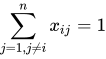


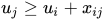






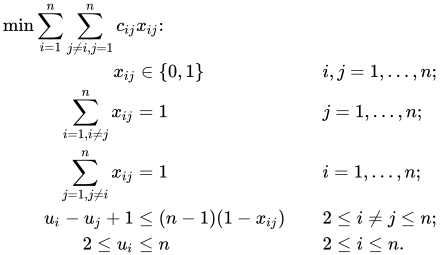
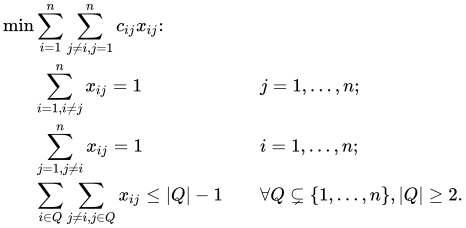






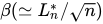
![{\displaystyle [0,1]^{2}}](https://wikimedia.org/api/rest_v1/media/math/render/svg/e2fd6e9b0db782a26c033d7c728aadac9eec363a)

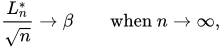

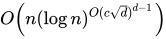
![{\displaystyle \beta =\lim _{n\to \infty }\mathbb {E} [L_{n}^{*}]/{\sqrt {n}}}](https://wikimedia.org/api/rest_v1/media/math/render/svg/797ef104f2559647e6ccf80ade649f04e1e0b21a)
![{\displaystyle \mathbb {E} [L_{n}^{*}]}](https://wikimedia.org/api/rest_v1/media/math/render/svg/f4bc3bf083f708f938ee8798c74d2efffb0fe6be)


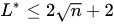




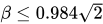


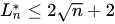
![{\displaystyle \mathbb {E} [L_{n}^{*}]\geq {\tfrac {1}{2}}{\sqrt {n}}.}](https://wikimedia.org/api/rest_v1/media/math/render/svg/84b7371bf7d7fff1a1a5ab12576c8ad55bf7105d)


![{\displaystyle \mathbb {E} [L_{n}^{*}]\geq {\bigl (}{\tfrac {1}{4}}+{\tfrac {3}{8}}{\bigr )}{\sqrt {n}}={\tfrac {5}{8}}{\sqrt {n}},}](https://wikimedia.org/api/rest_v1/media/math/render/svg/2ecdcc435bd0082cd41e82e66fdc3e4f626d1004)
![{\displaystyle \mathbb {E} [L_{n}^{*}]\geq {\bigl (}{\tfrac {5}{8}}+{\tfrac {19}{5184}}{\bigr )}{\sqrt {n}},}](https://wikimedia.org/api/rest_v1/media/math/render/svg/62c7a0de90ef16abab5425baa2d0004d3a3d7247)