
Loading article…
ハドロサウルス科(古代ギリシャ語のἁδρός(hadrós)「頑丈な、厚い」とσαύρα(saúra)「トカゲ」に由来)は、鳥盤類恐竜の科で、非公式にはカモノハシ恐竜と呼ばれています。このグループは、鼻先の骨が平らなカモノハシのくちばしのように見えることから、カモノハシ恐竜として知られています。エドモントサウルスやパラサウロロフスなどの属を含む鳥脚類は、白亜紀後期に一般的な草食動物のグループでした。[ 1 ]ハドロサウルス科は、ジュラ紀後期/白亜紀前期のイグアノドン類恐竜の子孫で、同様の体型をしていました。ハドロサウルス類は、白亜紀後期のアジアと北アメリカにおいて最も優勢な草食動物の一つであり、白亜紀末期にはいくつかの系統がヨーロッパ、アフリカ、南アメリカへと拡散した。
他の鳥盤類と同様に、ハドロサウルス科は前歯骨と恥骨を持ち、恥骨は骨盤の後方に位置していた。より原始的なイグアノドン類とは異なり、ハドロサウルス科の歯は歯列と呼ばれる複雑な構造に積み重なっており、効果的な研磨面として機能した。ハドロサウルス科は、主に2つの亜科に分けられる。1つは中空の頭蓋骨の隆起または管を持つランベオサウルス亜科( Lambeosaurinae )、もう1つは中空の頭蓋骨の隆起を持たないサウロロフス亜科( Saurolophinae)である。サウロロフス亜科は、2010年以前のほとんどの研究でハドロサウルス亜科(Hadrosaurinae)として識別されていた。一部の形態では中空の隆起が存在した。サウロロフス亜科はランベオサウルス亜科よりも体格ががっしりしている傾向があった。ランベオサウルス亜科には、アラロサウルス亜科、ツィンタオサウルス亜科、ランベオサウルス亜科、パラサウロロフス亜科が含まれ、サウロロフス亜科には、ブラキロフォサウルス亜科、クリトサウルス亜科、サウロロフス亜科、エドモントサウルス亜科が含まれる。
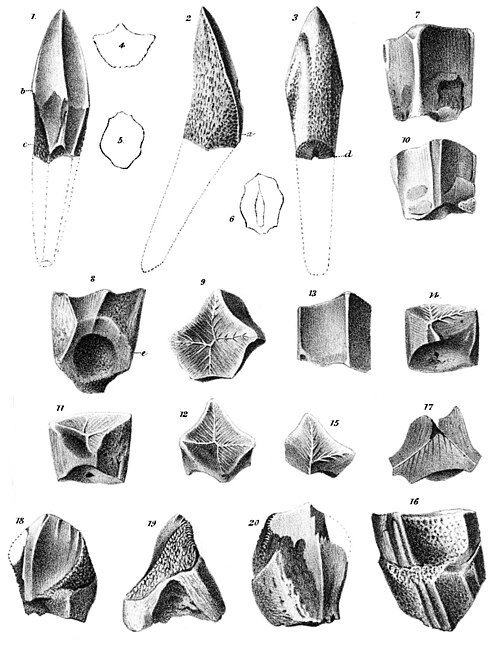
フェルディナンド・ヴァンデヴィア・ヘイデンは、1854年から1856年にかけてジュディス川付近で行った探検で、北アメリカで初めて認識された恐竜の化石を発見した。これらの標本はジョセフ・レイディによって入手され、1856年に彼が記載し命名した。命名されたいくつかの種のうち、ジュディス川層のトラコドン・ミラビリスと「グレート・リグナイト層」のテスペシウス・オキシデンタリスの2種である。前者は歯のコレクションに基づいており、後者は2つの尾椎と指骨に基づいていた。トラコドンの歯のほとんどは角竜類に属することが判明したが、T.オキシデンタリスのホロタイプと化石は、最初に認識されたハドロサウルス類の標本として認識されることになる。ほぼ同時期に、大陸の反対側のフィラデルフィアでは、地質学者のウィリアム・パーカー・フォルケが、約20年前に農夫のジョン・E・ホプキンスによって偶然発見された多数の大きな骨について知らされた。フォルケは1858年に、現在散在している化石を調査する許可を得て、これらの標本もレイディに渡された。それらは同年、ハドロサウルス・フォルキイとして記載され、ハドロサウルスの形態についてややより良い像を示した。レイディは1865年の論文でさらに詳しい記述を行った。[ 4 ] 1858年の彼の研究の中で、レイディは、この動物はおそらく両生類であったと簡単に示唆した。ハドロサウルスに関するこの学派は、その後1世紀以上にわたって支配的となる。[ 5 ]

「ハドロサウルス・ミノール」や「オルニトタルスス・イマニス」などのさらなる発見は東からもたらされ、エドワード・ドリンカー・コープはトラコドンが発見されたジュディス川層への探検隊を率いた。発見された断片に基づいて、彼は2属7種の新種を命名し、ハドロサウルスに資料を割り当てた。[ 4 ]コープはハドロサウルスの顎を研究し、歯がもろく、非常に簡単に抜け落ちる可能性があるという結論に達した。そのため、彼はこれらの動物が主に軟水植物を食べていたに違いないと推測し、 1883年にフィラデルフィア科学アカデミーにこの考えを発表し、この考えは将来の研究に大きな影響を与えることになる。[ 4 ] [ 5 ]ジュディス川地域での研究はその後何年も続いたが、この地層からは断片的な化石しか得られず、コープの種とトラコドン自体もやがて妥当性が疑わしいと見なされるようになった。東部諸州からも、特に有益な標本は得られなかった。その代わりに、アメリカ西部の他の場所から、ハドロサウルス類の研究の基盤となる非常に完全な標本が多数発見された。そのような標本の1つが、1908年に化石収集家のチャールズ・ヘーゼリウス・スターンバーグとその3人の息子によってワイオミング州コンバース郡で発見された、非常に完全なAMNH 5060 (エドモントサウルス・アネクテンスに属する)である。これは1912年にヘンリー・オズボーンによって記載され、彼はこれを「恐竜のミイラ」と名付けた。この標本の皮膚は、痕跡の形でほぼ完全に保存されていた。手の周りの皮膚は水かきを表していると考えられており、ハドロサウルス類が非常に水生動物であったという考えをさらに裏付けるものと見なされた。[ 4 ]
コープは鳥脚類に関するモノグラフを執筆する予定だったが、亡くなるまでにほとんど進展がなかった。この未実現の試みは、数十年後、リチャード・スワン・ラルとネルダ・ライトが同様のプロジェクトに取り組むきっかけとなった。最終的に彼らは、鳥脚類全体という範囲が広すぎることに気づき、北米のハドロサウルス類に絞り込んだ。彼らのモノグラフ『北米のハドロサウルス類恐竜』は1942年に出版され、この科に関するこれまでの理解を総括した。生物学と進化のあらゆる側面を網羅した決定版となるよう設計され、その一環として既知のすべての種が再評価され、多くが再記載された。彼らはハドロサウルス類が半水生であるという以前の著者の見解に同意したが、顎が弱いというコープの考えを再評価し、全く逆の結論に至った。歯は強力な電池に根付いており、摩耗を防ぐために絶えず交換されていたというのである。このようなシステムは、中生代の柔らかい植物を食べるという仕事には信じられないほど過剰に作られているように思われ、この事実は著者たちを困惑させた。彼らは依然として水生植物を主食とすることを提案したが、陸上植物を時折食べることで補われる可能性が高いと考えた。[ 4 ]

20年後の1964年、今度はジョン・H・オストロムによる非常に重要な研究が発表された。それは、1850年代のレイディの研究以来、ハドロサウルス類が半水生動物であるという考えに異議を唱えるものであった。この新しいアプローチは、彼らが生息していた環境と気候、共存する動植物、身体解剖学的特徴、ミイラから保存された胃の内容物などの証拠によって裏付けられていた。これらのすべてのデータを評価した結果、オストロムはハドロサウルス類が水生生活に適応していたという考えは著しく不十分であるとし、代わりに針葉樹などの植物を食べる能力のある陸生動物であったと提唱した。しかし、オズボーンが記述したパドル状の手と、長くややパドル状の尾の目的については確信が持てなかった。そのため、ハドロサウルス類は捕食者から逃れるために水中に避難していたという考えに同意した。[ 5 ]この後に数多くの重要な研究が続いた。オストロムの教え子であるピーター・ドッドソンは、1975年にハドロサウルス類の分類に大きな変化をもたらしたランベオサウルス類の頭蓋骨の解剖学に関する論文を発表し、マイケル・K・ブレット=サーマンは、1970年代から1980年代にかけて大学院での研究の一環として、このグループの全面的な改訂を行った。ジョン・R・ホーナーもまた、 1979年にマイアサウラを命名するなど、この分野に影響を与え始めた。[ 6 ] [ 7 ] [ 8 ] [ 9 ] [ 10 ] [ 11 ]
Hadrosaur research experienced a surge in the decade of the 2000s, similar to the research of other dinosaurs. In response to this, the Royal Ontario Museum and the Royal Tyrrell Museum collaborated to arrange the International Hadrosaur Symposium, a professional meeting about ongoing hadrosaur research that was held at the latter institution on September 22 and 23 in 2011. Over fifty presentations were made at the event, thirty-six of which were later incorporated into a book, titled Hadrosaurs, published in 2015. The volume was brought together primarily by palaeontologists David A. Eberth and David C. Evans, and featured an afterword from John R. Horner, all of whom also contributed to one or more of the studies published therein.[12] The first chapter of the volume was a study by David B. Weishampel about the rate of ornithopod research over history, and the interest in different aspects of it over that history, using the 2004 volume The Dinosauria as the source of data on the amount of works published in each decade. Various periods of high and low activity were found, but the twenty-first century was found to overwhelmingly be the most prolific time, with over two-hundred papers published. The advent of the internet was cited as a likely catalyst for this boom. Hadrosaur research experienced high levels of diversity within the decade, with previously uncommon subjects such as growth, phylogeny, and biogeography experiencing more attention, though the functional morphology of hadrosaurids was found to have declined in study since the dinosaur renaissance.[13]

Hadrosaurids likely originated in North America, before shortly dispersing into Asia. During the late Campanian-Maastrichtian, a saurolophine hadrosaurid migrated into South America from North America, giving rise to the clade Austrokritosauria, which is closely related to the tribe Kritosaurini.[14] During the late early Maastrichtian, several lineages of Lambeosaurinae from Asia migrated into the European Ibero-Armorican Island (what is now France and Spain), including Arenysaurini and Tsintaosaurini.[15] One of these lineages later dispersed from Europe into North Africa, as evidenced by Ajnabia, a member of Arenysaurini.[16]
ハドロサウルス科は、1869年にエドワード・ドリンカー・コープによって初めて使用され、当時はハドロサウルスのみが含まれていました。[ 17 ]この科が創設されて以来、中空のトサカを持つランベオサウルス亜科と、歴史的にハドロサウルス亜科として知られていたサウロロフス亜科との間で、このグループ内で大きな区分が認識されています。これら両方は、最近の文献すべてで強力に支持されています。系統解析により、ハドロサウルス科の関係の解像度が大幅に向上し、ハドロサウルス科の各グループ内のより細かい関係を記述するために、族(亜科より下の分類単位)が広く使用されるようになりました。[ 18 ]
ランベオサウルス亜科は、従来パラサウロロフス亜科とランベオサウルス亜科に分けられてきた。[ 19 ]これらの用語は、エヴァンスとライツによる2007年のランベオサウルス・マグニクリスタトゥスの再記載で正式な文献に登場した。ランベオサウルス亜科は、パラサウロロフス・ウォーカーリよりもランベオサウルス・ランベイに近縁なすべての分類群と定義され、パラサウロロフス亜科は、ランベオサウルス・ランベイよりもP.ウォーカーリに近いすべての分類群と定義される。近年では、ツィンタオサウルス亜科 とアラロサウルス亜科も出現している。[ 20 ]
ハドロサウルス類の系統関係に関する包括的な研究において、2010年にアルバート・プリエト=マルケスがハドロサウルス類の系統関係について疑問を呈した。プリエト=マルケスは、ハドロサウルス類のほとんど冠のない系統群に対してハドロサウルス類という名称がこれまでのほぼすべての研究で使用されてきたにもかかわらず、その模式種であるハドロサウルス・フォルキイは、国際動物命名規約(ICZN)が定めた動物命名規則に違反して、その名を冠する系統群からほぼ常に除外されてきたと指摘した。プリエト=マルケスは、ハドロサウルス類をH.フォルキイを含む系統群のみと定義し、従来のグループには代わりにサウロロフィナエという名称を使用した。[ 18 ]
ハドロサウルス科は、1997年の抄録でフォースターによって初めてクレードとして定義され、単に「ランベオサウルス亜科とハドロサウルス亜科、およびそれらの最新の共通祖先」とされました。1998年、ポール・セレノは、ハドロサウルス科を、サウロロフス(よく知られたサウロロフス亜科)とパラサウロロフス(よく知られたランベオサウルス亜科)を含む最も包括的なグループとして定義し、後にこの定義を修正して、科の模式属であるハドロサウルスを含めました。ホーナーら(2004)によると、セレノの定義では、テルマトサウルスやバクトロサウルスなど、他のいくつかのよく知られたハドロサウルス類が科の外に置かれるため、彼らはデフォルトでテルマトサウルスを科に含めるように定義しました。プリエト・マルケスは2010年にハドロサウルス科の系統発生をレビューし、科に含まれる可能性のある多くの分類群を含めました。[ 18 ]この科は現在、PhyloCodeで「 Hadrosaurus foulkii、Lambeosaurus lambei、およびSaurolophus osborniを含む最小のクレード」として正式に定義されている。[ 21 ] Lambeosaurinae と Saurolophinae の 2 つの主要な亜科は、 Euhadrosauria ( Saurolophidae と呼ばれることもある)クレードに属し、「 Hadrosaurus foulkiiを含まない限り、Lambeosaurus lambeiとSaurolophus osborniを含む最小のクレード」と定義されている。[ 21 ]このクレードは、 HadrosaurusやYamatosaurusのような基盤的なハドロサウルス科を除外するが、 Hadrosaurus がLambeosaurusとSaurolophusの最後の共通祖先の子孫である場合は自己崩壊する。[ 21 ]
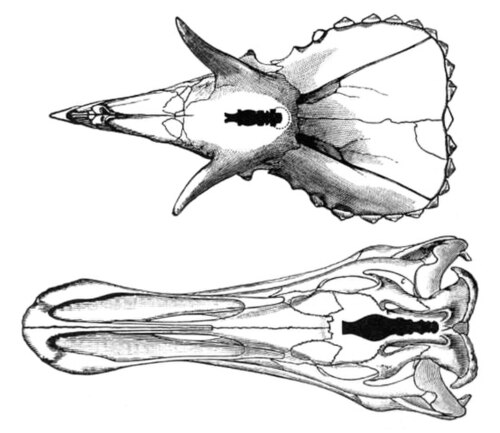
以下は Prieto-Marquez らによる 2016 年の系統樹です。この系統樹は、より多くの形質と分類群を含む、2010 年の元の分析の最近の修正です。彼らの分析の結果得られた系統樹は、最大節約法を使用して解決されました。61 種のハドロサウルス上科種が含まれ、273 の形態的特徴が特徴付けられました。頭蓋骨の特徴は 189、体幹の特徴は 84 です。形質が進化スキームを形成する複数の状態を持つ場合、ある状態から次の状態への進化を考慮するように順序付けられました。最終的な系統樹は、TNT バージョン 1.0で実行されました。[ 22 ]


The following cladogram is from Ramírez-Velasco (2022), including most recently named taxa.[23]

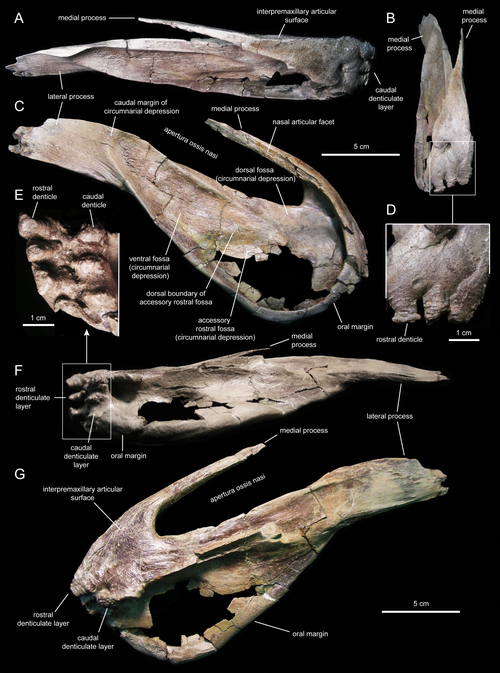
The most recognizable aspect of hadrosaur anatomy is the flattened and laterally stretched rostral bones, which gives the distinct duck-bill look. Some members of the hadrosaurs also had massive crests on their heads, probably for display and/or to make noises.[18] In some genera, including Edmontosaurus, the whole front of the skull was flat and broadened out to form a beak, which was ideal for clipping leaves and twigs from the forests of Asia, Europe and North America. However, the back of the mouth contained thousands of teeth suitable for grinding food before it was swallowed. This has been hypothesized to have been a crucial factor in the success of this group in the Cretaceous compared to the sauropods.
Skin impressions of multiple hadrosaurs have been found.[24] From these impressions, the hadrosaurs were determined to be scaled, and not feathered like some dinosaurs of other groups.
Hadrosaurs, much like sauropods, are noted for having their manus united in a fleshy, often nail-less pad.[25]
The two major divisions of hadrosaurids are differentiated by their cranial ornamentation. While members of the Lambeosaurinae subfamily have hollow crests that differ depending on species, members of the Saurolophinae (Hadrosaurinae) subfamily have solid crests or none at all. Lambeosaurine crests had air chambers that may have produced a distinct sound and meant that their crests could have been used for both an audio and visual display.

While studying the chewing methods of hadrosaurids in 2009, the paleontologists Vincent Williams, Paul Barrett, and Mark Purnell found that hadrosaurs likely grazed on horsetails and vegetation close to the ground, rather than browsing higher-growing leaves and twigs. This conclusion was based on the evenness of scratches on hadrosaur teeth, which suggested the hadrosaur used the same series of jaw motions over and over again.[26] As a result, the study determined that the hadrosaur diet was probably made of leaves and lacked the bulkier items, such as twigs or stems, that might have required a different chewing method and created different wear patterns.[27] However, Purnell said these conclusions were less secure than the more conclusive evidence regarding the motion of teeth while chewing.[28]
The hypothesis that hadrosaurs were likely grazers rather than browsers appears to contradict previous findings from preserved stomach contents found in the fossilized guts in previous hadrosaur studies.[28] The most recent such finding before the publication of the Purnell study was conducted in 2008, when a team led by University of Colorado at Boulder graduate student Justin S. Tweet found a homogeneous accumulation of millimeter-scale leaf fragments in the gut region of a well-preserved partially grown Brachylophosaurus.[29][30] As a result of that finding, Tweet concluded in September 2008 that the animal was likely a browser, not a grazer.[30] In response to such findings, Purnell said that preserved stomach contents are questionable because they do not necessarily represent the usual diet of the animal. The issue remains a subject of debate.[31]

Mallon et al. (2013) examined herbivore coexistence on the island continent of Laramidia, during the Late Cretaceous. It was concluded that hadrosaurids could reach low-growing trees and shrubs that were out of the reach of ceratopsids, ankylosaurs, and other small herbivores. Hadrosaurids were capable of feeding up to a height of 2 m (6 ft 7 in) when standing quadrupedally, and up to a height of 5 m (16 ft) bipedally.[32]
Coprolites (fossilized droppings) of some Late Cretaceous hadrosaurs show that the animals sometimes deliberately ate rotting wood. Wood itself is not nutritious, but decomposing wood would have contained fungi, decomposed wood material and detritus-eating invertebrates, all of which would have been nutritious.[33] Examination of hadrosaur coprolites from the Grand Staircase-Escalante indicates that shellfish such as crustaceans were also an important component of the hadrosaur diet.[34]
It's thought that chewing behaviour may have changed throughout life in hadrosaurids. Very young specimens show simple cup shapes occlusion zones, or areas where the teeth contact one another in chewing, whereas in adulthood there is a "dual function" arrangement with two distinct areas of different tooth wear. This change during growth may have helped transition from a diet of softer plants when young to more tough and fibrous ones during adulthood. It's thought the transition between states, characterized by a more gradual transition from one wear state to another, occurred at different times in the growth of different species; in Hypacrosaurus stebingeri it did not occur until a nearly adult stage, whereas in a saurolophine specimen likely less than a year old from the Dinosaur Park Formation the transition had already begun.[35]
Hadrosaurs have been noted as having the most complex brains among ornithopods, and indeed among ornithischian dinosaurs as a whole.[36][37][38] The brains of hadrosaurid dinosaurs have been studied as far back at the late 19th century, when Othniel Charles Marsh made an endocast of a specimen then referred to Claosaurus annectens; only basic remarks were possible but it was noted that the organ was proportionally small.[39]John Ostrom would give a more informed analysis and review in 1961, pulling on data from Edmontosaurus regalis, E. annectens, and Gryposaurus notabilis (then considered a synonym of Kritosaurus). Though still obviously small, Ostrom recognized that the brains may be more significantly developed than expected, but supported the view that dinosaur brains would have only filled some of the endocranial cavity, limiting possibility of analysis.[40] In 1977 James Hopson introduced the use of estimated encephalization quotients to the topic of dinosaur intelligence, finding Edmontosaurus to have an EQ of 1.5, above that of other ornithischians including earlier relatives like Camptosaurus and Iguanodon and similar to that of carnosaurian theropods and modern crocodilians but below that of coelurosaurian theropods. Reasonings suggested for their comparably high intelligence were the need for acute senses in the lack of defensive weapons, and more complex intraspecific behaviours as indicated by their acoustic and visual display structures.[36]
The advent of CT scanning for use in palaeontology has allowed for more widespread application of this without the need for specimen destruction. Modern research using these methods has focused largely on hadrosaurs. In a 2009 study by palaeontologist David C. Evans and colleagues, the brains of lambeosaurine hadrosaur genera Hypacrosaurus (adult specimen ROM 702), Corythosaurus (juvenile specimen ROM 759 and subadult specimen CMN 34825), and Lambeosaurus (juvenile specimen ROM 758) were scanned and compared to each other (on a phylogenetic and ontogenetic level), related taxa, and previous predictions, the first such large-scale look into the neurology of the subfamily. Contra the early works, Evans' studies indicate that only some regions of the hadrosaur brain (the dorsal portion and much of the hindbrain) were loosely correlated to the brain wall, like modern reptiles, with the ventral and lateral regions correlating fairly closely. Also unlike modern reptiles, the brains of the juveniles did not seem to correlate any closer to the brain wall than those of adults. It was cautioned, however, that very young individuals were not included in the study.[37]
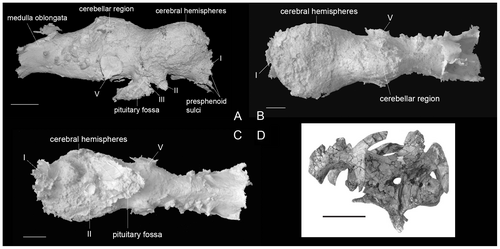
As with previous studies, EQ values were investigated, although a wider number range was given to account for uncertainty in brain and body mass. The range for the adult Hypacrosaurus was 2.3 to 3.7; the lowest end of this range was still higher than modern reptiles and most non-maniraptoran dinosaurs (nearly all having EQs below two), but fell well short of maniraptorans themselves, which had quotients higher than four. The size of the cerebral hemispheres was, for the first time, remarked upon. It was found to taking up around 43% of endocranial volume (not considering olfactory bulbs) in ROM 702. This is comparable to their size in saurolophine hadrosaurs, but far larger than in any ornithischians outside of Hadrosauriformes, and all large saurischian dinosaurs; maniraptors Conchoraptor and Archaeopteryx, an early bird, had very similar proportions. This lends further support to the idea of complex behaviours and relatively high intelligence, for non-avian dinosaurs, in hadrosaurids.[37]
Amurosaurus, a close relative of the taxa from the 2009 study, was the subject of a 2013 paper once again looking into a cranial endocast. A nearly identical EQ range of 2.3 to 3.8 was found, and it was again noted this was higher than that of living reptiles, sauropods and other ornithischians, but different EQ estimates for theropods were cited, placing the hadrosaur numbers significantly below even more basal theropods like Ceratosaurus (with an EQ range of 3.31 to 5.07) and Allosaurus (with a range of 2.4 to 5.24, compared to only 1.6 in the 2009 study);[37][38] more bird-like coelurosaurians theropods such as Troodon had stated EQs higher than seven. Additionally, the relative cerebral volume was only 30% in Amurosaurus, significantly lower than in Hypacrosaurus, closer to that of theropods like Tyrannosaurus (with 33%), though still distinctly larger than previously estimated numbers for more primitive iguanodonts like Lurdusaurus and Iguanodon (both at 19%). This demonstrated a previously unrecognized level of variation in neuro-anatomy within Hadrosauridae.[38]

Neonate sized hadrosaur fossils have been documented in the scientific literature.[41] Tiny hadrosaur footprints have been discovered in the Blackhawk Formation of Utah.[41]
In a 2001 review of hadrosaur eggshell and hatchling material from Alberta's Dinosaur Park Formation, Darren Tanke and M. K. Brett-Surman concluded that hadrosaurs nested in both the ancient upland and lowlands of the formation's depositional environment. The upland nesting grounds may have been preferred by the less common hadrosaurs, like Brachylophosaurus and Parasaurolophus. However, the authors were unable to determine what specific factors shaped nesting ground choice in the formation's hadrosaurs. They suggested that behavior, diet, soil condition, and competition between dinosaur species all potentially influenced where hadrosaurs nested.[41]
Sub-centimeter fragments of pebbly-textured hadrosaur eggshell have been reported from the Dinosaur Park Formation. This eggshell is similar to the hadrosaur eggshell of Devil's Coulee in southern Alberta as well as that of the Two Medicine and Judith River Formations in Montana, United States. While present, dinosaur eggshell is very rare in the Dinosaur Park Formation and is only found in two different microfossil sites. These sites are distinguished by large numbers of pisidiidclams and other less common shelled invertebrates, like unionid clams and snails. This association is not a coincidence, as the invertebrate shells would have slowly dissolved and released enough basic calcium carbonate to protect the eggshells from naturally occurring acids that otherwise would have dissolved them and prevented fossilization.[41]
In contrast with eggshell fossils, the remains of very young hadrosaurs are somewhat common. Tanke has observed that an experienced collector could discover multiple juvenile hadrosaur specimens in a single day. The most common remains of young hadrosaurs in the Dinosaur Park Formation are dentaries, bones from limbs and feet, as well as vertebral centra. The material showed little or none of the abrasion that would have resulted from transport, meaning the fossils were buried near their point of origin. Bonebeds 23, 28, 47, and 50 are productive sources of young hadrosaur remains in the formation, especially bonebed 50. The bones of juvenile hadrosaurs and fossil eggshell fragments are not known to have been preserved in association with each other, despite both being present in the formation.[41]

The limbs of the juvenile hadrosaurs are anatomically and proportionally similar to those of adult animals.[41] However, the joints often show "predepositional erosion or concave articular surfaces",[41] which was probably due to the cartilaginous cap covering the ends of the bones.[41] The pelvis of a young hadrosaur was similar to that of an older individual.[41]
The young of some hadrosaurs, namely Maiasaura, are suggested to have walked on only their two hind legs, while adults would have walked on all four.[2] As Maiasaura aged, the front limbs became more robust in order to take on weight, while the back legs became less robust as they transitioned to walking on all four legs.[2] Bone modeling also seems to support a locomotion shift in Maiasaura; outgrowths on the tibiae reinforce the bone in the direction of stresses that would be caused by bipedalism (in a one-year-old individual) and quadrupedalism (in an individual at least four years of age).[42] In contrast, Edmontosaurus nestlings appear to have been capable of fully quadrupedal locomotion, and do not show much change in limb proportions through growth.[43] Quadrupedal tracks of a small, presumably juvenile hadrosaur are known from the Cantwell Formation in Alaska.[3]
Comparisons between the scleral rings of several hadrosaur genera (Corythosaurus, Prosaurolophus, and Saurolophus) and modern birds and reptiles suggest that they may have been cathemeral, active throughout the day at short intervals.[44]
Spondyloarthropathy has been documented in the spine of a 78-million year old hadrosaurid. Other examples of pathologies in hadrosaurs include healed wounds from predators, such as those found in Edmontosaurus annectens, and tumors such as Langerhans cell histiocytosis, hemangiomas, desmoplastic fibroma, metastatic cancer, and osteoblastomas, found in genera such as Brachylophosaurus and Edmontosaurus.[45][46]Osteochondrosis is also commonly found in hadrosaurs.[47]