
Loading article…
ユニオン・ピアソン・エクスプレス(UPエクスプレスまたは単にUP)[ 3 ]は、トロント中心部のユニオン駅とトロント・ピアソン国際空港を結ぶ空港鉄道です。UPエクスプレスは、 2015年パンアメリカン競技大会に合わせて2015年6月6日に運行を開始しました。[ 2 ] [ 4 ] [ 5 ] UPエクスプレスは、ユニオン駅とピアソン駅間を28分で移動し[ 6 ]、週7日15分間隔で出発します。[ 7 ]運行開始の発表では、UPエクスプレスは初年度に年間235万人の乗客を輸送し、約120万回の自動車移動を削減すると予測されていました。[ 2 ] 2019年現在、年間450万人の乗客を輸送しています。[ 1 ]
UP Expressは、 GO Transitと同様に、Metrolinxの独立した部門として運営されています。空港鉄道リンクは、Metrolinxの地域交通計画「The Big Move 」で特定された優先プロジェクトの1つでした。[ 8 ]建設は、UP ExpressがGO TransitおよびVia Railと共有する鉄道回廊を拡張するジョージタウン・サウス・プロジェクトの一環として2011年に始まりました。[ 4 ] [ 9 ] UP Expressは、米国環境保護庁のTier 4排出基準を満たすディーゼル多目的ユニット(DMU)列車を使用しています。Metrolinxは、 UP Expressをキッチナー線とともに電化し、GOネットワークの残りの部分と統一された列車セットを使用する計画ですが、2019年の時点では、このプロジェクトはまだ初期段階でした。[ 10 ] UP Expressは、当初から電気列車を使用していないこと、および北米の他の空港と都市を結ぶ路線と比較して当初の運賃が非常に高いことで批判されています。[ 11 ] [ 12 ] [ 13 ]
The Union Pearson Express' maximum operating speed is 145 km/h (90 mph),[14] and its average speed is 56 km/h (35 mph). The line initially operated with four stations but a fifth was added in November 2025.
Improved transit connections to Pearson Airport had been of interest since the late 1980s. Before pursuing the airport rail link, three formal studies were conducted, in 1989, 1990 and 1991. The last two presented options for either making a connection from the GO Georgetown (later extended and renamed Kitchener) train line or the Toronto Transit Commission's Bloor–Danforth line (since renamed "Line 2 Bloor–Danforth").[15]

Transport Canada made a request for proposal for an airport rail link in April 2001. In May 2003, the bidding parties were shortlisted to four consortia, who were invited to submit business cases. On 13 November 2003, the Union Pearson AirLink Group, a subsidiary of SNC-Lavalin, was selected to finance, design, construct, operate and maintain an airport rail link.[17] The service was to be called Blue22, as a trip would take 22 minutes to or from Pearson with a stop at the Bloor GO Station (within walking distance of the Dundas West Toronto Transit Commission station). Trains were to be refurbished Budd Rail Diesel Cars and were expected to begin running between 2008 and 2010.[16]

2008 年までに、交渉での合意形成の失敗、規制上の障害、地域住民の反対により、プロジェクトは大きな進展を見せていなかった。2008 年 6 月、オンタリオ州政府は環境アセスメントのプロセスを、義務付けられていた 3 年間から 6 か月に修正し、その年の夏には、官民パートナーシップの条件についてユニオン ピアソン エアリンク グループとの交渉を再開した。さらに、高速リンクは、オンタリオ州首相のダルトン マクギンティ、トロント市長のデビッド ミラー、連邦政府から強い支持を表明する声明を受けた。[ 18 ]
2008 年 11 月、グレーター トロントおよびハミルトンの交通を担当するオンタリオ州政府機関であるMetrolinx は、 「The Big Move」と題する地域交通計画を発表し、空港鉄道リンクが、ミシサガ トランジットウェイ、ハイウェイ427号線と407号線沿いの高速交通回廊、エグリントン通りとフィンチ通り沿いのライト レール交通路線に加えて、ピアソン空港地区への多方向の高次交通接続を確立する戦略の一部であることを概説した。[ 15 ] 2008 年 12 月、Metrolinx は、UP Express とGO Transitのジョージタウン サウス拡張の両方の組み合わせを同時に評価する新しい EA の提案者となった。[ 19 ]最終的な環境プロジェクト レポートは 2009 年 7 月 30 日に発表された。 [ 15 ]
2年間の交渉の失敗と資金調達の困難を経て、オンタリオ州とユニオン・ピアソン・エアリンク・グループとの官民パートナーシップは2010年7月に中止され、メトロリンクスがサービスを直接所有・運営する責任を負うことになった。[ 20 ] [ 21 ]メトロリンクスは、後にユニオン・ピアソン・エクスプレスとなる新しい運営部門を設立した。[ 22 ] 2012年11月に正式名称が発表されるまで、「エア・レール・リンク」という名称が仮称として使用され、「UPX」は時折使用される略称であった。[ 3 ]
Metrolinx largely preserved the same project scope as had been approved in the environmental assessment, with the service designed for air travellers rather than for conventional commuters. Changes from SNC Lavalin's former proposal included refinements to take into account synergies with GO Transit.[22] Metrolinx engaged Sumitomo Corporation of America to supply Diesel Multiple Units (DMUs) for the line.[23] Kathy Haley was named the first president of the division in July 2011.[24]

In October 2011, the consortium AirLinx Transit Partners was selected to complete building the UP Express. The consortium was made up of some of Canada's largest construction companies such as Aecon and Dufferin Construction.[25] Construction on the spur line and passenger station at Pearson airport began in the spring of 2012, at a cost of $128.6 million.[26][27] At the time, the entire project was expected to cost $456 million.[28]
Undertaken as part of the Georgetown South Project, the work consisted of five new road overpasses and two road underpasses, one railway grade separation, one bridge reconstruction and the widening of 15 other bridges, construction or re-construction of four stations, major track and grading construction, signal installations utility relocations, as well as the new 3.3-kilometre (2.1 mi) elevated spur to and from the airport. The work was conducted while minimizing disruption to existing train operations, local residents and businesses. A new rail tunnel under Highway 401 was still required at a later date to meet future ridership demands.[29] Construction of tunnels for two tracks began in July 2019 and is expected to be completed in late 2021.[30]
Service began on 6 June 2015, operated by the Union Pearson Express division of Metrolinx. With an adult one-way fare of $27.50 cash or $19.00 with a Presto card, the service was criticized for being the most expensive airport rail link service in North America.[13] Amid public concern, fares were drastically reduced on 9 March 2016 to $12.00 cash and $9.00 with a Presto card.[31] The change also introduced GO pricing between Bloor, Weston, and Union stations. President Kathy Haley, who was heading up the project, stepped down on 31 March 2016, in a shakeup of the ranks that resulted in changes to the line's management approach.[32]
In 2017, the Discounted Double Fare program was introduced, which offered UP Express and GO Transit customers a discount of $1.50 when transferring to or from the Toronto Transit Commission (TTC), equal to a 50 percent reduction of the $3.00 TTC cash fare at the time. The arrangement ended in March 2020 when the Government of Ontario terminated funding for the program.[33]
On 16 November 2025, a fifth station at Mount Dennis opened.[34]
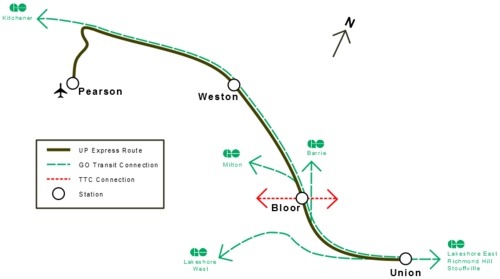
Union Pearson Express operates every 15 minutes between 4:55 am (6:00 am on weekends) and 1:00 am, making approximately 80 trips per day.[35]
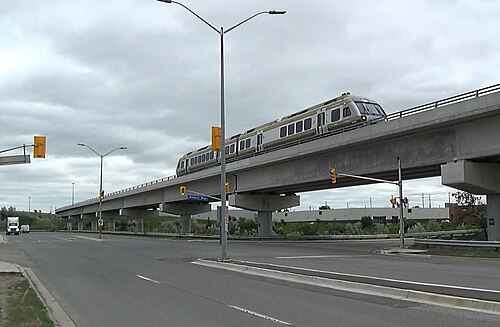
From Union Station, the UP Express heads northwest along the existing GO Transit Kitchener line. This 22-kilometre (14-mile) section of track between Bathurst Street and Highway 427 was upgraded as part of GO's Georgetown South Project, which improved infrastructure along the route to accommodate the UP Express, GO Transit, Canadian National, and Via Rail services.[4][15] The UP Express makes three intermediate stops at Bloor, Mount Dennis, and Weston GO stations. Bloor station was redesigned for better access and connection to GO Transit, and Metrolinx is constructing a direct connection to the Dundas West subway station.[36][37]
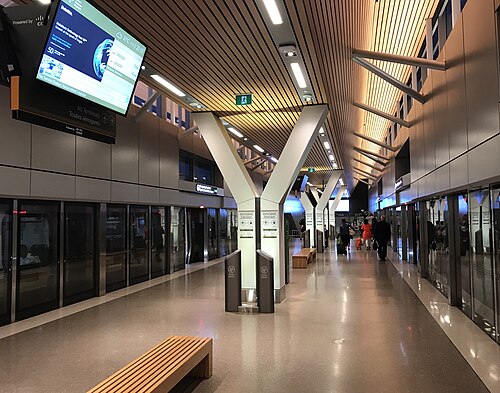
ハイウェイ427号線の先では、新たに建設された3.3 km (2.1マイル) の鉄道支線がキッチナー線から空港までUPエクスプレスを運び、オンタリオ州で最長の高架鉄道を形成している。[ 38 ] [ 39 ]ピアソン空港への高架支線は最高28メートル (92 フィート)の高さに達し、トロントのダウンタウンとミシサガ市街地のスカイラインを一望できる。[ 38 ] [ 40 ]ピアソンでは、UPエクスプレスはターミナル1に到着し、乗客は空港のターミナルリンク自動運転装置に乗り換えてターミナル3とビスカウント駐車場に接続できる。[ 22 ]

トロント・ユニオン駅では、UPエクスプレスは駅の西側ウィングのスカイウォーク沿いにある専用プラットフォームから運行しています。プラットフォームは完全に囲われており、待合エリア、ゲストサービスデスク、カフェ、ギフトショップ、ラウンジを備えています。[ 41 ]
ブロア駅、マウントデニス駅、ウェストン駅では、UPエクスプレスはGOトランジット・キッチナー線の低層ホームに隣接する専用の高層ホームから運行しています。
建設中のウッドバインGO駅は、完成すればUPエクスプレスも乗り入れる予定である。[ 42 ]

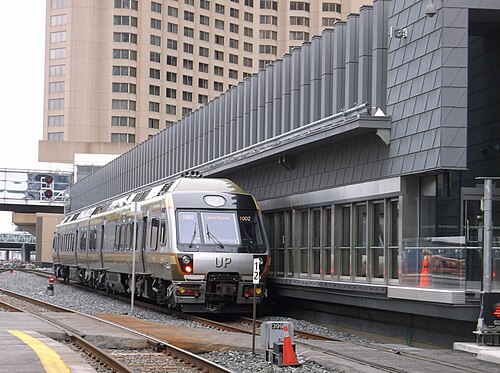
The Union Pearson Express uses Nippon Sharyo DMU trains. The fleet consists of 18 diesel multiple unit (DMU) cars, as four three-car and three two-car sets.[43] Initially, on 1 March 2011, Metrolinx announced that it had chosen to buy 12 DMU cars (six two-car trains) from Nippon Sharyo at a cost of $53 million, for the service.[44] This was later expanded to 18 DMU cars (adding one car to each train via an option order). This brought the cost to US$75 million.[28][43] The DMUs were manufactured in Japan, assembled in Nippon Sharyo's facility in Rochelle, Illinois, and towed by rail to Toronto, with the first trainset arriving on 15 August 2014.[40][45][46]

The trainsets seat between 115 and 173 people. On-board features include power outlets, Wi-Fi, luggage facilities, and washrooms.[36][47]
The UP Express DMUs are based on the design created for the Sonoma–Marin Area Rail Transit system in California. Powered by a diesel hydraulic drive with a six-speed automatic transmission and regenerative braking, the DMUs are believed to be the first trains in the world that comply with the United States Environmental Protection Agency Tier 4 emission standards, which will reduce emissions up to 90%.[40] Braking energy is converted into electricity by the auxiliary power generator, and helps to provide onboard lighting and heating.[48] They also comply with FRA Tier 1 crash energy management features. Modifications for UP Express use include enclosed overhead luggage bins that comply with Transport Canada rules and an enhanced enclosed luggage tower.
Tier 4 エンジンは、トロントの他のほとんどのディーゼル車よりも大幅に低い排出量を排出します。[ 49 ] 2009 年の UP エクスプレスの環境影響評価は、列車が Tier 4 ではなく Tier 3 基準であると想定して実施され、ピーク時の頻度では、追加の列車による大気質への影響は、汚染レベルを州の基準レベル以上に上昇させないことが示されました。[ 50 ]ディーゼル推進オプションに Tier 4 排出技術を使用することを想定した 2010 年の Metrolinx 電化調査では、ジョージタウン - UP エクスプレスのディーゼルサービスが地域の大気汚染に 0.2% 程度寄与し、電化によって地域の大気質がわずかに改善されるだけであることがわかりました。[ 51 ] 2011年に行われた人間の健康評価の追加レビューで、GO TransitはUP Express列車と既存のGO機関車のTier 4への改造の両方に対するTier 4排出規制の現在の計画を調査し、ディーゼルUP Expressサービスの人間の健康リスクは無視できるが、現在の背景大気質(トロントの他の汚染源によるもの)が問題であることがわかりました。[ 52 ]
運賃は年齢、出発地と目的地、支払い方法に基づいて決定されます(12歳以下の子供は年間を通してUP Expressに無料で乗車できます)。家族、往復、空港職員には割引が適用されます。[ 53 ]他のGO Transit路線と同様に、統合された列車チケットはVia Railを通じてカナダ全土の鉄道駅で購入できます。[ 54 ]運行開始当初、UP Expressの片道運賃は27.50ドル、Prestoカードの場合は19ドルでした。2015年6月19日までに、ユニオン・ピアソン・エクスプレスは1日平均約3,250人の乗客、つまり定員の12%に達しました。[ 55 ]メトロリンクスは、開業から1年後には1日5,000人の乗客、つまり約100万人の顧客を獲得すると予測しています 。メトロリンクスは、2020年までに 年間約246万回の乗車で運営コストを完全に回収できると見込んでいます。[ 56 ]
UPエクスプレスでは、乗車券の提示は自己申告制となっており、乗車中は事前に購入したUP乗車券、またはタッチ式のPrestoカード、非接触型クレジットカードもしくはデビットカード、またはモバイルウォレットを携帯する必要があります。これらの乗車券は、求められた場合に提示しなければなりません。提示できない場合は罰金が科せられることがあります。
しかし、サービス開始後数か月で乗客数は減少した。2015年8月の乗客数は2015年6月より17%少なく、9月の最初の2週間ではさらに4%減少した。乗客数は2015年9月の4週間で1日平均2,300人となり、6月から29%減少した。このサービスは運営費を回収するために1日あたり約7,000人の乗客が必要だった。[ 60 ] 2016年2月の報告書では、月間乗客数が夏から2015年11月には65,593回(1日あたり2,100回強)に減少したことが示された。これにより、メトロリンクスは乗客数を増やすために料金調整を検討し始めた。[ 61 ]
2016年1月までに、平均乗客数はさらに落ち込み、1日あたり1,967人となった。[ 62 ] 2016年3月9日、運賃が引き下げられ、ユニオンとピアソン間の片道運賃は12ドル、Prestoカード利用の場合は9ドルとなった。運賃引き下げ初日、職員は5,300人の乗車を記録し、そのうち40%がUPの初利用者、83%が航空旅行者、17%が通勤者であった。[ 63 ] 2016年6月までに、1日の平均乗客数は7,657人に増加し、7月29日には11,000人以上の乗客を輸送し、新記録を樹立した。[ 64 ]しかし、運賃引き下げによりUP Expressの総収入は減少し、運営費に必要な額を下回ると予想されている。[ 65 ] [ 66 ]開業日から2016年3月までのUPエクスプレスの州運営補助金は総額3930 万ドル、1乗車あたり約52.26ドルであることが明らかになった。[ 67 ]
乗客数が判明している最新の月である2018年7月には、UPエクスプレスは約35万6000人の乗客を輸送した。[ 57 ] 2022年7月から9月にかけては、UPエクスプレスは約71万9000人の乗客を輸送した。[ 68 ]
2021年3月11日、UP Expressはグレーター・トロント地域で初めて新しいPrestoオープン決済システムを導入した交通機関となった。乗客はPrestoカードをタップするだけでなく、クレジットカード(Visa、Mastercard、American Express)、Interacデビットカード、またはモバイルデバイス(携帯電話やスマートウォッチ)をPresto運賃端末にタップして乗降することもできる。[ 69 ] [ 70 ]
ルートのウェストン区間沿いに住む住民は、GOジョージタウン・サウス回廊の改良とUPエクスプレス列車の追加に対応するための変更に反対している。懸念事項には、踏切の閉鎖によるウェストンの分断、騒音レベル、大気質、不動産価値などがある。[ 18 ] [ 20 ] 2009年4月、鉄道回廊沿いのコミュニティを代表するクリーン・トレイン・コアリション(CTC)が結成され、メトロリンクスと州政府に対し、人口密度の高いジョージタウン・サウス回廊とユニオン・ピアソン鉄道リンクの電化を開業日に優先するよう圧力をかけた。[ 71 ]しかし、州政府とメトロリンクスのロブ・プリチャード会長は、ディーゼル列車を使用することが大幅な遅延を防ぐ唯一の方法であると示唆している。「グレーター・トロント地域はこのプロジェクトをできるだけ早く必要としていると信じており、それは世界で最もクリーンなディーゼル技術を採用することを意味する」とプリチャードは述べた。[ 27 ]
2012年8月、CTCは司法審査の申請を提出し、メトロリンクスに対して法的措置を取った。この申請は、オンタリオ州政府の指示に従ってパンアメリカン競技大会に間に合うようにUPエクスプレスを完成させたため、ディーゼル列車と電気列車の運行に関する適切な分析が行われず、メトロリンクスの法的義務に反しているとして、「エアレールリンク沿いにディーゼル多目的車両を導入または運行するという決定を取り消し、無効にする」ことを求めていた。また、世界保健機関(WHO)がディーゼル排気ガスを発がん性物質に再分類したため、大気質の再評価が必要であるとも主張した。[ 11 ]
CTCの代理人弁護士であるサバ・アフマド氏は、この申請は政府機関が自らの法律に従わなければならないかどうかの試金石だと述べた。[ 12 ] 2012年11月21日、オンタリオ州地方裁判所は申請を却下し、CTCに3万ドルの訴訟費用を支払うよう命じた。[ 72 ]
トロント交通局は、キプリング駅とピアソン空港を結ぶ頻繁な急行バス路線、900エアポートエクスプレスを提供しています。バスは10分間隔以下で出発し、ダウンタウンからピアソン空港までの所要時間は45分で、料金はTTCの運賃のみです。[ 73 ] [ 74 ]
From 1993 until 2014, the Toronto Airport Express was a privately operated airport bus service from the airport to downtown Toronto operated by Pacific Western Transportation. The route was founded by Gray Coach in 1979.[75] As of 2012, a "One Ride Scheduled Service" to or from downtown Toronto cost $26.95 and a "One Ride On-Demand Airport Express Connect" fare cost $29.95. A one-way trip took approximately 45 to 90 minutes, depending on traffic. The service ceased operation on 31 October 2014 due to declining ridership, the popularity of the Billy Bishop Airport on Toronto Island, delays due to downtown road construction, and anticipated competition from the Union Pearson Express.[76]
Other public transit bus services –operated by GO Transit, MiWay, and Brampton Transit –connect Pearson Airport to Toronto and other cities in the Greater Toronto Area.[77]
As of 2019, Metrolinx is planning a major upgrade to the Union Pearson Express to better integrate it into the GO Transit rail network and to double the frequency of trains to the airport. As of September 2019, planning work was in its early stages and no plans had been finalized. The proposal includes:[78][79]
According to the planning document dated 22 February 2019, it is uncertain whether the UP Express infrastructure at airport Terminal 1 can be modified to accommodate electrified GO trains. There were no cost estimates for infrastructure changes.[78][79]
{{cite press release}}: CS1メンテナンス: アーカイブサービスは非推奨になりました (リンク){{cite news}}: CS1メンテナンス: アーカイブサービスは非推奨になりました (リンク)THE FIRST two of 18 DMU cars being supplied by Sumitomo to Toronto transport authority Metrolinx for use on the Union Pearson Express (UP Express) airport rail link have arrived in Canada.
43°40′37″N79°28′12″W / 43.677°N 79.470°W / 43.677; -79.470