
Loading article…
Antiochus III the Great (/ænˈtaɪəkəs/; Ancient Greek: Ἀντίοχος ὁ Μέγας, Antíokhos ho Mégas; c. 241 BC – 3 July 187 BC)[2] was the sixth ruler of the Seleucid Empire, reigning from 223 BC to 187 BC.[3][4][5]
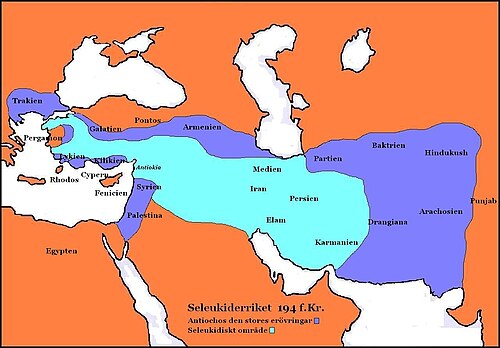
Ascending to the throne at the age of eighteen, Antiochus inherited an empire in turmoil after the death of his brother, Seleucus III Ceraunus. While his initial campaigns against Ptolemaic Egypt ended in failure, he spent the decade that followed successfully reasserting Seleucid authority over territory such as central Asia Minor, Parthia and Bactria. Pressing as far as the Kabul valley, he renewed a friendship with the Indian king Sophagasenus and earned himself the epithet "the Great" (Antiochos Megas). He also assumed the title Basileus Megas (Greek for 'Great King'), the traditional title of the Persian kings. Upon his return to the west, Antiochus launched another campaign against the Ptolemies and brought Coele-Syria, Phoenicia and Judea under Seleucid control.
Antiochus's designs on the Greek city-states earned him the antagonism of the Roman Republic. Declaring himself the "champion of Greek freedom against Roman domination", he waged a four-year war against Rome beginning in mainland Greece in the autumn of 192 BC, advised by the exiled Carthaginian general Hannibal and supported by an alliance with the Aetolian League.[6][7] He was resoundingly defeated at the battles of Thermopylae (191 BC) and Magnesia (190 BC), resulting in the loss of much of the Seleucid lands in Asia Minor to Rome's allies. Renewed rebellions ensued, and Antiochus died three years later on another expedition to the east.
Antiochus III was a member of the HellenisticSeleucid dynasty.[8][9][10][11] He was the son of king Seleucus II Callinicus and Laodice II, aunt of Seleucus, and was born around 242 BC near Susa in Persia.[12] He may have initially borne a non-dynastic name (starting with Ly-), according to a Babylonian chronicle. He succeeded, under the name Antiochus, his brother Seleucus III Ceraunus, upon the latter's murder in Anatolia; he was in Babylon at the time.[13]
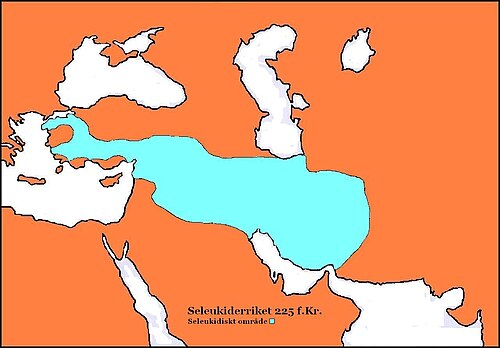
Antiochus III inherited a disorganized state. Not only had Asia Minor become detached, but the easternmost provinces had broken away, Bactria under the Seleucid Diodotus of Bactria, and Parthia under the rebel satrap Andragoras in 247–245 BC, who was himself later vanquished by the nomad chieftain Arsaces. In 222 BC, soon after Antiochus's accession, Media and Persis revolted under their governors, the brothers Molon and Alexander. The young king, under the influence of the minister Hermeias, headed an attack on Ptolemaic Syria instead of going in person to face the rebels. The attack against the Ptolemaic empire proved a fiasco, and the generals sent against Molon and Alexander met with disaster. Only in Asia Minor, where the king's cousin, Achaeus, represented the Seleucid cause, did its prestige recover, driving the Pergamene power back to its earlier limits.[14]
紀元前221年、アンティオコスはついに東方へと進軍し、モロンとアレクサンドロスの反乱は崩壊した。ポリュビオスは、この崩壊の一因として、アンティオコスがヘルメイアスの助言ではなくゼウクシスの助言に従ったことを挙げている。 [ 15 ]アルタバザネスの下で独立を主張していた小メディアもこれに続いた。アンティオコスは医師や同盟者と共謀してヘルメイアスを暗殺し、[ 16 ]その後シリアに戻った(紀元前220年)。一方、アカイオス自身も反乱を起こし、小アジアで王の称号を名乗った。しかし、王に対する反乱に対する不満から兵士たちの反乱が起こりつつあったため、アカイオスはクーデターの試みを断念し、撤退した。[ 17 ]アンティオコスはアカイオスにさらなる脅迫を送りつつ、当面は彼を見捨て、プトレマイオス朝シリアへの攻撃を再開した。[ 18 ] [ 14 ]
紀元前219年と218年の戦役でセレウコス朝軍はプトレマイオス朝の領土のほぼ境界まで迫ったが、紀元前217年にプトレマイオス4世はラフィアの戦いでアンティオコスを破った。この敗北によりアンティオコスのこれまでの成功はすべて無効となり、彼はレバノンの北へ撤退せざるを得なくなった。紀元前216年、彼の軍はアンティオコスの従兄弟アカイオスが率いる地元の反乱を鎮圧するためにアナトリア西部へ進軍し、紀元前214年までに彼を戦場からサルディスへと追いやった。アンティオコスはアカイオスを捕らえ、処刑した。城塞はアカイオスの未亡人ラオディケの指揮下で紀元前213年まで持ちこたえたが、後に彼女は降伏した。[ 14 ]
Having thus recovered the central part of Asia Minor (for the Seleucid government had perforce to tolerate the dynasties in Pergamon, Bithynia and Cappadocia), Antiochus turned to recovering the outlying provinces of the north and east. He besieged Xerxes of Sophene in 212 BC, who had refused to pay tribute.[19] During the siege of Arsamosata, some of Antiochus's advisors proposed deposing Xerxes and installing Mithridates, a nephew of Antiochus, in his place.[20][21] Antiochus declined this counsel. He summoned Xerxes, waived the bulk of the tribute arrears his father, Arsames I, had accumulated, and accepted a reduced immediate settlement in silver, horses, and mules. He allowed Xerxes to continue ruling Sophene and gave him his sister Antiochis in marriage. In 209 BC Antiochus invaded Parthia, occupied the capital Hecatompylos and pushed forward into Hyrcania, winning the Battle of Mount Labus. The Parthian king Arsaces II apparently successfully sued for peace.[14]

The year 209 BC saw Antiochus in Bactria, where the Greco-Bactrian king Euthydemus I had supplanted the original rebel. Antiochus again met with success.[22] Euthydemus was defeated by Antiochus at the Battle of the Arius, but after resisting the Seleucid king in the Siege of Bactra, he obtained an honourable peace by which Antiochus promised Euthydemus's son Demetrius the hand of Laodice, his daughter, and allowed Euthydemus himself to keep his royal title.[14][23]
Antiochus next, following in the steps of Alexander, crossed into the Kabul valley, reaching the realm of Indian king Sophagasenus and returned west by way of Seistan and Kerman (206/5).[14] According to Polybius:
He crossed the Caucasus and descended into India, renewed his friendship with Sophagasenus, king of the Indians, and received more elephants, raising their number to a total of one hundred and fifty, and provisioned his army once more on the spot. He himself broke camp with his troops, leaving behind Androsthenes of Cyzicus to bring back the treasure which this king (Sophagasenus) had agreed to give him.[24][23]

From Seleucia on the Tigris he led a short expedition down the Persian Gulf against the Gerrhaeans of the Arabian coast (205 BC/204 BC). Antiochus seemed to have restored the Seleucid empire in the east, which earned him the title of "the Great" (Antiochos Megas).[25] In 205/204 BC the infant Ptolemy V Epiphanes succeeded to the Egyptian throne, and Antiochus is said (notably by Polybius) to have concluded a secret pact with Philip V of Macedon for the partition of the Ptolemaic possessions.[14] Under the terms of this pact, Macedon was to receive the Ptolemaic possessions around the Aegean Sea and Cyrene, while Antiochus would annex Cyprus and Egypt.
Once more Antiochus attacked the Ptolemaic province of Coele Syria and Phoenicia, and by 199 BC he seems to have had possession of it before the Aetolian leader Scopas recovered it for Ptolemy. But that recovery proved brief, for in 198 BC Antiochus defeated Scopas at the Battle of Panium, near the sources of the Jordan, a battle which marks the end of Ptolemaic rule in Judea.[14]
Antiochus then moved to Asia Minor, by land and by sea, to secure the coast towns which belonged to the remnants of Ptolemaic overseas dominions and the independent Greek cities. This enterprise earned him the antagonism of the Roman Republic, since Smyrna and Lampsacus appealed to the Republic, which at the time acted as a defender of Greek freedom. The tension grew when Antiochus in 196 BC established a footing in Thrace. The evacuation of Greece by the Romans gave Antiochus his opportunity, and he now had the fugitive Hannibal at his court to urge him on.[14][26]
In 192 BC Antiochus invaded Greece with a 10,000-man army, and was elected the commander in chief of the Aetolian League.[27] In 191 BC, however, the Romans under Manius Acilius Glabrio routed him at Thermopylae, forcing him to withdraw to Asia Minor. The Romans followed up their success by invading Anatolia, and the decisive victory of Scipio Asiaticus at Magnesia ad Sipylum (190 BC), following the defeat of Hannibal at sea off Side, delivered Asia Minor into their hands.[14]
By the Treaty of Apamea (188 BC) Antiochus abandoned all the country north and west of the Taurus Mountains, most of which the Roman Republic gave either to Rhodes or to the Attalid ruler Eumenes II, its allies (many Greek cities were left free). As a consequence of this blow to the Seleucid power, the outlying provinces of the empire, recovered by Antiochus, reasserted their independence.[14] Antiochus mounted a fresh eastern expedition in Luristan, where he was killed while pillaging a temple of Bel at Elymaïs, Persia, in 187 BC.[7]

In 222 BC, Antiochus III married Princess Laodice of Pontus, a daughter of King Mithridates II of Pontus and Princess Laodice of the Seleucid Empire. The couple were first cousins through their mutual grandfather, Antiochus II Theos. Antiochus and Laodice had eight children (three sons and five daughters):[28]
In 191 BC, Antiochus III married a girl from Chalcis, whom he named "Euboea". They had no children. Laodice III may have fallen in disgrace; however, she clearly survived Antiochus III, and appears in Susa in 183 BC.[29]
Antiochus III resettled 2000 Jewish families from Babylonia into the Hellenistic Anatolian regions of Lydia and Phrygia.[30]Josephus portrays him as friendly towards the Jews of Jerusalem and cognizant of their loyalty to him (see Antiquities of the Jews, Book XII, Chapter 3),[31] in stark contrast to the attitude of his son. In fact, Antiochus III lowered taxes, granted subventions to the Temple, and let the Jews live, as Josephus puts it, "according to the law of their forefathers."[32]
Antiochus III is mentioned in the deuterocanonicalBooks of the Maccabees. The subject of Maccabees is the Maccabean Revolt against Antiochus's son, Antiochus IV Epiphanes. Antiochus III is first mentioned in 1 Maccabees 1:10, when Antiochus IV is introduced as "son of King Antiochus [Antiochus III]". Antiochus III is mentioned later in 1 Maccabees 8, which describes Judas Maccabeus's knowledge of the deeds of the Roman Republic, including an allusion to the defeat of Antiochus III by the Romans. The NRSV says "They [the Romans] also had defeated Antiochus the Great, king of Asia, who went to fight against them with one hundred twenty elephants and with cavalry and chariots and a very large army. He was crushed by them; they took him alive and decreed that he and those who would reign after him should pay a heavy tribute and give hostages and surrender some of their best provinces, the countries of India, Media, and Lydia. These they took from him and gave to King Eumenes." (1 Maccabees 8:6–8)
違いは、ギリシャ帝国のギリシャ王アンティオコス3世の視点からか、それとも後にギリシャの都市国家と意思疎通を図る国家元首の視点からか、という点にある。
アンティオコス3世はヒンドゥークシュ山脈を越え、カブール渓谷を支配していたスバガセナ(古典作家によるソファガセナス)という名のインドの王子を攻撃した。アンティオコス3世はスバガセナを破り、多額の賠償金と多くの象を強奪してから自国に戻った。この侵略は永続的な影響をもたらさなかった。
王朝は「セレウコス朝」と呼ばれていた)は、小アジアで精力的に勢力を拡大しており、紀元前196年にはヨーロッパにまで進出し、トラキアの一部を併合した。
紀元前192年の秋、
彼らはアンティオコス3世が軍隊を率いてギリシャに渡り、ローマの支配に対するギリシャの自由の擁護者だと宣言したという知らせを聞いた。
アンティオコス3世大王(紀元前242年頃~187年)セレウコス朝の王アンティオコス3世大王は、6代目の王(紀元前223年~187年)でした。
アンティオコスは、ローマ人に対するギリシャの自由の擁護者としてギリシャ本土に上陸しました(紀元前192年)。
3世(紀元前222年~187年)ヘレニズム時代のセレウコス朝の一員
ギリシャ系セレウコス朝のアンティオコス3世が大シリアを征服。紀元前172年または171~163年
マケドニアの二大将軍王朝、エジプトのプトレマイオス朝とシリアのセレウコス朝の間の戦争は、イスラエルの地の歴史を決定的に変えた。
その結果、イスラエルの地はシリアのギリシャ人セレウコス朝の帝国の一部となった。
官僚と兵士によって統治されていた。両政府はマケドニアとギリシャの都市国家からの移民を誘致するために多大な努力を払い、それによって人口にさらに別の人種的要素が加わった。
アンティオコス3世は紀元前242年、ペルシャのスーサ近郊でセレウコス2世の息子として生まれた。
The Aetolians called on Antiochus the 'liberate' Greece and to act as arbitrator between them and the Romans. Thereupon the king landed in Demetrias in the late autumn of 192 with a small army, and the Aetolian assembly elected him supreme strategos. His attempt to gather together al those who were dissatisfied with the peace agreement of 196 under the banner of Greek freedom had some success but proved a failure overall.
Jewish settlements in the interior of Asia Minor were known as early as the 3rd century BC when Antiochus III resettled 2000 Jewish families from Babylonia into Lydia and Phrygia