
Loading article…
聖ペトロと聖パウロの祝日、または聖ペトロと聖パウロの祭日は、ローマで殉教した使徒聖ペトロと聖パウロを記念するもので、典礼上は6月29日に祝われます。この祝祭は古代キリスト教に起源を持ち、選ばれた日付は彼らの死または聖遺物の移送のいずれかの記念日です。[ 1 ]
東方正教会と一部の東方カトリック教徒にとって、この祝祭は使徒断食(諸聖人の日曜日の翌月曜日、つまり聖霊降臨祭の翌々月曜日に始まった)の終わりを告げるものでもある。[ 2 ] 12の偉大な祝祭には含まれないが、東方正教会の伝統では偉大な祝祭として位置づけられている5つの追加の祝祭の1つであり、前日の夜から始まる徹夜の徹夜祈祷で祝われることが多い。 [ 3 ]ユリウス暦では、 1900年から2099年まで、 6月29日はグレゴリオ暦の7月12日に当たる 。
ロシア正教の伝承では、ウンジャのマカリウスのヘラジカの奇跡は、使徒の断食とそれに続く聖ペテロと聖パウロの祝祭の間に起こったとされている。[ 4 ]
コプト正教会とエチオピア正教会では、聖ペテロと聖パウロの祝日は、これらの伝統では使徒の断食の終わりでもあるエピップの5日目にも祝われます。 [ 5 ]
カナダのドゥホボル派は、霊的なキリスト教の一派であり、聖人を崇拝するわけではないが、聖ペテロと聖パウロの祝日は、伝統的に彼らにとって祝祭の日となっている。1895年以降、この祝日は、政府主導の殺戮への参加を拒否する象徴として、ドゥホボル派が武器を破壊した「武器焼却」を記念する日として、新たな意味を持つようになった。[ 6 ]現在、彼らの子孫は単に「ペテロの日」(ロシア語: Petro den .)として祝っており、時には「ドゥホボル平和の日」とも呼ばれる。[ 7 ] [ 6 ]
一般ローマ暦では、この祝祭は厳粛な祝日である。この祝祭は、354年のローマ暦で初めて言及されている。それ以前の版では、二重祝祭(トリエント暦)、一級二重祝祭(例:1954年の一般ローマ暦)、または一級祝祭(1960年の一般ローマ暦)として位置づけられていた。ピウス12世教皇の典礼改革以前は、この祝祭の後に共通の八日間が続いた。この祝祭では、新しく任命された首都大司教が教皇から職務の主要な象徴であるパリアムを受け取る。[ 8 ]
ラテン教会では義務の祝日ですが、司教会議によっては義務を免除することができます。[ 9 ] 2004年の免償手引書で は、この祝日に使徒を称える祈りを敬虔に唱える信者には部分免償を、司教によって祝福された聖具を敬虔に用いる信者には、その使用中に有効な信仰告白をすれば全免償を授けています。[ 10 ] [ 11 ]
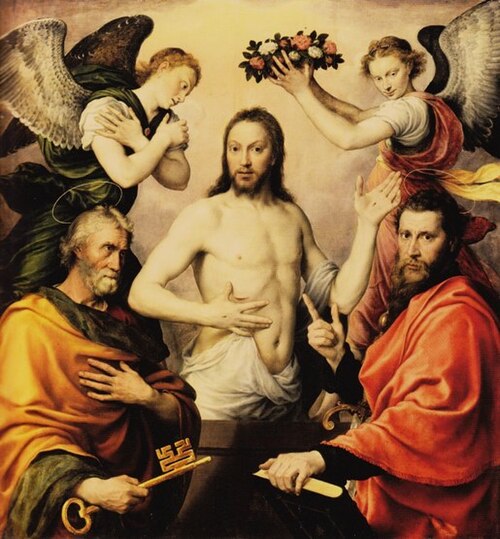
イングランド、スコットランド、ウェールズでは、世界のほとんどの地域と同様に、ラテン教会は引き続きこの祝日を義務祝日として守っています。しかし、アメリカ合衆国とカナダでは、1840年以降、義務祝日として守られていません。[ 12 ]
The Church of England celebrates 29 June as a festival.[13] The Lutheran churches celebrate it in the rank of a lesser festival.[14]
Because of the importance of Sts. Peter and Paul to the Catholic Church, many Catholic-majority countries observe their feast day as a public holiday. The feast is observed in Rome because St. Paul and St. Peter are patron saints of the Eternal City.[15] In the Apulia region of southeastern Italy, the feast has been associated with the Tarantella dance since the Middle Ages.[16]
In Malta, the solemnity is a public holiday and in Maltese is known as L-Imnarja. It is celebrated with festivals the preceding weekend in Nadur Gozo and as well as Buskett Gardens in Rabat.[17]
It is also a public holiday of the Canton of Ticino, Switzerland, as well as parts of the Swiss cantons of Lucerne and Graubünden.[18] It is a public holiday in Peru[19] and in various municipalities of the Philippines. In Ormoc, festivals, bazaars, parades, and pageants are held annually on the feast day, as Peter and Paul are the city's patron saints.[20]
In 1577, Jan Rubens named his son Peter Paul, because he was born during the office of vespers of this day.[21]
 Prat, Ferdinand (1911). "St. Paul". In Herbermann, Charles (ed.). Catholic Encyclopedia. Vol. 11. New York: Robert Appleton Company.
{{cite web}}: CS1 maint: multiple names: authors list (link)