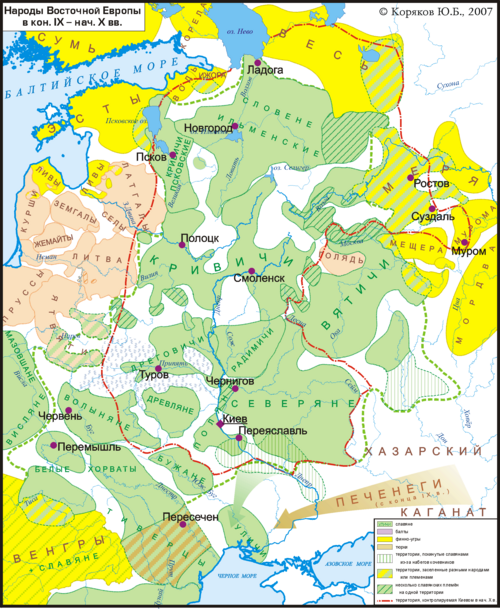
トロチコは、「王族の旅の物語は、年代記の物語の中で独自の機能を持つ仕掛けである。…しかし、もしそれが実際に何であるかをそのまま受け入れ、それが10世紀の文書的な民族誌的記述ではなく、12世紀初頭のキリスト教聖職者によって巧みに構築された中世のオリゴ・ゲンティス[ a ]であると認めるならば、原初年代記に大きく負っている東ヨーロッパ史の初期段階に関する確立された学術的物語を再考しなければならない」と主張する。[ 55 ]
1 2 P. B. Golden、「Rūs」、 Encyclopaedia of Islam、第2版、編集:P. Bearman、Th. Bianquis、CE Bosworth、E. van Donzel、WP Heinrichs。2018年7月26日取得。doi:10.1163 /1573-3912_islam_COM_0942。
↑ Roman Zakharii, " The Historyography of Normanist and Anti-Normanist theorys on the origin of Rus': A review of modern historyography and major sources on Varangian contraversy and other Scandinavian concepts of the origin of Rus' (未発表修士論文、オスロ大学、2002年)。
1 2 3ドミトリー・ニコラエヴィッチ・ヴェルホトゥロフ、「ノルマニズム: 名前には何が入っているのか?」、ヴァラ、1.5 (2015)、57-65、Клейн Л.С を引用。 Норманизм – антинорманизм: конец дискуссии. // ストラタムプラス。 1999。№5、Неславянское в славянском мире。 С. 91-101。
↑ Hedenstierna-Jonson, C.; Losquiño, IG (2023). Viking Camps: Case Studies and Comparisons . Routledge Archaeologies of the Viking World. Taylor & Francis. p. 1991. ISBN978-1-000-90576-22023年11月28日に取得。
↑ Christian Promitzer、「ブルガリアにおける身体人類学と民族形成、1878~1944年」、 Focaal—Journal of Global and Historical Anthropology、58(2010)、47~62、 doi :10.3167/fcl.2010.580104(49~50ページ)。
↑リチャード・マクマホン著「人類学的人種心理学 1820–1945: 共通のヨーロッパ民族アイデンティティ物語体系」、 Nations and Nationalism、15 (2009)、575–596 (p. 579) を参照。
↑参照:Matthew H. Hammond、「中世スコットランド史の記述と民族性」、Wayback Machineに 2023 年 3 月 25 日にアーカイブ済み、 The Scottish Historical Review、第 85 巻 (第 219 号) (2006 年 4 月)、1–27、 doi : 10.1353/shr.2006.0014。
↑Janet Martin, "The First East Slavic State", in A Companion to Russian History, ed. by Abbott Gleason (Oxford: Blackwell, 2009), pp. 34–50 (pp. 37–42).
↑Jonathan Shepherd, "Review Article: Back in Old Rus and the USSR: Archaeology, History and Politics", English Historical Review, vol. 131 (no. 549) (2016), 384–405 doi:10.1093/ehr/cew104 (pp. 386–87).
↑Jonathan Shepherd, "Review Article: Back in Old Rus and the USSR: Archaeology, History and Politics", English Historical Review, vol. 131 (no. 549) (2016), 384–405 doi:10.1093/ehr/cew104 (pp. 386–87).
↑Jonathan Shepherd, "Review Article: Back in Old Rus and the USSR: Archaeology, History and Politics", English Historical Review, vol. 131 (no. 549) (2016), 384–405 doi:10.1093/ehr/cew104 (p. 387).
↑Wladyslaw Duczko, Viking Rus: Studies on the Presence of Scandinavians in Eastern Europe (Leiden: Brill, 2004), esp. pp. 3–9.
↑Abbott Gleason, "Russian Historiography after the Fall", in A Companion to Russian History, ed. by Abbott Gleason (Oxford: Blackwell, 2009), pp. 1–14 (p. 5).
↑Elena Melnikova, "The 'Varangian Problem': Science in the Grip of Ideology and Politics", in Russia's Identity in International Relations: Images, Perceptions, Misperceptions, ed. by Ray Taras (Abingdon: Routledge, 2013), pp. 42–52 (p. 42).
↑Jonathan Shepherd, "Review Article: Back in Old Rus and the USSR: Archaeology, History and Politics", English Historical Review, vol. 131 (no. 549) (2016), 384–405 doi:10.1093/ehr/cew104 (p. 387), citing Leo S. Klejn, Soviet Archaeology: Trends, Schools, and History, trans. by Rosh Ireland and Kevin Windle (Oxford: Oxford University Press, 2012), p. 119.
↑Christian Raffensperger, "The Place of Rus' in Medieval Europe"Archived 10 August 2023 at the Wayback Machine, History Compass, 12/11 (2014), 853–865 doi:10.1111/hic3.12201 (esp. pp. 853–854, 858).
↑Elena Melnikova, "The 'Varangian Problem': Science in the Grip of Ideology and Politics", in Russia's Identity in International Relations: Images, Perceptions, Misperceptions, ed. by Ray Taras (Abingdon: Routledge, 2013), pp. 42–52, citing I. A. Nastenko (ed.), Sbornik Russkogo istoricheskogo obshchestva: "Antinormanism", vol 8. (no. 156) (Moscow: Russkaja Panorama, 2003) and V. V. Fomin, Varjagi i varjazhskaja Rus': Kitogam diskussii po varjazhskomu voprosu (Moscow: Russkaja Panorama, 2005).
↑ Artem Istranin および Alexander Drono、「ロシアの教科書における競合する歴史物語」、Wayback Machineに 2023 年 8 月 10 日にアーカイブ済み、 János M. Bak および Robert Maier 編『相互のイメージ: 東ヨーロッパの歴史的隣人の教科書表現』、Eckert. Dossiers、10 ([Braunschweig]: Georg Eckert Institute for International Textbook Research、2017)、31–43 (pp. 35–36)。
↑ James E. Montgomery、「Ibn Faḍlān と Rūsiyyah」、Wayback Machineに 2018 年 7 月 16 日にアーカイブ済み、 Journal of Arabic and Islamic Studies、3 (2000)、1–25。
↑アンドリー・ダニレンコ、「新しい次元を求めて「ロシア」という名前」、 Jahrbücher für Geschichte Osteuropas、新シリーズ、52 (2004)、1–32。
↑マリカ・マギ、「In Austrvegr : The Role of the Eastern Baltic in Viking Age Communication Across the Baltic Sea」、 The Northern World、84 (ライデン: Brill、2018)、pp. 141–216。
Lunt, Horace G. (1975). "On the Language of Old Rus: Some Questions and Suggestions". Russian Linguistics. 2 (3/4): 269–281. doi:10.1007/BF00221437. ISSN0304-3487. JSTOR40159848. S2CID153939821.
Franklin, Simon (1996). The emergence of Rus, 750-1200. London: Longman. ISBN9780582490918.
Pritsak, Omeljan (1981). The origin of Rus'. Cambridge, Mass.: Harvard University Press. ISBN9780674644656.
Tolochko, Olksiy P. (2008). "The Primary Chronicle's 'Ethnography' Revisited: Slavs and Varangians in the Middle Dnieper Region and the Origin of the Rus' State". In Garipzanov, Ildar H.; Geary, Patrick J.; Urbańczyk, Przemysław (eds.). Franks, Northmen, and Slavs: Identities and State Formation in Early Medieval Europe. Brepols. pp.169–188. ISBN978-2-503-52615-7. Archived from the original on 10 August 2023. Retrieved 17 May 2022.
Brink, Stefan; Price, Price (2008). The Viking World. Routledge. ISBN978-1134318261. Archived from the original on 14 April 2023. Retrieved 2 August 2014.
Duczko, Wladyslaw[in Polish] (2004). Viking Rus: Studies on the Presence of Scandinavians in Eastern Europe. Brill. ISBN9004138749. Archived from the original on 14 April 2023. Retrieved 5 May 2013.
Waldman, Carl; Mason, Catherine (2005). Encyclopedia of European Peoples. Infobase Publishing. ISBN1438129181. Archived from the original on 11 March 2023. Retrieved 27 January 2021.
External links
James E. Montgomery, "Ibn Faḍlān and the Rūsiyyah", Journal of Arabic and Islamic Studies, 3 (2000), 1-25. Archive.org. Includes a translation of Ibn Fadlān's discussion of the Rūs/Rūsiyyah.