Loading article…
Arm Holdings plc is a British semiconductor and software design company headquartered in Cambridge, England, whose primary business is the design of central processing unit (CPU) cores that implement the ARM architecture family of instruction sets. It also designs other chips, provides software development tools under the DS-5, RealView and Keil brands, and provides systems and platforms, system-on-chip (SoC) infrastructure and software. As a holding company, it also holds shares of other companies. Since 2016, it has been majority owned by Japanese conglomerate SoftBank Group.
"ARM" was originally an acronym for Acorn RISC Machine and later for Advanced RISC Machines. While ARM CPUs first appeared in the Acorn Archimedes, a desktop computer, today's systems include mostly embedded systems, including ARM CPUs used in virtually all modern smartphones. Processors based on designs licensed from Arm, or designed by licensees of one of the ARM instruction set architectures, are used in all classes of computing devices. Arm has two lines of graphics processing units (GPUs), Mali, and the newer Immortalis (which includes hardware-based ray-tracing).[6]
Arm's main CPU competitors in servers include IBM, Intel and AMD.[7] Intel competed with ARM-based chips in mobile devices but Arm no longer has any competition in that space (although vendors of actual ARM-based chips compete within that arena). Arm's main GPU competitors include mobile GPUs from technology companies Imagination Technologies (PowerVR), Qualcomm (Adreno), and increasingly Nvidia, AMD, Samsung and Intel. While competing in GPUs, Qualcomm, Samsung and Nvidia all have combined their GPUs with Arm-licensed CPUs.
Arm had a primary listing on the London Stock Exchange (LSE) and was a constituent of the FTSE 100 Index. It also had a secondary listing of American depositary receipts on New York's Nasdaq. However, Japanese multinational conglomerateSoftBank Group made an agreed offer for Arm on 18 July 2016, subject to approval by Arm's shareholders, valuing the company at £24.3 billion.[8][9] The transaction was completed on 5 September 2016.[10][11] A planned takeover deal by Nvidia, announced in 2020, collapsed in February 2022,[12] with SoftBank subsequently deciding to pursue an initial public offering on the Nasdaq in 2023, valuing Arm at US$54.5 billion.[13]
The acronym ARM was first used in 1983 and originally stood for "Acorn RISC Machine". Acorn Computers' first RISC processor was used in the original Acorn Archimedes and was one of the first RISC processors used in small computers. However, when the company was incorporated in 1990, what 'ARM' stood for changed to "Advanced RISC Machines". According to Steve Furber the name was changed at the behest of Apple, which did not wish to have the name of a competitor in the name of the company. At the time of the IPO in 1998, the company name was changed to "ARM Holdings",[14] often just called ARM like the processors.[15]
On 1 August 2017, the styling and logo were changed. The logo is now all lowercase ('arm') and other uses of the name are in sentence case ('Arm').[15][16]
同社は1990年11月12日にWidelogic Limitedとして設立されたが、1990年12月3日にAdvanced RISC Machines Limitedに急速に変更され、 Acorn Computers、Apple、VLSI Technologyの合弁事業として組織された。Acornは12人の従業員を提供し、VLSIはツールを提供し、Appleは300万米ドル( 2025年換算で700万ドルに相当)を投資した。[ 17 ] [ 18 ] Appleの副社長であるラリー・テスラーは重要な人物であり、合弁事業の初代CEOであるロビン・サクスビーの採用を支援した。[ 19 ] [ 20 ]新会社は、元々Acorn Archimedesで使用され、AppleがNewtonプロジェクトに採用したAcorn RISC Machineプロセッサの開発をさらに進めることを目的としていた。 1993 年が初の黒字年でした。1994 年にシリコンバレーと東京にオフィスが開設されました。ARM は 1997 年に Palmchip Corporation に投資し、システム オン チップ プラットフォームを提供し、ディスク ドライブ 市場に参入しました。[ 21 ] [ 22 ] 1998 年に、同社は社名をAdvanced RISC Machines LtdからARM Ltdに変更しました。[ 23 ]同社は1998 年に初めてロンドン証券取引所 (LSE) とNasdaqに上場し[ 24 ]、1999 年 2 月までに Apple の株式保有率は 14.8% に低下しました。[ 25 ]
2010年、ARMはIBM、テキサス・インスツルメンツ、サムスン、ST-エリクソン(現在は解散) 、フリースケール・セミコンダクター(現在はNXPセミコンダクター)と共同で、非営利のオープンソースエンジニアリング企業であるLinaroを設立した。[ 26 ]
In May 2026, Bloomberg News reported that Arm Holdings and its majority owner, SoftBank Group, had made a preliminary approach to acquire the wafer-scale integrated circuit maker Cerebras Systems, in the weeks before Cerebras's planned initial public offering. According to the report, the approach was rebuffed.[60]
Japanese conglomerate SoftBank Group made an agreed offer for ARM on 18 July 2016, subject to approval by ARM's shareholders, valuing the company at £23.4 billion (US$32 billion).[8][61] The transaction was completed on 5 September 2016.[10][62]
In 2017, a 25% stake of Arm was transferred to the SoftBank Vision Fund, which received investment from the Saudi sovereign fund.[63]
American technology company Nvidia announced plans on 13 September 2020 to acquire ARM from SoftBank, pending regulatory approval, for a value of US$40 billion in stock and cash, which would have been the largest semiconductor acquisition to that date. SoftBank Group would acquire slightly less than a 10% stake in Nvidia, and ARM would maintain its headquarters in Cambridge.[64][65][66][67] There was opposition to the deal, including national security concerns from the UK and competition concerns from fellow tech companies such as Google, Microsoft and Qualcomm, whose chips in use or on sale heavily rely on Arm's intellectual property.[68][69][70][71][72] It was also being battled by Arm China, its subsidiary,[73] a majority stake of which was held by Chinese investors.[74][75] The acquisition was initially scheduled to conclude before the end of 2022 per the contract.[76] However, the European Commission, the UK Competition and Markets Authority and the US Federal Trade Commission raised completion concerns focusing on Arm's role within Nvidia, while the UK government also raised concerns about national security. The merger attempt was eventually cancelled in February 2022[77] due to the aforementioned regulatory pressure and hurdles.[78][79]
Armは2023年8月21日にLSEではなくNasdaqでIPOを申請した。[ 80 ] [ 81 ]数日前にソフトバンクグループはビジョンファンドから25%の株式を約160億ドルで買い戻し 、Armの評価額は640 億ドルを超えた。[ 82 ] Armは2023年9月14日に上場し、 545億ドルの評価額で48億7000万ドルを調達した 。上場後もソフトバンクは同社の約90%を所有し続けている。[ 83 ] [ 84 ] [ 85 ]
ソフトバンクグループは2018年にArm Chinaの株式の半分以上を中国投資公司やシルクロード基金など様々な関係者からなる現地コンソーシアムに売却し、事実上、中国子会社の過半数所有権を中国政府と関係のある投資家グループに譲渡した。2020年以降、英国の親会社が子会社の最高経営責任者を解任しようとして失敗し、CEOが地位を維持したことで、ArmとArm Chinaの実質的な所有者との間の不和が明らかになった。[ 86 ] [ 87 ]この件は、ソフトバンクとNvidiaの取引に対する中国当局の承認待ち、およびArmの株式公開に悪影響を及ぼすという見方が広まった。 [ 88 ] [ 89 ]
2021年9月、Armは否定したが、英国の親会社が解任しようとしたArm Chinaの最高経営責任者が、Arm Chinaの「独立」を公に宣言したとの報道があった。[ 73 ] [ 90 ] 2022年2月、Arm ChinaのCEOであるアレン・ウーは、2025年に中国子会社の株式公開を行うというアイデアを提起した。[ 91 ]
2022年4月29日、法的に認められた書類によると、Arm ChinaのCEOと法定代理人がついに交代したと報じられた。しかし、アレン・ウーはこの件について異議を唱え続けた。[ 92 ]その後、2023年に主要スタッフが退社し、Arm Chinaと競合するチップ設計スタートアップ企業であるBorui Jingxinを設立した。特にエンジニアの獲得をめぐって競合している。[ 93 ] [ 94 ]
Unlike most traditional microprocessor suppliers, such as Intel, Freescale (the former semiconductor division of Motorola, now NXP Semiconductors) and Renesas (a former joint venture between Hitachi and Mitsubishi Electric), ARM only creates and licenses its technology as intellectual property (IP),[95] rather than manufacturing and selling its own physical CPUs, GPUs, SoCs or microcontrollers. This model is similar to those of fellow British design houses ARC International and Imagination Technologies, which have similarly been designing and licensing GPUs, CPUs, and SoCs, along with supplying tooling and various design and support services to its licensees.[96]
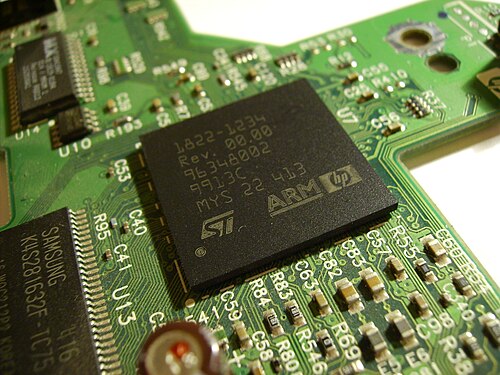
A characteristic feature of Arm processors is their low electric power consumption, which makes them particularly suitable for use in portable devices.[97]
Arm processors are used as the main CPU for most mobile phones[98] many PDAs and handhelds, like the Apple iPod and iPad,[99][100] and computer games and as well as many other applications, including GPS navigation devices, digital cameras and televisions.[101]
The world's second fastest supercomputer (previously fastest) in 2022,[102] the Japanese Fugaku is based on Arm AArch64 architecture.[103]
The supercomputer maker Cray has added an "ARM Option" (i.e. CPU blade option, using Cavium ThunderX2) to its XC50 supercomputers, and Cray claims that ARM is "a third processor architecture for building next-generation supercomputers", for clients such as the United States Department of Energy.[104]
Fujitsu (the supercomputer maker of June 2011 world's fastest K computer according to TOP500) announced at the International Supercomputing Conference in June 2016 that its future exascale supercomputer will feature processors of its own design that implement the ARMv8 architecture, rather than the SPARC processors used in earlier supercomputers. These processors will also implement extensions to the ARMv8 architecture equivalent to HPC-ACE2 that Fujitsu is developing with ARM Holdings.[105]
The Cray XC50-series supercomputer for the University of Bristol is called Isambard, named after Isambard Kingdom Brunel. The supercomputer is expected to feature around 160 nodes, each with two 32-core ThunderX2 processors running at 2.1 GHz. Peak theoretical performance of the 10,240 cores and 40,960 threads is 172 teraFLOPS.[106]
The Vanguard project by Sandia National Laboratories is to deliver an exascale ARM machine. The first generation called Hammer was based on X-Gene by Applied Micro. The second generation called Sullivan was based Cavium's ThunderXs processors. The third generation called Mayer was based on pre-production ThunderX2. The fourth generation also based on ThunderX2 is called Astra and was slated to become operational by November 2018.[107]
ARM968E-S was used to build the neuromorphic supercomputer, SpiNNaker (Spiking Neural Network Architecture).[108]
Arm has four lines of central processing units (CPUs)/processors:[109]
It also has two lines of graphics processing units (GPUs): Mali, and the newer Immortalis (with hardware-based ray-tracing). In addition, it offers Ethos neural processing units (NPUs), Corelink/CoreSight System/SoC IP, and TrustZone/CryptoCell/SecurCore Security IP.[109]
Arm offers several microprocessor core designs that have been "publicly licensed" for its newer "application processors" (non-microcontroller) used in such applications as smartphones and tablets.[110]
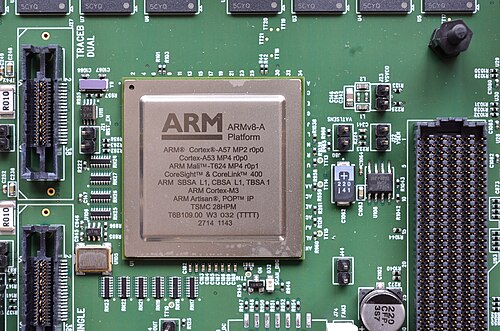
ARMv8.2-Aのコアには、 Cortex-A77、Cortex-A65AE、Cortex-A76、Cortex-A75、Cortex-A55が含まれます。ARMv8 -Aのコアには、Cortex-A73、Cortex-A72、Cortex-A32、Cortex-A35、Cortex-A57、Cortex-A53が含まれます。ARM のクライアント ロードマップには、2020 年に Hercules、2021 年に Matterhorn が含まれています。[ 111 ] [ 112 ]
32 ビット アーキテクチャ用のコアには、Cortex-A32、Cortex-A15、Cortex-A12、Cortex-A17、Cortex-A9、Cortex-A8、Cortex-A7、Cortex-A5、および古い「クラシック ARM プロセッサ」、さらにこれらのコアを含むマイクロコントローラのバリアント アーキテクチャ (ライセンス用) としてCortex-R7、Cortex R5、Cortex-R4、Cortex-M35P、Cortex-M33、Cortex-M23 、Cortex -M7、Cortex -M4 、 Cortex-M3、 Cortex-M1、Cortex-M0+、Cortex-M0があります。[ 113 ]
企業は、Armからこれらの設計のライセンスを取得して、GPU(場合によってはArmのMali)やモデム/無線ベースバンド(携帯電話用)などの他のコンポーネントとともに、自社のシステムオンチップ(SoC)に製造および統合することがよくあります。Armは、コア向けに複数のライセンスプログラムを提供しています。[ 114 ]また、ArmはArtisan POP IPも提供しており、Armはファウンドリと提携して物理的な実装を提供することで、市場投入までの時間を短縮できます。[ 115 ]
2016年2月、Armは、Built on Arm Cortex Technologyライセンス(略してBuilt on Cortex(BoC)ライセンス)を発表しました。このライセンスにより、企業はArmと提携してArm Cortex設計に変更を加えることができます。これらの設計変更は他の企業と共有されません。これらのセミカスタムコア設計には、Kryo 280などのブランドの自由もあります。[ 116 ]
In addition to licences for its core designs and BoC licence, Arm offers an "architectural licence" for its instruction set architectures, allowing the licensees to design their own cores that implement one of those instruction sets. An Arm architectural licence is more costly than a regular Arm core licence.[117]
The Financial Times reported in March 2023 that Arm had planned to charge the licensees royalties based on the value of the device, instead of the prior model based on the chip's value.[118]
Processors based on designs licensed from Arm, or designed by licensees of one of the ARM instruction set architectures, are used in all classes of computing devices (including in space[119][120]). Processors designed by Arm or by Arm licensees are used as microcontrollers in embedded systems, including real-time safety systems (cars' ABS),[121]biometrics systems (fingerprint sensor[122]), smart TVs (e.g. Android TV), all modern smartwatches (such as Qualcomm Toq), and are used as general-purpose processors in smartphones, tablets, laptops, desktops (even for running traditional x86Microsoft Windows programs[123][124]),[125]servers[126] and supercomputers/HPC,[127][128][129][104]
Systems, including iPhone smartphones, frequently include many chips, from many different providers, that include one or more licensed Arm cores, in addition to those in the main Arm-based processor.[130] Arm's core designs are also used in chips that support many common network-related technologies in smartphones: Bluetooth, WiFi and broadband,[131] in addition to corresponding equipment such as Bluetooth headsets,[132]802.11acrouters,[133] and network providers' cellular LTE.[134]
In 2011, Arm renewed a five-year, US$5 million research partnership with University of Michigan, which extended their existing research partnership to 2015. This partnership would focus on ultra-low energy and sustainable computing.[135][136]
In October 2017, Arduino announced its partnership with ARM. The announcement said, in part, "ARM recognized independence as a core value of Arduino ... without any lock-in with the ARM architecture." Arduino intends to continue to work with all technology vendors and architectures.[137]
In October 2018, ARM Holdings partnered with Intel in order to share code for embedded systems through the Yocto Project.[138] On 12 April 2023, ARM Holdings partnered with Intel Foundry Services to bring Arm SoCs to Intel's 18A process.[139]
2018 年 10 月 20 日、Arm はIoT向けオープンソースオペレーティングシステムであるArm Mbed OSを発表しました。[ 140 ] 2019 年 10 月 8 日、Arm はパートナーが将来のロードマップで協力するための新しいパートナーガバナンスモデルを発表しました。パートナーには、Analog Devices、Cypress、Maxim Integrated、Nuvoton、NXP、Renesas、Realtek、Samsung、Silicon Labs、u-bloxが含まれます。[ 141 ] 2020 年 11 月、Arm は IoT ソフトウェア部門全体を、Arm の完全子会社である Pelion としてスピンアウトしました。[ 142 ] 2022 年 10 月、Pelion の IoT サービスは、テキサス州オースティンに拠点を置くスタートアップ企業 Izuma Networks に買収されました。[ 143 ]
2019年10月8日、Armは自動運転車の開発を協力して加速するために、自律走行車コンピューティングコンソーシアム(AVCC)を発表しました。メンバーには、Arm、Bosch、Continental、Denso、General Motors、Nvidia、NXP、Toyotaが含まれます。[ 144 ]
2020年8月、Armは米国国防高等研究計画局(DARPA)と3年間の契約を締結し、DARPAの研究者がArmの市販技術すべてを使用できるようになった。[ 145 ]
2001年10月、ウォーレン・イーストはArm Holdingsの最高経営責任者(CEO)に任命された。2011会計年度、イーストはARMから総額1,187,500ポンドの報酬を受け取った。内訳は給与475,000ポンドとボーナス712,500ポンドである。[ 146 ] [ 147 ] [ 148 ]
2013年5月、社長のサイモン・セガーズがCEOに就任した。[ 149 ] [ 150 ]
2014年3月、元レクサム会長のスチュアート・チェンバースがジョン・ブキャナンの後任として会長に就任した。チェンバースはテスコの非常勤取締役であり、日本板硝子グループの元最高経営責任者で、以前はマースとロイヤル・ダッチ・シェルに勤務していた。[ 151 ]
2022年2月8日、レネ・ハースがセガースの後任としてCEOに即日就任し、セガースはArmを退社した。[ 152 ]
アップルは依然としてARM株の14.8%を保有している[...]
{{cite web}}: CS1 maint: deprecated archival service (link){{cite web}}: CS1 maint: deprecated archival service (link)は世界中のモバイルデバイスで市場をリードするアーキテクチャであり、すべてのハンドセットの80%が少なくとも1つのARMコアを搭載しています。
Crayは、同社のARMコンパイラが135のベンチマークのうち3分の2でLLVMおよびGNUのオープンソースARMコンパイラよりも優れたパフォーマンスを示し、3分の1では20%以上も大幅に優れたパフォーマンス
を
示し
た
と主張している。Cray ThunderX2ブレードは、Intel Xeon-SPまたはXeon PhiプロセッサとNVIDIA Tesla GPUを搭載した他のXC50ブレードと混在させることができる。空冷と液冷の両方のオプションが利用可能。CrayはすでにThunderX2搭載XC50の顧客を1社確保している。それは、英国の4つの大学(ブリストル、バース、カーディフ、エクセター)からなる研究コンソーシアムであるGreat Western 4(GW4)アライアンスである。 2017年1月、このアライアンスは、1万コアのARMベーススーパーコンピュータ「Isambard」の構築をCray社と契約したと発表した。このスーパーコンピュータは、ティア2のHPCサービスを提供する予定だ。英国気象庁もこの契約に関与しており、気象・気候計算コードがこのようなマシン上でどのように動作するかに関心を持っていた。このシステムは、工学・物理科学研究会議(EPSRC)からの300万ポンドの助成金で賄われる。今年末までに完全稼働する予定だ。
{{cite news}}: CS1メンテナンス: アーカイブサービスは非推奨になりました (リンク)ビットx86アプリケーションのみがサポートされています。