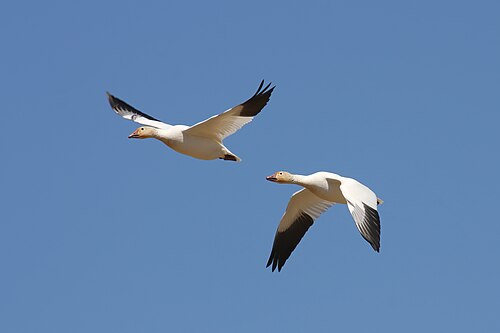
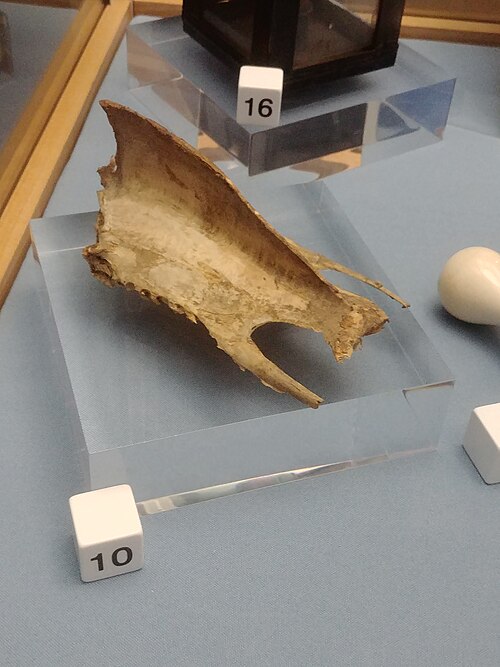
Fossils of true geese are hard to assign to genus; all that can be said is that their fossil record, particularly in North America, is dense and comprehensively documents many different species of true geese that have been around since about 10 million years ago in the Miocene. The aptly named Anser atavus (meaning "progenitor goose") from some 12 million years ago had even more plesiomorphies in common with swans. In addition, some goose-like birds are known from subfossil remains found on the Hawaiian Islands.
Geese are monogamous, living in permanent pairs throughout the year; however, unlike most other permanently monogamous animals, they are territorial only during the short nesting season. Paired geese are more dominant and feed more, two factors that result in more young.[5][6]
Fossil record
Goose fossils have been found ranging from 10 to 12 million years ago (Middle Miocene). Garganornis ballmanni from Late Miocene (~ 6–9 Ma) of Gargano region of central Italy, stood one and a half meters tall and weighed about 22 kilograms. The evidence suggests the bird was flightless, unlike modern geese.[7]
Migratory patterns
Most goose species are migratory, though populations of Canada geese living near human developments may remain in a locality year-round.[8] These 'resident' geese, found primarily in the eastern United States, may migrate only short distances, or not at all, if they have adequate food supply and access to open water.[8]
Navigation
Migratory geese may use several environmental cues in timing the beginning of their migration, including temperature, predation threat, and food availability.[9][10] Like all migratory birds, geese exhibit an ability to navigate using an internal compass, using a combination of innate and learned behaviors. The preferred direction of migration is heritable, and birds appear to orient themselves using Earth's magnetic field.[11] Migrations occur over the course of several weeks, and up to 85% of migration time is spent at perennial stopover sites, where individuals rest and build up fat stores for further travel.[12]
↑ Yirka, Bob (2017). "古代絶滅した巨大な飛べないガチョウの化石から、それが戦闘員だったことが示唆される" . phys.org . 2022年3月27日のオリジナルからアーカイブ済み。 2020年11月21日取得。
1 2 Handwerk, Brian (2020年12月16日) 「カナダガンは冬に南へ渡るのか?はい、しかし複雑な事情があります」ナショナルジオグラフィック。2024年2月29日のオリジナルからアーカイブ済み。 2024年3月17日取得。
↑ van Wijk, Rien E.; Koelzch, Andrea; Kruckenberg, Helmut; Ebbinge, Barwolt S.; Mueskens, Gerhard JDM; Nolet, Bart A. (2012). "Individually tracked geese follow peaks of temperature acceleration during spring migration" . Oikos . 121 (5): 655–664 . Bibcode : 2012Oikos.121..655V . doi : 10.1111/j.1600-0706.2011.20083.x .
↑ Jonker, Rudy M.; Eichhorn, Goetz; van Langevelde, Frank; Bauer, Silke (2010). "捕食の危険が渡りのタイミングの変化を説明できる: カオジロガンの場合" . PLOS ONE . 5 (6) e11369. Bibcode : 2010PLoSO...511369J . doi : 10.1371/journal.pone.0011369 . PMC 2894857 . PMID 20614027 .
↑ Wiltschko, Roswitha (2017). "ナビゲーション". Journal of Comparative Physiology A . 203 ( 6– 7): 455– 463. doi : 10.1007/s00359-017-1160-1 . PMID 28289837 .
↑ Blount, J. David; Horns, Joshua J.; Kittelberger, Kyle D.; Neate-Clegg, Montague HC; Sekercioglu, Cagan H. (2021). "鳥類による農地の渡り途中の中継地としての利用:作物管理方法と生態学的相関関係のレビュー" . Frontiers in Ecology and Evolution . 9 650641. Bibcode : 2021FrEEv...950641B . doi : 10.3389/fevo.2021.650641 .