Riftia's tubes are composed of chitin,[19] secreted out from cup-microvilli-like structures within glands which form crystallite chitin layers over time.[20] The tube is cylindrical, flexible, and closed at the prosterier end.[21]Riftia tubes can reach 2 m in length and 5cm in diameter and are very thick compared to those of other tubeworms, especially at the base.[22][6] The tubes are very resistant to enzymatic attack by bacteria, and can take years to decompose.[23] The worms are able to adjust both the top and the base of their tubes, which allows for some adaptability in the highly competitive and crowded spaces they grow in, as a worm may need to adjust its position to maximise its access to vent fluid as more worms settle in the colony.[24]Riftia tubes grow at a rate of 10 to 85cm (3.9 to 33.5in) per year.[25][26]
Physiology
Metabolism
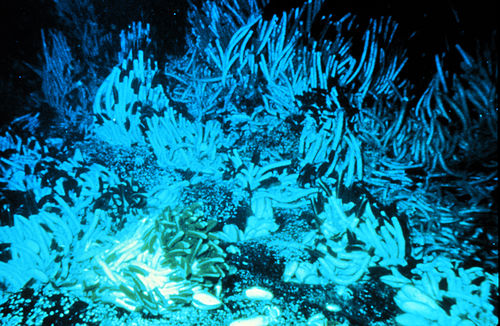
Riftia Pachyptila photographed at 2630 meters on the Eastern Pacific Ridge.
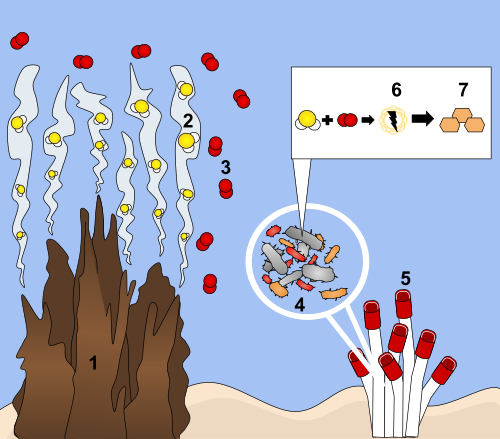
R. pachyptila は、熱水噴出孔に生息しない他の深海種とは生理機能が大きく異なります。深海種は一般的に代謝率が低いですが、 R. pachyptilaの組織における解糖、クエン酸回路、電子伝達に関連する酵素活性は浅海に生息する動物のものと似ており、深海に生息する種に典型的な代謝よりもかなり速い代謝を示唆しています。[ 27 ] 代謝を維持するために、R. pachyptila は硫化物酸化と炭素固定の両方に必要なすべての物質と、窒素やリンなどの他の基本的な細菌栄養素を吸収する必要があります。硝酸塩と亜硝酸塩は有毒ですが、生合成プロセスに必要です。栄養体内の化学合成細菌は硝酸塩をアンモニウムイオンに変換し、それが細菌内でアミノ酸を生成するために利用可能になり、それがチューブワームに放出されます。硝酸塩を細菌に運ぶために、R. pachyptila は血液中の硝酸塩濃度を周囲の水よりも 100 倍高く濃縮します。R . pachyptila が硝酸塩に耐え、濃縮する能力の正確なメカニズムはまだ不明です。[ 28 ]
↑ Jones, Meredith L (1981). "Riftia Pachyptila、新属新種、ガラパゴス海溝地熱噴出孔からのVestimentiferanワーム(Pogonophora)" . Proceedings of the Biological Society of Washington . 93 : 1295– 1313 . 2025年8月13日取得.
↑ Hilário, Ana; Capa, María; Dahlgren, Thomas G.; Halanych, Kenneth M.; Little, Crispin TS; Thornhill, Daniel J.; Verna, Caroline; Glover, Adrian G. (2011年2月14日). "シボグリニド管虫の生態と進化に関する新たな視点" . PLOS ONE . 6 (2) e16309. Bibcode : 2011PLoSO...616309H . doi : 10.1371/journal.pone.0016309 . ISSN 1932-6203 . PMC 3038861 . PMID 21339826 .
↑Bright M. "Riftia pachyptila". Archived from the original on 2 April 2015. Retrieved 19 March 2015.
↑Adams DK, Arellano SM, Govenar B (March 2012). "Larval dispersal: Vent life in the ocean column"(PDF). Oceanography.
12Jones ML, Gardiner SL (October 1989). "On the early development of the vestimentiferan tube worm Ridgeia sp. and observations on the nervous system and trophosome of Ridgeia sp. and Riftia pachyptila"(PDF). Biological Bulletin. 177 (2): 254–276. Bibcode:1989BiolB.177..254J. doi:10.2307/1541941. JSTOR1541941. Archived from the original(PDF) on 23 September 2015. Retrieved 19 March 2015.
↑Marsh AG, Mullineaux LS, Young CM, Manahan DT (May 2001). "Larval dispersal potential of the tubeworm Riftia pachyptila at deep-sea hydrothermal vents". Nature. 411 (6833): 77–80. Bibcode:2001Natur.411...77M. doi:10.1038/35075063. PMID11333980. S2CID411076.
↑Murad (17 April 2023). "The World's Longest-Living Animals – Unraveling the Secrets of Longevity". sciquest.org. Retrieved 13 August 2025.
↑"Giant Riftia Tubeworms – 2015". youtube.com. EVNautilus. 3 March 2023. Retrieved 14 August 2025.
↑Cordes, Erik E.; Arthur, Michael A.; Shea, Katriona; Arvidson, Rolf S.; Fisher, Charles R. (22 February 2005). "Modeling the Mutualistic Interactions between Tubeworms and Microbial Consortia". PLOS Biology. 3 (3) e77. doi:10.1371/journal.pbio.0030077. PMC1044833. PMID15736979.
12Giovannelli D, Chung M, Staley J, Starovoytov V, Le Bris N, Vetriani C (July 2016). "Sulfurovum riftiae sp. nov., a mesophilic, thiosulfate-oxidizing, nitrate-reducing chemolithoautotrophic epsilonproteobacterium isolated from the tube of the deep-sea hydrothermal vent polychaete Riftia pachyptila". International Journal of Systematic and Evolutionary Microbiology. 66 (7): 2697–2701. doi:10.1099/ijsem.0.001106. PMID27116914.
↑Robidart JC, Bench SR, Feldman RA, Novoradovsky A, Podell SB, Gaasterland T, etal. (March 2008). "Metabolic versatility of the Riftia pachyptila endosymbiont revealed through metagenomics". Environmental Microbiology. 10 (3): 727–37. Bibcode:2008EnvMi..10..727R. doi:10.1111/j.1462-2920.2007.01496.x. PMID18237306.
↑Distel DL, Lane DJ, Olsen GJ, Giovannoni SJ, Pace B, Pace NR, etal. (June 1988). "Sulfur-oxidizing bacterial endosymbionts: Analysis of phylogeny and specificity by 16S rRNA sequences". Journal of Bacteriology. 170 (6): 2506–10. doi:10.1128/jb.170.6.2506-2510.1988. PMC211163. PMID3286609.
↑"Exploring the deep ocean floor [This Dynamic Earth, USGS]". pubs.usgs.gov. Retrieved 5 July 2026.
↑Koschinsky, Andrea; Garbe-Schönberg, Dieter; Sander, Sylvia; Schmidt, Katja; Gennerich, Hans-Hermann; Strauss, Harald (1 August 2008). "Hydrothermal venting at pressure-temperature conditions above the critical point of seawater, 5°S on the Mid-Atlantic Ridge". Geology. 36 (8): 615–618. Bibcode:2008Geo....36..615K. doi:10.1130/G24726A.1. ISSN0091-7613.
↑ Corliss, John B.; Dymond, Jack; Gordon, Louis I.; Edmond, John M.; von Herzen, Richard P.; Ballard, Robert D.; Green, Kenneth; Williams, David; Bainbridge, Arnold; Crane, Kathy; van Andel, Tjeerd H. (1979年3月16日). "ガラパゴス海溝の海底温泉" . Science . 203 (4385): 1073– 1083. Bibcode : 1979Sci...203.1073C . doi : 10.1126/science.203.4385.1073 . ISSN 0036-8075 . PMID 17776033 .
外部リンク
NOAA海洋探査ファクトシート – 熱水噴出孔
Privett, B. (2001). "Riftia pachyptila" . Animal Diversity Web . 2008年2月25日取得.