Hyperbaric medicine is the branch of medicine in which clinical therapies are delivered in pressurized vessels containing prescribed barometric pressures of gases such as air or oxygen. The immediate effects include reducing the size of gas emboli and raising the partial pressures of the gases present. Initial uses were in decompression sickness, and it is also effective in certain cases of gas gangrene and carbon monoxide poisoning. There are risks associated with hyperbaric therapy, including barotrauma, and, if pure oxygen is used, a fire hazard.
Hyperbaric oxygen therapy (HBOT) is the medical use of greater than 99% oxygen at an ambient pressure higher than atmospheric pressure, and therapeutic recompression. The equipment required consists of a pressure vessel for human occupancy (hyperbaric chamber), which may be of rigid or flexible construction, and a means of a controlled atmosphere supply. Treatment gas may be the ambient chamber gas, or delivered via a built-in breathing system. Operation is performed to a predetermined schedule by personnel who may adjust the schedule as required.
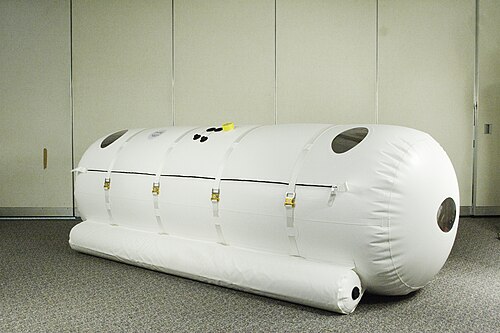
Hyperbaric air (HBA) consists of compressed atmospheric air (79% nitrogen, 21% oxygen, and minor gases) and is used for acute mountain sickness. This is applied by placing the person in a portable hyperbaric air chamber and inflating that chamber up to 14–28 kilopascals (2–4psi) using a foot-operated or electric air pump.[1][2][3]
Chambers used in the US made for hyperbaric medicine fall under the jurisdiction of the Federal Food and Drug Administration (FDA). The FDA requires hyperbaric chambers to comply with the American Society of Mechanical Engineers PVHO Codes[4] and the National Fire Protection Association Standard 99, Health Care Facilities Code.[5] Similar conditions apply in most other countries.
Hyperbaric medicine includes hyperbaric oxygen treatment, which is the medical use of oxygen at greater than atmospheric pressure to increase the availability of oxygen in the body;[6] and therapeutic recompression, which involves increasing the ambient pressure on a person, usually a diver, to treat decompression sickness or an air embolism by reducing the volume and more rapidly eliminating bubbles that have formed within the body.[7]
These uses are similar to those approved by the US FDA as of 2021.[9]
Mucormycosis, especially rhinocerebral disease in the setting of diabetes mellitus may be supported.[10]
Treatment efficacy of HBOT for most of these conditions is based on testing at 2-3 bar (atmospheres of pressure)[8], but it is also marketed at lower pressures (and lower costs) despite lack of evidence of efficacy.
There is insufficient evidence for use in autism, cancer, diabetes, HIV/AIDS, Alzheimer's, asthma, Bell's palsy, cerebral palsy, depression, heart disease, migraines, multiple sclerosis, Parkinson's, spinal cord injury, sports injuries, or stroke.[11][12][13] Furthermore, potential side effects pose an unjustified risk in such cases. A 2016 meta-analysis found no evidence of improvements in social abilities or cognitive functioning in autistic individuals treated with HBOT. The paper also noted conducting further trials would be ethically fraught, as studies had not revealed efficacy, but documented that HBOT can cause minor-grade ear barotrauma events.[14] Despite the lack of evidence of benefit, in 2015, the number of people utilizing this therapy has continued to rise.[15] There is also insufficient evidence to support its use in acute traumatic or surgical wounds.[16]
HBOT in diabetic foot ulcers increased the rate of early ulcer healing but does not appear to provide any benefit in wound healing at long-term follow-up. In particular, there was no difference in major amputation rate.[18] For venous, arterial and pressure ulcers, no evidence was apparent that HBOT provides a long-term improvement over standard treatment.[19]
Radiation injury
There is some evidence that HBOT is effective for late radiation tissue injury of bone and soft tissues of the head and neck. Some people with radiation injuries of the head, neck or bowel show an improvement in quality of life. Importantly, no such effect has been found in neurological tissues. The use of HBOT may be justified to selected patients and tissues, but further research is required to establish the best people to treat and timing of any HBO therapy.[20]
There are risks associated with HBOT, similar to some diving disorders. Pressure changes can cause a "squeeze" or barotrauma in the tissues surrounding trapped air inside the body, such as the lungs,[31] behind the eardrum,[32][33] inside paranasal sinuses,[32] or trapped underneath dental fillings.[34] Breathing high-pressure oxygen may cause oxygen toxicity.[35] Temporarily blurred vision can be caused by swelling of the lens, which usually resolves in two to four weeks.[36][37]
There are reports that cataracts may progress following HBOT,[38] and rarely, may develop de novo, but this may be unrecognized and under reported. The cause is not fully explained, but evidence suggests that lifetime exposure of the lens to high partial pressure oxygen may be a major factor. Oxidative damage to lens proteins is thought to be responsible. This may be an end-stage of the relatively well documented myopic shift detected in most hyperbaric patients after a course of multiple treatments.
Ears
People have ear discomfort as a pressure difference develops between their middle ear and the chamber atmosphere.[39] This can be relieved by ear clearing using the Valsalva maneuver or other techniques. Continued increase of pressure without equalizing may cause ear drums to rupture, resulting in severe pain. As the pressure in the chamber increases further, the air may become warm.
To reduce the pressure, a valve is opened to allow air out of the chamber. As the pressure falls, the patient's ears may "squeak" as the pressure inside the ear equalizes with the chamber. The temperature in the chamber will fall. The speed of pressurization and de-pressurization can be adjusted to each patient's needs.
Contraindications
The toxicology of the treatment has been reviewed by Ustundag et al.[40] and its risk management is discussed by Christian R. Mortensen, in light of the fact that most hyperbaric facilities are managed by departments of anaesthesiology and some of their patients are critically ill.[41]
Pregnancy is not a relative contraindication to hyperbaric oxygen treatments,[43] although it may be for underwater diving. In cases where a pregnant woman has carbon monoxide poisoning there is evidence that lower pressure (2.0 ATA) HBOT treatments are not harmful to the fetus, and that the risk involved is outweighed by the greater risk of the untreated effects of CO on the fetus (neurologic abnormalities or death.)[48][49] In pregnant patients, HBO therapy has been shown to be safe for the fetus when given at appropriate levels and "doses" (durations). In fact, pregnancy lowers the threshold for HBO treatment of carbon monoxide-exposed patients. This is due to the high affinity of fetal hemoglobin for CO.[43]
Mechanism of action
The therapeutic consequences of HBOT and recompression result from multiple effects.[50][51]
Pressure
The increased overall pressure is of therapeutic value in the treatment of decompression sickness and air embolism as it provides a physical means of reducing the volume of inert gas bubbles within the body;[52] Exposure to this increased pressure is maintained for a period long enough to ensure that most of the bubble gas is dissolved back into the tissues, removed by perfusion and eliminated in the lungs.[51]
The improved concentration gradient for inert gas elimination (oxygen window) by using a high partial pressure of oxygen increases the rate of inert gas elimination in the treatment of decompression sickness.[53][54]
For many other conditions, the therapeutic principle of HBOT lies in its ability to drastically increase partial pressure of oxygen in the tissues of the body. The oxygen partial pressures achievable using HBOT are much higher than those achievable while breathing pure oxygen under normobaric conditions (i.e. at normal atmospheric pressure). This effect is achieved by an increase in the oxygen transport capacity of the blood. At normal atmospheric pressure, oxygen transport is limited by the oxygen binding capacity of hemoglobin in red blood cells and very little oxygen is transported by blood plasma. Because the hemoglobin of the red blood cells is almost saturated with oxygen at atmospheric pressure, this route of transport cannot be exploited any further. Oxygen transport by plasma, however, is significantly increased using HBOT because of the higher solubility of oxygen as pressure increases.[51]
Hyperbaric chambers
Multiplace hyperbaric chambers, showing control panel, monitoring facilities, and different chamber sizes in Spanish facilities
Construction
The traditional type of hyperbaric chamber used for therapeutic recompression and HBOT is a rigid shelled pressure vessel. Such chambers can be run at absolute pressures typically about 6 bars (87psi), 600,000Pa or more in special cases.[55] Navies, professional diving organizations, hospitals, and dedicated recompression facilities typically operate these. They range in size from semi-portable, one-patient units to room-sized units that can treat eight or more patients. The larger units may be rated for lower pressures if they are not primarily intended for treatment of diving injuries.
The operating pressure depends on the application. Chambers used for clinical hyperbaric oxygen therapy commonly have a maximum allowable working pressure of 35 pounds per square inch (2.4bar) with a maximum of about 150 pounds per square inch (10bar) Chambers used for support of commercial or military diving operations and for research may have a maximum allowable working pressure of up to 1,000 pounds per square inch (69bar).[61]
Oxygen supply
A recompression chamber for a single diving casualty
In the larger multiplace chambers, patients inside the chamber breathe from either "oxygen hoods" – flexible, transparent soft plastic hoods with a seal around the neck similar to a space suit helmet – or tightly fitting oxygen masks, which supply pure oxygen and may be designed to directly exhaust the exhaled gas from the chamber. During treatment patients breathe 100% oxygen most of the time to maximise the effectiveness of their treatment, but have periodic "air breaks" during which they breathe chamber air (21% oxygen) to reduce the risk of oxygen toxicity. The exhaled treatment gas must be removed from the chamber to prevent the buildup of oxygen, which could present a fire risk. Attendants may also breathe oxygen some of the time to reduce their risk of decompression sickness when they leave the chamber. The pressure inside the chamber is increased by opening valves allowing high-pressure air to enter from storage cylinders, which are filled by an air compressor. Chamber air oxygen content is kept between 19% and 23% to control fire risk (US Navy maximum 25%).[55] If the chamber does not have a scrubber system to remove carbon dioxide from the chamber gas, the chamber must be isobarically ventilated to keep the CO2 within acceptable limits.[55]
A soft chamber may be pressurized directly from a compressor.[60] or from storage cylinders.[59]
Emergency HBOT for decompression illness follows treatment schedules laid out in treatment tables. Most cases employ a recompression to 2.8 bars (41psi) absolute, the equivalent of 18 metres (60ft) of water, for 4.5 to 5.5 hours with the casualty breathing pure oxygen, but taking air breaks every 20 minutes to reduce oxygen toxicity. For extremely serious cases resulting from very deep dives, the treatment may require a chamber capable of a maximum pressure of 8 bars (120psi), the equivalent of 70 metres (230ft) of water, and the ability to supply heliox as a breathing gas.[51]
U.S. Navy treatment charts are used in Canada and the United States to determine the duration, pressure, and breathing gas of the therapy. The most frequently used tables are Table 5 and Table 6. In the UK the Royal Navy 62 and 67 tables are used.
The Undersea and Hyperbaric Medical Society (UHMS) publishes a report that compiles the latest research findings and contains information regarding the recommended duration and pressure of the longer-term conditions.[63]
Home and out-patient
An example of mild portable hyperbaric chamber. This 40-inch-diameter (1,000mm) chamber is one of the larger chambers available for home.
There are several sizes of portable chambers, which are used for home treatment. These are usually referred to as "mild personal hyperbaric chambers", which is a reference to the lower pressure (compared to hard chambers) of soft-sided chambers. The American Medical Association is opposed to home use or any other use of hyperbaric chambers if it is not "in facilities with appropriately trained staff including physician supervision and prescription and only when the intervention has scientific support or rationale" due demonstrated hazard [64]
In the US, these "mild personal hyperbaric chambers" are categorized by the FDA as CLASS II medical devices and requires a prescription in order to purchase one or take treatments.[65] As with any hyperbaric chamber, the FDA require compliance with ASME and NFPA standards. The most common option (but not approved by FDA) some patients choose is to acquire an oxygen concentrator which typically delivers 85–96% oxygen as the breathing gas.
Oxygen is never fed directly into soft chambers but is rather introduced via a line and mask directly to the patient. FDA approved oxygen concentrators for human consumption in confined areas used for HBOT are regularly monitored for purity (±1%) and flow (10 to 15 liters per minute outflow pressure). An audible alarm will sound if the purity ever drops below 80%. Personal hyperbaric chambers use 120 volt or 220 volt outlets. The FDA warns against the use of oxygen concentrators or oxygen tanks with chambers that does not meet ASME and FDA standards, regardless of if the concentrators are FDA approved.[66]
History
Hyperbaric air
A British physician, Nathaniel Henshaw, proposed what would have been the first hyperbaric chamber for medical treatment of humans in 1662. The container was to have been pressurised with air, which at the time was not yet known to contain oxygen, later discovered by Carl Wilhelm Scheele around 1770 and first published by Joseph Priestley in 1775, or carbon dioxide. Although it is widely accepted that the chamber was built and used, there are inconsistencies in the description of the engineering details of construction and use that make it very unlikely that it would have been able to seal or withstand the forces involved, and the procedures described would have been hazardous.[67]
Victot T. Junod built a chamber in France in 1834 to treat pulmonary conditions at pressures between 2 and 4 atmospheres absolute.[68]
During the following century "pneumatic centres" were established in Europe and the USA which used hyperbaric air to treat a variety of conditions.[69]
Orval J Cunningham, a professor of anesthesia at the University of Kansas in the early 1900s observed that people with circulatory disorders did better at sea level than at altitude and this formed the basis for his use of hyperbaric air. In 1918, he successfully treated patients with the Spanish flu with hyperbaric air. In 1930 the American Medical Association forced him to stop hyperbaric treatment, since he did not provide acceptable evidence that the treatments were effective.[69][70]
Hyperbaric oxygen
The English scientist Joseph Priestley discovered oxygen in 1775. Shortly after its discovery, there were reports of toxic effects of hyperbaric oxygen on the central nervous system and lungs, which delayed therapeutic applications until 1937, when Behnke and Shaw first used it in the treatment of decompression sickness.[69]
2016: A man in Victoria, Australia died in a hyperbaric chamber of undisclosed causes while receiving treatment. The practitioners overseeing his care were found responsible for failing to ensure the patient's safety leading to his death. They were later fined AU$716,750.[79]
March 2025: A hyperbaric chamber exploded in Michigan, killing a five year old boy.[80][81]
July 2025: On Wednesday, July 9, 43-year-old physical therapist Walter Foxcroft was found dead inside a hyperbaric oxygen chamber at his health clinic in Lake Havasu City, Arizona, after the device caught on fire.[82][83]
Society and culture
Regulation
The use of hyperbaric chambers for medical and therapeutic procedures is generally regulated. Authorities have warned of potential risks to patients receiving treatment in unlicensed facilities, notably in Israel,[84] Canada,[85] and the United States.[86] In Italy, the use of hyperbaric chambers for therapy was severely restricted to limited medical settings after a serious fire which killed ten patients in 1997.[87][88]
In some jurisdictions, the use and availability of HBOT is further restricted at the subnational level. In the U.S. state of North Carolina, several cities including Durham, Raleigh and Charlotte have ordered operators of mild hyperbaric oxygen therapy to close to protect public safety due to a risk of fire.[89]
Unlicensed and fraudulent operators have been subject to prosecution. In Australia, Oxymed Australia Pty Ltd and director Malcolm Hooper were ordered to pay AUS $3 million in fines after advertising hyperbaric therapy against the country's Therapeutic Goods Act.[90] In Canada, certain soft-shelled hyperbaric chambers were removed from the market for a potential risk to patients.[91]
Costs
HBOT is recognized by Medicare in the United States as a reimbursable treatment for 14 UHMS "approved" conditions. A 1-hour HBOT session may cost between $300 and higher in private clinics, and over $2,000 in hospitals. U.S. physicians (M.D. or D.O.) may lawfully prescribe HBOT for "off-label" conditions such as stroke,[92][93] and migraine.[94][95] Such patients are treated in outpatient clinics. In the United Kingdom most chambers are financed by the National Health Service, although some, such as those run by Multiple Sclerosis Therapy Centres, are non-profit. In Australia, HBOT is not covered by Medicare as a treatment for multiple sclerosis.[96] China and Russia treat more than 80 maladies, conditions, and trauma with HBOT.[97]
Some research found evidence that HBOT improves local tumor control, mortality, and local tumor recurrence for cancers of the head and neck.[101]
Some research also found evidence of an increase in stem progenitor cells[47] and a decrease in inflammation.[102]
Neurological
Tentative evidence shows a possible benefit in cerebrovascular diseases.[103] Rats subjected to HBOT after some time following the acute phase of experimentally-induced stroke showed reduced inflammation, increased brain-derived neurotrophic factor, and evidence of neurogenesis.[104] Another rat study showed improved neurofunctional recovery as well as neurogenesis following the late-chronic phase of experimentally-induced stroke.[105]
The clinical experience and results so far published has promoted the use of HBOT therapy in patients with cerebrovascular injury and focal cerebrovascular injuries.[106] However, the power of clinical research is limited because of the shortage of randomized controlled trials.[103]
Radiation wounds
A 2010 review of wounds from radiation therapy found that, while most studies suggest a benefit, more experimental research is needed to validate its use.[107]
↑Robertson, J.A.; Shlim, D.R. (1991). "Treatment of moderate acute mountain sickness with pressurization in a portable hyperbaric (Gamow™) Bag". Journal of Wilderness Medicine. 2 (4): 268–273. doi:10.1580/0953-9859-2.4.268.
↑Butler, G. J.; Al-Waili, N.; Passano, D. V.; Ramos, J.; Chavarri, J.; Beale, J.; Allen, M. W.; Lee, B. Y.; Urteaga, G.; Salom, K. (2011). "Altitude mountain sickness among tourist populations: A review and pathophysiology supporting management with hyperbaric oxygen". Journal of Medical Engineering & Technology. 35 (3–4): 197–207. doi:10.3109/03091902.2010.497890. PMID20836748.
↑Hackett, Peter H.; Roach, Robert C. (2001). "High-Altitude Illness". New England Journal of Medicine. 345 (2): 107–114. doi:10.1056/nejm200107123450206. PMID11450659.
↑"Safety Standard for Pressure Vessels for Human Occupancy". Codes and Standards. American Society of Mechanical Engineers. Retrieved 25 April 2020.
↑Federal Food and Drug Agency. "Hyperbaric chamber". Product Classification. US FDA. Archived from the original on November 4, 2021. Retrieved 25 March 2024.
↑Betts, J Gordon; Desaix, Peter; Johnson, Eddie; Johnson, Jody E; Korol, Oksana; Kruse, Dean; Poe, Brandon; Wise, James; Womble, Mark D; Young, Kelly A (September 13, 2023). Anatomy & Physiology. Houston: OpenStax CNX. 22.4 Gas exchange. ISBN978-1-947172-04-3.
12U.S. Navy Supervisor of Diving (2008). "Chapter20: Diagnosis and Treatment of Decompression Sickness and Arterial Gas Embolism". U.S. Navy Diving Manual(PDF). SS521-AG-PRO-010, revision 6. Vol.5. U.S. Naval Sea Systems Command. p.37. Archived from the original(PDF) on 5 March 2011. Retrieved 15 May 2010.
12"Indications for Hyperbaric Oxygen Therapy". www.uhms.org. Undersea & Hyperbaric Medical Society. Retrieved 17 May 2025.
↑Commissioner, Office of the (28 February 2025). "Hyperbaric Oxygen Therapy: Get the Facts". FDA. Archived from the original on July 26, 2021. Retrieved 17 May 2025.
↑Chamilos G, Kontoyiannis DP (2015). "Chapter 133: Aspergillus, Candida, and other opportunistic mold infections of the lung". In Grippi MA, Elias JA, Fishman JA, Kotloff RM, Pack AI, Senior RM (eds.). Fishman's Pulmonary Diseases and Disorders (5thed.). McGraw-Hill. p.2065. ISBN978-0-07-179672-9.
↑"Hyperbaric Oxygen Therapy: Don't Be Misled". Food and Drug Administration. 22 August 2013. Archived from the original on 23 April 2019. Retrieved 16 December 2019.
12Bennett M; Heard R (2004). Bennett MH (ed.). "Hyperbaric oxygen therapy for multiple sclerosis". The Cochrane Database of Systematic Reviews. 2011 (1). CD003057. doi:10.1002/14651858.CD003057.pub2. PMC8407327. PMID14974004.
12Bennett MH, Weibel S, Wasiak J, Schnabel A, French C, Kranke P (November 2014). "Hyperbaric oxygen therapy for acute ischaemic stroke". The Cochrane Database of Systematic Reviews. 2014 (11). CD004954. doi:10.1002/14651858.CD004954.pub3. PMC10754477. PMID25387992.
↑Xiong T, Chen H, Luo R, Mu D (October 2016). "Hyperbaric oxygen therapy for people with autism spectrum disorder (ASD)". The Cochrane Database of Systematic Reviews. 10 (11). CD010922. doi:10.1002/14651858.CD010922.pub2. PMC6464144. PMID27737490. Authors' conclusions: To date, there is no evidence that hyperbaric oxygen therapy improves core symptoms and associated symptoms of ASD. It is important to note that adverse events (minor-grade ear barotrauma events) can occur. Given the absence of evidence of effectiveness and the limited biological plausibility and possible adverse effects, the need for future RCTs of hyperbaric oxygen therapy must be carefully considered.
↑Walker, Joseph Lauvrak. "Hyperbaric Oxygen Therapy Gets More Popular as Unapproved Treatment". Wall Street Journal. Retrieved 2015-03-14.
↑Eskes, Anne; Vermeulen, Hester; Lucas, Cees; Ubbink, Dirk T. (2013-12-16). Cochrane Wounds Group (ed.). "Hyperbaric oxygen therapy for treating acute surgical and traumatic wounds". Cochrane Database of Systematic Reviews. 2013 (12) CD008059. doi:10.1002/14651858.CD008059.pub3. PMC11529725. PMID24343585.
↑Bennett M, Heard R (April 2010). "Hyperbaric oxygen therapy for multiple sclerosis". CNS Neuroscience & Therapeutics. 16 (2): 115–24. doi:10.1111/j.1755-5949.2009.00129.x. PMC6493844. PMID20415839.
123McDonagh MS, Morgan D, Carson S, Russman BS (December 2007). "Systematic review of hyperbaric oxygen therapy for cerebral palsy: the state of the evidence". Developmental Medicine and Child Neurology. 49 (12): 942–47. doi:10.1111/j.1469-8749.2007.00942.x. PMID18039243.
12Collet JP, Vanasse M, Marois P, Amar M, Goldberg J, Lambert J, etal. (February 2001). "Hyperbaric oxygen for children with cerebral palsy: a randomised multicentre trial. HBO-CP Research Group". Lancet. 357 (9256): 582–86. doi:10.1016/S0140-6736(00)04054-X. PMID11558483. S2CID18668055.
↑"Hyperbaric Oxygen Therapy". American Cancer Society. 14 April 2011. Retrieved 14 February 2015.
↑Moen I, Stuhr LE (December 2012). "Hyperbaric oxygen therapy and cancer – a review". Targeted Oncology. 7 (4): 233–42. doi:10.1007/s11523-012-0233-x. PMC3510426. PMID23054400.
12Bennett MH, French C, Schnabel A, Wasiak J, Kranke P, Weibel S (December 2015). "Normobaric and hyperbaric oxygen therapy for the treatment and prevention of migraine and cluster headache". The Cochrane Database of Systematic Reviews. 2016 (12) CD005219. doi:10.1002/14651858.CD005219.pub3. PMC8720466. PMID26709672.
↑Bennett, Michael H.; Cooper, Jeffrey S. (21 June 2022). "Hyperbaric Cataracts". www.ncbi.nlm.nih.gov. StatPearls Publishing LLC. PMID29261974. Retrieved 30 July 2022.
↑Chen X, You J, Ma H, Zhou M, Huang C (January 2023). "Efficacy and safety of hyperbaric oxygen therapy for fibromyalgia: a systematic review and meta-analysis". BMJ Open. 13 (1) e062322. doi:10.1136/bmjopen-2022-062322. PMC9872467. PMID36690401.
12Broome JR, Smith DJ (November 1992). "Pneumothorax as a complication of recompression therapy for cerebral arterial gas embolism". Undersea Biomedical Research. 19 (6): 447–55. PMID1304671. Archived from the original on 2011-02-03. Retrieved 2008-05-23.
12Fitzpatrick DT, Franck BA, Mason KT, Shannon SG (1999). "Risk factors for symptomatic otic and sinus barotrauma in a multiplace hyperbaric chamber". Undersea & Hyperbaric Medicine. 26 (4): 243–47. PMID10642071. Archived from the original on 2011-08-11. Retrieved 2008-05-23.
↑Fiesseler FW, Silverman ME, Riggs RL, Szucs PA (2006). "Indication for hyperbaric oxygen treatment as a predictor of tympanostomy tube placement". Undersea & Hyperbaric Medicine. 33 (4): 231–25. PMID17004409. Archived from the original on 2011-02-03. Retrieved 2008-05-23.
↑Stein L (2000). "Dental Distress. The 'Diving Dentist' Addresses the Problem of a Diving-Related Toothache"(PDF). Alert Diver (January/ February): 45–48. Retrieved 2008-05-23.
↑Smerz RW (2004). "Incidence of oxygen toxicity during the treatment of dysbarism". Undersea & Hyperbaric Medicine. 31 (2): 199–202. PMID15485081. Archived from the original on 2011-05-13. Retrieved 2010-01-02.
↑Butler FK (1995). "Diving and hyperbaric ophthalmology". Survey of Ophthalmology. 39 (5): 347–66. doi:10.1016/S0039-6257(05)80091-8. PMID7604359.
↑Butler FK, White E, Twa M (1999). "Hyperoxic myopia in a closed-circuit mixed-gas scuba diver". Undersea & Hyperbaric Medicine. 26 (1): 41–45. PMID10353183. Archived from the original on 2009-06-09. Retrieved 2008-05-23.
↑Gesell LB, Adams BS, Kob DG (2000). "De Novo Cataract Development Following A Standard Course Of Hyperbaric Oxygen Therapy". Undersea Hyperb Med Abstract. 27 (supplement): 389–92. PMID18251434. Archived from the original on February 16, 2009. Retrieved 2008-06-01.
↑Lehm Jan P, Bennett Michael H (2003). "Predictors of middle ear barotrauma associated with hyperbaric oxygen therapy". South Pacific Underwater Medicine Society Journal. 33: 127–33. Archived from the original on July 22, 2009. Retrieved 2009-07-15.
↑Ustundag A, Duydu Y, Aydin A, Eken A, Dundar K, Uzun G (Oct 2008). "Evaluation of the potential genotoxic effects of hyperbaric oxygen therapy". Toxicology Letters. 180: S142. doi:10.1016/j.toxlet.2008.06.792.
↑Mortensen, Christian Risby (March 1982). "Hyperbaric oxygen therapy". The Western Journal of Medicine. 136 (3): 333–37. doi:10.1016/j.cacc.2008.07.007. PMC1273677. PMID18749067.
12345Jain KK. "Indications, Contraindications, and Complications of HBO Therapy"(PDF). Textbook of Hyperbaric Medicine. pp.75–80. Retrieved 22 September 2016.
123Marx JA, ed. (2002). "chapter 194". Rosen's Emergency Medicine: Concepts and Clinical Practice (5thed.). Mosby. ISBN978-0-323-01185-3.
↑Liu YH, Hsia TC, Liu JC, Chen W (December 2008). "Fracture of the maxillary bone during hyperbaric oxygen therapy". CMAJ. 179 (12): 1351. doi:10.1503/cmaj.080713. PMC2585132. PMID19047622.
↑Takenaka S, Arimura T, Higashi M, Nagayama T, Ito E (August 1980). "Experimental study of bleomycin therapy in combination with hyperbaric oxygenation". Nihon Gan Chiryo Gakkai Shi. 15 (5): 864–75. PMID6159432.
↑Stubbs JM, Johnson EG, Thom SR (2005). "Trends Of Treating Patients, That Have Received Bleomycin Therapy In The Past, With Hyperbaric Oxygen Treatment (Hbot) And A Survey Of Considered Absolute Contraindications To Hbot". Undersea Hyperb Med Abstract. 32 (supplement). Archived from the original on February 16, 2009. Retrieved 2008-05-23.
12Feldmeier J, Carl U, Hartmann K, Sminia P (Spring 2003). "Hyperbaric oxygen: does it promote growth or recurrence of malignancy?". Undersea & Hyperbaric Medicine. 30 (1): 1–18. PMID12841604.
↑Van Hoesen KB, Camporesi EM, Moon RE, Hage ML, Piantadosi CA (February 1989). "Should hyperbaric oxygen be used to treat the pregnant patient for acute carbon monoxide poisoning? A case report and literature review". JAMA. 261 (7): 1039–43. doi:10.1001/jama.1989.03420070089037. PMID2644457.
↑Elkharrat D, Raphael JC, Korach JM, Jars-Guincestre MC, Chastang C, Harboun C, Gajdos P (1991). "Acute carbon monoxide intoxication and hyperbaric oxygen in pregnancy". Intensive Care Medicine. 17 (5): 289–92. doi:10.1007/BF01713940. PMID1939875. S2CID25109979.
↑Gesell LB (2008). Hyperbaric Oxygen Therapy Indications. The Hyperbaric Oxygen Therapy Committee Report (12thed.). Durham, NC: Undersea and Hyperbaric Medical Society. ISBN978-0-930406-23-3.
1234U.S. Navy Supervisor of Diving (Apr 2008). "20"(PDF). U.S. Navy Diving Manual. SS521-AG-PRO-010, revision 6. Vol.5. U.S. Naval Sea Systems Command. Archived(PDF) from the original on March 31, 2014. Retrieved 2009-06-29.
↑Behnke AR (1967). "The isobaric (oxygen window) principle of decompression". Trans. Third Marine Technology Society Conference, San Diego. The New Thrust Seaward. Washington DC: Marine Technology Society.
↑Van Liew HD, Conkin J, Burkard ME (September 1993). "The oxygen window and decompression bubbles: estimates and significance". Aviation, Space, and Environmental Medicine. 64 (9 Pt 1): 859–65. PMID8216150.
123456789101112U.S. Navy Supervisor of Diving (April 2008). "Chapter 21: Recompression Chamber Operation"(PDF). U.S. Navy Diving Manual. Volume 5: Diving Medicine and Recompression Chamber Operations. SS521-AG-PRO-010, Revision 6. U.S. Naval Sea Systems Command. Archived(PDF) from the original on March 31, 2014. Retrieved 2009-06-29.
↑Kemper, Bart; Cross, Linda (September 2020). "Developing "Design by Analysis" Methodology for Windows for Pressure Vessels for Human Occupancy". ASCE-ASME Journal of Risk and Uncertainty in Engineering Systems, Part B: Mechanical Engineering. 6 (3) 030906. doi:10.1115/1.4046742.
↑Malnati P (30 April 2015). "Uncompromising composite hyperbaric oxygen chamber closes the gap". compositesworld.com newsletter. Composites World. Retrieved 29 March 2016.
↑"Hematocare: The revolution at 3 ata". Gaumond Medical Group Inc. 2014. Retrieved 29 March 2016.
12Staff. "Hyperlite folding portable hyperbaric chambers"(PDF). Technical specifications. London: SOS Ltd. Retrieved 29 March 2016.
1234567Mackey, Jaclyn (11 October 2023). "Design Life & Inspection of PVHO Windows and Viewports". woundeducationpartners.com. Retrieved 28 November 2024.
↑Stewart, Ashley (6 September 2023). "Hyperbaric Chambers Are Turning Away Divers. Will There Be One Nearby When You Need It?". gue.com. Retrieved 7 October 2023.
↑"Undersea and Hyperbaric Medical Society". Uhms.org. Retrieved 2011-08-21.
↑"Oppose Unsafe Use of "Mild Hyperbaric Therapy" D-270.986". AMA Policy Finder. American Medical Association. Retrieved 25 March 2024.
↑"Product Classification, Chamber, Hyperbaric". United States Food and Drug Administration. Retrieved 2011-08-22.
↑"Hyperbaric Oxygen Therapy: Get the Facts". FDA Consumer Updates. US FDA. 26 July 2021. Archived from the original on July 26, 2021.
↑Clarke, R. (2024). "Nathanial Henshaw: Not history's pioneering hyperbaric practitioner". Undersea Hyperb Med. 51 (2): 107–113. doi:10.22462/674. PMID38985147.
123456Sharkey S (April 2000). "Current indications for hyperbaric oxygen therapy". ADF Health. 1 (2). Retrieved 18 December 2013.
12Sellers, L. M. (1964). "The Fallibility of the Forrestian Principle. "Semper Primus Pervenio Maxima Cum Vi". (Orval James Cunningham)." Trans Am Laryngol Rhinol Otol Soc 23: 385–405
↑Brummelkamp WH, Hogendijk L, Boerema I (1961). "Treatment of anaerobic infections (clostridial myositis) by drenching the tissues with oxygen under high atmospheric pressure". Surgery. 49: 299–302.
↑Sheffield, P. J.; Desautels, D. A. (September 1997). "Hyperbaric and hypobaric chamber fires: a 73-year analysis". Undersea & Hyperbaric Medicine. 24 (3): 153–164. ISSN1066-2936. PMID9308138.
↑Mago, Vishal (January–March 2024). "Safety of Hyperbaric Medicine in Clinical Scenarios". Annals of African Medicine. 23 (1): 1–4. doi:10.4103/aam.aam_16_22. ISSN1596-3519. PMC10922184. PMID38358163.
↑Simini, Bruno (November 8, 1997). "Milan fire fuels concerns over hyperbaric oxygen facilities". The Lancet. 350 (9088): 1375. doi:10.1016/s0140-6736(05)65155-0. ISSN0140-6736.
↑"Men Charged In Fatal Hyperbaric Chamber Explosion - CBS Miami". www.cbsnews.com. 2012-04-25. Retrieved 2024-05-13.
↑"Equine hyperbaric oxygen chamber explosion in Florida kills woman and horse". DVM 360. 2012-02-22. Retrieved 2024-05-13.
↑"Vet blames dog for hyperbaric chamber explosion". FOX 5 Atlanta. 2016-04-12. Retrieved 2024-05-13.
↑"Fire kills 4 inside hyperbaric chamber - National". The Jakarta Post. Retrieved 2024-05-22.
↑"Hyperbaric company and director fined $726,750". WorkSafe Victoria. Retrieved 2024-05-22.
↑Boy, 5, dies in hyperbaric chamber explosion at Michigan medical facility, Associated Press, January 31, 2025
↑"4 charged in death of 5-year-old boy 'incinerated' in hyperbaric chamber". AP News. 2025-03-11. Retrieved 2025-07-13.
↑"Physical therapist dies in hyperbaric chamber at Lake Havasu facility". USA Today. 2025-07-10. Retrieved 2025-07-13.
↑"Arizona therapist dies after hyperbaric oxygen chamber catches fire". USA Today via MSN. 2025-07-13. Retrieved 2025-07-13.
↑"Health Ministry warns public not to go to unlicensed hyperbaric oxygen chambers". The Jerusalem Post. 2023-12-17. ISSN0792-822X. Retrieved 2024-05-22.
↑Government of Canada, Health Canada (2021-10-28). "Unlicensed soft-shelled hyperbaric chambers may pose serious health risks - Recalls, advisories and safety alerts – Canada.ca". recalls-rappels.canada.ca. Retrieved 2024-05-22.
↑Office of the Commissioner (July 26, 2021). "Hyperbaric Oxygen Therapy: Get the Facts". FDA. Archived from the original on July 26, 2021 – via U.S. Food and Drug Administration.
↑Shipley, Amy; Clarke, Liz (2024-01-31). "Italian Authorities Still Plan to Prosecute Substance Abuse Cases". The Washington Post. ISSN0190-8286. Retrieved 2024-05-22.
↑Colvin, AP (January 3, 1998). "Fire-safety standards for hyperbaric oxygen facilities". The Lancet. 351 (9095): 69. doi:10.1016/s0140-6736(05)78048-x. ISSN0140-6736. PMID9433452.
↑Australian Government Department of Health and Aged Care (December 3, 2021). "Oxymed Australia Pty Ltd and director Malcolm Hooper ordered to pay $3 million for unlawful advertising of hyperbaric oxygen therapy devices". Australian Therapeutic Goods Administration. Retrieved May 22, 2024.
↑Trudeau, Megan (6 November 2020). "Health Canada seizes several unlicensed hyperbaric chambers due to serious health risks". KelownaNow. Retrieved 2024-05-22.
↑Jain KK (1989). "Effect of Hyperbaric Oxygenation on Spasticity in Stroke Patients". J. Hyperbaric Med. 4 (2): 55–61. Archived from the original on 2008-11-01. Retrieved 2008-08-06.
↑Singhal AB, Lo EH (February 2008). "Advances in emerging nondrug therapies for acute stroke 2007". Stroke. 39 (2): 289–91. doi:10.1161/STROKEAHA.107.511485. PMC3705573. PMID18187678.
↑Eftedal OS, Lydersen S, Helde G, White L, Brubakk AO, Stovner LJ (August 2004). "A randomized, double blind study of the prophylactic effect of hyperbaric oxygen therapy on migraine". Cephalalgia. 24 (8): 639–44. doi:10.1111/j.1468-2982.2004.00724.x. PMID15265052. S2CID22145164.
↑Fife WP, Fife CE (1989). "Treatment of Migraine with Hyperbaric Oxygen". J. Hyperbaric Med. 4 (1): 7–15. Archived from the original on 2009-06-09. Retrieved 2008-08-06.
↑IN-DEEP. "Hyperbaric Oxygen Therapy for MS". Making Sense of MS Research. Retrieved 8 November 2012.
↑Textbook of Hyperbaric Medicine KK Jane, 5th Edition, 2010
↑Yoshida T, Kawashima A, Ujike T, Uemura M, Nishimura K, Miyoshi S (July 2008). "Hyperbaric oxygen therapy for radiation-induced hemorrhagic cystitis". International Journal of Urology. 15 (7): 639–41. doi:10.1111/j.1442-2042.2008.02053.x. PMID18643783.
↑Noyer CM, Brandt LJ (February 1999). "Hyperbaric oxygen therapy for perineal Crohn's disease". The American Journal of Gastroenterology. 94 (2): 318–21. doi:10.1111/j.1572-0241.1999.00848.x. PMID10022622. S2CID9674423.
↑Hachmo Yafit; etal. (2020). "Hyperbaric oxygen therapy increases telomere length and decreases immunosenescence in isolated blood cells: a prospective trial". Aging. 12 (22): 22445–22456. doi:10.18632/aging.202188. PMC7746357. PMID33206062.
↑Bennett MH, Feldmeier J, Smee R, Milross C (April 2018). "Hyperbaric oxygenation for tumour sensitisation to radiotherapy". The Cochrane Database of Systematic Reviews. 4 (7) CD005007. doi:10.1002/14651858.cd005007.pub4. PMC6494427. PMID29637538.
↑MacLaughlin KJ, Barton GP, Braun RK, Eldridge MW (July 2019). "Effect of intermittent hyperoxia on stem cell mobilization and cytokine expression". Medical Gas Research. 9 (3): 139–144. doi:10.4103/2045-9912.266989. PMC6779002. PMID31552878.
12Fischer BR, Palkovic S, Holling M, Wölfer J, Wassmann H (January 2010). "Rationale of hyperbaric oxygenation in cerebral vascular insult". Current Vascular Pharmacology. 8 (1): 35–43. doi:10.2174/157016110790226598. PMID19485935.
↑Lee Y, Chio C, Tsai K (2013). "Long course hyperbaric oxygen stimulates neurogenesis and attenuates inflammation after ischemic stroke". Mediators of Inflammation. 2013 512978. doi:10.1155/2013/512978. PMC3595722. PMID23533308.
↑Michalski D, Härtig W, Schneider D, Hobohm C (February 2011). "Use of normobaric and hyperbaric oxygen in acute focal cerebral ischemia – a preclinical and clinical review". Acta Neurologica Scandinavica. 123 (2): 85–97. doi:10.1111/j.1600-0404.2010.01363.x. PMID20456243. S2CID32844269.
↑Spiegelberg L, Djasim UM, van Neck HW, Wolvius EB, van der Wal KG (August 2010). "Hyperbaric oxygen therapy in the management of radiation-induced injury in the head and neck region: a review of the literature". Journal of Oral and Maxillofacial Surgery. 68 (8): 1732–39. doi:10.1016/j.joms.2010.02.040. PMID20493616.
↑Harch PG (13 April 2020), "Hyperbaric oxygen treatment of novel coronavirus (COVID-19) respiratory failure", Medical Gas Research, 10 (2): 61–62, doi:10.4103/2045-9912.282177, PMC7885706, PMID32541128, S2CID216380932
Further reading
Office of the Commissioner (26 July 2021). "Hyperbaric Oxygen Therapy: Get the Facts". Food and Drug Administration. Archived from the original on July 26, 2021.
Kindwall EP, Whelan HT (2008). Hyperbaric Medicine Practice (3rded.). Flagstaff, AZ: Best Publishing Company. ISBN978-1-930536-49-4.
Mathieu D (2006). Handbook on Hyperbaric Medicine. Berlin: Springer. ISBN978-1-4020-4376-5.
Neubauer RA, Walker M (1998). Hyperbaric Oxygen Therapy. Garden City Park, NY: Avery Publishing Group. ISBN978-0-89529-759-4.
Jain KK, Baydin SA (2004). Textbook of hyperbaric medicine (4thed.). Hogrefe & Huber. ISBN978-0-88937-277-1. (6th edition from Springer in press 2016)
Harch PG, McCullough V (2010). The Oxygen Revolution. Long Island City, NY: Hatherleigh Press. ISBN978-1-57826-326-4.