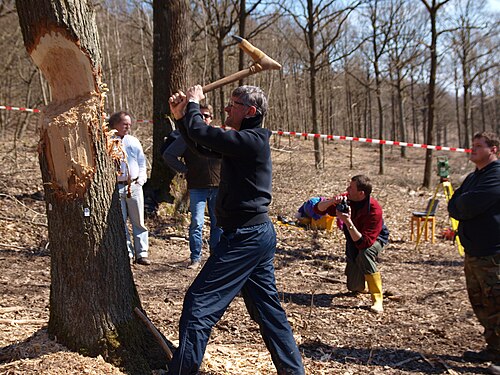
The work of flintknappers is also a kind of experimental archaeology as much has been learnt about the many different types of flint tools through the hands-on approach of actually making them. Experimental archaeologists have equipped modern professional butchers, archers and lumberjacks with replica flint tools to judge how effective they would have been for certain tasks. Use wear traces on the modern flint tools are compared to similar traces on archaeological artifacts, making probability hypotheses on the possible kind of use feasible. Hand axes have been shown to be particularly effective at cutting animal meat from the bone and jointing it.
Another field of experimental archaeology is illustrated by the studies of the stone flaking abilities of humans ("novice knapper" studies) and of non-human primates. In the latter case it has been shown that, after human demonstrations, enculturated bonobos are able to produce modified cores and flaked stones which are morphologically similar to early lithic industries in East Africa.[20]
Historians working on costume and fashion have made reconstructions of garments, including farthingales, which can give a better understanding of clothing types and textile crafts known only from archival records or depictions in portraits.[21][22]
In popular culture
The subject has proven popular enough to spawn several re-creation-type television shows:
The 1978 BBC TV series Living in the Past re-created life in an Iron Age village with 15 volunteers over a period of 13 months.
Discovery Channel's The Colony[25] seasons 1 and 2 showed aspects of experimental archaeology
Discovery Channel's MythBusters often conduct experimental archaeology to test the capability of mythical ancient weapons, including Archimedes' death ray and the tree cannon, as well as testing the capabilities of known weapons including the hwacha, wood vs. stone arrowheads, and the effects of cannonballs and splintering.
↑ Driscoll, K; Alcaina, J; Égüez, N; Mangado, X; Fullola, JM.; Tejero, JM. (2016). "Trampled under foot: A quartz and chert human trampling experiment at the Cova del Parco rock shelter, Spain" . Quaternary International . 424 : 130–142 . Bibcode : 2016QuInt.424..130D . doi : 10.1016/j.quaint.2015.04.054 .