↑ Neve KA 、Seamans JK、Trantham - Davidson H (2004年8 月)。「ドーパミン受容体シグナル伝達」。Journal of Receptor and Signal Transduction Research。24 ( 3 ) : 165–205。CiteSeerX 10.1.1.465.5011。doi : 10.1081/RRS-200029981。PMID 15521361。S2CID 12407397。
1 2 Van Tol HH、Wu CM、Guan HC、Ohara K、Bunzow JR、Civelli O、Kennedy J、Seeman P、Niznik HB、Jovanovic V (1992年7月)。「ヒト集団における複数のドーパミンD4受容体変異体」。Nature。358 ( 6382 ) : 149–52。Bibcode : 1992Natur.358..149T。doi : 10.1038 / 358149a0。PMID 1319557。S2CID 4345839。
↑Catalano M, Nobile M, Novelli E, Nöthen MM, Smeraldi E (October 1993). "Distribution of a novel mutation in the first exon of the human dopamine D4 receptor gene in psychotic patients". Biological Psychiatry. 34 (7): 459–64. doi:10.1016/0006-3223(93)90236-7. PMID8268330. S2CID34841647.
↑Rondou P, Haegeman G, Van Craenenbroeck K (June 2010). "The dopamine D4 receptor: biochemical and signalling properties". Cellular and Molecular Life Sciences. 67 (12): 1971–86. doi:10.1007/s00018-010-0293-y. PMC11115718. PMID20165900. S2CID21432517.
↑Thapar A, Langley K, Owen MJ, O'Donovan MC (December 2007). "Advances in genetic findings on attention deficit hyperactivity disorder". Psychological Medicine. 37 (12): 1681–92. doi:10.1017/S0033291707000773. PMID17506925. S2CID20556855.
12Munafò MR, Yalcin B, Willis-Owen SA, Flint J (January 2008). "Association of the dopamine D4 receptor (DRD4) gene and approach-related personality traits: meta-analysis and new data". Biological Psychiatry. 63 (2): 197–206. doi:10.1016/j.biopsych.2007.04.006. PMID17574217. S2CID28997438.
↑Wedemeyer C, Goutman JD, Avale ME, Franchini LF, Rubinstein M, Calvo DJ (May 2007). "Functional activation by central monoamines of human dopamine D(4) receptor polymorphic variants coupled to GIRK channels in Xenopus oocytes". European Journal of Pharmacology. 562 (3): 165–73. doi:10.1016/j.ejphar.2007.01.055. PMID17350612.
↑ Wu J, Xiao H, Sun H, Zou L, Zhu LQ (2012年6月). 「ADHDにおけるドーパミン受容体の役割:系統的メタ分析」. Molecular Neurobiology . 45 (3): 605–20 . doi : 10.1007/s12035-012-8278-5 . PMID 22610946 . S2CID 895006 .
↑ Ninomiya S, Anjiki A, Nishide Y, Mori M, Deguchi Y, Satoh T (2013年7月). "厩舎飼育馬のドーパミンD4受容体遺伝子の多型は欲求不満に対する行動反応の違いと関連している" . Animals . 3 (3): 663–9 . doi : 10.3390/ani3030663 . PMC 4494454 . PMID 26479526 .
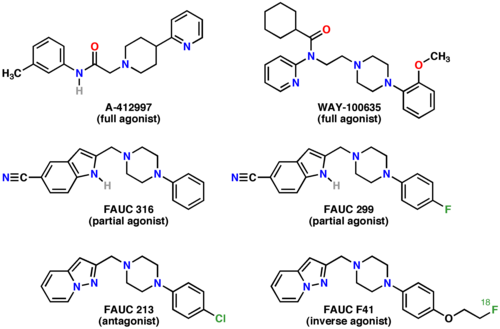
1 2 Hübner H、Kraxner J、Gmeiner P (2000年11月)。「シアノインドール誘導体の高選択性ドーパミンD(4)受容体部分アゴニスト:固相合成、結合アッセイ、および機能実験」。Journal of Medicinal Chemistry。43 ( 23 ) : 4563–9。doi : 10.1021 /jm0009989。PMID 11087581。
↑Kolasa T, Matulenko MA, Hakeem AA, Patel MV, Mortell K, Bhatia P, Henry R, Nakane M, Hsieh GC, Terranova MA, Uchic ME, Miller LN, Chang R, Donnelly-Roberts DL, Namovic MT, Hollingsworth PR, Martino B, El Kouhen O, Marsh KC, Wetter JM, Moreland RB, Brioni JD, Stewart AO (August 2006). "1-aryl-3-(4-pyridine-2-ylpiperazin-1-yl)propan-1-one oximes as potent dopamine D4 receptor agonists for the treatment of erectile dysfunction". Journal of Medicinal Chemistry. 49 (17): 5093–109. doi:10.1021/jm060279f. PMID16913699.
↑Enguehard-Gueiffier C, Hübner H, El Hakmaoui A, Allouchi H, Gmeiner P, Argiolas A, Melis MR, Gueiffier A (June 2006). "2-[(4-phenylpiperazin-1-yl)methyl]imidazo(di)azines as selective D4-ligands. Induction of penile erection by 2-[4-(2-methoxyphenyl)piperazin-1-ylmethyl]imidazo[1,2-a]pyridine (PIP3EA), a potent and selective D4 partial agonist". Journal of Medicinal Chemistry. 49 (13): 3938–47. doi:10.1021/jm060166w. PMID16789750.
↑Nakane M, Cowart MD, Hsieh GC, Miller L, Uchic ME, Chang R, Terranova MA, Donnelly-Roberts DL, Namovic MT, Miller TR, Wetter JM, Marsh K, Stewart AO, Brioni JD, Moreland RB (July 2005). "2-[4-(3,4-Dimethylphenyl)piperazin-1-ylmethyl]-1H benzoimidazole (A-381393), a selective dopamine D4 receptor antagonist". Neuropharmacology. 49 (1): 112–21. doi:10.1016/j.neuropharm.2005.02.004. PMID15992586. S2CID7529599.
12Prante O, Tietze R, Hocke C, Löber S, Hübner H, Kuwert T, Gmeiner P (March 2008). "Synthesis, radiofluorination, and in vitro evaluation of pyrazolo[1,5-a]pyridine-based dopamine D4 receptor ligands: discovery of an inverse agonist radioligand for PET". Journal of Medicinal Chemistry. 51 (6): 1800–10. doi:10.1021/jm701375u. PMID18307287.