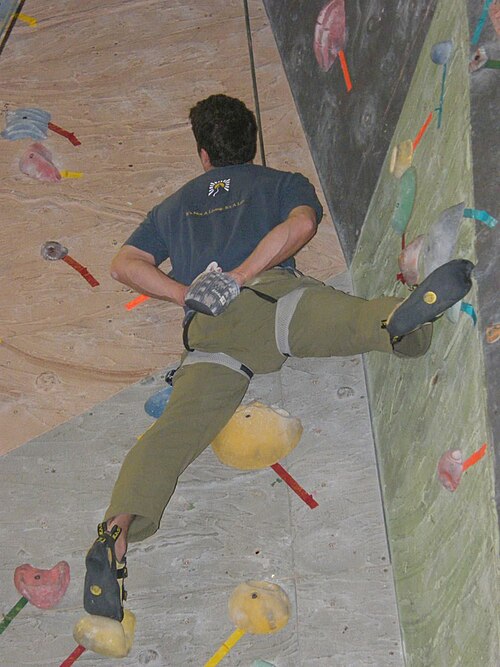
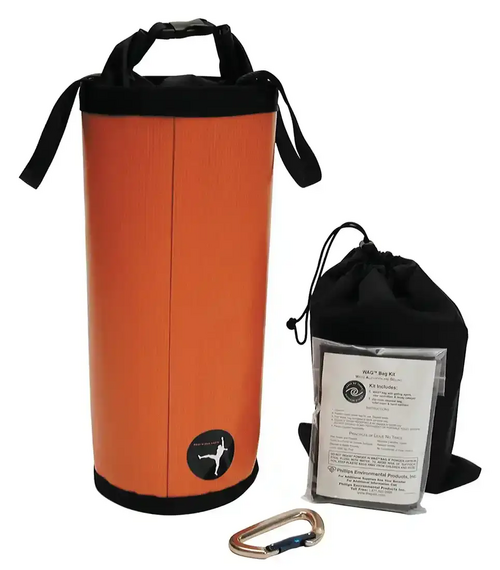
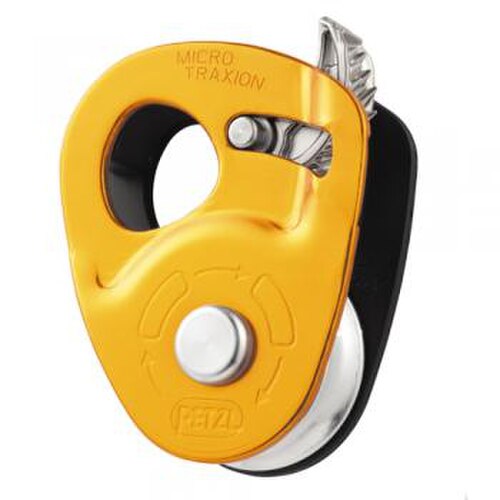
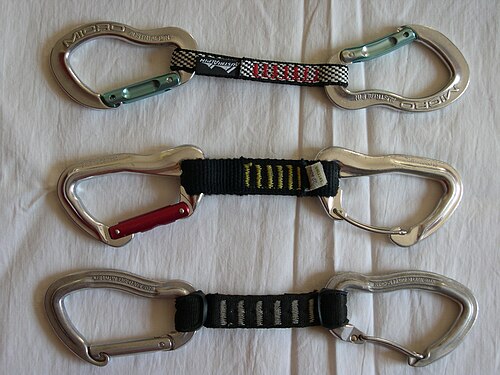
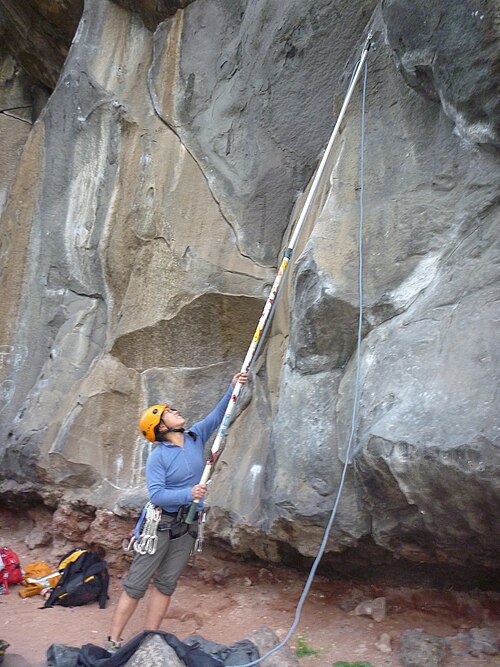
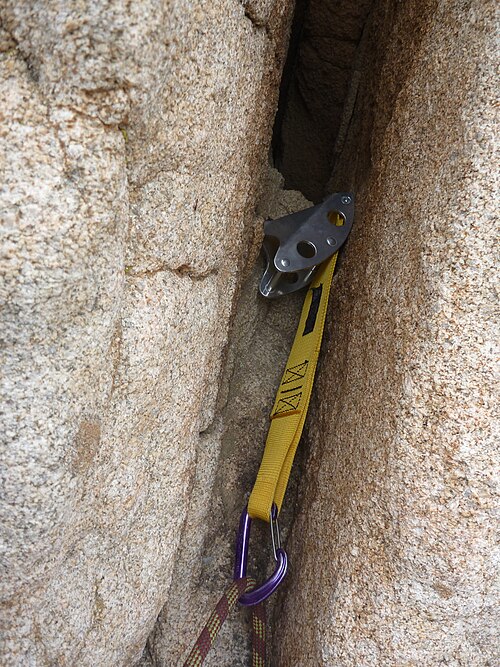
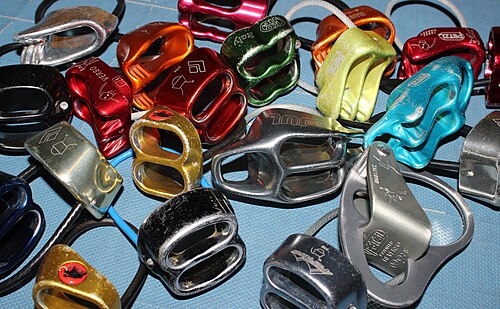
Glasses that are worn by the belayer to help them avoid having to look upward, which can cause neck strain.[14]
belay gloves
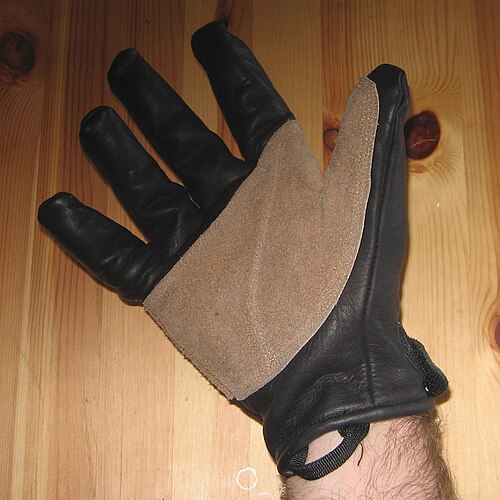
Belay glove Gloves that are worn by the belayer to protect their skin in the event of sudden rope movement and to aid grip.[14]
belay loop
The strongest point on a climbing harness, and the loop to which a belay device is physically attached.[1][2]
belay off
A climbing command from a belayer to confirm that the friction of belaying has been removed from a climbing rope. It is a standard response to a climber's "off belay" request.[15]
belay on
A climbing command from a belayer to confirm that the friction of belaying has been (re)applied to a climbing rope. It is a standard response to a climber's "on belay" request.[15]
2.A type of heavy-duty "all-weather" descender known as an "abseil rack" or a "rappel rack", consisting of metal bars on a U-shaped chassis, which is frequently used in caving. An alternative heavier device is a "whaletail" (also "whale tail") which is a machined block often used by rescuers.[65]
Secondary or intermediate fixed anchor point(s) along the length of a fixed rope (i.e. in addition to the main anchor at the top of the fixed rope) that is used to avoid edges that could increase rope wear.[66]
An energy-saving mountaineering technique where the unweighted (uphill) leg is rested between each forward step, by "locking" the knee of the rear leg.
retro-bolting
The addition of bolts to a route that has already been ascended using traditional climbingprotection. The technique is controversial, with ethical debate on the issues of improving climber safety versus protecting the integrity of the original traditional climbing challenge.[67][68]
rigging plate
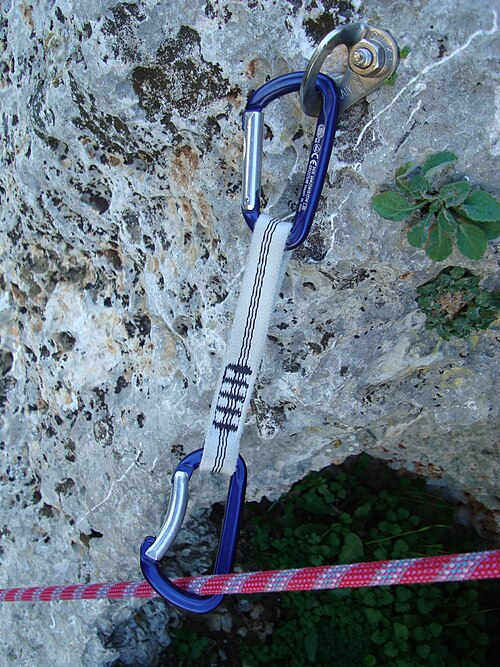
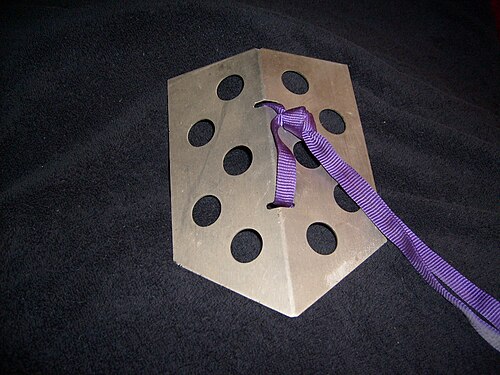
Blue rigging plate A light metal plate with several holes that can be used as a multi-anchor device that several items can be attached to at a belay station, notable versions include the Petzl PAW.
ripped
Term to denote when a piece of protection failed and "ripped-out" of the rock. See zipper fall.[2]
A move in which the crossing arm goes behind the other arm and is so far extended that the body is forced to twist until it ends up facing away from the rock. It was introduced by Antoine Le Menestrel to climb a route in Buoux called La rose et le vampire8b(5.13d) in 1985.[70]
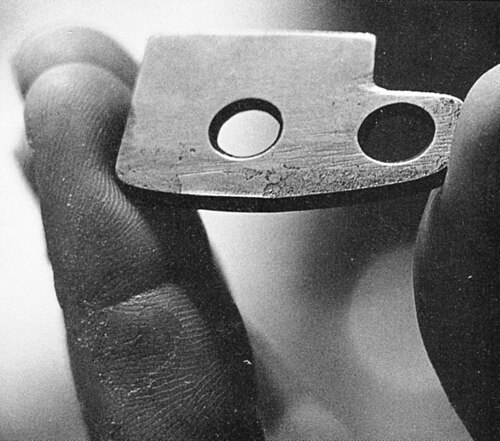
RURP A miniature, postage stamp-sized chrome-moly square piton, tied to a wire or rope and hammered into cracks; created by Yvon Chouinard in 1960 for extreme aid climbing routes in Yosemite; acronym for realized ultimate reality piton.[71]
A rock climb with a much lower official climbing grade than probably deserved; sometimes due to a "trick-move" at the crux that once learned, does make the route easier; or due to overly conservative grading.[2]
A type of climbing somewhere between hiking and graded rock climbing; involves climbing the easiest grades.
screamer
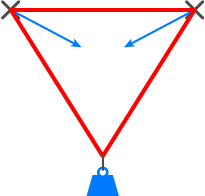
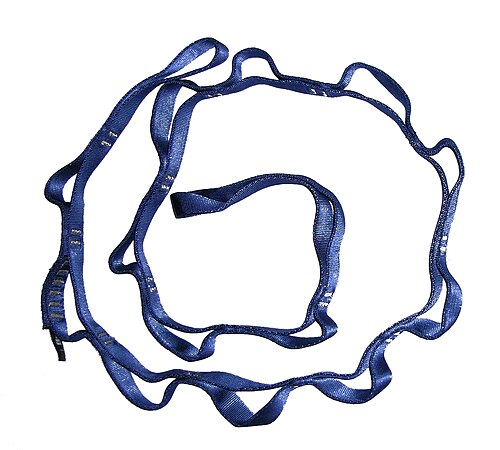
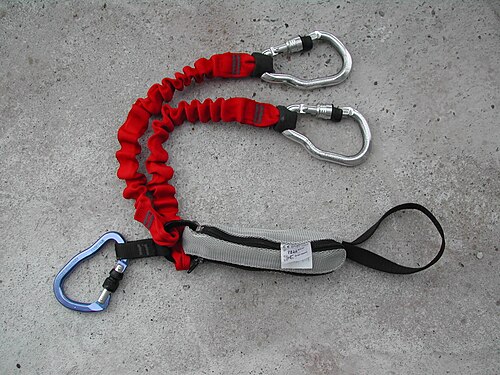
1.Shock absorbing sling designed to reduce peak loads in a climbing system. Very commonly used for winter / ice climbing. Made of a nylon webbing structure consisting of one large loop sewn in multiple places to make a shorter length.
The use of a single rope where one or both ends of the rope are attached to fixed anchor points. See fixed rope.
sit start
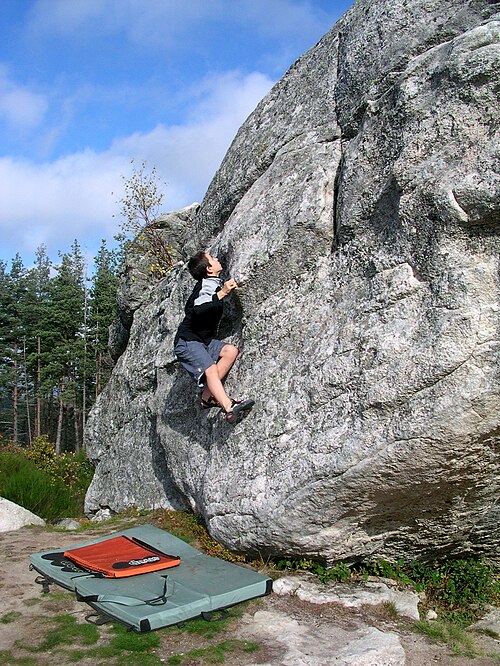
A sit startBouldering term for a route that must be started from a seated position on the ground with hands and feet on prescribed holds; acronyms are SS (sit-start), SDS (sit-down-start), or assis (french); concept invented by John Yablonski.[74]
A technique in mixed climbing and dry-tooling where the ice axe is inverted and the blade wedged into a crack above the climber's head, who then pulls down on the handle of the axe to gain upward momentum. See also undercling pull.[76]
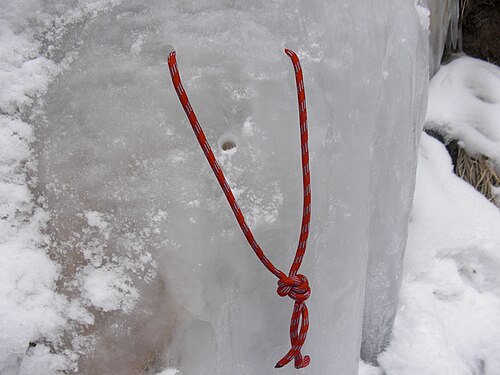
Term to describe pieces of webbing or cord left on a climb (e.g. "I found some old tat") often as part of an irretrievable anchor point that was part of an abseil station.[78]
Talus rocks An area of large rock fragments on a mountainside where the rocks are stable and not loose like scree.
talon hook
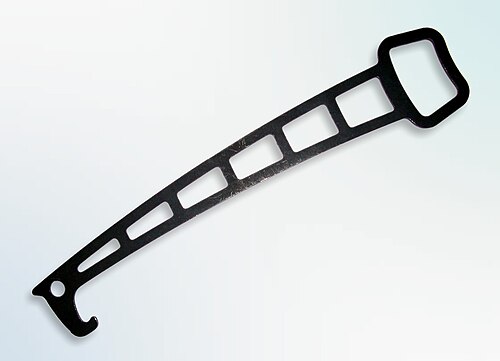
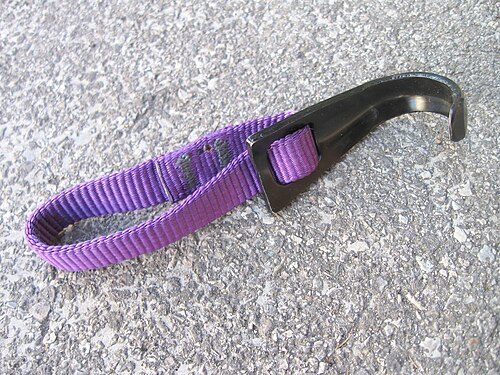
A type of three-pronged climbing hook used for securing the climber to a horizontal edge in the rock face. Each prong contains a curved hook of differing widths for securing onto respective edge sizes when aid climbing.
tape
Applying tape Adhesive tape that is wrapped around the fingers and hands to protect the skin; particularly useful in crack climbing.
A big wall climbing technique where the lead climber carries an additional static rope (in addition to their dynamic climbing rope) that hangs (or "trails") behind them as they ascend; the trail rope enables the belayer to pass equipment to the leader during the ascent, and for the leader to haul up equipment as the belayer ascends.[22][62]
A climbing move where the hips "twist" perpendicular to the wall, the inside arm is "locked" on an upper hold, the outside arm holds the body against the wall, and the feet press down to propel the body higher.
The UIAA grade system for rock climbing, which goes: ... VI, VII, VIII, IX, X, XI, .... , to XII; is less common than the French grade system or the American YDS grade system, but still used in Germany and parts of Eastern Europe.[6]
A downward hold which is gripped with the palm of the hand facing upwards.[1][2][11]
undercling pull
After a stein pull is completed, the undercling pull is a mixed climbing technique for continuing to use the hold to gain upward momentum by using the hold to pull into the rock; requires a lot more energy than a stein pull.[76]
A grading system for boulderingproblems invented by John Sherman, which goes: V0, V1, V2, V3, V4, V5, V6, V7, ... , to V17. The V-scale and the French font scale are the most common boulder grading systems in use worldwide.[1][6]
A thin coating of ice that forms over rocks when rainfall or melting snow freezes, which is hard to climb on as there is insufficient depth for crampons to have penetration. See also clear ice and glaze ice.
Part of the ice climbing system for grading the technical difficulty of ice climbing routes, which goes: WI1, WI2, WI3, WI4, WI5, WI6, and up to WI13.[4] See also M-grade.
Round webbing A hollow and flat nylon strip mainly used to make slings.
webolette
A piece of webbing with eyes sewn into the ends which can be used in place of a cordelette.
weighting
Any time a rope sustains the weight of the climber, e.g. "weighting the rope". This can happen during a minor fall, a whipper (long fall), or simply by resting while hanging on the belay rope. See also hangdogging.
French term for a figure-four move which came from American climber Tony Yaniro's use of it on Chouca8a+(5.13c).[80]
yo-yo
A free climbing term pre-redpointing, where a falling lead climber returns to the ground to restart, but leaves their rope clipped into the protection — in redpointing, the rope is pulled free from all protection before re-starting the climb.[2]
American system for grading walks, hikes, and climbs; the rock climbing (5.x) goes: 5.7, 5.8, 5.9, 5.10a, 5.10b, 5.10c, 5.10d, 5.11a, .... , 5.14a, 5.14b, 5.14c, 5.14d, 5.15a, etc., and with the French grade system, is the most widely used grading system worldwide for sport climbing.[6]
123456789Andrew Bisharat (6 October 2009). Sport Climbing: From Toprope to Redpoint, Techniques for Climbing Success. Mountaineers Books. ISBN978-1594852701. Retrieved 15 August 2023. ebook: ISBN9781594855139
123456"Grade Comparison Chart". Alpinist. 2023. Archived from the original on 30 March 2021. Retrieved 10 March 2023.
↑Ellison, Julie; Whitehead, JP (28 April 2016). "Training: 16 Climbing Games". Climbing. Retrieved 20 May 2019.
12345678Mandelli, Gabriele; Angriman, A (2016). Scales of Difficulty in Mountaineering. Central School of Mountaineering, Italy. S2CID53358088.
↑Weidner, Heather (11 November 2018). "Total Body Climbing: Use All Your Body Parts for Smart, Savvy Climbing". Climbing. Retrieved 20 May 2019.
↑Simon, Bryan R.; Hawkins, Seth C. (18 March 2019). "Learn This: Deep-Water Soloing 101". Climbing. Retrieved 10 May 2023.
↑Corrigan, Kevin (4 September 2022). "Rappellers Threw Themselves Face First Off Cliff With One-Nut Anchor". Climbing. Retrieved 21 March 2023.
12"Three Common Lead Climbing Mistakes to Avoid". Grippped Magazine. 1 March 2021. Retrieved 3 March 2023.
12345678910111213"Climbing Techniques and Moves | REI Expert Advice". REI. Retrieved 13 March 2019.
1234567891011121314"Intermediate Moves". ClimbingTechniques.org. Retrieved 13 March 2019.
↑Schwartz, Howie (21 July 2016). "Demystifying the Ball Nut!". Sierra Mountain Guides. Retrieved 10 March 2023.
12Osius, Alison (22 August 2022). "Sh*t Climbers Bring These Days". Outside. Retrieved 25 June 2024.
12345Brinlee, Chris (16 March 2016). "The Noob's Guide to Rock Climbing". Outside. Retrieved 5 July 2023.
↑"Belay stations – Mountaineering Methodology". www.mountaineeringmethodology.com. Archived from the original on 29 January 2018. Retrieved 8 December 2017.
↑Griffith, Conor (2023). "How It Works: The Bicycle". FrictinoLabs. Retrieved 5 March 2023.
↑Pack, Pamela (18 April 2016). "Learn This: Offwidth Protection Primer". Climbing. Retrieved 30 October 2023.
↑Santelices, Christian (18 June 2013). "How to Hip Belay". Climbing.com. Retrieved 20 April 2023.
↑Bagley, Pat (2 February 2023). "Learn This Critical Skill for Steep Rock: Boinking". Climbing. Retrieved 5 March 2023.
↑Fitchcroft, Cath (25 October 2007). "Bomb-proof belay stakes at Pembroke". British Mountaineering Council. Retrieved 1 March 2023.
1234Synott, Mark (23 February 2022). "Everything You Need to Know for Your First Big Wall". Climbing. Retrieved 16 May 2023.
↑Kirkpatrick, Andrew (2020). "CH04 Anchors". Down. Andrew Kirkpatrick Limited. ISBN978-1-9997005-7-7.
↑Siacci, Ryan (12 July 2023). "Many a visitor has left our shores with crappy dacks (a quaint piece of slang meaning basically what you'd expect) after an exciting episode with this Aussie icon". Climbing. Retrieved 8 November 2023.
↑"The Boot Flake on The Nose on El Cap is Gone, April Foola". Gripped Magazine. 2 April 2020. Retrieved 25 May 2023.
↑Kuehl, Matt (18 December 2015). "Don't Just Wing It: 6 Crucial Wide-Crack Techniques". Climbing. Retrieved 20 May 2019.
↑Achey, Jeff (27 April 2022). "Before "the Nut" There Was "the Pebble"… and It Was Sketchy". Climbing. Retrieved 12 September 2023.
↑Der Sächsische Bergsteigerbund, ed. (1 September 2009), "5.1 Klettergipfel", Sächsische Kletterregeln: Vollständige Fassung (in German), archived from the original(Webdokument) on 10 September 2011, retrieved 16 November 2009
1234567Potter, Stephen (25 July 2022). "Your Complete Guide to Rock Climbing Ropes". Climbing. Retrieved 21 March 2023.
↑Dunne, Toby (17 August 2021). "A brief history of competition climbing". British Mountaineering Council. Retrieved 10 March 2023.
↑Quinn, Steve (13 August 2008). "The Crux". Climbing. Retrieved 24 December 2022.
↑Walker, Noah (21 July 2021). "Do Ethical Dabs in Bouldering Exist?". Gripped Magazine. Retrieved 5 March 2023.
↑Mountaineering: the freedom of the hills. Mountaineers Books. 2017. ISBN9781680510034. OCLC978286879.
↑"Climbing Movement: 17. The DeadPoint". Climbing Tech Tips. 20 August 2017. Archived from the original on 20 September 2020. Retrieved 20 May 2019.
1234Cymerman, A; Rock, PB. "Medical Problems in High Mountain Environments. A Handbook for Medical Officers". US Army Research Inst. of Environmental Medicine Thermal and Mountain Medicine Division Technical Report. USARIEM-TN94-2. Archived from the original on 2009-04-23. Retrieved 2009-03-05.
↑"Film: Emilio Comici – Angel of the Dolomites". Gripped Magazine. 8 July 2015. Retrieved 25 August 2023.
↑"DIRTBAG: THE LEGEND OF FRED BECKEY Screening". The Mountaineers. Retrieved 2021-02-07.
↑Ellison, Julie (11 January 2013). "Extension Basics". Climbing. Retrieved 9 December 2016.
↑"Preventing Rope Drag". ClimbingTechniques.org. Retrieved 9 December 2016.
↑Potter, Stephen (23 August 2022). "A Beginner's Guide to Lead Climbing". Climbing. Retrieved 24 December 2022.
↑"Drilling Bolts? Do Not Do This!". Mountain Project. Retrieved 15 December 2017.
↑"Drilled Pitons in the desert". Mountain Project. Retrieved 15 December 2017.
12Larson, Josh (14 December 2021). "Uncoordinated? Here are Three Drills to Improve Your Dynamic Movement". Climbing. Retrieved 25 April 2023.
↑Frommer, Harvey (2005). The Sports Junkie's Book of Trivia, Terms, and Lingo: What They Are, Where They Came From, and How They're Used. Taylor Trade Publishing. p.308. ISBN978-1-4616-2603-9.
12Pardy, Aaron (2 November 2022). "Onsight and Flash – What Do They Mean?". Gripped Magazine. Retrieved 24 December 2022.
↑"What is French free climbing". Climber. 12 April 2021. Retrieved 5 March 2023.
↑Tim Hatch, François Leonardon. "IFSC 2021 Rules"(PDF). Archived from the original on May 8, 2021. Retrieved 2021-12-04.
123Pardy, Aaron (5 November 2022). "Redpoint, Pinkpoint, and Headpoint – What Do They Mean?". Gripped Magazine. Retrieved 21 December 2022.
↑Corrigan, Kevin (6 October 2022). "Hangboarding For Everyone". Climbing. Retrieved 10 March 2023.
↑Haas, Laz (21 July 2022). "How to Hangdog Sport Climbing". Climbing. Retrieved 3 March 2023.
12Nelson, Ryan (27 February 2012). "Is Mixed Climbing Legitimate?". Rock & Ice. Archived from the original on 30 April 2023. Retrieved 30 April 2023.
↑Mountaineering: the freedom of the hills. Mountaineers Books. 2017. ISBN9781680510034. OCLC978286879.
↑"Best Ice Climbing tools | Black Diamond Ice Axes | Black Diamond® Climbing Gear".
↑Buys, Jordan (15 November 2010). "Use your knees!". UKClimbing. Retrieved 12 December 2016.
↑Walker, Noah (31 December 2020). "Grading: Adam Ondra and Alex Megos on Ethics and Kneepads". Gripped Magazine. Retrieved 25 June 2024.
↑Adam Ondra (8 January 2021). "Climbing Ethics". AdamOndra.com. Retrieved 1 January 2022.
↑"Leavittation: How To Climb Offwidth Cracks". Gripped Magazine. 8 May 2013. Retrieved 6 March 2023.
↑Hartemann, Frederic; Hauptman, Robert (2005-06-15). The Mountain Encyclopedia: An A to Z Compendium of Over 2,250 Terms, Concepts, Ideas, and People. Taylor Trade Publishing. ISBN9781461703310.
↑Samet, Matt (26 June 2019). "Ah Yes: The Red-Tag / Open Project Dilemma". Climbing. Retrieved 15 September 2023.
12Ogden, Jared (2005). "Chapter1: Big Wall Climbing Procedures". Big Wall Climbing: Elite Technique (1sted.). Mountaineers Books. pp.94–140. ISBN978-0898867480.
↑Wharton, Josh (25 August 2022). "Top-rope soloing: How Josh Wharton Climbs Multi-pitches Faster and With Less Energy". Climbing. Retrieved 5 March 2023.
↑Black, Christian (3 February 2022). "Rope Solo Rock Climbing: Understanding How It's Done". GearJunkie. Retrieved 3 March 2023.
↑Warild, Al (1994). "Chapter 6: Descent". Vertical(PDF) (3rded.). National Speleological Society. p.96. ISBN978-0958925372. Retrieved 2 July 2024.
↑Chelton, Neil (2024). "How To Climb a Big Wall – Fixing Pitches". VDiff Climbing. Retrieved 10 May 2024.
↑Miller, Sam (26 October 2022). "Opinion: Not Retro-Bolting Is Irresponsible. A Doctor Sounds Off". Climbing. Retrieved 1 March 2023.
↑Bordeau, Steve (18 July 2023). "Should We Really Retro-bolt That Dangerous Classic?". Climbing. Retrieved 12 September 2023.
↑Midtbø, Magnus (30 October 2017). "How to Rodeo Clip – Climbing Rope Skills". Rock & Ice. Archived from the original on 11 March 2023. Retrieved 10 March 2023.
↑"Watch Anna Stohr do the Rose Move on the Famous Rose Route". Gripped Magazine. 22 November 2018. Retrieved 10 March 2023.
↑Ax, Anders (6 November 2015). "Tool Users: Realized Ultimate Reality Piton". Alpinist. Retrieved 10 March 2023.
↑Facante, Russ (4 April 2012). "Short-Fixing". Climbing. Retrieved 10 March 2023.
12Oakley, Miranda (23 December 2022). "Advanced Climbing Techniques: Simul-Climbing and Short-Fixing". Climbing. Retrieved 10 March 2023.
↑Copeland, Victor (15 October 2022). "The Weird Origins Of Bouldering's Sit Start". Climbing. Retrieved 13 August 2023.
↑Potter, Stephen (23 August 2022). "A Beginner's Guide to Lead Climbing". Climbing. Retrieved 18 March 2023.
123Issac, Sean (2 February 2004). "Ice Climbing Skills: The Stein Pull". Climbing. Retrieved 30 April 2023.
↑Soanes, Catherine and Stevenson, Angus (ed.) (2005). Oxford Dictionary of English, 2nd Ed., revised, Oxford University Press, Oxford, New York, p. 1775. ISBN978-0-19-861057-1.