
Loading article…
バルベリーニ象牙は、古代末期に制作された皇帝の二連祭壇画の一部であるビザンチン象牙の葉で、現在はパリのルーブル美術館に所蔵されている。皇帝が勝利を収めた姿で描かれている。一般的には6世紀前半の作品とされ、コンスタンティノープルの皇帝工房で制作されたと考えられている。皇帝は通常ユスティニアヌス帝、あるいはアナスタシウス1世かゼノン帝とされている。この象牙は、アウストラシアの女王ブリュンヒルダと関連付けられており、歴史的に重要な資料である。裏面にはフランク王国の王たちの名前が記されており、いずれもブリュンヒルダの親族であることから、彼女の重要な地位がうかがえる。ブリュンヒルダはこのリストを記すよう命じ、奉納像として教会に寄贈した。
これは執政官の二連祭壇画ではないものの、装飾様式において多くの共通点を持っている。主パネルでは、皇帝の左側にズボンを履いた征服された蛮族、おそらく征服または再征服された領土を表し、感謝または服従の意を示すために足を下げているしゃがみ込んだ寓意像、そして皇帝に伝統的な勝利の棕櫚の葉(現在は失われている)を授ける勝利の天使が皇帝に付き添っている。蛮族は皇帝の巨大な槍に一部隠れているが、槍は彼を貫いておらず、彼は戦闘的というよりは驚きと畏怖の念を抱いているように見える。上部には、流行の巻き毛の髪型をしたキリストが、異教の勝利像の様式で描かれた2人の天使に挟まれている。キリストは上空で君臨し、皇帝は地上でキリストを表している。下部パネルでは、西(左、ズボンを履いている)と東(右、象牙の牙、虎、小さな象を伴っている)の蛮族が、野生動物を含む貢物を携えてやって来ている。左側のパネルに描かれた兵士を表す人物は、勝利の女神像を携えている。右側の対応する人物像は失われている。
元々は5枚の長方形の板で構成されていたが、右側の板は(おそらく16世紀に)CONSTANT. N. IMP. CONST. という銘文が刻まれた板に置き換えられた。板は、中央の大きな板の周りで、舌と溝の接合部で接合されている。全体として、この作品は、このような良好な状態で残っている唯一の世俗的な品である。[ 1 ]全体の 寸法は高さ34.2 cm (13インチ) 、幅26.8 cm (11インチ)で、中央のパネルは高さ19 cm (7インチ) 、幅12.5 cm (5インチ)、奥行き2.5 cm (1インチ)である。象牙で作られ、彫刻され、宝石がはめ込まれている (7つの真珠が残っている)。一部の歴史家が想定しているのとは異なり、多色装飾の痕跡はない。
バルベリーニ家の象牙が二連祭壇画の一部であったかどうかは定かではない。つまり、もう一枚の肖像画(おそらく皇后の肖像画)を描いた二枚目の板があったかどうかは定かではない。この一枚目の板は既に重すぎて、実際に筆記板として快適に使うことはできず、本の表紙であったことを示す蝶番の痕跡もない。
裏面は平らで滑らかで、執政官の二連祭壇画に見られるような蝋をはめ込むための窪みはなく、書記板として使われていた。しかしながら、古いインクの碑文の上に後から刻まれた線が筋状に刻まれており、その中には名前のリスト(死者のための祈り)が含まれており、その中にはアウストラシアの王たちの名前や、主にラテン語の名前が見られる。 人名学によれば、このリストは現代における発見場所からプロヴァンス地方のものと思われていたが、オーヴェルニュ地方のものであることが判明している。碑文も7世紀(おそらく613年頃)のもので、この作品が初期の頃にガリアにもたらされたことを示している。
1625年までの象牙の来歴は不明である。1625年、この象牙は著名な骨董収集家ニコラ=クロード・ファブリ・ド・ペイレスクによって、エクス=アン=プロヴァンスで教皇特使フランチェスコ・バルベリーニ枢機卿 に贈呈され、ローマのバルベリーニ・コレクションの一部となった。ペイレスクは1625年10月29日付の友人パラメード・ド・ヴァラヴェス宛の手紙の中で、この象牙について具体的に言及している。
...[the cardinal] was pleased to see an ancient ivory bas-relief which I recovered a little earlier, where is represented the emperor Heraclius on horseback, with borders bearing a cross and his son Constantine carrying a Victory and many captive provinces beneath his feet, like that of the Grand 'Camayeul' of Tiberius. I gave it to him as he left (...) he had several similar pieces in the same manner in ivory, with which [my example] would go well.[2]
We can very probably find confirmation of it being in the Barberini collection through a mention of an ivory representing Constantine in the inventory of sculptures in the possession of Francesco Barberini between 1626 and 1631.[3] It was acquired by the Louvre in 1899 and has since then been in the département des objets d'art (inventory number OA 9063).
The work combines on the one hand a classic theme of the total power of the victorious emperor, crowned by Victory, whose universal rule is synonymous with peace and prosperity, and on the other hand the theme of Christian victory brought by Christ's patronage and blessing of the emperor. It introduces a new cosmic hierarchy into the representation of the triumph of the Roman Empire and is thus a highly political work designed to serve as imperial propaganda. The quality of the workmanship allows it to be attributed to an imperial workshop in Constantinople.
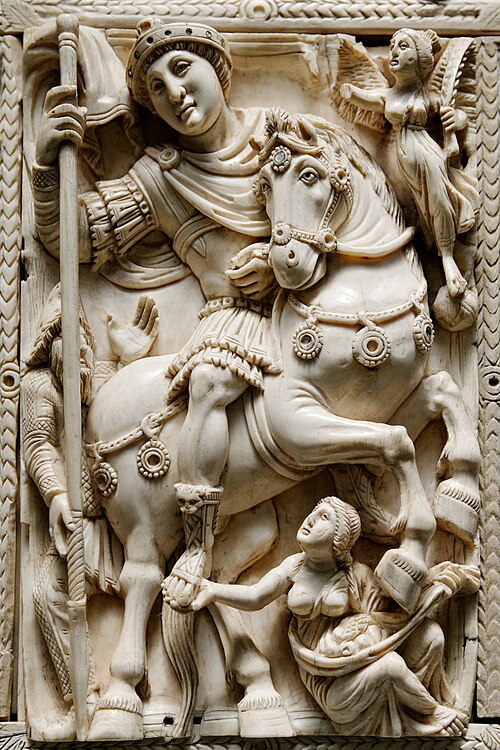
The composition is arranged around a central plaque which dominates it by its motif as much as by its stylistic quality. The sculpted motif is a triumphant figure of an emperor on a rearing horse. In his right hand the emperor holds the butt of a lance, the other end pointed towards the ground, and in his left he holds his horse's reins. Behind the lance is the figure of a barbarian, identified as such by his hair, his bushy beard and above all by his clothes - his curved cap (similar to a Phrygian cap), indicating an eastern origin, a long-sleeved tunic and baggy trousers. Symbolising a Persian or a Scythian, he may represent the peoples defeated by the emperor – as a sign of submission he touches the lance with his right hand and raises his left hand - or be "cheering",[4] perhaps a member of an auxiliary unit. Ernst Kitzinger noted as "remarkable... the amount of lively activity with which the central relief is packed", in contrast to the static figures at the centre of most diptychs. In his interpretation "The emperor has arrived on his charger this instant, his mantle still flying in the wind. It almost appears as though he had just passed through a low city gate which had caused him to tilt his head. He pulls in his reins and makes a rapid half-turn as he rams his spear into the ground to use it as a support in dismounting. ... In all Roman art there is no more spirited portrayal of an imperial adventus."[5]
右下隅、馬の下には、一人の女性が地面に横たわっている。彼女のローブはずり落ち、右胸が露わになっている。左手には、繁栄の象徴である果物が入ったローブの裾を持っている。右手は皇帝の右足に伸ばされ、服従の意を示している。彼女は大地を擬人化し、皇帝の普遍的な支配を象徴するとともに、果物は皇帝の治世の繁栄を象徴している。この擬人化は、勝利した皇帝や威厳ある皇帝の像でこの役割でよく表現されており、例えばテオドシウスのミッソリウム(同様にテルスが構図の下部、威厳ある玉座に座るテオドシウス1世の像の下に表現されている)やガレリウスの凱旋門のピエタス・アウグストルムのレリーフ(テトラルキアがガイアを含む一連の擬人化を伴っている)[ 6 ]などが挙げられる。テルス/ガイアのこれらの擬人化は、一般的に豊穣の角 という主要な属性によって識別できるが、これは象牙には実際には存在しないものの、女性のローブの果物で満たされたひだは同じ形をしており、同じ象徴的な機能を果たしている。

中央パネルの右上隅にある最初の女性像と対照的に、十字架の印が刻まれた地球儀の上に立つ翼のある勝利の女神の小像が、左手に勝利の象徴である棕櫚の葉を持ち、右手(現在は破損)には皇帝の頭に載せるための冠をほぼ確実に持っていた。この種の小像による擬人化は、勝利した皇帝の図像とのつながりの1つでもあり、いくつかの硬貨(例えば、コンスタンティヌス2世のソリドゥス金貨の裏面、右)だけでなく、彫刻(例えば、ガレリウスの凱旋門の犠牲の場面)や、いくつかの執政官の二連祭壇画にも見られる。
皇帝は、コンスタンティヌス帝がしていたような、前髪が顔の周りにアーチ状の円を描くボウルカットまたはアーキボルトカットの髪型をしており、真珠がちりばめられた冠を被っている。そのうち4つが現存している。顔立ちは卵型で、特にまぶたや鼻がかなり重厚だが、皇帝の肖像画に明るい印象を与えている。皇帝は、描かれている役割である最高司令官の軍服を着用している。胸当ての下には短いチュニックを、胸当ての上にはマント(パルダメントゥム)を羽織っており、そのひだが背中にたなびき、丸い留め具で肩に固定されている。留め具は元々、胸当てと同様に宝石で作られていた。彼はライオンの頭で飾られた、交差編みのブーツ(コトゥルニ)を履いている。馬具は、象嵌細工が施された一連のメダリオンで飾られているが、現在では馬の頭の中央にあるもの以外は失われている。
この中心モチーフのレリーフは特に強調されており、勝利の女神、槍、そして程度は低いものの皇帝と馬の頭部は、ほぼ立体的に彫刻されている。衣服のひだの造形や、皇帝の腕の筋肉といった解剖学的細部の表現における細心の注意は、古典主義的であると言えるだろう。これらの特徴は、人物像の不均衡なスケールと相まって、皇帝の威厳を際立たせ、テオドシウス帝時代の美術を彷彿とさせる。
側面パネルは中央パネルほど浮き彫りが深くなく(中央パネルの彫刻の最大深さは28mmで あるのに対し、 側面パネルはわずか9mm)、様式的にも中央パネルよりやや技巧に劣る。側面パネルには簡略化されたジグザグ模様の縁取りが施されており、中央パネルの縁取りには様式化された葉のガーランドを配置する余地が残されている。また、各側面の中央には、現在失われている4つの象嵌のための小さな丸い穴が開いている。

左側のパネルには、皇帝に匹敵する軍服と装備を身に着けた上級将校が描かれている。髭を生やした彼は、胸当てとパルダメントゥム(肩当て)を着用しており、パルダメントゥムは皇帝のものよりも簡素な留め具で右肩に固定されている。左側のベルトに装着された剣の鞘も確認できる。彼は皇帝に向かって進み、台座の上に立つ勝利の女神像を差し出す。この女神像は、中央パネルの勝利の女神像と同様に、冠と棕櫚の葉を持っている。彼の足元には袋が置かれている。この人物は、コリント式の柱頭を支える2本の柱と、皇帝の宮殿の一室を思わせるモザイク模様(おそらくオプス・セクティレ)で構成された建築的な構図の中に立っている。
この人物は執政官と解釈されることもあり、勝利の女神像と袋(おそらく金が入っていると解釈される)は執政官の象徴とされる。しかし、この人物は、クレメンス(513年)やユスティヌス(540年)の二連祭壇画などに描かれている執政官の寛大さであるスパルシオを表している可能性もあり、金の袋はより広く戦利品、つまり皇帝の勝利の証を象徴している。同様に、354年の暦に描かれたカエサル・ガルスが同様の勝利の女神像を持っている場合、彼は軍服ではなく私服を着ている。したがって、バルベリーニの象牙に描かれた将校は、象牙に描かれた勝利の戦役に参加した将軍を表している可能性が高い。右側の対称的なパネル(現在は失われている)には、同様の姿の別の将軍が描かれていたと考えるのが自然である。また、この人物は、おそらく508年にこの二連祭壇画を受け取ったフランク王クローヴィス1世を表している可能性もある。 [ 7 ]
下部のパネルは、中央の勝利の女神像に向かって進む蛮族と動物の二重の行列で飾られたフリーズのような形をしている。勝利の女神は中央パネルの皇帝像を見上げるように向きを変え、右手には伝統的な形で武器、鎧、戦利品が取り付けられた枝の形をした戦利品を持っている。敗北した蛮族は皇帝に貢物として様々な贈り物を携えており、服装や同行する野生動物によって区別されている。左側には、中央パネルの蛮族と同じタイプの髭を生やした二人の人物がおり、短いチュニック、フリギア帽、閉じたブーツを身に着けている。一人は王冠をかぶり、もう一人は中身不明の円筒形の容器(おそらく金)を持ち、彼らの前にはライオンが歩いている。彼らはペルシア人かスキタイ人かもしれない。
右側の二人の野蛮人は、全く異なる服装をしている。上半身裸で、羽飾りのついた布製の頭飾り、腰に巻いたシンプルな布、そしてサンダルを身につけている。彼らには虎と小さな象が付き添っている。虎は肩に象牙を、象は用途不明の杖を持っている。これらはインド人を表している。
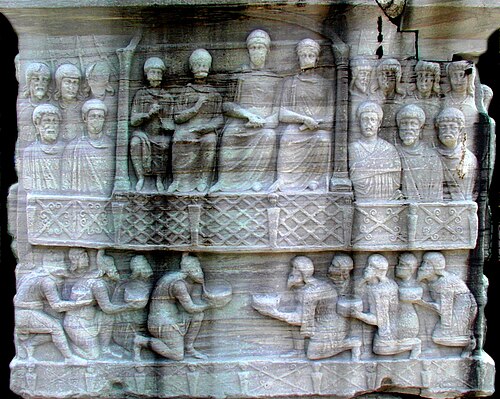
This motif of barbarians rendering homage to the emperor is common in Roman and Byzantine bas-reliefs – here, it is the aurum coronarium, the presenting of tribute. They show the emperor's clementia and underline the symbolism of imperial victory. One of two ivory fragments attributed to an imperial diptych now in Milan also represent this motif, in a slightly earlier work.[8] It can also be found in Constantinople, for example on the base of the column of Arcadius (in a composition comparable to that on the Barberini ivory) or on the obelisk of Theodosius in the hippodrome (shown left). On the obelisk of Theodosius ten barbarians, again divided into two groups, converge on the central figure of the emperor, in this example enthroned in majesty in an imperial box surrounded by other augusti. On the left are Persians, and on the right are indeterminate western barbarians, perhaps Germans or Goths. Victory is absent on this relief, but she is well represented on the lost base of the column of Arcadius and on the lost base traditionally attributed to the column of Constantine – in both cases Victory is in a central position, as a sort of intermediary between the defeated barbarians and the figure of the emperor, situated below.
The upper panel of the ivory is occupied by two angels bearing an imago clipeata, a large medallion bearing a bust of a young and beardless Christ, holding a cruciform sceptre in his left hand and making a traditional sign of benediction with his right (the ring-finger held over the thumb). The bust is framed by symbols of the sun to the left and of the moon and a star to the right. The pair of angels bearing an image of Christ here replaces the earlier image of two winged Victories bearing a personification of Constantinople to be found on the second panel of the previously mentioned imperial diptych at Milan – the substitution is far from insignificant and implies a paradigm shift vital to the dating and understanding of the Barberini ivory. Kitzinger notes that the angel on the left echoes the emperor's turned head, and says "Christ makes his appearance in heaven at the moment in which the emperor stages his triumphal adventus on earth. It is a graphic depiction of the harmony between heavenly and earthly rule."[9]
中央パネルに描かれた皇帝の正体という問題は、バルベリーニ象牙彫刻の解説者たちを悩ませてきた中心的な問題である。その最初の近代の所有者であるペイレスクは、ためらうことなく彼をヘラクレイオスと認識し、勝利の小像を捧げている将校を彼の息子コンスタンティノス3世と特定した。中央の人物の後の特定には、コンスタンティノス1世、コンスタンティウス2世、ゼノン、そして何よりもアナスタシウス1世またはユスティニアヌスも含まれている。[ 10 ] 象牙彫刻が制作された時点で、描かれている皇帝が必ずしも在位中の皇帝ではないという事実によって、特定は複雑になっている。したがって、象牙彫刻の年代は、皇帝を特定する上で間違いなく有用な指標ではあるが、その点に関して決定的なものではない。
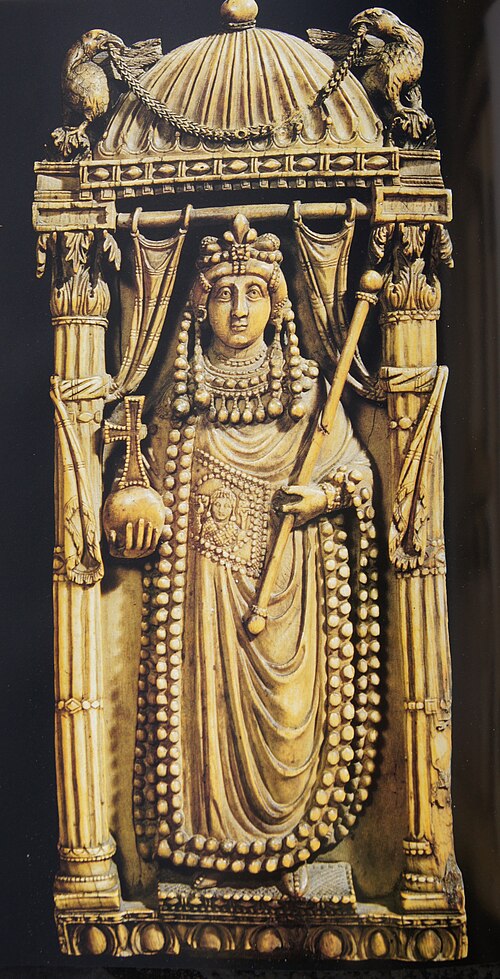


様式的な観点から見ると、中央パネルの高浮彫りの彫刻は、6世紀初頭に制作された他の2枚の象牙パネルと比較できる。どちらも皇后を表しており、1枚はフィレンツェのバルジェッロ美術館(左)、もう1枚はウィーン美術史美術館にある。[ 11 ]これらは、皇帝ゼノン(430~491年)とアナスタシウス1世(491~518年)の妻で ある皇后アリアドネ(?~518年)を描いている。この類似性から、バルベリーニの象牙に描かれた皇帝がアナスタシウスである可能性が示唆される。
アナスタシウス帝の治世は、502年から505年にかけてのササン朝ペルシアとの困難な戦争によって特徴づけられ、506年の和平によって現状が回復されたものの、コンスタンティノープルではローマの当初の挫折後の勝利として提示された。バルベリーニ象牙細工の製作は、このような文脈で捉えることができ、ペルシアに対する勝利が象徴されていたと考えられる。
Although the figure shares characteristics with certain consuls on diptychs contemporary with Anastasius I, such as that of Anastasius (517) and above all that of Magnus (518), the emperor's portrait on the Barberini ivory bears little resemblance with known portraits of Anastasius such as the medallion on the consular diptych of Anastasius. It is in fact closer to known portraits of Constantine, which has allowed certain historians to identify him with that emperor, including Barberini himself, as a contemporary catalogue entry for it shows (see above). This interpretation also owes something to the modern inscription on the right-hand replacement panel, in which it is easy to recognise the emperor's name, or at least so long as it does not refer to Constans or Constantius II instead.
On the other hand, stylistic criteria leave no doubt that the ivory is no earlier than the end of the 5th century, with the resemblance to the imperial portrait to portraits of Constantine explained by the commissioner's explicit will to recall the image of that emperor. From this perspective, this reference back to the iconography of Constantine fits Justinian better than it does Anastasius I.
The lower-relief style of the secondary panels, and notably the purely graphic and unplastic rendering of clothing, accommodates a later dating of the work to around the middle of the 6th century. The work's combination of high-quality reliefs evokes another famous work of ivory sculpture of this era, the Throne of Maximian at Ravenna, datable to 545–556, and another product of a top-quality workshop, perhaps even the same one, in either Constantinople or Alexandria – this would make the triumphant emperor Justinian.[12]

The prepossessing position given in the composition to the figure of Christ blessing the emperor also suggests a Justinian date – it is comparable to a consular diptych of Justin from 540, the last known consular diptych before Justinian suppressed the consulship in 541, and the first to place images of Christ and of the imperial couple (Justinian and Theodora) in medallions below the portrait of the consul. Up until then the Christian presence on these diptychs had been limited to the symbol of the cross, like those framing the imperial portraits on the consular diptych of Clement in 513. This cross could also be shown within a crown carried by two angels, the best-known motif of the Theodosian era – besides ivories such as that at Murano, it also figures on the bas-reliefs of the column of Arcadius and the decoration of the sarcophagus of Sarigüzel. Replacing the cross within the crown with a bust of Christ on the Barberini ivory marks another step in the Christianisation of the relief form, which would also date it to later than the reign of Anastasius and corresponds well to the ideological orientation observed at the start of Justinian's reign. The Archangel ivory in London, of which only one panel survives, represents an archangel holding a sceptre and a globe topped by a cross and can be assigned to the same ideological movement. It was dated precisely to the start of Justinian's reign in 527 by D.H. Wright, after making a new translation of its Greek inscription.[13]
The identification of the triumphant emperor with Justinian thus corresponds quite well to the imagery left behind by this emperor, which also includes equestrian statues and statues of Victory (for victories over the Persians that were heavily proclaimed in propaganda but not particularly real). A drawing by Nymphirios (a member of the entourage of Cyriac of Ancona) now in the library of the University of Budapest[14] shows the statue which surmounted the column raised by Justinian in 543/4 in the Augustaion in Constantinople and described at length by Procopius of Caesarea in his Edifices (I, 2, 5). The emperor, mounted on a horse with one hoof raised, holds an orb surmounted by a cross in his left hand and greets the viewer with his right hand. He is crowned with a large plumed headdress or toupha. According to the epigram which was its dedicatory inscription, conserved in the Anthology of Planudes[15] and confirmed by Procopius's account, the statue was set up so as to face east, towards the Persians, as a sign of the emperor threatening them. The connection of this statue with the triumphant emperor on the Barberini ivory is also justified in that the former was part of a sculptural group in the Augustaion which also included statues of three barbarian kings offering tribute to the emperor, as in the lower panel of the ivory.[16]


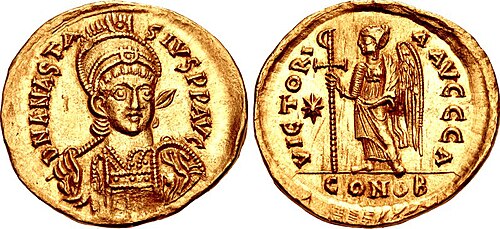
アウグスタイオンの彫像の図は、左のメダルの1つに描かれたユスティニアヌスの騎馬像と関連している可能性がある。[ 17 ] 問題のメダルは、1751年に発見され、1831年にメダル室(現在はフランス国立博物館の一部)から盗まれて失われた金貨で、重さは36ソリドゥス(164グラム)だが、その電鋳版は現存している。表面には、 槍を持ち、胸甲を着用し、王冠とトゥーファを被った将軍としてのユスティニアヌスの光輪付きの胸像が描かれている。銘文はDominus Noster Iustiniianus Perpetuus Augustus [ 18 ](我らが主ユスティニアヌス、永遠のアウグストゥス)と記されている。裏面には、再び光輪を被ったユスティニアヌスが、豪華な装束の馬に乗っている姿が描かれており、その馬具はバルベリーニの象牙に描かれた馬の馬具を彷彿とさせる。彼の前には、左腕に棕櫚の葉とトロフィーを抱えた勝利の女神が描かれている。地には星が描かれ、下部の銘文にはCONOB(コンスタンティノープルの造幣所を示す)のマークがあり、銘文にはSalus et Gloria Romanorum(ローマ人の安全と栄光)と記されている。ユスティニアヌスが四分の三横顔で描かれていることから、このメダルは538年以前に作られたものと推定される。それ以降、彼は常に正面顔で描かれるようになった(右)。534年のカルタゴのヴァンダル族からの奪還を記念する凱旋式での特に豪華な祝典が、この特別なメダルの鋳造を記念する出来事であった可能性がある。
もう一つの騎馬像は、奉納碑文のみが現存するものの(これもプラヌデスの詩集に記されている)、コンスタンティノープルの競馬場にあった。この像の図版は残っていないが、競馬場(コンスタンティノープルの主要な集会所であり、皇帝の宣伝画像を展示するのに最適な場所)にあったことから、皇帝の最も有名な騎馬像の一つであったに違いなく、象牙やその他の素材で模倣された可能性が高いと考えられる。碑文は確かに壮大な構成を示唆しており、バルベリーニの象牙彫刻の中心的モチーフを想起させるに違いない。
見よ、メデスの君主にして滅ぼし者よ、汝が支配するローマの父であり息子でもあるエウスタティオスが汝に捧げる供物とは、勝利の女神の上に立ち上がる馬、汝を戴冠させる第二の勝利の女神、そして風のように速くこの馬に跨る汝自身である。かくして汝の権力は高みに達した、ユスティニアヌスよ――そして地上では、メデスとスキタイの勇士たちは永遠に鎖につながれたままとなるであろう。

コンスタンティノープルにユスティニアヌス帝の騎馬像が存在することは、バルベリーニ象牙彫刻の中心テーマが、これらの彫像によって普及した失われた様式を再現したものであり、新たな様式を生み出したものではないことを示唆している。この様式の少なくとももう1つの例は、現在アテネのビザンチン・キリスト教博物館に所蔵されている青銅製の分銅(右)に現存している。この分銅には、バルベリーニ象牙彫刻の中心モチーフが正確に複製されているが、細部は少なく、サイズも大幅に縮小されている。青銅が象牙を直接モデルにしたというよりは、両者が単一のモデル、おそらく競馬場にあった失われた騎馬像から派生した可能性が高い。これは、二連祭壇画と同様に、青銅が皇帝の工房で製作された公式の品物であることに疑いを抱かせるものではない。しかし、青銅はモデルのより控えめな複製であり、安価であるため、象牙よりも広く流通することを意図していた可能性がある。
この小型の複製が存在することは、ユスティニアヌス帝の治世下におけるこの種のプロパガンダ画像の人気を裏付けるとともに、皇帝がこれらの画像を、立体的な巨大な人物像彫刻からレリーフ、青銅製のミニアチュール、象牙のパネルに至るまで、実に多様な媒体で制作・普及させることに熱心であったことを示している。ユスティニアヌス帝の治世には、勝利に終わった戦争、あるいはより多くの場合、プロパガンダ的に勝利として提示できる戦争が数多くあり、こうした種類の物品の制作が正当化されたのである。
伝統的にペルシア人として認識されている蛮族の卓越した地位、そしてこの像がアウグスタイオンの彫像群と類似していることから、この像の制作は532年にササン朝ペルシアとの間で締結された「永久平和条約」がきっかけとなったと考えることができるが、様式的な基準からすると、より後の年代が示唆される。