
Loading article…
The alternative minimum tax (AMT) is a tax imposed by the United States federal government in addition to the regular income tax for certain individuals, estates, and trusts. As of tax year 2018, the AMT raises about $5.2 billion, or 0.4% of all federal income tax revenue, affecting 0.1% of taxpayers, mostly in the upper income ranges.[1][2]
An alternative minimum taxable income (AMTI) is calculated by taking the ordinary income and adding disallowed items and credits such as state and local tax deductions, interest on private-activity municipal bonds, the bargain element of incentive stock options, foreign tax credits, and home equity loan interest deductions. This broadens the base of taxable items. Many deductions, such as mortgage home loan interest and charitable deductions, are still allowed under AMT. The AMT is then imposed on this AMTI at a rate of 26% or 28%, with a much higher exemption than the regular income tax.
The Tax Cuts and Jobs Act of 2017 (TCJA) reduced the fraction of taxpayers who owed the AMT from 3% in 2017 to 0.1% in 2018, including from 27% to 0.4% of those earning $200,000 to $500,000 and from 61.9% to 2% of those earning $500,000 to $1,000,000.
The major reasons for the reduction of AMT taxpayers after TCJA include the capping of the state and local tax deduction (SALT) by the TCJA at $10,000, and a large increase in the exemption amount and phaseout threshold. A married couple earning $200,000 now requires over $50,000 of AMT adjustments to begin paying the AMT. The AMT previously applied in 2017 and earlier to many taxpayers earning from $200,000 to $500,000 because state and local taxes were fully deductible under the regular tax code but not at all under AMT. Despite the cap of the SALT deduction, the vast majority of AMT taxpayers paid less under the 2018 rules.[3][4][5]
The AMT was originally designed to tax high-income taxpayers who used the regular tax system to pay little or no tax. Due to inflation and cuts in ordinary tax rates, a larger number of taxpayers began to pay the AMT. The number of households owing AMT rose from 200,000 in 1982 to 5.2 million in 2017, but was reduced back to 200,000 in 2018 by the TCJA.[6]
毎年、高所得の納税者は、代替ミニマム税 (AMT) または通常の税額のうち大きい方を計算して納付しなければなりません。[ 7 ]代替ミニマム課税所得 (AMTI) は、納税者の通常の所得に、インセンティブストックオプションのバーゲン要素、州および地方税控除、外国税額控除、受動的活動損失などの控除および控除が認められない項目を加算して計算されます。次に、AMTI の金額によって控除できる金額が決まり、控除額は AMTI から差し引かれます。最後に、控除額を差し引いた AMTI は、所得水準に応じて 26% または 28% で課税されます。
2025年の代替ミニマム税率と代替ミニマム税所得に対する控除額の表:
アリスは独身の納税者で、2019年にW-2賃金所得として10万ドルを得ています。彼女はまた、雇用主のために800株のインセンティブストックオプション(ISO)を行使し、売却せずに保有しています。各ISOの行使価格は100ドル、現在の公正市場価格は200ドルです。そのため、彼女は通常の所得には課税されず、代替ミニマム税(AMT)所得に加算される8万ドルのバーゲン要素を負担しています。彼女には項目別控除はありません。
アリスは所得税を2回計算しなければならない。
通常の課税
アリスは、100,000ドルに対する通常の連邦所得税を15,246ドルと計算します。100,000ドル - 12,200ドルの標準控除 = 87,800ドルの課税所得で、通常の税率10%、12%、22%、24%の場合、15,246.50ドルの税金を支払うことになります。
代替最低税制
アリスのAMT税負担額28,158ドルは、通常の税負担額15,246ドルよりも大きいため、彼女は連邦税として合計28,158ドル(通常の税額15,246ドルとAMT税額12,912ドル)を支払います。ISOバーゲン要素はAMT用語でタイミング調整であるため、彼女は支払ったAMT税額12,912ドルを最低税額控除として2020課税年度に繰り越すことができ、その際に支払った税額に対する控除を受けることができます。
Due to the effect of the exemption phaseout, there are effective marginal tax rates of 32.5% and 35%. A lower tax rate continues to apply to long-term capital gains (and qualifying dividends).[9] While the TCJA amended exemptions and phaseouts for single and married filers, it did not change it for trusts.[10][11][12][13]
Under the AMT the standard deduction does not apply, but the AMT exemption does.[14] State, local, and foreign taxes are not deductible. However, most other itemized deductions apply at least in part. Significant other adjustments to income and deductions apply. Individuals must file IRS Form 6251 if they have any net AMT due. The form is also filed to claim the credit for prior year AMT.
Other adjustments in computing AMT include:[15]
Many AMT adjustments apply to businesses.[16] The adjustments tend to have the effect of deferring certain deductions or recognizing income sooner. These adjustments include:
To the extent AMT exceeds regular Federal income, a future credit may be provided which can offset future regular tax to the extent AMT does not apply in a future year, if AMT is caused by timing adjustment items such as the exercise of ISOs. However, this credit is limited: see further details in the "AMT credit against regular tax" section.
AMTの計算の基礎となる通常の税額は、税務申告書の次の行に記載されています。個人所得税申告書フォーム1040の44行目から外国税額控除を差し引いた額。[ 17 ]
その他の調整もいくつか適用されます。さらに、パートナーまたは株主のAMT所得と調整の分配分は、パートナーシップ[ 18 ]またはS法人[ 19 ]からパートナーまたは株主に流れます。
AMTは外国税額控除によって減額され、通常の課税所得ではなくAMT所得に基づいて制限されます。[ 20 ]特定の事業税額控除が認められています。[ 21 ]
前身となる「最低税」は1969年の税制改革法[ 22 ]によって制定され、1970年に施行された。ジョセフ・バー財務長官は、155世帯の高所得世帯が連邦所得税を1セントも支払っていないと発表したことで、この制定を促した[ 23 ] [ 24 ]。これらの世帯は、非常に多くの税制上の優遇措置や控除を利用して、納税義務をゼロにまで減らしていた[ 25 ] 。議会はこれに対し、高所得世帯に、3万ドルを超える税制上の優遇措置の合計額の10%と納税者の通常の納税義務額の合計額に相当する追加税を課すことで対応した[ 26 ] 。
議会の内国歳入税制合同委員会のスタッフが作成した1969年法の解説書では、代替ミニマム税(AMT)の理由について次のように説明されている。
従来の税制では、個人または法人が様々な税制優遇措置によって課税対象から除外できる所得額に制限が設けられていませんでした。そのため、経済的所得が同程度の個人または法人であっても、優遇所得の規模によって税負担に大きなばらつきが生じていました。一般的に、所得の大部分を人的サービスや製造業から得ている個人または法人は、そうでない個人または法人よりも比較的高い税率で課税されていました。一方、所得の大部分をキャピタルゲインなどの源泉から得ている個人または法人、あるいはネットリース契約、不動産の加速償却、百分率減耗控除、その他の税制優遇措置の恩恵を受けられる個人または法人は、比較的低い税率で課税される傾向がありました。実際、これらの優遇措置の恩恵を受けられる高所得者の多くは、所得が中程度の個人よりも低い実効税率で課税されていました。極端なケースでは、個人が多額の経済的所得を得ながらも、全く税金を支払っていない場合もありました。これは、例えば1966年の154件の申告書で、調整後総所得が年間20万ドルだったケース(申告書に記載されていない所得控除のあるものを除く)にも当てはまる。同様に、多くの大企業は、全く税金を支払っていないか、非常に低い実効税率に相当する税金しか支払っていない。[ 27 ]
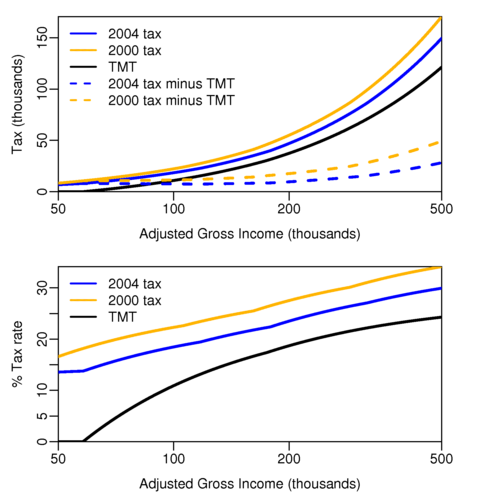
The AMT has undergone several changes since 1969. The most significant of those, according to the Joint Committee on Taxation, occurred under the Reagan era Tax Equity and Fiscal Responsibility Act of 1982.[26] The law changed the AMT from an add-on tax to its current form: a parallel tax system. The current structure of the AMT reflects changes that were made by the 1982 law. However, participation and revenues from the AMT temporarily plummeted after the 1986 changes.[28] Congress made other notable, but less significant, changes to the law in 1978, 1982, and 1986.[29]
Further significant changes occurred as a result of the Omnibus Budget Reconciliation Acts of 1990 and 1993, which raised the AMT rate to 24% from the prior level of 21% and then to 26% and 28% for individual filers with incomes that exceeded $175,000.[30] Now, some taxpayers who do not have very high incomes or participate in numerous special tax benefits and/or activities will pay the AMT.[31]
For years since then, Congress had passed one-year "patches" aimed at minimizing the impact of the tax. While not automatically indexed for inflation until a change in the law in early 2013, the exemption had been increased by Congress many times. In addition, the tax rate was increased for individuals effective 1991 and 1993, and the tax was limited for capital gains and qualifying dividends in 2003.
For the 2007 tax year, the patch was passed on December 20, 2007, but only after the IRS had already designed its forms for 2007. The IRS had to reprogram its forms to accommodate the law change.[32]
The tax rate and exemption increases are reflected in the following table:
1986年から2017年まで、法人税率は20%のままで、免除額は40,000ドルのままでした。2018年に、法人AMTは恒久的に廃止されました。2018課税年度以前は、過去3年間の平均年間総収入が7,500,000ドル以下の法人はAMTが免除されていましたが、このテストを満たし続ける限りにおいてのみ免除されていました。[ 33 ]さらに、法人は法人としての最初の年にAMTが免除されていました。関連会社は、3つの免除(40,000ドル、750万ドル、および最初の年)すべてにおいて、単一の法人であるかのように扱われました。[ 34 ]以前は、法人はAMTのためにフォーム4626を提出していました。法人は、調整済み当期利益の調整(増減)の対象にもなっていました。
2012年の米国納税者救済法は、 2012年の控除額を夫婦合算申告の場合は78,750ドル、独身の場合は50,600ドルに設定し、将来の控除額をインフレ率に合わせて調整した。[ 35 ] [ 36 ]
代替ミニマム税(AMT)[ 37 ]は、通常の連邦所得税よりも包括的な所得の代替指標に対して課されます。概念的には、通常の税金に加えてではなく、代わりに課されます。
暫定最低税が通常の税額を超える場合、AMT が課されます。[ 38 ]暫定最低税は、AMT 税率に代替最低課税所得 (AMTI) を乗じ、AMT 外国税額控除を差し引いたものです。通常の税額は、外国および属領税額控除のみを差し引いた通常の所得税です。[ 17 ]通常税が暫定最低税を超える年には、納税者が前年度に AMT を支払った額に応じて、通常税に対して控除 (AMT 控除) が認められます。この控除により、通常税が暫定最低税を下回ることはありません。
代替最低課税所得とは、通常の課税所得に特定の調整を加減し、税制優遇項目を加算し、認められる控除額(段階的に廃止されるもの)を差し引いたものです。
個人、遺産、信託はAMTの対象となります。パートナーシップおよびS法人は一般的に所得税またはAMTの対象ではありませんが[ 39 ]、代わりにAMTの計算に関連する所得および項目をパートナーおよび株主にパススルーします[ 40 ] 。外国人は、米国での取引または事業に実質的に関連する所得に対してのみAMTの対象となります[ 41 ]。
The rate of AMT varies by type of taxpayer.[42] Through 2018, individuals, estates, and trusts are subject to the same rate of tax on long-term capital gains for regular tax and AMT.
The deduction for personal exemptions is not allowed. Instead, all taxpayers are granted an exemption that is phased out at higher income levels.[43] See above for amounts of this exemption and phase-out points. Due to the phase-out of exemptions, the actual marginal tax rate (1.25*26% = 32.5%) is higher for the income above the phase-out point. The married-filing-separately (MFS) phase-out does not stop when the exemption reaches zero, either in 2009 or 2010. This is because the MFS exemption is half of the joint exemption, but the phase-out is the full amount, so for MFS filers the phase-out amount can be up to twice the exemption amount, resulting in a 'negative exemption'.
For example, using 2009 figures, a filer with $358,800 of income not only gets zero exemption, but is also taxed on an additional $35,475 that was never actually earned (see "Line 29 — Alternative Minimum Taxable Income" in 2009 Instructions for Form 6251 or "Line 28 — Alternative Minimum Taxable Income" in 2010 Instructions for Form 6251). This prevents a married couple with dissimilar incomes from benefiting by filing separate returns so that the lower earner gets the benefit of some exemption amount that would be phased out if they filed jointly. When filing separately, each spouse in effect not only has their own exemption phased out, but is also taxed on a second exemption too, on the presumption that the other spouse could be claiming that on their own separate MFS return.
All taxpayers claiming deductions for depreciation must adjust those deductions in computing AMT income to the amount of deduction allowed for AMT.[44] For AMT purposes, depreciation is computed on most assets under the straight line method using the class life of the asset. When a taxpayer is required to recognize gain or loss on disposal of a depreciable asset (or pollution control facility), the gain or loss must be adjusted to reflect the AMT depreciation amount rather than regular depreciation amounts.[45] This adjustment also applies to additional amounts deducted in the year of acquisition of the assets. For more details on these calculations, see MACRS.
さらに、2018年以前の法人納税者は、調整済み当期利益(ACE)調整を計算する際に、減価償却費控除の調整を行う必要がある場合があります。[ 46 ]このような調整は、1989年以前に取得した資産にのみ適用されます。
以下の点についても調整が必要です。
個人は、通常の税金で認められている特定の控除を代替ミニマム税の計算では認められません。[ 14 ]人的控除や標準控除は認められません。項目別控除の段階的廃止は適用されません。州、地方、または外国の所得税や不動産税は控除できません。これらの税金の還付は、代替ミニマム税の課税所得から除外されます。ほとんどのその他の項目別控除は控除できません。
医療費は、調整後総所得の 10% を超える部分のみ AMT で控除できます (これは AMT に限ったことではなく、通常の所得税にも適用されます)。[ 51 ]
個人の利息費用控除は調整される場合があります。[ 52 ]一般的に、個人の主たる住居または第二の住居の取得、建設、または改良に使用された債務に対する支払利息は影響を受けません。これには、そのような債務の借り換えによって生じる利息も含まれます。さらに、投資利息費用は、調整後の純投資所得の範囲内でのみ、代替ミニマム税(AMT)で控除できます。その他の非事業利息は、一般的にAMTで控除できません。
適格インセンティブストックオプションおよび従業員株式購入プランに基づいて受け取った株式についても調整が行われます。[ 53 ]どちらの場合も、従業員は取引または報酬要素についてAMT目的で所得を認識する必要があり、雇用主はこれに対して控除が認められ、従業員は受け取った株式に基礎を持ちます。
流通費と研究費は資産計上し、償却しなければならない。[ 54 ]
Before 2018, corporations were required to make an adjustment based on adjusted current earnings (ACE).[46] The adjustment increases or decreases AMTI for 75% of the difference between ACE and AMTI. ACE is AMTI further adjusted for certain items. These include further depreciation adjustments for most assets, adjustments to more closely reflect earnings and profits, cost rather than percentage depletion, LIFO, charitable contributions and certain other items.
The deduction for net operating losses is adjusted to be based on losses for AMTI.[55]
Farm losses are limited for AMT purposes. Passive activity losses are recomputed for AMT purposes based on income and deductions as recomputed for AMT. Certain adjustments apply with respect to farm and passive activity loss rules for insolvent taxpayers.[56]
All taxpayers must add back tax preference deductions in computing AMTI.[57] Tax preferences include the following amounts of deduction:
Taxpayers may elect an optional 10-year write-off of certain tax preference items in lieu of the preference add-back.
Note that in prior years there were certain other tax preference items relating to provisions now repealed.
Credits are allowed against AMT for foreign taxes[58] and certain specified business credits.[59]
The AMT foreign tax credit limitation is redetermined based on AMTI rather than regular taxable income. Thus, all adjustments and tax preference items above must be applied in computing the AMT foreign tax credit limitation.
After a taxpayer has paid AMT, a credit is allowed against regular tax in future years for the amount of AMT.[60] The credit for individuals is generally limited to the amount of AMT generated by deferral items (e.g. exercise of incentive stock options), as opposed to exclusion items (e.g. state and local taxes).[61] This credit is limited so that regular tax is not reduced below AMT for the year. Taxpayers may use a simplified method under which the AMT foreign tax credit limit is computed proportionately to the regular tax foreign tax credit limit. IRS Form 8801 is used to claim this credit.
The alternative minimum tax may apply to individuals exercising stock options. Under AMT rules, for incentive stock options at the time of exercise, the "bargain element" or "spread price" (the difference between the strike price and fair market value) is treated as an AMT adjustment, and therefore needs to be added to the AMT calculation even though no ordinary income tax is due at the time of exercise. In contrast, under the regular tax rules capital gains taxes are not paid until the actual shares of stock are sold. For example, if someone exercised a 10,000 share Nortel stock option at $7 when the stock price was at $87, the bargain element was $80 per share or $800,000. Without selling the stock, the stock price dropped to $7. Although the real gain is $0, the $800,000 bargain element still becomes an AMT adjustment, and the taxpayer owes around $200,000 in AMT.
The AMT was designed to prevent people from using loopholes in the tax law to avoid tax. However, the inclusion of unrealized gain on incentive stock options imposes difficulties for people who cannot come up with cash to pay tax on gains that they have not realized yet. As a result, Congress has taken action to modify the AMT regarding incentive stock options. In 2000 and 2001, people exercised incentive stock options and held onto the shares, hoping to pay long-term capital gains taxes instead of short-term capital gains taxes.[62] Many of these people were forced to pay the AMT on this income, and by the end of the year, the stock was no longer worth the amount of alternative minimum tax owed, forcing some individuals into bankruptcy. In the Nortel example given above, the individual would receive a credit for the AMT paid when the individual did eventually sell the Nortel shares. However, given the way AMT carryover amounts are recalculated each year, the eventual credit received is in many cases less than originally paid.
上記のノーテル社の例では、納税者はストックオプションを行使した直後に十分な株式を売却して代替ミニマム税(AMT)の納税義務を賄うことで問題を回避できたはずです。しかし、AMTはIPO前または非公開企業のストックオプションにも適用されます。このような場合、IRSは企業から提供された情報に基づいて株式の「公正市場価格」を計算するため、従業員が株式を売却できない場合(市場が存在しない場合、またはロックアップ期間などの契約上の制限がある場合)でも、その株式は相当な価値があるとみなされる可能性があります。このような場合、従業員がAMTを支払うのに十分な現金を持っていなければ、事実上オプションを行使することは不可能かもしれません。
代替ミニマム税(AMT)は当初、高所得世帯155世帯を対象として制定されましたが、2017年までに毎年520万人の納税者に影響を与えるまでに拡大し、362億ドル、つまり連邦所得税収入の2.4%を徴収しました。2018年度の税制改革法(TCJA)の成立により、影響を受ける納税者数は全納税者の約0.1%に減少しました。この数は、TCJAの個人向け規定が失効する2026年に再び増加すると予想されています。
例えば、1997年には60万5000人の納税者がAMTを支払いました。[ 63 ] 2008年までに、影響を受ける納税者の数は390万人に急増し、これは個人納税者の約4%に相当し、連邦所得税収入1031億ドルのうち260億ドルを徴収しました。[ 64 ] 2008年にAMTを支払った世帯の27%は、調整後総所得が20万ドル以下でした。[ 65 ]
1978年から2013年にかけてAMTが増加した主な理由は、通常の所得税項目とは異なり、AMTの免除額が2013年以前はインフレ率に連動していなかったことである。つまり、所得基準額が生活費の上昇に追いついていなかったということである。[ 66 ]その結果、労働者の所得がインフレ率に合わせて調整され、AMTの適用対象額を超えたため、毎年、この税金の影響を受ける世帯数が増加している。インフレ率に連動していないにもかかわらず、議会は免除額の短期的な増加をしばしば可決した。税政策センター(調査グループ)は、1985年にAMTがインフレ率に連動し、ブッシュ減税が実施されていなかった場合、2010年には、予測されていた2700万人ではなく、わずか30万人の納税者しかこの税金の対象にならなかったと推定している。 [ 67 ]バラク・オバマ大統領は、2011会計年度予算案にAMTのインフレ率連動を盛り込んだが、これは可決されなかった。
The 2001–2006 Bush tax cuts also exacerbated the effects of AMT by reducing marginal tax rates (for instance, the top rate from 39.6% to 35%)[66] without making corresponding changes to AMT rates. Economists often refer to this as the "take-back effect" of the Bush tax cuts.[63]
As the AMT expanded from 1978 to 2017, the inequalities created by the structure of the tax have become more apparent. Taxpayers are not allowed to deduct state and local taxes in calculating their AMT liability; as a result, taxpayers who live in states with high income tax rates are up to 7 times more likely to pay the AMT than those who live in states with lower income tax rates.[68] Similarly, taxpayers are not allowed to deduct personal exemptions in calculating their AMT liability, resulting in large families being more likely to pay the AMT than smaller families.[69] With the passage of the TCJA which eliminated personal exemptions in favor of an expanded standard deduction, this was no longer an issue.
In recent years, the AMT has been under increased attention.
The AMT rate has not been changed at the same time as regular income tax rates. The tax cut passed in 2001 lowered regular tax rates, but did not lower AMT rates. As a result, certain people are affected by the AMT who were not the intended targets of the laws. People with large deductions, particularly those resident in states or cities with high income tax rates, or those with nonqualifying mortgage interest deductions, are most affected. The AMT also has the potential to tax families with large numbers of dependents (usually children), although in recent years, Congress has acted to keep deductions for dependents, especially children, from triggering the AMT.
Because the AMT was not indexed to inflation until 2013, and because of recent tax cuts,[25][70] an increasing number of middle-income taxpayers have been finding themselves subject to this tax. The lack of indexing produces bracket creep. The recent tax cuts in the regular tax have the effect of causing many taxpayers to pay some AMT, reducing or eliminating the benefit from the reduction in regular rates. (In all such cases, however, the overall tax payable will not increase.)[71]
In 2006, the IRS's National Taxpayer Advocate's report highlighted the AMT as the single most serious problem with the tax code. The Advocate noted that the AMT punishes taxpayers for having children or living in a high-tax state and that the complexity of the AMT leads to most taxpayers who owe AMT not realizing it until preparing their returns or being notified by the IRS.[72] A brief issued by the Congressional Budget Office (CBO) (No. 4, April 15, 2004), concludes:
Over the coming decade, a growing number of taxpayers will become liable for the AMT. In 2010, if nothing is changed, one in five taxpayers will have AMT liability and nearly every married taxpayer with income between $100,000 and $500,000 will owe the alternative tax. Rather than affecting only high-income taxpayers who would otherwise pay no tax, the AMT has extended its reach to many upper-middle-income households. As an increasing number of taxpayers incur the AMT, pressures to reduce or eliminate the tax are likely to grow.[73]
In 2013, the IRS's National Taxpayer Advocate recommended repealing the AMT, arguing that it was burdensome, complex, and did not achieve its intended goal.[74][75]
However, CBO's rules[76] state that it must use current law in its analysis, and at the time the above text was written, the AMT threshold was set to expire in 2006 and be reset to far lower values.[77] Critics of the AMT argue that various features are flaws, though others defend some of these features:
1986年、ロナルド・レーガン大統領と連邦議会の両党が税制の大幅改正に合意した際、法律は微妙に修正され、個人控除、州税・地方税、標準控除、組合費などの特定の経費、さらには重病患者の医療費など、誰もが受けられる控除を全く異なるものにする方向へと転換された。同時に、一部の特殊な投資控除は削除または修正された。非課税の富裕層投資家向けの法律は、高税率州に住宅を所有する家族に焦点を当てるように変更された。
- –デビッド・ケイ・ジョンストン、ニューヨーク・タイムズ[ 81 ]
1986年の税制改革法によって、多くの定義変更と大規模な再編成を伴うさらなる変化が生じた。
さらに、AMTは本来の目的である対象者にも影響を与えていないという批判もある。議会は、1969年に21人の億万長者が所得税申告書で様々な控除を受けた結果、米国の所得税を一切支払っていなかったことが発覚した後にAMTを導入した。100万ドルの所得がある人の限界税率は39.6%であり、AMTはすべての所得に対して26%または28%の税率を使用するため、億万長者の実効税率が既に高いことから、AMTによって彼らが影響を受ける可能性は低い。AMTによって実際に税金を支払うのは、通常、約20万ドルから50万ドルの所得がある人々である。[ 82 ]
AMTの対象となるかどうかを判断するのは難しい場合があります。IRSの納税者擁護官によると、AMTを支払う義務があるかどうかを判断するには、9ページの説明書を読み、16行のワークシートと55行のフォームを記入する必要がある場合があります。[ 83 ]
The AMT is a tax of roughly 28% on adjusted gross income over $186,300[84] plus 26% of amounts less than $186,300 minus an exemption depending on filing status after adding back in most deductions. However, taxpayers must also perform all of the paperwork for a regular tax return and then all of the paperwork for Form 6251. Furthermore, affected taxpayers may have to calculate AMT versions of all carryforwards since the AMT carryforwards may be different than regular tax carryforwards. Once a taxpayer qualifies for AMT, he or she may have to calculate AMT versions of carryforward losses and AMT carryforward credits until they are used up in future years. The definitions of taxable income, deductible expenses, and exemptions differ on Form 6251 from those on Form 1040.
The complexity of the AMT paired with the history of last minute annual patches adjusting the law create tax liability uncertainty for taxpayers. For the last ten years, Congress has passed one-year patches to mitigate negative effects, but they are typically passed close to the end of the year. This makes it difficult for taxpayers to determine their tax liability ahead of time. In addition, because the AMT was not indexed for inflation until 2013, the cost of annual patches rises every year.[85]
The AMT's former lack of indexation was widely conceded across the political spectrum as a flaw. In 2005, the Urban-Brookings Tax Policy Center and the US Treasury Department estimated that around 15% of households with incomes between $75,000 and $100,000 must pay the AMT, up from only 2–3% in 2000, with the percentage increasing at high incomes. That percentage was set to increase quickly over the coming years if no changes had been made, most notably indexing for inflation. Currently, households with incomes below $75,000 are subject to the AMT only very rarely (and thus most tax advisors do not recommend computing AMT for such households). That was set to change in only a few years, however, if the AMT had remained unindexed.[86]
2005年の米国の世帯所得の中央 値は44,389ドルで、年間75,000ドルを超える世帯が世帯所得の上位25%を占めていました。これらの世帯は一般的にAMTを計算する必要があるため(ただし、現在支払う必要があるのはごく一部です)、AMTは依然として富裕層または中流上層階級にしか影響しないと主張する人もいます。しかし、バージニア州フェアファックス郡(102,460ドル)[ 87 ]やカリフォルニア州サンノゼ(76,354ドル)[ 88 ]などの一部の郡や一部の都市では、地域の中央所得が全国平均よりもかなり高く、典型的なAMTの閾値に近づくか、それを超えています。
こうした地域では生活費指数が一般的に高いため、その地域で「中流階級」に属する家族も代替ミニマム税(AMT)を支払わなければならない一方、生活費の低い貧しい地域では「地元の富裕層」だけがAMTを支払っている。言い換えれば、AMTを支払っている人の多くは、米国全体で見れば富裕層に分類される所得を持っているにもかかわらず、居住地域の生活費の高さから自分たちを「中流階級」だと考えているのである。
1984年の最初の税制改革研究の時点で、州税および地方税の控除を廃止すべきだという主張がなされていた。
州税および地方税の現行控除は、事実上、州および地方政府が提供する公共サービス(公教育、道路建設および補修、衛生サービスなど)に対する連邦補助金を提供している。納税者が同様のサービスを私的に購入する場合(例えば、水道や下水道の料金を支払う場合)、その支出は控除対象とはならない。州税および地方税の控除を認めることは、納税者が税引き前の資金で個人消費支出を賄うことを単に許可するにすぎない。[ 89 ]
州税および地方税控除の廃止を主張していた人々は、1986年の税制改革では敗れたものの、代替ミニマム税(AMT)の計算においてこれらの控除を除外するという譲歩を勝ち取った。この措置とAMTの物価連動制の廃止が相まって、州税および地方所得税の控除は徐々に廃止されていった。
代替ミニマム税(AMT)による外国税額控除の部分的な不適用は、海外で働く、あるいは外貨で給与を受け取る低所得の米国市民やグリーンカード保持者にとっても不利となる。特に世界的にドルが下落するにつれ、海外で働く人々の所得(IRSに米ドルで申告した場合)は、実際の所得が年々減少していても、また外国での納税義務が増加していても、急増する。彼らは事実上、為替レートの変動のみに基づいて課税されていることになるが、家計支出はすべて外貨建てであるため、その恩恵を受けることはできない。
AMT(代替ミニマム税)は、2018年時点でごく少数の個人納税者(0.1%)にしか影響を与えず、インセンティブストックオプションの行使や保有を制限したり、通常の税制では認められているがAMTでは認められていない税額控除や控除(例えば、民間活動による地方債など)を避けることで回避できる可能性があります。
AMT を納付する納税者にとって、IRA (個人退職口座) / 適格プランへの拠出、慈善寄付控除、住宅ローン利息 (ただし、「ハードマネー」の借り換え利息は除く) は特に価値があります。これらは、暫定最低税実効限界税率 32.5% または 35% (AMT 免除の段階的廃止範囲にある場合) [ 90 ]と州所得税の限界税率の全額[ 91 ]を合わせて、納税義務を軽減します。これは、通常の税制よりもかなり有利になる可能性があります。[ 92 ]
多くの政党が代替ミニマム税(AMT)の変更が必要であることに同意している一方で、その完全廃止に反対する意見もある。
政策アナリストの間では、AMTに対する批判に対処する最善の方法について意見が分かれている。アーバン・インスティテュートとブルッキングス研究所の共同プログラムである税政策センターのレン・バーマンとグレッグ・レイザーソンは、歳入中立で高度に累進的なAMTの代替案を提案している。彼らは、「AMTを廃止し、独身者の場合は調整後総所得が10万ドルを超える場合、夫婦の場合は20万ドルを超える場合に、その4%の追加税を導入する」という選択肢を提案している。この基準額は2007年以降、インフレ率に応じて調整される。著者らは、この計画はAMTの本来の目的、つまり高所得者に対する一定水準の課税を確保するという目的を共有すると主張している。[ 95 ]
他の団体は、代替ミニマム税(AMT)を改革するのではなく、廃止することを提唱している。そのような団体の1つであるケイトー研究所は、次のように述べている。
右派系の全米納税者組合も廃止を支持している。「政策立案者が免除、控除、減税を通じて特定の社会的・財政的理念を推進しておきながら、納税者がそれらを過剰に利用した際にこれらのインセンティブを取り上げるというのは、全く不公平だ。」[ 97 ]
保守系のタックス・ファウンデーションは、通常の税法の欠陥を修正するだけでAMTを事実上廃止できると述べている。経済学者のパトリック・フリーナーは、
通常、課税所得に対する不当な制限が、AMTのセーフティネットが作動する原因となる。所得が通常の税法によって包括的に課税されていれば、合法的に課税を回避する方法はなく、たとえその法律がまだ有効であったとしても、納税者は誰もAMTフォームを提出する必要はないだろう。[ 98 ]
通常の税を廃止し、AMTを修正して指数に連動させることを提案する人もいる。2005年の大統領諮問委員会の連邦税改革に関する提案では、通常の税の廃止に加えて、AMTの免除額を10万ドル(独身者の場合は5万ドル)に引き上げ、その後指数に連動させ、一律25%の税率を適用し、所得を生み出す活動に対して適切な免除を認めることを提唱した。[ 99 ]
{{cite web}}: CS1 maint: multiple names: authors list (link){{cite web}}: CS1 maint: archived copy as title (link){{cite web}}: CS1 maint: deprecated archival service (link){{cite web}}: CS1 maint: deprecated archival service (link)Standard tax texts
CBO issue brief